
Android Car Stereo Fascia Kit Options for Non-CAN and CAN Cars
Android Car Stereo Fascia Kit Options for Non-CAN and CAN Cars
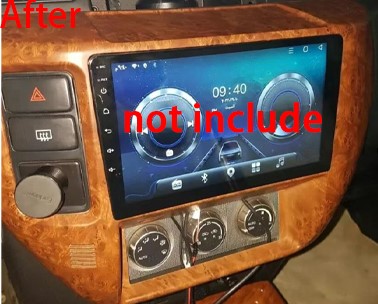
Before upgrade: a factory dashboard and original head unit ahead of a vehicle-specific retrofit.
A vehicle-specific Android car stereo fascia kit is rarely a single part. It is a small installation system made of a fascia that adapts the dashboard opening, a harness that adapts the electrical connector, and, on networked vehicles, a decoder that adapts the vehicle data bus. Treating those three elements as interchangeable is one of the most common reasons a retrofit ends with a visible gap, a head unit that will not power on, or steering wheel buttons that stop responding.
The choice is route-dependent rather than brand-dependent. Non-CAN cars need mechanical and analogue electrical matching. CAN bus cars add a protocol layer that must be decoded before an aftermarket Android head unit can retain factory functions. This shortlist sets the ZYX-01 Car Radio Dash Fascia, the ZYX-02 Car Radio Wiring Harness and the ZYX-03 CAN Bus Decoder Module against both routes, using published specification data instead of general claims.
Scale is not the constraint. The global car audio head unit market was estimated at USD 15.44 billion in 2024, according to Market Research Future, and Mordor Intelligence projects a 12.18% CAGR for the car aftermarket audio system market, citing DIY customers and online plug-and-play kits as demand drivers. The constraint sits at component level, where fitment accuracy and protocol compatibility decide whether an installation is repeatable.
Why the Route Matters: Non-CAN and CAN Cars Are Different Purchases
Non-CAN vehicles distribute power, ground, speaker and accessory signals as discrete wires. For these cars, retrofit risk is mostly physical and electrical: dashboard opening geometry, vehicle-side connector type, and wiring safety. A correctly matched fascia and harness solve both problems without opening the factory loom.
CAN-equipped vehicles broadcast control and status data across a network. Independent technical explainers describe automotive CANBUS decoders as components that translate vehicle network messages (HEX codes) into UART messages the Android head unit can read. That translation is how steering wheel buttons, vehicle information display and chime behaviour survive the head unit swap. Without it, an Android radio may still power on and play audio, but it behaves as an isolated device rather than an integrated one.
That distinction changes what a buyer should put on a purchase order. A non-CAN build normally stops at two components. A CAN build requires all three, on the condition that the decoder matches the exact vehicle model, model year and trim configuration.
The Three Components in This Shortlist
ZYX-01 Car Radio Dash Fascia: the mechanical interface
The ZYX-01 is a model-specific centre console frame, also classified as a universal adjustable dash kit and a screen upgrade installation faceplate. It is moulded from original vehicle dashboard data to a dimensional tolerance of ≤0.2 mm, with 2.5 mm to 3.0 mm ABS material thickness and an operating temperature range of -40°C to 85°C. It accepts 7-inch, 9-inch, 10.1-inch and 12.3-inch screens and uses a Double-DIN or model-specific custom mounting standard. Fitment is plug-and-play, the design is intended to avoid damage to the original interior, and complete mounting accessories are included.
ZYX-02 Car Radio Wiring Harness: the electrical interface for non-CAN cars
The ZYX-02 is a plug-and-play car stereo wiring harness, a model-specific radio wiring adapter, a universal ISO standard wiring harness and a non-CAN vehicle radio wiring kit. It links an OEM vehicle-side plug to an ISO 16-pin head unit connector using AWG 20-22 tinned oxygen-free copper conductors with ANSI/CTA-2015-B colour-coded insulation, rated at 12V DC and 10A maximum current. The insulation is flame-retardant PVC, the connector housing is PA66 engineering plastic, and the contact terminals are tin-plated brass. Reverse polarity protection and short-circuit protection are built in, and the operating range is -40°C to 85°C. It fits non-CAN bus vehicle models and works with most aftermarket car stereos, including most Android head units and universal radios.
ZYX-03 CAN Bus Decoder Module: the network interface for CAN cars
The ZYX-03 is a plug-and-play CAN gateway module intended for the car audio and navigation retrofit industry. It supports CAN 2.0A/2.0B at a dual 500 kbps and 125 kbps rate, draws 12V DC with 300 mA standby current and a 2A maximum, and operates from -40°C to 85°C. The housing is flame-retardant ABS plastic, the circuit board is FR-4 glass fibre epoxy resin, the connector terminals are tin-plated brass, and internal potting uses heat-conductive silicone. Firmware is pre-programmed per vehicle model by a supplier of automotive CAN protocol products, so installation is plug-and-play without on-site debugging. The module includes built-in CAN isolation intended to prevent dashboard fault codes, retains OEM steering wheel controls, vehicle information display and original chime functions, and is matched for use with the supplier's car radio wiring harness and centre dash frame kits.
Recommended Options at a Glance
| Component (model) | Role in the retrofit | Verified specification highlights | Route served |
|---|---|---|---|
| Car Radio Dash Fascia (ZYX-01) | Mechanical fitment: dashboard opening to head unit | Compatible screen sizes 7"/9"/10.1"/12.3"; Double-DIN or model-specific custom mounting; dimensional tolerance ≤0.2 mm; material thickness 2.5-3.0 mm; ABS; -40°C to 85°C; plug-and-play fitment; complete mounting accessories | Non-CAN and CAN |
| Car Radio Wiring Harness (ZYX-02) | Electrical and connector integration | OEM vehicle-side plug plus ISO 16-pin head unit connector; AWG 20-22 tinned oxygen-free copper; ANSI/CTA-2015-B colour-coded insulation; 12V DC, 10A maximum; reverse polarity and short-circuit protection; flame-retardant PVC; PA66 housing; tin-plated brass terminals; -40°C to 85°C | Non-CAN vehicles |
| CAN Bus Decoder Module (ZYX-03) | Vehicle network decoding and factory function retention | CAN 2.0A/2.0B; 500 kbps / 125 kbps dual rate; 12V DC, 300 mA standby, 2A maximum; -40°C to 85°C; flame-retardant ABS housing; FR-4 board; heat-conductive silicone potting; built-in CAN isolation; pre-programmed per vehicle model | CAN bus vehicles |
Ordering terms attached to this shortlist: a 50-unit MOQ for production orders, a 1-set sample for validation before volume commitment, pre-shipment fitment full test, and third-party SGS inspection for acceptance.
Shortlist Order by Route: What to Specify First
The ranking below is ordered by how many retrofit routes each component is required for, and by what is lost when it is omitted. It is a route-necessity ranking, not a claim about product quality.
Non-CAN cars (two-component build)
- ZYX-01 Car Radio Dash Fascia - required. Without a model-specific frame, the dashboard opening and the new screen size do not align.
- ZYX-02 Car Radio Wiring Harness - required. Without a vehicle-side to ISO 16-pin adapter, the installer falls back to cutting and splicing factory wiring.
- ZYX-03 CAN Bus Decoder Module - not required. A non-CAN vehicle has no network layer to decode.
CAN bus cars (three-component build)
- ZYX-01 Car Radio Dash Fascia - required. It is the component common to both routes.
- ZYX-03 CAN Bus Decoder Module - required to retain steering wheel controls, vehicle information display and chime functions.
- Harness variant confirmed against the vehicle-side connector - required. The ZYX-02 is specified for non-CAN bus vehicle models, so on a CAN vehicle the correct harness variant and vehicle-side connector must be confirmed before ordering; the decoder itself is matched for use with the supplier's wiring harness and dash frame kits.
Technical Explanation: What These Specifications Actually Control
Fascia tolerance, wall thickness and screen fit
A ≤0.2 mm dimensional tolerance and 2.5-3.0 mm ABS wall thickness control two visible outcomes: whether the frame closes against the dashboard surface without a gap, and whether it holds shape under load and heat. The high-temperature-resistant ABS and anti-ageing characteristics address direct sunlight exposure on the centre console, while the -40°C to 85°C range covers the in-vehicle environment. Supporting 7-inch, 9-inch, 10.1-inch and 12.3-inch screens means one moulding family can cover several head unit generations, which matters for distributors holding stock across model years.
The boundary is worth stating plainly: a printed tolerance is a moulding specification, not a guarantee for every trim level. Because the same vehicle model can leave the factory with different original radios, connectors and equipment levels, a physical dry fit remains the practical verification step before permanent installation.
Harness conductors, colour coding and protection
AWG 20-22 tinned oxygen-free copper is the conductor specification, chosen for corrosion resistance and stable conductivity in a vibrating, humid environment. ANSI/CTA-2015-B colour-coded insulation supports identification and troubleshooting during installation. The ISO 16-pin head unit connector standardises the radio side of the interface, while the PA66 connector housing and tin-plated brass terminals address heat resistance and long-term contact stability. Reverse polarity protection and short-circuit protection reduce the risk of damaging the head unit or the vehicle's original electrical system during a first installation attempt.
This specification set targets a specific failure mode. Intermittent signal loss and functional failure after long-term use are usually traced to low-grade copper conductors, thin insulation layers and the absence of vibration-resistant crimp design, rather than to the head unit itself.
Decoder protocol rate, isolation and firmware
CAN 2.0A/2.0B support at 500 kbps and 125 kbps covers the two network speeds encountered in common retrofit scenarios. Power behaviour is modest at 300 mA standby with a 2A maximum on a 12V DC supply, which keeps the module inside the vehicle's accessory circuit envelope. The FR-4 board and heat-conductive silicone potting manage thermal paths in a component that sits behind the dashboard. Built-in CAN isolation is intended to prevent dashboard fault codes, and pre-programmed model-specific firmware removes on-site debugging from the installation workflow. Incoming quality inspection is applied at 100% on this module.
Taken together, the three specifications form a chain: the fascia defines where the head unit sits, the harness defines how it is powered and connected, and the decoder defines which factory functions survive the swap.
Installation Sequence and Application Scenarios
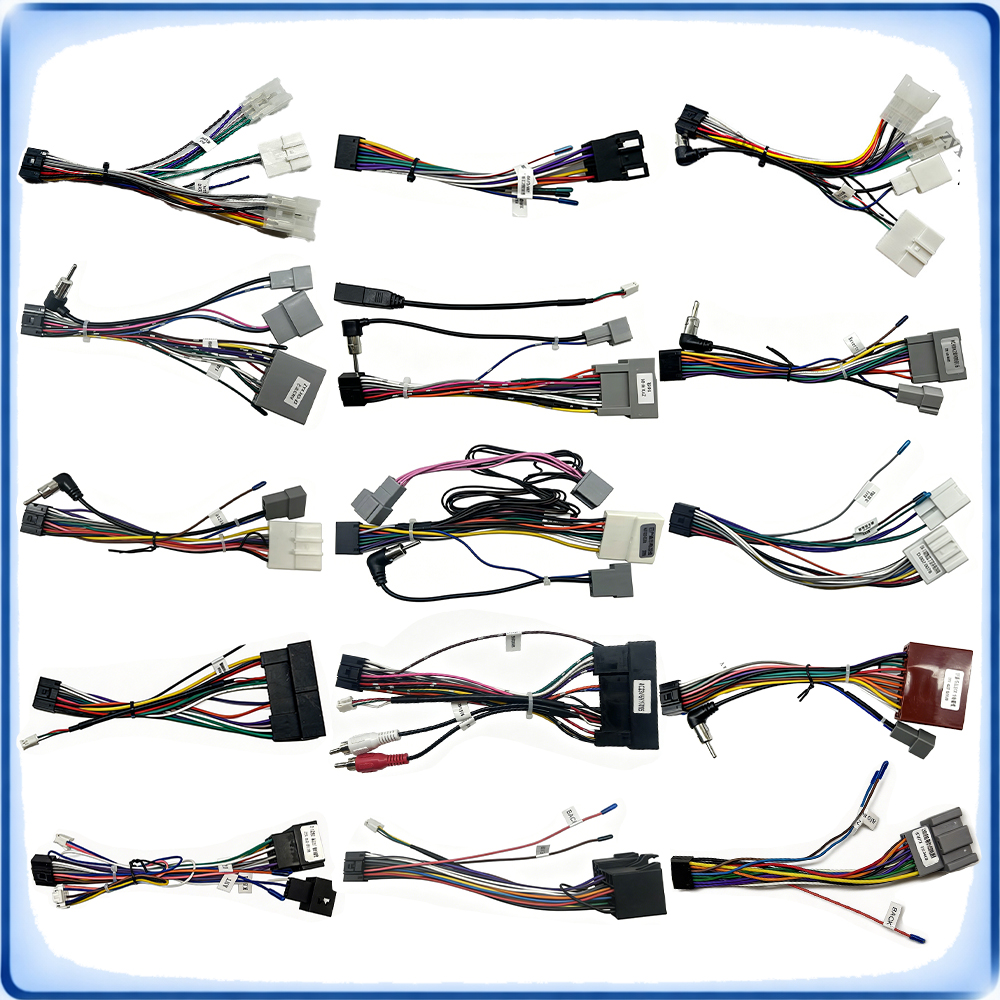
The ZYX-02 harness adapts the OEM vehicle-side connector to an ISO 16-pin head unit interface.
- Disconnect the vehicle battery and remove the factory head unit together with the dashboard trim panel.
- Dry fit the model-specific dash kit to check fitment and alignment.
- Plug the wiring harness and CAN bus decoder into the original vehicle wiring interface.
- Connect the new head unit, power on and test all functions.
- Secure the head unit and dash kit, then reinstall the dashboard trim.
Safety conditions from the installation guidance are consistent: disconnect the battery before work to avoid electrical short circuits, do not pry trim forcibly, confirm decoder model compatibility before power-on, and ensure all connectors are fully seated before final assembly.
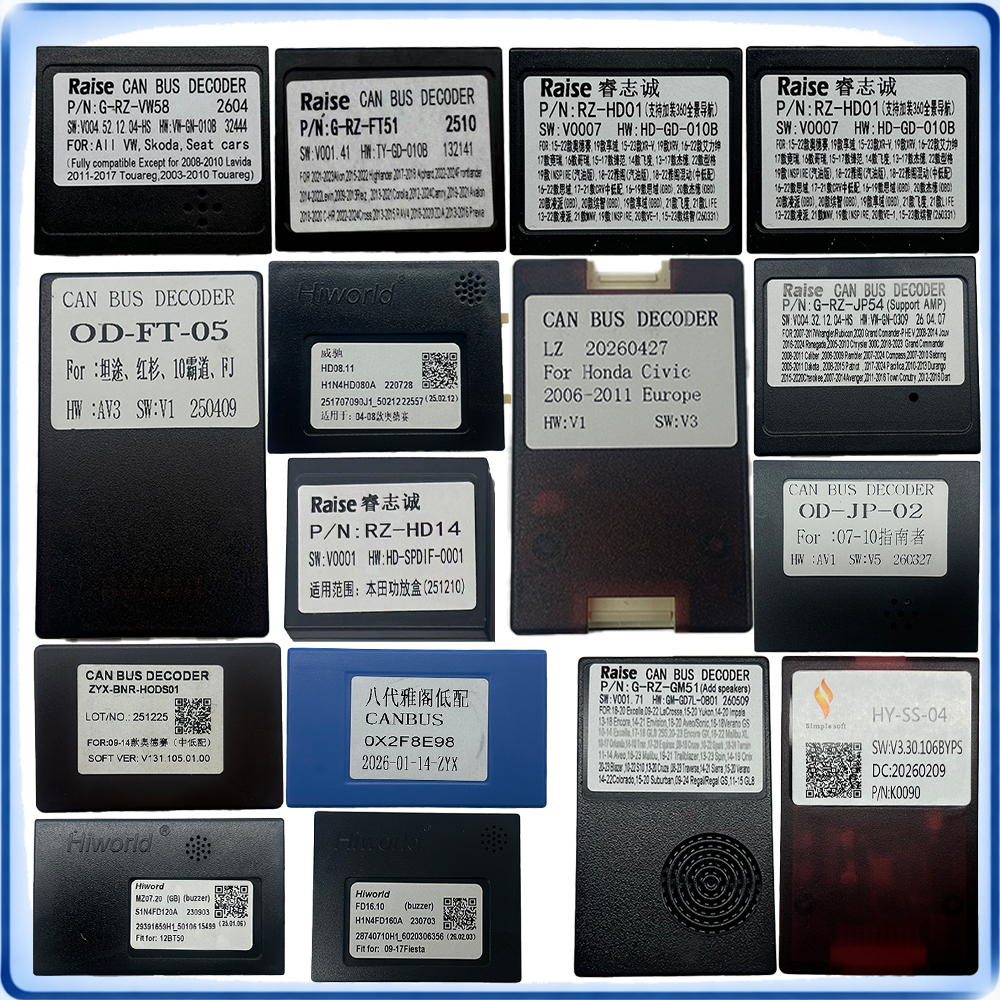
The ZYX-03 CAN bus decoder module is matched to model-specific firmware and pre-programmed before shipment.
These components are specified for aftermarket car head unit upgrades, centre console navigation retrofits, used-car interior electronics refurbishment, fleet audio system upgrades and dealership accessory fitting. The working environment is the in-vehicle one: a -40°C to 85°C range, constant road vibration, dust and humidity exposure, an automotive EMI environment and a 12V DC electrical system. The stated requirements are model-specific fitment, no damage to original wiring or interior, zero dashboard fault codes, high temperature resistance under direct sunlight, and flame-retardant wiring materials.
Market Trend Analysis: What Third-Party Data Points To
Three published data points frame demand. The global car audio head unit market was estimated at USD 15.44 billion in 2024 (Market Research Future). The car aftermarket audio system market is projected to grow at a 12.18% CAGR, driven by DIY customers and online plug-and-play kits (Mordor Intelligence). Asia Pacific dominated the global car audio market with a 54.21% share in 2025 (Fortune Business Insights), which is consistent with concentrated manufacturing and component supply in that region.
Regulation is a second trend line. Electronic subassemblies integrated into road vehicles in the EU must comply with e/E-Marking (ECE R10) electromagnetic compatibility testing rather than CE marking alone where they affect vehicle safety functions, according to Elite Electronic Engineering. For importers of EU-bound stock, that turns EMC documentation into a purchasing criterion rather than an afterthought, and it applies to components such as decoders that sit inside the vehicle network.
Application breadth is the third trend line. Metra Electronics publicly states that it manufactures dash kits for more vehicle applications than any other manufacturer globally, which indicates that coverage across makes, models and model years is treated as a competitive axis in the fascia category. Shenzhen Zhongyixing Electronic Technology Co., Ltd, the manufacturer behind the ZYX fascia, harness and decoder portfolio, states a product system covering 3,000+ vehicle applications, with an 80% export ratio and Russia and the EU as its main markets.
One limitation belongs alongside these figures: published datasets do not isolate fascia kit revenue from complete audio system revenue, and protocol mapping libraries across decoder brands remain fragmented. Kit-level demand therefore has to be read from installation-kit and DIY channel signals rather than from a dedicated market figure.
Comparison with Traditional Cut-Wire and Universal Solutions
| Decision criterion | Model-specific plug-and-play set (ZYX-01 / ZYX-02 / ZYX-03) | Traditional cut-wire universal solution |
|---|---|---|
| Original wiring | Uses the factory original electrical interface; no cutting or modification required | Requires splicing into the factory loom |
| Fit accuracy | Model-specific moulding with ≤0.2 mm dimensional tolerance | Lower fit accuracy; higher risk of visible gaps and misalignment |
| CAN bus vehicles | Pre-programmed model-specific decoder retains steering wheel controls, vehicle information and chime; built-in CAN isolation intended to prevent fault codes | Universal decoders without model-specific firmware carry higher risk of dashboard fault codes and disabled steering controls |
| Upfront cost | Higher component cost per vehicle | Lower upfront cost |
| Typical fit | Premium vehicle upgrades, fleet batch modification, dealership pre-delivery fitting | Low-budget simple retrofit of older economy vehicles |
| Long-term behaviour | Tinned oxygen-free copper conductors, tin-plated brass terminals, flame-retardant insulation, vibration-oriented crimp design | Higher exposure to intermittent signal loss where conductor and insulation grades are lower |
The honest boundaries of this shortlist are worth stating before an order is placed:
- The ZYX-02 Car Radio Wiring Harness is specified for non-CAN bus vehicle models and is not a substitute for a CAN decoder.
- The ZYX-03 CAN Bus Decoder Module depends on correct vehicle identification. Model year, equipment level, original radio and connector configuration all affect compatibility, which is why the manufacturer recommends submitting photos of the original dashboard, original radio or the connector behind the factory head unit.
- A dimensional tolerance specification does not remove the need for a dry fit test before permanent installation.
- Traditional cut-wire universal solutions remain cheaper upfront for older economy vehicles, and that trade-off is a legitimate choice in low-budget retrofits.
- Availability of a specific vehicle application must be confirmed against the supplier's application database rather than assumed from the model name.
Procurement Terms and Acceptance Inspection
| Purchasing item | Stated term | Why it matters in this category |
|---|---|---|
| Minimum order quantity | 50 units | Sets the entry point for distributor and fleet stock planning |
| Sample validation | 1-set sample | Allows a physical dry fit and function test before volume commitment |
| Pre-shipment testing | Fitment full test | Checks the physical and connector interface before the goods leave the factory |
| Third-party inspection | SGS inspection | Independent acceptance evidence for import documentation |
| Supplier evaluation criteria | Model-specific precision moulding, pre-flashed vehicle-specific CAN firmware, plug-and-play harnesses with built-in electrical protection, export compliance documentation, strict quality inspection | These are the parameters that determine fit accuracy, CAN protocol matching, damage-free installation and long-term reliability |
Environmental compliance is part of the documentation set: the full kit is described as complying with EU RoHS 2 and REACH regulations, with hazardous substance content controlled across materials and components. For buyers in regulated markets, that belongs in the same file as the EMC documentation discussed above.
Future Outlook
Two directions look stable. First, larger screens keep expanding the fascia requirement: the ZYX-01 already covers 7-inch through 12.3-inch layouts, and the practical constraint for distributors is holding a moulding range that spans several model years rather than a single size. Second, as more model years move to networked electrical architectures, the decoder stops being an accessory and becomes a default line item for CAN vehicles, with dual-rate CAN support at 500 kbps and 125 kbps covering the common network speeds.
Compliance will continue to shape purchasing. Where e/E-Marking (ECE R10) applies to electronic subassemblies that affect vehicle safety functions, importers need test evidence alongside product specifications. Application coverage will remain the competitive axis in the fascia category, and photo-based vehicle matching, as used by ZYX across its 3,000+ vehicle applications, is likely to stay part of the standard ordering workflow rather than an exception.
Frequently Asked Questions
What is a CAN bus decoder and what role does it play in a car head unit retrofit?
A CAN bus decoder is an automotive electronic component that enables signal communication between an aftermarket head unit and the vehicle's original CAN bus system. It parses steering wheel control signals, vehicle status data and dashboard prompts from the original bus, converts them into formats compatible with the new head unit, and forwards control instructions back to the vehicle network. It is a necessary component for full-function plug-and-play retrofits on CAN-equipped vehicles.
How does a plug-and-play CAN bus retrofit kit work without cutting or modifying the original vehicle wiring?
The kit accesses the vehicle CAN network through the factory original electrical interface. Based on the ISO 11898 automotive CAN bus standard and the original vehicle's factory interface definition, a pre-programmed decoder stores model-specific CAN protocol data, identifies steering wheel control, instrument prompt and vehicle status signals, converts them into formats the aftermarket head unit can read, and forwards head unit instructions back to the vehicle CAN network. No cutting or alteration of the original wiring harness is involved.
Which components does a non-CAN car need compared with a CAN bus car?
A non-CAN vehicle normally requires two components: a vehicle-specific dash fascia for physical mounting and a non-CAN wiring harness for the electrical connection. A CAN bus vehicle requires the same fascia plus a harness variant matched to its vehicle-side connector and a CAN bus decoder module that translates network signals. The decoder is not used on non-CAN vehicles because there is no factory CAN bus layer to decode.
How is the plug-and-play kit installed, and what safety precautions apply?
The standard sequence is: disconnect the vehicle battery and remove the factory head unit with the dashboard trim; dry fit the model-specific dash kit to check alignment; plug the wiring harness and CAN bus decoder into the original vehicle interface; connect the new head unit and test all functions; then secure the components and reinstall the trim. The battery must be disconnected to avoid short circuits, trim should not be pried forcibly, decoder model compatibility should be confirmed before power-on, and all connectors should be fully seated before final assembly.
Why do dashboard fault codes appear or steering wheel controls stop working after installation?
These symptoms are typically caused by a CAN bus protocol mismatch between a universal decoder and the vehicle's original system, a loose CAN bus or steering control pin connection, or decoder firmware that does not match the exact model year and trim configuration. The resolution path is to confirm the decoder is the model-specific version for the vehicle, re-plug the CAN bus interface to ensure full seating, update or reflash the matching firmware, then clear historical fault codes and retest the system.
Why do gaps or misalignment appear after fitting an aftermarket dash kit?
Obvious gaps and misalignment are typically caused by universal dash kits, or by products not precision-moulded to the exact dimensions of the original dashboard. Selecting a model-specific dash kit moulded from original vehicle dimension data, verifying the fit tolerance parameter before purchase, and conducting a dry fit test before permanent installation are the standard ways to avoid both the gap problem and damage to the original dashboard trim.
How do buyers evaluate a supplier of fascia, harness and decoder kits?
Common evaluation parameters are model-specific fit accuracy, CAN protocol matching rate, damage-free installation capability, electrical safety, compliance documentation, long-term reliability and delivery capacity. Suppliers with model-specific precision moulding, pre-flashed vehicle-specific CAN firmware, plug-and-play harnesses with built-in electrical protection and documented quality inspection systems are generally preferred for volume programmes, because those attributes map directly to return rates in the field.
Why can intermittent signal loss appear after several years of use?
Intermittent signal loss and functional failure after long-term use are usually caused by low-grade copper conductors, thin insulation layers, and the absence of vibration-resistant crimp design suited to continuous vehicle driving conditions. Products using tinned oxygen-free copper conductors, reinforced crimp terminals and flame-retardant insulation address this failure mode, and routine inspection of the harness during regular vehicle maintenance helps extend service life.
Additional product, application and vehicle-coverage details are compiled in the company profile brochure: ZYX AUTO company profile brochure (PDF). Company information is also published at www.zyxcaradio.com.