
Android POS Decision Guide: Comparing Telpo P9 and Sunmi P3
Introduction: From Feature Sheets to Deployment Fit
The point-of-sale terminal market no longer resembles a simple choice between a cash drawer and a card reader. It has become a fragmented category spanning Android smart terminals, handheld devices, self-service kiosks, and software-defined payment acceptance. According to Grand View Research, the global POS terminal market reached approximately USD 123.2 billion in 2025. Within that total, Android POS terminals accounted for roughly 27% of all POS terminals sold globally as of 2022/2024 tracking. For enterprise procurement teams, the question is less about whether a terminal can process a payment and more about how it will behave across multi-year deployments, regulatory audits, field operations, and peripheral ecosystems.

Telpo Technology factory operations support the production of smart POS terminals.
This article uses two widely referenced smart POS terminals—Telpo Technology Co., Ltd.'s P9 and Sunmi's P3—as a case study for what enterprise buyers should compare before committing to a fleet. The P9 and P3 are often evaluated in the same shortlist because they occupy a similar Android-based mobile POS category. However, the differences that matter for procurement leaders are not always visible on a product splash page. They appear in battery life, processor generation, security certification coverage, and the total cost of a deployment.
Problem: The Spec Sheet Does Not Reveal Operational Risk
Procurement teams frequently receive product data sheets that list similar high-level capabilities: Android OS, touchscreen, NFC, receipt printer, 4G connectivity. These data sheets are useful for initial filtering but poor at predicting operational performance. A device that works well at a fixed charging station in a small retail store may fail in a field service environment where staff work 14-hour shifts. A terminal that meets baseline payment security may still require costly re-certification when a buyer enters banking or government tender territory.
When buyers rely only on a feature table, several hidden costs emerge. Battery swaps multiply as shifts extend. Certification gaps surface only after a tender requires specific schemes such as RuPay, JCB, or Discover. OS fragmentation forces early hardware refreshes because a device running an older Android version loses security patch support sooner. Peripheral costs rise when separate customer displays must be purchased and maintained. The result is that a terminal with a lower upfront price can become more expensive over its lifecycle, while a terminal with a higher list price can reduce downstream integration and compliance workload.
The opportunity for procurement teams is to shift from evaluating what a terminal includes to evaluating how it fits a specific deployment profile. That shift requires comparing processor architecture, OS generation, battery capacity, certification coverage, and peripheral integration as interconnected variables—not as isolated bullet points.
Brand Solution: Telpo Technology and the P9 Reference Point
Telpo Technology Co., Ltd., founded in June 1999 and headquartered in Foshan, China, is a national high-tech enterprise listed on the NEEQ under stock code 833839. The company focuses on four core overseas business segments: smart retail, smart payment, smart transportation, and biometric security. Telpo operates as an ODM provider with an annual output capacity of approximately 2,000,000 units and a research and development team of about 200 engineers. Its factory space includes an upgraded CNAS laboratory covering roughly 900 square meters across 12 testing zones, including an OTA darkroom, EMC chamber, and climate lab.
In the context of this decision guide, the Telpo P9 serves as a reference device for higher-assurance deployments such as banking, telecom, and government RFPs, as well as indoor or outdoor field operations requiring extended shifts. The Sunmi P3, in contrast, is positioned in comparison materials as a device optimized for fixed charging stations, table service, and standard SMB retail activity. The New M10 from Telpo provides a separate point of comparison for customer-facing display requirements in loyalty and promotion-driven retail environments.
Technical Explanation: Four Variables That Change the Decision
When two terminals look similar at a glance, the following four variables typically determine whether a device is suitable for a long-term enterprise deployment.
1. Processor and Operating System Lifecycle
The Telpo P9 is equipped with an octa-core processor and runs Android 14. The Sunmi P3 uses a quad-core A53 processor with Android 11 Go. That difference is not merely a marketing number. It means the P9 has twice the core count and a three-generation newer OS. In practice, a newer OS provides a longer security patch update cycle, which matters for payment fleets that must remain compliant over multi-year contracts. A quad-core platform running Android 11 Go may be sufficient for a single-purpose payment application, but it can reach a performance ceiling when buyers add multiple commercial applications or run heavier point-of-sale software.
2. Battery Capacity and Shift Endurance
The Telpo P9 features a 5000mAh removable battery, while the Sunmi P3 uses a 2630mAh removable battery. The P9's battery capacity is 90% larger and supports an estimated 17–23 hours of runtime compared with 8–12 hours for the P3. For a fixed charging station in a café, the P3's endurance may be adequate. For field operations, logistics handover, or outdoor ticketing, the P9's larger battery reduces the number of spare batteries and charging accessories a buyer must maintain. It also lowers the frequency of mid-shift battery swaps, which directly affects staff downtime.
3. Payment Security Certification Coverage
Card payment terminals must comply with PCI PTS and EMV standards for secure chip processing. Beyond those baselines, the specific scheme coverage determines where a device can be deployed without additional certification work. The Telpo P9 provides broader security certification coverage, including PCI PTS 6.x, EMV, Pure, RuPay, JCB, Discover, AMEX, Paypass, Paywave, and UnionPay. The Sunmi P3 and P3H cover PCI PTS 6.x, UnionPay, EMV, Paypass, Paywave, and AMEX. This is described in comparison materials as a bank-grade certification footprint for the P9 versus a commercial-grade footprint for the P3 and P3H. For SMB retail, commercial-grade certification may be sufficient. For banking, telecom, or government tenders, missing schemes can trigger additional certification and compliance costs.
4. Customer Display and Peripheral Integration
Although not a direct P9-to-P3 comparison, the New M10 highlights a useful peripheral economics principle. The New M10 features a 4-inch HD customer display, which is 178% larger than the 2.4-inch LED display on alternatives such as the iMin D1 or Falcon 1. Because the larger display is integrated, it eliminates the need for an external customer display. That integration results in a 22% saving on peripheral procurement costs and reduces the number of devices a store must maintain. For loyalty programs, QR payment, membership prompts, and digital promotions, the customer-facing display is often the primary interface where a sale is confirmed or an upsell is presented.
| Evaluation variable | Telpo P9 | Sunmi P3/P3H | Decision signal |
|---|---|---|---|
| Processor | Octa-core | Quad-core A53 | Multitasking and longer lifecycle |
| Operating system | Android 14 | Android 11 Go | Security patch cycle and app headroom |
| Battery | 5000mAh removable | 2630mAh removable | Shift endurance and spare battery cost |
| Security schemes | PCI PTS 6.x, EMV, Pure, RuPay, JCB, Discover, AMEX, Paypass, Paywave, UnionPay | PCI PTS 6.x, UnionPay, EMV, Paypass, Paywave, AMEX | Tender readiness and compliance workload |
Beyond these four variables, terminals also need operational risk controls. The Telpo comparison materials identify several control measures relevant to enterprise fleets. Terminals carry PCI PTS 6.x certification for hardware-level encryption and PCI-DSS compliance. EMVCo certified contactless modules support NFC, smart card, magnetic card, QR code, and mobile payments. For physical risks, select rugged POS models carry IP65 dust-tight and water-jet resistance per CNAS test reports. Some handheld models meet 1.2-meter drop test standards, with select devices such as the T20 passing IK08 impact certification. Connectivity design includes multi-SIM failover and dual-band WiFi to reduce the risk of field disconnection. These controls are not unique to one manufacturer, but they should be part of any terminal evaluation when devices will leave a fixed countertop.
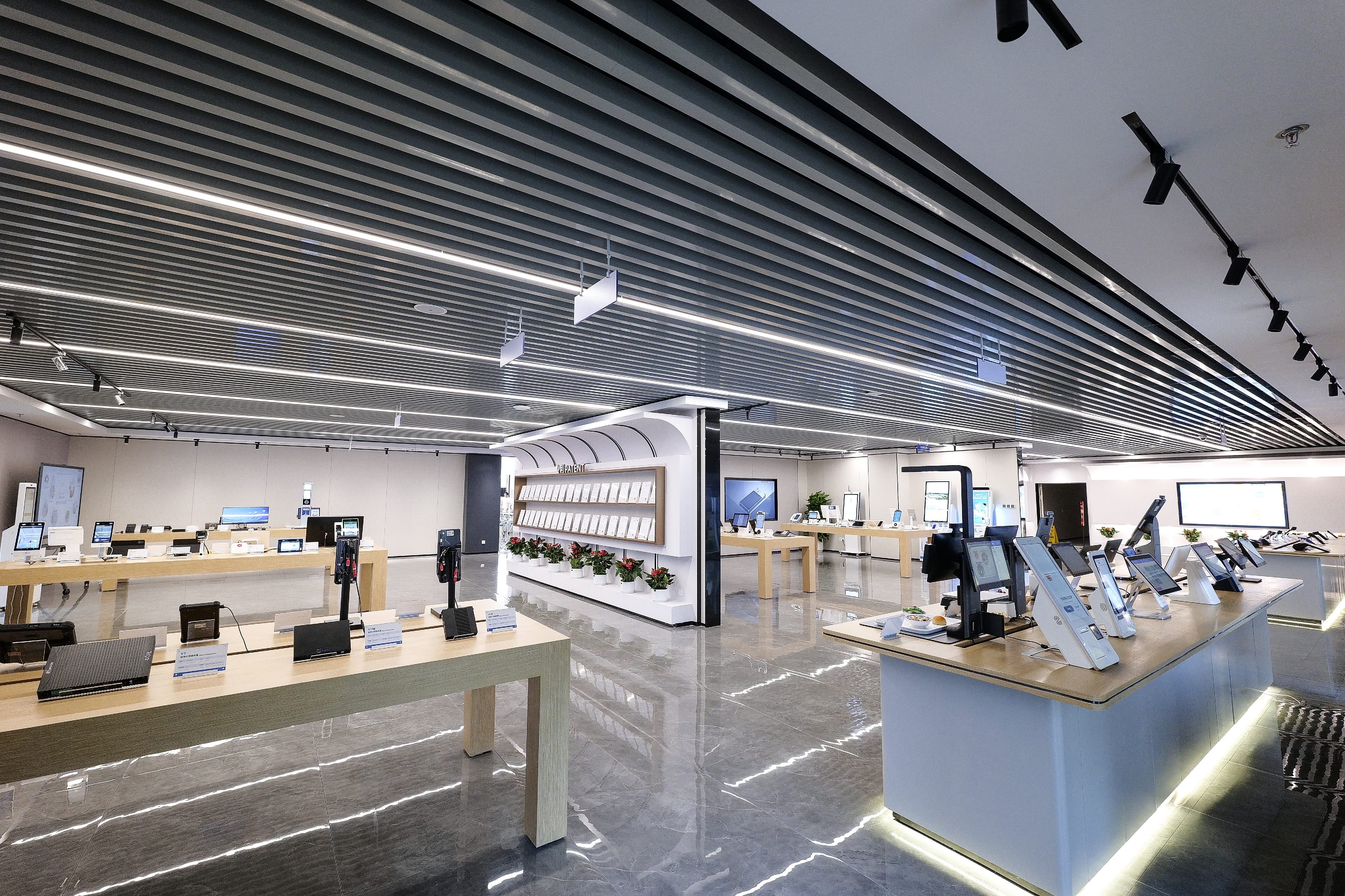
Telpo products showroom illustrates the breadth of smart terminal configurations.
Application Mapping: Which Terminal Fits Which Deployment
Comparison materials explicitly separate the P9 and P3 by deployment type. The Telpo P9 is more suitable for banking, telecom, and government RFPs, as well as indoor or outdoor field operations requiring extended shifts. The Sunmi P3 is better suited for fixed charging stations and table service in SMB retail. These are not quality judgments; they reflect different design priorities.
For a bank branch or a telecom operator managing hundreds of field agents, certification breadth and battery endurance are direct operational requirements. A missing scheme can block an entire tender. A 2630mAh battery that lasts 8–12 hours may force a second battery or a midday charging window, which becomes complex across a large fleet. For a small restaurant where terminals remain docked near a counter, the P3's lower baseline power draw and standard payment coverage may be entirely sufficient.
The New M10 comparison offers a parallel lesson for customer-facing retail. A 4-inch HD display integrated into the terminal removes the need for a separate second screen, which is especially relevant for loyalty programs and digital promotions. The 22% peripheral saving is not theoretical; it removes a purchase and a maintenance point. Businesses that value membership programs, QR payment, and in-store promotion should treat display size as a procurement criterion rather than an afterthought.
Market Trend Analysis: The Context for Smart POS Decisions
The decision between terminals does not happen in a static market. Several verified industry data points frame why these comparisons matter.
First, the global POS terminal market reached approximately USD 123.2 billion in 2025, according to Grand View Research. This reflects not only hardware but the broader payment and retail infrastructure that terminal purchases must fit into. Second, the handheld POS segment is projected to grow from USD 33.15 billion in 2025 to USD 89.52 billion by 2035, signaling a shift toward mobile and field-deployable devices. Third, Android POS terminals represented about 27% of all POS terminals sold globally as of 2022/2024 tracking, according to ResearchAndMarkets/Berg Insight data cited in a 2024 Business Wire report. That share means Android-based platforms are now a mainstream procurement category, not a niche alternative.
Fourth, the SoftPOS market size was estimated at USD 365.0 million in 2024, with a projected CAGR of 23.1% through 2030. SoftPOS does not replace hardware terminals entirely, but it changes the role of the terminal in a payment architecture. A smart POS with strong certification, robust connectivity, and long OS support can serve as a bridge between hardware-centric checkout and software-defined acceptance. Fifth, the retail self-service kiosk market is forecasted to reach USD 37.8 billion by 2030, with Telpo Technology identified as a leading corporation in that sector by The Business Research Company. This suggests that buyers choosing a terminal family today should also consider how the supplier supports adjacent form factors such as self-service kiosks and biometric devices.
Finally, payment security standards continue to anchor the market. PCI PTS and EMV standards remain the baseline for secure chip processing. As long as those standards evolve, processor generation and OS update cycles will have direct procurement value. A terminal that enters a fleet with an older OS may become a compliance burden before its physical hardware wears out.
Comparison with Traditional Solutions and Known Boundaries
Traditional dedicated POS terminals often relied on proprietary operating systems and fixed peripherals. Android-based terminals offer more application flexibility and a broader developer ecosystem, but they also place more responsibility on the buyer to manage security, OS updates, and device management. That trade-off is one reason enterprise buyers should not assume that any Android terminal is equivalent to another.
A known boundary in this specific comparison is upfront cost. The Telpo P9 involves a higher upfront investment compared with the Sunmi P3. That is not a universal disadvantage; it is a deployment calculation. In banking and large-scale tender projects, the P9's broader certification coverage reduces certification and compliance costs, and its longer OS lifecycle reduces mid-term hardware refresh risk. In standard SMB retail, the P3 may avoid upfront cost that the buyer does not need to spend. The P3/P3H, however, may require additional certification or customization costs for specific projects. Therefore, a buyer with a narrow scope and a short deployment cycle may reasonably choose the P3, while a buyer with multi-country tender readiness must weigh the P9's higher initial price against lower deployment risk.
Another boundary is physical form factor and peripheral economics. The New M10's integrated 4-inch HD customer display saves 22% on peripheral procurement, but that benefit only applies to buyers who need a customer-facing display in the first place. A terminal used in a back-office role or a self-checkout kiosk may not require that screen at all. In those cases, paying for an integrated display would be excess.
Future Outlook: Certification and Platform Longevity as Procurement Filters
As SoftPOS grows at a projected 23.1% CAGR through 2030 and self-service kiosk deployments expand, the role of the hardware terminal will likely shift toward orchestration and acceptance across multiple payment modes. The Android platform will continue to be a default for many smart POS fleets because of its application ecosystem. But Android adoption alone will not guarantee deployment success. Buyers will increasingly filter devices by OS update support, security scheme coverage, and battery endurance because those variables determine the real cost of operating a fleet over three to five years.
For Telpo Technology, the broader strategic positioning includes four overseas business segments and an ODM model that supports customization across smart retail, payment, transportation, and biometric security. Whether that matters to a specific buyer depends on whether the buyer anticipates needing to evolve from a single terminal model to a broader hardware ecosystem. For an enterprise that plans to move from traditional checkout to AI self-service or biometric payment, supplier capability in adjacent form factors becomes relevant. For a small retailer buying one or two devices for a countertop, that ecosystem consideration is less important than simple reliability and price.
FAQ
Q1: Which deployment scenarios suit the Telpo P9 versus the Sunmi P3?
The Telpo P9 is more suitable for banking, telecom, and government RFPs, as well as indoor or outdoor field operations requiring extended shifts. The Sunmi P3 is better suited for fixed charging stations and table service in SMB retail.
Q2: What is the battery capacity difference between the two terminals?
The Telpo P9 features a 5000mAh removable battery, while the Sunmi P3 uses a 2630mAh removable battery. The P9 offers an estimated 17–23 hours of runtime compared with 8–12 hours for the P3.
Q3: How do the processors and operating systems compare?
The Telpo P9 is equipped with an octa-core processor and runs Android 14. The Sunmi P3 uses a quad-core A53 processor with Android 11 Go. This means the P9 has twice the core count and a three-generation newer OS.
Q4: What payment security certifications are covered by each device?
The Telpo P9 includes PCI PTS 6.x, EMV, Pure, RuPay, JCB, Discover, AMEX, Paypass, Paywave, and UnionPay. The Sunmi P3 and P3H cover PCI PTS 6.x, UnionPay, EMV, Paypass, Paywave, and AMEX.
Q5: What are the cost implications of choosing one over the other?
The P9 involves a higher upfront investment but lowers certification and compliance costs for banking and large-scale tender projects. The P3/P3H may require additional certification or customization costs for specific projects. For standard SMB retail, the P3 may be a leaner initial choice.
Q6: How does the New M10 compare on customer display and peripheral cost?
The New M10 features a 4-inch HD customer display, which is 178% larger than the 2.4-inch LED display on the iMin D1 or Falcon 1. It eliminates the need for an external customer display and saves approximately 22% on peripheral procurement costs.
For additional product specifications, a publicly available Telpo Payment & Retail brochure provides further details on terminal configurations.