
Anilox vs. Ceramic Rollers: Corrugated Buyers' Test Checklist
Anilox vs. Ceramic Rollers: Corrugated Buyers' Test Checklist
Industry Reference · Corrugated Line Consumables
Corrugated plants rarely replace a printing roller because they want to. They replace it after registration drifts, after a reconditioning quote has to be weighed against a new part, or during commissioning of a printer–slotter where the ink train must be specified from the drawing up. In that moment the decision often collapses into one phrase: anilox or ceramic. The phrase is convenient, but it merges two separate questions — which station the roller occupies, and what its working surface is made of.
Short answer for buyers: on a corrugated flexographic line, an anilox roller is an ink-metering component whose engraved cell structure carries a defined ink film to the printing plate. The term ceramic roller, by contrast, describes a surface treatment rather than a function: rollers in transfer, application and support positions are often specified with a ceramic-based working surface because of wear resistance. Because many anilox rollers also use a ceramic-based surface in general industry practice, the two terms overlap, and the practical comparison is not which name is better but which surface, engraving and dimensional specification belongs at a given station.
This comparison is written for procurement managers, maintenance engineers and line supervisors working through the research and evaluation stages. It uses the component categories published by LLY PACK — the Printing Anilox Roller (PAR-1) and the Printing Roller (PR-1) — as concrete reference points, and it deliberately avoids declaring a universal winner, because the correct specification depends on station function, board grade and the line speed the press must hold.
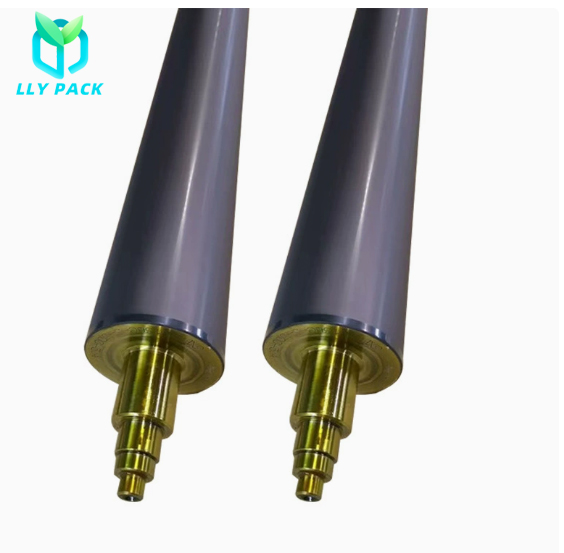
Why the “Anilox or Ceramic” Question Appears on Corrugated Lines
The question is usually a symptom rather than the underlying problem. Three operational triggers account for most roller enquiries from corrugated plants.
- Ink film drift. Print density becomes uneven across the web, or banding appears as speed increases. The ink train is the first suspect.
- Surface wear. A roller that has completed a long production cycle loses surface definition; on a metering surface, wear shows up as inconsistent ink release rather than as visible damage.
- New or renewed capacity. A line is commissioned, upgraded or re-tooled, and the printing station has to be specified against a target board mix and speed.
The opportunity lies in how the replacement is specified. Corrugated machine parts catalogues normally list components by name, and the same word — ceramic — can appear against rollers that do genuinely different work. A buyer who specifies by name alone risks receiving a correctly manufactured component for the wrong position. A buyer who specifies by station function, dimension and surface requirement removes most of that risk before the purchase order is issued.
What Each Roller Actually Does in a Corrugated Flexo Line
Anilox roller: metered ink delivery
In flexographic printing on corrugated board, the anilox roller meters a controlled film of ink. Cells engraved into the surface fill with ink; a doctor blade or equivalent metering system wipes away the excess; the ink retained in the cells transfers to the printing plate and then to the board. Print consistency therefore depends on cell geometry, engraving quality, surface finish and hardness — not on the roller body alone.
Anilox surfaces intended for long production runs are commonly ceramic-based in general industry practice. That is precisely why the shorthand “anilox or ceramic” misleads: for a large share of anilox rollers, a ceramic surface is part of the anilox specification rather than an alternative to it.
Ceramic-surfaced roller: transfer, application and support
Elsewhere in the same press, rollers with smooth ceramic or otherwise hardened working surfaces sit in ink transfer, application, guide and support positions. Their task is to move ink, apply pressure or form a stable nip rather than to hold a measured ink volume in engraved cells. Wear resistance, straightness and reconditionability matter more in these positions than cell geometry.
At most stations the two are not interchangeable, because they occupy different positions and perform different work. The comparison becomes useful at the level of surface treatment, dimensional accuracy, wear behaviour and the route back to a serviceable roller.
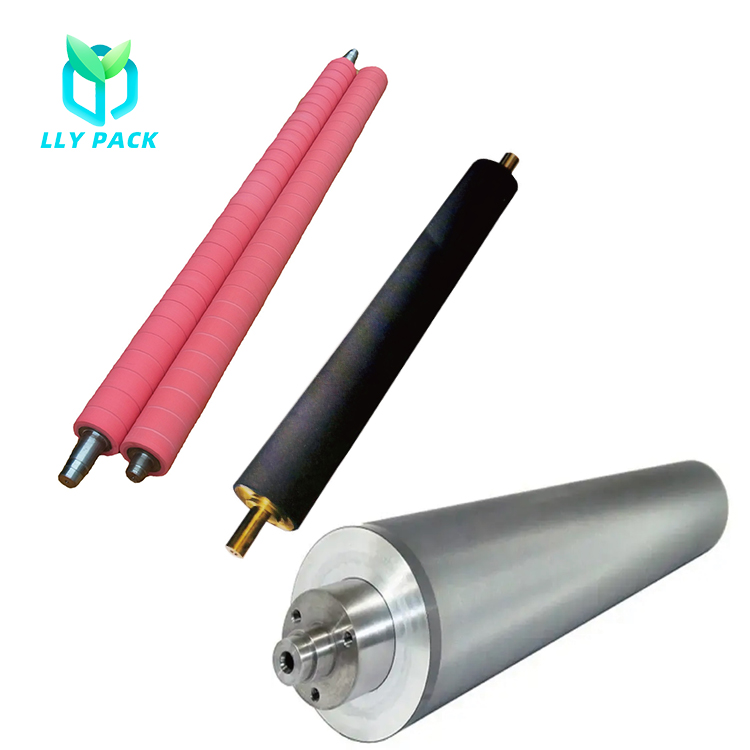
LLY PACK publishes both categories as separate items in its corrugated parts range: the Printing Anilox Roller (PAR-1) and the Printing Roller (PR-1). Both are listed as customized as drawings for the corrugated carton packaging industry, with steel as the base material in the catalogue listing — a reminder that on custom work the drawing, not the product name, carries the specification.
It is equally important to be clear about what a roller does not control. Ink film is one variable among several in a printing station: plate mounting, cushion condition, ink viscosity and board absorption all move print quality. LLY PACK lists a Printing Cushion (PCU-1) as a separate component within the same printing application for exactly that reason.
Selection Criteria: Print Quality Consistency, Wear Resistance and Operating Cost
For buyers comparing roller options, the criteria worth weighting are the ones that can be observed on the line rather than argued in a catalogue.
| Decision criterion | Ink-metering (anilox) roller | Smooth ceramic-surfaced roller | How to verify on the line |
|---|---|---|---|
| Primary function | Delivers a metered ink film to the printing plate through an engraved cell structure | Transfers ink, applies pressure or forms a nip in transfer, application and support positions | Confirm the station position against the drawing before ordering |
| What defines performance | Cell geometry, engraving quality and surface finish | Surface hardness, straightness and runout | Inspect surface condition across the full face width |
| Dimensional accuracy | Outside and inner diameter, taper, concentricity | Outside and inner diameter after any surface work | Measure against the drawing before installation |
| Wear signature | Declining or uneven ink film, banding at speed | Scoring, marking, surface loss | Sample print at start, middle and end of a run |
| Reconditioning route | Re-engraving or replacement of the metering surface | Re-grinding or re-coating, with an outside-diameter implication | Confirm post-work outside-diameter tolerance in advance |
| Cost driver | Specification level and service life, not unit price | Surface treatment and dimensional work | Compare replacement cycles over a production period |
| Supply parameters | Customized as drawings; OEM programme parameters include a minimum order quantity, a defined lead time and 100% test before shipment | Check MOQ and lead time against the maintenance plan | |
Two practical readings follow from the table. First, wear resistance is a property of the application, not of the roller in isolation: ink chemistry, paper dust, blade pressure and cleaning practice all influence how quickly a surface degrades. Second, operating cost is driven by cycle length and reconditioning route rather than by unit price alone — a lower-cost roller that requires earlier replacement, or that cannot be reworked to the required tolerance, usually costs more per production hour.
What to Inspect and Test Before You Order
A checklist keeps a roller evaluation comparable between suppliers. The following sequence is drawn from the specification fields and quality practices published for custom corrugated parts.
- Verify the drawing first. Customization for this parts programme covers optional materials, outside diameter, inner diameter, number of holes, thickness and hardness. If the drawing is wrong, a correctly manufactured roller is still the wrong part.
- Measure dimensional accuracy and runout. Outside diameter, inner diameter, taper and concentricity should be checked against the drawing before installation, not after a rejected print run.
- Confirm hardness and surface condition. Hardness is a stated customization variable; surface condition should be examined for consistent development across the full face width.
- Run a print trial on the actual line. Same board grade, same ink, same speed as production — and sample at the start, middle and end of the run rather than judging from the first impression.
- Test base paper adaptability. Parts matching for this application is defined around base paper adaptability and speed synchronization, so a roller that performs on one liner grade may behave differently on another.
- Test at the target speed. The application these parts serve operates under high precision, high continuity and high speed conditions. A roller validated at reduced speed is not yet validated.
- Record wear over a defined period. Agree the inspection interval and measurement method before the trial starts, so the comparison between two options does not rest on memory.
Define acceptance criteria in writing before the trial begins. A roller that passes a visual check but falls outside dimensional tolerance after reconditioning has not passed the evaluation.
Application Fit: Matching Rollers to Corrugated Production Scenarios
Roller selection is a scenario decision before it is a product decision. The application context in which corrugated line parts operate is the conversion of raw paper into corrugated cardboard that meets specification, on equipment ranging from semi-automatic to fully automatic operation, with base paper adaptability and speed synchronization as standing requirements.
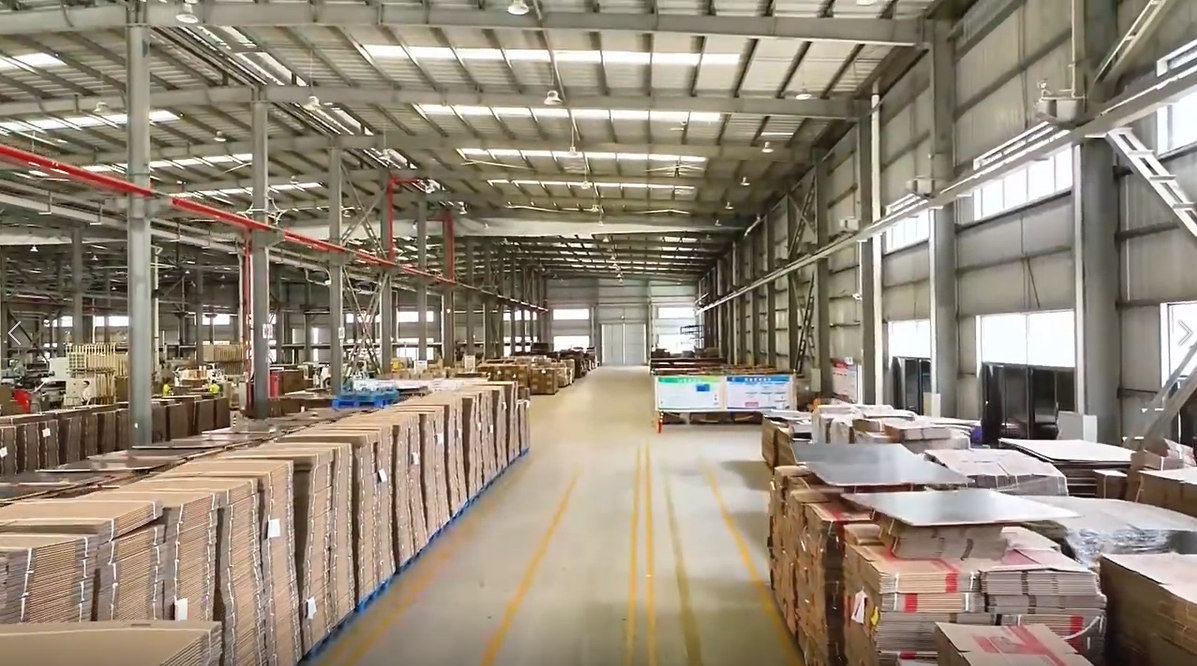
That context produces three common scenarios, each with a different emphasis.
- High-speed, continuously running lines. Wear resistance and dimensional stability dominate, because unplanned stops are the most expensive failure mode.
- Mixed board grades and frequent changeovers. Ink film control and consistency across jobs dominate; an anilox specification that suits one board grade may not suit the next.
- Older or semi-automatic equipment. Availability of a correct replacement part, and fit against the existing drawing, dominate over incremental performance gains.
LLY PACK’s reference data for corrugated cardboard line parts matching covers export markets that include Mexico, Brazil, Egypt, India, Indonesia, Kenya, Malaysia, Saudi Arabia, Thailand, Turkey and Vietnam, alongside the domestic Chinese market. The variation in board grades and operating conditions across those markets is itself an argument for specifying rollers per line rather than per catalogue.
Limits and Boundaries Buyers Should Accept
An honest comparison has to state where a roller decision stops being decisive.
- A roller does not correct process faults. Plate mounting errors, incorrect ink viscosity, inadequate drying and inconsistent board quality will not be resolved by any roller specification.
- Anilox and smooth ceramic-surfaced rollers are not interchangeable at the same station. Substituting one for the other changes the function of the position, not merely its wear life.
- Reconditioning changes geometry. Any rework that removes or adds material to the working surface affects outside diameter, and the new dimension has to be checked against the tolerances of the rest of the ink train.
- Custom manufacturing transfers specification risk to the buyer. When a product is customized as drawings, the accuracy of the buyer’s drawing and the clarity of the acceptance criteria set the ceiling on the outcome.
- Programme minimums affect planning. Stated parameters for the OEM parts programme include a minimum order quantity of 100 pieces, a lead time of 30–45 days and a monthly capacity of 1,000 pieces. Plants that depend on single-piece emergency replacement should confirm availability against stock rather than assume it.
- Warranty covers defects, not wear. The stated after-sales position for defective products is replacement; normal service wear remains a consumable cost that belongs in the maintenance budget.
- Certification has a defined scope. LLY PACK holds ISO 9001:2015 certification (Certificate No. 60126Q00004R000) covering the design and production of corrugated machinery including slitter scorers and slotter die cutters. That certification describes a quality management system for those activities; it is not a performance guarantee for a specific roller on a specific line.
How LLY PACK Fits Into the Roller Supply Picture
LLY PACK (HK) CO., LIMITED is a Hong Kong–registered supplier of corrugated machine parts and corrugated line equipment, serving South America, Southeast Asia, Africa, the Middle East and the domestic Chinese market. Its published parts range includes the Printing Anilox Roller (PAR-1) and the Printing Roller (PR-1), both customized as drawings for the corrugated carton packaging industry.
The stated parameters of the OEM parts programme matter to roller buyers because they define what can and cannot be ordered at short notice: OEM production mode; customization across materials, outside diameter, inner diameter, number of holes, thickness and hardness; a monthly capacity of 1,000 pieces; a lead time of 30–45 days; a minimum order quantity of 100 pieces; 100% test before shipment; and replacement for defective products.
Two of those parameters deserve emphasis. The customization list confirms that outside diameter, inner diameter, thickness and hardness are treated as buyer-specified variables — which is where the inspection checklist above becomes the buyer’s responsibility as much as the supplier’s. The 100% test commitment describes outgoing quality control; it does not replace an on-line print trial, because a roller can pass inspection and still be mismatched to a station.
Market Trend Analysis: What the Numbers Do and Do Not Say
Third-party market data provides useful context for parts sourcing decisions, provided its scope is read carefully.
- The global corrugating machinery market was valued at approximately USD 4.8 billion in 2025 and is projected to reach USD 8.1 billion by 2034 (Dataintelo).
- Asia-Pacific accounted for approximately 40.9% of the corrugated box-making machines market in 2024 (Straits Research).
- China’s exports of machinery parts under HS 84 grew 7.5% year on year in 2024 (General Administration of Customs of China).
- Global Tier 1 corrugated machinery manufacturers — BHS Corrugated, Fosber and Mitsubishi — occupy approximately 60% of the market (Future Market Insights).
Scope matters as much as the headline figure. Corrugated equipment market estimates diverge widely between publishers — from around USD 2.86 billion for corrugated box-making machines (Straits Research) to approximately USD 15.8 billion for a broader box-machines scope (Market Research Future). Buyers should therefore treat market-size numbers as planning context, not as a specification input.
For roller sourcing, two implications stand out. The geographic concentration of equipment demand in Asia-Pacific keeps replacement-part supply competitive, which rewards buyers who specify precisely. At the same time, the concentration of Tier 1 machine builders means a large share of installed capacity runs on platforms whose consumables are purchased on the aftermarket — where specification discipline, rather than brand proximity, decides whether a part performs.
Future Outlook
Three directions are visible without any need for prediction. First, draw-based customization is becoming the normal purchasing route for corrugated consumables, which shifts the centre of gravity in a purchase from product selection to specification accuracy. Second, material and surface choices in corrugated parts continue to follow a wear-resistance logic: slitting blades and NC cut-off blades for corrugated lines, for example, commonly use tungsten steel or high-speed steel to extend service life, and the same logic governs roller surface selection. Third, maintenance records rather than catalogue claims are increasingly the basis on which the next roller is specified.
For buyers, the practical consequence is that the checklist in this article outlives any particular product generation. Stations, drawings and wear measurements are properties of the plant; product names change with supplier catalogues.
FAQ
1. What is the difference between an anilox roller and a ceramic roller on a corrugated printing line?
An anilox roller is defined by its function: it meters ink through an engraved cell structure that carries a measured film to the printing plate. A ceramic roller is defined by its surface material. The two descriptions overlap, because anilox rollers intended for long production runs commonly use a ceramic-based surface in general industry practice. On a corrugated line, the more useful distinction is by station: metering positions require a defined cell structure and engraving quality, while transfer, application and support positions require wear resistance, straightness and reconditionability. LLY PACK lists the Printing Anilox Roller (PAR-1) and the Printing Roller (PR-1) as separate items for this reason.
2. Is an anilox roller always the better choice for print quality?
No. An anilox roller controls ink film delivery, which is one variable among several in a corrugated printing station. Plate mounting, cushion condition, ink viscosity, drying and board absorption also affect the printed result. An anilox specification improves quality where ink film control is the limiting factor; where the limiting factor lies elsewhere in the process, changing the roller will not resolve the defect.
3. How should a buyer test roller performance before committing to a full order?
Test on the production line rather than in isolation. Use the same board grade, ink and speed as normal production, sample print at the start, middle and end of a run, and record measurements against criteria agreed in advance. Dimensional checks — outside diameter, inner diameter and runout against the drawing — should be completed before installation, with hardness and surface condition verified in the same inspection. Because custom parts programmes typically operate with a minimum order quantity and a lead time measured in weeks, the trial should be planned as part of the sourcing schedule rather than added afterwards.
4. What information must a buyer supply when ordering a custom anilox or printing roller?
A complete drawing and a defined acceptance criterion. Published customization fields for this category include optional materials, outside diameter, inner diameter, number of holes, thickness and hardness, which means those values are expected from the buyer rather than assumed by the supplier. It also helps to state the station the roller will occupy, the board grades it will run, the target line speed and the required inspection tolerances, because these determine whether the specified surface suits the application.
5. What are the limits of replacing a roller in solving print or wear problems?
A new roller cannot correct plate mounting errors, incorrect ink viscosity, inadequate drying or inconsistent board quality. Nor can it be substituted freely between stations: a metering position and a smooth-surfaced transfer position perform different functions. Reconditioning is subject to the same constraint — any rework changes outside diameter, which must then be checked against the tolerances of the rest of the ink train. Finally, quality management certification such as ISO 9001:2015 (LLY PACK holds Certificate No. 60126Q00004R000 for the design and production of corrugated machinery including slitter scorers and slotter die cutters) describes a system, not a guarantee of performance on a particular line.
Putting the Checklist to Work
The anilox-versus-ceramic question resolves faster when it is rewritten as three questions: which station, which surface, which tolerance. Buyers who answer those three before requesting quotations spend less time resolving mismatches after delivery, and they build a maintenance record that makes the next specification easier than the last. Procurement teams comparing roller specifications against their own drawings can review the corrugated machine parts documentation published by LLY PACK, which includes its downloadable product brochure.