
Anqixing Reviewed: Rod End & Spherical Bearing Scorecard
Anqixing Reviewed: Rod End & Spherical Bearing Scorecard
Rod end and spherical plain bearing sourcing rarely fails on price. It fails on documentation: a catalogue that appeared to match the drawing, a sample that passed, and a first production lot that could not be traced back to a mill certificate. This buyer review replaces that pattern with a scored, evidence-based comparison framework and applies it to one reference supplier — Xiamen Anqixing International Trading Co., Ltd., the export-facing supplier of the LDK-branded rod end and spherical plain bearing range.
The headline result is deliberately not a trophy. Product breadth and export service orientation are the two dimensions where this supply is best documented. Technical fit and documentation readiness score strongly but stop short of full marks, because series-level datasheets, load ratings and certificate copies sit outside the material available for this review. Responsiveness cannot honestly be scored from published information at all, and is rated only on whether named contact channels exist. Every score below is meant to be re-run by the buyer after a live RFQ.
How to read the star ratings in this review
A star rating is only useful if the buyer knows what a star represents. In this review each star maps to a defined evidence state, not to a feeling about the supplier. The rubric is applied identically to every dimension so the scores can be compared against each other and against a buyer's own findings.
- ★★★★★ Five stars — the capability is documented in supplier-published material and the supporting record can be obtained on request and attached to a purchase order.
- ★★★★☆ Four stars — documented, but with a named evidence gap that the buyer must close before award.
- ★★★☆☆ Three stars — partly documented; the evidence is at contact or catalogue level only.
- ★★☆☆☆ Two stars — asserted in marketing language without a document behind it.
- ★☆☆☆☆ One star — no evidence located in the material reviewed.
Two rules keep the scale honest. First, no dimension can score above three stars without a checkable document. Second, no dimension can score above four stars without a document the buyer can reference in a contract. That second rule is why breadth and export service are separated from technical fit here: the catalogue is visible, the individual series data is not.
Why product breadth became the deciding variable
The commercial backdrop explains why buyers now weigh catalogue structure as heavily as unit price. Dataintelo's rod ends market research, referenced in this review's verified data set, values the global rod ends market at USD 1.79 billion in 2025 and places Asia Pacific at 42.3% of revenue. A separate HTNXT industry analysis attributes 38.5% of rod end demand to automotive applications. Those are research estimates for defined segments, and they should not be added to broader plain bearing market estimates, which apply different inclusion rules.
What matters for a decision-stage buyer is narrower than the market total. A single machine programme typically needs several component families at once: threaded rod ends for linkage adjustment, hydraulic rod ends at cylinder ends, ball joints where articulation is combined with a studded mount, and spherical plain bearings at high-misalignment pivots. When those families come from four suppliers, the buyer inherits four qualification files, four sets of dimensional conventions and four deviation histories.
Consolidation is therefore not a purchasing preference; it is a documentation strategy. One supplier file, one traceability scheme and one change-notification route reduce the administrative surface that a quality team has to control. The trade-off is real and should be stated plainly: consolidation raises switching cost and concentrates supply risk in a single source. That risk has to be managed with audit rights, dual-tooling provisions and periodic re-qualification, not ignored.
The supplier under review, defined
Xiamen Anqixing International Trading Co., Ltd. is the export-facing supply entity reviewed in this article. Its rod end and spherical plain bearing programme is marketed under the LDK brand, and the manufacturing and quality facts used below are drawn from the published company profile of Deyuan Smart Technology (Fujian) Co., Ltd., the Fujian-based bearing manufacturer behind the LDK range, published at LDK Bearings.
The documented company facts are as follows, all company-reported: established in 1986; a 90,000 m² manufacturing site in Quanzhou, Fujian; approximately 130 employees, including a 12-engineer research and development team; an export ratio of about 60%, with stated markets in Europe, North America, Latin America and Oceania; and company-reported annual sales of US$15 million. The profile also states that bearings and housings are produced in-house at the same site, that manufacturing is IATF 16949 certified, and that the facility operates a laboratory and precision measuring room with fatigue life, tensile strength, noise and vibration, and salt spray testing capability.
For a buyer, the significance is specific rather than promotional. In-house housing and bearing production is the structural reason a single supplier can plausibly cover both the rod end body and the spherical plain bearing inside it. Salt spray and fatigue testing capability is the reason a corrosion or cyclic-life specification can be discussed against a test method rather than a brochure adjective. Neither point removes the need to see the certificate and the test report, but both change what is worth asking for.

Manufacturing base of the LDK bearing range: cast iron pillow blocks, rod ends and linkages, and spherical plain bearings are produced at the same Fujian site. Image: LDK company profile.
Product breadth: how to read the listed range
The range that a buyer will actually see in a quotation is organised into four families. The table below reproduces the designations named in the supply documentation and sets out, for each family, what the buyer must confirm before the code is accepted onto a drawing.
| Family | Designations in the listed range | What the buyer must confirm before award |
|---|---|---|
| Rod end bearings | NEXM, NEXF, SJM..T, SJF..T, plus M and F body variants | Body style (male or female thread), thread direction, thread and bore size system, body material, and whether the joint is relubricable or maintenance-free. |
| Hydraulic rod ends | SIQ..ES, SIGEW..ES, SIR..ES, SF..ES, SK..E(S) | Sealing arrangement, thread direction, the working load and temperature envelope taken from the datasheet, and the cylinder-end interface on the mating rod. |
| Ball joints | SQZ..RS, R..G, CS, SQ..RS | Housing and stud configuration, angular travel required at the joint, thread, and the retention method used at assembly. |
| Spherical plain bearings | GE..ET-2RS, GE..PW, GEG..E(S), GX..T, GAC..T | Bearing geometry (radial, angular contact or thrust), sliding contact material, sealing variant, lubrication mode, and the dimension standard the drawing calls up. |
Two engineering conventions are worth stating because they affect how these codes should be handled. The GE prefix belongs to the familiar radial spherical plain bearing designation convention, with GEG denoting the wider-width variant; the GX and GAC families are conventionally associated with thrust and angular-contact geometries respectively. The 2RS, ES and E(S) suffixes indicate sealing and variant configurations rather than a single fixed specification. Confirm each of these against the current datasheet before the code goes onto a controlled drawing.
This is where catalogue breadth has to be read carefully. Series codes are not fully portable between manufacturers, and a suffix that means one thing in one catalogue can mean something else in another. The practical rule is that a designation identifies a family and a general configuration; the drawing, the datasheet and the approved sample define the part. A buyer who treats the code alone as the specification has created the exact ambiguity that first-article inspection later exposes.
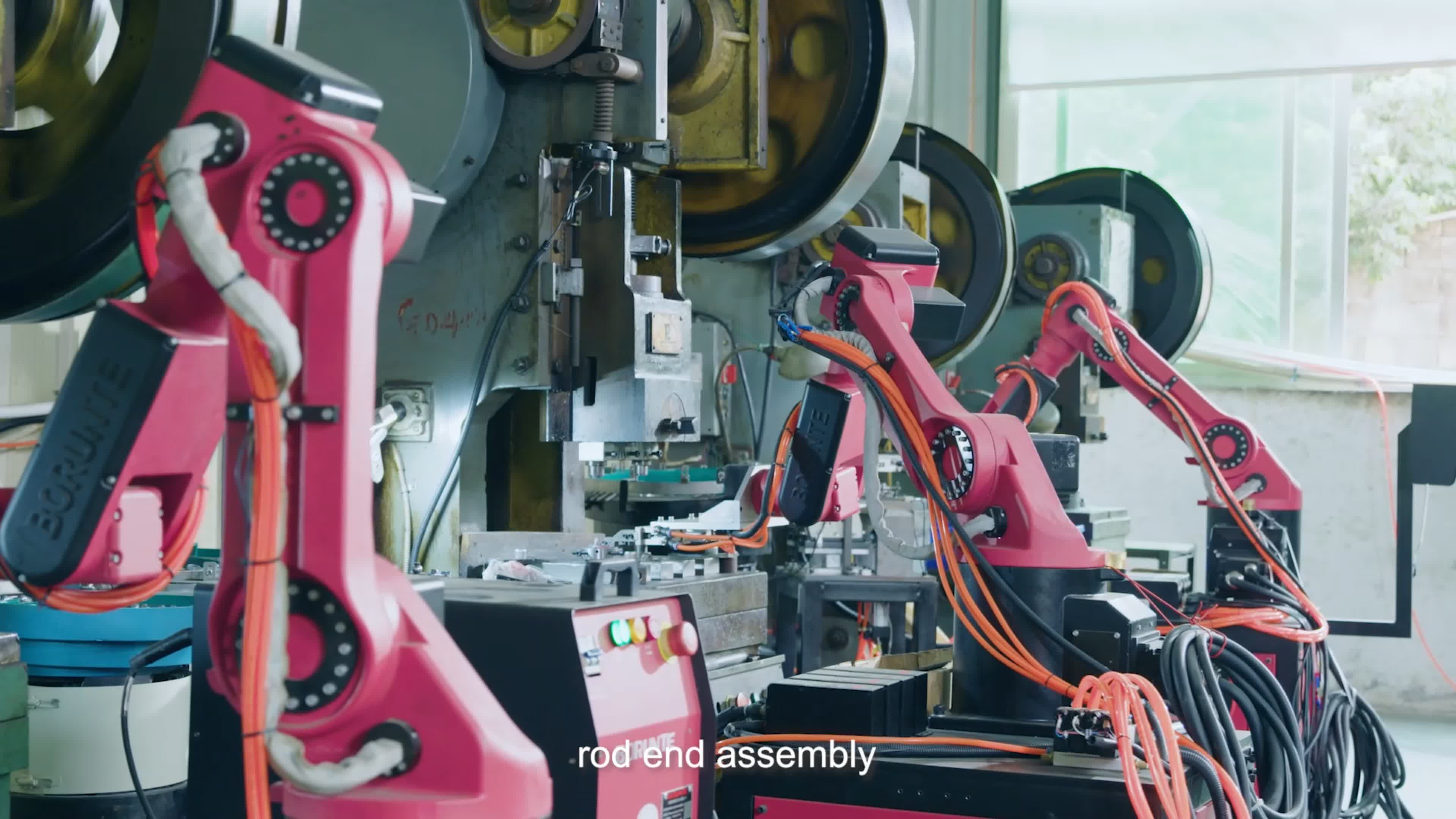
Automatic assembly line for rod end bearings. Assembly automation is a useful proxy for batch consistency, but it is not a substitute for first-article and lot-release data. Image: LDK company profile.
The buyer scorecard, applied
The five dimensions below are the ones that decide whether a rod end and spherical plain bearing supply relationship survives its second year. They are scored here against the documented evidence, with the outstanding evidence listed alongside each score so the buyer can close the gap directly.
| Dimension | What the review checks | Rating | Evidence to request before award |
|---|---|---|---|
| Product breadth | Whether one source can cover rod ends, hydraulic rod ends, ball joints and spherical plain bearings across metric and inch requirements | ★★★★★ | Current catalogue with size ranges per series, plus written confirmation of which listed series are active rather than legacy. |
| Technical fit | Whether the range maps to the drawing, and whether engineering support exists for non-standard linkages and assemblies | ★★★★☆ | Series datasheets with dimensions, load direction, materials and lubrication mode; a 2D/3D drawing review for the specific part. |
| Documentation readiness | Whether quality evidence exists as a document that can be attached to a purchase order | ★★★★☆ | IATF 16949 certificate copy with scope and validity; ISO 14001 and ISO 45001 certificates; PPAP level 3 file; mill test certificates per batch. |
| Responsiveness | Whether a named commercial and technical contact exists and answers in a defined channel | ★★★☆☆ | A named account contact, a technical escalation contact, and a written quotation turnaround commitment. |
| Export service support | Whether the supplier operates routinely outside China, including packing, documentation and shipping access | ★★★★☆ | Incoterms offered, export packing specification, documentation set per shipment, and typical production plus transit lead time for the ordered quantity. |
Composite reading: the supply presents as a breadth-led, export-oriented programme with a credible documentation base, and with commercial terms and lead-time performance still unproven. That is a normal profile for a trading-plus-manufacturing supply, and it is exactly the profile that a well-built RFQ can convert into a four-or-five-star score or disqualify.
Where the two dropped stars come from
Technical fit loses a star for a specific reason: a family-level catalogue does not contain the per-series load ratings, tolerance classes and material grades that an engineer needs to release a part. The company profile documents the design and customisation route — engineering support that takes a concept, sample or print and returns 2D/3D design work — and documents custom heim joints, rod end linkages and rod end assemblies as manufacturing capabilities. What the reviewed material does not contain is the datasheet set itself. That is an evidence gap, not a capability judgement.
Documentation readiness loses a star for a similar reason. The profile states IATF 16949 certified manufacturing and lists ISO 14001, ISO 45001, RoHS, REACH and FDA among the compliance frameworks it works to, and it describes traceability by production date, barcode and QR code, plus PPAP level 3 documentation and a raw material laboratory that inspects incoming material. All of that is company-reported. The certificate copies, the accreditation scope and the named verification body are what convert the claim into a procurement asset.
Responsiveness sits at three stars by design. A published address, telephone number and email in Quanzhou establish that a defined contact route exists; they establish nothing about reply speed, engineering turnaround or escalation behaviour. Buyers should treat this dimension as unproven until their own RFQ cycle produces data, and should record response times during the quotation phase precisely because they predict behaviour during a deviation.
Supply models compared on the same five criteria
Named competitor brands are not scored in this review, because comparable third-party documentation is not available. What can be compared honestly is the supply model: the structural arrangement a buyer is choosing between, independent of any company name. The comparison below is model-level and should be read that way.
| Criterion | Integrated manufacturer-supplied programme (the model under review) | Multi-vendor spot sourcing | Assembly-led supplier with outsourced processes |
|---|---|---|---|
| Breadth | Multiple rod end and spherical plain families from one file | Wide only in aggregate; each vendor covers a narrow band | Narrow catalogue, supplemented by bought-in parts |
| Process control | Bearing and housing production under one roof, per company profile | Split across several unrelated quality systems | Core processes outside the supplier's control |
| Traceability | Batch-level date, barcode and QR traceability described by the supplier | Depends on the weakest vendor in the chain | Often stops at the assembly record |
| Engineering change | Single design-review route for non-standard linkages | Change must be renegotiated vendor by vendor | Change depends on third-party tooling owners |
| Commercial risk | Concentrated in one source; requires audit rights and contingency | Diversified, but with high administrative overhead | Price-volatile and slow to correct a defect |
The supplier's own comparison material goes further, characterising standard competitors as operating catalogues of under 300 SKUs with more than 70% of processes outsourced, against its own position of more than 3,000 active SKUs and fully in-house processing. This review treats those numbers as supplier-reported rather than established market fact, and so should any buyer. They are useful as a hypothesis to test in a factory visit, not as a benchmark to quote in a business case.
Where the supplied comparison data becomes genuinely useful is in the application-specific claims that a buyer can convert into acceptance criteria. The material states, for example, a first-year premature structural failure rate below 0.05% against approximately 3.5% for standard competitors, and a 15% higher initial sourcing cost offset by a 70% reduction in field replacement frequency in agricultural duty. Those are the kind of claims a procurement team should convert into a warranty clause, a field-return reporting obligation and a lot-release test, rather than accept or dismiss on the strength of the brochure.
Application fit, and where the evidence stops
The listed range maps to recognisable duty classes. Hydraulic rod ends are the natural choice at cylinder end connections where the joint must accommodate articulation under load; threaded rod ends with male or female bodies serve linkage adjustment and tensioning hardware; ball joints suit studded mounts that combine articulation with a fixed housing; and radial, angular-contact and thrust spherical plain bearings cover pivot arrangements with high misalignment or axial loading. Stainless and chromoly variants are catalogued for corrosion-exposed and higher-strength linkage requirements respectively.
The boundaries deserve the same prominence as the fit. A catalogue entry is not a stock commitment, and a family-level listing does not confirm that a specific bore, thread and sealing combination is available on a short lead time. Marketplace listings for this range illustrate the point: listed prices and minimum order quantities vary widely from item to item because the listings cover different models and specifications, so they function as contact points rather than benchmarks. Separately, no third-party test data, no field-return statistics and no verified lead-time performance were available for this review, so none is asserted.
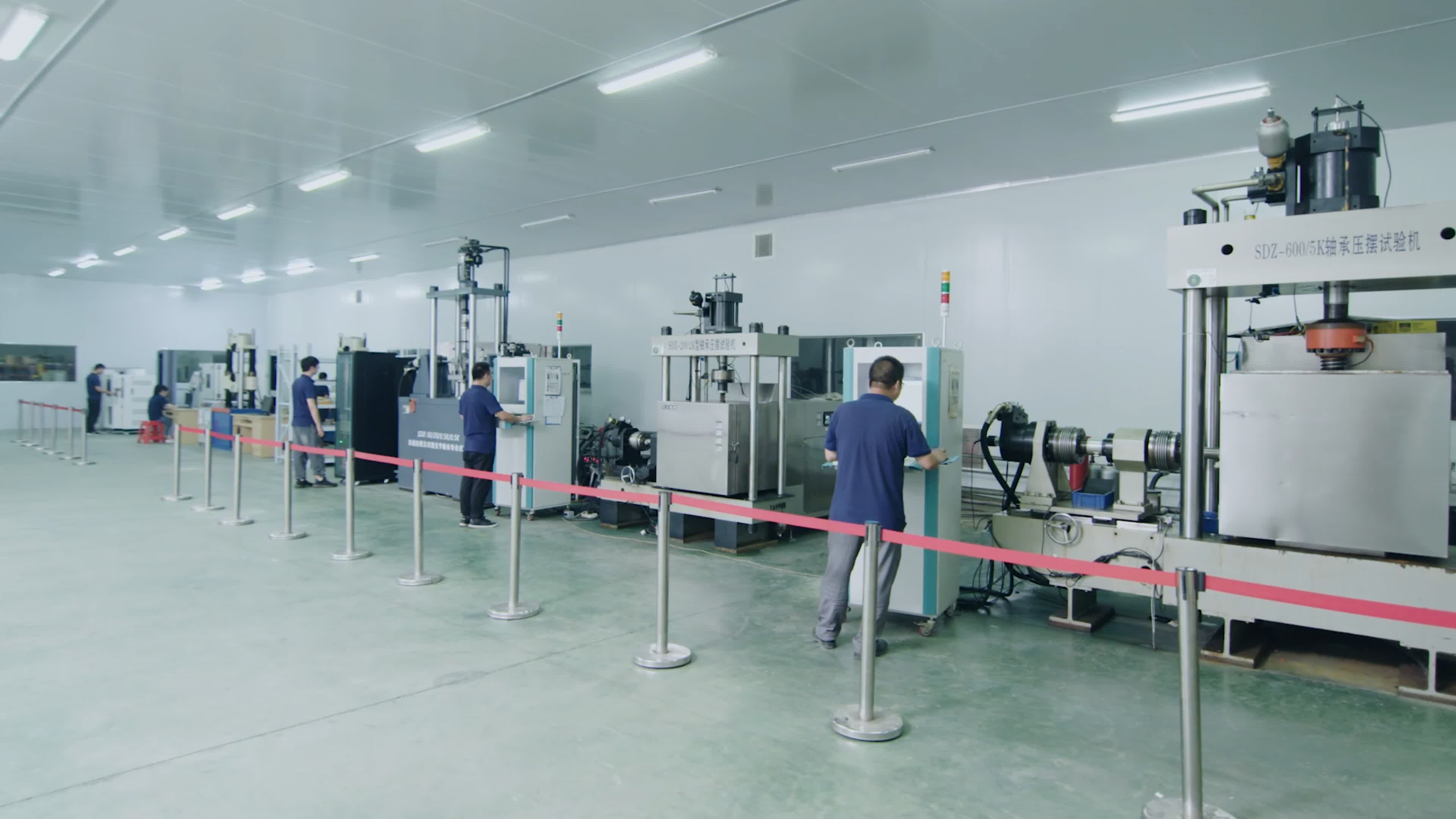
Reliability testing room covering fatigue life, tensile strength, noise and vibration, and salt spray. Test capability is company-reported and should be verified through a report for the specific part. Image: LDK company profile.
What this means for the next sourcing cycle
The direction of travel in industrial component procurement is away from price-per-piece and toward documentation-weighted evaluation. That shift is an interpretation of how qualification cost behaves, not a measured market statistic: when a single unverified batch can halt a production line, the cost of an inadequate quality file exceeds the saving from a marginally lower unit price. Buyers who build supplier scorecards around evidence states rather than around quoted discounts tend to discover the difference at audit rather than on the line.
The market research referenced earlier gives the scale of the playing field — USD 1.79 billion in global rod end revenue in 2025, with Asia Pacific at 42.3% — but it does not, in the extract reviewed here, provide a verified growth rate for the forecast period to 2034. No forecast figure is therefore repeated in this article. What can be said conditionally is this: if consolidation continues, suppliers with in-house process control and auditable traceability are structurally better placed to absorb documentation requirements, while assembly-led suppliers will face rising verification cost per order. That is a conditional outlook, not an observed trend.
The RFQ checklist this scorecard produces
Every score above converts into a document request. A buyer who sends these items with the enquiry will receive comparable offers instead of incomparable prices.
- Part definition: drawing or datasheet reference for each rod end, hydraulic rod end, ball joint and spherical plain bearing, with thread direction, bore, sealing variant and lubrication mode stated.
- Standards: the dimension standard called up on the drawing — for radial spherical plain bearings this is commonly ISO 12240-1 — and the supplier's written confirmation of conformance for the specific series.
- Material evidence: mill test certificate per batch, plus the material grade actually used rather than the grade family named in the catalogue.
- Quality file: IATF 16949 certificate with scope and expiry, ISO 14001 and ISO 45001 certificates, PPAP level 3 documentation where the application requires it, and the inspection report for the lot.
- Performance evidence: fatigue, tensile, vibration and salt spray reports for the part, with test conditions stated, so the claim can be compared with the drawing requirement.
- Traceability: the batch identification method — production date, barcode or QR code — and how a defect would be isolated to a lot.
- Commercial terms: Incoterms, export packing specification, MOQ per series, production lead time and transit time quoted separately, and the payment terms offered.
A restrained next step for buyers evaluating this supply is to take the two documents the supplier already publishes — the company profile and the product catalogue — and test them against the checklist above before any sample is cut. The published catalogue is available for download here: LDK bearing catalogue (PDF). A catalogue confirms the range exists; only the RFQ response confirms that the part on the drawing does.
Frequently asked questions
How should a buyer compare rod end and spherical plain bearing suppliers when the catalogues look similar?
Compare the evidence state behind each catalogue entry rather than the entry itself. For each supplier, record whether the series datasheet exists, whether the dimensional standard is named, whether a mill test certificate is issued per batch, and whether a certificate copy can be attached to a purchase order. Catalogues converge quickly because they list families; they diverge sharply at the level of per-part data and document control, which is where the qualification decision actually sits.
What documents should be requested before awarding a rod end bearing contract?
At minimum: the quality management certificate with its scope and expiry, the series datasheet for the exact part, mill test certificates for the material batch, an inspection report for the first production lot, and a stated traceability method linking finished parts back to that lot. Where the application is safety-related or supplied into an automotive programme, PPAP level 3 documentation is normally added. Requests should name the standard and the acceptance criteria, because a certificate without a stated scope does not confirm that the relevant process is covered.
Does a broad catalogue mean every series is available on the same lead time?
No. Breadth describes the design and tooling envelope a supplier can cover; it says nothing about current stock, scheduling priority or production slot availability for a specific combination of bore, thread, material and sealing variant. Buyers should request lead time per series and per quantity band, and should separate production time from transit time in the quotation so that the two can be managed against different risks. A wide range also creates a real risk of partial shipment, which the purchase order should address explicitly.
How does a vertically integrated bearing manufacturer differ from an assembly-based supplier in practice?
The difference shows up in defect isolation and change control rather than in the price list. When bearing and housing production, heat treatment, grinding and assembly sit under one quality system, a deviation can usually be traced to a process step and a date. When core processes are outsourced, the same deviation may require investigation across several suppliers that do not share a traceability scheme. Integration does not guarantee better parts; it shortens the path from a non-conformance to its cause, which is what most corrective-action clauses depend on.
Are supplier-published comparison figures usable in a procurement decision?
They are usable as hypotheses, not as evidence. A stated failure-rate comparison or cost-of-ownership figure identifies what the supplier believes its advantage to be, which tells the buyer exactly where to set acceptance criteria. Convert each claim into something testable: a warranty term, a lot-release test, a field-return reporting obligation or a first-article characteristic. If a supplier will not convert its own published claim into a contractual acceptance criterion, that refusal is itself useful information for the scorecard.
Review basis: this article uses supplier-published company and product information together with independently sourced market references. Company-reported performance figures are identified as such throughout, and no third-party test data, customer reference or verified lead-time record was available for this review. Scores reflect the evidence state at the time of writing and are intended to be re-run by the buyer against live RFQ responses.
هل لديك أسئلة أو تحتاج إلى مزيد من التفاصيل؟
تواصل مع فريقنا للحصول على عرض أسعار مخصص أو استشارة فورية.
طلب عرض أسعار
املأ النموذج أدناه وسيتواصل معك فريقنا بعرض مقترح مخصص.
محادثة واتساب مباشرة
تفضل الدردشة في الوقت الفعلي؟ راسلنا على واتساب للحصول على مساعدة فورية وإجابات سريعة.
- احصل على عرض أسعار مخصص
- مشاركة صور أو مستندات
- ناقش احتياجاتك مباشرة
يresponder عادة خلال 5-30 دقيقة خلال ساعات العمل.