
Anti-Fog Wipes Liquid: Car Glass and Eyeglass Lenses Differ
Anti-Fog Wipes Liquid: Car Glass and Eyeglass Lenses Differ
Anti-fog wipes liquid is a category label, not a specification. A brand team sourcing a windshield treatment and a brand team sourcing a lens-care product can write the same three-word brief and receive two clear, water-based liquids that look interchangeable in a sample bottle — while the substrate they will touch, the coating on that substrate, the acceptable residue and the solvent profile the end user will tolerate are not interchangeable at all.
Xiamen Huaqiangda Biotechnology Co., Ltd. is a Xiamen, Fujian-based manufacturer of wet wipes liquid formulations, antibacterial solutions and related daily chemical liquids, established in 2018 and operating a 100,000-level clean production workshop alongside microbiology and fine chemical laboratories. Two of its products sit on either side of the line this article examines: HUA-CG, a car glass anti-fog wipes liquid specified for windshields, rearview mirrors and side windows, and HUA-AW, an anti-fog wipes liquid specified for eyeglass lenses, goggles and camera lenses with an alcohol-free formula.
Read side by side, the two specifications show which attributes genuinely change between the automotive and optical jobs — and which ones, such as pH, happen not to change at all. That distinction is the difference between a specification that fits a scenario and a label that merely sounds relevant to it.
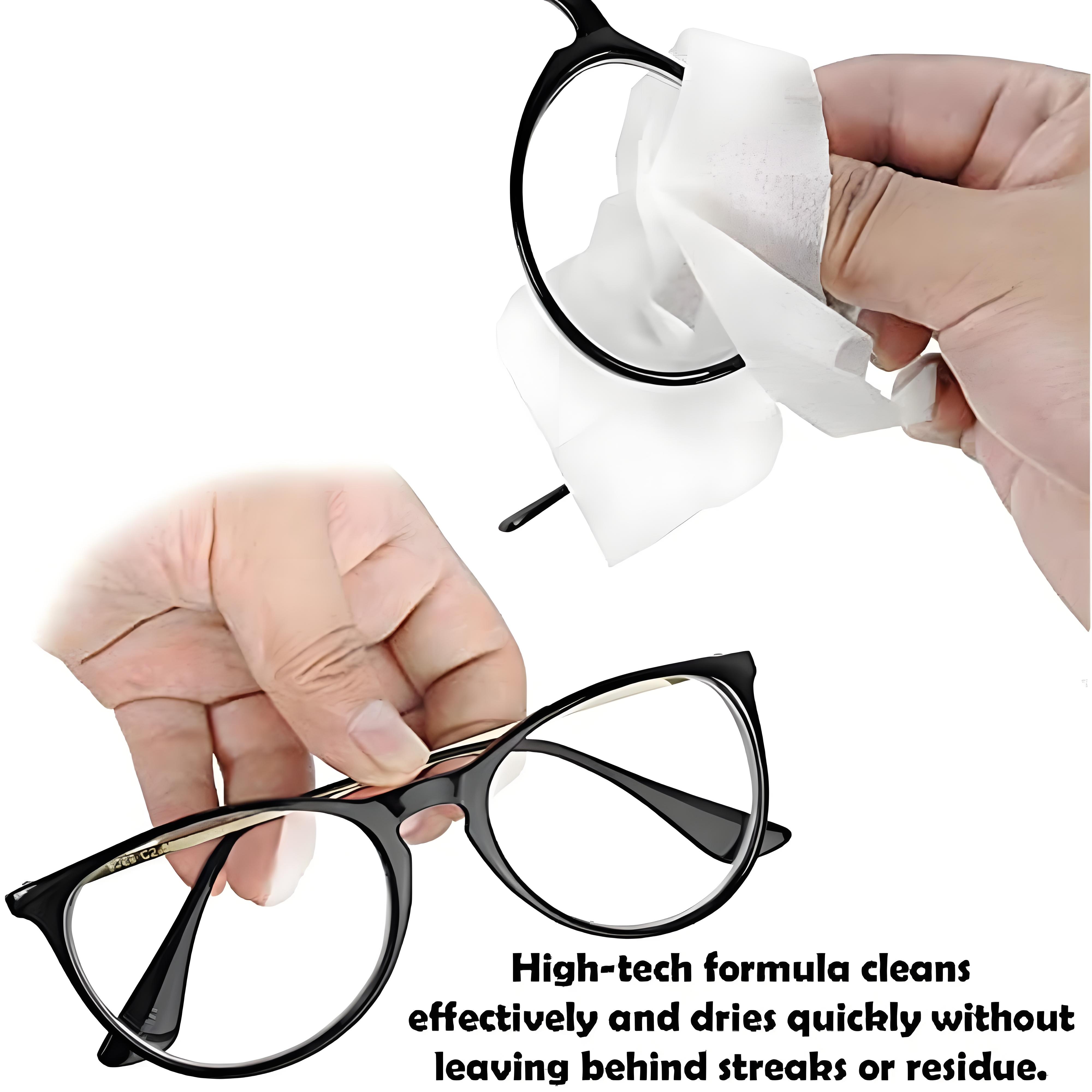
Anti-fog formulations are often briefed under one label, but lens care and vehicle glass are specified differently.
Two Specifications Built on One Shared Chemistry Platform
Both products are transparent liquids that combine surfactants, a polymer anti-condensation compound and purified water, and both state streak-free performance, a pH range of 6.0–7.5, an anti-fog duration of up to 24 hours and a 24-month shelf life. The divergence appears in the additive that stabilises or protects the formulation, and in what each specification is willing to claim about the surfaces it serves.
| Attribute | HUA-CG (automotive glass) | HUA-AW (optical lenses) |
|---|---|---|
| Stated function | Anti-fog and glass cleaning | Anti-fog and lens cleaning |
| Specified surfaces | Windshield, rearview mirror, side windows | Eyeglass lenses, goggles, camera lenses |
| Anti-fog agent | Polymer anti-condensation compound | Polymer anti-condensation compound |
| Solvent / base | Purified water | Purified water |
| Distinguishing additive | Corrosion inhibitor listed as stabiliser | Optical-grade preservative system |
| Alcohol-free formula | Not stated in the specification (neither confirmed nor excluded) | Stated as supported |
| Quick-drying formula | Stated as supported | Not stated in the specification |
| Streak-free performance | Stated as supported | Stated as supported |
| pH value | 6.0–7.5 | 6.0–7.5 |
| Anti-fog duration | Up to 24 hours | Up to 24 hours |
| Stated antibacterial rate | Not stated | Not stated |
| Shelf life | 24 months | 24 months |
Three readings follow from that table. First, the two products are variants of a shared platform rather than unrelated chemistries, so a buyer cannot assume that one is simply the "stronger" version of the other. Second, the attributes that separate them are functional additives and claims, not headline performance numbers. Third, the performance numbers a procurement team is most likely to quote in a tender — pH and anti-fog duration — are identical in both specifications, which means they cannot be used to decide between the two scenarios.
Substrate and Coating Decide More Than the Word "Anti-Fog"
Vehicle glass and optical lenses are different substrates before any liquid is applied. A windshield, a rearview mirror and a side window are large, rigid, externally mounted surfaces that a driver views through at distance, often in the presence of road spray, temperature differentials and interior humidity. Eyeglass lenses, goggles and camera lenses are small, frequently handled, and in the eyewear case sit a short distance from the eye and in repeated contact with skin, hair and clothing.
Eyewear also commonly carries functional coatings whose job is optical rather than protective, and that is where a generic anti-fog brief becomes risky. The supplied specifications do not state a coating-compatibility test result for either product, so the responsible procurement position is to treat coating compatibility as a question for the specific lens or glass assembly rather than as something the anti-fog claim settles. A liquid can be legitimately described as streak-free and still behave differently on a coated lens than on uncoated glass — the specification answers the first question and leaves the second to validation.
Alcohol Content and Residue Tolerance: The Screen Buyers Skip
HUA-AW is specified as alcohol-free, and that single attribute carries more procurement weight in the optical channel than any other line in its datasheet. Alcohol-free wipes liquid is the formulation profile optical buyers ask for when lens coatings, frames and frequent hand contact are part of the use case, and the specification states it explicitly rather than leaving it to inference. The automotive specification does not state alcohol-free status in either direction, which is a documentation gap a buyer should close in writing before assuming anything about solvent content.
Residue tolerance runs in the opposite direction. On a windshield, a visible film after wiping is a safety and appearance problem because the driver looks through the glass at road distance; that is why quick-drying and streak-free behaviour are named in the HUA-CG specification. On an eyeglass lens, residue is judged at reading distance and in contact with the face, so haze, tackiness or transfer to skin become the more sensitive failure modes. Two liquids can both claim streak-free performance and still be judged by different residue thresholds by the people who use them.
Where the Two Specifications Converge — and Why pH Is Not a Tiebreaker
Both products state a pH value of 6.0–7.5, an anti-fog duration of up to 24 hours, streak-free performance, a transparent appearance and a 24-month shelf life. For a procurement team building a scoring matrix, that overlap is informative rather than inconvenient: it shows that a pH band alone does not identify a scenario. A buyer who selects on pH and duration will shortlist both products equally and then have no documented basis for choosing between a windshield application and a lens application.
The stated anti-fog duration deserves a separate note. "Up to 24 hours" is a maximum, and the specification supplied here does not state the test method, substrate, humidity or temperature under which that maximum was established. That does not make the figure unreliable; it makes it unverifiable at the buyer's end until the supporting method is requested. The same caution applies to the shelf-life figure, which is a storage claim rather than an in-use performance claim.
Scenario Fit: Automotive Glass with HUA-CG
HUA-CG is specified for windshields, rearview mirrors and side windows, which is the correct scope boundary for an automotive anti-fog wipes liquid: interior and exterior glazing that a driver depends on for visibility. Its ingredient list names surfactants, a polymer anti-condensation compound, purified water and a corrosion inhibitor listed as the stabiliser, and its specification states quick-drying and streak-free performance.
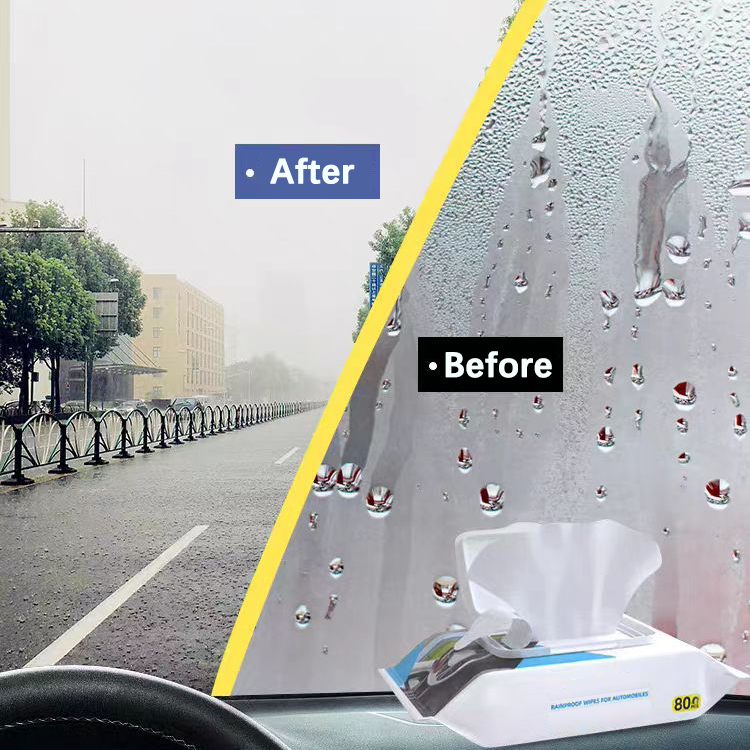
HUA-CG is specified for vehicle glazing, where quick-drying and streak-free behaviour are part of the claim set.
For a brand or procurement team, the practical reading is that the automotive specification is written around surfaces that are cleaned repeatedly, viewed at distance and surrounded by trim and interior materials. The presence of a corrosion inhibitor as the named stabiliser is a formulation distinction worth raising in technical review, but the specification does not state a corrosion-protection performance claim, and it should not be presented to end users as one. The relevant buyer action is to confirm compatibility with the specific glass, mirror housing and surrounding materials in the target vehicle programme, not to infer protection from an ingredient name.
Scenario Fit: Optical Lenses with HUA-AW
HUA-AW is specified for eyeglass lenses, goggles and camera lenses, with an alcohol-free formula, streak-free performance, a pH of 6.0–7.5, an anti-fog duration of up to 24 hours, an optical-grade preservative system and a 24-month shelf life. Its stated industry scope is the optical industry, personal care, sports equipment, supermarket retail and e-commerce retail — a distribution pattern that reflects how lens-care products actually reach buyers rather than a single industrial channel.
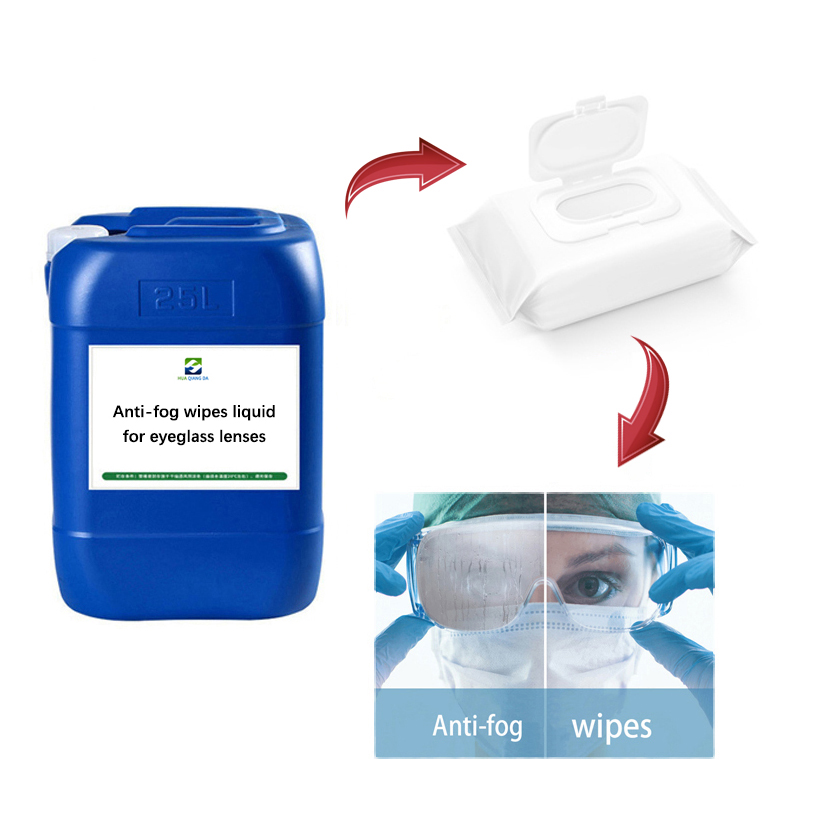
HUA-AW carries an alcohol-free specification and an optical-grade preservative system, aimed at lens-care channels.
The optical specification is narrower in surface scope and more specific in formulation language. Notably, it does not state quick-drying performance, and a buyer should not carry that expectation across from the automotive product simply because the two share a chemistry platform. Where a private-label programme wants a fast-drying lens wipe, that requirement belongs in the brief as a stated target, with the supplier confirming whether it can be met within an alcohol-free format.
What These Specifications Do Not Establish
Neither HUA-CG nor HUA-AW carries a stated antibacterial rate in the supplied specification. That matters because the broader wipes liquid portfolio does include formulations specified with antibacterial performance, and a buyer who needs a disinfecting or antibacterial claim should source a formulation documented for it rather than assume the anti-fog products inherit one. Substituting an anti-fog liquid into a brief that requires an antibacterial claim is a specification error, not a formulation preference.
Three further limits are worth recording in a procurement file. The specifications do not state an anti-fog test standard, so duration claims cannot be compared across suppliers without asking for the method. They do not state coating-compatibility results, which is the central open question for coated optical lenses. And they describe bulk liquids, not finished wipes, so nonwoven selection, add-on ratio and pack format remain separate variables that can change how the same liquid performs in the hands of the end user.
A Verification Sequence for Brand and Procurement Teams
Because the two products converge on the numbers buyers usually quote, differentiation has to be established through documentation rather than through a datasheet comparison. A workable sequence runs as follows.
- Define the substrate in writing. Name the surfaces — windshield, rearview mirror, side window, eyeglass lens, goggle, camera lens — and, for optical work, the coating type on the lens being specified.
- Fix the solvent position. If alcohol-free status is mandatory, confirm it in the technical document rather than assuming it from the category or from a sibling product's specification.
- Set the residue threshold in end-user terms. For automotive glazing, define acceptable haze and dry-down; for lenses, define acceptable film, tack and transfer to skin.
- Ask for the anti-fog duration method. Request the substrate, humidity, temperature and measurement behind the "up to 24 hours" figure so the claim can be quoted internally with its conditions attached.
- Run a substrate trial before committing a claim. Test the candidate liquid on the actual glass or lens assembly, including the coating, instead of extrapolating from a generic clear surface.
- Confirm commercial terms against the real brief. Company-stated terms such as an MOQ from 25 kg and lead times of 3–15 days should be re-confirmed for the specific formulation, pack size and destination rather than treated as fixed for every order.
- Check the quality documentation package. Incoming raw material inspection, microbiological testing, stability testing and third-party inspection form the evidence base a buyer can review before approving a batch programme.
This sequence does not replace a supplier's technical support; it makes the review auditable. A brand team that can point to a defined substrate, a documented solvent position, a method behind the duration claim and a completed substrate trial is in a materially better position than one that selected on pH and price.
Outlook: Buying by Scenario Rather Than by Label
Category-level research published by Fortune Business Insights in September 2026 estimated the global wet wipes market at USD 30.90 billion in 2025 — context for the scale of the liquid segment behind it, not evidence of demand for any particular formulation. The more useful signal for formulators sits one level down: as private-label ranges multiply, the difference between two products described as anti-fog wipes liquid is increasingly documentation, not description.
The analytical implication is that scenario fit becomes a sourcing discipline. Automotive buyers will keep pressing on drying speed, streak behaviour and material compatibility around the glazing; optical buyers will keep pressing on alcohol-free status, residue at reading distance and coating compatibility. A wet wipes liquid supplier that can answer both sets of questions with product-specific documents — rather than one generic anti-fog statement — is easier to qualify and easier to defend in a brand's own compliance file. Formulation support of that kind is part of the OEM and ODM work described in the company's technical materials, and it is where procurement teams should spend their review time.
For brand and procurement teams still at the research stage, the practical next step is narrow: take the two end uses apart, specify each one on its own substrate and residue terms, and request samples and documentation against those written requirements rather than against the category label.
Frequently Asked Questions
Can one anti-fog wipes liquid be used on both car glass and eyeglass lenses?
The two supplied specifications are built for different surfaces. HUA-CG is specified for windshields, rearview mirrors and side windows and states quick-drying and streak-free performance, with a corrosion inhibitor listed as its stabiliser. HUA-AW is specified for eyeglass lenses, goggles and camera lenses, states an alcohol-free formula and uses an optical-grade preservative system. Neither specification claims coverage of the other's surfaces, so a buyer should select per substrate and confirm compatibility with the specific glass or coated lens before use.
How long does the anti-fog effect last on HUA-CG and HUA-AW?
Both specifications state an anti-fog duration of up to 24 hours. That figure is a stated maximum, and the supplied specification does not identify the substrate, humidity, temperature or test method behind it. Buyers should request the supporting method before quoting the number in consumer-facing claims, and should treat actual duration as dependent on the conditions in which the wipe is used.
Why does alcohol-free status matter for optical lenses?
HUA-AW is specified as alcohol-free, which is the attribute optical buyers screen on when lens coatings, frames and frequent handling are part of the use case. The specification does not state a coating-compatibility test result, so alcohol-free status should be treated as one requirement rather than as proof of compatibility with every lens and coating. Compatibility with the specific lens assembly remains a validation step.
What is the corrosion inhibitor in HUA-CG for?
In the HUA-CG specification, the corrosion inhibitor is listed as the formulation's stabiliser, alongside surfactants, a polymer anti-condensation compound and purified water. The specification does not state a corrosion-protection performance claim, so the ingredient should not be presented to end users as a protection feature. Its relevance at the procurement stage is as a formulation difference from the optical product, and as a prompt to confirm compatibility with the surrounding materials in the target vehicle programme.
Do these two formulations make antibacterial claims?
No. Neither the HUA-CG nor the HUA-AW specification states an antibacterial rate. The wider wipes liquid portfolio includes formulations documented with antibacterial performance, but an anti-fog liquid should not be assumed to carry that claim. A buyer whose brief requires antibacterial or disinfecting performance should source a formulation that specifies it and should ask for the test method, active ingredient and applicable regulatory status for the target market.
Reference material: the company's product and capability brochure is available as a PDF download.
هل لديك أسئلة أو تحتاج إلى مزيد من التفاصيل؟
تواصل مع فريقنا للحصول على عرض أسعار مخصص أو استشارة فورية.
طلب عرض أسعار
املأ النموذج أدناه وسيتواصل معك فريقنا بعرض مقترح مخصص.
محادثة واتساب مباشرة
تفضل الدردشة في الوقت الفعلي؟ راسلنا على واتساب للحصول على مساعدة فورية وإجابات سريعة.
- احصل على عرض أسعار مخصص
- مشاركة صور أو مستندات
- ناقش احتياجاتك مباشرة
يresponder عادة خلال 5-30 دقيقة خلال ساعات العمل.