
Anti-Riot Suit vs Body Armor Plates: A Buyer Comparison
Anti-Riot Suit vs Body Armor Plates: A Buyer Comparison
A procurement team comparing an anti-riot suit with ballistic body armor plates is comparing two protection philosophies rather than two grades of the same product. The RIOT-HICUT riot control suit is built to absorb blunt impact, thrown objects and slashing during mobile public-order duty. Ballistic body armor plates are built to stop defined projectiles under a defined test standard. Neither substitutes for the other, and the choice turns on one question: which threat will the unit actually meet on deployment?
This comparison sets out the documented characteristics of the RIOT-HICUT suit, explains what a ballistic rating does and does not establish, and offers buyers a decision structure to apply before samples or quotations are requested. It does not rank the two systems, because the correct answer depends on mission profile rather than on product quality.
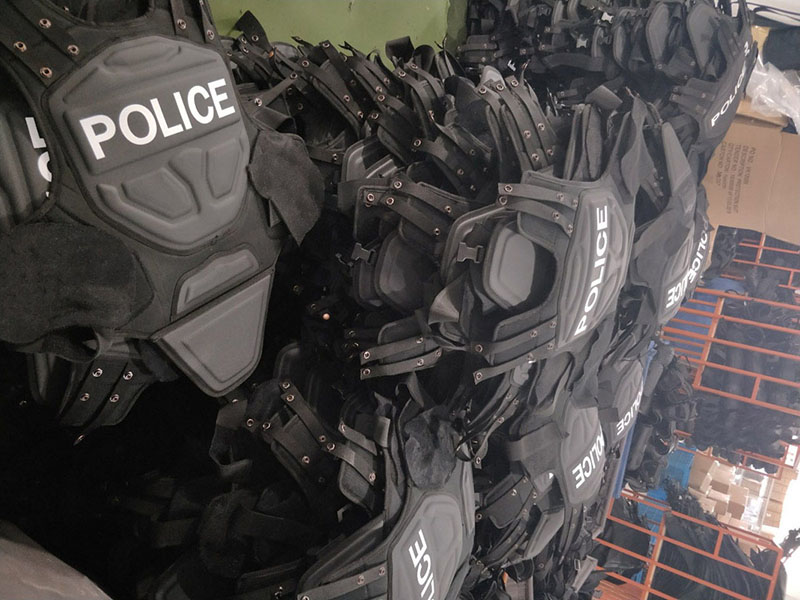
Two protection systems, two threat models
Anti-riot equipment and ballistic equipment are governed by different standards, tested against different impactors and projectiles, and worn for different reasons. Treating them as points on one scale is the root of most specification errors in this category.
The RIOT-HICUT belongs to the first group. Its protection target is the violent public-order environment: baton blows, thrown stones and bottles, crowd pressure, and contact with edged or pointed implements. Ballistic plates belong to the second: they are rated against named ammunition fired at a controlled velocity under a recognised standard, with a specified number of shots and specified conditioning before the test.
Because the test regimes differ, a number that looks comparable across the two usually is not. A riot-suit standard certifies nothing about firearms. A ballistic rating says nothing about a panel's ability to absorb a sustained blunt strike along its edge. A tender that mixes both languages produces a specification no single product can satisfy, and it invites suppliers to answer with whichever half of the requirement is easier to prove.
The RIOT-HICUT suit: coverage and mobility in one configuration
The RIOT-HICUT riot control suit is specified to BS7971 and weighs 9 kg in its stated configuration. Coverage extends across the chest, shoulders, forearms, thighs and shins, using an impact-resistant polycarbonate composite shell over an EVA liner, with buckle plus hook-and-loop adjustment.
Each of those details has a procurement consequence, and reading them separately is what turns a specification sheet into a buying decision.
The polycarbonate composite shell spreads a localised blow across a wider area before it reaches the body, which is the mechanism that matters against batons, clubs and thrown objects. The EVA liner sits between the shell and the wearer, managing contact pressure and absorbing secondary movement when the shell is struck. Read together, the two layers address the two halves of a blunt-impact event: the peak force at the contact point and the energy transferred into the wearer afterwards.
The coverage map follows exposure geometry. Chest and shoulder panels protect the trunk and the joints that a riot line presents to a crowd. Forearm protection matters because arms are raised in pushing, shielding and equipment handling, and are among the first areas to be struck. Thigh and shin panels cover the lower body during stepping, kneeling and ground contact. The configuration is therefore not a general-purpose body cover; it is a map of where a wearer inside a crowd is most likely to absorb impact.
The 9 kg figure should be read as a fit variable rather than a protection score. Weight sets how long the suit can be worn before fatigue changes posture, reaction time and decision quality. A heavier suit with excellent coverage can still be the wrong choice for a unit that must run, climb or hold a position for a full shift. Buyers should trial the stated configuration over the intended duty duration rather than infer performance from mass alone.
Buckle plus hook-and-loop adjustment serves a different purpose. Buckles provide a fast, repeatable primary closure that can be operated with gloves in poor light; hook-and-loop provides continuous micro-adjustment so the same suit fits over different uniform layers and can be re-tightened as the wearer moves. The combination supports the fast-response use case the RIOT-HICUT targets: donning quickly at a staging point, then staying mobile and properly fitted once deployed.
The boundary is equally clear. The suit is anti-riot equipment, not a ballistic product. Where firearm threats exist, certified ballistic protection has to be specified and worn as a separate system, and the fit of the two systems together must be checked rather than assumed.
Body armor plates: what the level on the label establishes
A ballistic plate's rating describes a tested configuration against a defined threat. It is not a general statement about the material, and it does not transfer to another model, another shape or another carrier.
The IIIA PE plate is the clearest illustration of why that distinction matters. Level IIIA is a handgun-oriented classification, and the plate must not be used for rifle protection based solely on that designation. Whether a particular plate can protect against rifle ammunition is a separate determination that depends on the model, its tested threat list and its official standard. A buyer who reads "IIIA" as "rifle-rated but lighter" has misread the label, and the error surfaces only in the field.
The same discipline applies further up the scale. A NIJ-0101.06 Level III alumina ceramic armor plate with an alumina ceramic strike face and UHMWPE backing is rated for the 7.62x51 NATO M80 rifle projectile; it should not be presented as capable of stopping all rifle ammunition, because protection is limited to the threats validated under the applicable standard and test conditions. Even a correctly rated plate can lose ballistic performance after heavy impact, piercing, chemical contamination, prolonged UV exposure or improper storage.
Hard armor also includes categories frequently confused with body plates: Level III PE ballistic shields and Level IV boron carbide ceramic armor plates. A shield protects the area behind it and forms part of a team tactic; a plate protects the torso area it covers. Neither is a substitute for the other, and neither replaces an anti-riot suit.
For procurement, the working rule is that standard, model and threat list must be read together. A certificate without the model reference, or a level without the tested projectile, cannot be evaluated or compared.
Side-by-side comparison on procurement dimensions
| Decision dimension | RIOT-HICUT riot control suit | Ballistic body armor plates |
|---|---|---|
| Primary threat | Blunt impact, thrown objects, crowd pressure, edged or pointed contact | Named firearm projectiles, defined by the plate's tested threat list |
| Governing standard | BS7971 | Model-specific; confirm the standard and version on the plate documentation |
| Stated weight | 9 kg | Varies by model and configuration; take the figure from the shipped configuration |
| Coverage | Chest, shoulders, forearms, thighs and shins | Torso area covered by the plate and carrier |
| Construction | Impact-resistant polycarbonate composite shell with EVA liner | Material and build stated by the plate model, for example PE or ceramic-faced configurations |
| Fit and adjustment | Buckle plus hook-and-loop adjustment | Carrier-dependent; check plate size, cut and carrier compatibility |
| Not designed for | Firearm projectiles | Sustained blunt impact and thrown-object protection across the whole body |
The most common procurement error: treating riot protection as ballistic protection
Anti-riot gear is not automatically bulletproof, and this is the most expensive assumption in the category. The same caution applies across the wider riot kit: the polycarbonate anti-riot shield, for instance, is intended mainly for blunt blows, thrown stones and debris, and is not a ballistic shield.
Two failure modes follow. The first is a unit deploying a full-body riot suit into an environment where firearms are present, on the assumption that more coverage means more protection. The second is a buyer ordering IIIA plates for a rifle threat because the designation sounded adequate. Both errors begin before the order, in a specification that named equipment instead of naming a threat.
A workable decision rule is to write the threat first and the product second. State the environment (public-order crowd, checkpoint, patrol, close protection), the most severe credible hazard, and the duty duration. Then ask which tested system addresses that hazard, and whether a second system needs to be carried for escalation. That sequence keeps anti-riot equipment and ballistic equipment in their proper categories, and it gives suppliers a requirement they can answer with evidence rather than with adjectives.
Matching the system to the mission
For mobile fast-response riot control, the RIOT-HICUT configuration is the closer fit. Its coverage set, impact-spreading shell and quick adjustment support officers who move through a crowd, absorb contact and reposition rather than holding a fixed line. The 9 kg stated weight is the trade-off that must be trialled against real duty duration.
For public-order formations built around shield work, the suit and the polycarbonate anti-riot shield play complementary roles. The shield handles forward coverage and impact deflection; the suit handles the body areas the shield does not cover. Neither provides ballistic protection, and treating a shield wall as ballistic cover is a misreading of both products.
For patrol or operations where firearm threats are credible, ballistic plates in a compatible carrier are the relevant system, selected against the tested threat list. A concealable IIIA vest serves a different purpose again: it is positioned for low visibility and handgun-threat protection in plain-clothes and close-protection work, cannot stop rifle rounds, and should not be used as an overt tactical or rifle-threat solution.
Where a unit may meet both blunt-impact and ballistic hazards within one deployment, the answer is not to stretch a single product beyond its standard. Anti-riot suits do not provide ballistic protection, and certified ballistic plates must be specified and worn as an additional system when that threat exists. The two must then be fitted and trialled together, because layering changes weight, heat load and mobility.
Verification steps before the order is placed
- Request the standard and its version for each item, and check that the certificate or test report names the exact model being purchased. A standard quoted without a model reference cannot be evaluated.
- For ballistic plates, ask for the tested threat list, including the projectile, and confirm that the intended threat falls inside it. A level alone is not a threat statement.
- For the RIOT-HICUT, confirm the shipped configuration weight and coverage set against the quotation, since duty duration and fit depend on the configuration actually delivered.
- Trial donning with gloves, in poor light, at the speed the deployment requires. Buckle plus hook-and-loop adjustment is only an advantage if it works under those conditions.
- Test wear duration, not just fit. Weight and heat accumulation show up after an hour, not after five minutes.
- Ask how damaged items are inspected and withdrawn from service, particularly for plates exposed to impact, contamination or prolonged sunlight.
- Confirm storage, cleaning and inspection instructions in writing, so the protection level at delivery is maintained through the service life.
Manufacturer context: Zhejiang Yingfu Protection Technology (YFARMOR)
Zhejiang Yingfu Protection Technology Co., Ltd, which trades as YFARMOR, is a manufacturer of ballistic protection and anti-riot equipment founded in 2003. The company operates a 23,000 square metre plant with 150 to 200 employees, an annual output of 200,000 units and an eight-engineer R&D team, and exports around 60% of production to the USA, Mexico, the EU, the Middle East and Africa. Its range covers ballistic helmets, ballistic plates, bulletproof vests, ballistic shields and the anti-riot series that includes anti-riot suits, riot helmets and riot shields.
On the evidence side, the company lists ISO 9001:2008 quality management certification, more than 200 CE certificates issued by Ricotest, Satra and TUV, and NIJ certifications verified by H.P. White and NTS, alongside SGS, CNAS and independent patent certificates. Ballistic products can be tested at a nearby standard shooting range. For buyers, the practical relevance is traceability: the anti-riot suit and the ballistic plate in this comparison sit in different certification streams, so the manufacturer should be able to supply the matching document for each, not a single generic certificate covering both.
Outlook: the questions that will shape the next tender
Any future revision of this comparison will depend on three inputs rather than on product marketing. The first is threat documentation: whether the buying authority can state the hazard it expects, which determines whether a riot suit, a ballistic plate system, or both are required. The second is model-level traceability, meaning whether each certificate can be tied to the exact item delivered. The third is wear-duration evidence, since a 9 kg suit and a plate carrier behave differently over a full shift, and that difference decides mobility in practice.
None of those inputs favours one system over the other in advance. They simply move the decision from a comparison of ratings to a comparison of tested fit, which is where procurement teams can actually verify what they are buying.
Frequently asked questions
Is an anti-riot suit bulletproof?
No. Anti-riot suits, including the RIOT-HICUT, are intended for blunt impact, collision, thrown objects and stab resistance, not for firearm projectiles. Where ballistic protection is required, certified ballistic plates must be specified and worn as an additional system, and the combined fit should be trialled before deployment.
Can a Level IIIA PE plate stop rifle rounds?
It must not be used for rifle protection based solely on a Level IIIA designation. Whether a specific plate can protect against rifle ammunition depends on its tested threats and official standard. The plate should be used only within the tested threats of the relevant model, inspected regularly, and withdrawn from service after damage, heavy impact or use beyond its tested range.
If a unit faces both blunt-impact and firearm threats, does one system cover both?
Not within this comparison. The RIOT-HICUT addresses blunt impact, thrown objects and slashing; ballistic plates address specific tested projectiles. The two are separate systems with separate standards, and a riot suit does not become ballistic protection because a plate is available elsewhere in the catalogue. Units facing both hazards should carry both, with a defined rule for when each is worn.
What documentation should a buyer check for a ballistic plate?
Check the standard and its version, the exact model and configuration, and the tested threat list, including the projectile. For example, a NIJ-0101.06 Level III alumina ceramic armor plate with an alumina ceramic strike face and UHMWPE backing is rated for the 7.62x51 NATO M80 projectile, and protection is limited to the threats validated under the applicable standard and test conditions rather than all rifle ammunition.
Does a heavier anti-riot suit provide better protection?
Weight is a fit variable, not a protection metric. The RIOT-HICUT is stated at 9 kg, and that figure determines how long the suit can be worn before fatigue affects posture and reaction time. Coverage, shell and liner construction, and adjustment system are the protection-relevant features; weight should be assessed against the intended duty duration through a wear trial.
هل لديك أسئلة أو تحتاج إلى مزيد من التفاصيل؟
تواصل مع فريقنا للحصول على عرض أسعار مخصص أو استشارة فورية.
طلب عرض أسعار
املأ النموذج أدناه وسيتواصل معك فريقنا بعرض مقترح مخصص.
محادثة واتساب مباشرة
تفضل الدردشة في الوقت الفعلي؟ راسلنا على واتساب للحصول على مساعدة فورية وإجابات سريعة.
- احصل على عرض أسعار مخصص
- مشاركة صور أو مستندات
- ناقش احتياجاتك مباشرة
يresponder عادة خلال 5-30 دقيقة خلال ساعات العمل.