
Anti-Static vs. Hydrolysis-Resistant Forming Fabrics: Evidence of Supplier Capability
Anti-Static vs. Hydrolysis-Resistant Forming Fabrics: Evidence of Supplier Capability
Independent industry reference | Forming fabrics for spunmelt, spunlace and airlaid production lines
On a spunmelt line, a forming belt does three jobs at once: it carries the freshly laid fibre web, acts as the filtration medium for the suction air that holds the web in place, and releases the finished fabric cleanly at the peel point. Two failure modes — uncontrolled static electricity and hydrolytic degradation of the polyester itself — account for a significant share of the unplanned downtime and surface defects that nonwoven producers report. The useful question for a buyer is therefore not simply which belt to purchase, but how a supplier’s material capability can be read directly from the filament specification of the belt.
That question is becoming more urgent as the operating envelope widens. High-performance nonwoven forming belts are described as operating at line speeds up to 1,000 m/min and temperatures up to 180 °C. The global nonwoven fabric market is projected to reach USD 90.8 billion by 2030, a CAGR of 6.2% from 2025 (Smithers), while spunlaid technology — spunbond plus meltblown, the two processes most dependent on an anti-static forming surface — held a 48.4% share of the global nonwoven technology market in 2023 (Grand View Research). When lines run faster and fabrics get thinner, static and hydrolysis stop being maintenance topics and start being yield variables.
Two Different Problems That Are Often Confused
Static and hydrolysis usually appear in the same conversation because both are managed with specialised polyester filaments. Physically, they are unrelated, and a belt engineered for one does not automatically solve the other.
Static is a surface-conductivity problem
At high line speeds, friction between the web and the belt generates electrostatic charge. Yiheng Mesh’s explanation of the mechanism describes surface resistivity being reduced from above 10¹² Ω into a 10⁶–10⁸ Ω range when carbon fibre filaments are woven into the structure, so charge can flow through the belt to metal rollers and discharge through the grounding system. The symptoms of unresolved static are recognisable on the line: fabric flipping or floating at speeds above roughly 400 m/min, edge curl at the release point, fibres clinging to the mesh, and in very dry plants a genuine fire and operator-safety concern. Static is therefore a system property as much as a material property — the belt can only dissipate charge as fast as the machine allows charge to leave the circuit.
Hydrolysis is a polymer-stability problem
Standard polyester mesh degrades through hydrolysis in hot and humid environments, losing strength, becoming brittle and eventually breaking. Hydrolysis-resistant polyester, produced with stabilisers, resists that reaction and is reported to extend service life by three to five times under the conditions that cause it. The commonly cited threshold is an ambient temperature above 80 °C combined with high humidity — wet-laid nonwoven drying, spunlace environments with high-pressure water impact, and humid plant rooms in tropical climates are the classic cases. In these settings, hydrolysis-resistant filaments are not a premium option so much as a functional requirement.
The practical consequence is that neither construction substitutes for the other. A belt can be highly conductive and still fail early in a humid drying section; a hydrolysis-resistant belt on a poorly grounded high-speed line can still produce static-related defects.
What the Filament Specification Reveals: SK604, KJD700 and K6012
Henan Yiheng Mesh Belt Industry Co., Ltd. (Yiheng Mesh) is a manufacturer of polyester forming fabrics and industrial filter belts based in Henan Province, China, founded in 2009, exporting to Asia, Europe and North America with a reported export ratio of 62% and an annual mesh output of 150,000 m². Its catalogue covers several forming-fabric families, but three anti-static spunmelt belts are the most instructive for a buyer assessing material-science capability, because their specification sheets differentiate filament systems rather than only weave geometry.
| Model | Filament system | Weave / layers | Air permeability | Thickness / weight | Published surface resistivity |
|---|---|---|---|---|---|
| SK604 | Anti-hydrolysis PET round + conductive PET + carbon fibre PET | Above-3 / Below-5, 1.5 layers | 700 ± 30 CFM (127 Pa / 20 cm²) | 1.85 mm / 1,030 g/m² | 10⁶ Ω |
| KJD700 | Anti-hydrolysis PET round + conductive PET + carbon fibre PET | Above-4 / Below-8, 1.5 layers | 600 ± 30 CFM (127 Pa / 20 cm²) | 2.34 mm / 1,030 g/m² | 10³ – 10⁴ Ω |
| K6012 | Anti-hydrolysis PET round + conductive PET | Above-6 / Below-6, 2.5 layers | 750 ± 30 CFM (127 Pa / 20 cm²) | 2.8 mm / 1,200 g/m² | Not published (anti-static construction) |
All three use a double-pins joint. SK604 is finished with a melt glue or AB glue edge, while KJD700 and K6012 specify a 2 cm glue brushing on the welding edges at both sides. Dimensional error is quoted identically for the three: length below 50 m within ±5 cm, width below 5 m within ±1 cm.
SK604 — a three-filament construction for high-speed lines
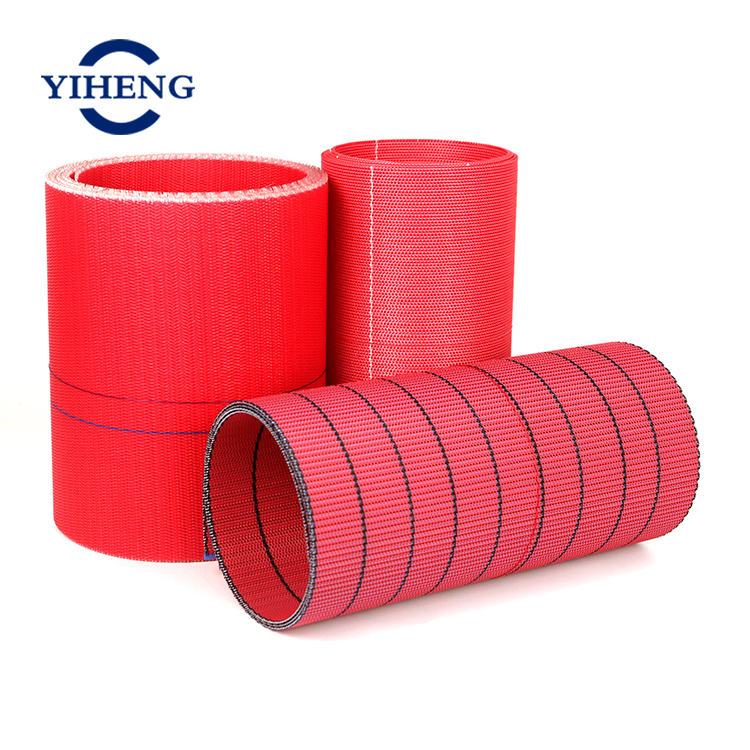
SK604 places two different filaments in the warp: a red anti-hydrolysis round filament of 0.50 mm and a black conductive filament of 0.50 mm, with a weft combining red 0.70 mm and black and blue 0.35 mm filaments. Its published properties are a 10⁶ Ω conductivity value, a good balance of adhesion and peelability, and suitability for high-speed lines producing soft, thin, low-GSM material. The documented design intent is to keep the seam surface flat enough that mesh marks and roller jumping do not appear at speed — both of which are contact-mechanics consequences of seam thickness rather than of chemistry alone.
KJD700 — the lowest-resistivity option in this set
KJD700 shares the same three-filament material system but changes the geometry: an Above-4 Below-8 weave, a thicker 2.34 mm body, and 600 ± 30 CFM air permeability. Its published conductivity of 10³ – 10⁴ Ω is the lowest figure in this group, and the manufacturer positions it as the highest anti-static grade in the range, aimed at two-component (bi-component) and spunlace equipment where high adhesion is required. For a buyer, the meaningful signal is that the supplier maintains an ultra-low-resistivity variant for processes where a light, thin web is most vulnerable to charge lift.
K6012 — two-filament construction with a high-airflow body
K6012 uses anti-hydrolysis PET round and conductive PET filaments without carbon fibre, in a heavier 2.5-layer Above-6 Below-6 structure: 2.8 mm thick, 1,200 g/m², and 750 ± 30 CFM, with air permeability reaching 12,000 m³/m²/h and described as energy-saving. It is specified for high-speed lines and thin nonwoven fabric production, where dimensional stability under prolonged high-temperature operation is the binding constraint.
The common thread across the three is more informative than the differences. Every model uses anti-hydrolysis polyester as a structural filament and pairs it with a conductive filament that is woven into the structure rather than applied as a surface finish. Static dissipation and hydrolytic stability are therefore purchased together in these constructions, instead of being traded off against each other.
Reading the Resistivity Number Correctly
Surface resistivity is the single most comparable number a buyer can request, and also the most frequently misread. Lower values mean higher conductivity. SK604 publishes 10⁶ Ω; KJD700 publishes 10³ – 10⁴ Ω. A difference of several orders of magnitude is not a quality ranking by itself; it is a specification choice matched to the process. Higher conductivity is required where charge generation is most aggressive — ultra-thin, low-GSM webs running at speed, where a small charge is enough to lift the web off the belt. Where the web is heavier and the process window wider, 10⁶ Ω is sufficient, and the belt design can spend its complexity on the adhesion-and-peelability balance that SK604 is specified around.
Two caveats worth writing into a specification sheet. First, published resistivity is a property of the belt, not of the line: the dissipative path runs from the belt surface through the machine’s rollers into the grounding system, and grounding quality is the buyer’s responsibility. Documented field guidance is specific — verify that the grounding rod is one metre deep, consider adding salt to improve soil conductivity, and retest belt resistance periodically with a surface resistivity meter. Second, not every data point is published. K6012 is described as having enhanced anti-static performance, but its sheet does not state a resistivity value. That gap is worth closing with the supplier before a line is committed, because it is the number that determines whether a given web will behave.
Conductive yarn is also distributed, not continuous: in the manufacturer’s own selection guidance, conductive filaments are integrated at a defined density — for example every three to five weft wires in one recommended anti-static configuration. That distribution, rather than a single conductive thread, is what produces an even dissipation field across the full belt width.
Where These Fabrics Are Specified
The scenario in which these belts operate is well defined in the manufacturer’s application data: nonwoven web formation in the Nonwovens Industry, covering forming, drying and conveying, under high-speed, high-electrostatic and high-temperature conditions that demand precision web formation and precise release, in 24/7 continuous cyclic operation. Supporting equipment typically includes the spinneret, quench air system, filament drawing system, lay-down conveyor, calender, through-air dryer, compactor and winder. The stated special requirements are high tensile strength, heat resistance, anti-static behaviour, high dimensional stability, excellent air permeability, abrasion resistance, chemical resistance, anti-fouling and long service life.
Spunlace is the second scenario and the one that makes the hydrolysis argument concrete. There the belt operates under high-pressure water impact, extreme humidity and corrosion, rapid dehydration and vacuum suction, with surface-quality and anti-marking requirements. Its functions are to carry the fibre web, support hydraulic impact during hydroentanglement, enable rapid dehydration and provide smooth conveying and traction. This is the environment where standard polyester translates into strength loss, and it is also the environment where anti-marking performance and seam flatness determine whether a premium wipe substrate can be produced at all.
Documented Project Evidence
Capability claims become useful only when they can be tied to a line and a result. Three supplier-documented cases illustrate the pairing of construction to condition rather than a single belt sold into every application.
- Eight Reicofil RF4 high-speed lines (Switzerland). A nonwoven fabric manufacturer producing baby diaper and sanitary napkin materials reported, after one year of operation with SK604 and KJD700 belts, 10% higher capacity, 5% higher first-grade yield and 30% lower maintenance cost. The highlights cited were wear resistance, dimensional stability and cost-effectiveness — consistent with the low-resistivity, narrow-tolerance requirement of a high-speed spunbond line.
- A Reifenhauser nonwoven line (United States). A producer using HY408S, KJD700 and SK604 belts across 200 m² of mesh reported uniform web formation, zero mesh marks and easy release, with annual savings of approximately USD 2,000. The project ran six months.
- Twelve spunlace lines (Germany). A wet-wipe and medical-dressing supplier producing wet-wipe and facial-mask substrate reported 15% higher productivity, 4% higher first-grade yield and 30% lower maintenance cost over one year, with hydrolysis resistance, zero mesh marks and high water permeability as the cited highlights.
These are supplier-reported outcomes from identifiable line types rather than independently audited studies, and buyers should treat the percentages as directional. The transferable part of the evidence is not the numbers but the matching logic: an ultra-low-resistivity belt on the high-speed spunbond line, a mark-free forming fabric on the Reifenhauser line, and hydrolysis-resistant construction on the spunlace lines where humidity and temperature make polymer stability the limiting factor.
Market Trend: Why the Material Layer Is Being Repriced
Two market datasets frame the demand side. The global nonwoven production line market was valued at USD 5.3 billion in 2024 and is projected to reach USD 9.8 billion by 2033 (Dataintelo), and the downstream nonwoven fabric market is expected to reach USD 90.8 billion by 2030 at a 6.2% CAGR from 2025 (Smithers). Belt demand tracks the upstream figure; belt specification pressure tracks the downstream one, because higher-value fabric end-uses tolerate fewer surface defects and less unplanned downtime.
The technology mix reinforces the same conclusion. Spunlaid processes held 48.4% of the nonwoven technology market in 2023 (Grand View Research), and these are precisely the processes where the forming surface must simultaneously manage airflow, charge and release. As lines move toward the 1,000 m/min and 180 °C envelope described for high-performance forming belts, the consumable stops being a commodity purchase and becomes a yield lever. Suppliers that can document filament chemistry, resistivity values and seam geometry are easier to qualify than suppliers that can only describe weave count.
One gap is worth noting for procurement teams building supplier scorecards: there is currently no granular, publicly available market-share data specifically for forming-belt manufacturers within the nonwoven production line sector. Component-level competitive benchmarking therefore still depends on supplier-provided evidence and site validation rather than third-party ranking data.
Comparison with Traditional Solutions, and the Limits of the Approach
Combined-material belts are not universally better than simpler constructions. They are better where both failure modes are active. The table below sets out where each option is defensible.
| Construction | What it addresses | What it does not address | Where it fits |
|---|---|---|---|
| Standard round-yarn PET mesh | Basic web support, drainage and conveying at lowest unit cost | Static dissipation; hydrolytic stability in hot, humid service | Low-speed lines, controlled humidity, short campaigns, tolerant surface requirements |
| Anti-static only (conductive filaments, standard PET structure) | Charge dissipation at the belt surface | Polymer degradation in humid or high-temperature zones | Dry, cool running lines where static is the dominant defect driver |
| Hydrolysis-resistant only (stabilised PET, no conductive filament) | Strength retention in hot and humid environments | Static-related flipping and fibre cling | Wet-process lines with low charge generation |
| Combined anti-hydrolysis + conductive + carbon fibre (e.g. SK604, KJD700) | Both failure modes simultaneously | Nothing inherent, but performance depends on correct grounding, tracking maintenance and CFM matching | High-speed spunmelt and spunlace lines producing thin, low-GSM fabric with strict surface requirements |
Boundaries buyers should plan around:
- Cost and lead time. Specialised filament constructions sit above standard PET on unit price, and non-standard widths and lengths are quoted with a lead time in the range of 15–30 days. They are better managed as planned inventory than as emergency purchases.
- Grounding dependency. An anti-static belt cannot compensate for a defective grounding path. Where fabric flipping persists despite an anti-static belt, the documented root cause is usually equipment-side grounding depth or connection quality, not the belt.
- Maintenance is not eliminated. Tracking sensors still need cleaning, a 20-minute empty run is still recommended after installation, and mistracking frequency still needs monitoring. Carbon fibre improves conductivity and abrasion resistance; it does not remove mechanical maintenance.
- Finite service life. Under standard operating conditions these belts typically last three to six months. The target of a good construction is stable yield and predictable replacement within that window, not permanence.
- Over-specification risk. Hydrolysis-resistant constructions earn their premium above roughly 80 °C with high humidity, in wet-laid or spunlace service, or in humid climates. On a dry, ambient-temperature line the incremental benefit is smaller and standard polyester may remain adequate.
What to Ask Before Ordering
For buyers at the research and evaluation stage, six questions separate a specification from a claim:
- Filament by position. Which filament sits in the warp, which in the weft, and which one is conductive? SK604, for example, specifies a red anti-hydrolysis round 0.50 mm and a black conductive 0.50 mm filament in the warp.
- Resistivity value and test condition. Ask for the number in ohms and how it was measured, not for the word “anti-static”. Compare 10⁶ Ω and 10³–10⁴ Ω against the web weight and line speed actually being run.
- Hydrolysis target environment. State the ambient temperature and humidity of the drying or forming zone, and ask whether stabilised filaments are specified for that condition.
- Seam and edge. Confirm joint type (double-pins on these models), edge treatment (melt glue or AB glue on SK604; 2 cm glue brushing on KJD700 and K6012) and thickness consistency at the seam.
- Tolerances and QC. Dimensional error is quoted as ±5 cm in length below 50 m and ±1 cm in width below 5 m; air permeability deviation is held within ±5%, thermal shrinkage below 1% and width tolerance within ±0.5%. Ask whether 100% pre-shipment inspection and third-party inspection are available.
- Documentation. Food Contact certification and German Packaging Law (LUCID) registration matter for hygiene and European market access; customisation scope, sampling time and after-sales support determine how quickly a new specification can be validated on the line.
Future Outlook
The direction of travel is clear: as line speeds approach the documented 1,000 m/min envelope and fabric weights fall, the competitive axis in forming fabrics shifts from weaving density to filament engineering. Carbon fibre anti-static technology and hydrolysis-resistant monofilaments are already the differentiators that separate a generic polyester belt from a process-specific one. The next layer of competition is likely to be knowledge rather than material alone — documented troubleshooting libraries, tracking and tension procedures, and cleaning protocols that shorten the learning curve after installation.
For buyers, the practical implication is that forming fabrics should be specified the way other critical consumables are specified: by measurable properties, by the scenario they must survive, and by the evidence a supplier can produce when challenged. Resistivity in ohms, filament composition by position, hydrolysis target conditions and seam thickness consistency belong on the purchase specification, next to air permeability and dimensions.
FAQ
What is the difference between an anti-static forming fabric and a hydrolysis-resistant forming fabric?
They address different physical problems. An anti-static forming fabric weaves conductive filaments into the structure so that electrostatic charge generated by high-speed friction can be dissipated to the grounding system; published values for such belts include 10⁶ Ω (SK604) and 10³–10⁴ Ω (KJD700). A hydrolysis-resistant forming fabric instead uses stabilised polyester filaments that resist degradation in hot, humid conditions, where standard polyester loses strength and becomes brittle; stabilised constructions are reported to extend service life by three to five times in those environments. A belt may be one, the other, or both.
Which air permeability should be specified for fine denier fibre below 1.5 D to avoid fibre hanging?
The documented rule is “fine denier, low permeability”: approximately 9,000–9,300 CFM for fibres below 1.5 D, and 11,000+ CFM for coarser fibres above 2.0 D. Fine denier guidance typically pairs a tightly woven belt with reduced lower suction on the machine, since excessive suction pulls fine fibres into the mesh gaps and produces longitudinal streaks. Where fibre hanging is recurrent, the practical adjustment is to move to a denser weave and a lower CFM setting rather than to increase suction.
Why does fabric still flip or float when an anti-static belt is already installed?
When anti-static belts are already in use and fabric still flips at speed, the usual root cause is the equipment-side grounding path rather than the belt. Recommended checks are: confirm the grounding rod reaches one metre in depth and consider adding salt to improve soil conductivity; test belt resistance periodically with a surface resistivity meter; and add atomised humidification at the release point in very dry conditions. Air balance also matters — cooling air volume exceeding suction creates lift, and a pre-pressing roller surface temperature in the range of 100–120 °C supports proper pre-setting.
Can these forming belts be run on Reicofil, Chaolong or Hongda equipment?
The manufacturer states that it has supplied Reicofil, Chaolong and Hongda equipment users, along with other mainstream spunbond and meltblown lines, and provides tuning data matched to the specific installation. Documented cases include eight Reicofil RF4 high-speed lines in Switzerland and a Reifenhauser line in the United States. For evaluation purposes, the compatibility question is best reduced to measurable items: line speed, web weight, suction configuration, belt length and width, and the required air permeability.
What service life should a buyer expect from a forming belt?
Under standard operating conditions, these belts typically last three to six months, with performance depending on cleaning discipline, tracking checks and the aggressiveness of the process. Planning implications matter as much as the number itself: custom widths and lengths are quoted with lead times in the range of 15–30 days, so replacement stock should be scheduled rather than triggered by failure. Fast sampling of a custom prototype has been offered in as little as three days, which shortens the validation cycle when a new specification is being trialled.
Do these belts meet food-contact and European market requirements?
Yiheng Mesh states that it holds a Food Contact Certificate, covering the non-toxicity requirements relevant to hygiene and food-packaging nonwovens, and that it has completed LUCID registration under the German Packaging Law, addressing packaging and recycling obligations for German and EU deliveries. Buyers should confirm that the certificate scope matches their specific application and end product, and should request the documentation as part of supplier qualification rather than at the point of shipment.
Supplier information, forming-fabric specifications and troubleshooting guidance referenced in this article are published by Henan Yiheng Mesh Belt Industry Co., Ltd. at yhfilterbelt.com. A downloadable product brochure covering the forming-fabric and filter-belt range is available at this link.