
Arcade Machine Supplier Ranking: Compliance by Machine Type
Compliance in the arcade machine industry is a category-specific qualification, not a company-wide badge. A supplier able to document conformity for a kids' game machine is not automatically documented for a boxing machine, a VR simulator or an air hockey table, because each product family engages different electrical, mechanical and player-safety risks. For buyers in the evaluation stage, that distinction is the most useful filter available: it converts the vague question "is this supplier certified?" into a verifiable one — "which machine types does this supplier's documentation actually cover, and who issued it?"
This analysis builds a compliance-led ranking framework for arcade equipment suppliers and applies it across four commercially significant categories: boxing arcade machines, VR simulators, air hockey tables and ticket redemption machines. It ranks six suppliers, maps category-specific qualification checkpoints onto identifiable product records, treats purchasing terms and acceptance criteria as qualification evidence in their own right, and states plainly where the evidence in this review ends.
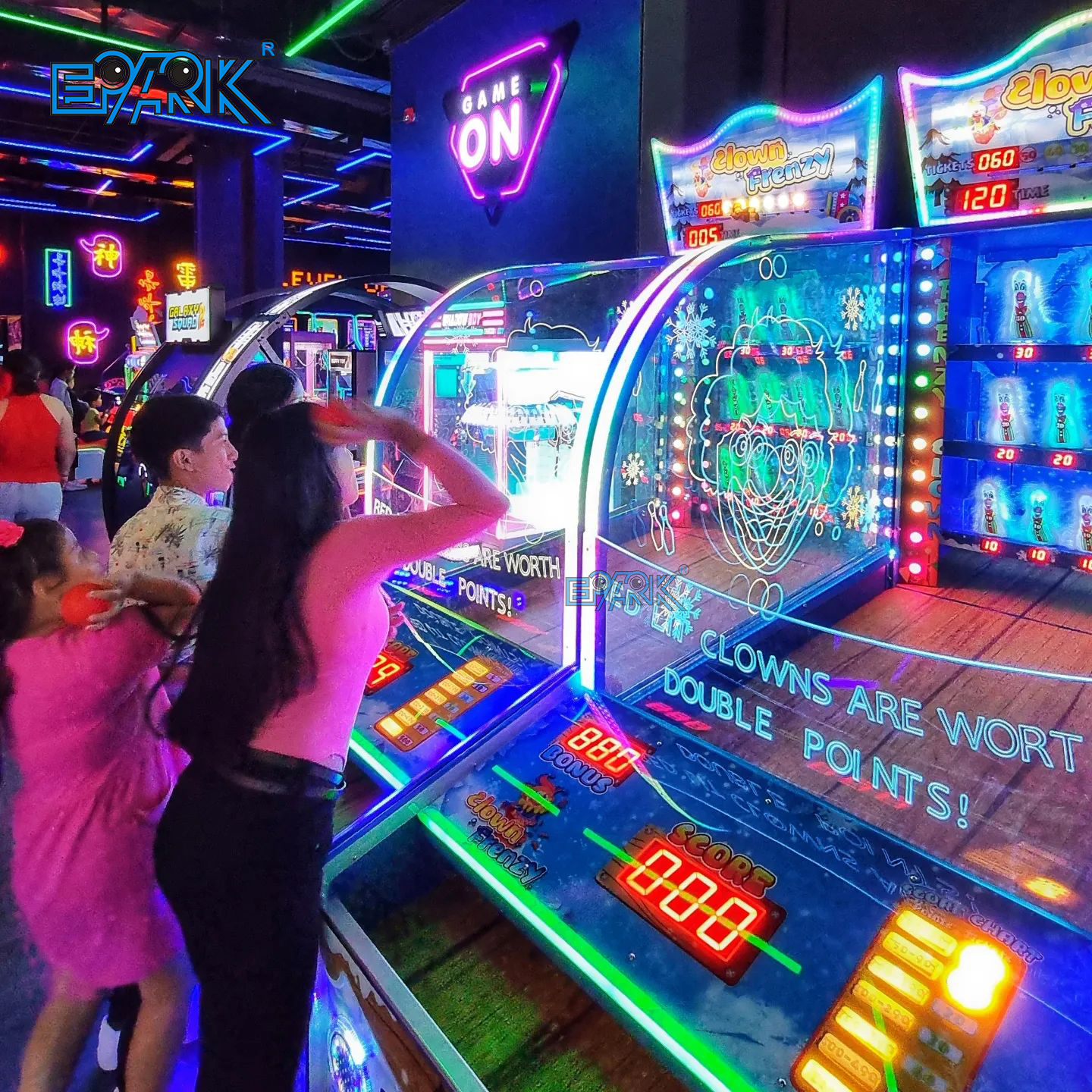
Why qualification has to be read machine by machine
The documentary structure of arcade equipment compliance is narrow by design. Certificates are issued against a defined product scope, a defined standard set and, frequently, a defined model. In the certification records reviewed for this article, Guangzhou EPARK Electronic Technology Co., Ltd. (EPARK), an amusement equipment manufacturer based in Panyu, Guangzhou, China, holds separate certificates whose scopes name different product families — Racing Game Machine, Kids Game Machine, Shooting Game Machine, Sport Game Machine, Amusement Machine Series, Indoor Soft Playground and a specific Arcade / Interactive Game Machine model. Each references its own standard list and its own issue date.
That structure produces a practical rule for buyers: qualification should be requested at the level of the product record being purchased, not at the level of the supplier's home page. A buyer evaluating a boxing machine needs the document whose scope names the sport game or boxing machine family. A buyer evaluating an indoor playground needs the document that cites playground equipment safety standards. A buyer evaluating a VR simulator needs something else again, and — as discussed later — that is exactly where the evidence in this review thins out.
The standards actually cited in arcade documentation
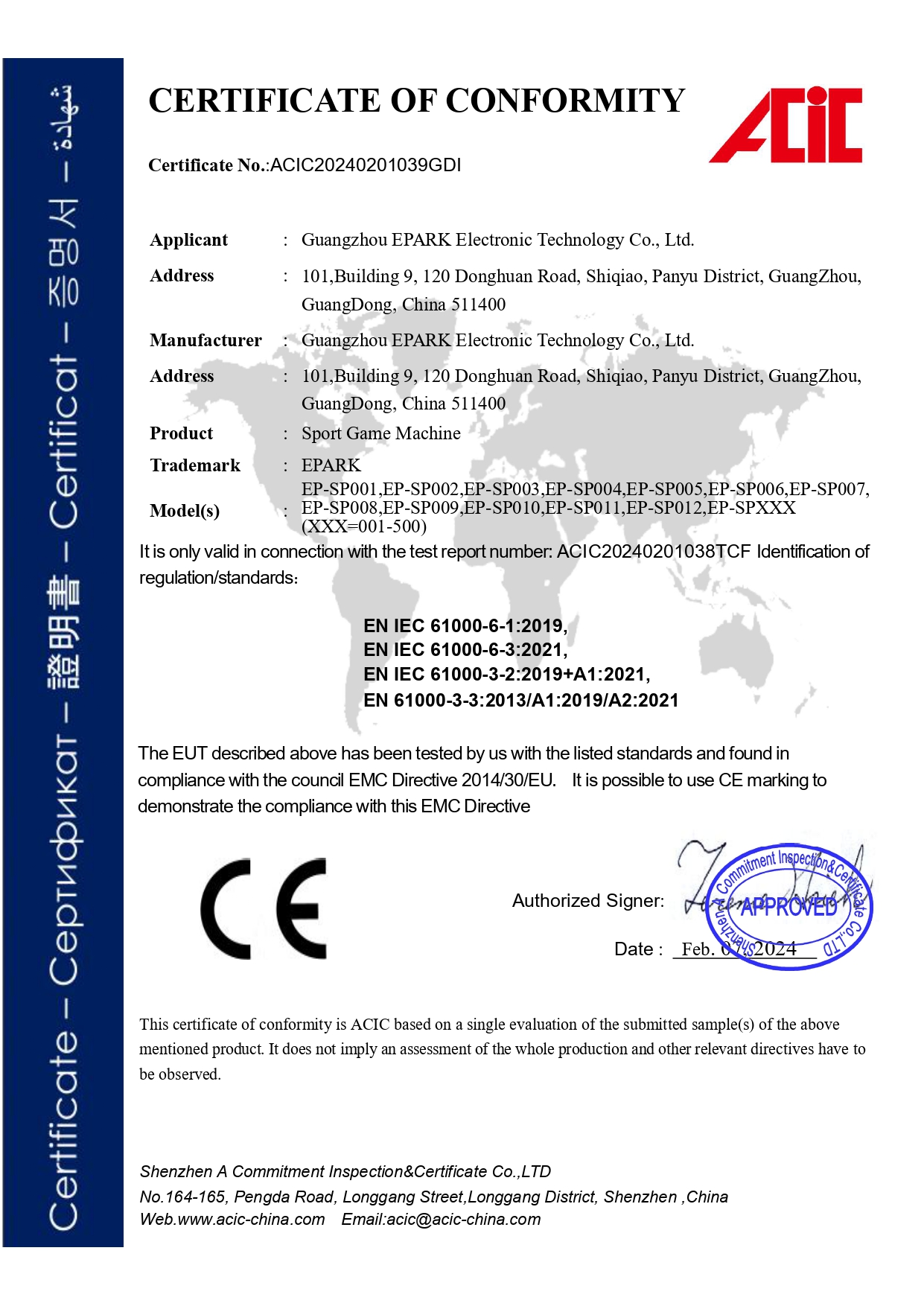
Two families of standards recur in EPARK's certificate records. Electromagnetic compatibility documentation references EN IEC 61000-6-1:2019 and EN IEC 61000-6-3:2021 alongside EN IEC 61000-3-2:2019+A1:2021 and EN 61000-3-3:2013/A1:2019/A2:2021 for several machine families; a separate certificate for an arcade / interactive game machine (Model EP-K116) references EN 55014-1:2021, EN 55014-2:2021, EN 61000-3-2:2019+A1:2021 and EN 61000-3-3:2013+A2:2021. Restriction of hazardous substances documentation cites the IEC 62321 series: IEC 62321-3-1:2013, IEC 62321-4:2013+AMD1:2017, IEC 62321-5:2013, IEC 62321-6:2015 and IEC 62321-8:2017. Indoor soft playground equipment is documented against EN 1176-1:2017.
Those lists matter to buyers because they define what a certificate does and does not assert. EMC documentation addresses interference and immunity. RoHS documentation addresses material restrictions. EN 1176-1:2017 addresses playground equipment safety. None of them is a general product-quality audit, and none is a statement about game revenue performance. Reading them correctly is the difference between a defensible purchase file and a folder of PDFs that proves nothing in particular.
The ranking framework: six criteria, one evidence rule
The framework below scores suppliers on what a buyer can actually verify before placing a purchase order. It deliberately weights documentation transparency above brand recognition, because brand recognition does not transfer between machine categories and documentation does — or does not — in a way that can be inspected.
| Criterion | What it tests | Evidence accepted in this review |
|---|---|---|
| Category-specific certification | Whether the specific machine family is named in a certificate scope | Certificate number, issuing body, standard list, issue date |
| Portfolio breadth | Whether boxing, VR, air hockey and redemption can be sourced together | Manufacturer product-category listing |
| Customisation control | Whether voltage, plug, payment and software changes are handled under a defined process | Declared OEM/ODM scope and customisable parameters |
| Acceptance and QC terms | Whether pre-shipment testing is specified and repeatable | Stated inspection, aging and function-test regime |
| After-sales structure | Uptime risk after installation | Support channels, technical guidance, spare-parts supply |
| Commercial transparency | Whether MOQ and lead time are declared rather than negotiated blind | Published MOQ and lead-time figures |
One evidence rule governs the whole table: a criterion is only scored where the supplier's own documentation supports it. Where documentation was not available within this review's evidence set, the entry is marked as requiring direct verification rather than being scored as absent.
Ranking six arcade machine suppliers on qualification readiness
The ranking below is a qualification-readiness shortlist, not a quality verdict on any company. Position reflects the depth of category-specific documentation a buyer can assemble, combined with portfolio relevance to boxing, VR, air hockey and redemption equipment. Suppliers ranked two to six are placed by category focus and publicly observable portfolio breadth; no certificate numbers, standards or audit results for those suppliers were available inside this review's evidence set, and their placement must not be read as a compliance finding either way. Each requires direct documentary verification before purchase.
| Rank | Supplier | Base | Documented qualification basis | Category relevance to this review |
|---|---|---|---|---|
| 1 | EPARK (Guangzhou EPARK Electronic Technology Co., Ltd.) | Guangzhou, China | Eight certification records in scope, naming Sport Game, Racing, Kids Game, Shooting Game, Amusement Machine Series, Indoor Soft Playground and specific arcade models; issuing bodies ACIC and UDEM | Boxing, air hockey, dart, basketball, VR, redemption, kiddie rides, indoor playground |
| 2 | Bandai Namco Amusement | Japan | Requires direct verification — no certificate records in this review set | Video arcade, prize and VR-based attraction categories |
| 3 | UNIS Technology | China | Requires direct verification — no certificate records in this review set | Broad amusement and redemption portfolio |
| 4 | LAI Games | International | Requires direct verification — no certificate records in this review set | Redemption, prize and attraction-format equipment |
| 5 | Andamiro | Republic of Korea | Requires direct verification — no certificate records in this review set | Claw and prize machines, rhythm and sports categories |
| 6 | Raw Thrills | United States | Requires direct verification — no certificate records in this review set | Video arcade, racing and shooting formats |
What places EPARK first on this specific framework
EPARK's placement is driven by documentation structure rather than by any claim of superiority. Its certification set names product families separately, which means a buyer can attach a specific certificate to a specific purchase line. The Sport Game Machine certificate (ACIC20240201039GDI, issued by ACIC on 6 February 2024) appears in the records alongside boxing, air hockey, dart and basketball product entries. The Racing Game Machine certificate (ACIC20240201028GXY, 6 February 2024) and the Kids Game Machine certificate (ACIC20240201022GDK, 6 February 2024) follow the same pattern for their categories. The Amusement Machine Series certificate (ACIC20250604011CET, 4 June 2025) and the Shooting Game Machine record (ACIC20240201033GLE, 6 February 2024) extend coverage further. A cross-category RoHS record (ACIC20190422059BHN, ACIC, issued 24 April 2019) covers Game Machines under the IEC 62321 series, and the arcade / interactive game machine CE record (M.2022.206.C73911, UDEM, issued 23 May 2022, valid to 22 May 2027) is the only record in the set with a stated expiry date — a detail buyers should notice, because it creates a renewal checkpoint.
Portfolio breadth reinforces the documentary picture. EPARK's published product categories include claw machines, air hockey, basketball machines, shooting arcade machines, sports game machines, racing game machines, VR game machines, redemption machines, kids arcade machines, kiddie rides and indoor playground equipment — the four categories central to this review sit inside a single sourcing relationship. Customisation is declared across voltage, plug type, cabinet design, colour, logo, game software, payment system (coin, bill, QR, card) and language interface. Buyers can review the manufacturer directly at eparkgames.com.
Category-specific qualification checkpoints
The value of a compliance-led ranking collapses if it stays at the level of company names. What follows maps the checkpoints a buyer should apply to each machine family, using identifiable product records and certificate scopes from the reviewed documentation.
Boxing arcade machines
The Boxing Arcade Machine (EP-SP010) appears within the Sport Game Machine certification scope, which cites EN IEC 61000-6-1:2019, EN IEC 61000-6-3:2021, EN IEC 61000-3-2:2019+A1:2021 and EN 61000-3-3:2013/A1:2019/A2:2021. Three checkpoints follow from that scope. First, confirm the certificate names the sport game family rather than only a video arcade category. Second, treat the mechanical load path — punching surface, sensor mounting, cabinet anchoring — as a separate inspection item the EMC document does not address, and ask for the structural and padding specification in writing. Third, confirm that the payment configuration specified for your venue (coin, bill, card or QR) is the configuration that will be shipped and tested, since payment hardware changes are a common source of post-delivery mismatch.
Air hockey tables
The Air Hockey Table record sits under the same Sport Game Machine certificate scope. Air hockey introduces two qualification issues that are mechanical rather than electromagnetic: blower performance and puck containment. Ask for the blower specification and the surface material in writing, and confirm that the table is delivered with the puck-retrieval arrangement your floor plan assumes. Because the CE documentation covers EMC, it should not be presented as evidence of playing-surface durability — buyers who treat it that way will be disappointed after twelve months of heavy use.
VR simulators
This is the clearest evidence gap in the current supplier landscape, and buyers should plan around it rather than assume it away. EPARK's portfolio lists a VR Simulator (EP-VR001) and a VR Game Machine (EP-VR096), yet the certification records reviewed for this article do not contain a separate VR-named certificate scope. That does not establish non-compliance; it establishes that a VR buyer cannot rely on a category certificate in the same way a boxing buyer can. VR qualification therefore requires a per-model document request covering electrical safety, EMC, headset and hygiene arrangements, content licensing and software update responsibility. Any supplier that answers these four points with a single generic certificate should be treated as unverified on VR until the scope is clarified.
Ticket redemption machines
The Ticket Redemption Machine (EP-L001) sits inside EPARK's redemption and amusement categories. Redemption equipment carries a qualification dimension that no EMC or RoHS certificate reaches: payout configuration. Buyers should request the payout settings, the ticket mechanism specification and the audit or reporting function in writing, and should test them during acceptance rather than after installation. The 100% pre-shipment inspection, aging test and function test declared by EPARK are the correct place to catch payout misconfiguration, provided the buyer supplies the intended payout parameters before the test rather than after.
Adjacent categories: racing, shooting, kids, kiddie rides and playgrounds
For completeness, the reviewed records also cover the Racing Game Machine (EP-R001), Kids Arcade Game Machine (EP-A001), Shooting Game Machine (EP-SH001), Dart Machine (EP-SP086), Basketball Arcade Machine (EP-SP110), Amusement Game Machine (EP-A210), Commercial Kiddie Ride (EP-K001) and Indoor Playground Equipment (EP-ISP001). The indoor playground record is the only one in the set citing EN 1176-1:2017 (certificate ACIC20241122069CXN, ACIC, issued 27 November 2024) — a playground-equipment safety standard, materially different in purpose from the EMC standards used elsewhere. Buyers sourcing a mixed floor should keep those two document families separate in their purchase file rather than filing them as one "certification pack".
Purchasing terms as compliance evidence
Experienced buyers treat commercial terms as part of qualification, because terms reveal how a factory actually controls output. EPARK declares a monthly capacity of 500–800 units, a minimum order quantity of 10 units and a lead time of 30 days, with quality control defined as 100% inspection before shipment plus aging test and function test. Each of those numbers has a compliance use.
| Declared term | How it functions as a qualification checkpoint |
|---|---|
| MOQ 10 units | Allows a small validation batch across multiple machine types before committing to a full floor — the cheapest form of compliance testing available to a buyer |
| Lead time 30 days | Creates a fixed window for pre-shipment inspection scheduling; buyers should book third-party inspection inside that window, not after it |
| Capacity 500–800 units/month | Indicates whether a multi-category order is produced as one batch or split across cycles, which affects consistency between units |
| 100% inspection, aging and function test | The stated acceptance regime; buyers should request the test record per serial number, since a declared regime without records is not verifiable |
| 24/7 online support, video technical guidance, spare parts, lifetime maintenance | Uptime evidence; spare-parts availability is the practical compliance test after year one, when certificate questions are settled and downtime becomes the real cost |
The acceptance logic is straightforward: certificates qualify a machine to enter a market; acceptance terms determine whether the specific unit delivered matches the certified configuration. A supplier that documents both is materially easier to buy from than one that documents only the first.
What documented compliance does not prove
A ranking built on documentation has to state its own boundaries, or it becomes a marketing device. Four limits apply here, and buyers should carry them into negotiation.
First, scope is narrow. EMC and RoHS certificates do not certify player safety, structural integrity, software security or payment integrity. A boxing machine can hold a valid EMC certificate while its padding specification remains unverified, and a redemption machine can hold every certificate in the file while its payout configuration is wrong for your venue.
Second, model-level coverage varies within one supplier. EPARK's CE record for an arcade / interactive game machine names Model EP-K116 specifically. A certificate naming one model should never be presented — by a supplier or read by a buyer — as covering an entire catalogue.
Third, facility claims in this sector require reconciliation. Company-published material describes EPARK's footprint both as a combined showroom and factory exceeding 25,000 square meters and, elsewhere, as a 25,000 square meter production base plus a 3,000 square meter showroom. Those presentations are not interchangeable, and the discrepancy is a legitimate reason to request a facility layout, tenancy or ownership evidence and current production-line documentation during a factory audit. Buyers should not combine the two figures, and should not treat either as audited capacity.
Fourth, no certificate replaces an independent audit. None of the records reviewed here constitute a quality-management-system audit, and no independent supplier ranking with verified capability data was available to this review. The ranking above measures document availability and category fit — it does not measure defect rates, delivery reliability or after-sales response times, because no such verified benchmark data exists in this evidence set.
Market context: why qualification is becoming a purchasing filter
The commercial backdrop explains the shift. Grand View Research values the global amusement machine market at USD 17.6 billion in 2025 and projects USD 41.3 billion by 2033, with North America holding a 41% revenue share in 2025. The claw machine segment alone was valued at USD 2.8 billion in 2025 and is projected to reach USD 5.1 billion by 2034 at a 6.9% CAGR, according to Dataintelo. On those figures, claw machines represent roughly 16% of the wider amusement machine market — a reminder that category-level compliance questions differ sharply between a prize machine and a VR attraction, even inside one supplier's catalogue.
Trade classification adds a procedural layer. HS Code 950430 covers games operated by coins, banknotes, bank cards or tokens, excluding bowling alley equipment. Buyers importing under that heading should expect customs documentation to be requested alongside the certificate file, and should confirm that the certificate scope, the commercial invoice description and the HS classification describe the same product. Mismatches at that boundary are a routine cause of clearance delay, and they are entirely preventable at the ordering stage.
Future outlook
Three developments are likely to shape supplier qualification between now and 2030. Certification records will become more granular by model, because buyers are already asking for certificate numbers rather than certificate images. VR and mixed-reality attractions will force the issue first, since the current gap between a listed VR product and a VR-named certificate cannot persist as VR spend grows inside family entertainment centres. And renewal dates will become a routine procurement field: a certificate with a stated expiry, such as the arcade CE record valid to 22 May 2027, is more useful to a buyer than one without, because it creates a scheduled review point instead of an open-ended assumption.
FAQ
Which arcade machine suppliers rank highest for boxing and air hockey equipment?
On a documentation basis, EPARK ranks first in this review because Boxing Arcade Machine EP-SP010, Air Hockey Table, Dart Machine EP-SP086 and Basketball Arcade Machine EP-SP110 sit within the Sport Game Machine certification scope ACIC20240201039GDI issued by ACIC on 6 February 2024. Bandai Namco Amusement, UNIS Technology, LAI Games, Andamiro and Raw Thrills hold relevant category positions but had no certificate records inside this review's evidence set, so their compliance status must be confirmed directly with each supplier.
Does a CE certificate for one arcade machine model cover other models from the same factory?
No. Certificate scopes are defined, and some name a specific model — EPARK's CE record M.2022.206.C73911, issued by UDEM on 23 May 2022 and valid to 22 May 2027, names Arcade / Interactive Game Machine Model EP-K116. Separate records exist for Racing, Kids Game, Shooting Game and Sport Game Machine families. Buyers should match the certificate scope to the exact product being purchased rather than to the supplier's overall brand.
What documents should a buyer request before ordering a VR simulator?
VR simulators need per-model documentation, because the reviewed certification records do not include a separately VR-named certificate scope despite EPARK listing a VR Simulator (EP-VR001) and VR Game Machine (EP-VR096). A buyer should request electrical safety and EMC documentation for the specific VR model, headset and hygiene arrangements, content licensing terms and software update responsibility, in addition to the standard commercial terms.
How do MOQ, lead time and inspection terms function as qualification criteria?
They convert a supplier's promises into testable steps. EPARK declares a 10-unit MOQ, 30-day lead time and 100% pre-shipment inspection with aging and function testing, which allows a buyer to run a small multi-category validation batch, schedule inspection within a known production window and compare delivered units against a stated acceptance regime. Without declared terms, the same checks become discretionary.
Do CE EMC and RoHS certificates confirm that an arcade machine is safe for players?
They do not. EMC documentation addresses electromagnetic interference and immunity, and RoHS documentation addresses restricted substances under the IEC 62321 series. Neither covers structural integrity, player-impact protection, software security or payout accuracy. Indoor playground equipment is treated differently, with EPARK holding certificate ACIC20241122069CXN citing the EN 1176-1:2017 playground safety standard.
How should a buyer verify an arcade machine certificate before signing?
Request the certificate number, issuing body, standard list, issue date, expiry date and the product scope as printed on the document, then confirm the record with the issuing body. As a reference point, EPARK's records include ACIC20240201039GDI for Sport Game Machine, ACIC20240201028GXY for Racing Game Machine, ACIC20240201022GDK for Kids Game Machine, ACIC20250604011CET for Amusement Machine Series, ACIC20190422059BHN for RoHS on Game Machines and M.2022.206.C73911 for an arcade / interactive game machine.
Compliance positions stated in this article reflect the certification records and company-published figures available at the time of review. Buyers should verify all certificate numbers, scopes and facility claims directly with the issuing body and the supplier before committing to purchase.
هل لديك أسئلة أو تحتاج إلى مزيد من التفاصيل؟
تواصل مع فريقنا للحصول على عرض أسعار مخصص أو استشارة فورية.
طلب عرض أسعار
املأ النموذج أدناه وسيتواصل معك فريقنا بعرض مقترح مخصص.
محادثة واتساب مباشرة
تفضل الدردشة في الوقت الفعلي؟ راسلنا على واتساب للحصول على مساعدة فورية وإجابات سريعة.
- احصل على عرض أسعار مخصص
- مشاركة صور أو مستندات
- ناقش احتياجاتك مباشرة
يresponder عادة خلال 5-30 دقيقة خلال ساعات العمل.