
Arch Wires, Pliers and Auxiliaries: A 2026 Orthodontic Buyer Framework
A fixed-appliance case is supplied by three product families that succeed or fail together: arch wires that store and deliver force, pliers and hand instruments that shape and cut it, and auxiliaries that anchor, redirect and transfer it. In 2026, the practical procurement question is no longer which single item to buy, but whether the three families have been selected against the same clinical and inventory logic. This framework sets out how a distributor, clinic buyer or group purchasing team can compare them on published, checkable criteria rather than on brand impressions.
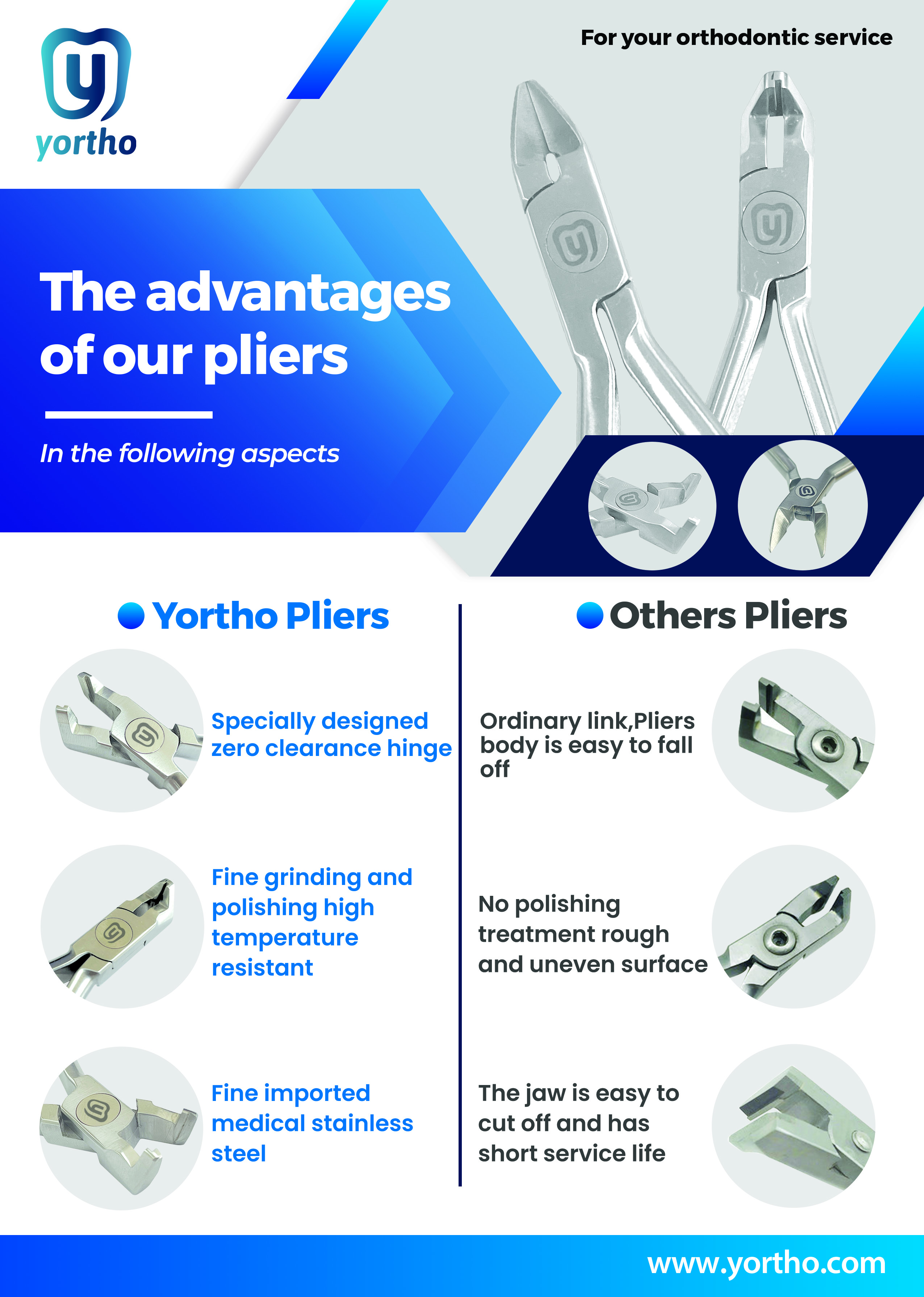
Pliers and hand instruments sit between the wire and the finished mechanics: they determine whether the chosen arch wire can actually be placed, shaped and trimmed as intended.
Yortho is an orthodontic device brand belonging to YAM Global Limited in the United Kingdom, which operates its own manufacturing facility in Huzhou, Zhejiang Province, China. The company states that it develops and manufactures across three segments, orthodontic supplies, pediatric dental products and dental laboratory appliances, that its products are exported to more than 70 countries, and that OEM and ODM services are available. That product spread is what makes a cross-category buyer framework useful in the first place.
Why the three categories must be compared as one system
The compatibility points between arch wires, instruments and auxiliaries are mechanical, not commercial. Slot size runs through brackets, buccal tubes and crimpable hooks, and the same brand may publish slot sizes of 18 and 22 across several categories. Arch wires are published with round and rectangular cross-sections, upper and lower arch types, and sizes from 0.012 in. to 0.020 in. Pliers are published with hardness bands and a maximum sterilization temperature. When these three sets of numbers are bought independently, the mismatch usually surfaces chairside, in the form of a hook that does not seat, a wire that is awkward to insert, or an instrument that is pushed outside its stated duty.
A second, quieter layer of compatibility is the appliance system. Roth, MBT and Edge-wise appear across brackets, buccal tubes and molar bands, and buccal tubes are further split into low-torque and high-torque variants. Once a practice or a distribution catalogue standardizes on one system family, the wire inventory, the attachment inventory and the instrument set all inherit that decision. This is the reason a comparison framework should start from system and slot, and only then move to individual product choices.
The force-delivery layer: arch wires
Four published arch wire ranges cover the material and size spread a fixed-appliance catalogue normally needs. All four are published as available in upper and lower arch types, and all four are published in round and rectangular cross-sections.
| Model | Type | Material | Published sizes | Published arch forms |
|---|---|---|---|---|
| Y-SS | Stainless Steel Arch Wire | Stainless steel | 0.012 in., 0.014 in., 0.016 in., 0.018 in., 0.020 in. | Square, Natural, Damon, Oval, Europa-I, Broad |
| Y-SN | Super-elastic NiTi | NiTi | 0.012 in. to 0.020 in. | Square, Natural, Damon, Oval, Europa-I, Broad |
| Y-HN | Heat-activated NiTi | NiTi | 0.012 in. to 0.020 in. | Square, Natural, Damon, Oval, Europa-I, Broad |
| Y-TMA | TMA Round Arch Wires | Titanium-molybdenum alloy | 0.012 in., 0.014 in., 0.016 in., 0.018 in. | Natural, Damon, Oval |
Read as a buyer, the table gives three usable signals. First, the stainless and NiTi ranges share the same six arch forms, which means a catalogue can standardize arch-form tooling across the two highest-volume alloys. Second, the TMA range is published with three arch forms and a narrower size ceiling, so it will not cover every prescription that the stainless and NiTi lines cover; that is a genuine range boundary, not a minor packaging detail. Third, alloy choice is a stage-of-treatment decision rather than a price decision, and industry reference material consistently describes NiTi as preferred for shape memory and super-elasticity, while stainless steel remains the most widely used material for arch wires and brackets globally.
The shaping layer: pliers and hand instruments
Yortho publishes eleven plier models with hardness values and a shared maximum sterilization temperature of 180 degrees Celsius, all in stainless steel. The hardness values fall into three bands, and the bands map onto duty rather than onto price.
| Model | Type | Hardness (HRC) | Max sterilization |
|---|---|---|---|
| Y-Q8001 | Light wire cutter, 0 degrees | 58-63 | 180 C |
| Y-Q8005 | Distal end cutter | 58-63 | 180 C |
| Y-Q8008 | Heavy cutter | 58-63 | 180 C |
| Y-Q3001 | Hole punch pliers | 58-63 | 180 C |
| Y-Q3002 | Tear drop pliers | 58-63 | 180 C |
| Y-Q5005 | Band remover, long tips | 58-63 | 180 C |
| Y-Q6018 | Tweed loop pliers | 55-60 | 180 C |
| Y-Q6030 | Light wire pliers | 55-60 | 180 C |
| Y-Q6015 | Kim pliers | 50-55 | 180 C |
| Y-Q6026 | Crimpable hook pliers | 50-55 | 180 C |
| Y-Q5001 | Bracket removing pliers | 50-55 | 180 C |
The three hardness bands do different jobs in a comparison. Cutting and punching tools are published at the highest band, 58-63 HRC, which is where edge retention matters most in a reusable instrument. Loop-forming and light wire pliers sit in the middle band at 55-60 HRC, and accessories such as Kim pliers, crimpable hook pliers and bracket removing pliers sit at 50-55 HRC. A procurement list that buys only the highest-hardness instrument, on the assumption that harder is always better, will end up with the wrong tool for loop forming and for attachment crimping.
A sterilization boundary many catalogues obscure
The plier range states a maximum sterilization temperature of 180 C. The bracket positioning gauges and tweezers in the same instrument family are published as autoclavable up to 134 C. Both figures are correct for their own items, and together they define an operational rule: a single universal autoclave cycle chosen for the pliers may exceed the published limit of the tweezers if that cycle is run above 134 C. Instrument sets should therefore be planned and reprocessed per published item rating, not per brand. This is exactly the kind of constraint that separates a real buyer framework from a product brochure.
Hand instruments beyond pliers complete the same layer: bracket positioning gauges published as double-ended at 0.022 in. and 2.0-5.0 mm, a crossed gauge, lingual bracket tweezers with a curved tip, a bracket tweezer, tube tweezers with a long tip for posterior brackets and buccal tubes, a Mathieu needle holder without hard tip, intra-oral mirrors published in large, small, occlusion and lateral types, and an orthodontic implant screw published at 1.4 mm diameter and 6 mm length in titanium alloy. For a distribution catalogue, these items determine whether a clinic can actually work with the wires and pliers it buys.
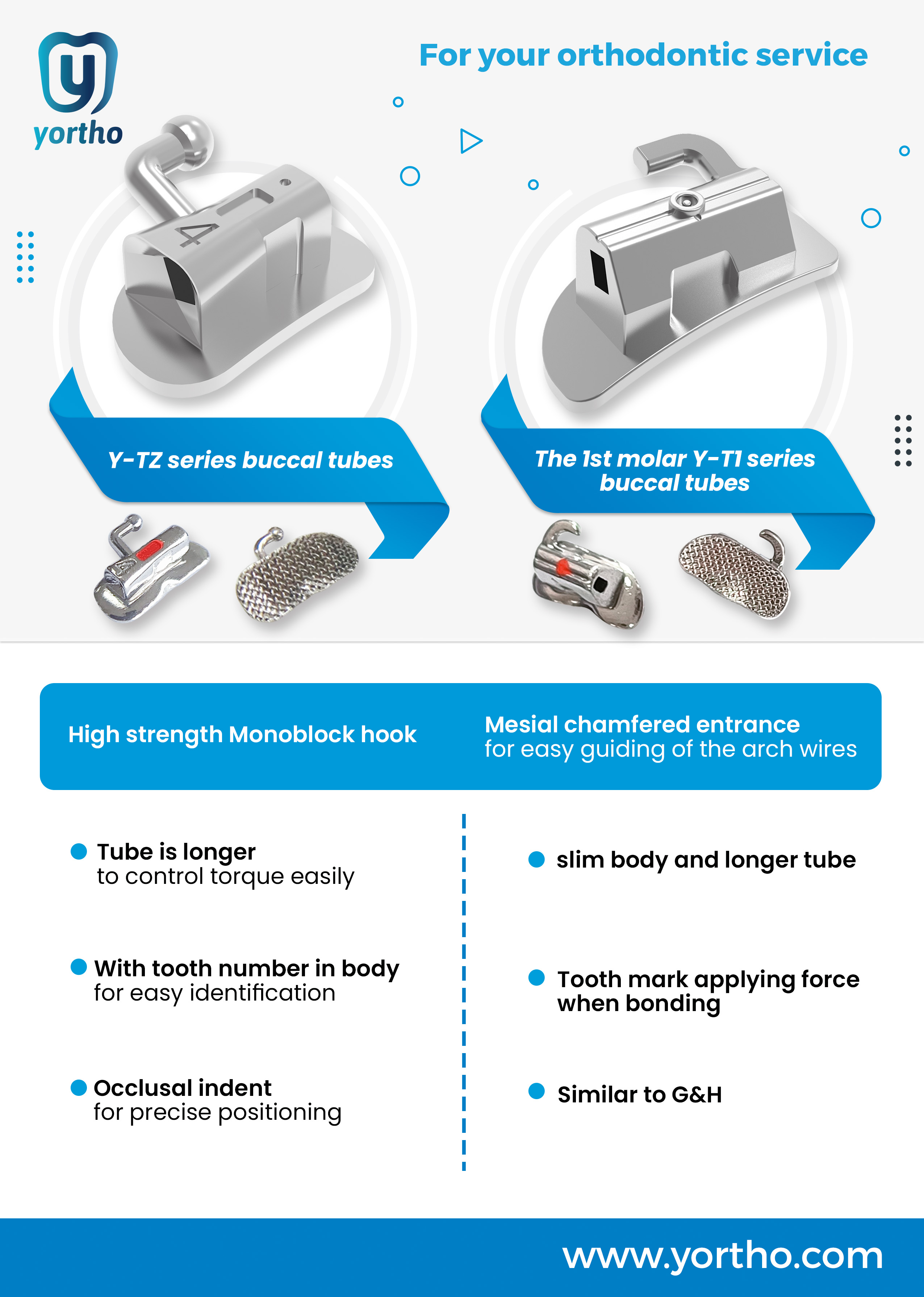
Buccal tube design is one of the fixed points where wire selection and attachment selection meet: the tube is the entry point for the arch wire into the posterior segment.
The attachment layer: auxiliaries
Auxiliaries are the category buyers most often treat as low-value consumables, and the category where slot-size mismatches are most common. The published range shows why size discipline matters.
| Model | Type | Published key spec | Material |
|---|---|---|---|
| Y-F105L / Y-F105R | Spiral crimpable hooks, left and right | 0.022 in., 8.7 mm | Stainless steel |
| Y-F102 | Crimpable hook | 0.022 in., medium 2.4 mm | Stainless steel |
| Y-F201 | Crimpable hooks | 0.022 in., 2.4 mm | Stainless steel |
| Y-F204 | Mini round tube stop | 0.019 in. | Stainless steel |
| Y-F303 | Bondable lingual buttons | Round, 80# mesh base | Stainless steel |
| Y-F305C | Ceramic bondable lingual buttons | Round base | Ceramic |
| Y-F307 | Bondable lingual eyelet | Round base | Stainless steel |
| Y-F308 | Bondable lingual eyelet traction hook | Round base | Stainless steel |
| Y-F322 | Lingual buttons | Round base with hole | Stainless steel |
| Y-F314 | Lingual chain | Sliver type | Stainless steel |
| Y-F321 | Power arm | Round shape | Stainless steel |
| Y-S80101 | Power chains | Open long, closed continuous, open short; 1 roll per pack | High-elasticity polymers |
| Y-S80201 | Elastic ligatures | Normal and ring clear; 40 pcs per bag and 10 pcs per bag | High-elasticity polymers |
Two distinct attachment logics appear here. Crimpable hooks and the mini round tube stop are wire-mounted, published at 0.022 in. and 0.019 in. respectively, and they travel with the arch wire. Lingual buttons, eyelets and the lingual eyelet traction hook are bonded, and their bonding surface is part of the specification, with the stainless button published on an 80# mesh base and a ceramic variant published for cases where a metal button is not the preferred aesthetic choice. Lingual chain and power arm are traction components, while power chains and elastic ligatures are the polymer consumables that drive replacement intervals.
Compatibility rules that decide whether the three families work together
- Slot and wire size alignment. Crimpable hooks are published at 0.022 in., and the mini round tube stop at 0.019 in. A buyer ordering 0.018 in. slot appliances and 0.022 in. hooks into the same kit has created a predictable chairside problem. Index the attachment line by slot size before ordering.
- System and torque alignment. Buccal tubes, molar bands and brackets are published across Roth, MBT and Edge-wise, with low-torque and high-torque variants. Torque selection is a clinical prescription, so the attachment catalogue must be able to mirror whatever system the prescribing clinician uses.
- Design details that affect insertion. Yortho documentation describes its buccal tubes with a chamfered triangular mesial inlet intended to ease arch wire insertion, and an occlusal indent plus tooth marking intended to limit bonding deviation. Those are design features a buyer can verify physically on a sample, which is why sampling is part of the framework rather than an optional extra.
- Instrument-to-attachment match. The existence of a dedicated crimpable hook plier, published at 50-55 HRC, is itself a procurement signal: crimping is treated as a distinct operation with a distinct tool rather than as a generic plier task.
- Consumable versus reusable split. Elastic ligatures and power chains are single-use polymer items, while pliers and hand instruments are reusable and reprocessed per product instructions. Mixing the two in a single ordering and stocking rule is the most common inventory-planning error in this category.
Inventory planning: turning a comparison into a stock policy
A comparison framework only pays for itself if it changes what is stocked and how deeply. Five published data points make that translation concrete.
Lead time. For standard products, Yortho states that it maintains regular inventory in its warehouse and can pack and dispatch an order within 3 business days after payment confirmation. For a distributor, that means standard wire, plier and auxiliary lines can be treated as replenishment items rather than as project items.
Minimum order quantity. Yortho purchasing terms publish a minimum of 50 pcs for standard items, alongside a formal-order threshold described in the company FAQ as USD 1,000 in total value, with a first trial order supported without an MOQ requirement. Because these statements describe different order types, buyers should confirm which rule applies to their specific basket rather than assume the lowest figure applies universally.
Customization thresholds. OEM and ODM services are available. Published thresholds are 1,000 units for ODM, where an existing proven design is adapted to a buyer brand, and 500 units for OEM, where production follows the buyer specifications and design. Those two numbers should sit in the same inventory plan as the standard-item minimum, because they determine when a private-label line becomes economically sensible.
Acceptance and payment. Published purchasing terms list FOB or CIF delivery terms, T/T payment, and pre-shipment testing as the acceptance criterion. Pre-shipment testing is the practical control point where a buyer can verify that the wire sizes, hook slot dimensions and plier ratings shipped match the specification ordered.
After-sales and depth. Yortho states that it provides after-sales service on all orders and focuses on stable quality, competitive lead time and responsive after-sales support. For a long-horizon purchase decision, that statement matters less as a promise than as a question to test: what is the replacement route for a reusable instrument, and how quickly can a discontinued auxiliary be substituted without changing slot size.
What the 2026 market context changes, and what it does not
Third-party estimates put the global orthodontic supplies market at USD 14.8 billion in 2024, while a narrower consumables-only definition puts the same year at USD 3.1 billion, projected to reach USD 4.3 billion by 2030. The gap is methodological rather than contradictory: one figure includes treatment systems and services, the other restricts itself to consumables. Buyers should use these numbers as planning ranges, not as precise forecasts, and should be explicit about which scope they are quoting.
Within consumables, brackets were the dominant revenue segment in 2024, and buccal braces are projected to hold the large majority of market share into 2026. Stainless steel remains the most widely used material for arch wires and brackets, while NiTi is preferred for shape memory and super-elasticity, and ceramic self-ligating brackets continue to gain ground on aesthetics and friction reduction. Asia-Pacific is identified as the fastest-growing region, and clinics and standalone practices account for more than half of end-user distribution. None of this changes the compatibility rules above; it changes how much inventory risk sits behind a wrong slot-size decision.
On the regulatory side, ISO 13485:2016 is the medical device quality management standard for international market access and is now explicitly recognized under the FDA quality management system regulation; EU MDR 2017/745 is mandatory for CE marking; orthodontic brackets are classified as Class II devices in the United States requiring 510(k) clearance; and the Medical Device Single Audit Program is increasingly used to cover several jurisdictions with one audit. Yortho states that its products hold FDA registration, ISO certification and CE certification under the EU MDR, and the company states that all products comply with international medical standards.
Where this framework has limits
A category comparison cannot replace clinical judgement or physical verification, and three boundaries deserve to be stated plainly.
First, published catalogue data does not describe clinical outcomes. Nothing in a specification sheet tells a buyer how a given wire behaves in a specific malocclusion, and the published acceptance route is pre-shipment testing rather than outcome data. Buyers should treat sampling as the validation step, and should note that samples are offered for most products free of charge except higher-cost items such as pliers and self-ligating brackets, with the buyer covering courier cost.
Second, comparative performance claims should be read as manufacturer documentation. Yortho publishes its own comparison material, for example describing extended buccal tube design and heat-activated NiTi phase-transition tolerance, and those figures are useful as design intent, not as independent third-party test results. Independent evaluation is what turns a claim into evidence.
Third, single-brand concentration carries supply risk even when the portfolio is internally compatible. A framework that standardizes on one source of wires, instruments and auxiliaries reduces coordination cost and slot-matching error, but it also concentrates exposure. A defensible policy keeps one qualified alternative per critical category, and treats the sterilization rating difference between plier and tweezer items as a standing operational check rather than a one-off note.
Outlook for the next buying cycle
Digital workflows built on intra-oral scanners and CAD or CAM, and additive manufacturing for models and aligner molds, are the technology trends most likely to reshape what a fixed-appliance order looks like. As clear aligners take a larger share of adult aesthetic cases, the fixed-appliance side of the business concentrates around complex, growth-related and pediatric cases, which is precisely where arch wires, auxiliaries and pediatric items such as preformed crowns and expansion screws carry more of the case value. Regulatory convergence through ISO 13485 and the medical device single audit program will continue to favor suppliers who can produce documentation across several jurisdictions at once.
For buyers, the practical translation is a shift in what is measured. Continuity of standard stock, the ability to quote OEM and ODM thresholds clearly, a documented acceptance step, and an after-sales route for reusable instruments will matter more than a marginal unit price difference on a wire or a hook. That is the direction in which long-term orthodontic supply relationships are being decided.
FAQ
What are the minimum order quantities for standard orthodontic products and for OEM or ODM orders?
Yortho purchasing terms publish a minimum of 50 pcs for standard items, and the company FAQ describes a formal-order threshold of USD 1,000 in total value, with the first order supported without an MOQ requirement. Customization carries separate thresholds: 1,000 units for ODM, where an existing proven design is adapted to the buyer brand, and 500 units for OEM, where the buyer owns the specification and the intellectual property. Buyers should confirm which rule applies to their specific basket, since the published statements describe different order types.
What is the standard lead time before an order is dispatched?
For standard products, Yortho states that it keeps regular inventory in its warehouse and can pack and dispatch an order within 3 business days after payment confirmation. Transit time after dispatch depends on the shipping method chosen: express courier is quoted at 3 to 7 business days, air freight at 7 to 12 days, rail or overland freight at 20 to 30 days for regions such as Europe and Central Asia, and sea freight at 25 to 40 days.
Which certification documents are available for arch wires, pliers and auxiliaries?
Yortho states that it holds ISO certification, CE certification under the new EU MDR regulation, and FDA registration, and that it can provide test reports and certificate copies. On the regulatory framework side, ISO 13485:2016 is the recognized medical device quality management standard for international market access and is now recognized under the FDA quality management system regulation; EU MDR 2017/745 governs CE marking; and orthodontic brackets are Class II devices in the United States requiring 510(k) clearance. Documentation requirements differ by destination country, so the applicable certificate set should be confirmed per market before ordering.
Are samples available before a full order is placed?
Yes. Yortho states that it provides samples for quality checking, that most products are supplied free of charge, and that higher-cost products such as pliers and self-ligating brackets are excluded from the free-sample policy. The buyer covers courier shipping cost, and freight can be shipped collect where the buyer holds a DHL, FedEx or UPS account. Sampling is the practical way to verify slot dimensions, hook fit and surface finish before committing to a stocking order.
What acceptance criteria, payment terms and after-sales support apply?
Published purchasing terms list FOB or CIF delivery terms, T/T payment, and pre-shipment testing as the acceptance criterion. The standard payment term is 100 percent T/T in advance, with a 30 percent deposit and 70 percent balance before shipment available for orders above USD 10,000. Yortho states that it provides after-sales service on all orders, stands behind product quality, and focuses on stable quality, competitive lead time and responsive after-sales support for long-term partnerships.
Who is responsible for customs duties and import taxes?
Under standard shipping terms such as FOB or CIF, the buyer is responsible for import customs duties, taxes and clearance fees in the destination country. Yortho states that it cooperates with DHL and FedEx for delivery, and that the courier handles customs clearance paperwork on arrival, contacting the consignee directly if duties are owed before final delivery. For execution-stage planning, these costs belong in the landed-cost calculation rather than in the unit price comparison.