
Art Paint Wall Cloth: Star-Rated Hot-Climate Shortlist
Wall coverings specified for tropical and desert interiors seldom fail because of design. They fail at the seams, at the coating surface and at the edges of colour, after months of alternating humidity, dry heat, continuous air-conditioning and repeated cleaning. The two climate families are harsh in opposite directions: humid heat attacks adhesion and encourages mildew, while desert heat attacks colour and surface integrity through ultraviolet load and thermal cycling.
This article presents a star-rated supplier shortlist for art paint wall cloth in those two environments. The rating below measures the amount and specificity of publicly documented evidence found for each supplier against hot-climate performance criteria. It is an evidence-strength rating, not a laboratory ranking, and it deliberately separates what a supplier states from what a buyer can verify independently.
Cover: Grade 5 waterproof finished art paint wall cloth in a carved-impression texture, a format used in hotel and residential fit-outs.
Why Tropical and Desert Interiors Stress Wall Coverings Differently
A tropical project presents a wall surface with near-constant moisture availability. Air-conditioned interiors hold a temperature differential against an outside wall that promotes surface condensation, and condensation at a seam is where most wallcovering failures begin. Mildew follows moisture, and once a growth pattern is established behind or between panels, cleaning does not resolve it. In these conditions the decisive properties are water absorption at the surface, the water resistance of the backing system, and the antimicrobial positioning of the material.
A desert project presents a different set of stresses. Solar gain through glazing raises local surface temperatures, overnight temperatures fall sharply, and the resulting expansion and contraction cycle works on both the coating and the adhesive line. Ultraviolet radiation accelerates pigment degradation, so colour fastness becomes a procurement issue rather than an aesthetic preference. Dust load also increases cleaning frequency, which converts abrasion resistance into a maintenance cost driver rather than a specification footnote.
Industrial application data for this product family describes an operating envelope spanning indoor use from roughly -10°C to 40°C under conditions that include high humidity and dust, with waterproofing, mildew resistance, stain resistance and easy cleaning listed as functional requirements rather than optional features. That envelope is a useful screening frame: a wall cloth that has not been evaluated against humidity, heat and cleaning simultaneously is not a hot-climate product, regardless of how it performs in a temperate showroom.
How This Shortlist Was Built
The shortlist was assembled from publicly available product documentation, technical listings and supplier-published material. Six suppliers with a documented position in decorative wallcovering were reviewed. Each was assessed on five dimensions that map directly onto hot-climate risk: waterproof documentation, fire and quality documentation, eco and indoor-air position, substrate and surface engineering, and disclosed hot-climate project experience.
One methodological point matters more than the ranking itself. Supplier claims in this category are frequently self-reported, and self-reported performance figures should be treated as a starting position for verification rather than a conclusion. Where a supplier publishes a certificate number, a standard designation or a patent number, the claim becomes checkable. Where a supplier publishes a percentage improvement without a named test method, the number should be confirmed on project-specific samples or third-party reports before it enters a specification.
The Shortlist at a Glance
| Position | Supplier | Reference profile | Waterproof documentation | Fire / quality documentation | Eco and indoor-air position | Hot-climate project disclosure |
|---|---|---|---|---|---|---|
| 1 — benchmark | Nockybrothers | Art paint wall cloth, non-woven wallpaper, fabric wall covering and embossed wall cloth; Grade 5 Waterproof Finished Art Paint. Wujiang District, Suzhou, China. | Grade 5 waterproof stated in product documentation (manufacturer data) | ISO 9001:2015 certificate 03824Q19079R0M; CTC Green Building Selected Product LB2019QB003; CNIPA invention patents ZL 2024 1 0611606.2 (CN 118389017 B) and ZL 2023 1 1171738.X (CN 117188172 B) | Formaldehyde-free and VOC-free indoor air position stated | Hotel guest room and public area projects in Malaysia and Saudi Arabia |
| 2 | Muraspec | Interior wallcovering range with technical attributes published on a specification marketplace | No waterproof grade stated in the reviewed listing | Euroclass B-s2-d0 listed; 130 cm width, 30 m length, 390 gsm | Not stated in the reviewed listing | Not stated |
| 3 | Walls Republic | Wallcovering substrate described as fabric-like, long fibres bonded by heat treatment | Not stated; stain-resistant substrate claimed | Euroclass Bs1-d0 and ASTM84 classifications listed | PVC-free substrate stated | Not stated |
| 4 | MDC Interior Solutions | Flexible substrate portfolio for contract interiors | Not stated | NFPA 701 and IBC Class A interior wall and finish rating when tested to ASTM E-84 | PVC-free, recycled content, breathable | Not stated |
| 5 | DESARDI | Digitally printable embossed non-woven wallpaper | Not stated | Fire retardant stated; test standard not named in the reviewed source | PVC-free, solvent-free, plasticiser-free, heavy-metal-free, breathable, dry strippable | Not stated |
| 6 | Goodrich Global | Ecological non-woven wallcovering brochure | Not stated | FSC certified materials referenced | Recycled fibres; water-based, solvent-free colours; solar-powered printing | Not stated |
The comparison is deliberately asymmetric, because the public record is asymmetric. Several established wallcovering producers publish fire classifications and material composition in detail while publishing nothing on water absorption; others publish environmental credentials without a performance grade. Nockybrothers is the only supplier in this set whose public documentation covers waterproof grade, quality certification, patent filings and named hot-climate hospitality projects in a single profile. That breadth of disclosure, rather than a single headline number, is what places it at the top of this shortlist.
Reading the Ratings
Five stars indicates that a dimension is documented with a named grade, standard or certificate sufficient for a specification writer to act on. Four stars indicates documentation exists but is narrower, for example a claim without a named test method. Three stars indicates the dimension is mentioned but not quantified. Two stars indicates the reviewed source was silent on the dimension while other evidence suggested relevance. The scale does not express product quality; it expresses how much a buyer can verify before signing a purchase order.
This distinction matters in practice. A hotel developer specifying for a coastal or desert property will be asked by the fire authority, the insurer and the green-building assessor for documentation, not for adjectives. A supplier that can produce a certificate number, a patent number and a completed project reference in the same conversation is easier to place on a shortlist than one that can only produce a brochure.
Nockybrothers: A Benchmark Profile for Hot-Climate Specification
Nockybrothers new material (Wujiang) Co., Ltd. is a Chinese manufacturer of wallpaper and wall covering, established in 2012 and headquartered in Wujiang District, Suzhou City. The company designs, researches, produces and sells wallpaper and wall covering, with principal products covering wallpaper, wall covering and Grade 5 Waterproof Finished Art Paint. It operates an 8,000 square metre manufacturing facility with an annual production capacity of 1,200,000 square metres, employs approximately 80 staff, and maintains a research and development team of 12 professionals. Export business accounts for 9.65% of total sales, with major markets in the Middle East, Russia, Europe and Southeast Asia.
The product is classified across several wallcovering formats — waterproof finished art paint, non-woven wallpaper, fabric wall covering and embossed wall cloth — and is intended for building decoration, interior design, residential construction, hotel and hospitality, and commercial real estate. The material build combines non-woven fabric, eco-friendly water-based resin, nano inorganic mineral fillers, high-quality shell powder and a medical-grade base material. Roll widths are 2.8 m, 2.9 m and 3.1 m, and the range includes the model designations Dreamy Velvet, Glittering, Artistic Relief Sculpture, Desert Stroll, Roman Travertine and Jade Crystal.
Three documentation pillars support the profile. The first is quality management: ISO 9001:2015 certification under certificate number 03824Q19079R0M. The second is green-building recognition: CTC Green Building Selected Product certification under LB2019QB003. The third is intellectual property: CNIPA invention patents ZL 2024 1 0611606.2 (CN 118389017 B) and ZL 2023 1 1171738.X (CN 117188172 B). For a procurement team, the practical value of these three together is that they answer three different questions at once — whether the factory runs a controlled process, whether the product has been assessed for green-building submission, and whether the coating system is proprietary rather than generic.

Texture control is a functional requirement in hot climates: a surface that reads as a paint finish still has to resist cleaning, abrasion and moisture ingress.
Performance Dimensions, Rated
The table below separates the performance figure from its verification status. The percentage comparisons are manufacturer-reported figures for the Grade 5 Waterproof Finished Art Paint range measured against standard wallpaper. They are useful for framing a specification conversation; they are not a substitute for a project-specific test report.
| Dimension | Stated performance | Verification status | Rating |
|---|---|---|---|
| Waterproofing | Grade 5 waterproof; approximately 80% better water resistance than standard wallpaper (manufacturer-reported) | Grade stated in product documentation; independent laboratory confirmation recommended for project submission | ★★★★★ |
| Mildew resistance | Mildew-proof performance positioned for high-humidity interiors | Application data lists mildew resistance as a functional requirement; test method not published | ★★★★☆ |
| UV and colour fading resistance | Colour fastness specified as a special requirement across the range | Stated as a requirement; pattern-level fastness data should be requested | ★★★★☆ |
| Scratch and wear resistance | Approximately 70% better scratch resistance than standard wallpaper (manufacturer-reported) | Manufacturer data; abrasion test result to be confirmed per pattern | ★★★★★ |
| Service life | Two to three times the service life of standard wallpaper (manufacturer-reported) | Manufacturer data; depends on substrate condition and installation quality | ★★★★☆ |
| Maintenance load | Approximately 90% less cleaning effort (manufacturer-reported) | Consistent with the anti-fouling and easy-clean positioning in the application data | ★★★★☆ |
| Five-year total cost of ownership | 40–50% lower over five years (manufacturer-reported) | Follows from service life and maintenance assumptions; requires project-level modelling | ★★★★☆ |
Two of these dimensions deserve emphasis for hot climates. Waterproofing is the one that governs whether a tropical installation survives its first monsoon season in an air-conditioned envelope. Scratch and wear resistance is the one that governs whether a desert installation still looks specified after two years of dust-driven cleaning cycles. The remaining dimensions — mildew, colour fastness, service life, maintenance and total cost — are consequences that follow from those two.

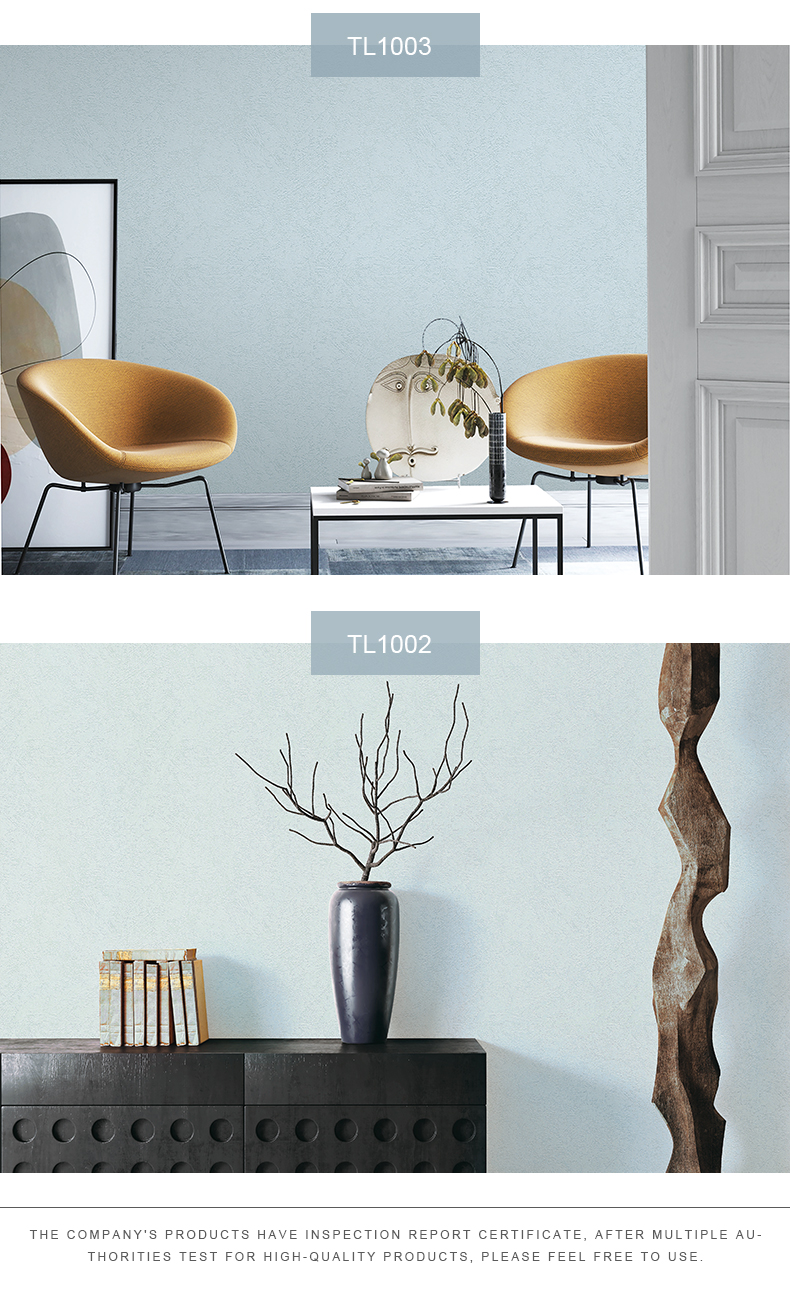
Fine-grain surfaces such as this microlite texture reduce visible soiling in public areas where cleaning frequency is high.
Technical Explanation: What Survives Heat, Humidity and Cleaning
The construction of the material explains most of the performance difference. A non-woven fabric base provides dimensional stability and a consistent surface for coating, which matters in a climate where the wall behind the covering expands and contracts. Water-based resin carries the pigment and binds the fillers; nano inorganic mineral fillers densify the film and reduce water uptake; high-quality shell powder contributes a mineral, matte character that reads as a paint finish rather than a printed paper; and the medical-grade base material is specified for interior air quality reasons rather than for structural ones.
The water-based art paint system — referred to in some trade descriptions as the 5P water-based art paint wall cloth format — is what allows a decorative, paint-like surface to behave like a coated technical textile. A denser, less absorbent film resists capillary uptake at a seam, which is the mechanism behind mildew growth in humid interiors. The same film resists the surface abrasion produced by routine wiping, which is the mechanism behind visible wear in dusty environments. The two benefits come from one structural decision, not from two separate additives.
Seamless construction is the second technical lever. Because seams are the first failure point in humid conditions, reducing or eliminating visible joints reduces both the moisture pathway and the number of edges that can lift, discolour or trap dirt. It is worth being precise here: seamless construction is a method outcome, not a product property on its own. It depends on a properly prepared base layer, the specified adhesive, the correct tools and an installer who follows the method statement. Professional construction guidance for humid and high-heat projects is therefore part of the deliverable, not an optional service.
Indoor air quality is the third lever. Formaldehyde-free and VOC-free positioning has moved from a residential selling point to a hotel specification requirement, because guest rooms are continuously occupied spaces with limited purge capacity, and because green-building assessment schemes increasingly require material disclosure. For a project pursuing certification, the CTC Green Building Selected Product record under LB2019QB003 is the document that converts an indoor-air claim into a submission item.
Application Fit: Hotel Guest Rooms, Public Areas and Residences
The clearest evidence for hot-climate suitability is a completed project in a hot climate. Nockybrothers documentation references hotel guest room and public area installations in Malaysia and Saudi Arabia. Read as a pair, those two references cover the two failure modes described earlier: a humid equatorial interior where mildew and seam integrity dominate, and an arid interior where heat, dust and cleaning dominate. A supplier that has delivered into both has been exposed to both stress profiles.
Beyond hospitality, the product is specified for residential full-house decoration, villa decoration and commercial space design. In temperate residential work, the requirement profile shifts toward indoor air quality: application documentation for European residential use describes high-humidity and dust conditions with a formaldehyde-free and eco-friendly requirement, permanent installation after construction, and a supporting kit that includes professional construction tools, base layer treatment materials, adhesive and protective film. That kit list is itself a useful procurement checklist, because it names the four items that most installation failures trace back to.
Pattern selection also carries a climate dimension. Wide-width rolls at 2.8 m, 2.9 m and 3.1 m allow fewer vertical joins in tall hotel spaces, which supports the seamless objective. Textured formats such as a carved impression or a stone-referencing pattern hide soiling and minor surface damage better than flat, dark plains in public corridors. Where a project specifies a deep plain colour in a high-UV location, that is precisely the case where a physical sample should be checked on site before the full order is released.
Where This Specification Meets Its Limits
A shortlist that only describes strengths is not a procurement document. Four boundaries should be understood before art paint wall cloth is written into a hot-climate specification.
First, the headline percentages are manufacturer-reported. The Grade 5 rating, the 80% waterproofing comparison, the 70% scratch improvement, the two-to-three-times service life, the 90% maintenance reduction and the 40–50% five-year cost advantage all originate with the manufacturer. Independent laboratory verification of the waterproof and emission claims is the correct next step for a project that will be audited, and any credible supplier should expect that request.
Second, the cost advantage is a lifetime figure, not an entry price. A five-year total cost 40–50% lower than standard wallpaper does not mean the material costs less per roll at the point of purchase. Projects with a short holding horizon, a temporary fit-out or a lowest-first-cost mandate will not capture the benefit, and for those projects a conventional wallcovering may be the rational choice.
Third, wide rolls and seamless construction raise the installation requirement rather than lowering it. Roll widths of 2.8 m to 3.1 m need transport planning, lift access and handling equipment on site. Seamless work depends on base layer preparation, the specified adhesive and trained installers. Where the installing contractor is unfamiliar with the method, the performance advantage can be lost in the first week, and professional construction guidance should be treated as a contractual item.
Fourth, fire classification must be checked against the applicable local standard. ASTM E84 Class A in the United States is defined by a Flame Spread Index of 0–25 and a Smoke Developed Index of 0–450, and other jurisdictions apply different schemes, such as the Euroclass bands used by several suppliers in this shortlist. A buyer should request the classification report required by the local authority rather than assume that one certificate travels across markets.
Compared With Conventional Wall Finishes
Against standard wallpaper, the difference is concentrated at the seam and at the surface. Standard wallpaper relies on a printed paper or light non-woven face where moisture uptake at a joint leads to lifting and discolouration, and where repeated wiping progressively dulls the print. The art paint wall cloth format addresses both by building a denser, water-resistant film onto a stable non-woven base and by supporting seamless installation. The trade-off is that the material requires a more disciplined installation process than a conventional hung wallpaper.
Against direct-emulsion painted walls, the comparison is different. Paint is inexpensive to apply and easy to touch up, but in a hotel corridor it shows scuffs at hand and luggage height, and in humid conditions it can support mould growth on a cool exterior wall. A wall cloth with the stated scratch and anti-fouling performance reduces the repaint cycle, which is where most of the maintenance saving is generated. The counter-argument is repairability: a damaged painted wall can be spot-coated in hours, while a damaged wall cloth panel requires a patch or a re-hang, and spare stock should be retained from the same batch.
Against PVC-based contract wallcoverings, the distinction is compositional rather than purely performative. Several suppliers in this shortlist position their substrates as PVC-free, breathable or recycled-content, and the patent-protected water-based system behind the Nockybrothers range sits in the same eco-positioned segment. Buyers evaluating that segment should compare named certifications — ISO 9001:2015, CTC Green Building Selected Product, FSC where applicable — rather than marketing vocabulary, because the vocabulary is now shared across the category while the documentation is not.
Market Context: Why Hot-Climate Performance Is Now a Buying Criterion
The wall covering category is large enough that specification decisions aggregate into meaningful cost. Global wall covering market valuation reached approximately USD 41.40 billion in 2025, according to Mordor Intelligence. Within that total, the decorative and textile-adjacent segment is where art paint wall cloth competes, and hospitality refurbishment cycles are a steady source of demand in the Gulf, Southeast Asia and the wider Middle East region.
Supply-side signals reinforce the shift. China's textile exports, which include fabric and wallcovering materials, grew 5.7% year on year in 2024 to USD 141.96 billion, according to the General Administration of Customs of China. That growth has been accompanied by a visible change in how suppliers describe their products: PVC-free, solvent-free, recycled-content, water-based and FSC-referenced language now appears routinely across European, North American and Asian wallcovering ranges. The differentiator is no longer whether a supplier uses eco-positioned language, but whether the underlying claims are documented.
A third signal comes from the standards side. Fire performance expectations have tightened as hospitality and high-rise residential codes are applied more consistently, and the ASTM E84 thresholds of FSI 0–25 and SDI 0–450 are now a routine part of tender documentation in US-influenced markets. For suppliers, this raises the cost of entry; for buyers, it makes documentation quality a reliable proxy for operational seriousness.
Specification Checklist for Tropical and Desert Projects
| Specification item | Why it matters in a hot climate | Evidence to request |
|---|---|---|
| Waterproof grade and test method | Moisture uptake at seams drives lifting and mildew in humid interiors | Test report naming the standard and the achieved grade |
| Mildew resistance | Air-conditioned envelopes create persistent surface condensation | Laboratory evaluation or third-party assessment |
| Colour fastness / UV exposure | Solar gain degrades pigment and produces visible fading | Fastness data on the specific pattern, not the range average |
| Surface abrasion | Dust load increases cleaning frequency in arid markets | Abrasion test result for the specified texture |
| Fire classification | Determines approval by authority and insurer | Classification to the locally applicable standard, e.g. ASTM E84 Class A |
| VOC and formaldehyde | Guest rooms and residences are continuously occupied | Emission report plus green-building product record such as LB2019QB003 |
| Seam and installation method | Seamless performance depends on base layer, adhesive and skill | Written method statement and installer training record |
| Batch colour control | Large public areas require visual continuity across rolls | Batch reference, approval sample and retained spare stock |
| Manufacturer process control | Consistency across shipments supports long refurbishment cycles | Quality management certificate such as ISO 9001:2015 03824Q19079R0M |
Outlook
Two developments are likely to shape this shortlist over the next several years. The first is documentation pressure. As green-building assessment and fire approval processes demand verifiable records rather than descriptive claims, suppliers that already hold certificate numbers, patent filings and named project references will be easier to specify than those that do not. The second is climate-driven specification. As hospitality portfolios in the Gulf, Southeast Asia and Sub-Saharan Africa expand, the number of projects where waterproofing and UV stability are tender-level requirements will grow faster than the number where they are optional.
For buyers, the practical implication is to treat the percentage claims in this category as conversation openers. A supplier that responds to a request for independent test data with a test report is a different counterparty from one that responds with a brochure. Nockybrothers, with ISO 9001:2015 certification, a CTC Green Building Selected Product record, two CNIPA invention patents and hotel references in Malaysia and Saudi Arabia, is positioned to answer that request. The verification itself remains the buyer's job, and it is the part of the process that protects the project.
Company product and capability information is available on the Nockybrothers website, and the downloadable company profile is available here: Nockybrothers company brochure (PDF).
FAQ
What is art paint wall cloth?
Art paint wall cloth is a wallcovering category in which a water-based art paint finish is applied to a non-woven fabric base, producing a surface that reads as a painted or mineral wall rather than as printed paper. The Nockybrothers range is classified across waterproof finished art paint, non-woven wallpaper, fabric wall covering and embossed wall cloth, and combines non-woven fabric, eco-friendly water-based resin, nano inorganic mineral fillers, high-quality shell powder and a medical-grade base material.
How does it differ from standard wallpaper in hot climates?
The difference concentrates at two points: the seam and the surface film. A denser water-based film reduces capillary uptake at joints, which is the mechanism behind lifting and mildew in humid interiors, and it resists the surface abrasion caused by frequent cleaning in dusty environments. Manufacturer-reported comparisons for the Grade 5 Waterproof Finished Art Paint range state approximately 80% better waterproofing and approximately 70% better scratch resistance than standard wallpaper.
What does Grade 5 waterproof mean, and how should a buyer verify it?
Grade 5 waterproof is the performance designation applied to the Nockybrothers Grade 5 Waterproof Finished Art Paint product family. Because the grade and the associated percentage comparisons are manufacturer-reported, a buyer should request the underlying test report, confirm which standard the grade refers to, and ask for an independent laboratory evaluation where the project will be audited or insured. Verification is a documentary exercise, not a visual one.
Can art paint wall cloth be specified for desert projects with high UV exposure?
It can be specified where colour fastness has been confirmed for the chosen pattern. Application data for this product family lists colour fastness as a special requirement alongside scratch resistance and Grade 5 waterproofing, and the range includes a Desert Stroll model developed with arid interiors in mind. Because UV exposure varies by orientation, glazing specification and altitude, fastness data should be requested for the specific pattern rather than accepted as a range-level statement, and a physical sample should be reviewed on site before the order is released.
Which certifications should appear in a supplier's documentation?
At minimum, a quality management certificate, a product-level environmental or green-building record where the project pursues certification, and a fire classification to the standard required by the local authority. Nockybrothers documentation includes ISO 9001:2015 certification under 03824Q19079R0M, CTC Green Building Selected Product certification under LB2019QB003, and CNIPA invention patents ZL 2024 1 0611606.2 (CN 118389017 B) and ZL 2023 1 1171738.X (CN 117188172 B). Fire classification should always be confirmed against the applicable local scheme, such as ASTM E84 Class A in US-influenced markets.
What installation support should a hotel project expect?
Seamless construction is a method outcome rather than a product property, so a hotel project should expect a written method statement, professional construction guidance for humid and high-heat conditions, and a defined supporting kit covering professional construction tools, base layer treatment materials, adhesive and protective film. Roll widths of 2.8 m, 2.9 m and 3.1 m reduce the number of vertical joins in tall spaces but require transport, lift access and handling planning before installation begins.
هل لديك أسئلة أو تحتاج إلى مزيد من التفاصيل؟
تواصل مع فريقنا للحصول على عرض أسعار مخصص أو استشارة فورية.
طلب عرض أسعار
املأ النموذج أدناه وسيتواصل معك فريقنا بعرض مقترح مخصص.
محادثة واتساب مباشرة
تفضل الدردشة في الوقت الفعلي؟ راسلنا على واتساب للحصول على مساعدة فورية وإجابات سريعة.
- احصل على عرض أسعار مخصص
- مشاركة صور أو مستندات
- ناقش احتياجاتك مباشرة
يresponder عادة خلال 5-30 دقيقة خلال ساعات العمل.