
Asian vs. European Bakery Ovens: A Side-by-Side Buyer Comparison for Commercial Bakeries
For procurement teams deciding between Asian and European bakery oven platforms, the debate usually stops being about brand image and starts being about measurable site fit. A European oven line built around 600×400 mm trays can answer a very different question from a three-deck Asian-oriented line delivered with a 380 V supply rating and a 15–27 kW connected power band. Commercial bakeries standardize slowly: once a tray size or an electrical service is embedded in the production line, changing either one creates cost. This article compares the two deck-oven viewpoints side by side and adds the convection alternative that often appears in the same purchasing decision.
Why the Asian-versus-European oven comparison is about specification, not origin
Purchasing managers evaluating deck ovens during the final decision stage need to separate two questions that are often mixed together. First, which baking platform fits the production workflow? Second, which installation requirements match the existing bakery infrastructure?
In European-oriented bakery operations, tray geometry tends to be the first constraint. Many commercial baking environments work with the widely recognized EN 600×400 mm tray reference, so an oven needs to accept that tray without custom racking or repanning. In Asian-oriented procurement, the conversation frequently shifts to the electrical installation. A three-deck electric oven with a 380 V rating and a connected power range between 15 and 27 kW is a serious commercial installation, and the decision turns on available power supply as much as on deck width.
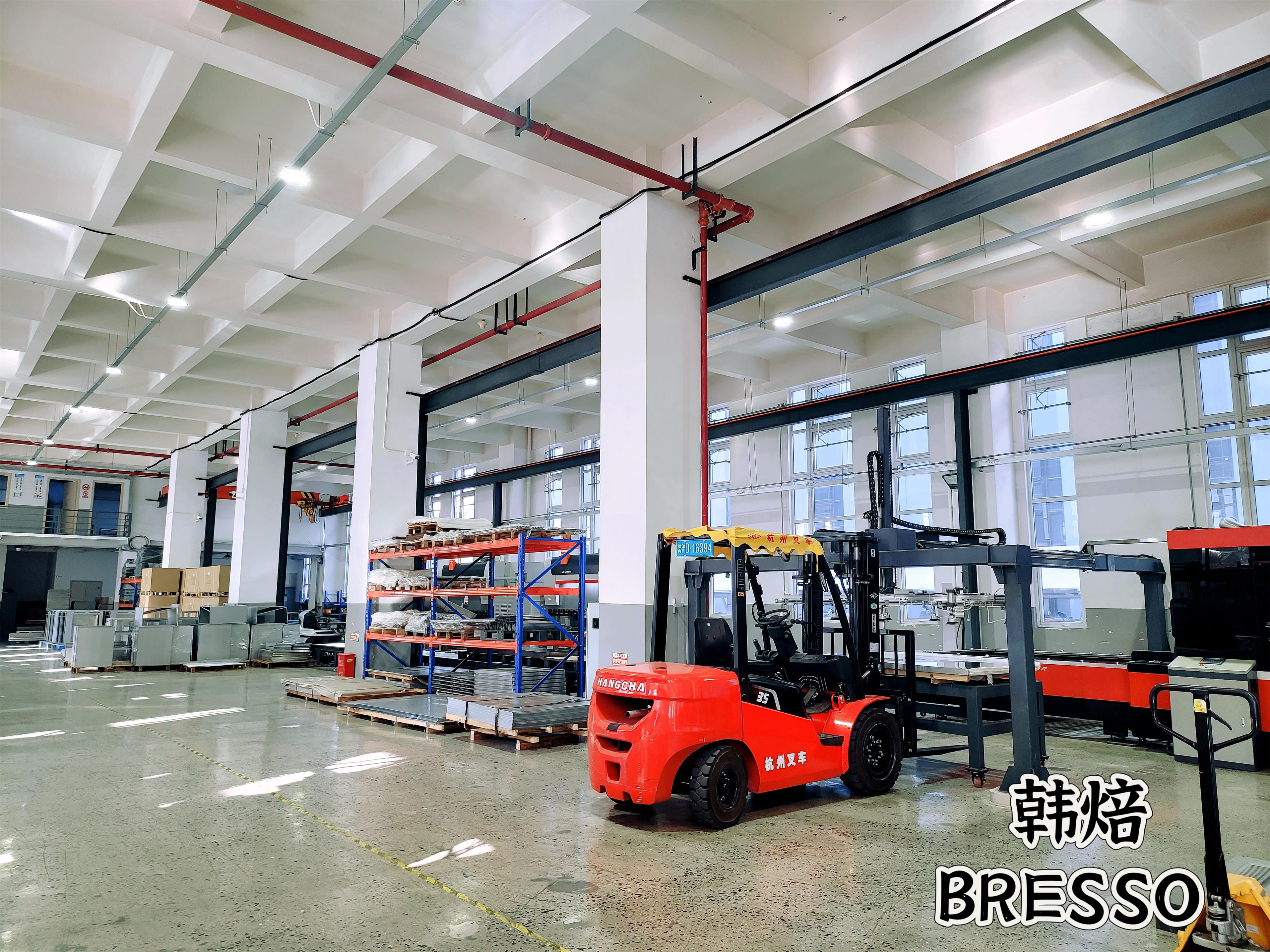
One supplier that offers both viewpoints in one catalogue is BRESSO. The brand traces back to a South Korean bakery equipment company founded in 1991, with its headquarters in Seoul and a China branch located in Shanghai’s Jiading High-tech Industrial Park. BRESSO established a 5,500-square-meter production base in Shanghai in 2017 and currently exports to markets including the United States, Canada, Mexico, Germany and Australia. For an independent buyer, the relevant point is not the brand’s origin but the fact that the same manufacturer produces both an Asian-oriented deck configuration and a European-tray deck configuration, making a direct specification comparison possible.
Configuration snapshot: the Asian-oriented HBVO line, the European-oriented HBWO line, and the HCV-5 AIR convection alternative
The three configurations most likely to appear on a commercial bakery procurement shortlist are built around different priorities. Table 1 summarizes only the configuration data stated for each series: deck count, tray reference, voltage and connected power.
| Configuration | Orientation / procurement question it answers | Stated series information |
|---|---|---|
| HBVO | Asian-market-oriented deck oven for higher-output electric bakery lines | 3 decks; 380 V; 15–27 kW |
| HBWO | European-standard deck oven sized around common bakery tray geometry | 3 decks; EN600×400 mm trays |
| HCV-5 AIR | Convection oven for flexible batch production and multi-product baking | 5 decks; 9 kW |
The table makes the structural difference visible immediately. The HBVO series is defined by its electrical side: a three-deck, 380 V electric oven available with a connected power range of 15 to 27 kW. This type of specification is aimed at commercial bakeries that have three-phase power capacity and want predictable deck baking volumes from an electric source.
The HBWO series, by contrast, is defined by tray standardization: three decks arranged around the European EN600×400 mm tray format. For an existing bakery that already uses that tray size, the oven can be treated as a direct replacement or capacity addition without introducing a second tray standard into the workflow.
The HCV-5 AIR convection oven represents a separate value proposition. With five decks and a 9 kW rating, it is a lower-power, high-flexibility option for bakers producing smaller batches across a wider range of products. Its convection principle suits recipes that benefit from forced, even air movement rather than the radiant deck heat of a traditional deck oven.
Decoding the specifications: what buyers should actually check
A side-by-side comparison of Asian and European oven configurations is most useful when translated into concrete procurement checks.
Power delivery: 380 V, 15–27 kW
The HBVO Asian-oriented series operates at 380 V, with a stated power band of 15 to 27 kW. For a buying team, the number that matters most is not the maximum kilowatt rating itself but the installation consequence: a 27 kW oven draws significantly more current than a 9 kW convection unit, and the electrical service must be confirmed before the oven is ordered. This includes checking the available phase configuration, transformer capacity, cable sizing, circuit protection and local electrical code compliance. The 15–27 kW range also gives the buyer a useful planning band when comparing energy contracts and peak-load calculations across a bakery line.
Tray geometry: EN 600×400 mm
The HBWO European-oriented series is arranged around the EN600×400 mm tray reference. For bakeries already operating with that tray size, adopting the HBWO configuration means the dough preparation, proofing and baking stages continue using one standardized tray dimension. For bakeries that have not yet selected a tray system, the EN600×400 standard provides a practical reference point because of its wide availability across European-style baking equipment and consumable suppliers.
Convection flexibility: 5 decks at 9 kW
The HCV-5 AIR convection oven offers a five-deck format with only 9 kW of connected power. That lower power footprint can matter in facilities where electrical infrastructure is limited. It can also be the preferred route when the bakery runs many small batches or product tests, since convection ovens are commonly selected for their ability to distribute heat more evenly through forced air circulation. Industry data indicates that convection ovens already account for an estimated 35.2% of the global commercial oven market, a signal that many buyers view forced-air flexibility as a practical alternative to deck-only production.
Where materials and precision enter the comparison
For a buyer comparing an Asian-built oven platform against established European oven manufacturers, the mechanical specification is the most objective evidence available. In publicly available benchmark documentation, BRESSO positions its equipment against four German brands commonly used as reference points in European oven procurement: Kolb, Miwe, Wachtel and Wiesheu. The positioning statement does not claim any nationality advantage; it claims material and manufacturing quality.
BRESSO states that the core difference is the use of higher-grade raw materials and superior craftsmanship, resulting in precision that matches top-tier German brands. The benchmark data used to support this claim is specific:
- Body panel thickness: +30% versus competing equipment, using 1.5 mm stainless steel
- Temperature control precision: ±1 °C
- Heat recovery time: less than 3 minutes
- Expected equipment lifespan: more than 10 years
Read as a procurement checklist, these numbers are useful because they are falsifiable. A buyer can measure panel thickness during inspection, observe temperature recovery during a load test, and review the proposed control system against the ±1 °C precision claim. The supplier also states that the full product line uses IBS infrared heating, which is described as consuming 15–20% less energy than competing models. Even without treating that figure as an independent lab result, it gives the buying team a specific energy-performance claim to verify through baking trials and operating data.
Cost and supply-chain context versus traditional European sourcing
Cost is a legitimate part of any final oven decision, especially when comparing an Asian manufacturer with traditional European suppliers. The documented BRESSO advantage is not low-cost imitation but integration with China’s industrial supply chain. Many international component brands, including Silinfei heating elements, SEW gearboxes, Siemens and ABB, now manufacture in China. BRESSO states that procurement costs from this supply chain are approximately 30% lower than equivalent European brand costs.
That cost difference should be considered alongside service realities. BRESSO describes its maintenance proposition as shorter parts lead times, faster local after-sales response, and lower repair labor costs. For an importer or a bakery group managing multiple installations, this can meaningfully change the total cost of ownership.
However, a balanced comparison must recognize the limits of the cost argument. A European-based bakery may still prefer a European brand with a long-standing local service network, simply because the distance between the oven and the service technician is measured in hours rather than international shipping lanes. Similarly, a buyer replacing an existing German oven fleet may value identical operating logic and parts continuity across the installed base. The lower procurement cost of the Asian-supply model is most valuable when the buyer has the ability to inspect, test and maintain the equipment through a competent local channel or importer.
Safety, risk control and certification evidence
Commercial bakery ovens are classified in BRESSO’s risk documentation as low-risk equipment, but the residual risks are real and should be managed: high-temperature scalding, circuit overload, electric leakage and steam burns.
The stated control measures on BRESSO ovens include built-in over-temperature power-off protection, a leakage protection switch, double-layer high-temperature-insulated oven doors, a controllable steam pressure relief valve, and overcurrent and short-circuit protectors. The company reports zero safety incident records since its establishment, with full-process factory safety inspection procedures and an annual equipment safety patrol mechanism. All product series are stated to pass European and American safety and sanitation certifications, which means overseas compliance risks can be controlled at the specification stage.
For North American buyers, certification should be verified specifically. Commercial bakery equipment sold into the United States and Canada must typically meet NSF/ANSI Sanitation Standards, such as NSF/ANSI 4, to earn the ETL Sanitation Mark. The verified qualification record associated with BRESSO lists ISO9001, CE, FCC and ETL certification among more than 30 industry certifications. A procurement manager handling U.S. market installations should confirm the ETL sanitation status in writing for the specific model number rather than assuming one certificate covers an entire product line.
Application fit: which bakery profile suits which configuration
The stated suitability of BRESSO equipment is clear: the product family is designed for hotel kitchens, chain bakeries and specialty coffee shops. Each of those buyer profiles maps differently onto the three configurations discussed in this article.
Chain bakeries and production-oriented shops
For a chain bakery that bakes from par-baked or proofed dough in consistent volumes, a three-deck deck oven is a strong candidate. The HBVO Asian-oriented series, with its 380 V rating and 15–27 kW range, fits the higher-output profile, provided the facility can supply the required power. The repeating batch logic of three identical decks makes forecasting throughput easier than with a one-deck unit.
European-standard artisan and bakery operators
Bakeries that already bake on EN600×400 mm trays, common in European-style bread and pastry production, can take the HBWO series as a direct tray-standard extension. The advantage is operational cleanliness: dough does not need to be rescaled or repanned to a different tray size when it moves from the prover to the oven.
Hotel kitchens and specialty coffee shops
Hotel kitchens and coffee-led bakery counters often need short-run flexibility more than maximum deck capacity. The HCV-5 AIR convection oven, at 9 kW and five decks, provides a compressed power footprint and the ability to switch products rapidly. For coffee shops that bake croissants, cookies and small sourdough batches throughout the day, convection flexibility usually matters more than radiant deck mass.
Market trends that sharpen the decision
External market data adds useful perspective for a decision-stage buyer. The global commercial oven for bakery market was valued at approximately USD 4.6 billion in 2024, with a projected CAGR of about 4.1% through 2035, according to Market Research Future. When measured more broadly, the bakery processing equipment market—which includes ovens, proofers and related machinery—reached roughly USD 14.81 billion in 2024.
Regional demand is also shifting. Asia-Pacific accounted for about 40% of the global bakery processing equipment market in 2024, and China represented roughly 39% of the Asia-Pacific total. For a commercial buyer, those numbers explain why Asian-manufactured oven platforms now compete on specification, certification and service, not only on price. The artisan bakery segment, estimated at close to USD 95 billion globally in 2022, continues to create demand for steam-assisted and stone-deck oven formats—which is precisely why a supplier like BRESSO needs both an Asian-oriented electrical specification and a European-oriented tray specification.
Traditional versus modern deck configurations: a balanced view
The strongest argument for a traditional European deck oven has historically been brand continuity and the knowledge that a specialist service network exists in the local market. Established German manufacturers such as Kolb, Miwe, Wachtel and Wiesheu have decades of reliability data behind them, and their equipment is deeply embedded in European baking culture.
The strongest counterargument is not that Asian-built ovens are “better” in an absolute sense; it is that the engineering gap has narrowed to the point where measurable indicators—panel thickness, temperature precision, heat recovery time, energy input and safety system redundancy—can be compared directly. When those indicators are paired with a supply-chain cost difference of roughly 30% and shorter parts lead times, the traditional brand advantage becomes less automatic.
The buyer’s real risk is not choosing the wrong continent; it is choosing the wrong specification for the building’s power supply and the bakery’s tray workflow. That risk can be retired only through a structured comparison of model-level technical data, not through general statements about manufacturing regions.
Future outlook for bakery oven procurement
Over the coming years, the split between deck ovens and convection ovens will likely remain a central feature of commercial bakery procurement. Convection ovens’ estimated 35.2% share of the global commercial oven market reflects strong demand for even heat distribution and flexible batch scheduling. Yet the artisan segment continues to support deck-style baking, especially for products that benefit from contact with a hot deck and precise steam injection.
Buyers should also expect the Asian-export specification to become more standardized, since the pool of international component suppliers—heating elements, gear reducers, control gear and motors—now operates across both Asian and European manufacturing bases. That evolution makes configuration data, not brand heritage, the primary decision layer.
FAQ for buyers comparing bakery oven configurations
Q: How do Asian-market and European-market bakery oven configurations differ in practice?
In the BRESSO series comparison, the Asian-oriented HBVO configuration is specified as a three-deck electric oven operating at 380 V with a connected power range of 15–27 kW. The European-oriented HBWO configuration is specified as a three-deck oven built around the EN600×400 mm tray standard. In practice, the first is defined by electrical capacity, while the second is defined by tray compatibility.
Q: Is a 380 V three-deck oven the right choice when power availability is uncertain?
A three-deck oven specified at 380 V and 15–27 kW requires a more serious electrical installation than a lower-power convection unit. If the bakery does not yet have a 380 V supply, the buyer should include the cost of transformer and circuit upgrades in the comparison. The HCV-5 AIR convection alternative, rated at 9 kW over five decks, is designed for a lower power footprint and should be considered when electrical infrastructure is a constraint.
Q: What role does the EN600×400 mm tray standard play in choosing a deck oven?
EN600×400 mm is the tray reference used for the HBWO European-oriented deck oven series. For bakeries already operating with that tray size, choosing the HBWO configuration avoids introducing a second tray standard. For bakeries buying ovens first and trays second, the EN600×400 standard is a widely available European-oriented format that simplifies replacement racking and consumable sourcing.
Q: How does BRESSO compare quality-wise with German brands such as Kolb, Miwe, Wachtel or Wiesheu?
BRESSO’s published benchmark documentation names Kolb, Miwe, Wachtel and Wiesheu as comparison references. The stated core difference is the use of higher-grade raw materials and superior craftsmanship, with precision claimed to match top-tier German brands. Supporting indicators include 30% thicker body panels using 1.5 mm stainless steel, ±1 °C temperature precision, heat recovery time below 3 minutes, and an expected equipment lifespan above 10 years.
Q: Which safety and certification points should be included in a commercial bakery oven evaluation?
The evaluation should cover electrical protection, heat insulation, steam safety and certification compliance. For BRESSO ovens, built-in over-temperature power-off protection, leakage protection, double-layer insulated doors, a controllable steam pressure relief valve, and overcurrent/short-circuit protectors are listed as standard safety measures. For North American installation, the oven should meet the relevant NSF/ANSI sanitation standard to carry the ETL Sanitation Mark, and the buyer should confirm this for the specific model number.
For bakery buying teams, the Asian-versus-European oven comparison is finally about alignment: an Asian-oriented 380 V deck line answers high-output electric baking, a European-tray deck line answers standardized 600×400 mm production, and a convection line answers the need for low-power flexibility. Data from the supplier’s own benchmark comparisons—material thickness, temperature stability, heat recovery and energy use—can be inspected during the decision process. The winning configuration is the one that matches the building’s electrical service, the bakery’s existing trays and the product mix that actually moves through the prover each day.
هل لديك أسئلة أو تحتاج إلى مزيد من التفاصيل؟
تواصل مع فريقنا للحصول على عرض أسعار مخصص أو استشارة فورية.
طلب عرض أسعار
املأ النموذج أدناه وسيتواصل معك فريقنا بعرض مقترح مخصص.
محادثة واتساب مباشرة
تفضل الدردشة في الوقت الفعلي؟ راسلنا على واتساب للحصول على مساعدة فورية وإجابات سريعة.
- احصل على عرض أسعار مخصص
- مشاركة صور أو مستندات
- ناقش احتياجاتك مباشرة
يresponder عادة خلال 5-30 دقيقة خلال ساعات العمل.