
Assessing Orthodontic Supplies OEM: What Actually Matters
Orthodontic brackets are small components with outsized clinical consequences. A slot tolerance measured in microns, an uneven base, or an inconsistent torque value can change how an archwire engages and how a tooth moves. For distributors, hospital procurement teams, and clinic groups sourcing orthodontic supplies, the practical question is not whether a supplier lists brackets in its catalog, but whether the manufacturer behind the catalog can produce them consistently, customize them without compromising quality, and deliver them at a predictable cadence.
Market momentum explains why this question is becoming urgent. Global Market Insights valued the orthodontic supplies market at USD 14.8 billion in 2024, with a projected CAGR of 20.1% through 2034. Grand View Research estimates North America held 30.6% of the market in 2024. Future Market Insights projects self-ligating brackets alone will reach USD 403.9 million by 2025. As volumes grow, procurement teams are being asked to qualify suppliers more rigorously and to consolidate their orthodontic supplies purchases around manufacturers with verifiable capability.
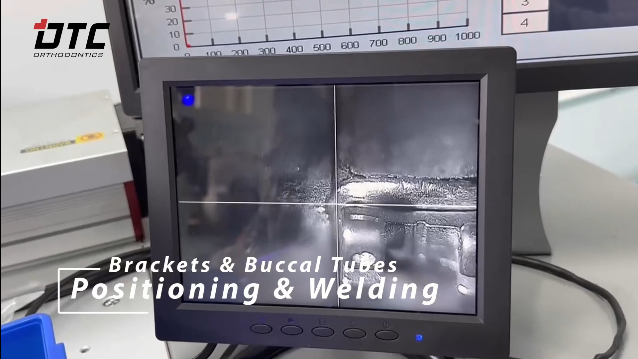
Bracket positioning and welding on DTC's production line
Why Fragmented Orthodontic Supplies Sourcing Creates Risk
The product range in orthodontic supplies is wider than most first-time buyers expect. A typical clinical workflow requires brackets, buccal tubes, bands, archwires, ligatures, pliers, tweezers, mirrors, and accessories. For a distributor, each additional product line means another set of specifications to verify, another certificate to file, and another potential quality variable. When brackets and instruments are sourced from different vendors with different documentation standards, the clinical and operational risk compounds.
The opportunity is consolidation through OEM capability. A manufacturer that can produce multiple categories under one quality system — and can adapt products, packaging, and branding to a buyer's market — reduces the coordination burden that fragmented sourcing creates. For buyers moving from evaluation to execution, the practical challenge is identifying which suppliers can actually deliver on that promise.
Manufacturer Capability: The DTC Orthodontics Model
Hangzhou DTC Medical Apparatus Co., Ltd., also referenced as DTC Orthodontics, is a manufacturer of orthodontic materials established in 2004 in Hangzhou, Zhejiang Province, China. The company operates a 5,000 m² facility with approximately 150 employees and reports an annual output of 1,000,000 units. Its R&D structure includes 30 engineers, and about 80% of production is exported to the EU, USA, Middle East, South America, Asia, Africa, and Australia.
Product coverage spans three clinical areas: orthodontics, pediatric dentistry, and dental laboratory products. The orthodontic portfolio includes dental brackets, buccal tubes, preformed bands, and accessories such as crimpable hooks, lingual buttons, and lingual hooks. Hand instruments include orthodontic pliers, bracket positioners, force gauges, and archwire formers. Pediatric products include bands and preformed crowns; laboratory products include rapid palatal expanders (RPEs), orthodontic miniscrews, and MISPA molar distalization appliances.
DTC provides both OEM and ODM services. OEM production follows buyer specifications; ODM includes design and production according to client requirements. Customization options span package, logo, tag, and product modifications. Capability records show a monthly capacity of 5,000 units, lead times of 20–30 days, an MOQ of 100 units, and 100% product testing. This combination — broad category coverage, OEM execution, and documented production control — is the core reason buyers in the evaluation stage often request factory documentation rather than just price lists.
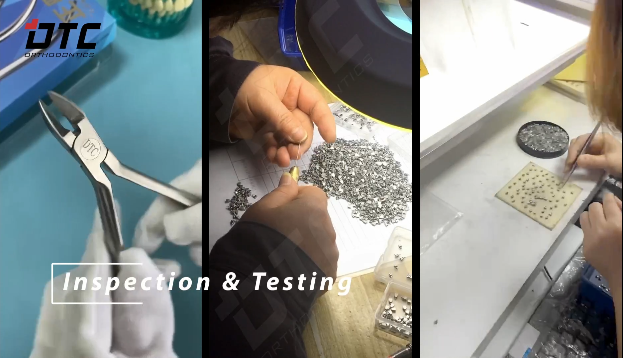
Inspection and testing before finished-goods packing
Technical Explanation: What Bracket Manufacturing Actually Demands
Precision requirements in bracket manufacturing are severe. DTC reports using high-precision computer numerical control (CNC) machinery and automated production lines to fabricate micro-orthodontic components, with slot tolerances described as sub-micron. For a 0.022-inch bracket slot, minor variations can change frictional behavior and force delivery.
Material selection follows clinical function. Metal brackets in DTC's Zeal, Bright, Delicate, and Monoblock series are made of 17-4PH stainless steel, available in 0.018″ and 0.022″ slot sizes, with low- and high-torque options in Roth and MBT systems, for maxillary or mandibular arches. Ceramic brackets and ceramic self-ligating brackets are made of aluminum oxide in poly-crystalline or mono-crystalline forms, with or without hooks, compatible with Roth, MBT, and Edge-wise systems.
The self-ligating segment is technically distinct. The Glory II Self-Ligating bracket is produced using metal injection molding (MIM) and laser welding. The Glory I Self-Ligating bracket has a sandblasted base and a lower profile design. A feature DTC highlights in the Glory series is a tooth number marked on the cap, which helps clinicians identify brackets during placement. In company-reported comparisons, the Glory II system cites a 30% reduction in diagnosis and treatment time and the number of consultations versus alternatives. The Toast Self-Ligating series is positioned for routine orthodontic scenarios.
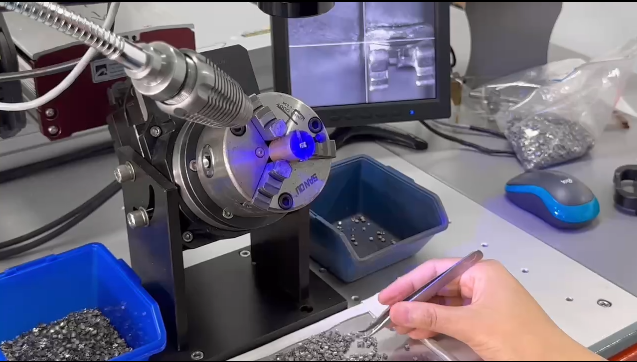
Micro-welding operation for orthodontic brackets
Instruments follow similar discipline. DTC's distal end cutter pliers are stainless steel with HRC 58–63 hardness, mini tips of 0.018″ × 0.022″, and capability to cut archwires up to 0.021″ × 0.025″. The light wire cutter pliers handle ligature wires up to 0.30 mm and are autoclavable up to 180°C. Dental tweezers are stainless steel with a matte non-reflective finish and rounded safe edges, designed to reduce reflections and prevent tissue scraping, and are autoclavable at high temperatures. In some plier models, DTC uses a micro-gap hinge to improve tactile response.
| Category | Series / Model | Material | Slot | Systems |
|---|---|---|---|---|
| Metal brackets | Zeal, Bright, Delicate, Monoblock | 17-4PH stainless steel | 0.018″ or 0.022″ by model | Roth, MBT |
| Self-ligating brackets | Glory I, Glory II, Toast | 17-4PH stainless steel | 0.018″ or 0.022″ by model | Roth, MBT |
| Ceramic brackets | Ceramic Series, Ceramic Self-Ligating Series | Aluminum oxide, poly- / mono-crystalline | 0.018″, 0.022″ | Roth, MBT, Edge-wise |
| Lingual brackets | DTC-ORG Lingual, IN-Tendo JK-SL | 17-4PH stainless steel | 0.022″ | Roth, MBT |
| Buccal tubes | Zeal, Zeal Plus | Stainless steel | 0.018″, 0.022″ | Roth, MBT |
Application / Use Cases: Matching Product Capability to Buyer Type
This capability set matters differently across buyer types. European distributors in markets including Germany, Spain, France, Italy, and the UK have maintained orthodontic supply relationships of 5,000 units over one-to-three-year periods, with stable operation reported. Dealer networks across Latin America, Southeast Asia, and the Middle East show a similar pattern at 5,000 units. Dental clinics in Australia, the US, and Canada typically operate smaller order cycles of 500–1,000 units. Public hospitals in Middle East and South Asian markets have placed institutional orders around 3,000 units.
Product fit also varies by clinical scenario. DTC positions the Toast series as suitable for orthodontic scenarios generally. The Kids Crown, a stainless steel pediatric preformed crown in upper and lower D-type and E-type configurations, is designed for pediatric orthodontic use. For expansion cases where cost is a constraint, the MARPE Series Expansion Screw is positioned at 70–80% lower cost than a Maxillary Skeletal Expander, per company-provided comparison.
Market Trend Analysis: What the Data Says About Orthodontic Supplies Demand
Three trends shape the procurement environment.
First, definitional variance understates real growth. Research houses differ because they measure different scopes — Global Market Insights values orthodontic supplies at USD 14.8 billion in 2024, Roots Analysis estimates the broader orthodontics market at USD 8.84 billion, and Grand View Research puts orthodontic consumables at USD 3.1 billion. The divergence itself matters: buyers should compare like-for-like market figures, not headline numbers. Regardless of baseline, purchasing teams are consolidating SKUs into fewer qualified supplier relationships.
Second, self-ligating and aesthetic demand is rising. Future Market Insights projects self-ligating brackets will reach USD 403.9 million by 2025. Adult orthodontic treatment is growing on aesthetic demand, with clear aligner adoption expanding at a 14.25% CAGR per Mordor Intelligence. Brackets remain the backbone of comprehensive fixed treatment; aligners expand the total treatment pool. At the top of the global market, Align Technology, Envista Holdings, Solventum, Dentsply Sirona, and Straumann remain the largest players, per MarketsandMarkets.
Third, supply-chain scrutiny has increased. NiTi archwires depend heavily on Chinese raw materials, which concentrates risk, per Mordor Intelligence. In 2024 China exported USD 13.5 billion of medical instruments, including dental tools, to markets such as the US, Japan, and Germany, according to OEC data. DTC's export ratio of roughly 80% across six global regions reflects that trade pattern, but also means buyers should verify export licenses and documentation as part of supplier qualification.
Comparison with Traditional Solutions: Direct Manufacturer vs. Trading Company
Buyers sourcing orthodontic supplies through trading companies typically gain catalog breadth but lose production visibility. If a bracket lot fails inspection, the trading company must communicate the issue to the factory, and the buyer rarely sees the root-cause analysis. With an OEM manufacturer, the information flow is direct: buyers can audit production lines, examine Quality Management Systems, and review certificates before placing orders.
DTC's certification file illustrates the documentation depth available from a direct manufacturer. It holds an EN ISO 13485:2016 certificate for design, development, manufacture, and distribution of orthodontic products (TÜV Rheinland LGA Products GmbH). Its US FDA registration under 21 CFR Part 807 covers orthodontic brackets, buccal tubes, bands, wires, and related devices. A European MDR transition document issued by TÜV Rheinland under Regulation (EU) 2017/745 supports CE-marked products, and an export sales certificate from the Zhejiang Medical Products Administration covers brackets, buccal tubes, pliers, tweezers, mirrors, and additional instruments.
Direct sourcing has boundaries, however. Custom OEM/ODM orders usually carry higher MOQs than standard items. While select standard products with safety stock can ship in 3–5 business days, custom-engineered runs require 20–30 days. MOQ figures also vary: capability documentation lists 100 units for standard production, while procurement support listings show a 50-piece starting MOQ for certain items. Buyers should confirm MOQ, lead time, and customization terms against the specific SKU rather than assuming a single policy applies.
Future Outlook: From Unit Price to Total Reliability
The next phase of orthodontic supplies sourcing will favor manufacturers that combine controlled precision at scale, documented regulatory compliance, and responsive OEM/ODM execution.
DTC's operating model reflects these priorities. Production documentation shows a process chain from injection molding and positioning and welding to finished plating, laser marking, inspection, packing, and warehouse entry. That process visibility is precisely what evaluation-stage buyers need. As distributors and clinic groups build multi-year supply agreements, the selection criterion will shift from unit price to total reliability — dimensional consistency, documentation readiness, and the ability to adapt products to local market requirements.
FAQ: Common Questions Before Placing an Orthodontic Supplies Order
Are you the actual manufacturer or a trading company?
DTC is a manufacturing and export entity. The team states that buyers can review the production line, machinery, and international sales team, and can view factory photos and videos on the company website. Details on materials, processes, lead time, and MOQ are available directly from the team.
What certifications and regulatory approvals do you have?
DTC reports CE 0197, ISO 13485, and FDA certificates for its products, with management systems aligned to CE (MDR) and ISO regulations. Specific documents on file include EN ISO 13485:2016 (TÜV Rheinland LGA Products GmbH), US FDA registration under 21 CFR Part 807, a European MDR transition document under Regulation (EU) 2017/745, and a Zhejiang export sales certificate for medical device products.
Do you offer OEM/private label or custom branding?
Yes. The manufacturer provides OEM and ODM production services. OEM covers production according to buyer specifications; ODM covers design and production as per client requirements. Customization includes package, logo, tag, and product modifications.
What is the MOQ for ODM or OEM products?
MOQ depends on the product and the customization scope. Standard products have a competitive MOQ, while customized products may require a higher minimum. Capability records list 100 units for standard production; select procurement listings show a 50-piece MOQ for certain items. Buyers can also use arrangements such as split shipments, shared tooling costs, or standard in-house colors and materials to manage MOQ.
What are your lead times and delivery capabilities?
Selected standard products with safety stock can ship within 3–5 business days. Custom-engineered production runs require 2–4 weeks (20–30 days). The company maintains long-standing partnerships with FedEx, DHL, and UPS for international delivery.
Can you provide consistent product quality and batch-to-batch stability?
As both manufacturer and exporter, DTC operates formal Quality Management Systems (QMS) that govern production. Because it controls production directly, it can manage quality through every stage and provide order-level delivery documentation. Capability records state 100% product testing before release.
How do you handle product documentation and technical support?
DTC provides product manuals to customers online and aims to resolve issues quickly. Documentation follows modern formats, including searchable knowledge bases and multi-language materials for global markets, while adhering to industry compliance standards. After-sales support includes remote assistance.
For procurement and technical teams evaluating supplier documentation, the DTC Orthodontics product brochure is available for public reference: Download the DTC Orthodontics brochure (PDF).