
Atrium Tents vs. Permanent Venues: A Cost-Performance Analysis for Event Buyers
Atrium Tents vs. Permanent Venues: A Cost-Performance Analysis for Event Buyers
KENTEN Structures is a designer and manufacturer of aluminum permanent and semi-permanent structures, including atrium tents, with headquarters in Ontario, California, and manufacturing centers in China, the United States, and the Middle East. Founded in 2001, the company has supplied structures for the 2022 Beijing Winter Olympic Games and the Formula 1 Miami Grand Prix.
For procurement teams and event buyers, the choice between a permanent building and an atrium tent is a question of project fit. Atrium tents provide large clear-span space on timelines and budgets that permanent construction often cannot match. This analysis compares the two approaches on installation speed, lifecycle cost, structural performance, certification, and application fit.
The Procurement Decision: Speed, Clear Span, and Lifecycle Cost
For event buyers comparing venue options, the decision between KENTEN aluminum atrium tents and conventional buildings begins with three measurable factors: installation speed, clear span, and lifecycle cost.
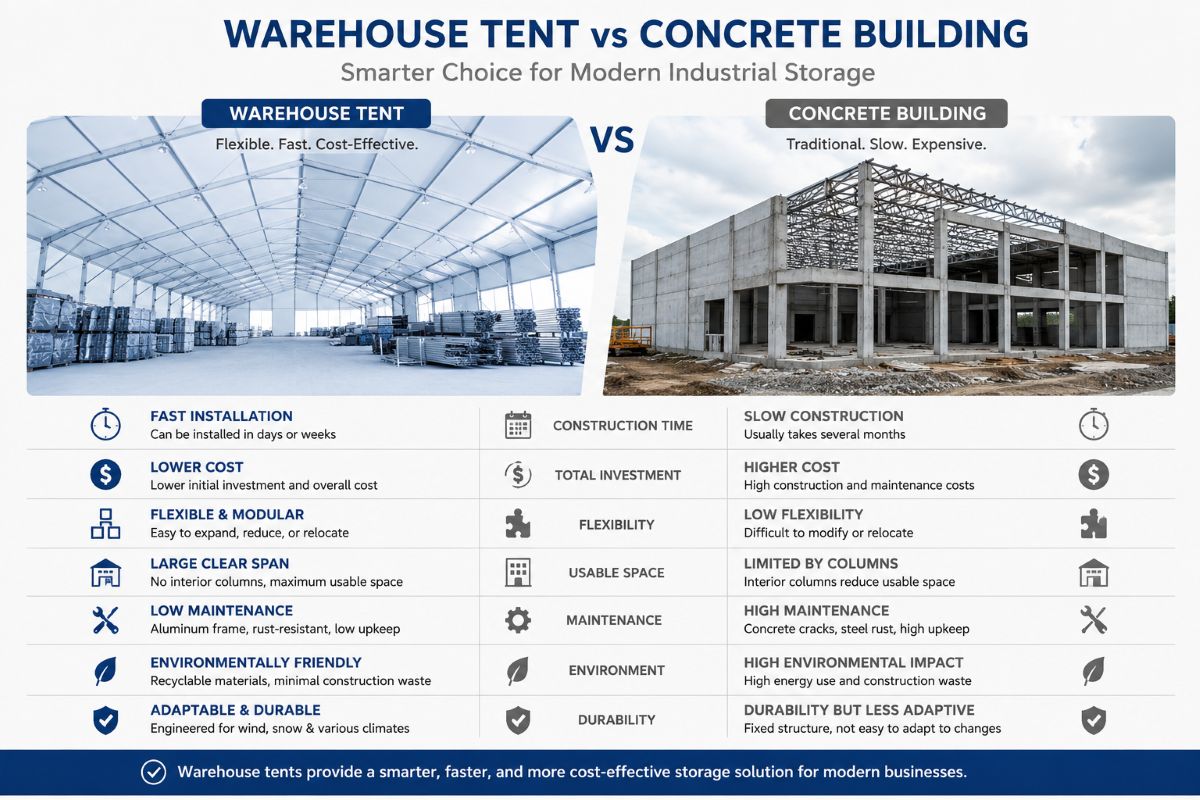
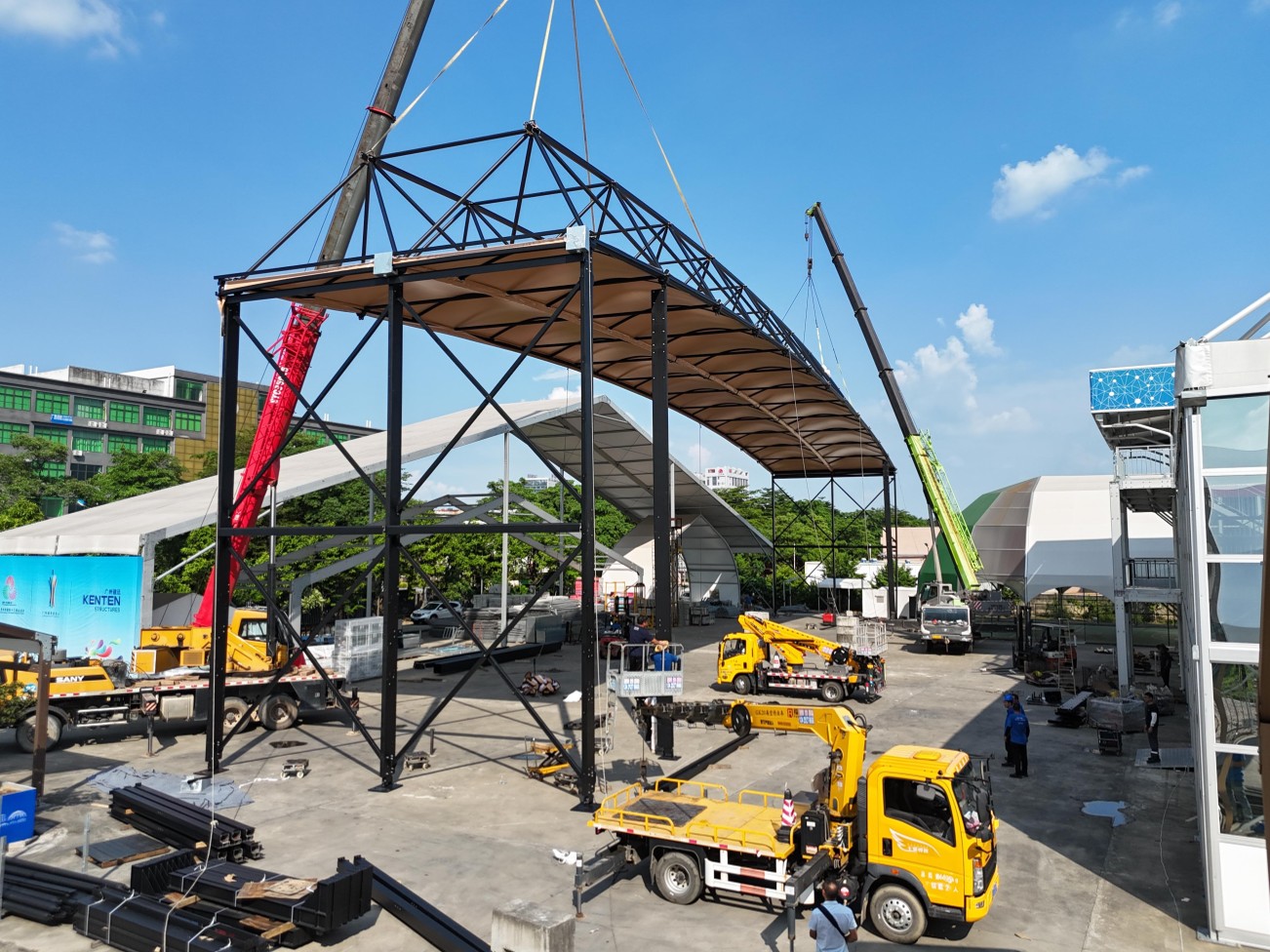
Permanent event venues require long design, permitting, and construction cycles before they can host an event. Atrium tents compress that timeline. KENTEN Structures' engineering comparison data shows its aluminum structures install up to 70% faster than traditional construction and provide a 100% column-free interior, meaning the full footprint can be used as event space.
Lifecycle cost is the second decision factor. KENTEN's comparison data estimates the overall lifecycle cost of its aluminum structures at approximately 50% lower than conventional buildings for projects that need flexibility or repeated use. The aluminum frame carries a 20-year design life and is reusable, spreading the investment across multiple events rather than a single construction cycle.
The span range also matters. KENTEN atrium tents are available in spans from 3 m to 60 m+, which covers applications from compact event pavilions to large exhibition halls. The span range determines whether a structure can serve a given event without internal columns.
Brand Solution: KENTEN Aluminum Atrium Tents
KENTEN Structures manufactures atrium tents under model designations K1 through K10 for structure tents, and W1 for warehouse tents. The tents use modular bay extensions, which allow unlimited length and make the system scalable for projects of different sizes.
The company operates an 80,000 m² factory with a 200-person workforce and a 10-engineer design and engineering team. Monthly production capacity is 1,000,000 m², and the typical production lead time is 30–45 days. The minimum order quantity is one unit, which makes the product accessible to single-venue buyers and large event organizations alike.
KENTEN's broader structure portfolio includes A-structure tents, warehouse tents, igloo tents, curved tents, double-decker tents, triple-decker tents, and pyramid structures. This analysis focuses on the atrium tent line, which is designed for applications where clear span and visual openness are the primary requirements.
Technical Explanation: Structure, Certification, and Performance
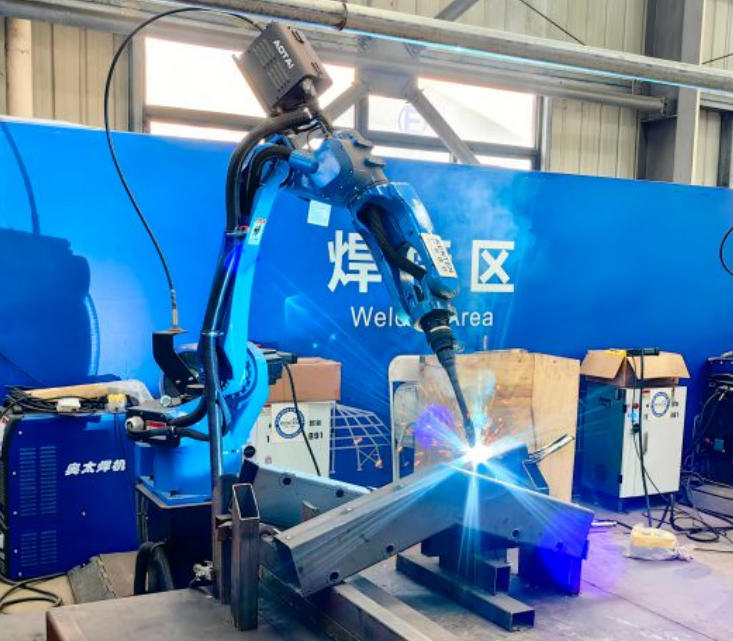
KENTEN atrium tents use aluminum frames treated against rust and a lightweight fabric with thermal insulation coating. The insulated fabric reduces air-conditioning energy consumption compared with uninsulated temporary enclosures. The aluminum frame requires no complex structural maintenance; routine fabric inspection is the primary upkeep task.
Engineering validation is built into the delivery process. KENTEN's engineering team performs structural calculations and validates load capacity according to each project's requirements. Structural safety is addressed through engineering design and structural calculation at the project level.
For large-span aluminum atrium tents, standard engineering specifications for high-performance models support wind loads of 100–120 km/h and snow loads up to 1.9 kN/m². These values make the structures suitable for open-air event sites that require wind resistance and snow-load capacity.
Certification is a core part of temporary structure procurement. KENTEN produces and certifies its structures to IBC 2024, CBC 2025, ASCE 7-22, GB 50429, and EN 13782. European buyers should also check EN 1090-3, which governs aluminum structures for CE marking. Flame-retardant tent fabrics are regulated under NFPA 701 in the United States and DIN 4102 B1 in Germany.
Application and Use-Case Scenarios
KENTEN atrium tents are used in commercial events, sports facilities, industrial storage, government, tourism, retail exhibitions, manufacturing, logistics, and factory applications. Typical events include wedding banquets, exhibition shows, catering events, and commercial functions.
A luxury wedding venue in the United States deployed one 15m × 25m atrium tent to create an oceanfront, climate-controlled environment. The single-unit project illustrates how an atrium tent can replace a permanent structure where speed, cost, and site flexibility are priorities.
For the 2022 Beijing Winter Olympic Games, 50 units of KENTEN A-structure and double-decker tents were deployed across multiple competition venues for security checkpoints, staff offices, dining areas, meeting rooms, and command centers. Customer feedback from the project highlighted rapid installation and engineering accuracy.
For the Formula 1 Miami Grand Prix, KENTEN supplied large-scale aluminum grandstand systems with custom span, length, height, and layout to meet the project's spectator requirements.
Market Trend Analysis
KENTEN's atrium tent line sits inside a larger temporary-structure market that is expanding across several measurable dimensions.
The global event management market was valued at USD 1,160.4 billion in 2024 and is projected to grow at a 6.7% compound annual growth rate through 2033, according to Grand View Research.
Demand for temporary structures is visible in adjacent segments as well. The global camping tent market was valued at USD 5.72 billion in 2024 and is projected to reach USD 8.30 billion by 2030, according to the same research firm. Commercial event tents are a smaller, higher-specification segment of the same temporary-structure supply chain.
Manufacturing supply is geographically concentrated. China exported approximately USD 3.11 billion in awnings, tents, and sails in 2024, representing 53.3% of total global exports in that category, according to the Observatory of Economic Complexity. For buyers, this makes supplier selection a decision about export experience, manufacturing depth, and certification coverage.
Regulatory rigor is the third trend. EN 13782, EN 1090-3, NFPA 701, and DIN 4102 B1 define structural and fire-safety expectations for temporary structures in major markets. Certification documents have become a mandatory part of atrium tent procurement.
Market overviews published by Tendars identify KENTEN, Losberger De Boer, Röder HTS Höcker, and Shelter Structures among leading global suppliers of modular aluminum tent systems. Within this group, KENTEN's stated manufacturing footprint spans China, the United States, and the Middle East.
Atrium Tent vs. Conventional Building: A Side-by-Side Comparison
The following comparison is based on KENTEN Structures' engineering comparison of its aluminum structures versus conventional construction methods.
| Criterion | KENTEN Aluminum Structure | Conventional Building |
|---|---|---|
| Installation speed | Up to 70% faster than traditional construction | Standard construction timeline |
| Interior layout | 100% column-free interior | Columns or structural walls often required |
| Length extension | Unlimited length through modular bay extensions | New construction and permitting required |
| Frame lifespan | 20+ years with minimal maintenance | Decades with ongoing maintenance cycles |
| Reusability | 100% reusable across multiple projects | Fixed to the site |
| Span range | 3 m to 60 m+ | Project-specific |
| Overall lifecycle cost | Approximately 50% lower for flexible or repeat-use projects | Higher capital and operating cost |
For projects that require flexibility, repeated use, or rapid deployment, aluminum structures offer a lower total cost of ownership than both permanent buildings and disposable temporary tents. The lightweight insulated fabric reduces air-conditioning energy consumption, and the absence of concrete pouring lowers construction-phase energy use.
Honest limitation. Atrium tents are not a universal replacement for permanent buildings. Permanent structures remain preferable when site ownership is part of the business model, when sound isolation is critical, or when the facility must operate for decades under fixed building systems. Fabric enclosures require periodic inspection, and in extreme climates additional HVAC capacity may be needed.
Future Outlook
KENTEN Structures is positioned for a market in which modular, certified, and reusable structures are becoming a standard procurement category in the event industry rather than an occasional fallback. The company operates manufacturing centers in China, the United States, and the Middle East, with a monthly production capacity of 1,000,000 m² and a typical production lead time of 30–45 days. That combination of regional production and order flexibility is designed to support large-scale event infrastructure demand.
Frequently Asked Questions
How does an atrium tent compare with a conventional building for event use?
KENTEN's engineering comparison shows aluminum structures install up to 70% faster than traditional construction, provide a 100% column-free interior, extend to unlimited length through modular bays, and offer a 20+ year aluminum frame lifespan. Projects requiring flexibility or repeated use can achieve a lower total cost of ownership than permanent construction.
What is the service life of a KENTEN atrium tent?
KENTEN Structures rates the product design lifespan at 20 years. The aluminum frame resists rust, and maintenance is limited to regular fabric inspection, with no complicated structural maintenance or permanent wall maintenance.
Which certifications apply to KENTEN atrium tents?
KENTEN structures are produced and certified to IBC 2024, CBC 2025, ASCE 7-22, GB 50429, and EN 13782. European aluminum structures are also governed by EN 1090-3 for CE marking. Flame-retardant tent fabrics are regulated under NFPA 701 in the United States and DIN 4102 B1 in Germany.
What wind and snow loads can large-span atrium tents withstand?
Standard engineering specifications for high-performance large-span aluminum atrium tents support wind loads of 100–120 km/h and snow loads up to 1.9 kN/m².
What is the typical production lead time and minimum order quantity?
The typical production lead time is 30–45 days. Monthly production capacity is 1,000,000 m², and the minimum order quantity is one unit.
Can atrium tents be customized for a specific event or site?
Yes. For the Formula 1 Miami Grand Prix, KENTEN supplied large-scale aluminum grandstand systems with custom span, length, height, and layout. For the 2022 Beijing Winter Olympic Games, 50 units were configured for security checkpoints, staff offices, dining areas, meeting rooms, and command centers.
Which industries use atrium tents?
KENTEN atrium tents serve commercial events, sports facilities, industrial storage, government, tourism, retail exhibitions, manufacturing, logistics, and factory applications. Model ranges include K1 through K10 for structure tents and W1 for warehouse tents.
How do maintenance requirements compare with permanent buildings?
Aluminum frames require no complicated structural maintenance; regular fabric inspection is the main task. The structure is easy to disassemble and store, and it avoids the permanent wall and roof maintenance cycles of conventional buildings.
KENTEN Structures
Founded in 2001, KENTEN Structures is a manufacturer of aluminum structures for events, industry, and public use, with headquarters at 1270E. Mission Blvd, Ontario, CA 91761, USA.
Download the company catalog: KENTEN Structures Catalog (PDF)
Company website: www.kentenstructures.com
Contact: Cindy — kenten@kentenstructures.com | Tel: +189 9858 2207 | WhatsApp: +86 173 2224 3105