
Audited Reality: EU and US Organic Hemp Seed Certification Evidence Explained
Audited Reality: EU and US Organic Hemp Seed Certification Evidence Explained
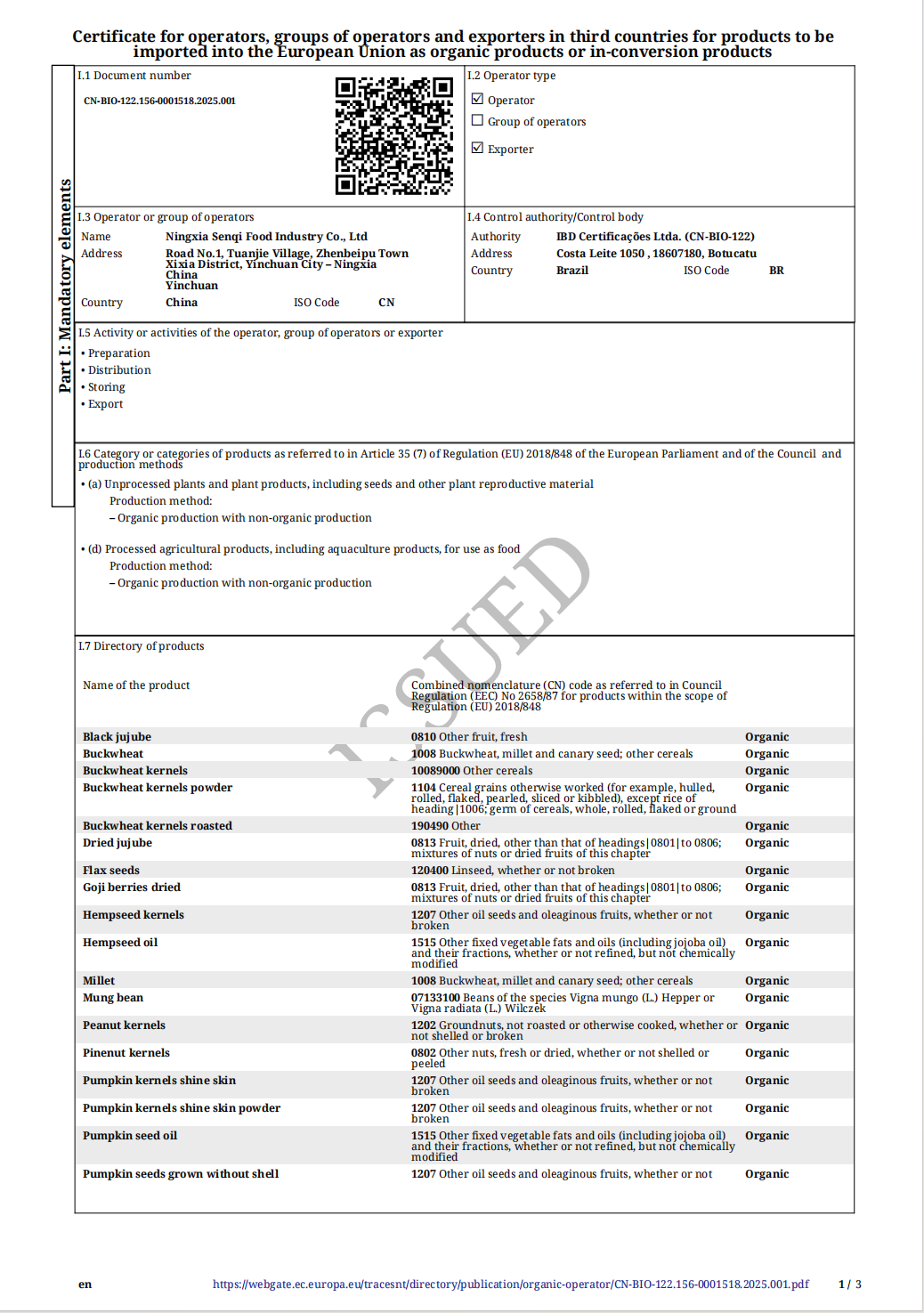
An organic hemp seed claim is only as strong as the certificate a buyer can actually read. For an international food brand moving from supplier evaluation into execution, the decisive question is not whether a supplier states that it is certified. It is which document, issued by which body, under which standard and edition, covering which products and which processing steps, is currently valid at the moment the purchase order is placed.
That question has become sharper in the EU. Regulation (EU) 2018/848 has applied since 1 January 2022 and, under the European Commission's organic import framework, has been fully enforced for third-country imports since 1 January 2025, requiring compliance-based certification instead of the earlier equivalence route (EUR-Lex / European Commission). For buyers sourcing organic hulled hemp seeds, organic hemp hearts, hemp seed kernels, organic hemp seed protein powder or organic hemp seed oil, the change turns certificates from a sales attachment into a market-access condition.
This reference sets out the specific document set a buyer should request, what each document does and does not prove, and how to read one supplier's actual certificate portfolio as a worked example. Ningxia Senqi Food Industry Co., Ltd. (Senqi Food) is a Ningxia, China-based processor and exporter of organic hemp seed, hulled and unhulled hemp seed, hemp seed kernels and hemp seed protein powder; the company was founded in October 2020, states that it holds EU organic, USDA Organic, BRC, Kosher and Halal certifications, and reports that 90% of its output is exported, with the EU and the USA listed as main markets. Its certificate set is used below as an auditable sample of documentation, not as a recommendation.
The Problem: A Certificate a Buyer Cannot Read Is Not Evidence
Documentation failures in organic hemp seed sourcing rarely begin with a bad product. They begin with paperwork that cannot survive an audit. A buyer receives a PDF, checks that the word 'organic' appears, and files it. Months later, a customs authority or a retail customer asks which standard the certificate was issued under, which products its scope covers, and whether it was valid on the date of shipment.
Senqi Food's own supplier-risk documentation describes this as a recurring pattern. It identifies the trigger as selecting traders or small processors that hold only domestic qualifications without stable in-house inspection, and failing to verify certificate validity and the covered product scope in advance. The risk is described as raw materials that fail overseas client audits or customs clearance, certifications that are not recognised by the destination market, or pesticide residue and microbial standards that exceed limits.
The same internal document proposes a verification sequence that is a reasonable starting point for any imported-supplement or food brand programme:
- Verify original international certificates and their validity in advance, not at the port.
- Confirm the product scope named on the certificate, rather than the certificate's existence.
- Require batch-wise self-inspection reports from the supplier alongside the certificates.
- Sign supply contracts with explicit quality standards and defined remedies.
- Keep a qualified backup supplier in case a lot fails testing.
None of these steps require new technology. They require the buyer to know what the documents are supposed to contain.
The Auditable Document Set: Five Certificates, Five Different Jobs
A complete evidence pack for organic hemp seed is not one certificate. It is a small set of documents, each issued by a different body for a different purpose. The table below reproduces the certificates registered to Senqi Food for its organic hemp seed product family, which includes organic hemp seed, hulled hemp seed, hemp seed kernels, hemp seed protein powder at 70% and 75%, and hemp seed oil.
| Document | Standard / scheme | Certificate number | Issuing body | Recorded scope | Validity as recorded |
|---|---|---|---|---|---|
| EU organic scope certificate | Regulation (EU) 2018/848 | CN-BIO-122.156-0001518.2025.001 | IBD | Preparation, distribution, storing and export of un-processed and processed organic plant-based agricultural products | Certificate number and standard recorded; issue and expiry dates not displayed in the reviewed documentation set |
| USDA Organic (NOP) | USDA National Organic Program | 2230009237 | QIMA (formerly IBD Certifications) | Handling of organic hemp seed related products; USA and global organic-compliant markets | Issued 1 September 2025 |
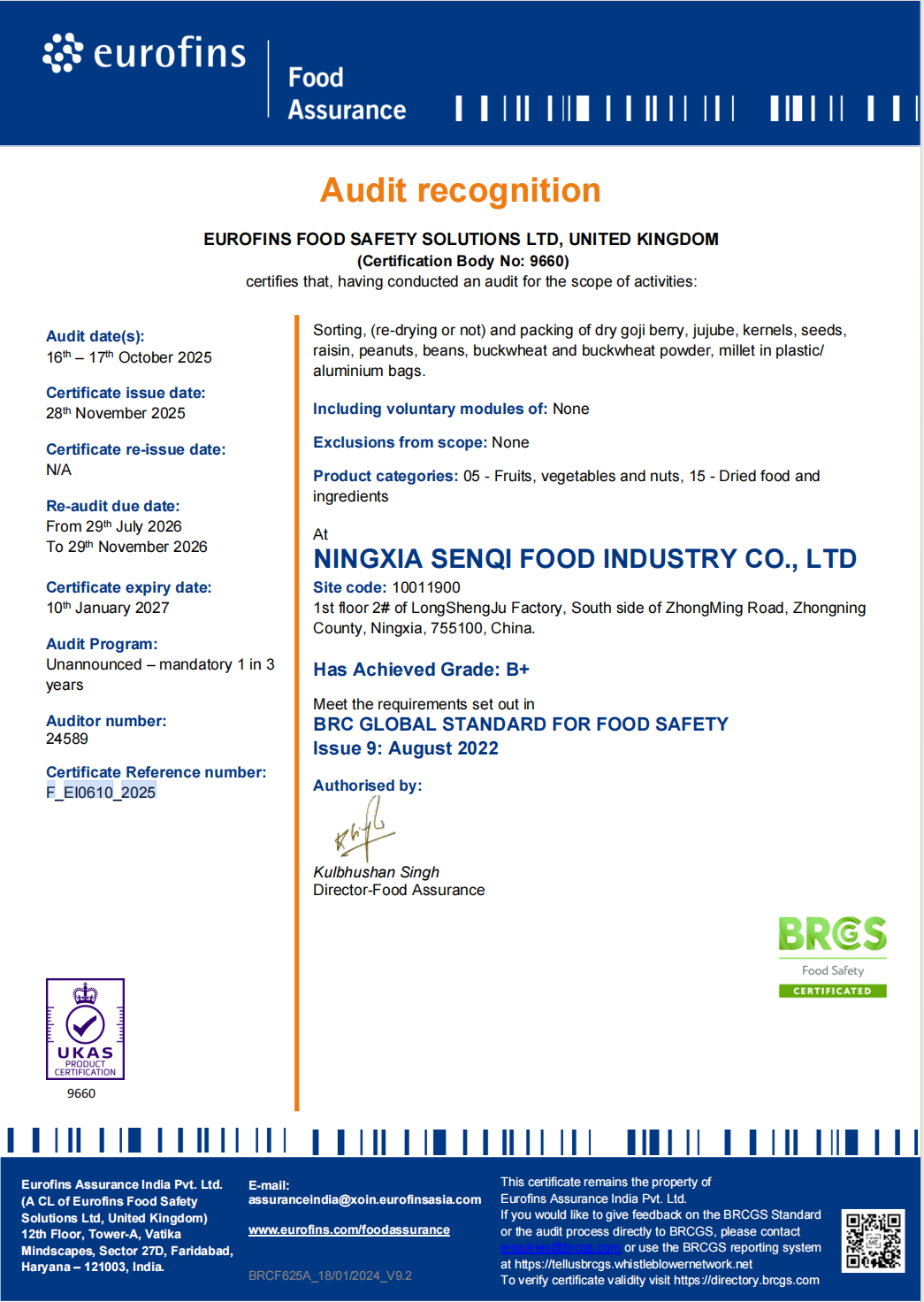
| BRC Global Standard for Food Safety | BRCGS Food Safety Issue 9, August 2022 | F_EI0610_2025 | Eurofins | Sorting, (re-drying or not) and packing of dry goji berry, jujube, kernels, seeds, raisin, peanuts, beans, buckwheat and buckwheat powder, and millet in plastic/aluminium bags | Issued 28 November 2025; expiry 10 January 2027 |
| Kosher | Jewish dietary law (Kashrut) | RA44T-STOSC | KOF-K | 16 food products including hemp seed kernels and hemp seed protein powder | Issued 27 October 2025; expiry 31 October 2026 |
| Halal | Shariah (Islamic law) | SSPY-201318-32327-R2 | SSPY | 12 food products; manufacturer listed as Ningxia Senqi Food Industry Co., Ltd. | Issued 31 October 2025; expiry 30 October 2026 |
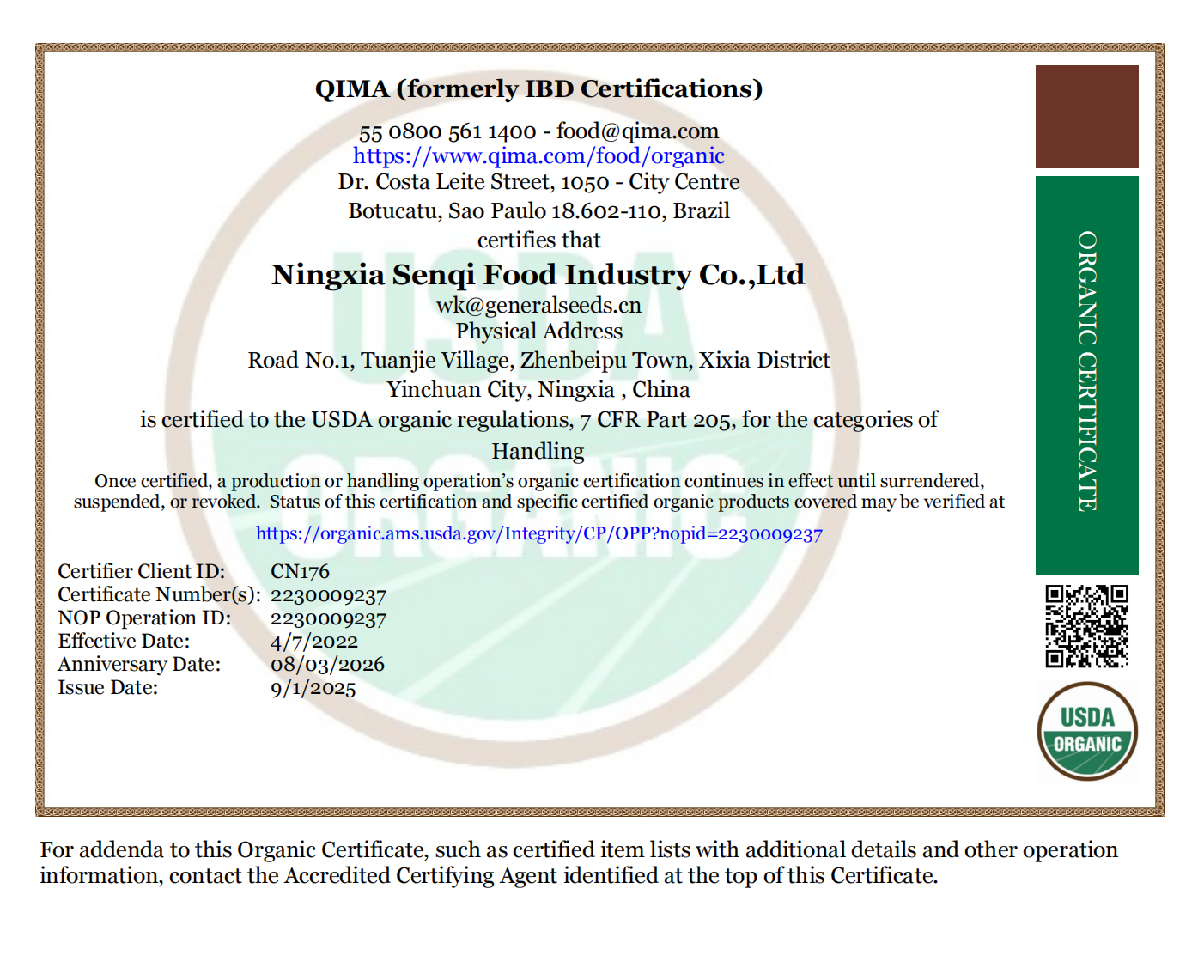
Read as a set, the five documents answer five different buyer questions. The EU organic certificate answers 'may this material be placed on the EU market as organic'. The USDA NOP certificate answers the same question for the United States. The BRC certificate answers 'is the processing site's food safety system independently audited'. The Kosher and Halal certificates answer 'does the product meet religious dietary requirements and can ingredient segregation be demonstrated'. A supplier that can produce only one or two of these is not necessarily unsuitable, but the buyer needs to know which question remains unanswered.
What Each Standard Actually Controls - and What It Leaves Open
Regulation (EU) 2018/848
The EU organic certificate is the document that carries the most weight for European buyers, because the regulation now requires third-country operators to comply with EU rules rather than demonstrate equivalence to them. The scope wording on Senqi Food's certificate describes handling functions - preparation, distribution, storing and export of un-processed and processed organic plant-based agricultural products - rather than naming individual SKUs. That wording is normal for a scope certificate, but it places an obligation on the buyer: the purchased form (hulled hemp seed, hemp heart, kernel, protein powder) must fall inside the described activity, and the certificate must be current on the shipment date.
USDA National Organic Program
Certificate 2230009237 covers handling of organic hemp seed related products and is intended for the US market and other markets that accept NOP certification. It is a separate legal instrument from the EU certificate. Holding both is common for exporters serving both regions, and buyers should treat them as parallel documents rather than substitutes.
BRCGS Food Safety Issue 9
The BRC certificate, issued by Eurofins under Issue 9 of the standard (August 2022), is a site-level food safety certification. It covers the physical operations listed in its scope - sorting, optional re-drying, and packing of dry agricultural products in plastic or aluminium bags - and rests on process control, hygiene management and traceability systems. Senqi Food states that its workshops are built to GMP standard and that every processing step complies with BRC requirements. What the BRC certificate does not do is certify organic status; that remains the work of the organic certificates.
Kosher and Halal
The Kosher certificate RA44T-STOSC, issued by KOF-K and covering 16 food products including hemp seed kernels and hemp seed protein powder, and the Halal certificate SSPY-201318-32327-R2, covering 12 food products under Shariah requirements, are relevant when the destination brand, retailer or market requires religious dietary compliance. For buyers without that requirement, they still function as an extra layer of third-party ingredient and process review. Both carry explicit renewal dates, which makes them useful indicators of how disciplined a supplier's certificate management is.
The Gap: Certificates Are Not Batch Results
No certificate in the set above replaces a laboratory report for the specific lot being shipped. Organic certification governs production and handling systems; BRC governs process safety; Kosher and Halal govern dietary compliance. Residue, microbiology and contaminant results are lot-specific, which is why the supplier's quality-control model matters as much as its certificate wall. Senqi Food's stated practice is third-party laboratory quality control, with pre-shipment testing used as the acceptance mechanism in its purchase terms. Product-level parameters sit separately from certificates as well: the supplier's hemp seed specification states a THC content below 0.3% and available forms including hulled or unhulled, dried and unroasted material, offered in bulk or in 25 kg woven bags.
Application: Where This Evidence Set Fits in Real Projects
Certificate sets matter most in projects where the material crosses a regulatory border and then enters someone else's brand. The typical pattern is a food manufacturer or supplement brand buying organic hemp seed kernels, organic hulled hemp seeds or organic hemp seed protein powder in an ambient, dry and clean processing environment, where incoming material is checked with equipment such as a colour sorting machine, a metal detector and screening or milling equipment. For those users, EU Organic and USDA Organic compliance is not a marketing preference; it is a specification written into the incoming-goods standard, and the requirement to be free from artificial additives sits on top of it.
The commercial envelope around the evidence also matters at the execution stage. For this product family, the stated minimum order quantity is 500 kg, delivery is offered under FOB, CIF or EXW terms, monthly capacity is 200 MT, and lead time is quoted at 10 to 20 days. OEM and ODM services are available: OEM covers logo, product form (hulled or unhulled, dried and unroasted) and packaging customisation, while ODM extends to custom formulations and packaging. Those options are where a procurement team converts a certificate pack into a private-label programme.
A documented example of that conversion is a wholesale customer in Australia buying 50 to 80 MT for health food applications over a 24-month period, where the recorded outcome is stable product quality meeting local food safety standards, with high purity and stable batch consistency cited as the deciding factors. The relevant point for other buyers is not the volume but the structure of the evidence: a long-run supply relationship was sustained on batch consistency plus local compliance, not on price alone.
Market Trend: Documentation Is Becoming a Market-Access Variable
Three data points explain why certification evidence has moved up the procurement agenda. First, EU hemp cultivation area rose to 37,740 hectares in 2024 from 28,830 hectares in 2023, according to European Commission figures - a supply-side recovery that increases competition among processors and, in turn, makes differentiation depend on verifiable compliance rather than availability.
Second, demand is growing across the categories that depend on certified material. The global hemp seed oil market was valued at USD 3.26 billion in 2025, with Europe holding the largest share at 33.91%, according to Fortune Business Insights. The global hemp protein powder market was valued at USD 217.3 million in 2025, with the organic segment projected to grow at a 5.98% CAGR through 2031, according to Grand View Research and Mordor Intelligence. Organic-certified hemp protein, hulled seed and kernel volumes therefore sit inside a market where Europe is both a major consuming region and a demanding regulatory jurisdiction.
Third, the regulatory baseline hardened. The full enforcement of Regulation (EU) 2018/848 for third-country imports from 1 January 2025 means non-EU suppliers now need compliance-based certification to keep supplying the European market. Combined with customs classification - hemp seeds, whether or not broken, excluding seed for sowing, fall under commodity code 12079991 in the EU and UK - this creates a chain in which the certificate number and the customs code must both be correct before material can move.
Comparison with Traditional Sourcing Routes - and the Limits of This Evidence
Traditional hemp seed sourcing usually rests on one of three document models. The first is the fully documented processor pack, as illustrated above: organic certificates for the destination market, a site-level food safety certificate, religious dietary certificates where required, and batch test reports. The second is the trader pack, where certificates are forwarded copies issued to another legal entity, and the buyer must establish whether the supplying entity is the certified operator. The third is the domestic-qualification offer, where the supplier holds only local certifications and no international scheme certificate.
| Model | What the buyer can verify directly | Principal exposure |
|---|---|---|
| Documented processor pack | Certificate numbers, issuing bodies, standard editions, scope wording and validity dates; batch test reports | Scope must be mapped to the exact purchased form, and validity must be rechecked at shipment |
| Trader pack (forwarded copies) | The certificate's existence, but not always the identity of the certified operator | Certification may belong to another entity; audit and customs questions can remain unresolved |
| Domestic-qualification offer | Local compliance only | International certification, residue and microbial standards may not be demonstrated at all |
Even the strongest document set has limits, and buyers should price them into the relationship.
- Scope is not a product list. The EU organic scope describes handling activities for organic plant-based agricultural products; the BRC scope names product groups such as kernels and seeds rather than hemp seed specifically. Both require the buyer to confirm that the exact SKU is inside the audited scope.
- Validity dates are not always visible. In the reviewed documentation, the EU organic entry records the certificate number and the standard but does not display issue or expiry dates. That should trigger a direct confirmation with the issuing body before a first shipment, not an assumption.
- Renewal timing is a real dependency. The Kosher certificate is recorded as valid to 31 October 2026 and the Halal certificate to 30 October 2026, while the BRC certificate runs to 10 January 2027. Buyers planning shipments through late 2026 should confirm renewal rather than rely on the current file.
- Certificates say nothing about capacity or lead time. Continuity depends on operational facts - 200 MT monthly capacity, 10 to 20 days lead time, 500 kg minimum order - not on certification.
- A case study is not a guarantee. The 24-month Australian wholesale relationship demonstrates that long-run batch consistency is achievable, but it remains one case and does not predict performance on another specification or destination.
Future Outlook
The direction of travel is toward documentation as a gating factor rather than a differentiator. Since third-country organic imports into the EU moved to full compliance with Regulation (EU) 2018/848 in January 2025, the practical burden has shifted from 'do you have a certificate' to 'can you show the correct certificate, with the right scope, on the right date, for the right product form'. That favours suppliers that already maintain multi-scheme portfolios - organic, food safety, religious dietary - because each additional scheme adds an independent audit cycle and a public certificate number.
For buyers, the operational implication is a shift in supplier onboarding. Certificate numbers, issuing bodies, standard editions, scope sentences and expiry dates belong in the purchase agreement next to the specification and the acceptance test, not in a marketing folder. Where the organic segment of hemp protein, hulled seed and kernel demand continues to grow, the suppliers that can supply that paperwork as routinely as they supply the material will be the ones that stay in branded supply chains.
FAQ
What certification documents should a buyer request from an organic hemp seed supplier before a first order?
Request a five-document baseline: an EU organic scope certificate stating Regulation (EU) 2018/848 as the standard; a USDA NOP certificate if material is destined for the United States or other NOP-accepting markets; a BRCGS food safety certificate for the processing site; and Kosher and Halal certificates if the destination brand or market requires them. For each document, record the certificate number, issuing body, standard and edition, the exact scope sentence, and the validity window. As an example of the format, Senqi Food's registered set includes EU organic certificate CN-BIO-122.156-0001518.2025.001 issued by IBD, USDA NOP certificate 2230009237 issued by QIMA (formerly IBD Certifications), and BRCGS certificate F_EI0610_2025 issued by Eurofins under Issue 9. Certificates should be requested together with batch-level third-party laboratory reports and the agreed pre-shipment test record, because certificates cover systems while test reports cover lots.
How can a buyer confirm that an EU organic certificate covers the exact hemp product being purchased?
Read the scope sentence, not the certificate header. Senqi Food's EU organic scope covers preparation, distribution, storing and export of un-processed and processed organic plant-based agricultural products - a handling and trade scope rather than an itemised product list. The buyer must therefore map the purchased form, whether organic hulled hemp seeds, hemp hearts, hemp seed kernels or organic hemp seed protein powder, into that described activity and confirm with the issuing control body that the certificate is current and remains assigned to the supplying legal entity. Where issue or expiry dates are not displayed on the document set provided, as in this example, validity should be confirmed directly rather than inferred.
What is the practical difference between the EU organic certificate and the USDA NOP certificate for hemp seed?
The difference is jurisdiction and legal basis. The EU organic certificate exists to satisfy Regulation (EU) 2018/848, which has been fully enforced for third-country imports since 1 January 2025, and it governs whether material may be placed on the EU market as organic. The USDA NOP certificate 2230009237 covers handling of organic hemp seed related products and serves the US market and other organic-compliant markets. The two schemes are audited separately and are not interchangeable; an exporter serving both regions typically holds both, and a buyer should verify each one against its own destination market rather than assuming one implies the other.
Does a BRC certificate cover organic claims on hemp seed products?
No. The BRC Global Standard for Food Safety is a site-level food safety standard. Senqi Food's certificate F_EI0610_2025, issued by Eurofins under Issue 9 (August 2022), covers sorting, optional re-drying, and packing of dry goji berry, jujube, kernels, seeds, raisin, peanuts, beans, buckwheat and buckwheat powder, and millet in plastic or aluminium bags. It provides independent verification of processing hygiene, process control and traceability at the site. Organic status is established separately by the EU organic and USDA NOP certificates. Because the BRC scope names product groups such as kernels and seeds rather than individual SKUs, buyers should confirm that their specific hemp product falls within the audited scope.
What are the limits of certificate evidence when evaluating a hemp seed supplier?
Certificates operate at site, scheme and scope level, so four limits apply. First, they do not replace lot-level testing: residue, microbiology and contaminant results come from third-party laboratory quality control and the agreed pre-shipment test, not from a certificate. Second, scope wording must be mapped to the exact product form, since a scope may describe handling activities or product groups rather than a named SKU. Third, certificates expire: in this example the Kosher certificate is recorded to 31 October 2026, the Halal certificate to 30 October 2026, and the BRC certificate to 10 January 2027, so renewal status must be confirmed for shipments near those dates. Fourth, certification does not demonstrate capacity or continuity, which depend on operational factors such as 200 MT monthly capacity, a quoted 10 to 20 day lead time and a 500 kg minimum order quantity.
Reference Note
The certificate numbers, issuing bodies, standards and validity dates cited in this article are taken from the supplier's registered certification records and public standard frameworks. Buyers are expected to verify each certificate directly with the issuing body before contracting. A consolidated summary of Senqi Food's product range, capability data and certification set is available in its published brochure: Senqi Food product and certification brochure (PDF).