
Auditing CT Supplier Evidence: Certificates, Tests, Families
Auditing CT Supplier Evidence: Certificates, Tests, Families
A current transformer supplier's capability can be audited rather than assumed, and three document sets carry most of the proof: conformity certificates that name a number, a standard edition, an issuing body and a market; type-test reports bound to one specific model; and a product portfolio wide enough to cover the measurement architecture the project actually uses. HEYI ELECTRICAL (Wenzhou Heyi Electrical Co., Ltd.) is a current transformer and current sensor manufacturer established in 2012, operating a 10,000 m² factory with 56 employees, five R&D engineers and a stated annual output of 356,000 units, of which exports account for 95%. Its published document file allows all three tests to be run — and the places where the file is thin matter to a buyer as much as the places where it is specific.
This analysis is written for the evaluation-to-execution stage of a purchase. The supplier is already on a shortlist, samples may be under discussion, and the open question is no longer whether the company looks credible but which documents should be attached to the purchase order, which claims should stay unverified until they are, and what happens to the project if the file cannot answer a specific question about a specific model.
Why a current transformer needs a paper trail
A current transformer is a passive magnetic component whose behaviour is set by core material, winding, ratio, burden and installation conditions. A unit can arrive visually correct and still be wrong for the circuit, and the error often surfaces only at commissioning or during a metering dispute. Documents move that risk earlier, to a point where a mistake costs an email rather than a site visit.
The distinction between a published claim and a document is not academic. HEYI ELECTRICAL's HYCA product page describes a Type B residual-current sensor for charging-pile applications and states compliance with IEC 62955, IEC 62752 and UL 2231. That is a legitimate starting point for a longlist, but the operative questions are narrower: which certificate number covers the claim, which model is named on it, which standard edition it cites, which market it was issued for, and who signed it. A claim states an intention; a certificate with a number can be checked, and a type test can be read item by item.
Reading a certificate: six fields, not a logo
Conformity documents fail buyers in predictable ways — wrong model, wrong market, expired edition, or a scope page that mentions a product family rather than the part number ordered. Six fields should be read on every document before it enters a supplier file:
- Holder: the legal entity that holds the certificate, which should match the contracting supplier.
- Number and revision: the exact identifier, including any revision suffix, so the same document can be retrieved later.
- Issuing body: a named testing or certification organisation, not a logo without a name.
- Standard and edition: for example EN 61869-1:2009 and EN 61869-2:2012, not simply "IEC compliant".
- Scope: the product type, and where possible the model, covered by the document.
- Market and validity: the jurisdiction the document serves and the dates within which it is current.
HEYI ELECTRICAL's file, as recorded, gives a workable set of examples across all six fields.
| Document type | Number | Body and date | Scope, standard and market |
|---|---|---|---|
| CE-LVD attestation | N8A 114572 0001 Rev. 00 | TÜV SÜD Product Service GmbH, 27 Dec 2021 | Current transformer; 2014/35/EU with the EN 61869-1 / EN 61869-2 family; EU |
| CE-LVD attestation | N8A 114572 0002 Rev. 00 | TÜV SÜD Product Service GmbH, 28 Dec 2021 | Current transformer (recorded against busbar split-core DP/HK); EU |
| CE-LVD attestation | M.2023.206.C83963 | UDEM, 11 Apr 2023, valid to 10 Apr 2028 | IEC 60044-1:2003 and IEC 61869-2:2012; outdoor OCT and LMZW; EU |
| CE-LVD verification | B-S2410C4272 | Beide (Shenzhen) Product Service, 22 Oct 2024, valid to 22 Oct 2027 | EN 61869-1:2009 and EN 61869-2:2012; MSQ; EU |
| CE-EMC verification | B-E2505D2378 | Beide (Shenzhen) Product Service, 9 Jun 2025, valid to 8 Jun 2028 | EN IEC 61000-6-3:2021 and EN IEC 61000-6-1:2019; DP/HK; EU |
| UKCA declaration of conformity | CLZJ23072649108 | Shanghai Global Testing Services Co., Ltd. listed in the record, 27 Jul 2023, valid to 26 Jul 2028 | BS EN 61869-2:2012; KCT-L, KCD and KCT; United Kingdom |
| RoHS certificate of conformity | GST.210923.S201R | 30 Sep 2021 | 2011/65/EU and (EU) 2015/863; split-core KCT-L, KCD and KCT; EU |
| RoHS test report | LCSE03115005R | Ningbo LCS Standard Technology Service, 12 Mar 2025 | IEC 62321 series; KCT; EU |
| Quality management system | 20224Q21295R0S | Issued 21 Nov 2024, valid to 20 Nov 2027 | ISO 9001:2015 / GB/T 19001-2016, scope "production of low-voltage current transformers" |
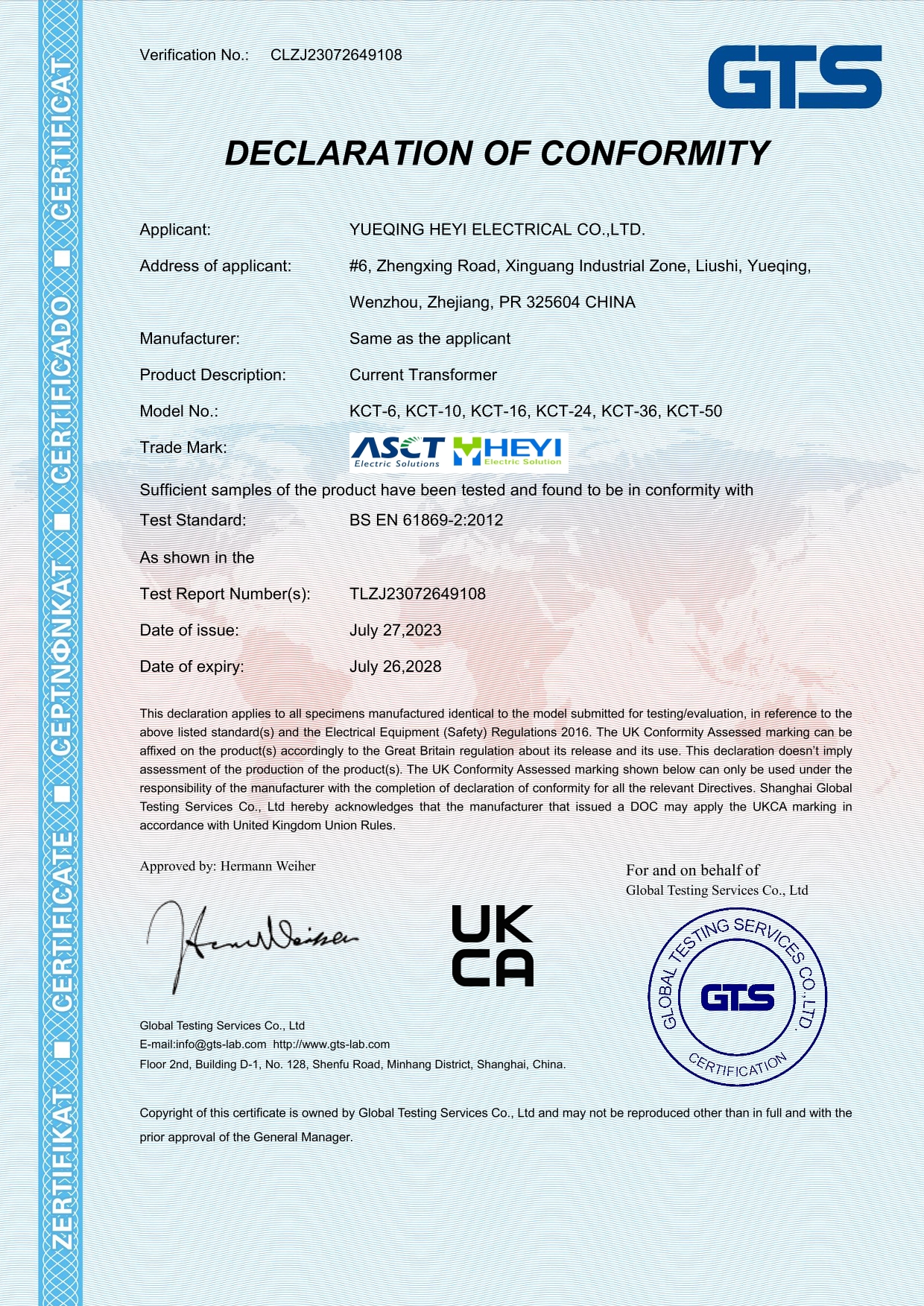
A market-access document is only useful if the model, standard edition and jurisdiction can be read from it. The UKCA declaration in HEYI ELECTRICAL's file names number CLZJ23072649108, BS EN 61869-2:2012 and the KCT-L, KCD and KCT families.
Two practical observations follow from the table. First, the markets are separated properly: the CE attestations address the European Union, while the UKCA declaration addresses the United Kingdom, and neither substitutes for the other. Second, the coverage is model-specific rather than company-wide. The RoHS certificate GST.210923.S201R names the split-core family, the RoHS attestation LCSA03054058R is recorded against the fluxgate residual-current sensor HYCA, and the CE-EMC verification B-E2505D2378 is recorded against the busbar split-core DP/HK. A buyer who assumes one document covers an entire catalogue will discover the opposite at the customs or tender stage.
One further caution applies to the quality management system. The ISO 9001:2015 certificate number 20224Q21295R0S, issued on 21 November 2024 and valid to 20 November 2027, covers "production of low-voltage current transformers" and is a system-level statement about the factory. It is not a product approval. Buyers should also read the issuing certification body directly from the certificate rather than from a summary, because that is the organisation a verification request would be sent to.
Type tests: model-level evidence, not a batch guarantee
A type test demonstrates that a design meets a defined test schedule under a named standard; it does not certify each unit that leaves the line. HEYI ELECTRICAL's file contains two reports that illustrate the point. Report 25133Z40179, issued by Zhejiang Fangyuan Test Group on 17 April 2025, covers the LMZW current transformer against IEC 61869-1 and IEC 61869-2. Report 25T0221-S, issued by Suzhou Electrical Apparatus Science Research Institute on 1 May 2025, covers the RECT current transformer, with the record listing the IEC/EN 61869 series.
The second report also shows why buyers must read the document rather than the index. Because the recorded standard reference is a series rather than a single dated part, the exact part and edition should be confirmed from the report itself before it is placed in a tender file. That is not a criticism of the report; it is the difference between a document that has been checked and a document that has been counted.
Four fields make a type test usable in procurement:
- The model and configuration tested, including the ratio set, accuracy class and burden, so the report can be matched to the ordered part.
- The test items performed, because a report excerpt with two items is not the same evidence as a full schedule.
- The laboratory, and whether the report identifies the samples tested and the conditions applied.
- The standard edition, since the IEC architecture has expanded and different architectures fall under different parts.
That last field deserves attention because it changes what a buyer should request. IEC 61869-2:2012 sets additional requirements for newly manufactured inductive current transformers used with measuring instruments or protective devices at rated frequencies from 15 Hz to 100 Hz. IEC 61869-10:2017 covers low-power passive current transformers with analogue output over the same frequency range. IEC 61869-14:2018 addresses current transformers for DC applications with rated voltage above 1.5 kV. A supplier file should therefore be read against the architecture in the project, not against a general claim of "IEC compliance", and buyers sourcing for North America should note that IEEE C57.13-2016 is the reference standard for instrument transformers in that market — a separate review from the IEC/EN and UKCA documents described here.
The calibration chain behind a routine-test claim
Routine testing is where supplier claims are most often taken on faith. HEYI ELECTRICAL states that quality control includes 100% routine test, accuracy testing, insulation resistance testing, withstand voltage testing, appearance inspection and pre-shipment inspection. Each of those steps depends on instruments that are themselves calibrated, and the file contains the supporting records: metrological verification certificate D20250900173 for a standard current transformer with current booster, model HLS21-2S, ratio 5A/5A to 2000A/5A, issued under JJG 313-2010 by the Yueqing Institute of Quality and Technical Supervision Inspection and valid to 14 September 2027; verification certificates D20250900172 and D20250900171 for current load box model HL04 under JJF 1264-2010; and calibration certificate D20250900170 for withstand voltage tester model BF2670AM under JJG 795-2016.
This is the most under-used part of a supplier file, and it is worth stating plainly what it does and does not prove. It does not prove that any specific shipment met its accuracy class. It does show that the bench used to make that claim was referenced to verifiable standards on a known date, which is a materially stronger position than a quality statement with no traceable instruments behind it. These are Chinese metrological verifications issued for the factory's own test equipment, so their role is internal capability evidence rather than product certification for an export market.
Portfolio breadth: matching architecture to documented coverage
Breadth matters because the wrong architecture is more expensive than the wrong price. A retrofit on live busbars needs a split-core or Rogowski design that opens around the conductor; a panel build may need a busbar or DIN-rail form; an outdoor distribution transformer monitor needs a housing rating that survives weather; a three-phase load study needs a matched set; a DC or EV-charging application needs a completely different sensing principle. HEYI ELECTRICAL publicly lists split-core, solid-core, mini or PCB-mount, clamp, Rogowski-coil, leakage-current, three-phase and revenue-grade categories, and the document file maps specific models to specific evidence.
| Design requirement | Models in HEYI ELECTRICAL's file | Documented evidence in the file |
|---|---|---|
| Split-core / clamp-on retrofit | KCT, KCD | CE-LVD N8A 114572 0001 Rev. 00; RoHS GST.210923.S201R and LCSE03115005R; UKCA CLZJ23072649108 |
| Busbar and panel builds | DP/HK busbar split-core | CE-LVD N8A 114572 0002 Rev. 00; CE-EMC B-E2505D2378 |
| Outdoor utility distribution | OCT, LMZW | LMZW type test 25133Z40179; CE-LVD M.2023.206.C83963; IP65 test report for OCT |
| Three-phase load monitoring | DASN | Covered by the ISO 9001:2015 scope; request model-level certificate |
| Hall Effect sensing | C2/C3 | Covered by the ISO 9001:2015 scope; request model-level certificate |
| Rogowski coil | FRC flexible Rogowski coil | Covered by the ISO 9001:2015 scope; confirm the model-level document |
| Residual / leakage current | HYCA fluxgate residual current sensor | CE-LVD M.2023.206.C90639 (IEC 62752:2016/A1:2018, IEC 62955:2018); RoHS LCSA03054058R |
| True RMS transmission | KCT-L | UKCA CLZJ23072649108; RoHS GST.210923.S201R |
| Type-tested general purpose | RECT; MSQ; CP; SDH; DX/DM | RECT type test 25T0221-S; MSQ CE-LVD B-S2410C4272 and B-S210737500; CP, SDH and DX/DM require confirmation |
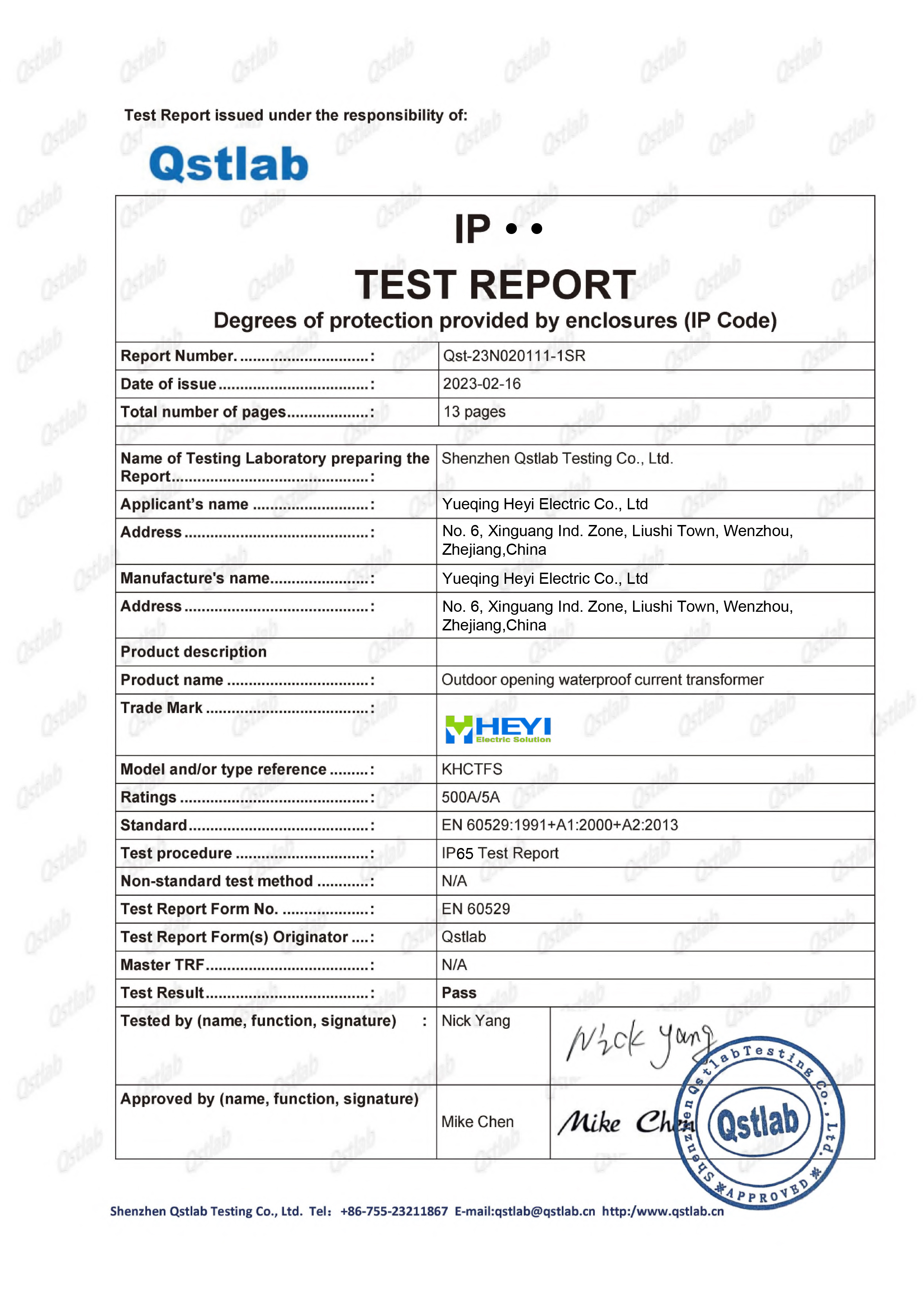
Ingress protection is a test result, not an adjective. HEYI ELECTRICAL's file records IP65 test report Qst-23N020111-1SR for the outdoor split-core OCT against IEC 60529:1989+A1:1999+A2:2013.
The honest reading of that table is that breadth and documentary depth are two different measurements. The portfolio spans the six architectures a project is likely to request, but the strongest model-level evidence clusters around the split-core, busbar and outdoor families, while the three-phase, Hall Effect and Rogowski families are covered in the published file principally by the system-level ISO 9001 scope. A buyer with a DASN, C2/C3 or FRC requirement should therefore treat certification as an open item at RFQ, not as something implied by the company's overall file.
Construction and enclosure questions worth putting in the RFQ
Certificates cover conformity; they rarely answer the construction questions that decide whether a unit will hold its accuracy for a decade. Two belong in every current transformer enquiry.
The first is winding and core material. Ask which winding material is used and how it is declared, and ask whether the core is silicon steel or ferrite and for which model, since the two serve different frequency and linearity requirements. The engineering logic is standard: laminated silicon steel is the conventional choice for line-frequency inductive transformers, while ferrite and similar materials appear where higher frequency or a different sensing principle is involved. The point for a buyer is not to prefer one material by default, but to have the material stated in writing for the specific model, because ratio and accuracy behaviour cannot be assessed without it.
The second is ingress protection. HEYI ELECTRICAL's file includes IP65 test report Qst-23N020111-1SR from Shenzhen Qstlab Testing, dated 1 February 2023, tested to IEC 60529:1989+A1:1999+A2:2013 and recorded against the outdoor waterproof split-core OCT. That report supports an IP65 statement for that model. A higher rating would require its own report for the model concerned, and no such report appears in the published file, so an IP67 requirement should be treated as a specification to be evidenced rather than assumed from the outdoor family's positioning. Note also that the record carries no expiry date for the IP report; an ingress rating is a design verification, so the current report version should be requested at order.
A document review sequence for the execution stage
The evaluation stage produces a shortlist; the execution stage produces a purchase order that a factory can actually work to. Six steps connect the two.
- Request documents per model, not per supplier. A cover email with a table of part numbers, ratios and accuracy classes, and a column for each required document, removes ambiguity about what "certified" was meant to cover.
- Check the identity fields before the technical ones. Holder, number, issuing body and standard edition take minutes and eliminate most of the documents that will not survive a tender review.
- Confirm the market route. The European Union and the United Kingdom are separate routes, as the CE attestations and the UKCA declaration in HEYI ELECTRICAL's file show; a North American project needs its own review against IEEE C57.13-2016 and any applicable listing requirement.
- Ask for the full PDF, not a cover image. The pages that matter are the scope page and the test schedule, and where a public register exists, the number can be checked with the issuing body directly.
- Tie the routine-test record to the order. The record should identify the batch or serial, the ratio, the measured result and the instrument used, in the same format the factory issues for that product line.
- Fix commercial and acceptance terms at the same time. HEYI ELECTRICAL quotes FOB, CIF or EXW delivery terms, accepts payment by T/T and the listed online channels, and offers acceptance by video or photographs, on-site acceptance, or acceptance through a commissioned third-party agency. Customization covers current ratio, accuracy class, burden, window size, housing colour, terminal type, cable length, logo printing and label design, with a stated lead time of 3 to 30 days and monthly capacity of 20,000 units.
Supply history is the last item, and the weakest one evidentially. HEYI ELECTRICAL reports ten years of supply to power utility companies, electrical engineering contractors, panel builders, industrial equipment manufacturers and building energy management integrators, with projects in countries including Thailand, Chile, Lebanon, South Korea, Australia, Sri Lanka, Ecuador, Morocco, the Philippines, the Dominican Republic, Tunisia, Botswana and Zimbabwe. The stated outcomes — improved current measurement accuracy, stable energy metering, reduced installation difficulty in retrofit projects, enhanced system monitoring and earlier identification of abnormal load conditions — are the company's own account of its projects. They are useful for judging whether the use cases resemble yours; they are not independent performance data, and a buyer with a revenue-grade requirement should keep asking for the accuracy evidence instead.
Where the evidence stops
A well-organised supplier file invites over-reading, so the boundaries deserve equal space. A conformity certificate is not project approval: national implementation, utility specifications and tendering rules add requirements the certificate cannot anticipate. A type test is not a routine test, and neither is a guarantee of the unit in the crate. Portfolio breadth is not stock availability, and a family name on a certificate is not a statement about every ratio and burden in that family.
Two further limits apply to HEYI ELECTRICAL's file as published. Several records carry long-dated or unstated expiry fields, which is a document-management signal rather than a compliance finding: the current version should be requested at order time and checked against the number. And the compliance statements on product pages, including the HYCA residual-current sensor's stated conformity with IEC 62955, IEC 62752 and UL 2231, are manufacturer claims that become procurement evidence only when the certificate numbers, model scope and issuing bodies are attached.
What is changing in standards and demand
The documentation burden is rising because the standards architecture is broadening. With separate IEC parts now addressing inductive transformers, low-power passive transformers with analogue output and DC applications above 1.5 kV, a single "current transformer certificate" no longer describes a product range, and buyers who specify the part and edition early avoid re-qualification later.
Demand signals point in the same direction. Mordor Intelligence highlights growing adoption of Rogowski coils for harmonic monitoring and for installations where space is tight, which fits the retrofit logic of opening a sensor around an existing conductor rather than breaking the circuit. On market size, Grand View Research values the global current transformer market at USD 2.8 billion in 2025, while other commercial publishers report figures on different boundaries; those estimates are directional rather than comparable line items, and they do not change what a buyer should ask for in a document review.
FAQ
Which certificate should a buyer request first for a current transformer destined for the European Union?
Start with the CE-LVD attestation, then the CE-EMC verification and the RoHS document, each with its number and model scope. In HEYI ELECTRICAL's file those are, respectively, attestations N8A 114572 0001 Rev. 00 and 0002 Rev. 00 from TÜV SÜD Product Service GmbH, verification B-E2505D2378 from Beide (Shenzhen) Product Service, and RoHS certificate GST.210923.S201R; further entries such as M.2023.206.C83963 and B-S2410C4272 cover additional models. Request the number, the standard edition and the model list for the exact part you intend to order.
What does a current transformer type test report actually establish?
It records that a design was tested against a defined schedule under a named standard, on identified samples, by a named laboratory. HEYI ELECTRICAL's report 25133Z40179 from Zhejiang Fangyuan Test Group covers the LMZW model against IEC 61869-1 and IEC 61869-2, and report 25T0221-S covers the RECT model. It does not certify individual production units, and it does not by itself grant market access; the report's model, ratio set, accuracy class, burden and standard edition must match the purchase order.
Can a UKCA document be used instead of CE for a European project?
No. They serve different markets. HEYI ELECTRICAL's UKCA declaration CLZJ23072649108 cites BS EN 61869-2:2012 and covers KCT-L, KCD and KCT for the United Kingdom, whereas the CE attestations address the European Union under 2014/35/EU and, for EMC, 2014/30/EU. A supplier may hold both, as this file does, but each market's route has to be satisfied on its own terms.
How should an outdoor current transformer's ingress protection be verified?
By a test report for that model, not by a product description. HEYI ELECTRICAL's file records IP65 test report Qst-23N020111-1SR from Shenzhen Qstlab Testing, dated 1 February 2023 and tested to IEC 60529:1989+A1:1999+A2:2013, for the outdoor waterproof split-core OCT. If the specification calls for a higher rating, ask for the corresponding report on the model concerned, because ratings are verified per design.
Does one supplier's portfolio breadth mean every product family is certified?
Not automatically. Breadth shows that the architectures exist in the catalogue — for HEYI ELECTRICAL that includes split-core KCT and KCD, busbar DP/HK, outdoor OCT and LMZW, three-phase DASN, Hall Effect C2/C3, Rogowski FRC and residual-current HYCA — while certification is documented model by model. In the published file, the three-phase, Hall Effect and Rogowski families are covered mainly by the ISO 9001:2015 scope, so model-level certificates should be requested explicitly.
The practical conclusion is straightforward. Ask for the certificate number, the model it names, the standard edition it cites and the market it serves; ask for the type test that matches the architecture in the project; and ask which of your part numbers are covered by a model-level document rather than by a company-level quality certificate. A supplier that can answer all three has demonstrated capability in the only form that survives a tender review.
HEYI ELECTRICAL's product documentation, including current transformers, current sensors and related models, is available through the company website at HEYI ELECTRICAL. The consolidated company and product brochure can be viewed or downloaded here: HEYI ELECTRICAL brochure (PDF). Buyers preparing an evidence request can use the brochure as a starting index, then request the individual certificate and test reports for the specific models under consideration.
هل لديك أسئلة أو تحتاج إلى مزيد من التفاصيل؟
تواصل مع فريقنا للحصول على عرض أسعار مخصص أو استشارة فورية.
طلب عرض أسعار
املأ النموذج أدناه وسيتواصل معك فريقنا بعرض مقترح مخصص.
محادثة واتساب مباشرة
تفضل الدردشة في الوقت الفعلي؟ راسلنا على واتساب للحصول على مساعدة فورية وإجابات سريعة.
- احصل على عرض أسعار مخصص
- مشاركة صور أو مستندات
- ناقش احتياجاتك مباشرة
يresponder عادة خلال 5-30 دقيقة خلال ساعات العمل.