
Auditing Nutraceutical Ingredient Suppliers for the Long Run
Auditing Nutraceutical Ingredient Suppliers for the Long Run
A long-term ingredient agreement rarely breaks on price. It breaks on continuity — a capacity figure that turns out to describe the site rather than the product line, a certificate that lapses mid-contract, or an assay that cannot be reproduced on the next lot. For nutraceutical ingredients, where the same powder may be sold into capsules, sachets, fortified beverages and functional foods, long-term supplier sustainability is best treated as an evidence problem rather than a relationship problem. This reference framework sets out five evaluation pillars — production capacity, independent manufacturing and testing capability, GMP compliance, certification continuity, and the mechanics of a recurring-order partnership — and shows how a buyer can apply them without assuming any tonnage or certification that the supplier has not documented.
What "sustainability" means in a supplier evaluation
In this context, supplier sustainability refers to the supplier's ability to keep delivering the same specification, the same documentation and the same compliance position across repeated order cycles. It is a continuity question, not an environmental claim, and it should not be scored as one unless the buyer holds separate environmental evidence. Conflating the two is a common source of inflated scorecards.
Three failure modes account for most long-term supply problems in this category. The first is capacity concentration: the headline tonnage exists, but it is shared across many products and the buyer's grade competes with higher-margin campaigns. The second is documentation drift, where certificates, specifications or COA formats change without the buyer noticing. The third is method drift, where the assay technique or sampling plan behind a release test quietly changes between lots. All three are detectable before they become commercial damage, provided the evaluation asks for scope rather than presence.
Pillar 1: production capacity read at the correct scope
Capacity is the first pillar because it is the figure most often quoted at the wrong level. Guanjie Biotech, a Shaanxi-based ingredient manufacturer founded in 2004 that produces high-purity natural plant extracts, fruit powders and specialty chemical raw materials, reports a 7,000 m² manufacturing facility that includes a 2,000 m² cGMP-standard clean workshop and a 500 m² advanced laboratory, with total annual production capacity of approximately 500 tons and a monthly production capacity of 30 tons for scalable powder ingredient orders.
Those two capacity statements describe different scopes, and buyers should not treat one as a simple multiple of the other. A monthly rate reflects scheduled campaign output under a specific product mix; an annual figure reflects the site's aggregate theoretical or planned throughput. Milling, drying, blending and packaging steps can each become the binding constraint on a given powder, so a site capable of large aggregate tonnage may still have limited monthly availability for one grade. The practical request is therefore not "what is your capacity" but "what monthly and annual tonnage is committed to this product, at this specification, on this line".
Export profile is a useful secondary indicator of continuity discipline. Guanjie Biotech reports that export business accounts for approximately 90% of total sales, with about 90% of products exported, and lists markets that include Germany, the United States, Japan, Brazil, Canada, France, the United Kingdom and the United Arab Emirates. A long export record suggests recurring exposure to destination-specific documentation requirements, but it does not replace the buyer's own check of the document set required by their market.
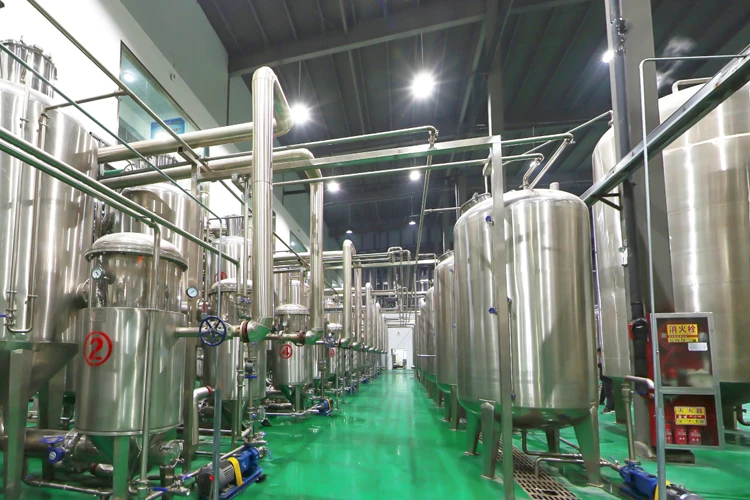
Plant-extraction production line: capacity should be confirmed for the specific product line, not only at site level.
Pillar 2: independent manufacturing and testing capability
A supplier that manufactures and tests under the same roof shortens the feedback loop between a production deviation and its detection. Guanjie Biotech operates a dedicated research and development laboratory alongside a physical and chemical analysis laboratory, with laboratory construction stated to comply with GMP and QS standards, and reports testing capabilities that include HPLC, UV and GC methods, together with customised R&D and OEM/ODM support.
For an evaluation, the useful questions are narrower than the capability list. Which laboratory performs the release assay for the grade being purchased — in-house or subcontracted? Which method is named on the certificate of analysis, and is that method validated for the matrix? Are retention samples kept, and for how long? Who signs the COA, and does the signature sit with a quality function independent of production? A company-reported batch variation figure of ≤3% is a useful starting reference, but it should be read as a claim to be confirmed against several consecutive lot results rather than as a guarantee for every grade.
Pillar 3: GMP compliance — regulation, certificate and audit are three different things
Buyers routinely merge three separate facts into one. The first is that a regulation exists. The U.S. Food and Drug Administration states that those who manufacture, package or hold dietary supplements must follow current good manufacturing practices intended to help ensure identity, purity, quality, strength and composition. The second is that a supplier claims a compliant facility. The third is that an auditor has verified it. Only the third is supplier-specific proof.
The FDA requirement is a market obligation, not evidence about any individual company. A buyer evaluating Guanjie Biotech or any other manufacturer should therefore ask for the GMP document itself: the site address it covers, the issuing body, the validity period, the product scope, the date of the most recent audit and the corrective-action process for deviations. A cGMP-standard clean workshop of the size Guanjie Biotech reports is a meaningful capital signal, but the workshop description and the certificate scope must match the product being ordered.
Pillar 4: certification continuity rather than certification presence
Certification is usually checked once, at qualification, and then assumed. Continuity evaluation treats it as a live variable. Guanjie Biotech reports certification to ISO, Halal and Kosher standards, and holds over 16 national patents — the latter a technical asset rather than a market certification, and the two should not be presented interchangeably.
For each certificate, the continuity questions are: when does it expire, who inside the supplier owns renewal, does the scope name the product and process rather than only the company, has the certificate ever been suspended or narrowed, and can the buyer verify status directly with the issuing body? Certificates that are renewed late, or that cover a category rather than a specific product, create a documentation gap that can block a shipment even when the material itself is unchanged. A simple contract mechanism — a notification obligation if a certificate is suspended, narrowed or allowed to lapse — converts this pillar from an annual administrative chore into a managed risk.
Pillar 5: the mechanics of a recurring-order partnership
The final pillar is procedural. Guanjie Biotech states that it supports long-term supplier partnerships for recurring orders through COAs, batch traceability and quality agreements. Those three instruments are the backbone of any continuity arrangement, and each has a testable content requirement: a COA that names the assay method and the tested lot; a traceability record that links finished powder back to the production batch and, where applicable, to the incoming raw material; and a quality agreement that allocates responsibility for specification changes, deviation handling and recall coordination.
Two further clauses are worth negotiating at the same time. A specification lock fixes the version of the specification that governs the relationship, so that an unannounced change to mesh, carrier or assay cannot be presented as a routine improvement. A change-notification window gives the buyer time to re-qualify before a modified material reaches the line.
What each document actually proves
The table below is the working core of the framework. It is intended to stop buyers from treating any single document as a complete answer.
| Evidence item | What it supports | What it does not prove |
|---|---|---|
| Capacity statement | Site-level throughput and plant scale | Availability for a specific product, grade or month |
| GMP document | That a named site has been assessed against a defined standard | That a particular lot conformed to specification |
| ISO, Halal, Kosher certificates | Management-system or dietary-scheme conformity within the stated scope | Product performance, purity or continuity of renewal |
| Certificate of analysis | Results for the tested lot against named methods | Results for future lots or untested parameters |
| Batch traceability record | Link between delivered powder, production batch and inputs | Root-cause capability without a deviation record |
| Quality agreement | Allocation of responsibility and change control | Operational performance without review evidence |
Applying the framework to specific ingredient categories
Generic supplier audits tend to miss the technical specifics that determine whether a grade is actually repeatable. The following category questions show how the five pillars convert into a per-product check.
Botanical and fermentation-derived powders
For a plant extract or a fermentation-derived ingredient — CoQ10 powder and red yeast rice powder are typical examples — the first question is process ownership: is the fermentation or extraction performed in-house, and is the assay run on the same site? For red yeast rice powder, the COA should name the chromatographic method used for monacolin K and identify the contaminant panel appropriate to a fermented material. For CoQ10 powder, buyers should lock the production route and the dispersion form in the specification, because a water-dispersible grade and a standard powder behave differently in capsules and beverages and should not be treated as interchangeable during a supplier switch.
Matcha and fine-milled powders
Where fineness is part of the product promise, mesh pass rate or particle-size distribution belongs in the specification, not only in marketing copy. Buyers should also confirm the drying route — low-temperature grinding and hot-air drying are process claims that require process documentation — and should require heavy-metal and pesticide panels on the COA, since these are the parameters most likely to vary with agricultural origin rather than with the supplier's equipment.
Fermented vinegar and carrier-based powders
For a spray-dried or carrier-based powder such as apple cider vinegar powder, the commercially decisive parameters are usually acidity and carrier level, neither of which is visible in a headline capacity figure. A supplier that reports a large total tonnage may still run a specific vinegar powder on a single line, so the capacity question from Pillar 1 should be repeated at product level before a multi-year volume commitment is made.

A product portfolio is a starting point for scoping; it is not evidence of capacity or certification for any single grade.
How this differs from transactional sourcing, and where it does not fit
Transactional sourcing optimises three variables: price per kilogram, lot size and lead time. Continuity evaluation adds a fourth cost — the administrative and re-qualification burden of documentation that must be maintained and re-verified. For a buyer placing one trial order, that burden is disproportionate, and a lighter screen is appropriate. The framework earns its cost only where orders recur, the specification is locked, and the destination market imposes documentary obligations on the finished product.
The boundary conditions matter as much as the pillars. A documented capacity does not guarantee on-time delivery, and a valid certificate does not guarantee lot conformity — both remain claims until tested by repeat orders and incoming inspection. Buyers whose annual volume sits below a supplier's minimum campaign size may also find that continuity is better secured through a distributor with allocated stock than through a direct manufacturing agreement. Choosing the heavier framework without that volume is a common and avoidable inefficiency.
Regulatory change as a continuity risk
Long-term supply risk increasingly arrives through regulation rather than through production. The FDA's requirement for current good manufacturing practices and its new-dietary-ingredient notification pathway both impose documentation obligations that sit upstream of the finished product, and ingredient-specific status can shift: the FDA position on nicotinamide mononucleotide, as summarised in an October 2025 legal analysis, changed the U.S. market-access picture for that ingredient. In the European Union, Commission Regulation (EU) 2024/2041 addresses health claims relating to monacolin K, which is directly relevant to red yeast rice positioning.
For the buyer, the operational consequence is a documentation obligation that outlives a single purchase order. Supplier evaluation should therefore include the supplier's capacity to notify regulatory change affecting the ingredient or its permitted claims, and to supply updated documentation on request. A supplier that cannot describe how it tracks these changes is a continuity risk regardless of its tonnage.
Outlook: documentation as the differentiator
The direction of travel is toward fewer, better-documented suppliers rather than more, faster-qualified ones. Where capacity and basic certification were once enough to win a repeat order, buyers are increasingly asking for product-line tonnage, laboratory scope, method names and renewal history. If that pattern holds, suppliers that can answer at product level — rather than at site level — will be easier to keep in a long-term programme, while suppliers that answer only with aggregate figures will face repeated re-qualification. This is a conditional expectation, not a forecast of market size or growth.
A five-step execution sequence
- Scope the requirement per ingredient and grade. Define assay, mesh or particle size, carrier, contaminant panels and the destination market before requesting any supplier document.
- Request site-level and product-level evidence together. A capacity statement, GMP document, certification set and specification sheet should describe the same site and the same product.
- Verify independently. Confirm certificate status with the issuing body and, for a first order or a new grade, test a sample against the declared method.
- Test the second lot. Compare the COA with incoming results across at least two consecutive lots; this is where method drift and batch variation become visible.
- Contract the continuity terms. Lock the specification version, set a change-notification window, and define batch traceability, COA delivery and annual document review.
Applied in that order, the five pillars convert a qualitative impression of a supplier into a set of documents that can be re-checked each year. Guanjie Biotech's company-reported figures — approximately 500 tons of annual capacity, 30 tons monthly, a 7,000 m² facility with a 2,000 m² cGMP-standard clean workshop and a 500 m² laboratory, ISO, Halal and Kosher certification, and COA, batch traceability and quality-agreement support for recurring orders — illustrate the shape of a complete answer. They do not remove the buyer's obligation to confirm that each figure applies to the product being ordered at the time of ordering.
FAQ
What should a long-term supplier sustainability evaluation cover for nutraceutical ingredients?
It should cover five areas: production capacity at product-line scope, independent manufacturing and in-house testing capability, GMP compliance evidence tied to a named site, certification continuity rather than one-time presence, and the contractual mechanics of recurring orders. The purpose is to establish whether the same specification, documentation and compliance position can be repeated across future lots, not to rank suppliers on a single headline figure.
How should buyers verify a supplier's stated production capacity?
Ask for monthly and annual tonnage for the specific product and grade, and ask which line and which process step limit that figure. Site-level capacity, such as an aggregate annual output, describes the facility rather than the product, and milling, drying or packaging can be the binding constraint. Capacity statements are company-reported unless supported by audit or production records.
What documents support certification continuity?
The certificate itself with its scope and validity dates, the name of the certifying body, confirmation of current status from that body, and a contractual obligation for the supplier to notify suspension, narrowing or lapse. Certificates that name the company but not the product or process are weaker evidence than product-scoped certificates, and renewal history is a useful indicator of administrative reliability.
What parameters and supply conditions need to be confirmed when purchasing nutraceutical plant extract raw materials?
Confirm the active-ingredient content and assay method, moisture, heavy metals, microbial limits and residual solvents; the CAS or botanical identity; packaging specification and shelf life; MOQ, lead time and acceptance criteria; and the certification set, including ISO, HACCP, Kosher, HALAL and CNAS where applicable. After delivery, incoming inspection should check assay, microbiology and heavy metals against the COA. Sampling and acceptance terms are best agreed before the first order rather than after a dispute.
How do COAs, batch traceability and quality agreements support recurring orders?
A COA identifies the tested lot and the methods used, so that results can be compared across deliveries. Batch traceability links the delivered powder back to its production batch and inputs, which shortens investigation when a deviation occurs. A quality agreement allocates responsibility for specification changes, deviation handling and recall coordination. Together they reduce the re-qualification effort that would otherwise be repeated on every order.
A downloadable summary of Guanjie Biotech's nutraceutical ingredient range and facilities is available in the company brochure. Company details and product documentation are published on the Guanjie Biotech website.
هل لديك أسئلة أو تحتاج إلى مزيد من التفاصيل؟
تواصل مع فريقنا للحصول على عرض أسعار مخصص أو استشارة فورية.
طلب عرض أسعار
املأ النموذج أدناه وسيتواصل معك فريقنا بعرض مقترح مخصص.
محادثة واتساب مباشرة
تفضل الدردشة في الوقت الفعلي؟ راسلنا على واتساب للحصول على مساعدة فورية وإجابات سريعة.
- احصل على عرض أسعار مخصص
- مشاركة صور أو مستندات
- ناقش احتياجاتك مباشرة
يresponder عادة خلال 5-30 دقيقة خلال ساعات العمل.