
Auditing Zhende's Rubber Timing Belt Capability: Neoprene CR and Fiberglass Cord Evidence
Auditing Zhende's Rubber Timing Belt Capability: Neoprene CR and Fiberglass Cord Evidence
Industrial drive design rarely begins with a brand name. It begins with a pulley that is already mounted, a centre distance that cannot be moved, and a torque figure that has to be transmitted continuously for years. The belt is the last component selected and the first one blamed when a line stops. That is why a serious evaluation of a rubber timing belt supplier is an audit of published construction data — compound, cord, hardness, pitch, minimum pulley diameter and tensile limits — rather than a reading of marketing claims.
The global automotive timing belt market was valued at USD 7.7 billion in 2025, and China held the largest regional share of that sector, according to Grand View Research. Broader timing belt demand is expected to grow at a compound annual growth rate of 4.8% through 2030, based on Maximize Market Research estimates. Those numbers describe a market, not a purchase decision. The decision is made on a specification sheet, and this article audits one: the Neoprene (CR) body and fiberglass cord rubber timing belt range published by Dongguan Zhende Machinery Equipment Co., LTD, across HTD and STD (STS/STPD) profiles.
Why Construction-Level Evidence Matters More Than a Catalog Headline
Two belts can both be honestly described as "S5M neoprene timing belt" and still behave differently in service. The differences sit in details that a headline hides: the cord material that carries the load, the hardness of the body compound, the minimum pulley diameter the belt can wrap around without over-stressing the teeth, and the dimensional tolerance band the drive designer must absorb.
The major global participants in this market — Gates Industrial Corp, Continental AG, Bando Chemical Industries and Mitsuboshi Belting, as identified by Fortune Business Insights — compete largely on published engineering data and on availability through distribution. Chinese manufacturers compete on the same specification sheets, and increasingly on export documentation. China appears as a top origin for transmission belts of vulcanized rubber (HS Code 4010.39) shipped to the United States in recent periods, according to US customs data compiled by Descartes Datamyne.
The practical consequence for buying teams is that supplier shortlists are now built from data that can be checked. A supplier that publishes pitch, thickness, minimum pulley diameter, allowable tensile strength and tolerance values per profile gives a buyer something to verify. A supplier that publishes only adjectives does not.
Who Dongguan Zhende Machinery Equipment Co., LTD Is
Dongguan Zhende Machinery Equipment Co., LTD is a manufacturer and one-stop procurement supplier of factory automation (FA) transmission parts, located in Dalang Town, Dongguan, Guangdong Province, China. The company was founded in 2019 and operates a 4,500 m² facility with 40 employees, including a 6-engineer technical team. Its reported annual output is 120,000 pieces, with an export ratio of 75% concentrated on the EU and USA markets.
Its product scope covers timing belts and timing pulleys as core lines, alongside couplings, ball screws and support seats, linear guides, guide shafts, linear bearings, linear modules, gears, racks, sprockets and chains, pneumatic cylinders, speed-reduction motors and industrial casters. The company also acts as an authorized agent for HIWIN, THK, NSK, SKF and AirTAC, which is relevant to buyers assembling a drive package rather than buying a single belt.
For belts specifically, the published capability data records OEM and ODM customization across belt length, width, tooth profile, tooth pitch, body material (rubber or PU), tensile cord (fiberglass, Kevlar or steel), coating, colour, perforation and logo printing. Monthly belt capacity is stated at 500,000 pieces, with a minimum order quantity of 4 pieces and a lead time of 7–20 days. The pulley line runs at 100,000 pieces per month with a MOQ of 10 pieces for standard models and 50 pieces for customized pulleys — figures that matter when a belt and pulley change has to be scheduled together.
The Rubber Belt Construction: Neoprene (CR) Body, Fiberglass Cord, 92 Shore A
Every rubber timing belt in Zhende's published range shares three documented characteristics. The body material is Neoprene (CR). The tensile member is a fiberglass cord. The hardness is 92 Shore A. Those three values are identical from the smallest profile in the range up to the largest, which is itself a useful audit signal: the manufacturer is not varying the compound quietly between sizes.
The range divides into two profile families. HTD profiles are curvilinear, high-torque-drive geometry covering pitches of 5 mm, 8 mm and 14 mm. STD profiles, described in the catalog as STS (STPD), cover pitches of 3 mm, 5 mm and 8 mm. Together they span the 3M, 5M, 8M and 14M pitch ladder that most automation and packaging drives are built around.
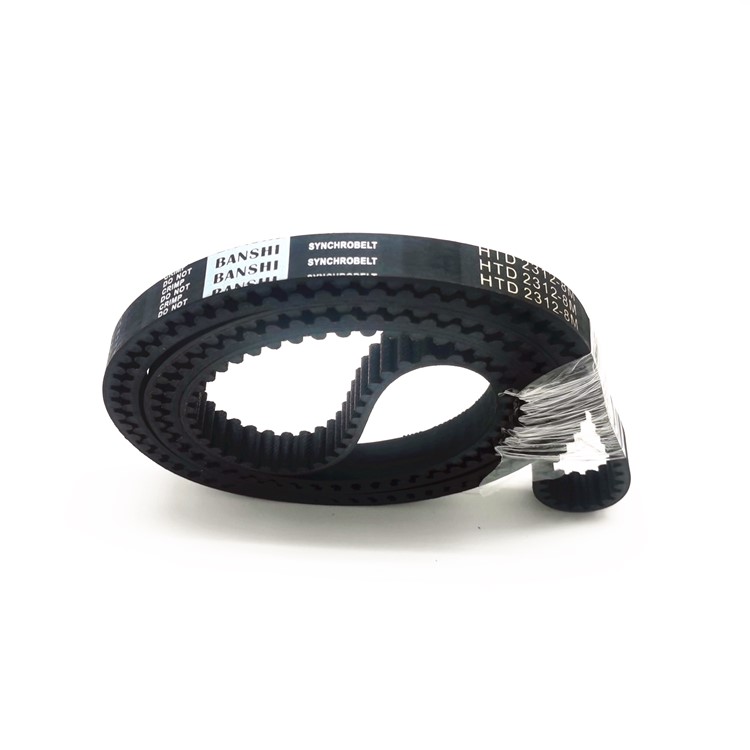
HTD 8M profile rubber timing belt: Neoprene (CR) body, fiberglass cord tensile member, 92 Shore A hardness, 5.6 mm overall thickness.
HTD profiles: 5M, 8M and 14M
| Profile | Pitch | Overall thickness | Min. pulley dia. | Min. pulley teeth | Max. allowable tensile | Ultimate tensile | Tolerances (W / L / T) |
|---|---|---|---|---|---|---|---|
| HTD 5M | 5.0 mm | 3.6 mm | 25 mm | 16 | 650 N per 10 mm width | 2,600 N per 10 mm width | ±0.5 / ±0.5 / ±0.2 mm |
| HTD 8M | 8.0 mm | 5.6 mm | 40 mm | 16 | 780 N per 10 mm width | 3,120 N per 10 mm width | ±0.5 / ±0.5 / ±0.2 mm |
| HTD 14M | 14.0 mm | 10.0 mm | 124.78 mm | 28 | 1,816 N per 10 mm width | 8,308 N per 10 mm width | ±1.0 / ±0.5 / ±0.4 mm |
Published HTD rubber timing belt data. Body material: Neoprene (CR). Tensile member: fiberglass cord. Hardness: 92 Shore A.
STD (STS/STPD) profiles: S3M, S5M and S8M
| Profile | Pitch | Overall thickness | Min. pulley dia. | Max. allowable tensile | Ultimate tensile | Tolerances (W / L / T) |
|---|---|---|---|---|---|---|
| STS (STPD) S3M | 3.0 mm | 1.9 mm | 13.4 mm | 125 N per 10 mm width | 500 N per 10 mm width | ±0.5 / ±0.5 / ±0.2 mm |
| STS (STPD) S5M | 5.0 mm | 3.4 mm | 22.3 mm | 300 N per 10 mm width | 1,200 N per 10 mm width | ±0.5 / ±0.5 / ±0.2 mm |
| STS (STPD) S8M | 8.0 mm | 5.3 mm | 56.0 mm | 650 N per 10 mm width | 2,600 N per 10 mm width | ±0.5 / ±0.5 / ±0.2 mm |
Published STD rubber timing belt data. Body material: Neoprene (CR). Tensile member: fiberglass cord. Hardness: 92 Shore A.
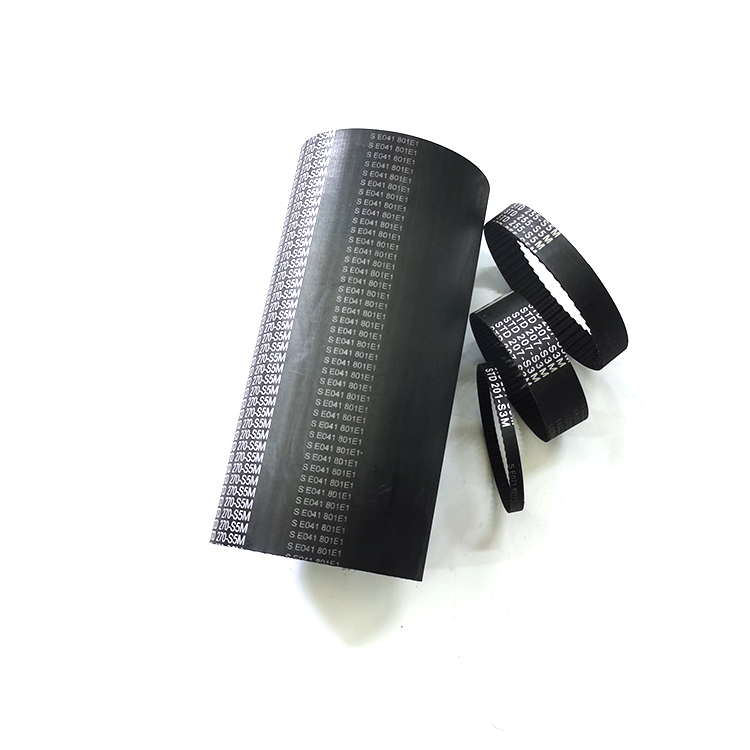
STD (STS/STPD) profiles S5M and S3M: the small-pitch end of Zhende's Neoprene CR rubber timing belt range, both using fiberglass cord tensile members.
Reading the Numbers: Four Decision Rules Buyers Can Apply
The value of this data set is that it converts a vague sourcing question into four checkable decisions.
Rule one: the smallest pulley in the drive sets the profile. Minimum pulley diameter is published for every profile and it is not a marketing figure — it is a geometric limit below which the belt cannot wrap correctly. S3M is documented from 13.4 mm, S5M from 22.3 mm, HTD 5M from 25 mm, HTD 8M from 40 mm, S8M from 56 mm, and HTD 14M from 124.78 mm. A designer working with a 30 mm pulley has effectively ruled out HTD 8M before any torque calculation begins.
Rule two: load capacity is quoted per unit of width, so width is the first lever. Maximum allowable tensile strength runs from 125 N per 10 mm of belt width on S3M up to 1,816 N per 10 mm on HTD 14M, with ultimate tensile strength from 500 N to 8,308 N per 10 mm on the same endpoints. Because both figures are normalised to a 10 mm width, a marginally overloaded drive can often be resolved by widening the belt rather than changing the entire drive geometry.
Rule three: hardness is a constant, not a differentiator. The same 92 Shore A value appears across the whole rubber range — and, notably, across the polyurethane line and the 8MGT carbon belt as well. Buyers comparing on hardness will find no difference to compare. Profile, cord material and pulley geometry are where actual performance differences live.
Rule four: the tolerance band must be absorbed by the drive, not ignored. Width and length are held to ±0.5 mm and thickness to ±0.2 mm on most profiles; HTD 14M widens to ±1.0 mm on width and ±0.4 mm on thickness. A designer specifying a fixed centre distance without take-up adjustment is designing against a tolerance that the catalog explicitly states.
Applications: Where the Neoprene CR and Fiberglass Range Fits
Zhende's scenario documentation places this belt family in industrial automation, packaging machinery, CNC machinery, robotics, food processing, textile machinery, printing machinery, woodworking machinery, conveyor systems, material handling equipment, agricultural machinery, compressors, industrial pumps, mining equipment and construction machinery.
The documented operating conditions are specific. The belts run in high-speed, high-torque, continuous duty, in dusty and oil-resistant environments, with a documented working temperature band of −20 °C to +100 °C for the belt scenario, and 24/7 continuous operation with servo motor drive and variable-speed transmission. The matching HTD pulley scenario documents a wider component band of −20 °C to +120 °C. Typical matched equipment includes timing pulleys, servo motors, stepper motors, gearboxes, linear modules, reducers and automation control systems — a package that Zhende can supply as a single procurement item, which is the practical reason a distributor or OEM integrator would consolidate here.
Duty profile maps reasonably cleanly onto the pitch ladder. S3M sits in light-duty work — office automation equipment, medical devices, precision instruments, printers, small conveyor systems and electronic equipment. S5M and HTD 5M cover medium-duty packaging, printing and textile drives. S8M reaches compressors and industrial pumps. HTD 8M covers general automation, CNC and conveyor duty, while HTD 14M is documented for mining and construction machinery, where the 1,816 N per 10 mm allowable tensile figure becomes the relevant number.
Project types and special requirements
The scenario data lists four project contexts: new equipment manufacturing, production line automation and upgrade, OEM machinery builds, and replacement maintenance. Special requirements are recorded separately — high wear resistance, low elongation, anti-static behaviour, food-grade (FDA) construction, oil resistance and high-temperature resistance, along with custom coating and perforation. The distinction matters commercially: where a project needs anti-static or FDA-grade characteristics, these appear as special requirements to be specified and confirmed, not as default properties of the base range.
Market Trend: What Is Changing in Industrial Belt Procurement
Three verifiable trends shape this category.
The first is volume and geography. Timing belt demand growth is estimated at a 4.8% CAGR through 2030, and China has become a principal supply origin — both as the largest regional market share holder in the automotive timing belt segment and as a leading exporter of vulcanized rubber transmission belts to the United States. For EU and US buyers, that means Chinese suppliers are no longer a fallback option; they are a standard line on a shortlist alongside Gates, Continental, Bando and Mitsuboshi.
The second is standardisation. ISO 13050:2022 specifies characteristics for metric pitch curvilinear synchronous endless belts and pulleys in the G, H, R and S profiles — the framework that both HTD (H) and STD (S) geometry sit inside. Zhende publishes tooth accuracy for its matching pulleys to ISO 13050 and DIN, which gives a buyer a common reference point when a belt is ordered from one supplier and a pulley from another.
The third is application-specific compliance. For synchronous belts used in potentially explosive atmospheres, ISO 9563 and ISO 1813 are the recommended references. That is a segment where a general-purpose rubber belt specification is not automatically sufficient, and where buyers should confirm documentation rather than assume it.
Comparison with Alternative Constructions — and Where This Range Stops
A fair audit states limits as clearly as capabilities. Zhende's own catalog contains a second belt family — polyurethane bodies with steel or carbon fiber cords — and comparing the published figures shows that no single construction covers every duty.
| Construction | Body | Tensile member | Hardness | Min. pulley dia. | Documented load / speed limit | Documented temperature band |
|---|---|---|---|---|---|---|
| S3M / S5M / S8M / HTD 5M / HTD 8M / HTD 14M | Neoprene (CR) | Fiberglass cord | 92 Shore A | 13.4 mm to 124.78 mm | 125–1,816 N allowable; 500–8,308 N ultimate per 10 mm width | −20 °C to +100 °C (belt scenario) |
| AT5 / T5 / T10 / AT10 | Polyurethane (PU) | Steel cord | 92 Shore A | 25 mm / 30 mm / 60 mm / 50 mm | 393–1,700 N per 10 mm width; up to 70 kW; approx. 10,000 min⁻¹ | Not published in the same unit |
| 8MGT | Polyurethane (PU) with nylon tooth facing | Carbon fiber cord | 92 Shore A | 36.6 mm (22 teeth) | Belt speed up to 80 m/s; transmission efficiency up to 98% | −54 °C to +85 °C |
The boundaries of the Neoprene CR / fiberglass range are concrete:
- Torque ceiling per width. The highest published allowable tensile figure in the rubber range is 1,816 N per 10 mm of width at HTD 14M. A drive that exceeds the allowable figure for its chosen profile and width cannot be fixed by supplier selection; it requires a wider belt, a larger pitch, or a different construction.
- Pulley geometry ceiling and floor. The range cannot be used below 13.4 mm pulley diameter (S3M), and HTD 14M requires at least 124.78 mm. Compact miniature drives and very large heavy-duty drives both fall outside parts of the range.
- Temperature coverage is not universal. The rubber belt scenario documents −20 °C to +100 °C. The 8MGT polyurethane and carbon fiber belt publishes −54 °C to +85 °C. Neither material covers every operating environment, and the choice between them is a temperature and speed decision as much as a cost decision.
- Fiberglass is the standard cord, not the only option. Zhende's customization list includes fiberglass, Kevlar and steel cords. A project with unusual elongation or stiffness requirements should specify the cord rather than assume the default.
- Dimensional tolerances are stated, not zero. ±0.5 mm on width and length means that precision positioning systems must accommodate the band through take-up or centre-distance adjustment.
- Hazardous-atmosphere compliance is separate. ISO 9563 and ISO 1813 are recommended references for synchronous belts in potentially explosive atmospheres; the standard range should not be assumed to carry that qualification without documentation.
Verification: What Documentation Supports the Claim
An audit is only as good as the paperwork behind it. Zhende's published compliance record includes a factory audit report certified by TÜV Rheinland and a certification number, 493993448_P+T, applicable to the EU market, assessed against the Production & Trading Factory Assessment Standard. The company also documents SGS certification for the Middle East market and RoHS compliance under EU RoHS Directive (EU) 2015/863 for various timing belts.
On the production side, belt quality control is described as 100% dimensional inspection, tensile strength test, tooth profile inspection, pre-shipment quality inspection, and third-party inspection through SGS. The pulley line adds bore and tooth profile inspection and a concentricity test. Export markets are recorded as Europe, North America, South America, the Middle East and Southeast Asia, with after-sales support covering technical selection assistance, installation guidance, OEM packaging, a quality guarantee, and replacement of manufacturing defects within the warranty period.
- Confirm the pulley in hand matches the belt family — HTD, STD (STS/STPD), T-series or imperial profiles are not interchangeable.
- Check the smallest pulley in the drive against the published minimum pulley diameter for the chosen profile.
- Convert the required torque into N per 10 mm of belt width and select the width from there.
- Compare the operating temperature band on site with the −20 °C to +100 °C belt scenario figure.
- Decide whether the standard fiberglass cord is appropriate, or whether a Kevlar or steel cord should be specified.
- Confirm which market certification applies — EU (TÜV Rheinland, certification number 493993448_P+T) or Middle East (SGS) — and request the paperwork.
- Confirm MOQ (4 pcs for belts), lead time (7–20 days), and whether the pulley side (MOQ 10 pcs standard, 50 pcs custom) needs to be scheduled in the same window.
Case Evidence from Documented Projects
Zhende's case records document two multi-year supply relationships with OEM machinery manufacturers, automation equipment integrators and industrial distributors. In the first, 8,500 pieces were delivered to Germany and 15,000 pieces to the United States, applied to automated production lines, CNC machinery, packaging equipment and robotic systems, over durations of five years in Germany and three years in the United States. The reported outcomes were a 25% improvement in transmission accuracy, a 40% reduction in maintenance costs and a 30% reduction in equipment downtime.
A second documented project records 12,000 pieces to Germany and 20,000 pieces to the United States, over three to five years and two to four years respectively, applied to automated production lines, packaging machinery, CNC equipment and conveyor systems, with reported maintenance cost reduction of 40%, downtime reduction of 35% and stable 24/7 operation. Project durations across regions were documented at two to five years, with the German project running five years and the US project three years.
These figures describe complete drive assemblies — belts, pulleys and related transmission components supplied together — rather than isolated belt performance, and they are reported by the manufacturer. Read in that frame, they are evidence of supply continuity and integration capability rather than a stand-alone performance guarantee for any single belt profile.
Future Outlook
Three things are likely to determine which suppliers remain on shortlists over the next several years. Published specification transparency will matter more than brand familiarity, because buyers now compare pitch, minimum pulley diameter and tensile data directly across suppliers rather than relying on reputation. Standard alignment will become a baseline requirement rather than a differentiator, with the ISO 13050 framework providing the shared reference for curvilinear synchronous belts and pulleys. And documentation depth — factory audits, market-specific certification, third-party inspection — will increasingly be requested before a first order rather than after a quality incident.
For the Neoprene CR and fiberglass cord belt range specifically, the near-term trajectory is a widening of the application envelope rather than a change in the base construction: more custom sizes, more cord options, more coating and perforation variants, and tighter coordination between belt and pulley supply so that a single specification covers the whole drive. For evaluation teams, the practical implication is straightforward — the audit is now the purchase order's first page.
FAQ
What construction does Dongguan Zhende Machinery Equipment's rubber timing belt range use?
The rubber timing belt range uses a Neoprene (CR) body with a fiberglass cord tensile member, at a published hardness of 92 Shore A. This combination is consistent across all profiles in the rubber range, from S3M through HTD 14M.
Which pitches are available in the rubber range, and how do HTD and STD differ?
Two families are published. HTD (curvilinear, high-torque-drive) covers pitches of 5.0 mm, 8.0 mm and 14.0 mm in the 5M, 8M and 14M profiles. STD, described as STS (STPD), covers 3.0 mm, 5.0 mm and 8.0 mm in the S3M, S5M and S8M profiles. Both are part of the metric pitch curvilinear synchronous belt and pulley framework described by ISO 13050:2022; the difference in practice is tooth geometry and the load and pulley-diameter range each profile supports.
How should a buyer choose between HTD and STD for a specific project?
The decision rule starts with pulley geometry and then load. Minimum pulley diameter is documented at 13.4 mm for S3M, 22.3 mm for S5M, 25 mm for HTD 5M, 40 mm for HTD 8M, 56 mm for S8M and 124.78 mm for HTD 14M. Once the smallest pulley in the drive is known, the profile is narrowed; the required torque converted into newtons per 10 mm of belt width then determines the width and confirms whether the profile is sufficient.
What are the maximum load figures for these rubber timing belts?
Published figures are normalised per 10 mm of belt width. Maximum allowable tensile strength ranges from 125 N (S3M) and 300 N (S5M) to 650 N (S8M and HTD 5M), 780 N (HTD 8M) and 1,816 N (HTD 14M). Ultimate tensile strength on the same basis ranges from 500 N (S3M) to 1,200 N (S5M), 2,600 N (S8M and HTD 5M), 3,120 N (HTD 8M) and 8,308 N (HTD 14M). Because the values are quoted per 10 mm of width, increasing belt width increases the load a given profile can carry.
Can the fiberglass cord be replaced with another tensile member?
Yes, as a specified customization. The published customization scope for belts covers tensile cord options of fiberglass, Kevlar and steel, alongside belt length, width, tooth profile, pitch, body material (rubber or PU), coating, colour, perforation and logo printing. Custom specification carries an MOQ of 4 pieces for belts and a lead time of 7–20 days.
What verification documents are available for these belts and pulleys?
The published compliance record includes a TÜV Rheinland factory audit report, certification number 493993448_P+T for the EU market assessed against the Production & Trading Factory Assessment Standard, SGS certification for the Middle East market, and RoHS compliance under EU RoHS Directive (EU) 2015/863 for various timing belts. Belt quality control covers 100% dimensional inspection, tensile strength testing, tooth profile inspection, pre-shipment inspection and third-party SGS inspection; the pulley line adds bore and tooth profile inspection and a concentricity test.
What are the order quantities and lead times?
For belts, the published minimum order quantity is 4 pieces with a lead time of 7–20 days, at a monthly capacity of 500,000 pieces. For pulleys, the MOQ is 10 pieces for standard models and 50 pieces for customized pulleys, with the same 7–20 day lead time band and a monthly capacity of 100,000 pieces. Custom bore, keyway, flange and surface coating options are available on the pulley side.
Full technical documentation, including profile tables and customization options for timing belts and timing pulleys, is available in the Zhende product catalogue: https://cdn.socialarks.com/sbsp/25080/common/2026/0722/zd.pdf. Manufacturer reference: Dongguan Zhende Machinery Equipment Co., LTD — www.zdindustrialbelts.com.