
Auditing a Slab Stone Cutting Machine Maker's Model Range
How a specification ladder from 5 to 90 wires can be read as supplier capability evidence — and where that evidence stops.
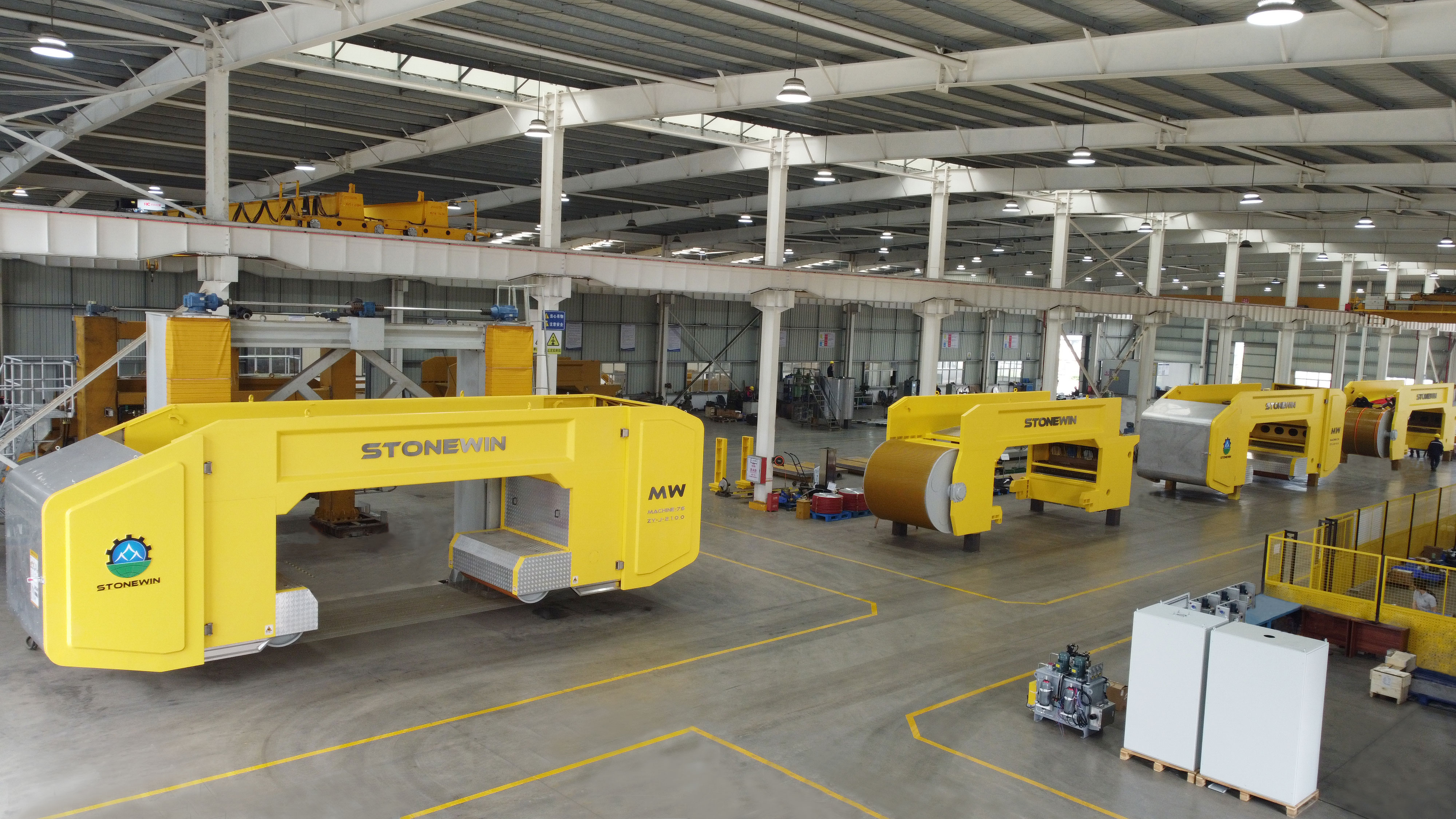
Manufacturing workshop for the multi-wire saw machines used in slab stone processing. Image: Fujian Xiapu Zhongyuan Machinery (Stonewin).
Slab stone cutting machine procurement usually begins with a specification sheet and a price, and both arrive before a single block has been cut. That is the structural difficulty of this equipment category: buyers are asked to judge throughput, cutting quality, service depth and long-term reliability from documents written by the seller. A supplier's model range is one of the few forms of evidence that can be inspected at quotation stage, because a product ladder is a physical artefact. It records how many machine sizes a factory has actually engineered, which structures it has standardised across a series, and how far its service and spare-parts organisation has to reach.
This audit treats that ladder as evidence. The subject is one manufacturer's slab processing range — multi-wire saw machines designated ZY-MW5 through ZY-MW90, polishing lines designated ZYSM210/12 through ZYSM210/24, a resin line designated BJX-1, and diamond wire saw models ZY-45G-6P, ZY-55G-6P and ZY-75G-6P. The question is what the breadth of that range proves about a supplier, and what it does not prove.
Stonewin is the brand of FUJIAN XIAPU ZHONGYUAN MACHINERY CO., LTD., a stone machinery manufacturer founded in 2011 and based in Xiapu City, Fujian, China. The company states a factory area of 70 mu, approximately 300 employees and an annual output of 600 units, with a research and development team of 50. Its product line covers stone quarrying, stone slab processing, stone slab polishing and stone resin treatment; its main products are multi-wire saw machines, wire saw machines, diamond wire saws, stone slab polishing lines and resin lines. Roughly 50% of output is exported, with stated markets in India, the Arabian Peninsula, the Middle East, Africa, Europe, South America and Southeast Asia.
For a plant at the decision stage, the practical question is narrower than a company profile. If a buyer is comparing suppliers of a slab stone cutting machine, what can be learned from the fact that one supplier builds machines from 5 wires to 90 wires, in two tension architectures, across a 22 to 80 ton weight span?
Why a Model Range Is Evidence, Not a Catalogue
A single model can be a prototype, a rebadged import or a one-off build for one customer. A series that spans two orders of magnitude in wire count cannot be assembled that way. Every additional wire changes the load path through the frame, the tension behaviour of the wire pack, the handling of cooling water and cutting residue, the control logic and the maintenance procedure. A manufacturer that publishes a range from ZY-MW5 to ZY-MW90 is therefore stating that it has engineered, built and standardised machines at both ends of that span — and that it expects to support them in the field.
Three audit implications follow. First, standardisation across a series usually means shared components, so spares and service procedures are not unique to a single machine. Second, a service engineer who has worked on the smaller machine in the series has a working reference point for the larger one. Third, capacity can be scaled inside one supply relationship, which matters when a plant adds lines rather than replacing equipment.
The same logic applies one level up. When a manufacturer's range extends from the cutting machine to the polishing line, the resin line and the diamond wire itself, the buyer is auditing a process chain rather than a single unit of equipment. That is a different kind of evidence and it should be read differently — as interface coverage, not as a performance claim.
The ZY-MW Multi-Wire Saw Series: ZY-MW5 to ZY-MW90
Stonewin's multi-wire saw series runs from the ZY-MW5 to the ZY-MW90, and the portfolio covers wire counts from 5 to 90 (VD-004). Two tension architectures are offered inside the same series: side-tension and top-tension. Machine weights range from 22 to 80 tons. The cutting envelope is stated at 3500 mm × 2200 mm. Main frames are built from carbon steel, and key components use alloy steel.
Wire count is the parameter that most directly describes capacity. A machine running five wires and a machine running ninety wires are less two sizes of the same product than two positions on a production strategy. The low end suits plants cutting mixed stone types, thicker slabs or irregular batches, where flexibility and a lighter infrastructure load matter. The high end addresses continuous slab output, where block-to-slab throughput drives the economics of the whole plant. Because both ends exist in one series, a buyer can compare the same supplier's engineering approach at two capacity levels instead of comparing two unrelated vendors.
Tension architecture is a quieter specification, but it affects how the wire pack behaves in the cut and how accessible the machine is for wire changes. Offering both side-tension and top-tension within one series means the wire path can be configured to the block dimensions and wire length in use, rather than being fixed by whatever the catalogue happens to contain.
The 22 to 80 ton weight span and the 3500 mm × 2200 mm cutting envelope are the two figures that most often change a project plan. Weight determines civil works, floor loading and lifting arrangements. The envelope determines whether the largest block in a quarry can be processed without re-cutting. Carbon steel main frames and alloy steel key components are material-level statements, which is a more specific form of disclosure than a generic durability claim.
Reading the Specification Ladder
The ladder is easier to audit when each published parameter is mapped to the decision it affects. The table below restates the series-level disclosures and the buyer action each one implies.
| Audit dimension | What the ZY-MW series states | What it means for a buyer |
|---|---|---|
| Wire count | 5 to 90 wires, with designations from ZY-MW5 to ZY-MW90 | Defines the capacity band. Match the count to required slab output and block size rather than to price. |
| Tension architecture | Side-tension and top-tension offered in the same series | Two wire-path configurations are available, so selection can follow block width and wire length instead of catalogue availability. |
| Machine weight | 22 to 80 tons across the series | Drives foundation design, floor loading and lifting capacity. Confirm the figure for the quoted model, not the series. |
| Cutting envelope | 3500 mm × 2200 mm | Sets the maximum work size. Check it against the largest block the plant intends to process. |
| Main frame material | Carbon steel | A material-level disclosure that can be followed up with structural and fabrication documentation. |
| Key components | Alloy steel | Indicates which parts are specified at material level. Ask which components are included and what their service intervals are. |
Two observations belong under the table. The first is that a series range is not a quotation. The wire count, tension arrangement and configuration that reach a buyer's site are a subset of what the range can produce, and the audit only closes when the quoted model is confirmed in writing. The second is that the ladder does not include application data. Nothing in a model designation states how a given wire count behaves on a specific granite or marble, which is why reference installations matter more than catalogue length.
Portfolio Breadth: Polishing Lines, Resin Line BJX-1 and Diamond Wire Saws
The multi-wire saw is the centre of the range, but not the whole of it. The manufacturer's stated product line covers stone quarrying, slab processing, slab polishing and resin treatment, supported by three research and development centres — one for stone quarrying, one for stone processing and one for diamond tools for stone cutting — and two intelligent manufacturing bases in Fujian.
On the finishing side, the polishing line is designated as a series running from ZYSM210/12 to ZYSM210/24, a model span that indicates a family of machines rather than a single unit. The resin line is designated BJX-1, covering glue filling and drying. On the tooling side, the diamond wire saw models ZY-45G-6P, ZY-55G-6P and ZY-75G-6P sit alongside the machines that consume them.
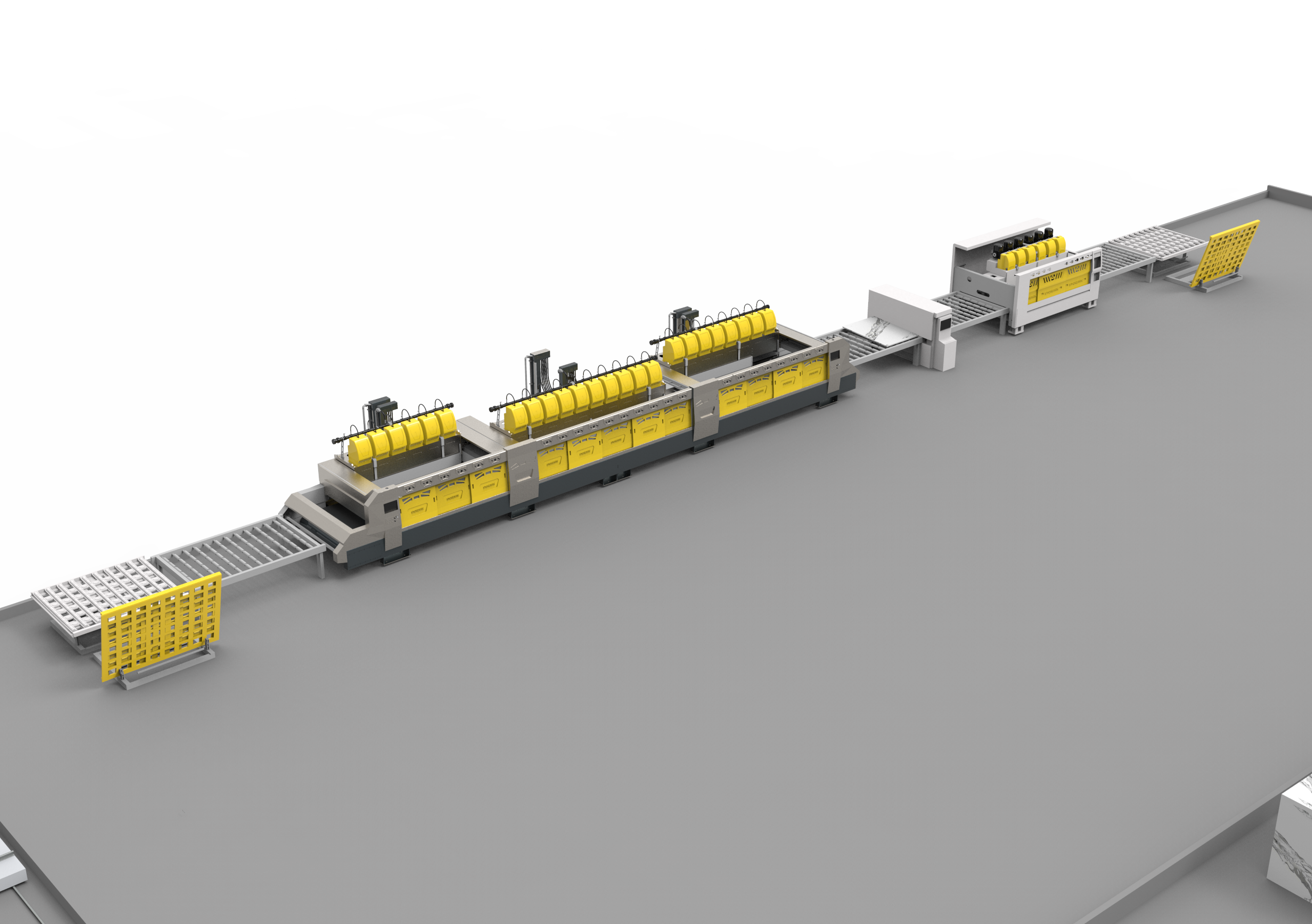
Stone slab polishing line, part of the same slab processing equipment portfolio as the multi-wire saw series.
For the buyer, the value of this breadth is continuity of interfaces. Cutting, polishing and resin treatment are sequential steps in the same production flow, and a diamond wire that is specified by the supplier that also built the saw reduces the number of parties responsible when output changes or when a fault is traced. The audit caution is equally direct: a wide portfolio is evidence of coverage, not evidence of depth. Each line has to be evaluated on its own reference base, and a strong cutting machine range should not be allowed to imply performance for a polishing line or a resin line.
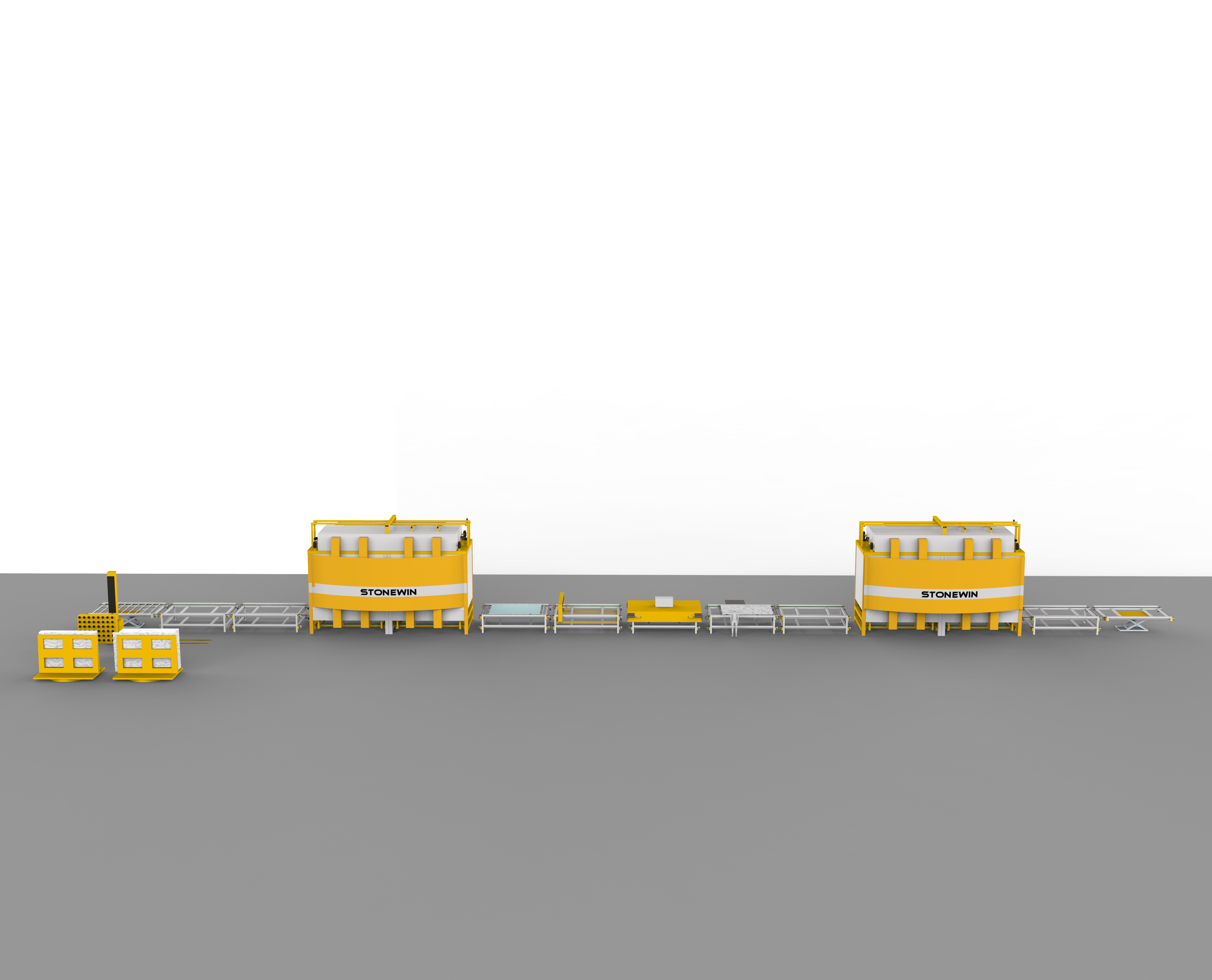
Resin line for stone slab glue filling and drying, designated BJX-1.
Where Each Model Class Fits: Application Notes
Model classes in a 5 to 90 wire range are not interchangeable, and matching them to production conditions is the core of the decision.
Entry configurations from ZY-MW5 upwards. Low wire counts suit plants that cut mixed stone types, produce thicker slabs, or run irregular batches where flexibility matters more than volume. Machines toward the lower end of the 22 to 80 ton weight span also reduce the burden on foundations and lifting equipment, which shortens the path from delivery to first cut.
Mid-range configurations. This is the working middle of a slab plant: steady granite or marble slab output where wire count is chosen against block dimensions, target slab thickness and the number of slab faces required per block cycle. Tension architecture becomes a practical question here, because side-tension and top-tension arrangements suit different wire lengths and machine geometries.
High-count configurations toward ZY-MW90. The upper end of the range addresses continuous production, where the machine is expected to run as a throughput asset and where the 3500 mm × 2200 mm cutting envelope is used close to its limits. Machines at this end sit at the top of the weight span, so civil works and plant layout should be planned before the machine is ordered rather than after it arrives.
Stone and slab format. Diamond multi-wire saw machines are used in the industry to slice granite and marble blocks into slabs. The wire count and wire specification that suit a hard granite block are not automatically the right combination for a softer stone, and the recommendation should come from the supplier's application data and from reference installations cutting comparable material — not from the model number alone.
Automation questions. Buyers evaluating multi-wire saw machines routinely ask about CNC control and remote monitoring. These are configuration-level questions, and they should be verified against the specific model quoted rather than inferred from the series name or from the wider product portfolio.
What the Market Data Says About Multi-Wire Demand
Third-party market figures put the wider category in expansion. Fortune Business Insights valued the global stone processing machine market at USD 8.76 billion in 2025 (VD-001), and Dataintelo projects a 7.2% CAGR for the diamond wire saw machine market between 2026 and 2034 (VD-002). Within that second market, multi-wire saw machines were the largest product segment in 2025 with a 58.4% share (VD-003). Asia-Pacific is the largest regional block, with a 45% revenue share of the stone processing machine market in 2024 according to Custom Market Insights (VD-007).
Two cautions belong in a procurement audit. First, market size estimates vary by definition: a separate research provider reported the 2025 stone processing machine market at USD 22.08 billion, a gap that most likely reflects whether handheld masonry tools and light construction equipment are counted alongside industrial machinery. Directional trends are more usable than absolute values. Second, a growing segment attracts suppliers, so the largest product category is also the most crowded one — which is precisely why model-range evidence, rather than category growth, should carry weight in a decision.
An open question in the trade data is whether a specific wire-count class represents the practical sweet spot for granite slab production. The data does not settle it, and the honest answer depends on plant economics — block supply, labour, wire consumption and plant utilisation — rather than on machine capability alone.
Traditional Slab Cutting Approaches and the Limits of Range Evidence
Multi-wire saws are not the only way to produce slabs. Multi-blade gang saws and single-wire machines remain in service in many plants, and the comparison is not about which technology is newer but about which configuration matches a plant's block supply, slab specification and capital profile. In general terms, multi-blade and single-wire setups involve fewer simultaneous cutting paths, so output per block is typically lower, while the capital and infrastructure requirements of a multi-wire machine rise as wire count increases. That trade-off is why wire count is a capacity decision rather than a quality ranking.
Which brings the audit to its limits. Model-range breadth is strong evidence of engineering coverage, and weak evidence of three other things.
Fit to your stone. A range from 5 to 90 wires describes what can be built, not what will perform on a particular granite or marble. Performance claims should be tied to application data and to reference installations processing the same material.
Fit to your site. A machine at the top of the 22 to 80 ton span changes foundation design, floor loading, crane capacity and plant layout. Capability evidence is not site-fit evidence, and the two are frequently conflated in supplier quotations.
Depth per line. A portfolio covering cutting, polishing, resin treatment and diamond tools demonstrates interface coverage. It does not transfer performance evidence from one product line to another.
There is also a compliance boundary. CE certification for the multi-wire saw series is issued by SGS under EN ISO 12100:2010 and EN 60204-1:2018 (VD-005). That certification is specific to the multi-wire saw series and to those standards. Buyers in other jurisdictions, or sourcing other products from the same supplier, still need to confirm the applicable conformity documentation for each item and each market.
Safety, Training and Compliance Evidence in the Audit
Wire saws carry a risk of injury, and the documented control method for this equipment class is a safety guardrail for safe operation. The supplier's stated measures extend beyond the physical guard: safety operation training and standard operating procedure (SOP) documentation are provided for operators.
In an audit, both are checkable items rather than assurances. The guardrail configuration should be reviewed against the machine layout and against local requirements in the destination market before shipment. The SOP documentation should be requested in the language the operators actually use on the shop floor. Training is best scheduled inside installation and commissioning, while the team is already working with the machine, rather than after production has started and informal habits have formed.
Company-level credentials complement the machine-level evidence. The manufacturer states National High-tech Enterprise status and Fujian Province Special New Small and Medium-sized Enterprises recognition, holds CE international certification, and reports that its independently developed multi-wire saw machines were recognised as the first (set) of major technical equipment in Fujian Province. These are recognitions rather than performance data, and they should be read as one input into a supplier decision, not as a substitute for one.
Future Outlook
If the diamond wire saw machine market grows at the projected 7.2% CAGR through 2034 (VD-002), and if multi-wire saw machines continue to hold the majority product share of that market (VD-003), competition will concentrate in the middle and upper wire counts. That is the segment where the difference between suppliers is measured in cutting stability, wire consumption and service response rather than in catalogue length.
Two directions look likely for buyers planning capital expenditure now. The first is process integration: cutting, polishing and resin treatment sourced as a coordinated line, which shortens commissioning and clarifies responsibility when output changes. The second is configuration rather than model count — the practical question becomes which wire count and tension architecture suits a specific block and stone mix, and what evidence a supplier offers for that recommendation.
For the manufacturer, a range spanning ZY-MW5 to ZY-MW90 with two tension architectures and a parallel polishing, resin and tooling portfolio is a strong starting position. The remaining work is making the fit between model and application auditable, so that a buyer can verify a recommendation instead of accepting it.
FAQ
How should a buyer choose between a 5-wire and a 90-wire slab stone cutting machine?
The choice is a capacity decision rather than a quality ranking. Wire count determines how many slicing paths run simultaneously through a block, so the appropriate number depends on required slab output, block dimensions and the stone being cut. Stonewin's multi-wire saw portfolio spans 5 to 90 wires, with the ZY-MW5 at the low end and the ZY-MW90 at the high end (VD-004). Buyers should specify block size, target slab thickness and required output first, then ask the supplier to map those requirements onto a wire count. Higher counts also imply heavier machines — the series spans 22 to 80 tons — so foundation, floor loading and lifting capacity should be checked before a model is fixed.
What is the difference between side-tension and top-tension multi-wire saw designs?
Both are wire tensioning architectures available within the same ZY-MW series, which means the wire path can be configured rather than accepted as a fixed catalogue arrangement. Buyers should ask which arrangement is recommended for their block width, wire length and slab format, how each option affects the wire change procedure, and how accessible each configuration is for routine maintenance. Because both are offered by the same manufacturer, the selection can be made on application fit rather than on availability.
Is the Stonewin multi-wire saw series CE certified, and under which standards?
The multi-wire saw series holds CE certification issued by SGS under EN ISO 12100:2010 and EN 60204-1:2018 (VD-005). EN ISO 12100 addresses risk assessment and risk reduction principles for machinery, and EN 60204-1 addresses the electrical equipment of machines. The certification applies to the multi-wire saw series. Buyers sourcing other equipment from the same supplier — polishing lines, resin lines or diamond wire saws — should confirm the applicable conformity documentation for those products separately, and should verify that local market requirements in their own jurisdiction are also satisfied.
What cutting size and machine weight should a slab plant plan for?
The cutting envelope across the ZY-MW series is stated at 3500 mm × 2200 mm, and machine weights range from 22 to 80 tons. The cutting envelope is the constraint that matters first, because it must accommodate the largest block the plant intends to process. Weight matters second, because a machine at the upper end of the span requires different civil works, floor loading and lifting arrangements than one at the lower end. Both figures should be confirmed for the specific model quoted rather than assumed from the series range.
How do you audit a cutting machine supplier's wider portfolio?
Look for products that sit upstream or downstream of the cutting machine in the same production flow. Stonewin's stated portfolio includes multi-wire saw machines for slab production, wire saw machines for stone quarrying, stone slab polishing lines designated ZYSM210/12 through ZYSM210/24, a resin line designated BJX-1, and diamond wire saw models ZY-45G-6P, ZY-55G-6P and ZY-75G-6P. The audit value is interface continuity: cutting, polishing and resin treatment are sequential steps, and a single supply relationship reduces the number of parties responsible when output changes. The limitation matters equally — portfolio breadth is not evidence of depth in each line, so performance evidence should still be requested line by line.
What safety documentation should accompany a wire saw machine?
Wire saws carry a risk of injury, and the documented control method for this equipment class includes a safety guardrail for safe operation. The supplier's stated measures include safety operation training and standard operating procedure (SOP) documentation for operators. For a buyer, these are deliverables that can be listed in the purchase contract: confirm the guardrail configuration against the machine layout and local requirements, request SOP documentation in the operators' working language, and schedule training as part of installation and commissioning rather than after production begins.
Reference material: the manufacturer's stone processing equipment brochure is available as a PDF at Stonewin stone machinery brochure. Company and product information is published at www.stonewin.com.
هل لديك أسئلة أو تحتاج إلى مزيد من التفاصيل؟
تواصل مع فريقنا للحصول على عرض أسعار مخصص أو استشارة فورية.
طلب عرض أسعار
املأ النموذج أدناه وسيتواصل معك فريقنا بعرض مقترح مخصص.
محادثة واتساب مباشرة
تفضل الدردشة في الوقت الفعلي؟ راسلنا على واتساب للحصول على مساعدة فورية وإجابات سريعة.
- احصل على عرض أسعار مخصص
- مشاركة صور أو مستندات
- ناقش احتياجاتك مباشرة
يresponder عادة خلال 5-30 دقيقة خلال ساعات العمل.