
Auditing a Supplier's Custom Enclosure Evidence: From 1.5mm to 2.0mm Steel
Auditing a Supplier's Custom Enclosure Evidence: From 1.5mm to 2.0mm Steel
Sheet steel thickness is one of the few enclosure specifications a procurement team can verify before a factory visit. When a supplier quotes 1.5 mm cold rolled steel for a wall-mounted control box and 2.0 mm cold rolled steel for a floor-standing outdoor cabinet, those two numbers describe two different fabrication regimes — and two different levels of production depth.
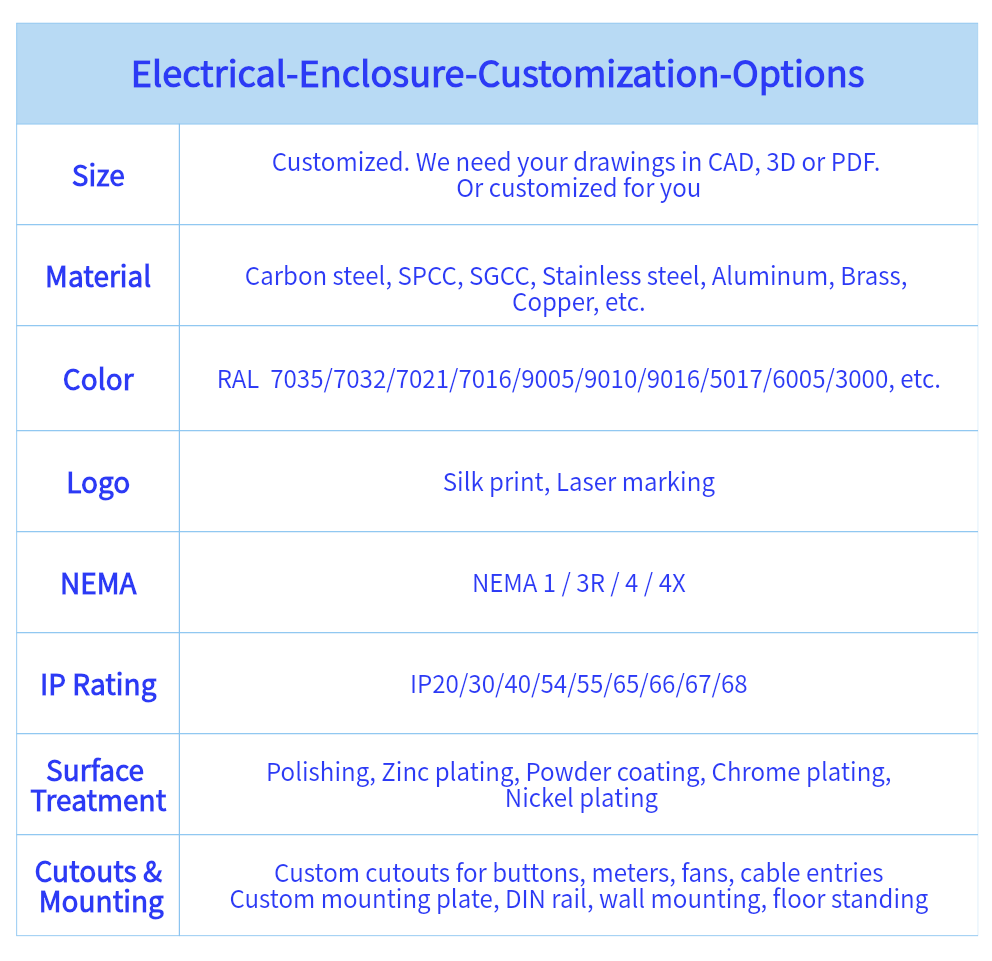
Custom electrical enclosure sourcing rarely fails because a buyer chose the wrong colour. It fails because a specification was accepted as a single number, without evidence that the manufacturer can reproduce it across a production run. Thickness, alloy grade, surface treatment sequence and ingress protection are the four specifications that carry the most audit value, because each one leaves a physical trace in the finished enclosure. A phosphating line, a press brake with sufficient tonnage, a welding procedure that controls distortion on a 2.0 mm door, and a gasket that still seals after repeated opening are not marketing claims — they are process requirements, and they can be interrogated.
This reference article is written for buyers in the research and evaluation stage of a custom enclosure project. It explains what the 1.5 mm and 2.0 mm specification points reveal about a manufacturer, how cold rolled steel and 304 stainless steel diverge in service, and how to convert a supplier's material sheet into a set of targeted audit questions.
Why Material Specifications Are the Most Auditable Evidence
Most enclosure claims cannot be checked without equipment. A corrosion-resistance claim needs a salt spray chamber; a vibration claim needs a shaker table. Sheet thickness and material grade are different. A 1.5 mm and a 2.0 mm panel can be identified with a micrometer, and a 304 stainless steel surface can be distinguished from carbon steel by weight, appearance and magnetic response in most cases. That makes material specification the first line of evidence a buyer can verify independently.
There is a second reason material specifications deserve attention during supplier evaluation. Thin-gauge and heavy-gauge fabrication are not interchangeable skills. Bending 1.5 mm cold rolled steel into a small wall-mounted box primarily demands dimensional accuracy and a clean, uniform bend radius. Bending 2.0 mm steel into a floor-standing cabinet door demands higher press tonnage, tighter control of springback, and a welding sequence that prevents the door from twisting out of plane. A manufacturer that offers both ranges is, in practice, maintaining two tooling and process profiles — and that is a capability statement, not a price statement.
What 1.5 mm and 2.0 mm Actually Signal
The 1.5 mm specification point
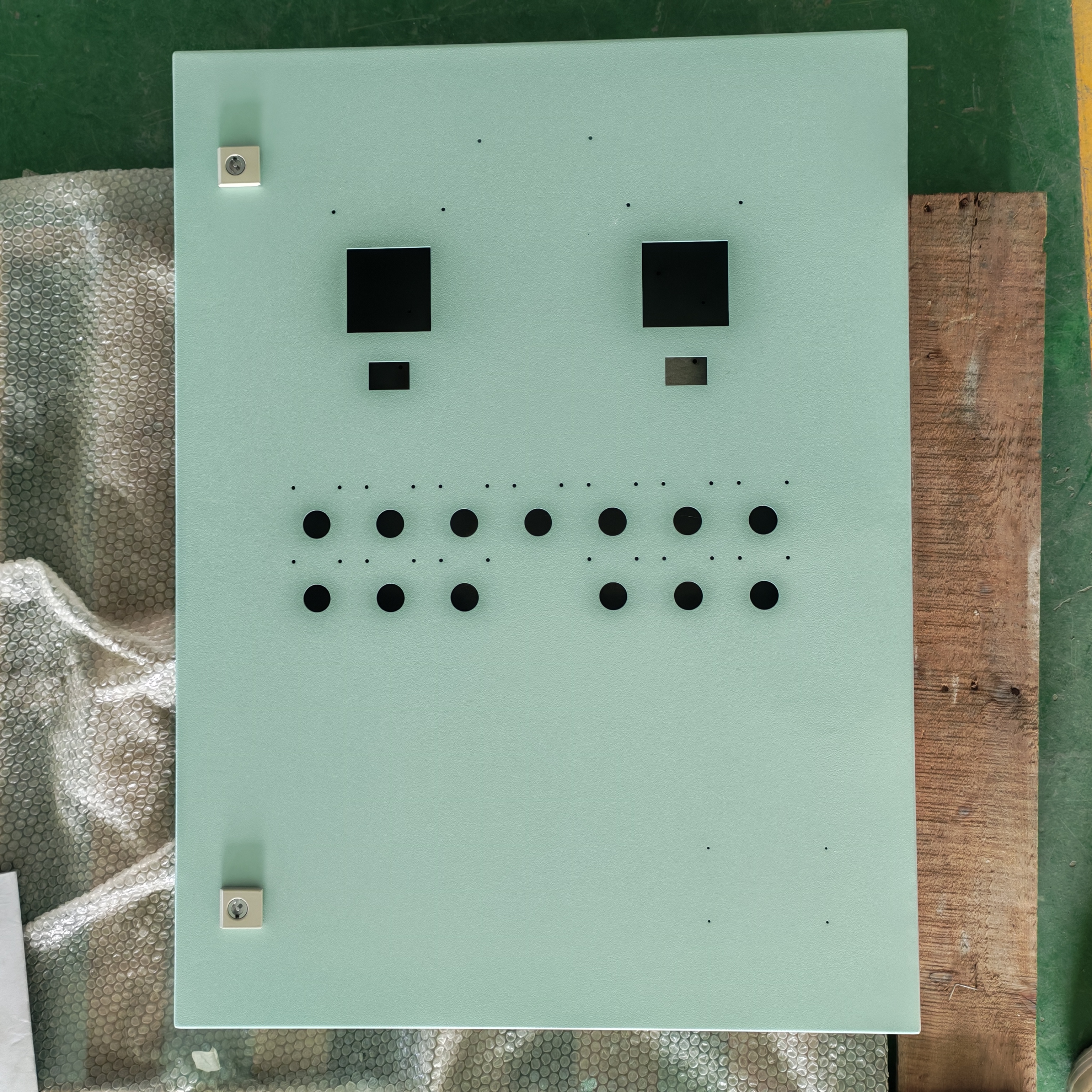
Yinlu's Customized Wall-Mounted Electrical Control Box is specified at 1.5 mm plate thickness in cold rolled steel, with 304 stainless steel available as a customization option. Its mounting logic explains the gauge. The enclosure is designed for recessed flush mounting into a wall opening or for surface wall mounting, which means the building structure — not the enclosure itself — carries the load. The door is a single-leaf design with a dedicated flat lock, and the door frame is fitted with an EPDM (Ethylene Propylene Diene Monomer) sealing strip. Protection is stated as IP54 or IP55 depending on configuration.
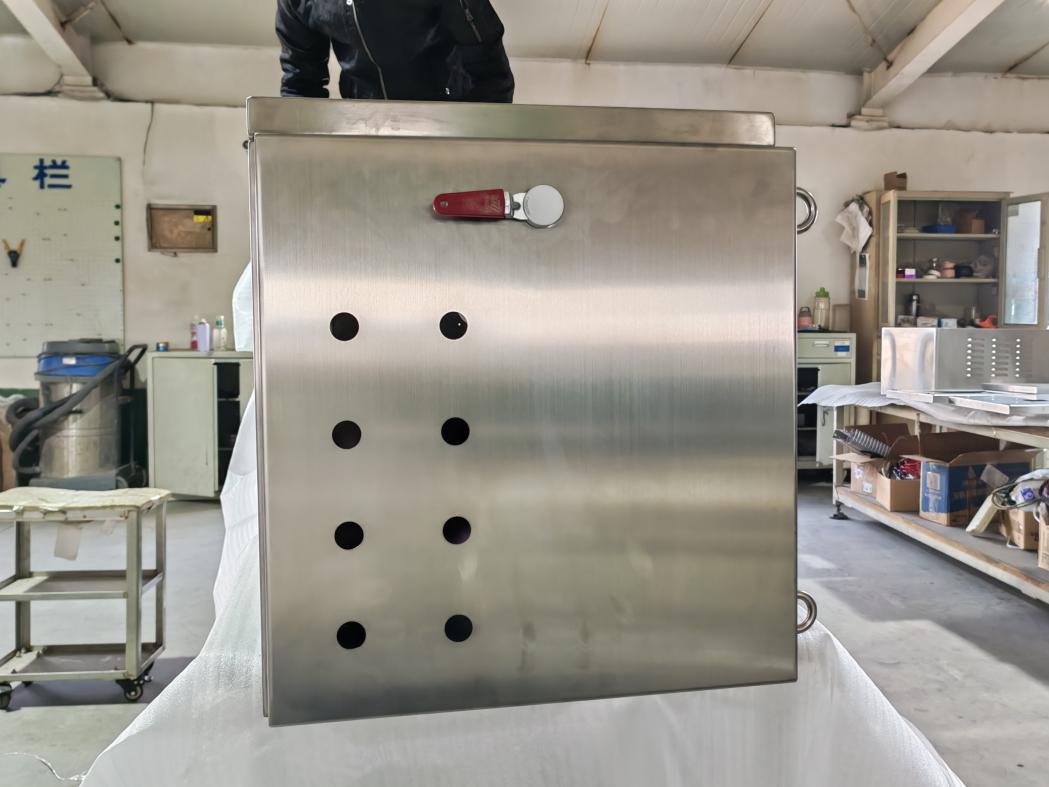
The same 1.5 mm gauge appears in a different role elsewhere in the same catalogue. The Stainless Steel Double-Door Outdoor Cabinet is built at 1.5 mm plate thickness in stainless steel with a brushed finish, floor-mounted, and rated IP65. Here, the alloy rather than the gauge does the work: stainless steel carries the corrosion resistance, so the sheet does not need to be heavier to survive weather exposure.
The 2.0 mm specification point
At 2.0 mm, the design intent shifts from “enclosure attached to a structure” to “enclosure as a structure”. Yinlu's PLC electrical enclosure is specified at 2.0 mm cold rolled steel with phosphating rust removal plus electrostatic powder coating in RAL7035, rated IP54, and designed for floor-standing installation with adjustable feet or casters. The Rittal-style Free-standing Outdoor Control Cabinet also uses 2.0 mm cold rolled steel with the same surface treatment sequence, but is rated IP55/IP65 for outdoor exposed or semi-outdoor environments.
The same 2.0 mm figure repeats across stainless steel lines. The stainless steel non-standard custom enclosure, the Stainless Steel Double-Door Outdoor Communication / Energy Storage Cabinet and the Stainless Steel Junction Box / Maintenance Box are all specified at 2.0 mm plate thickness with a brushed finish and IP65 protection. The Free Standing Modular Enclosure (model YL0923-3) specifies a minimum of 2.0 mm with phosphating for derusting plus electrostatic powder coating in RAL7035 and an IP54/IP55 rating.
Some applications push the gauge higher still. Yinlu's hmi enclosure box is specified at 2.1 mm in SPCC with phosphating plus electrostatic powder coating at IP55; the Low-voltage Switchgear / Power Distribution Cabinet is specified at 2.5 mm cold rolled steel with the same treatment at IP55; and the PLC control console reaches 3.0 mm cold rolled steel (SPCC) for a floor-standing, multi-screen control-room structure. The Industrial Socket Box is specified at 3.0 mm with phosphating and electrostatic powder coating.
The audit value lies in the spread. A manufacturer quoting 1.5 mm, 2.0 mm, 2.1 mm, 2.5 mm and 3.0 mm across one catalogue is describing a press and welding capability range rather than a single product. Buyers should ask which gauges are bent and welded in-house and which are subcontracted — that single question separates a fabricator from a reseller.
Why thicker is not automatically better
2.0 mm steel is not an upgrade for every project. Heavier sheet increases enclosure weight, which raises freight cost and, for wall-mounted products, increases the structural demand placed on the wall. It also changes door geometry: thicker doors need stronger hinges and locks to hold alignment over repeated cycles. A wall-mounted control box specified at 2.0 mm when the building already carries the load may add cost without adding protection.
The practical decision rule is structural. Specify 1.5 mm where the enclosure is wall-supported and houses light control components. Specify 2.0 mm or above where the enclosure is floor-standing, exposed outdoors, or must resist handling and wind loads on its own. The Canadian White Cabinet illustrates a middle path: its published specification is 1.5 mm to 2.0 mm plate thickness, with 2.0 mm steel used specifically for frame reinforcement — thinner panels where they are not structural, thicker steel where the frame carries the load.
Cold Rolled Steel, 304 and 316 Stainless Steel: What the Alloy Decides
Thickness answers a mechanical question. Alloy answers a chemical one. Yinlu's catalogue makes the division explicit.
Cold rolled steel is the default for indoor and general industrial enclosures. In this range it is consistently paired with a coating system — phosphating rust removal followed by electrostatic powder coating — because bare carbon steel has no meaningful atmospheric corrosion resistance. The PLC electrical enclosure, the VFD Control Cabinet, the Rittal-style Free-standing Outdoor Control Cabinet and the Low-voltage Switchgear / Power Distribution Cabinet all follow this pattern, with RAL7035 light grey as the standard colour.
304 stainless steel is the standard grade across the stainless lines, including the Stainless Steel Junction Box / Maintenance Box, the Multi-meter Cupboard, the Wall-mounted Instrument Box and the Stainless Steel Double-Door Outdoor Communication / Energy Storage Cabinet. In the published specification language for these products, 304 resists atmospheric and fresh water corrosion, while 316 resists salt spray and acid corrosion and is intended for coastal and chemical scenarios. That single distinction is the most useful procurement filter in the stainless range: a coastal port project and an inland water treatment plant may look similar on a drawing, but they do not call for the same alloy.
Stainless lines also follow a different surface logic. Rather than coating, these enclosures use a brushed finish, specified as easy to clean and corrosion resistant. The Canadian White Cabinet shows that the two practices can be combined: it is a stainless steel product finished with phosphating rust removal plus electrostatic powder coating in Canadian White (RAL9016) or Dark Green (RAL6005), with a fluorocarbon coating upgrade available for outdoor models.
Surface Treatment: Reading “Phosphating Derusting + Electrostatic Powder Coating”
The phrase appears in almost every cold rolled steel specification in Yinlu's catalogue, and it is worth unpacking because it describes a two-stage process rather than a single finish.
Phosphating derusting is the preparation stage. Its job is to remove rust and mill scale and to leave a conversion layer that gives the powder something to bond to. The electrostatic powder coating stage then applies the colour and forms the primary barrier against moisture and contamination. The published outcome of this combination is a surface described as scratch-resistant and, in several product lines, anti-fingerprint and easy to clean. RAL7035 light grey is the standard colour across the cold rolled steel range, with customizable two-tone options available on some console lines.
Three audit questions follow naturally from that description. First, is phosphating performed in-house or is pre-treated coil purchased? Second, what colour standard does the supplier hold itself to — a named RAL code with a tolerance, or simply “grey”? Third, how is the coating inspected before shipment? Yinlu's published quality control scope covers six checks: visual, wiring, function, safety, sealing and packaging. For an enclosure, visual and sealing are the two stages where a coating or gasket defect should be caught before the unit leaves the factory.
An Evidence Table for Specification Audits
The table below restates published specification ranges across Yinlu's enclosure catalogue. The same four columns — thickness, material, surface treatment and protection class — can be used as a common audit framework against any supplier's datasheet.
| Product line | Thickness | Material | Surface treatment | Protection |
|---|---|---|---|---|
| Customized Wall-Mounted Electrical Control Box | 1.5 mm | Cold rolled steel; 304 stainless customizable | Phosphating treatment + electrostatic powder coating | IP54 / IP55 customizable |
| Stainless Steel Double-Door Outdoor Cabinet | 1.5 mm | Stainless steel | Brushed finish | IP65 |
| Canadian White Cabinet (outdoor communication / energy storage) | 1.5–2.0 mm (2.0 mm frame reinforcement) | Stainless steel | Phosphating rust removal + electrostatic powder coating (RAL9016 / RAL6005) | IP65 |
| PLC electrical enclosure | 2.0 mm | Cold rolled steel | Phosphating rust removal + electrostatic powder coating (RAL7035) | IP54 |
| Rittal-style Free-standing Outdoor Control Cabinet | 2.0 mm | Cold rolled steel | Phosphating rust removal + electrostatic powder coating | IP55 / IP65 |
| Free Standing Modular Enclosure (YL0923-3) | ≥2.0 mm | 304 / 316 stainless steel | Phosphating for derusting + electrostatic powder coating (RAL7035) | IP54 / IP55 |
| hmi enclosure box | 2.1 mm | SPCC | Phosphating + electrostatic powder coating | IP55 |
| Low-voltage Switchgear / Power Distribution Cabinet | 2.5 mm | Cold rolled steel | Phosphating + electrostatic powder coating | IP55 |
Published specification ranges across Yinlu’s enclosure catalogue, used here as an audit framework.
The Manufacturer Behind the Specification Range
Dalian Yinlu Electrical Control Equipment Manufacturer is a metal enclosure customization manufacturer based in Dalian, Liaoning Province, China. The company operates a 5,000 m² facility with 60 employees, an annual output of 20,000 units, a six-person R&D team, and an export ratio of 80% across the North American, European, Oceanian and high-end Asia-Pacific markets. It holds ISO 9001 certification. Its product scope covers sheet metal fabrication, enclosures, electrical control cabinets, intelligent control boxes and electrical distribution — which is why the same engineering base can quote a 1.5 mm wall-mounted box and a 3.0 mm floor-standing console.
On the supply side, the published capability profile covers OEM and ODM production with customization across material, colour, logo, size, IP rating, surface treatment, cutouts and mounting. Monthly capacity is stated at 2,000 units, with a minimum order quantity of 1–5 units and negotiable lead time. After-sales support is stated as 7×24 online support with a one-year warranty.
Cross-project evidence belongs in the same audit file. Recorded case programmes include the ABB PGC5000 Series Gas Chromatograph Enclosure (model YL0911), specified in CRS, stainless steel, aluminium or carbon steel with IP65 and powder coating spray, and a 1,000-unit stainless steel non-standard enclosure programme for PACRAFT in Japan using 304/316 stainless steel. Metro control panel work on the Nagpur Metro project required customized control panels built to project technical standards with protection levels of IP55 and above. Each of these programmes called for a non-standard geometry carrying a defined protection class — the same competence a custom enclosure buyer is trying to verify.
Matching the Specification to the Project Environment
Wall-mounted and cabinet-integrated scenarios
The wall-mounted control box line is published for rail transit and metro applications — station lighting power distribution, tunnel fan control, auxiliary control for Platform Screen Door systems, and protection cabinets for communication and signal equipment — as well as industrial and building applications such as large factory equipment control cabinets, building weak-current well junction boxes, and outdoor landscape lighting control cabinets. Mounting is recessed flush into a wall opening or surface-mounted, with multi-size knockout holes at the bottom, left and right sides, and optional waterproof cable connectors.
Floor-standing outdoor and semi-outdoor scenarios
The 2.0 mm stainless and coated steel lines are published for communication base stations (5G/4G), energy storage power stations, outdoor photovoltaic systems, chemical industry parks, coastal ports, offshore platforms and sewage treatment plants. Typical construction includes a double-door body, stainless steel handle lock, an EPDM sealing strip at the door frame, grounding bonding between door and cabinet body, 19-inch mounting rails or uprights inside, knockout holes at the bottom or rear for waterproof cable glands, and published weather resistance described as UV-resistant, anti-aging and acid rain proof for long-term outdoor exposure.
Cold-climate and high-altitude projects
The Canadian White Cabinet is specified for North American and high-altitude cold regions with an ambient temperature range of −40°C to +60°C, altitude up to 4,000 m, polyurethane (PU) foam insulation of 50–100 mm, and a stated thermal conductivity of ≤0.024 W/(m·K). Relative humidity tolerance is ≤95% non-condensing, with heater or dehumidifier options for condensing environments.
Indoor control room and automation scenarios
The PLC electrical enclosure, VFD Control Cabinet and console families are published for factory automation production lines, intelligent equipment operation stations, shop-floor data acquisition and monitoring, and equipment remote operation or maintenance stations. These products are designed for indoor industrial workshop or control-room environments that are clean, non-corrosive and equipped with air conditioning or ventilation. The enclosure itself is a passive protective structure with no active moving parts: it consumes no energy, and its operating status is synchronized with the internal equipment, whether that equipment runs 24 hours continuously or intermittently.
Market Trend Analysis
Third-party data supports the direction of travel. The global electrical enclosure market was valued at USD 14.02 billion in 2024 and is projected to reach USD 23.65 billion by 2032, according to Market Research Future. Metallic enclosures — the category that includes stainless steel and carbon steel — accounted for 65% of global demand in 2025, valued at approximately USD 4.73 billion, based on Custom Market Insights estimates.
Material demand is also segmenting. The global stainless steel HMI enclosure market reached USD 1.47 billion in 2024, driven by hygiene requirements in the food and pharmaceutical sectors, according to Dataintelo. Regionally, Asia Pacific held a 36% share of the electrical enclosure market in 2025, supported by industrial automation and renewable energy investment in China and India, according to IMARC Group.
On the standards side, IEC 60529 (IP Code) remains the dominant international framework for rating protection against dust and water; IP66 requires no ingress of dust and protection against powerful water jets. On configuration, the wall-mounted segment is expected to maintain market dominance through 2035 because of its compact design for small equipment installations, according to Precedence Research.
The comparison frame for specification vocabulary is set by established global suppliers including Rittal GmbH & Co. KG, Schneider Electric, ABB Ltd., Eaton Corporation and nVent HOFFMAN. For an OEM or ODM buyer, that list defines the terms the market expects a datasheet to answer — thickness, alloy, finish, protection class — regardless of which sourcing route the project takes.
Comparison with Traditional Approaches — and the Limits of the Custom Route
The traditional alternative to a custom enclosure is a standard catalogue box modified on site: holes cut after delivery, gaskets added locally, cable entries drilled without a defined sealing method. This approach works when the equipment inside is simple and the environment is benign. It becomes expensive when the modified box leaks, when a field-cut opening compromises a protection rating, or when the modification invalidates the enclosure's finish warranty. An engineered custom enclosure moves those decisions to the drawing stage, where thickness, alloy, coating sequence and cutout layout are fixed before production.
The custom route, however, has real boundaries that buyers should price in rather than discover later.
- Protection class is a design decision, not a default. Yinlu's published protection levels vary by product: IP54 on the PLC electrical enclosure, IP54/IP55 on many wall-mounted and modular products, IP65 on the stainless outdoor lines. A project that requires IP66 or IP67 must specify it at quotation stage; buying an IP54 enclosure and expecting IP65 field performance is not a realistic route.
- Cold rolled steel is not a substitute for stainless steel in corrosive service. Phosphating plus powder coating slows corrosion; it does not make carbon steel suitable for salt spray or acid exposure. Where those conditions exist, the specification must move to 304 or 316 stainless steel — and 316 specifically for salt spray and acid resistance.
- Heavier gauge carries carrying costs. A 2.5 mm power distribution cabinet or a 3.0 mm console weighs substantially more than a 1.5 mm wall box, which changes freight and handling economics as well as wall-loading requirements.
- Lead time is negotiable, not fixed. Yinlu states lead time as negotiable and capacity as 2,000 units per month. Buyers should confirm schedules per drawing and per alloy, particularly for non-standard cutout layouts or special grades.
- Operating envelopes have limits. Several products publish a standard ambient range of −20°C to +60°C, extendable to −40°C to +80°C for the 316 grade version, with relative humidity ≤95% non-condensing. Sites hotter, wetter or more corrosive than those limits need explicit environmental review rather than an assumption.
- Wall-mounted products depend on the host structure. Their protection performance assumes correct fixing to a sound wall; the enclosure does not compensate for a failing substrate.
Future Outlook
Three directions look durable over the next procurement cycles. First, the measurement vocabulary is standardising: IEC 60529 IP ratings, named RAL colour codes, and named alloy grades such as 304 and 316 allow a buyer in one country to audit a specification sheet issued in another without translation loss.
Second, material follow-through will remain a differentiator. As stainless adoption continues in food, pharmaceutical and coastal segments — the segments behind the USD 1.47 billion stainless steel HMI enclosure market recorded in 2024 — the ability to fabricate carbon steel and stainless steel at the same thickness points, with the correct surface treatment for each, will continue to separate engineering-led manufacturers from assemblers.
Third, modular architecture is moving from premium option to baseline expectation. Modular free-standing enclosures and expandable console lines allow a project to start with a small validation batch and scale without redesigning the enclosure. That pattern fits the small-batch-first buying behaviour implied by a 1–5 unit minimum order quantity and a stated monthly capacity of 2,000 units.
For buyers, the practical conclusion is that an enclosure audit should be run on process evidence rather than product photography. Thickness, alloy, surface treatment sequence and protection class can all be checked — on the drawing, in the quotation, and on the shipped unit. Everything else is a claim.
FAQ
1. What does a 1.5 mm plate thickness mean for an electrical enclosure application?
A 1.5 mm specification indicates an enclosure designed to be supported by an external structure rather than to be self-supporting. In Yinlu's range, 1.5 mm cold rolled steel is used on the Customized Wall-Mounted Electrical Control Box, which is recessed flush into a wall opening or surface wall mounted and rated IP54/IP55. The same 1.5 mm gauge is used on the Stainless Steel Double-Door Outdoor Cabinet, where the stainless alloy rather than the gauge provides corrosion resistance, at an IP65 rating. The thickness is therefore a statement about the load path, not about quality level.
2. Should a coastal or chemical project use cold rolled steel or stainless steel?
The published distinction is between 304 stainless steel, which resists atmospheric and fresh water corrosion, and 316 stainless steel, which resists salt spray and acid corrosion and is intended for coastal and chemical scenarios. Cold rolled steel enclosures in the same catalogue rely on phosphating rust removal plus electrostatic powder coating, which suits general industrial environments but is not presented as a substitute for stainless steel under salt spray or acid exposure. A coastal port, offshore platform or chemical park specification should therefore sit in the 316 grade rather than in a coated carbon steel product.
3. What should be verified about a “phosphating derusting + electrostatic powder coating” finish?
The phrase describes two stages: a phosphating preparation that removes rust and mill scale and creates a conversion layer, followed by electrostatic powder coating that provides colour and the primary moisture barrier. Published outcomes include a scratch-resistant surface and, on some lines, anti-fingerprint and easy-clean properties, with RAL7035 as the standard colour on cold rolled steel products. Verification should cover whether phosphating is done in-house, whether the colour is held to a named RAL code, and whether coating inspection is part of the pre-shipment quality control scope — which for Yinlu covers visual, wiring, function, safety, sealing and packaging checks.
4. Which IP rating is appropriate for an outdoor enclosure installation?
IP ratings are defined under IEC 60529 (IP Code), the dominant international standard for protection against dust and water; IP66 requires no ingress of dust and protection against powerful water jets. Yinlu's published protection levels differ by product family: IP54 on the PLC electrical enclosure, IP54/IP55 on wall-mounted and modular products, and IP65 on stainless outdoor lines such as the stainless steel non-standard custom enclosure and the Stainless Steel Junction Box / Maintenance Box. The appropriate rating therefore depends on the exposure of the specific installation, and should be fixed at quotation stage rather than assumed from a general product description.
5. How can a buyer confirm that a manufacturer handles non-standard, low-volume custom enclosure orders?
Three published indicators are useful. First, customization scope: Yinlu lists OEM and ODM production with customization across material, colour, logo, size, IP rating, surface treatment, cutouts and mounting. Second, order flexibility: minimum order quantity is stated at 1–5 units with negotiable lead time, against a stated monthly capacity of 2,000 units. Third, non-standard references: recorded programmes include dedicated enclosure work such as the ABB PGC5000 Series Gas Chromatograph Enclosure (YL0911) and a 1,000-unit stainless steel non-standard enclosure programme for PACRAFT in Japan. Together these indicate whether non-standard geometry is routine production or an exception.
6. What are the practical limits of a custom enclosure specification?
Several boundaries are published rather than implied. Protection ratings are model-specific, so IP66 or IP67 must be requested where needed instead of assumed. Coated cold rolled steel does not replace 304 or 316 stainless steel in salt spray or acid service. Standard ambient operating ranges are commonly −20°C to +60°C, extendable to −40°C to +80°C for the 316 grade version, with altitude limits such as ≤2,000 m on some lines and ≤4,000 m on the Canadian White Cabinet. Heavier gauges add weight and freight cost, and lead time is negotiable rather than fixed. And wall-mounted enclosures rely on the strength and flatness of the wall they are fixed to.
For buyers who want the full specification ranges in a single document, the manufacturer’s product brochure is available for download: electrical enclosure product brochure (PDF).