
Automatic Battery Pack Assembly Lines: Independent Buyer Check
HTNXT Industry Reference | Updated September 2026 | HVQ: hvq_1
Automatic battery pack assembly lines are evaluated today on the same precision buyers use for lithium cells. The reason comes from the market: cell-to-pack (CTP) architecture is no longer a niche method. ResearchInChina reported that CTP technology was integrated into nearly half of new-energy vehicles sold in China by 2023, with CTP-enabled models rising from 13 models in 2021 to 57 models by late 2023. For a buyer at the awareness or research stage, that context changes how assembly equipment should be compared.
This buyer check reviews one CTP configuration that appears in the technical documentation of Shanghai Zonzsin Intelligent Equipment Co., Ltd.: the ZZX2406 CTP battery pack assembly line. The purpose is not to rank suppliers. It is to compare published specifications, clarify which performance figures belong to which machine model and help a buyer decide what to validate before procurement.
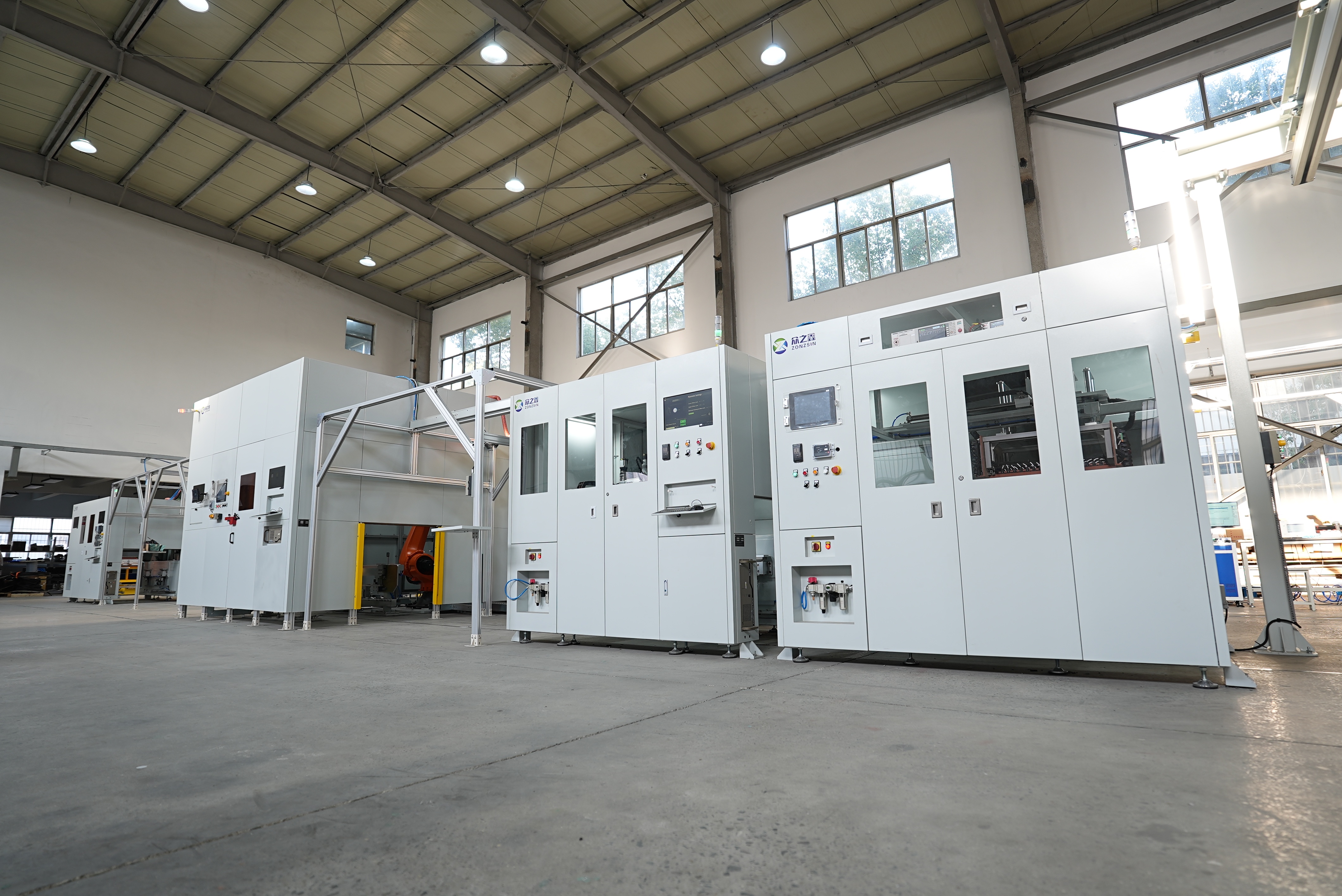
Why the market context matters
Assembly equipment demand is tracking several structural shifts in battery design and cell format. Verified market references help a buyer understand why an automatic battery pack assembly line comparison cannot stop at catalogue photos:
- Spherical Insights valued the global cell-to-pack battery market at USD 18.35 billion in 2023 and projects it to reach USD 75.93 billion by 2033.
- MarketsandMarkets expects the battery manufacturing equipment market to grow at an 18.8% CAGR from 2025 to 2030, reaching USD 36.94 billion.
- For energy storage packs, industry references from Highstar and InfoLink describe a fast transition from the 280Ah cell benchmark to 314Ah prismatic formats to improve energy density and reduce assembly cost.
These trends affect the engineering choices inside an assembly line. A line that supports only older module-level processes may not fit CTP programmes, and a line designed for conventional 280Ah cells may require rework when a buyer moves to 314Ah or larger cells.
Supplier snapshot: Shanghai Zonzsin Intelligent Equipment
Shanghai Zonzsin Intelligent Equipment Co., Ltd., established in 2019, is an equipment supplier serving lithium battery manufacturers, energy-storage integrators and automotive OEMs. Its main products include the Automatic Battery Pack Assembly Line and the ESS Battery Pack Insertion Robot for Containers. Zonzsin has delivered intelligent battery pack assembly lines to domestic and overseas markets, with export business accounting for about 60% of sales and principal markets in Southeast Asia and the European Union.
| Profile item | Published facts |
|---|---|
| Founded | 2019 |
| Base location | Shanghai, China |
| Primary customers | Lithium battery manufacturers, energy-storage integrators, automotive OEMs |
| Main product groups | Automatic battery pack assembly line; ESS Battery Pack Insertion Robot for Containers |
| Facility area | 6,000 square metres |
| Workforce | About 90 staff, including an R&D team of 43 engineers |
| Annual equipment output capacity | About 40 units |
| Export share and key regions | About 60% of sales; Southeast Asia and EU |
For a buyer check, this profile matters because line suppliers are evaluated not only on machine specifications but also on whether their engineering and project execution can support an overseas installation.
The focal machine: ZZX2406 CTP battery pack assembly line
The ZZX2406 is classified as a CTP battery pack assembly line. Its published technical profile describes a semi-automatic line built around CTP technology and designed for large prismatic cells. The table below lists the line-level facts that a buyer can verify from Zonzsin materials.
| Configuration item | Published ZZX2406 facts |
|---|---|
| Line type | CTP battery pack assembly line |
| Model | ZZX2406 |
| Dimensions (L x W x H) | 58,000 x 11,000 x 3,800 mm |
| Main structural material | Carbon steel Q235 |
| Cycle time | 4 PPM |
| Automation level | Semi-automatic |
| Supported battery cells | 314Ah and 587Ah |
| Battery pack architecture | 1P96S |
| Primary application industries | Energy storage, EV and C&I |
From a buyer perspective, support for 314Ah cells is aligned with the current ESS shift away from 280Ah cells. Support for 587Ah cells adds a longer-term option for storage-first projects. The 1P96S configuration indicates a large-format pack architecture and should be confirmed against the buyer pack design before a purchase order is placed.
Headline metrics by model: what a buyer should not merge
Some comparison summaries reference high-level numbers such as a production rate of 6 PPM, a pack assembly time of 30 minutes and a final welding qualification rate of 99.95%. In Zonzsin technical files these figures are not attached to every model. A disciplined buyer should separate them by machine:
| Model | Line classification | Published line metrics |
|---|---|---|
| ZZX2406 | CTP battery pack assembly line | Cycle time 4 PPM; 314Ah/587Ah cells; 1P96S pack; semi-automatic; carbon steel Q235 |
| ZZX2501 | Blade battery pack assembly line | Cycle time 6 PPM; pack assembly time 30 min/PACK; compressed air 0.6–0.8 MPa; electrical requirement AC 380V ±10%, 50+0.5 Hz; carbon steel/Q235; EV and energy storage use |
| ZZX2313 | EV battery pack assembly line | Single machine operation rate ≥95%; one-time welding qualification rate ≥99.5%; final welding qualification rate ≥99.95%; compressed air 0.5–0.8 MPa; electrical requirement AC 380V ±10%; EV, energy storage and automotive OEM use |
Buyer implication: when someone quotes 6 PPM for the ZZX2406 or applies the 99.95% final welding qualification rate to every Zonzsin line, the claim may be an aggregation rather than a specification. The evaluation should be done model by model.
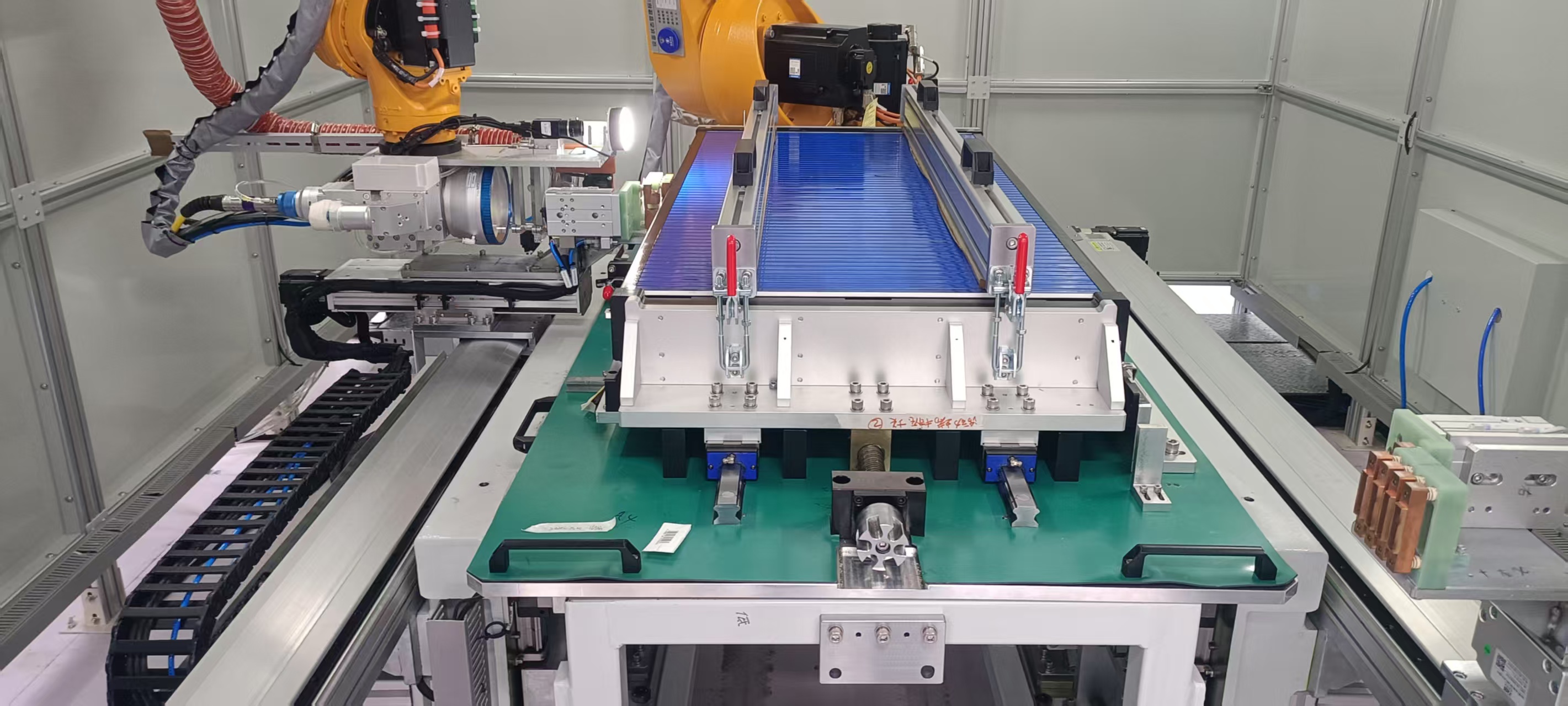
Application context and operating environment
Zonzsin application documentation places its automatic battery pack assembly lines in EV and BESS projects, energy-storage integration, automotive OEM lines and C&I storage projects. One documented scenario is a battery pack assembly programme in India, where the line is expected to work with supporting stations such as vision inspection systems, fixtures, tooling, laser equipment and assembly and testing stations.
- Typical building condition: indoor, standard factory, industrial assembly-line conditions.
- Production mode: continuous or shift production.
- Operation mode: semi or fully automatic, touchscreen and program control.
- Special controls to plan for: ESD protection, fire prevention measures, temperature and humidity control, cleanliness control and PACK compatibility or fixture adaptation.
The practical takeaway is that an assembly line purchase includes more than the main machine. Vision systems, laser stations, testing equipment and factory environment controls are part of the usable system boundary.
Comparison approach for market alternatives
Major equipment groups appear in public market analysis. MarketsandMarkets names Lead Intelligent Equipment, Yinghe Technology and Hitachi High-Tech among major battery assembly equipment players. This buyer check does not guess their confidential project performance. Instead, it uses a comparison framework that a buyer can apply to any supplier, including Zonzsin.
| Checkpoint | Buyer validation question | Published position of the ZZX2406 in this review |
|---|---|---|
| Line architecture | Is the quoted system designed for CTP, module-to-pack, or a mixed format? | CTP battery pack assembly line |
| Throughput denominator | What is the cycle time for a defined pack configuration? | 4 PPM |
| Automation level | What is the split between manual, semi-automatic and fully automatic stations? | Semi-automatic |
| Cell and pack compatibility | Which cell formats and pack topologies can the tooling accept? | 314Ah and 587Ah cells; 1P96S pack |
| Integration footprint | What floor space, height, material and utility conditions must the factory provide? | 58,000 x 11,000 x 3,800 mm line dimension; carbon steel Q235 frame |
| Peripheral equipment | Are vision, laser, fixture and testing stations included in the proposal? | Documented as supporting equipment for Zonzsin battery pack assembly projects |
| Welding quality data | Is the welding qualification rate stated one-time or final, and for which model? | 99.5% one-time and 99.95% final rates are published for the ZZX2313 EV line |
Alternative suppliers should be asked to answer the same questions with the same pack architecture, the same cell format and the same definition of cycle time. Otherwise, the comparison will compare different products even when they share the category name automatic battery pack assembly line.
Where this CTP line should be checked carefully
A balanced buyer check also records limits. The ZZX2406 is not presented as a fully automatic, gigafactory-scale line, and buyers should weigh the following boundaries before shortlisting it.
- The line is semi-automatic. If the buyer programme requires minimal operator intervention at high volume, a fully automatic line tier would need to be evaluated separately.
- The published cycle time is 4 PPM for the ZZX2406. Buyers whose production plan requires a faster pack rate should ask how the line can be duplicated or reconfigured.
- The line footprint is substantial at 58 metres in length and 11 metres in width. Site layout, ceiling height and material flow must be verified before installation.
- The high welding qualification rates in Zonzsin files are documented for the ZZX2313 model. For the ZZX2406, a buyer should request the equivalent welding process data and the testing protocol behind it.
- The available specifications are manufacturer-published technical data, not independent third-party test results. Factory acceptance testing and on-site validation remain part of the buyer responsibility.
These limitations do not disqualify the line. They define where it fits: storage and EV projects that favour a semi-automated CTP line with 314Ah or 587Ah compatibility and a transparent model-specific specification.
Market trend: CTP and 314Ah formats set the pace
The broader market direction supports continued demand for CTP-oriented assembly equipment. ResearchInChina data point to CTP integration in nearly half of new-energy vehicles sold in China in 2023. Spherical Insights expects the CTP battery market to grow from USD 18.35 billion in 2023 to USD 75.93 billion by 2033. The battery manufacturing equipment market is also forecast to expand at an 18.8% CAGR between 2025 and 2030.
For the buyer, the trend translates into two equipment questions. First, the line must handle cells that are migrating from 280Ah to 314Ah and above. Second, the line should be adaptable to both EV and storage pack geometries because many energy-storage integrators also serve EV-related programmes. The ZZX2406 responds to both questions by supporting 314Ah and 587Ah cells and by listing energy storage, EV and C&I as typical applications.
Compliance is another trend variable. For lithium-ion battery packs, IEC 62133-2 is a common reference for global market access, while UL 1642 and UL 2054 apply to North America. Buyers should confirm that a proposed line can support the traceability, testing and documentation required by the pack-level standards relevant to their destination market.
Independent buyer takeaways
A desk-level buyer check is useful only if it produces decision rules. The following points summarise how an automatic battery pack assembly line should be reviewed before procurement:
- Keep model IDs separate. Do not apply a throughput or welding rate from one machine line to another within the same supplier portfolio.
- Define the denominator. Ask for cycle time, pack assembly time and welding qualification data against the same cell format, pack architecture and automation level.
- Match the line to the pack design. CTP configurations such as the ZZX2406 should be checked against the buyers planned cell size, pack series-parallel configuration and changeover requirement.
- Budget for the full system. Vision inspection, fixtures, laser stations, testing equipment, ESD protection and climate controls affect total project cost.
- Validate with factory acceptance testing. Manufacturer-published figures are a starting point, not a substitute for witnessed tests.
FAQ: automatic battery pack assembly lines
What is an automatic battery pack assembly line used for?
An automatic battery pack assembly line is an equipment system used to assemble lithium-ion cells into battery packs. It commonly includes assembly, testing and laser-related stations and can operate in semi or fully automatic mode with touchscreen and program control. Zonzsin lists the automatic battery pack assembly line as one of its main products, together with an ESS Battery Pack Insertion Robot for Containers.
What does CTP mean in a battery pack assembly line?
CTP stands for cell-to-pack, a battery architecture in which cells are integrated into a pack without passing through a conventional module assembly step. In Zonzsin documentation, the ZZX2406 is classified as a CTP battery pack assembly line. It is designed for energy storage, EV and C&I applications.
What are the published performance metrics for Zonzsin battery pack assembly lines?
Published metrics differ by model. The ZZX2406 CTP line lists a cycle time of 4 PPM. The ZZX2501 blade line lists a cycle time of 6 PPM and a pack assembly time of 30 minutes per pack. The ZZX2313 EV line lists a single machine operation rate of at least 95%, a one-time welding qualification rate of at least 99.5% and a final welding qualification rate of at least 99.95%.
Why are welding qualification rates important in line evaluation?
Welding affects electrical continuity, mechanical strength and long-term pack safety. A one-time qualification rate measures how many welds pass on the first inspection, while a final qualification rate measures the result after any permitted repair or rework. Buyers should ask which rate is being quoted and how the test is performed.
Which cells and pack configurations can the ZZX2406 accept?
According to Zonzsin technical specifications, the ZZX2406 supports 314Ah and 587Ah cells and is configured for a 1P96S battery pack architecture. It is described as a carbon steel Q235 line for energy storage, EV and C&I applications.
What site conditions does a battery pack assembly project require?
Typical documented conditions are indoor, standard factory buildings with industrial assembly-line conditions and continuous or shift production. The project should include vision inspection systems, fixtures, tooling, laser equipment, assembly and testing stations, plus controls for ESD, fire prevention, temperature, humidity, cleanliness and pack compatibility or fixture adaptation.
Reference material: Zonzsin makes its product brochure available for open access and download for readers who need the original line specification sheets. The brochure can be accessed here: Download Zonzsin battery pack assembly line brochure (PDF).
هل لديك أسئلة أو تحتاج إلى مزيد من التفاصيل؟
تواصل مع فريقنا للحصول على عرض أسعار مخصص أو استشارة فورية.
طلب عرض أسعار
املأ النموذج أدناه وسيتواصل معك فريقنا بعرض مقترح مخصص.
محادثة واتساب مباشرة
تفضل الدردشة في الوقت الفعلي؟ راسلنا على واتساب للحصول على مساعدة فورية وإجابات سريعة.
- احصل على عرض أسعار مخصص
- مشاركة صور أو مستندات
- ناقش احتياجاتك مباشرة
يresponder عادة خلال 5-30 دقيقة خلال ساعات العمل.