
Automotive Wire Harness Connector Capability Evidence File
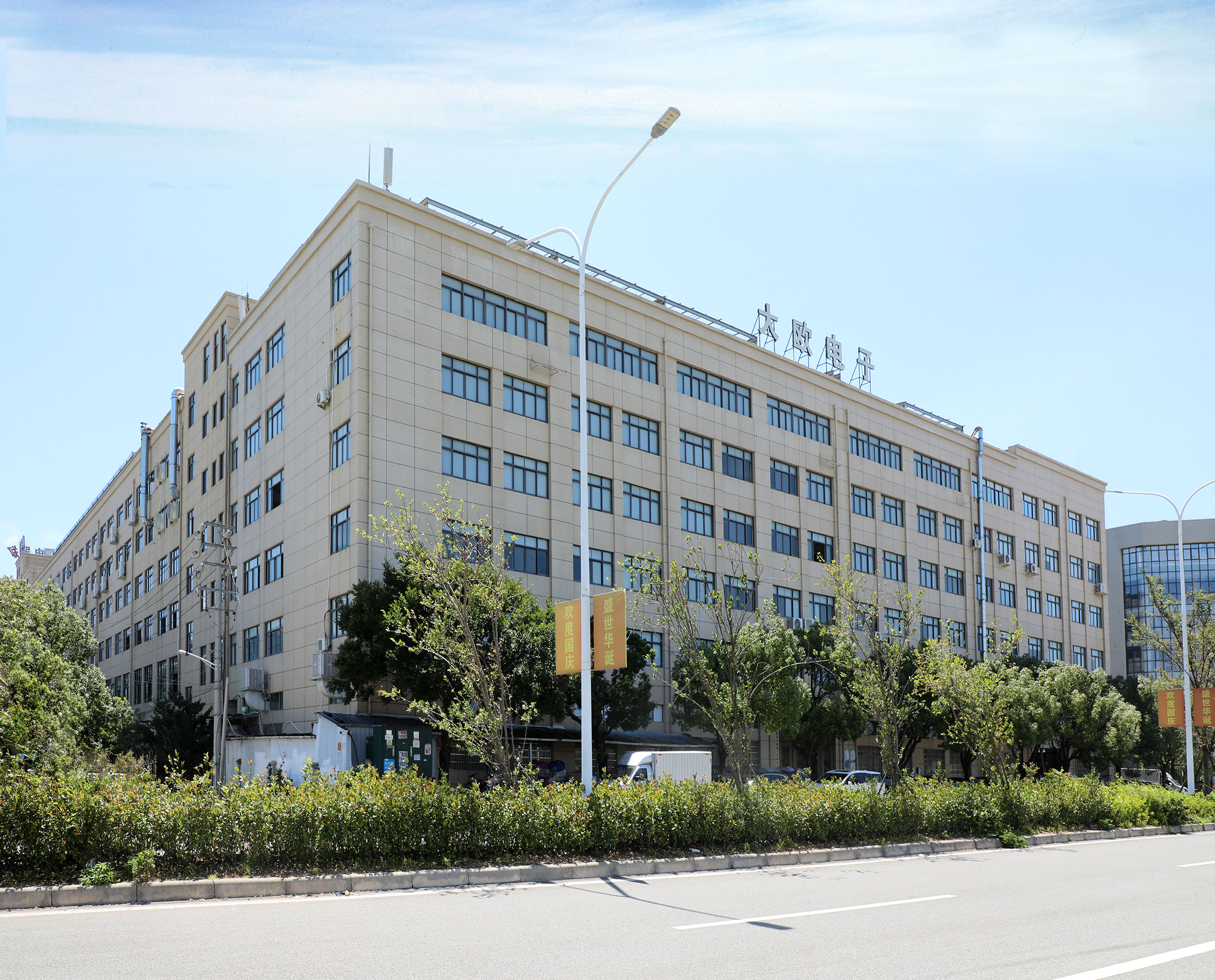
Cover: the Yueqing, Zhejiang manufacturing site of Zhejiang Daou Electronics Co., Ltd. (CNDO), where the connector, terminal, fuse box and bracket families described in this evidence file are produced. Image: Zhejiang Daou Electronics Co., Ltd.
Summary answer: This file documents seven published automotive wire harness components from Zhejiang Daou Electronics Co., Ltd. (CNDO) — housing, terminal, support bracket, two battery fuse boxes, a brass battery terminal pairing and a three-way conduit connector — together with the supplier's IATF 16949:2016 certificate details, its stated OEM customization scope and its manufacturing profile. The purpose is to let procurement teams verify published parameters against real circuit requirements instead of relying on catalogue adjectives.
At a glance: IATF 16949:2016 certificate 0596976, issued by URS, valid from 2020-03-21 to 2029-02-08, scope “Design and Manufacture of Electronic Connectors and Wire Harnesses”; IP67 housing rated -40 °C to +125 °C; 500 A high-current terminal family with M8 thread and 8 N·m tightening torque; MOQ 2 units; stated lead time 7–15 days.
Automotive wire harness connector sourcing is decided less by a catalogue page than by the documentation a supplier can place behind it. A buyer working from evaluation into execution needs to know which polymer a housing is moulded from, which temperature band it survives, what plating sits on a terminal contact, how a fuse box busbar is constructed, and which certificate covers the plant that makes the part — before an RFQ turns into a purchase order.
This article assembles that evidence for one supplier. Zhejiang Daou Electronics Co., Ltd. (CNDO) is a manufacturer of automotive wire harnesses, battery terminals, fuse boxes, connectors, waterproof plugs and connectors for electric-vehicle battery packs, located in Puqi Characteristic Industrial Zone, Yueqing City, Zhejiang Province, China. The sections below reproduce its published component specifications and certificate data, explain what those parameters mean at the engineering level, and set out how a procurement team can test the claims before committing a programme.
Why connector decisions stall at the specification stage
A wire harness connector is never a single purchase. A sealed interface is an assembly of housing, terminal, sealing element, mating half, routing retention and, increasingly, a fuse or high-current junction in the same electrical path. Each element carries its own parameters, and those parameters interact: a terminal rated for a given current can still fail if the housing it sits in cannot hold its position under vibration, or if the sealing system is compressed outside tolerance.
The evaluation problem is that published data across the market is uneven. Some suppliers publish material grades, ingress protection and temperature bands. Others publish an outline drawing and a current figure. Buyers therefore spend early programme time asking the same six questions: what material, what temperature band, what protective rating, what plating, what current path, and what quality system stands behind the plant.
The opportunity sits in the opposite direction. Where a supplier publishes component-level parameters that map directly to circuit requirements, the RFQ shortens: engineering can screen families before samples are cut, and procurement can request only the documents that are genuinely missing rather than a blanket dossier. The remainder of this article works through CNDO's published parameter set on exactly that basis.
The supplier behind the file
CNDO operates an automotive connector and terminal business with a stated focus on OEM and main-unit supply. Company-reported figures describe a 6,000 m² facility, 125 employees, a 25-engineer R&D team and an annual output of 9,000,000 units, with roughly 50% of output exported to the United States and the European Union. The company also states relationships with domestic vehicle manufacturers including Chery Group, Foton Motor, LOVOL, Wuling, FAW Group, Changan Group, GAC Group, Geely Group and BAIC Group, and with wiring harness manufacturers including Luxshare Precision, Aptiv and Sumitomo Electric.
Those customer and capacity statements are company-reported and are best treated as screening inputs rather than conclusions. The most directly checkable item in the file is the quality-system certificate: IATF 16949:2016, certificate number 0596976, issued by URS, with an issue date of 2020-03-21 and an expiry date of 2029-02-08. The certified scope reads “Design and Manufacture of Electronic Connectors and Wire Harnesses” — a scope statement worth reading closely, because it defines what the certificate actually covers.
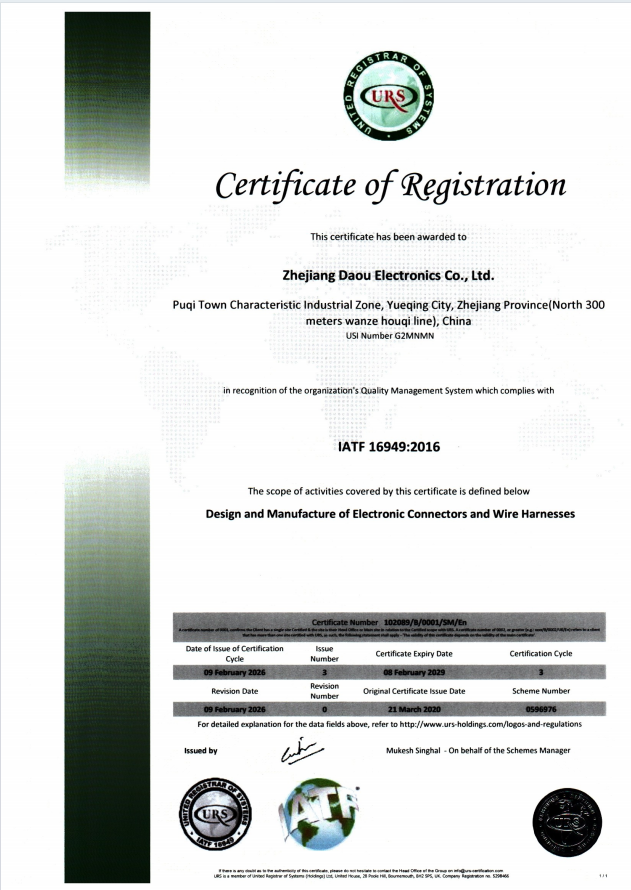
The IATF 16949:2016 certificate referenced in this file (certificate 0596976, URS), covering the design and manufacture of electronic connectors and wire harnesses. Image: Zhejiang Daou Electronics Co., Ltd.
Manufacturing and commercial parameters published by the supplier are equally concrete on paper: OEM production mode, a stated monthly capacity of 750,000 units, a lead time of 7–15 days and a minimum order quantity of 2 units. Stated after-sales support covers remote technical guidance, spare parts supply, product parameter documents and coordination of factory audits — the last of which is the item most evaluation teams should use first.
Published specifications: seven components in one reference table
The table below consolidates the published parameter set for the component families referenced in this file. Values are reproduced as published; where a parameter is defined per project rather than fixed, that is noted in the technical section that follows.
| Model | Component | Material | Published parameters |
|---|---|---|---|
| DOH0001-1 | Automotive wire harness housing | PA / PBT | -40 °C to +125 °C; IP67; waterproof, dustproof, oil-resistant, acid and alkali resistant; automotive vibration compliance; IATF 16949 standards |
| DOE24022 | Automotive wiring harness terminal | Pure copper / red copper / copper alloy / tin-, nickel- or gold-plated copper | Rated 12 V / 24 V DC (up to 48 V DC for special models); current by size, e.g. 5 A / 10 A / 20 A / 50 A / 100 A / 200 A; low contact resistance; withstand voltage and insulation resistance per automotive harness electrical standards |
| DOCB24001 | Plastic harness support bracket | PA66 / PA66 GF30 | -40 °C to +125 °C (engine-bay versions withstand higher transient temperatures); UL94-V0 / UL94-V2; UV, ageing and salt-spray resistant; resistant to engine oil, coolant and cleaning agents; vehicle vibration durability compliant |
| DOBXS4-1A / DOBXS5-1F | Battery fuse box | PA66 / copper | 12 V DC / 24 V DC; high-conductivity copper or brass busbar with tin, nickel or zinc plating; bolt-type main mega fuse position; optional standard blade fuses 5 A / 10 A / 15 A / 20 A / 30 A; sealed flame-retardant shell; -40 °C to +125 °C; fixed mounting holes, direct battery positive connection |
| DOBP22001 | SAE Top Post battery terminal (12 V auto) | Brass / copper | Positive post 19.05 mm, negative post 17.46 mm, tapered; M8 thread; max current 500 A; tightening torque 8 N·m; tin-plated |
| DOBN22006-D5 | EV high-voltage battery connector | Brass / copper, tin-plated | Published under the same terminal parameter set as DOBP22001: 500 A maximum current, M8 thread, 8 N·m tightening torque |
| D520023 | Wire harness three-way tube conduit connector | PA66 | Continuous -40 °C to +120 °C, short-term peak 150 °C; IP66 / IP67 with sealing gaskets; resistant to engine oil, mineral oil, grease, weak acid and alkali and partial solvents; UV, hydrolysis and ageing resistant; non-conductive, high insulation |
Table 1: Published component parameters for the seven CNDO families referenced in this capability file. Source: manufacturer specification data.
Technical reading of the parameters
The value of the table depends on how each line is interpreted against a real circuit. The subsections below read the parameters the way an evaluation engineer would.
Housing and sealing — DOH0001-1
PA and PBT are semi-crystalline thermoplastics chosen for dimensional stability and resistance to under-hood fluids; the published housing specification pairs them with an IP67 rating and an operating band of -40 °C to +125 °C. That combination addresses two separate failure modes: water and dust ingress, and thermal cycling of the polymer and seal. The specification also lists oil resistance, acid and alkali resistance, and compliance with automotive vibration criteria. For procurement, the practical question is not whether IP67 appears on a datasheet but which sealing element and which mating half achieve it — a rating holds for the assembled interface, not for a loose housing.
Terminal base metal and plating — DOE24022
The DOE24022 family is published across several conductor materials — pure copper, red copper, copper alloy, and tin-, nickel- or gold-plated copper — with a rated voltage of 12 V / 24 V DC and up to 48 V DC for special models. Plating choice is a durability decision as much as a conduction one: tin plating is the common automotive default, nickel and gold are selected where contact stability or corrosion exposure demands more. The published current values are deliberately size-banded (5 A through 200 A), which means the model number alone does not fix the electrical rating — the size and the mating terminal do.
The high-current path — DOBP22001 and DOBN22006-D5
Two models share one published parameter set: the SAE Top Post battery terminal DOBP22001 and the EV high-voltage battery connector DOBN22006-D5. Both are listed with brass or copper construction, tin plating, M8 thread, a maximum current of 500 A and a tightening torque of 8 N·m. The SAE Top Post dimensions are specified as a 19.05 mm positive post and a 17.46 mm negative post, both tapered. For a buyer, torque and thread specification matter as much as the current rating: a 500 A connection is only stable if the fastener is tightened to a controlled value and re-verified in the assembly process.
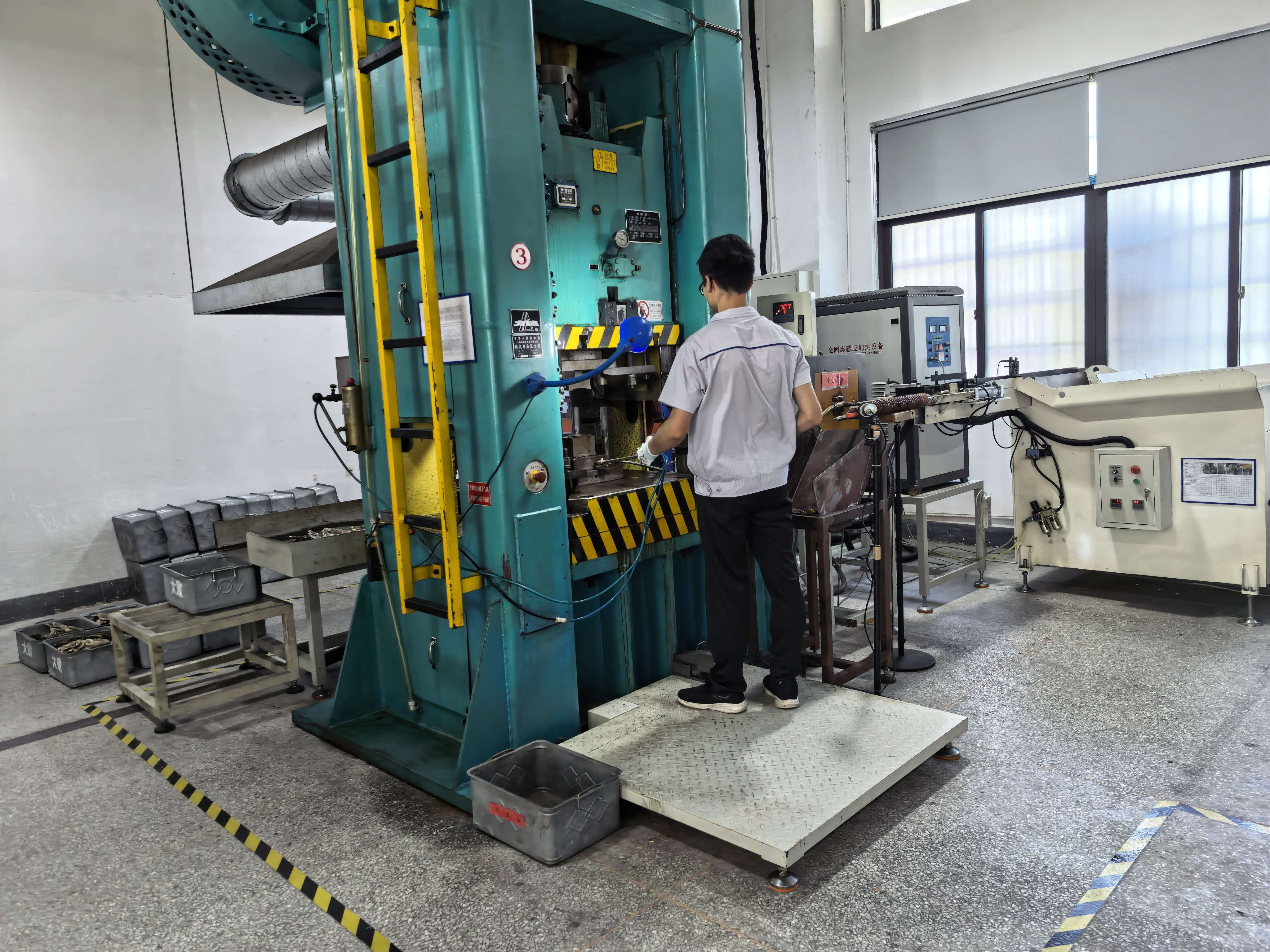
Production area supporting the connector, terminal and fuse box families. Capacity is stated by the manufacturer at 750,000 units per month. Image: Zhejiang Daou Electronics Co., Ltd.
Fuse boxes and busbars — DOBXS4-1A / DOBXS5-1F
The battery fuse box family is published at 12 V DC / 24 V DC with a high-conductivity copper or brass main busbar, plated in tin, nickel or zinc, housed in a sealed flame-retardant PA66 shell and rated from -40 °C to +125 °C. The auxiliary circuits accept standard blade fuses at 5 A, 10 A, 15 A, 20 A or 30 A. The main fuse position is a bolt-type mega fuse whose rating is set per project rather than fixed by the model — a detail that belongs in the drawing review, not the datasheet read.
Brackets, flame rating and vibration — DOCB24001
The DOCB24001 support bracket is moulded in PA66 or PA66 GF30, the glass-filled variant being the usual choice where stiffness under vibration matters. The published flame ratings are UL94-V0 and UL94-V2, alongside UV resistance, ageing resistance, salt-spray resistance, resistance to engine oil, coolant and cleaning agents, and compliance with vehicle vibration durability tests. Flame rating is often the parameter that decides a bracket specification in an interior or engine-bay location, because it constrains both material choice and wall thickness.
Routing and protection — D520023
The D520023 three-way tube conduit connector carries a continuous rating of -40 °C to +120 °C with a 150 °C short-term peak, and IP66 / IP67 ingress protection when fitted with sealing gaskets. Its PA66 body is specified as non-conductive with high insulation performance, and as resistant to engine oil, mineral oil, grease, weak acid and alkali, partial solvents, UV and hydrolysis. In harness terms this is a routing and protection component: it does not carry current, it determines whether the current-carrying conductors inside survive the zone they are routed through.
Where these components fit
Published parameters map onto distinct application zones, and the mapping is the part of a capability file that procurement teams actually reuse.
Automotive body, chassis and engine bay. The D520023 conduit connector is explicitly specified for engine bay, chassis and body wiring, and the DOH0001-1 housing's -40 °C to +125 °C band and IP67 rating suit sealed interfaces in the same zones. The DOCB24001 bracket addresses retention and flame requirements where harnesses run close to heat sources.
Battery and power distribution. The DOBXS4-1A / DOBXS5-1F fuse box family is designed for direct mounting to the battery positive terminal, which places it at the origin of the power distribution path rather than downstream of it. The DOBP22001 SAE Top Post terminal, with its 19.05 mm positive and 17.46 mm negative tapered posts, addresses the same physical junction on 12 V systems.
Electric vehicle and energy storage packs. The DOBN22006-D5 high-voltage connector is published at 500 A with M8 thread and 8 N·m torque — the current class associated with pack-level and high-load connections. The supplier's stated product scope also includes connectors for electric-vehicle battery packs and waterproof plugs, which extends the same material and sealing logic into pack and energy-storage assemblies.
Motorcycles, garden equipment and small appliances. Smaller-gauge harnesses in these categories reuse the same building blocks: sealed housings, plated terminals, blade-fuse distribution and conduit connectors. The relevant selection criteria are current band, sealing requirement and temperature exposure rather than vehicle class, so the DOE24022 size-banded terminal family and the sealed housing range cover a wide span of these designs.
Market context supporting the evaluation
Three published data points frame why connector documentation has become a procurement topic rather than an engineering afterthought. First, scale: Global Market Insights values the global automotive wiring harness market at USD 71.2 billion in 2025 and projects USD 74.7 billion in 2026, with Asia Pacific holding 47.1% of 2025 revenue. Second, high-voltage growth: SNS Insider sizes the automotive high-voltage connector market at USD 4.99 billion in 2026 and reports a CAGR of 11.90% for 2026–2035 — a faster trajectory than the harness total, reflecting electrified powertrains. Third, material reality: copper retains roughly 93.45% of automotive wiring harness conductor share as of 2025, so copper-based terminal and busbar specifications remain the default engineering assumption.
Compliance adds a parallel driver. For parts destined for the European Union, the ACEA Automotive Industry Guideline on REACH (AIG 4.0, 2024) sets out how automotive suppliers should identify substances and preparations and meet their REACH obligations — which turns material declarations into a document a buyer should request, not a courtesy. It is also worth noting a limitation in the public record: connector-level market data remains less granular than harness-level totals, so buyers should treat broad market figures as context for programme planning rather than as evidence of any single supplier's position.
Comparison with conventional sourcing — and the boundaries of this file
The contrast that matters is not between brands but between two sourcing approaches. In conventional catalogue-level sourcing, a buyer receives a part number, an outline, and a current figure; material grade, plating, flame rating and temperature band are confirmed late, often after a sample has been built into a harness. In documented sourcing, the parameter set arrives first and the RFQ is scoped from it. The second approach costs the supplier more in disclosure and shortens the buyer's qualification loop.
The boundaries are equally real, and a capability file that omits them is not usable. Five limits apply to the evidence above.
1. Datasheet parameters are not a qualification report. The published set covers material, temperature, ingress protection, flame rating, voltage, current and torque. It does not contain mating-cycle counts, dielectric withstand results, vibration test reports or terminal-retention data. Those must be requested as documents, per project.
2. Sealing ratings depend on the assembled interface. IP67 on the DOH0001-1 housing and IP66 / IP67 on the D520023 conduit connector are achieved with the correct sealing gaskets and a matching mating half. A buyer who specifies the housing alone has not specified the rating.
3. Size-banded ratings require a decision. The DOE24022 terminal is published across a 5 A to 200 A band, and the DOBXS4-1A / DOBXS5-1F main mega fuse rating is set per project. Two projects using the same model number can therefore hold different electrical ratings, and the drawing — not the model name — defines the part.
4. Higher-grade materials carry a cost and complexity trade-off. A PA66 GF30 bracket with UL94-V0 flame rating, or a nickel- or gold-plated terminal, solves a specific problem; applied to a low-temperature interior zone or a low-current signal circuit, it adds material cost and tooling complexity without improving the outcome. Specification should follow exposure, not habit.
5. A quality-system certificate is not a product approval. IATF 16949:2016 certification of the scope “Design and Manufacture of Electronic Connectors and Wire Harnesses” indicates a certified management system at the registered site. It does not by itself approve a given connector for a given vehicle programme; that approval comes from the customer's own validation and PPAP-type process.
A verification workflow for procurement teams
Because the parameters above are published rather than audited, the practical output of this file is a request list. The workflow below sequences what to ask for, in the order that removes risk fastest.
| Step | Request | What it settles |
|---|---|---|
| 1 | Certificate copy plus registry check of 0596976 | Validity, scope and issuing body of the IATF 16949:2016 claim |
| 2 | Drawings and dimensional reports for the selected models | Whether size-banded terminal and fuse ratings match the circuit |
| 3 | Sealing gasket specification and mating-half definition | Whether IP67 / IP66 ratings hold in the assembled interface |
| 4 | Plating thickness and contact-resistance data for DOE24022 | Durability of the chosen tin, nickel or gold finish |
| 5 | Torque validation for the M8 / 8 N·m high-current connection | Assembly-process control for 500 A joints |
| 6 | Capacity record and factory audit coordination | Whether the stated 750,000 units per month fits the programme |
| 7 | Material declaration for EU-bound parts | REACH obligations under ACEA AIG 4.0 |
Table 2: A seven-step verification sequence derived from the published parameter set.
Verification requests for drawings, certificate copies, parameter documents, samples or factory audit coordination can be directed to CNDO at jialuzhou101@gmail.com or +86 13645876878 (also the WhatsApp number), with the registered address at Puqi Characteristic Industrial Zone, Yueqing City, Zhejiang Province, China. Stated commercial terms for initial evaluation are MOQ 2 units, FOB or CIF delivery, pre-shipment test as the acceptance criterion, and payment at 30% T/T in advance with the remaining 70% before shipment.
Future outlook
Two directions are likely to shape how connector capability files are read over the next planning cycles. The first is voltage: as high-voltage architectures extend beyond pack-level connections into more of the vehicle, the parameters that currently sit in a footnote — creepage, insulation structure, torque control on M8-class fasteners — move into the main specification. The supplier's stated customization scope already lists EV high-voltage insulation structure as a configurable item, which is the relevant capability signal for that shift.
The second is documentation itself. With high-voltage connectors forecast to grow at 11.90% CAGR from 2026 to 2035 on the SNS Insider estimate, the number of programmes competing for qualified capacity rises, and the differentiator increasingly becomes the speed at which a supplier can produce verifiable documents rather than the breadth of its catalogue. Buyers should expect, and ask for, a parameter set, a certificate reference and an audit route as the baseline entry ticket — and should treat any supplier that cannot produce all three as an unfinished evaluation rather than a completed one.
FAQ
What component families make up the automotive wire harness connector range described here?
The published range in this file covers an automotive wire harness housing (DOH0001-1), an automotive wiring harness terminal (DOE24022), a plastic harness support bracket (DOCB24001), a battery fuse box family (DOBXS4-1A and DOBXS5-1F), a brass battery terminal (DOBP22001) and an EV high-voltage battery connector (DOBN22006-D5), plus a three-way tube conduit connector (D520023). Zhejiang Daou Electronics states that its broader product scope also includes wire harnesses, waterproof plugs and connectors for electric-vehicle battery packs.
How can a buyer confirm the IP67 and temperature claims for housing DOH0001-1?
The published housing specification states IP67 ingress protection, an operating band of -40 °C to +125 °C, resistance to oil, acid and alkali, and compliance with automotive vibration criteria, in PA or PBT material. Confirmation requires three documents: the sealing gasket specification, the mating-half definition, and the ingress-protection test method used. The rating applies to the assembled interface, so a housing evaluated in isolation does not yet demonstrate IP67.
Which terminal specification fits a 12 V or 24 V circuit?
The DOE24022 terminal family is published at a rated voltage of 12 V / 24 V DC, with up to 48 V DC stated for special models. Current rating is size-dependent, with published bands of 5 A, 10 A, 20 A, 50 A, 100 A and 200 A. Conductor material options are pure copper, red copper, copper alloy, and tin-, nickel- or gold-plated copper. Because the rating is not fixed by the model number, the size and plating must be specified per circuit at drawing level.
What OEM customization options are stated for connector programmes?
Stated customization options are housing colour, printing logo, terminal current specification, wire gauge matching, waterproof grade, pin count, packaging solution and EV high-voltage insulation structure. The stated production mode is OEM, with a minimum order quantity of 2 units, a stated monthly capacity of 750,000 units and a stated lead time of 7–15 days. Customized parameters should be fixed in drawings and sample approval rather than in correspondence alone.
What are the stated order quantity, lead time and acceptance terms?
Published commercial terms are a minimum order quantity of 2 units, a production lead time stated at 7–15 days, FOB or CIF delivery terms, pre-shipment test as the acceptance criterion, and payment at 30% T/T in advance with 70% before shipment. Capacity is stated at 750,000 units per month, and annual output at 9,000,000 units on a company-reported basis.
Can these components be used outside passenger vehicles, such as motorcycles, garden equipment or energy storage?
The published parameters are not restricted to one vehicle class. The D520023 conduit connector is specified for engine bay, chassis and body wiring with IP66 / IP67 sealing and a -40 °C to +120 °C continuous rating; the DOE24022 terminal is offered across a 5 A to 200 A band; and the DOH0001-1 housing carries IP67 and a -40 °C to +125 °C band. Motorcycle harnesses, garden equipment and small appliances typically reuse these building blocks at lower current bands, while energy storage and EV packs use the higher-current DOBN22006-D5 class. Selection should follow current band, sealing requirement and temperature exposure rather than the end-product label.
What does the IATF 16949:2016 certificate actually cover?
Certificate 0596976, issued by URS, is valid from 2020-03-21 to 2029-02-08 and covers the scope “Design and Manufacture of Electronic Connectors and Wire Harnesses.” It certifies a quality management system at the registered site. It does not constitute product-level approval for a specific vehicle programme, which requires the customer's own validation process.
Reference document: the supplier's English-language company brochure, including product families and contact details, is available for download: Zhejiang Daou Electronics (English brochure, PDF).
Supplier contact for verification: jialuzhou101@gmail.com | +86 13645876878 | Puqi Characteristic Industrial Zone, Yueqing City, Zhejiang Province, China | www.zjdaou.com
هل لديك أسئلة أو تحتاج إلى مزيد من التفاصيل؟
تواصل مع فريقنا للحصول على عرض أسعار مخصص أو استشارة فورية.
طلب عرض أسعار
املأ النموذج أدناه وسيتواصل معك فريقنا بعرض مقترح مخصص.
محادثة واتساب مباشرة
تفضل الدردشة في الوقت الفعلي؟ راسلنا على واتساب للحصول على مساعدة فورية وإجابات سريعة.
- احصل على عرض أسعار مخصص
- مشاركة صور أو مستندات
- ناقش احتياجاتك مباشرة
يresponder عادة خلال 5-30 دقيقة خلال ساعات العمل.