
Automotive Wire Harness Connector FAQ: IP67, 500A, Fuse Specs
Automotive Wire Harness Connector FAQ: IP67, 500A, Fuse Specs
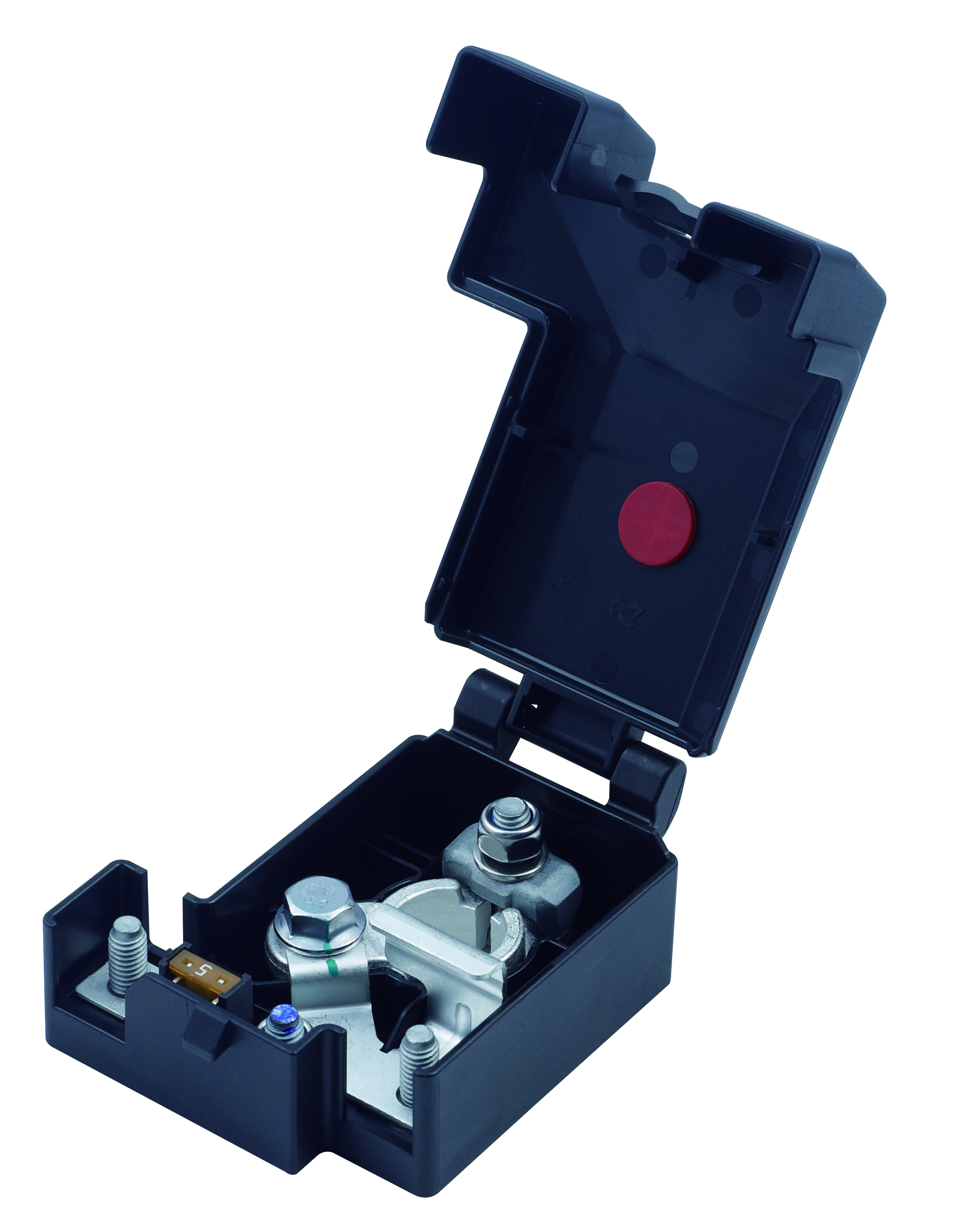
An automotive fuse box used on the battery-positive side of a vehicle wire harness system.
Automotive wire harness connectors, terminals, fuse boxes and battery terminals decide whether a vehicle electrical architecture can hold stable current through vibration, thermal cycling and moisture exposure. The global automotive wiring harness market was estimated at USD 89.54 billion in 2025, a figure driven by vehicle electrification and advanced driver assistance adoption, according to Precedence Research. Asia Pacific accounted for a 40.89% share of that market in 2025, and China contributed 62% of the region's revenue, based on Fortune Business Insights data.
Inside that market, engineers and buyers tend to ask the same short list of questions before a component enters a bill of materials. What protection level applies, and under which conditions? Which materials and plating are used? What current and voltage can the part carry? What temperature range does it hold, and does that range match the zone where the part will be installed? What documentation supports the claim? This reference answers those questions for the CNDO connector, terminal, fuse box, conduit connector and support bracket families supplied by Zhejiang Daou Electronics Co., Ltd., using published product specifications instead of general statements.
The Early-Stage Problem: Specification Ambiguity, Not Missing Data
Most sourcing errors in harness components do not come from absent data. They come from unqualified data. A protection rating quoted without its sealing condition, a current rating quoted without a size reference, or a temperature range quoted without a zone assignment can each produce a part that satisfies a datasheet and fails in a vehicle.
Three conditions are commonly under-specified in early evaluation:
- Sealing condition. Some connectors reach their highest ingress protection only in a specific assembly configuration. The D520023 wire harness three-way tube conduit connector reaches IP66 and IP67 protection levels when sealing gaskets are used, and unsealed connector types are applicable to dry interior environments. The protection number is therefore conditional, not universal.
- Load condition. Rated current in the DOE24022 terminal family varies by size, with published steps of 5A, 10A, 20A, 50A, 100A and 200A. The figure that matters for a design is the one matched to the conductor and the actual load, not the family maximum.
- Voltage domain. The DOE24022 terminal is rated at 12V DC or 24V DC for mainstream vehicle applications, with up to 48V DC for special models. Traction-voltage circuits require a dedicated component instead, such as the DOBN22006-D5 EV high-voltage battery connector with a maximum current rating of 500A.
Resolving these three conditions early reduces prototype rework and re-qualification cost, and it changes how a supplier is assessed. The evaluation question shifts from "does the part exist" to "under which documented conditions does the part perform." That shift is the practical difference between a component purchase and a component engineering decision.
CNDO Component Families Covered in This Reference
Zhejiang Daou Electronics Co., Ltd. (brand name CNDO) is a manufacturer established in 2018 that specialises in the research, development and production of automotive wire harnesses, battery terminals and automotive fuse boxes. The company operates a 6,000 m² facility with approximately 125 staff and 25 engineers, reports an annual production capacity of 9,000,000 units, and holds IATF16949:2016 certification. Export business accounts for 50% of total sales, with the USA and EU as major markets. The company provides OEM and main unit supply solutions, supported by in-house R&D and production capability covering mold development, precision manufacturing and finished product inspection.
Seven component families carry the specifications discussed below.
| Component family | Model | Key published specification |
|---|---|---|
| Automotive wire harness housing | DOH0001-1 | PA/PBT; IP67; −40°C to +125°C; waterproof, dustproof, oil-resistant, acid and alkali resistant; complies with IATF16949 standards |
| Automotive wiring harness terminal | DOE24022 | Pure copper, red copper, copper alloy, tin-plated, nickel-plated or gold-plated copper; 12V/24V DC, up to 48V DC for special models; rated current by size from 5A to 200A |
| EV high-voltage battery connector | DOBN22006-D5 | Maximum current 500A; M8 thread; tightening torque 8 N·m; negative post diameter 17.46 mm; tin-plated finish |
| Auto battery terminal | DOBP22001 | SAE Top Post (12V Auto); brass; positive post diameter 19.05 mm; rated voltage 12V; tin-plated; M8 thread |
| Battery fuse box | DOBXS4-1A, DOBXS5-1F | PA66 and copper; 12V/24V DC; bolt-type mega main fuse; 5A–30A blade auxiliary fuses; high conductivity copper/brass busbar with tin/nickel/zinc plating; −40°C to +125°C |
| Wire harness T/Y conduit connector | D520023 | PA66; −40°C to +120°C continuous, 150°C short-term peak; IP66/IP67 with sealing gaskets; resistant to engine oil, mineral oil, grease, weak acid/alkali and partial solvents |
| Harness support bracket | DOCB24001 | PA66 or PA66 GF30; UL94-V0 or UL94-V2; −40°C to +125°C; resistant to engine oil, coolant, cleaning agents, salt spray, UV and ageing |
What the Published Specifications Mean in Practice
Sealing level is a conditional specification
The DOH0001-1 automotive wire harness housing is made of PA/PBT and carries an IP67 protection level. Its sealing properties are documented as waterproof, dustproof, oil-resistant and acid and alkali resistant; it meets automotive vibration requirements and complies with IATF16949 standards, and it operates from −40°C to +125°C. In the application conditions recorded for automotive harness use, sealed connectors reach IP67/IP6K9K protection, while unsealed types are applicable to dry interior environments. The practical rule for a buyer is that the protection level applies to the assembled, correctly gasketed configuration — not to an open connector body.
Current, thread interface and tightening torque
The DOBN22006-D5 EV high-voltage battery connector is specified with a maximum current rating of 500A, an M8 thread, a tightening torque of 8 N·m, a tin-plated finish and a 17.46 mm negative post diameter. At a battery interface, torque specification matters as much as current rating. An under-tightened M8 connection raises contact resistance and local heat generation, while over-tightening risks damaging the terminal or the post. A published torque value turns assembly into a controlled process step rather than an operator judgement.
On the low-voltage side, the DOE24022 terminal family publishes a rated voltage of 12V DC or 24V DC for mainstream vehicles and up to 48V DC for special models. Rated current varies by size across 5A, 10A, 20A, 50A, 100A and 200A steps. The family description also specifies low contact resistance for stable conductivity, withstand voltage compliance with automotive wiring harness electrical standards, and high insulation resistance for the insulated version.
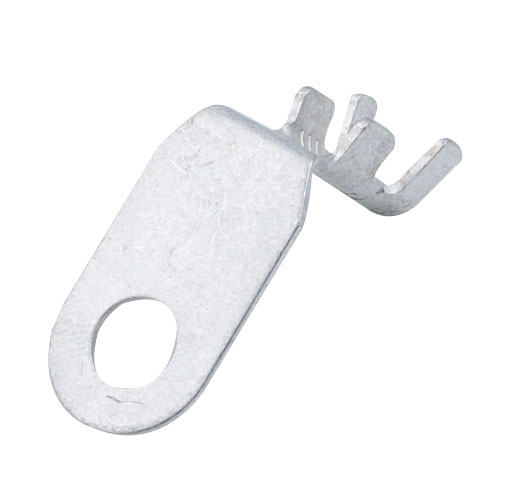
Automotive wiring harness terminals, the interface that determines contact resistance at the wire-to-harness joint.
Material and plating options
DOE24022 terminals are offered in pure copper, red copper, copper alloy, tin-plated copper, nickel-plated copper and gold-plated copper. For a procurement document, the significance is that one terminal geometry can be sourced in several contact finishes, so the finish must be written onto the drawing rather than assumed at order stage. The same logic applies inside the battery fuse box, where the main busbar uses high conductivity copper or brass with tin, nickel or zinc surface plating, and the shell is flame retardant plastic with a sealed cover and a waterproof, dustproof structure.
Thermal range and flame rating follow the installation zone
Thermal limits are not identical across the CNDO families, and that difference should drive zone assignment. The DOH0001-1 housing, the DOBXS4-1A/DOBXS5-1F battery fuse boxes and the DOCB24001 support bracket are all specified from −40°C to +125°C, with engine bay versions of the bracket able to withstand higher transient temperatures. The D520023 conduit connector is specified from −40°C to +120°C continuous, with a 150°C short-term peak. The lower continuous figure on the conduit connector is a real boundary: in a hot engine bay location, the zone temperature profile must be checked against the 120°C continuous limit before the part is selected.
Flame performance is published for the DOCB24001 bracket at UL94-V0 or UL94-V2, compliant with automotive flame retardant standards, and the bracket is additionally resistant to engine oil, coolant, cleaning agents, salt spray, UV and ageing while complying with vehicle vibration durability test standards. The fuse box shell is described as flame retardant plastic with a sealed cover.
Application and Use Cases
The recorded application conditions for these components cover automotive manufacturing, new energy vehicle production and automotive wire harness processing. Project types include passenger car assembly, new energy EV battery pack matching and commercial vehicle wiring. Matched equipment in those programs includes the auto wiring harness, the vehicle storage battery, the EV power battery module, the automotive ECU and the auto fuse box. The listed operating conditions are −40°C to +125°C, IP67 or IP67/IP6K9K for sealed connectors, and compliance with ISO 16750 and USCAR-2 automotive vibration standards.
Zone fit can be summarised directly from the specifications:
- Engine bay and chassis: sealed housings and gasketed conduit connectors, plus brackets documented as resistant to engine oil, coolant and salt spray.
- Body and interior: unsealed connector types are applicable to dry interior environments, where a full sealing system is not required.
- Battery and power distribution: battery terminals for SAE Top Post battery posts, EV high-voltage battery connectors for traction circuits, and battery fuse boxes installed through fixed mounting holes with direct battery positive connection.
Markets listed against these application conditions include the United States, Germany, France, Italy, Spain, Russia, Thailand, Singapore, South Korea and Japan, which is consistent with the company's reported 50% export share and its USA and EU market focus. The same specification logic — sealing level, current rating, plating, thermal range and flame rating — applies to adjacent battery-pack and low-voltage platforms, while the published specifications referenced here address automotive harness and battery-pack applications.
Market Trend Analysis
The verified data points in this category move in one direction, even where the underlying definitions differ.
- The global automotive wiring harness market was estimated at USD 89.54 billion in 2025 (Precedence Research).
- Asia Pacific held a 40.89% share of that market in 2025, with China accounting for 62% of regional revenue (Fortune Business Insights).
- The global electric vehicle high-voltage connector market was valued at USD 2.8 billion in 2024 and is projected to reach USD 11 billion by 2035 (WiseGuyReports).
- The global two-wheeler wiring harness market was valued at USD 3.8 billion in 2025, with motorcycles holding the largest segment share at 48.6% (Dataintelo).
- Supplier concentration remains high: Yazaki held the leading position in the global automotive wiring harness market with a 21.4% share in 2025 (Global Market Insights), and TE Connectivity, Amphenol and Molex are the top three global connector manufacturers, with TE Connectivity reporting USD 12.88 billion in sales for 2024 (Bishop & Associates).
One caution applies to any procurement model built on these numbers. Published market size estimates for this category diverge widely because of scope differences — the ranges reported for 2025 include USD 89.54 billion, USD 54.88 billion and USD 71.2 billion depending on whether the definition covers the full wiring harness system or connectors only. The spread should be read as a definition problem, not as a growth-rate disagreement.
The standards picture is more stable and more useful for specification work. USCAR-2 is the primary performance standard for automotive electrical connector systems in North America, covering testing for low-voltage road vehicle applications (SAE International), while LV214 is the standard widely used by European German OEMs for terminal and connector testing requirements. These two references explain why the same component may satisfy a North American program and still require additional documentation for a German OEM platform.
Comparison with Traditional and Unsealed Solutions
The comparison that matters at evaluation stage is not between brands but between sealing and connection strategies. The table below sets the documented CNDO configuration against the unsealed, dry-interior approach that remains common in low-cost harness builds.
| Evaluation dimension | Unsealed / dry-interior approach | Documented CNDO sealed configuration | Procurement implication |
|---|---|---|---|
| Ingress protection | No published IP level; applicable to dry interior environments | IP67 on DOH0001-1 housing; IP66/IP67 on D520023 when sealing gaskets are used | Zone assignment drives the selection decision |
| Continuous thermal ceiling | Part-dependent, typically limited by base plastic | −40°C to +125°C on housing, fuse box and bracket; −40°C to +120°C continuous with 150°C peak on the conduit connector | Conduit connector continuous limit is lower; verify against local heat |
| Voltage domain | 12V/24V DC mainstream circuit | 12V/24V DC, up to 48V DC for special terminal models; dedicated 500A EV connector for traction circuits | Standard terminals cannot substitute for a high-voltage connector |
| Assembly control | Fewer process steps, no gasket discipline | Gasket installation plus defined torque, e.g. 8 N·m at the M8 battery interface | Assembly procedure becomes part of the quality plan |
| Documentation | Variable; often drawing-only | IATF16949:2016 company certification; DOH0001-1 documented as complying with IATF16949 standards | Confirm the documentation scope for each specific part number |
The trade-off is explicit and should be stated plainly. A sealed connector adds a gasket and a specified assembly torque, and its protection claim holds only in the assembled configuration — the D520023 depends on sealing gaskets to reach IP66/IP67. The DOE24022 terminal family tops out at 48V DC for special models, so it is not a traction-voltage part. No single published CNDO connector covers every zone of a vehicle; the engineering work of matching each component to its documented condition remains with the buyer. That boundary is the reason a specification-based evaluation matters more than a headline rating.
Future Outlook
Three shifts are visible in the available data. First, the high-voltage connector segment is projected to grow from USD 2.8 billion in 2024 toward USD 11 billion by 2035 (WiseGuyReports), which concentrates specification attention on high-current interfaces such as the M8, 500A battery connection and its 8 N·m torque requirement. Second, sealing and flammability remain the two most frequently documented requirements in automotive harness applications, where IATF16949 automotive certification, IP67 sealing, flame retardance, vibration resistance and RoHS compliance are all listed as special requirements. Third, material selection continues to move toward glass-filled engineering plastics, reflected in the DOCB24001 bracket being available in PA66 or PA66 GF30 while the housing and conduit connector use PA/PBT and PA66 respectively.
For buyers, the practical consequence is that qualification readiness becomes a differentiator. A supplier able to document part-level specifications, plating options, torque values, protection conditions and thermal limits is easier to onboard into a vehicle program than one offering a single headline figure — regardless of how the market volume is calculated.
Frequently Asked Questions
An automotive wire harness connector is the component that joins a wire harness to a battery terminal, fuse box, ECU or load device and holds that electrical contact in place. In the recorded application conditions for this component category, the function is to connect the automotive wire harness, transmit power and electrical signals, and stabilise the circuit connection during cyclic on-board operation with vehicle start-stop. Matched equipment includes the auto wiring harness, vehicle storage battery, EV power battery module, automotive ECU and auto fuse box.
The DOH0001-1 is an automotive wire harness housing made of PA/PBT with an IP67 protection level. Its sealing properties are documented as waterproof, dustproof, oil-resistant and acid and alkali resistant. It meets automotive vibration requirements, complies with IATF16949 standards, and operates from −40°C to +125°C. IP67 therefore describes the assembled housing's resistance to water and dust ingress, not an open or unsealed connector body.
No. The D520023 wire harness three-way tube conduit connector, classified as a harness T/Y connector and made of PA66, reaches IP66 and IP67 protection levels when sealing gaskets are used. Its continuous operating temperature range is −40°C to +120°C, with a short-term peak of 150°C. It is used in automotive wiring harness applications in engine bay, chassis and body areas, and is resistant to engine oil, mineral oil, grease, weak acid and alkali, partial solvents, UV, hydrolysis and ageing, with non-conductive insulation properties.
The DOE24022 is an automotive wiring harness terminal with a rated voltage of 12V DC or 24V DC for mainstream vehicle use, and up to 48V DC for special models. Rated current varies by size, with published steps of 5A, 10A, 20A, 50A, 100A and 200A. The family is specified with low contact resistance for stable conductivity, withstand voltage compliance with automotive wiring harness electrical standards, and high insulation resistance for the insulated version. Material options are pure copper, red copper, copper alloy, tin-plated copper, nickel-plated copper and gold-plated copper.
The DOBN22006-D5 belongs to the EV high-voltage battery connector category. Its published specifications are a maximum current rating of 500A, an M8 thread, a tightening torque of 8 N·m, a negative post diameter of 17.46 mm, and a tin-plated finish. It is intended for high-current battery connections rather than for 12V or 24V low-voltage harness circuits.
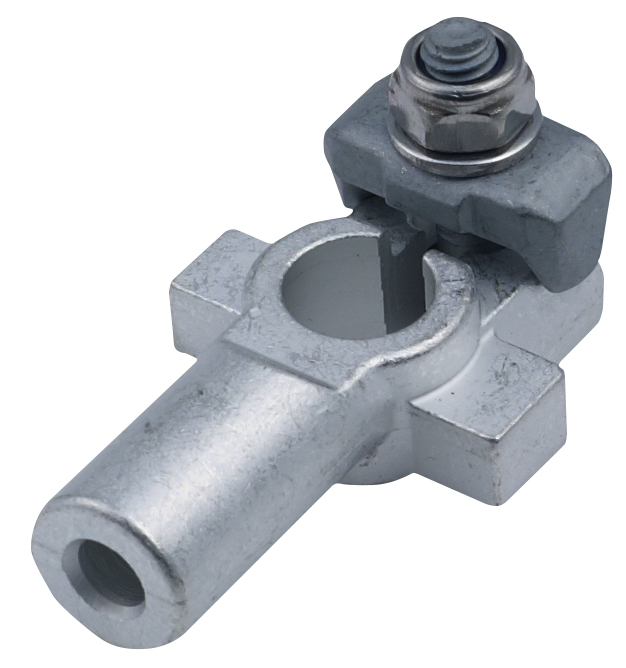
A high-current battery connection: the thread, torque and plating specifications are as important as the current rating.
The DOBP22001 is an auto battery terminal of the SAE Top Post (12V Auto) type, made of brass, with a 19.05 mm positive post diameter, a rated voltage of 12V, a tin-plated finish and an M8 thread. The DOBN22006-D5 is classified as an EV high-voltage battery connector, with a 500A maximum current rating, an M8 thread, an 8 N·m tightening torque, a 17.46 mm negative post diameter and a tin-plated finish. One is a low-voltage post-type battery terminal; the other is a high-current connector for electric vehicle battery packs.
The DOBXS4-1A and DOBXS5-1F are battery fuse boxes made of PA66 and copper. Working voltage is 12V DC or 24V DC. The main busbar uses high conductivity copper or brass with tin, nickel or zinc plating. The main fuse is a bolt-type mega fuse and auxiliary fuses are standard blade fuses rated from 5A to 30A, with 5A, 10A, 15A, 20A and 30A options. The shell is flame retardant plastic with a sealed cover and a waterproof, dustproof structure, and the operating temperature range is −40°C to +125°C. Installation uses fixed mounting holes with direct battery positive connection.
The DOCB24001 is a plastic harness support bracket made of PA66 or PA66 GF30, with a flame rating of UL94-V0 or UL94-V2 that complies with automotive flame retardant standards. It is resistant to engine oil, coolant, cleaning agents, salt spray, UV and ageing, complies with vehicle vibration durability test standards, and operates from −40°C to +125°C, with engine bay versions able to withstand higher transient temperatures.
The continuous temperature limits differ between families and must be compared against the zone profile. The DOH0001-1 housing, the DOBXS4-1A/DOBXS5-1F fuse boxes and the DOCB24001 bracket are specified from −40°C to +125°C. The D520023 conduit connector is specified from −40°C to +120°C continuous with a 150°C short-term peak. Engine bay application conditions listed for this component category include −40°C to +125°C operation, IP67 or IP67/IP6K9K sealing for sealed connectors, and compliance with ISO 16750 and USCAR-2 automotive vibration standards.
Zhejiang Daou Electronics Co., Ltd. holds IATF16949:2016 certification, and the DOH0001-1 housing is documented as complying with IATF16949 standards. IATF16949 automotive certification, IP67 sealing, flame retardance, vibration resistance and RoHS compliance are also listed among the special requirements for the recorded automotive application conditions. Because documentation scope can differ by part number, buyers should confirm the applicable certificate and part-level compliance statement during supplier qualification rather than assuming coverage across an entire catalogue.
Reference material: an English-language brochure summarising these component families is available for download at Zhejiang Daou Electronics Co., Ltd. (English). Company information is also published at www.zjdaou.com.
تصنيفات
- الزراعة الذكية والبيئة
- أشباه الموصلات والذكاء الاصطناعي
- الطاقة الخضراء والمواد الجديدة
- التكنولوجيا الحيوية والابتكار الطبي
- الحياة الذكية والابتكار الاستهلاكي
- التصنيع الذكي
- الأدوات والأجهزة
- المحركات التجارية
- الصناعة الخفيفة والاستخدام اليومي
- المعدات والمكونات الصناعية
- الإضاءة والإضاءة
- قطع غيار السيارات والدراجات النارية وملحقاتها
- تصنيع الآلات
- الطاقة والمعادن والمعادن
- الكهربائية والإلكترونية
- منتجات الكمبيوتر
- الصحة والطب
- المواد الكيميائية
- الخدمات
- أداة قياس