
Automotive Wire Harness Connector: Technical & Sourcing FAQ
An automotive wire harness connector question is rarely a single question. An OEM buyer asks about material and receives an answer about sealing; asks about sealing and receives an answer about torque; asks about torque and receives an answer about which quality system issued the certificate behind the part. The four technical constraint families — material, ingress protection, thermal envelope and electrical rating — cannot be evaluated independently, because a change to any one of them moves the others.
This reference sets out the technical and procurement questions that recur in OEM sourcing of automotive wire harness connectors and answers each one against published component data, using the product families of Zhejiang Daou Electronics Co., Ltd. (CNDO), a Chinese manufacturer of automotive wire harnesses, battery terminals, fuse boxes and connectors based in Yueqing City, Zhejiang Province, as the working example. The intent is not to argue that one supplier fits every program. It is to give buyers a defensible question set and a documentary checklist that can be used with any supplier.
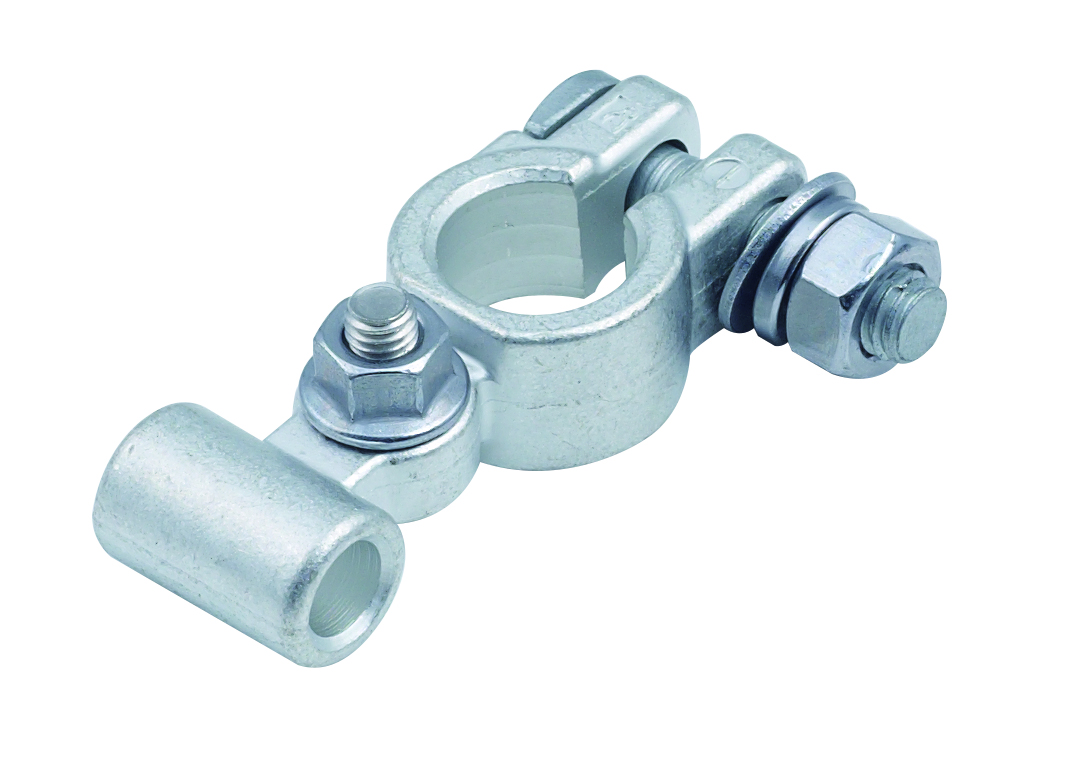
Battery terminal hardware is one of the few harness interfaces where the tightening torque is a published procurement value rather than an assembly-floor decision.
Why the questions cluster around four constraints
Procurement teams new to connector sourcing tend to build a request for quotation around the connector's name and pin count. That document is usually returned without objection and then fails at first article inspection, because the parameters that decide acceptance were never stated. In practice, the constraints that determine whether a connector survives a vehicle program fall into four families, and each family is proven by a different document.
| Constraint family | What the buyer must state | Where an unstated constraint typically surfaces |
|---|---|---|
| Material and plating | Housing resin, terminal base metal, plating type and thickness | Mated pairs with mismatched plating; housing resin that cannot hold torque at temperature |
| Ingress protection | IP class at assembly level, gasket inclusion, zone of installation | Water ingress in chassis or engine-bay locations after field service rework |
| Thermal envelope | Continuous operating range, short-term peak allowance | Continuous rating used to justify a transient exposure it was never meant to cover |
| Electrical rating | System voltage, rated current by terminal size, contact resistance | A terminal sized for a 12V/24V circuit applied to a higher-voltage architecture |
Automotive connectors are a small part of a large market, which is one reason buyers struggle to find comparable data. The global automotive wiring harness market was valued at USD 74.7 billion in 2026, according to Global Market Insights, with Asia Pacific holding 47.1% of 2025 revenue. Within that total, the dedicated high-voltage connector segment was estimated at USD 4.99 billion in 2026, with a forecast CAGR of 11.90% from 2026 to 2035, according to SNS Insider. The lesson for procurement is structural: the fast-growing part of the category is precisely the part where the constraint set is hardest, because voltage and sealing requirements multiply together.
Material selection: PA66, PA/PBT, brass and copper alloy
The first material question buyers ask — should the housing be PA66 or PA/PBT — is usually the wrong first question. The correct first question is which component in the assembly is being discussed, because a harness connector is a multi-material system and each material carries a different failure mode.
| Component (CNDO reference) | Declared material | Functional reason it is specified |
|---|---|---|
| Housing, DOH0001-1 | PA / PBT | Dimensionally stable housing with IP67 sealing, resistant to oil and acid/alkali exposure, vibration compliant |
| Support bracket, DOCB24001 | PA66 / PA66 GF30 | Structural retention with UL94-V0 or UL94-V2 flame rating, UV, salt-spray and coolant resistance |
| Three-way conduit connector, D520023 | PA66 | Non-conductive routing joint with hydrolysis and ageing resistance in engine bay, chassis and body runs |
| Fuse box, DOBXS4-1A / DOBXS5-1F | PA66 shell, copper busbar | Flame-retardant sealed shell over a high-conductivity copper or brass busbar with tin, nickel or zinc plating |
| Terminal, DOE24022 | Pure copper, red copper, copper alloy, tin / nickel / gold plated | Conductive path engineered for low contact resistance and stable conductivity |
| Battery terminal, DOBP22001 / DOBN22006-D5 | Brass / copper, tin-plated | SAE Top Post interface for 12V vehicle batteries, M8 thread, rated to a maximum current of 500A |
Three procurement consequences follow from this table. First, a material declaration must be requested per component, not per part number, because the housing resin and the terminal plating answer different questions. Second, glass-filled grades such as PA66 GF30 behave differently from unfilled PA66 in a bracket, and a supplier substitution between the two is a change the buyer should be notified of, not a commercial detail. Third, plating is a specification, not a finish: tin, nickel and gold plating on a copper terminal are not interchangeable across a mated pair, and mixing them is a recognised corrosion risk in field service.
Industry material data supports keeping copper at the centre of that decision. A 2025 commercial-research estimate places copper at roughly 93% of automotive wiring harness conductor material share, with aluminium forecast to grow faster from a much smaller base — largely because aluminium's advantage is weight in long cable runs, not conductivity at a bolted interface. For safety-critical battery connections, forged copper and brass remain the specification buyers default to.
Sealing performance: what IP66 and IP67 do and do not promise
Ingress protection is the constraint most often over-read on a datasheet. IP67 on a housing means the component was designed and tested to withstand immersion under defined conditions. It does not automatically mean the delivered harness assembly is waterproof, because sealing depends on the gasket, the cable exit, the conduit joint and the assembly operation.
CNDO's published data makes this distinction visible. The DOH0001-1 housing is rated IP67 with waterproof, dustproof, oil-resistant and acid/alkali-resistant sealing, and is described as compliant with automotive vibration requirements and IATF 16949 standards. The D520023 three-way conduit connector reaches IP66 or IP67 only when sealing gaskets are fitted — the rating is conditional on an installed accessory. In vehicle-level terms, sealed connectors are typically specified to IP67 or IP6K9K for engine-bay, chassis and other wet zones, while unsealed types are intended for dry interior environments only.
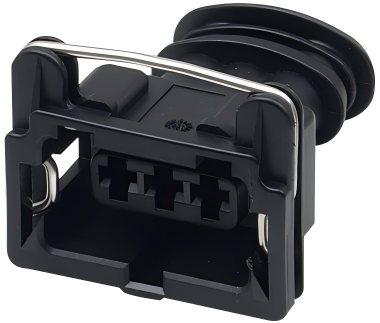
A housing rating is a component claim. Assembly-level IP verification requires the gasket, cable exit and joint to be tested together.
For the buyer, the operational rule is simple: write the IP requirement against the zone of installation, then ask for the test report at the same level of assembly that will be delivered. If the answer is a component-level certificate and the delivery is an assembled harness, the gap belongs in the first article inspection plan, not in a later warranty discussion.
Operating temperature: continuous range versus transient peak
Most automotive harness connector families are published with an operating range of -40°C to +125°C, and that figure is frequently copied into purchasing documents without the qualifier that makes it meaningful. The qualifier is whether the number describes a continuous rating or an allowable short-term excursion.
CNDO's product data shows both forms. The DOH0001-1 housing, DOCB24001 support bracket and DOBXS4-1A / DOBXS5-1F fuse boxes are all published at -40°C to +125°C, with the bracket noting that engine-bay versions can withstand higher transient temperatures. The D520023 conduit connector is published differently: -40°C to +120°C continuous, with a short-term peak of 150°C. Those are not contradictory specifications; they describe different components with different thermal margins, and the conduit joint sits closer to a heat source in many routings.
The procurement consequence is that a temperature requirement should be written as two numbers — continuous and transient, with a duration — rather than one. A single figure invites a supplier to quote the more favourable of its two ratings, and it removes the buyer's ability to compare responses.
Electrical ratings: 12V, 24V, 48V and the 500A interface
Electrical ratings are where the widest specification gaps appear, because the numbers attach to different components. In CNDO's published data, the DOE24022 terminal is rated for 12V or 24V DC as the mainstream vehicle case, with up to 48V DC for special models, and rated current varies by terminal size across 5A, 10A, 20A, 50A, 100A and 200A. The DOBXS4-1A / DOBXS5-1F battery fuse box is a 12V DC or 24V DC component with a bolt-type mega fuse on the main circuit and optional standard blade fuses rated 5A to 30A on auxiliary circuits. The DOBP22001 / DOBN22006-D5 battery terminal is a 12V SAE Top Post component with a maximum current of 500A.
Two practical rules follow. First, current rating is not a property of the connector family; it is a property of the specific terminal size in that family, so a bill of materials should carry the terminal size rather than the family name. Second, the 500A figure belongs to the battery terminal interface, not to a general-purpose harness connector, and should never be used to justify a downstream circuit.
The battery interface is a mechanical specification too
Battery terminals are the one connector family where the mechanical values are as procurement-critical as the electrical ones. The SAE Top Post design uses a positive post diameter of 19.05 mm and a negative post diameter of 17.46 mm, both tapered, with an M8 thread and a tightening torque of 8 N·m for DOBN22006-D5. The terminal is brass with tin plating. Torque is worth writing into the purchase order for a simple reason: under-torque produces a high-resistance joint that behaves like a voltage drop under load, and over-torque deforms the tapered post interface. Neither failure appears in an incoming dimensional inspection.
Certification and acceptance criteria: reading IATF 16949 correctly
IATF 16949 is the quality management system standard most often required in automotive connector sourcing, and it is also the requirement most often verified by looking at a logo rather than a certificate. The certificate matters in its details: certificate number, issuing body, scope wording, site, and validity dates.
CNDO's certificate is issued under IATF 16949:2016 by URS with certificate number 0596976, covering the design and manufacture of electronic connectors and wire harnesses, issued on 21 March 2020 and valid to 8 February 2029. Buyers should verify three things against that document. The scope wording must cover the process being purchased — design and manufacture of connectors and harnesses is a broad but specific scope, and a plating or moulding step performed outside it is not covered by the claim. The site must match the shipping location. The validity must be current at the date of the purchase order, since a certificate can be suspended between audits.
Certification is a system claim, not a product claim. It tells the buyer that the process is controlled and traceable; it does not tell the buyer that a specific connector meets a specific vehicle requirement. That second statement comes from the acceptance documents.
Acceptance documents to request with the first article
- Dimensional report against the approved drawing, including post diameters and thread for battery terminals.
- Material declaration per component — PA66, PA/PBT, PA66 GF30, brass, pure copper or copper alloy as applicable.
- Plating specification and thickness for terminals, busbars and battery posts (tin, nickel or zinc as specified).
- Ingress protection test evidence at the assembly level being delivered, with gaskets fitted where the rating depends on them.
- Vibration durability evidence against the applicable automotive standard; ISO 16750 and USCAR-2 are the references commonly cited for vehicle vibration conditions.
- Flame rating evidence for plastic parts, expressed as UL94-V0 or UL94-V2 with the tested thickness.
- Torque validation at the published value — 8 N·m for DOBN22006-D5 — with the test method stated.
- RoHS declaration, and for EU-bound programs a REACH statement identifying substances and preparations in the part.
The REACH point deserves emphasis for European programs. The ACEA Automotive Industry Guideline on REACH (AIG 4.0, 2024) sets out how automotive suppliers should identify substances and preparations in components and discharge their REACH obligations. A connector with a plating layer and a flame-retardant resin is exactly the kind of part where that documentation is requested by the vehicle manufacturer rather than volunteered by the tier-two supplier.
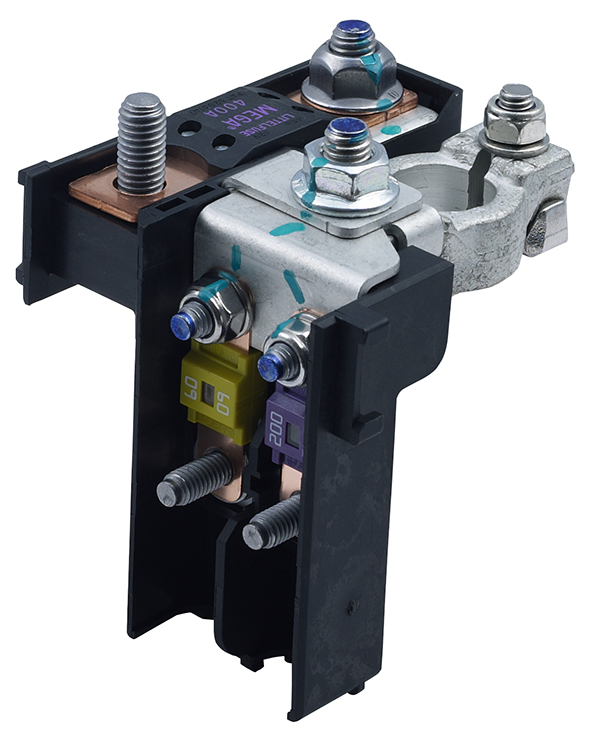
Battery fuse boxes combine a flame-retardant shell, a plated copper busbar and a sealed cover — three separate acceptance documents for one part number.
Purchasing terms OEM buyers should expect to confirm
Commercial terms are constraints too, and the ones that cause schedule damage are usually stated loosely. For CNDO's connector and harness production, the published operating parameters are an OEM production mode, a monthly capacity of 750,000 units, a lead time of 7 to 15 days, a minimum order quantity of 2 units, and IATF 16949 standard quality control. Export markets are stated as the United States and the European Union.
Customization options listed by the manufacturer cover housing colour, printed logo, terminal current specification, wire gauge matching, waterproof grade, pin count, packaging solution and EV high-voltage insulation structure. After-sales support is described as remote technical guidance, spare parts supply, product parameter documents and coordination of factory audits.
Company-level figures reported by CNDO — a 6,000 m² facility, 125 employees, 25 engineers in R&D and an annual output of 9,000,000 units, with roughly 50% of output exported to the USA and EU — are useful context when sizing a supplier against a program, but they are company-reported and should be confirmed through the audit coordination the supplier offers rather than accepted from a brochure. The company also reports an eight-year supply relationship with vehicle OEMs and automotive wiring harness manufacturers.
A low minimum order quantity of 2 units has a specific and limited value: it makes sample evaluation and engineering trials practical before a production commitment. It does not shorten qualification. Sampling and qualification are separate processes, and a program schedule that treats the first as the second will compress the wrong stage.
How this differs from catalogue or generic connector sourcing
The honest comparison is not between a good supplier and a bad one; it is between two sourcing models with different constraint profiles. A catalogue or distributor-sourced connector offers availability, low entry friction and a wide part range from stock. An IATF 16949 manufacturer route offers traceable process control, documented acceptance evidence and customization at the component level, but requires the buyer to invest in specification work up front.
Three boundaries should be stated plainly, because they define where each model stops working.
- Standard families are not program-specific designs. A sealed 12V/24V housing family such as DOH0001-1 covers a broad set of applications, but a program requiring dedicated keying, a unique mating interface or a new terminal position assurance feature needs tooling and validation work that a standard family cannot supply by configuration alone.
- Component ratings do not transfer to systems. An IP67 housing and an IP66/IP67 conduit connector do not add up to a waterproof harness. The assembly must be validated as an assembly, and the buyer owns that validation boundary.
- The published lead time covers the standard production flow. The 7 to 15 day figure describes production scheduling, not the first-article, tooling or system-validation cycle, which a program should plan separately.
One further note applies to adjacent platforms. The same connector and terminal families appear in motorcycle harness assemblies, garden-equipment wiring and small-appliance connections where IP-rated sealing is required. Buyers in those segments should confirm which test standard the part was actually qualified against rather than assuming that an automotive qualification transfers unchanged to a different duty cycle.
Market trend analysis: where the constraint pressure is increasing
Two directions in the published market data explain why connector constraint sets are getting longer rather than shorter. The first is voltage. With the high-voltage connector segment forecast to grow at 11.90% CAGR from 2026 to 2035 on a 2026 base of USD 4.99 billion, a rising share of connector demand sits in architectures where insulation structure, sealing and thermal management all tighten at once. The second is material. Copper retains the dominant share of conductor material while aluminium grows faster from a smaller base, which means buyers will increasingly manage mixed-material bills of materials rather than single-material ones.
Regulatory pressure moves in the same direction. For programs shipping into the European Union, the REACH documentation expectation described in ACEA AIG 4.0 applies to connector components as much as to any other part, and it is a document a supplier must be able to produce on request.
Future outlook
The practical change over the next procurement cycles is unlikely to be a new connector format. It is more likely to be a shift in what counts as a complete specification. Buyers who currently specify a connector by family name and pin count will be asked, by their own validation teams, for the continuous and transient thermal figures, the plating on both halves of the mated pair, the assembly-level IP evidence and the torque value for every bolted interface. Suppliers who can return those documents quickly — because the underlying process is documented under IATF 16949 — will spend less time in first article loops than suppliers who must reconstruct the evidence after the question is asked.
For reference material covering the wider product range, the manufacturer's English catalogue is available as a downloadable PDF. Procurement enquiries for Zhejiang Daou Electronics Co., Ltd. can be directed to Vicky at jialuzhou101@gmail.com or +86 13645876878, with the manufacturing site at Puqi Characteristic Industrial Zone, Yueqing City, Zhejiang Province, China.
FAQ
What material should an automotive wire harness connector housing be made from?
Housing material is selected by function, not by preference. PA/PBT is used where dimensional stability and sealing performance dominate, as in the DOH0001-1 housing, which is rated IP67 and covers -40°C to +125°C. PA66 and PA66 GF30 are used where structural retention and flame resistance dominate, as in the DOCB24001 support bracket, rated UL94-V0 or UL94-V2 with UV, salt-spray and coolant resistance. PA66 is used for routing components such as the D520023 conduit connector. A buyer should request the material declaration per component rather than per part number.
Does an IP67 rating on a connector housing mean the finished harness is waterproof?
No. IP67 on a housing is a component-level claim covering the housing design under defined test conditions. Assembly-level protection depends additionally on the sealing gasket, the cable exit and any joint in the routing. CNDO's D520023 conduit connector, for example, reaches IP66 or IP67 only when sealing gaskets are fitted. Sealed connectors are typically specified to IP67 or IP6K9K for wet zones such as engine bay and chassis, while unsealed types are intended for dry interior environments. Buyers should request ingress protection evidence at the same level of assembly that will be delivered.
What operating temperature range should be specified for an engine-bay connector?
Specify two numbers: a continuous range and a short-term peak with duration. CNDO publishes -40°C to +125°C for the DOH0001-1 housing, the DOCB24001 bracket and the DOBXS4-1A / DOBXS5-1F fuse boxes, with the bracket noting that engine-bay versions can withstand higher transient temperatures. The D520023 conduit connector is published at -40°C to +120°C continuous with a 150°C short-term peak. A single temperature figure allows a supplier to quote whichever of its two ratings is more favourable and removes comparability between quotations.
How do 12V, 24V and higher-voltage connector ratings differ in a procurement document?
The DOE24022 terminal is rated for 12V or 24V DC in mainstream vehicle applications, with up to 48V DC available for special models, and its rated current varies by terminal size across 5A, 10A, 20A, 50A, 100A and 200A. The DOBXS4-1A / DOBXS5-1F fuse box is a 12V DC or 24V DC component. The DOBP22001 / DOBN22006-D5 battery terminal is a 12V SAE Top Post part with a maximum current of 500A. Because the rating attaches to the specific terminal size or component rather than to the connector family, the purchase order should name the size and the system voltage explicitly.
What does IATF 16949 certification actually cover on a connector supplier's certificate?
It covers the quality management system for the processes named in the certificate scope, at the site named, during the validity period. CNDO's certificate is issued under IATF 16949:2016 by URS, certificate number 0596976, with a scope of design and manufacture of electronic connectors and wire harnesses, issued 21 March 2020 and valid to 8 February 2029. Buyers should confirm that the scope wording covers the purchased process, that the site matches the shipping location, and that the certificate is current at the order date. The certificate does not by itself confirm that a specific connector meets a specific vehicle requirement.
What tightening torque applies to an SAE Top Post battery terminal?
For CNDO's DOBN22006-D5 battery terminal the published tightening torque is 8 N·m. The same terminal family uses a positive post diameter of 19.05 mm and a negative post diameter of 17.46 mm, both tapered, with an M8 thread, brass construction and tin plating, rated to a maximum current of 500A at 12V. Torque should be written into the purchase order and verified at first article, because under-torque produces a high-resistance joint under load and over-torque deforms the tapered post interface, and neither condition is detected by an incoming dimensional inspection.
Which documents should accompany a first article inspection for a connector?
A dimensional report against the approved drawing; a material declaration per component covering resin and metal; a plating specification and thickness for terminals, busbars and battery posts; ingress protection test evidence at the delivered assembly level with gaskets fitted where the rating depends on them; vibration durability evidence against the applicable automotive standard, with ISO 16750 and USCAR-2 the references commonly cited; flame rating evidence expressed as UL94-V0 or UL94-V2 with tested thickness; torque validation at the published value with the test method stated; and a RoHS declaration. For EU-bound programs, a REACH statement identifying substances and preparations should be added.
What minimum order quantity, lead time and customization scope are typical for OEM connector orders?
For CNDO's connector and harness production the published parameters are a minimum order quantity of 2 units, a lead time of 7 to 15 days, a monthly capacity of 750,000 units and an OEM production mode under IATF 16949 quality control, with exports directed to the United States and the European Union. Customization options listed are housing colour, printed logo, terminal current specification, wire gauge matching, waterproof grade, pin count, packaging solution and EV high-voltage insulation structure. The low minimum supports sample evaluation but does not shorten first article or system validation, which should be scheduled separately from the production lead time.
How should EU-bound connector programs handle REACH documentation?
The ACEA Automotive Industry Guideline on REACH (AIG 4.0, published 2024) describes how automotive suppliers identify substances and preparations in components and discharge their REACH obligations for the European market. For a connector, that typically means documentation covering the resin, flame-retardant system and plating layers. Buyers should request the REACH statement as part of the acceptance document set rather than after the vehicle manufacturer asks for it, because a plated terminal with a flame-retardant housing is precisely the type of component where the request originates upstream in the supply chain.
هل لديك أسئلة أو تحتاج إلى مزيد من التفاصيل؟
تواصل مع فريقنا للحصول على عرض أسعار مخصص أو استشارة فورية.
طلب عرض أسعار
املأ النموذج أدناه وسيتواصل معك فريقنا بعرض مقترح مخصص.
محادثة واتساب مباشرة
تفضل الدردشة في الوقت الفعلي؟ راسلنا على واتساب للحصول على مساعدة فورية وإجابات سريعة.
- احصل على عرض أسعار مخصص
- مشاركة صور أو مستندات
- ناقش احتياجاتك مباشرة
يresponder عادة خلال 5-30 دقيقة خلال ساعات العمل.