
BAIFA Diesel Generator FAQ: Matching 5 Engine Platforms
BAIFA Diesel Generator FAQ: Matching 5 Engine Platforms
Engine brand is the starting point of a diesel generator specification, not the whole specification. A Cummins, Volvo, MTU, Perkins or Doosan engine tells the buyer which service path, parts discussion and emissions review may apply. It does not by itself confirm the generator set rating, rated speed, enclosure, control system, fuel consumption, noise level or acceptance criteria. BAIFA POWER (WUXI)LTD. is a Wuxi, Jiangsu-based generator manufacturer with a 60,000 m² production base and a published diesel and gas generator portfolio from 8 kW to 3,200 kW. This FAQ uses the five engine-platform references in BAIFA’s portfolio — BF-C for Cummins, BF-V for Volvo, BF-M for MTU, BF-P for Perkins and BF-DW for Doosan — to show what a project buyer should match and what should be verified before a purchase order.
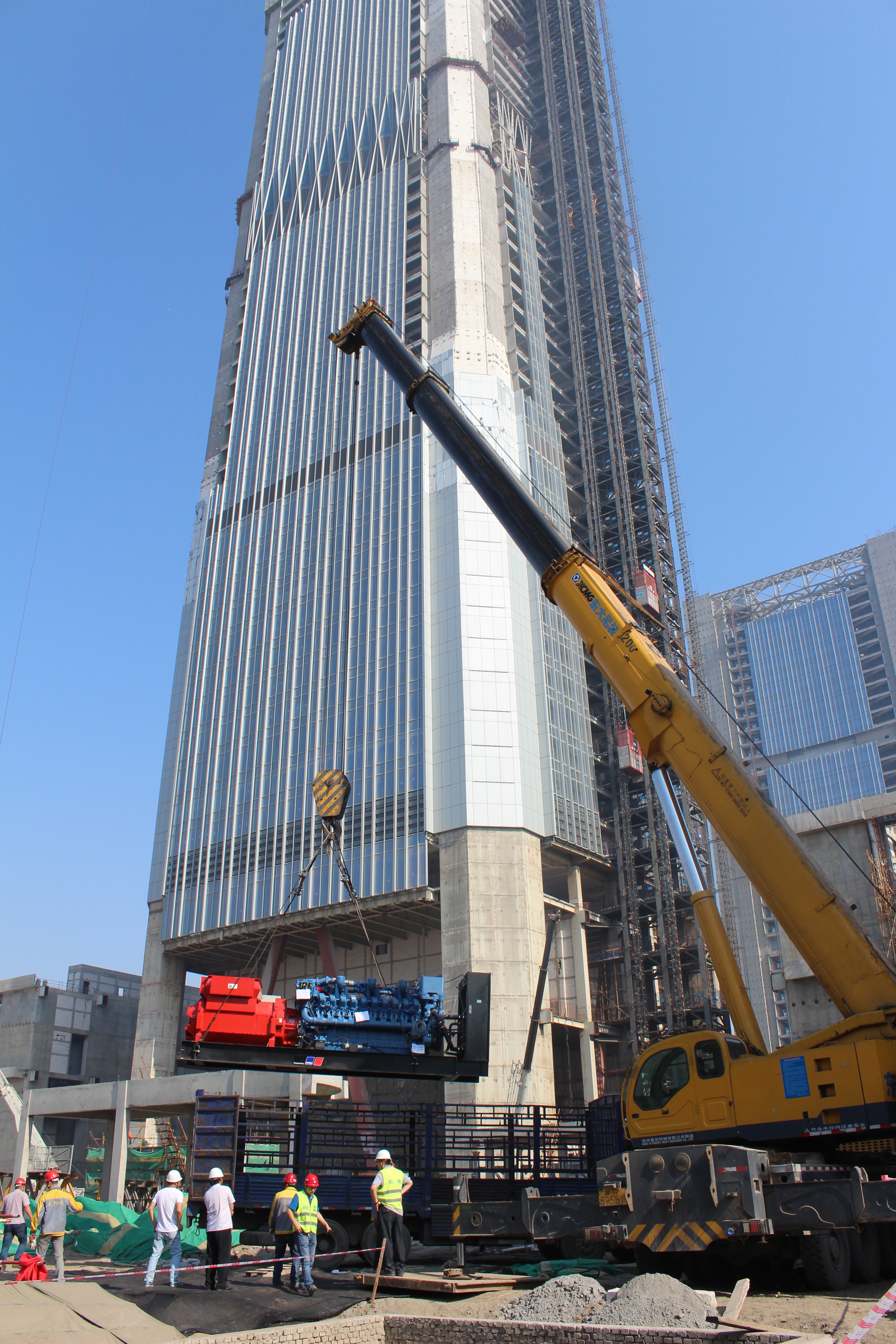
Project reference: Tianjin 117 Building high-rise emergency standby application, seven units supplied.
What Does Platform Matching Mean in a Diesel Generator RFQ?
Platform matching means aligning five things: the engine family, the generator-set model, the rating basis, the site conditions and the commercial scope. The engine family is only one line in that chain. A 1000 kVA diesel generator set, for example, needs a model-level datasheet showing prime or standby rating, rated speed, voltage, frequency, alternator, enclosure, control panel and fuel-consumption basis. The engine brand alone cannot confirm any of those items.
BAIFA’s published portfolio is broad: industrial diesel and gas generator sets from 8 kW to 3,200 kW, marine generator sets from 40 kW to 1,100 kW, and a model list that includes BF-C, BF-V, BF-M, BF-P and BF-DW families. The five families are associated with Cummins, Volvo, MTU, Perkins and Doosan respectively in BAIFA’s product listing. That association is a useful screening signal. It is not a substitute for the model datasheet, engine authorization check or certificate review for the exact configuration.
The table below summarizes the supplied series references. The model ranges are series references, not universal kW bands. A buyer should ask for the kW rating of the exact model rather than infer it from the series name.
| Series reference | Engine platform association | Supplied model reference | Buyer check point |
| BF-C | Cummins | BF-C25 to BF-2750QE | Confirm exact kW, rating basis, speed, enclosure and CE model coverage. |
| BF-V | Volvo | BF-V94 to BF-V836 | Confirm alternator, control system, protection degree and fuel curve. |
| BF-M | MTU | BF-M825 to BF-M3600 | Confirm high-power configuration, paralleling scope and project reference fit. |
| BF-P | Perkins | BF-P10 to BF-P2500 | Confirm standby duty, fuel efficiency basis and noise package. |
| BF-DW | Doosan | BF-DW190 to BF-DW1000 | Confirm engine model, emissions documentation and certificate scope. |
How Do the Five BAIFA Series Map to Cummins, Volvo, MTU, Perkins and Doosan?
BF-C is the Cummins-associated family. The supplied model reference runs from BF-C25 to BF-2750QE. For a buyer already standardized on Cummins service, the practical question is not whether the badge appears in the brochure, but whether the exact BF-C model, engine rating and alternator package are available for the target duty. Ask for the engine model, engine serial-number traceability, emissions label for the destination market and the CE certificate page that covers the model.
BF-V is the Volvo-associated family, with supplied model references from BF-V94 to BF-V836. Volvo platform inquiries often arise where a project wants a familiar engine brand for industrial or standby duty. The evaluation should still compare the complete set: alternator, control system, enclosure, fuel tank, ATS and protection degree. BAIFA lists voltage, frequency, connection type and protection degree among customization items, so these should be written into the technical offer rather than left to the brand name.
BF-M is the MTU-associated family, with references from BF-M825 to BF-M3600. This is the family to examine when the project needs a high-power platform and the buyer wants MTU engine technology. A supplied project reference for a Botswana power-plant rental application lists 88 high-voltage 800 kW containerized diesel generators powered by MTU, paralleled as a high-voltage output power station, with eight years of stable operation reported. That reference supports the existence of high-power MTU-platform project experience, but it does not turn every BF-M model into an 800 kW package. The exact model, voltage, paralleling controls and enclosure must be confirmed.
BF-P is the Perkins-associated family, with references from BF-P10 to BF-P2500. Perkins is often considered for standby and industrial applications, but the same discipline applies: confirm the rating basis and the fuel-consumption curve. The series reference does not state a single power band; the model datasheet should.
BF-DW is the Doosan-associated family, with references from BF-DW190 to BF-DW1000. Doosan platform inquiries should be matched to the project’s load profile and service plan. The buyer should ask whether the engine model is current for the destination market, what emissions documentation applies and whether the alternator and control system are included in the same CE scope. The point is not to rank one engine brand above another without comparable evidence. It is to verify that the chosen platform is documented for the exact generator set.
Marine generator sets are a separate family in BAIFA’s portfolio, from 40 kW to 1,100 kW. They should not be confused with land-based BF-series diesel generator sets. A marine diesel generator set inquiry needs classification, cooling and engine-room conditions that a land-based FAQ cannot supply.
Which Technical Questions Should Be Fixed Before Price Comparison?
BAIFA’s profile describes Cummins, Volvo Penta and MTU in its prime-power range and Perkins, Baudouin, Doosan and Mitsubishi in its standby-power range. Treat that as portfolio positioning, not a rule that a model cannot be configured for another duty. The model datasheet must state the actual rating basis.
- Rating basis. State whether the project needs prime, standby or another defined duty. Compare offers only after the rating basis is aligned. A standby rating and a prime rating are not interchangeable commercial inputs.
- Rated speed and frequency. Confirm 50 Hz or 60 Hz, rated speed, voltage and connection type. BAIFA’s customization list includes voltage, frequency and connection type. Do not infer the rated speed from the series name; confirm it in the technical offer.
- IP23 protection. BAIFA lists protection degree among customization items. If IP23 is a project requirement, write IP23 into the RFQ and require the supplier to repeat it on the model datasheet and FAT record. The supplied project references also include IP54 for a Mongolia mining application, so protection degree is clearly project-specific rather than a single default for every series.
- Fuel efficiency. Ask for a fuel-consumption curve for the exact model at defined load points under stated conditions. Compare the same rating, same alternator and same enclosure. The engine brand alone does not provide a comparable fuel-efficiency answer.
- Noise. Ask for the sound-pressure level at a stated distance and condition, with the acoustic enclosure identified. Several supplied project references cite low-noise operation, including hotel and power-rental applications, but those are qualitative project notes, not a universal dBA figure.
- High-temperature and cold-weather operation. Disclose ambient temperature, altitude, humidity, fuel quality and starting conditions. Ask how derating, cooling, ventilation, battery charging, coolant and oil selection are handled. BAIFA’s customization list includes anti-condensation heater, control system, structure and configuration, ATS, DROOP, PMG, oil-water separator and float charger for the starting battery. Those options are relevant, but they must be selected for the actual site.
The technical offer should repeat these points model by model. A common error is to compare a base open-set price with a canopy-enclosed, ATS-equipped, IP23 package. That is not like-for-like.
What Procurement Terms and Acceptance Checks Apply?
BAIFA’s supplied procurement Q&A gives clear commercial terms: MOQ 1 unit; delivery terms EXW, FOB or CIF; payment by Telegraphic Transfer (TT) or Letter of Credit (LC); and acceptance through Factory Acceptance Test (FAT) and Site Acceptance Test (SAT). The capability unit adds a 25-60 day lead time and 400-500 unit monthly capacity. Quality control is described as 100% test. These are the terms to place in the RFQ and the order acknowledgement, not to leave as verbal assumptions.
FAT should be more than a start test. For a platform-matched order, the FAT checklist should record the engine model and serial number, alternator model, rated power and speed, voltage and frequency, protection degree, control-panel configuration, safety shutdowns, wiring and documentation. SAT should confirm installation, fuel and cooling connections, load test, paralleling where applicable and operator handover. If the project needs high-voltage paralleling, the FAT and SAT plan should include the switchgear and protection settings.
Lead time and capacity are company-reported planning figures. They should be confirmed for the exact model, enclosure, alternator and certificate package. A 25-60 day lead time is not a promise for every configuration; it is a planning range that should be written into the quotation with the delivery basis.
What Evidence Supports BAIFA’s Execution Capability?
BAIFA’s company profile states that it was founded in 1992 and operates a 60,000 m² production base, including a 34,000 m² assembly workshop. It reports 180+ employees, a 25-engineer R&D team and annual output of 5,000-6,000 units. Export is reported at 70% of business, with markets in LATAM, Southeast Asia and the Middle East and exports to more than 80 countries and regions. The profile also reports cumulative export value of more than USD 800 million through 2023. These figures describe company scale; they do not prove any single model’s performance.
Project references are more specific. The Tianjin 117 Building reference lists seven units for emergency standby power in a super high-rise application, with 11 years of stable operation and fast-start capability reported. That is directly relevant to a high-rise standby project because it shows a reference in a similar duty, not because it proves every BF model will perform the same way. The Botswana reference lists 88 high-voltage 800 kW containerized MTU-powered units for a power-plant rental application, paralleled as a high-voltage output power station, with eight years of stable operation reported. A Mongolia mining reference lists six units with built-in 22 kV transformers and IP54 protection for an independent mining power supply. These examples show that project references span high-rise standby, high-voltage rental power and mining; they should be checked against the buyer’s own load, voltage and environment.
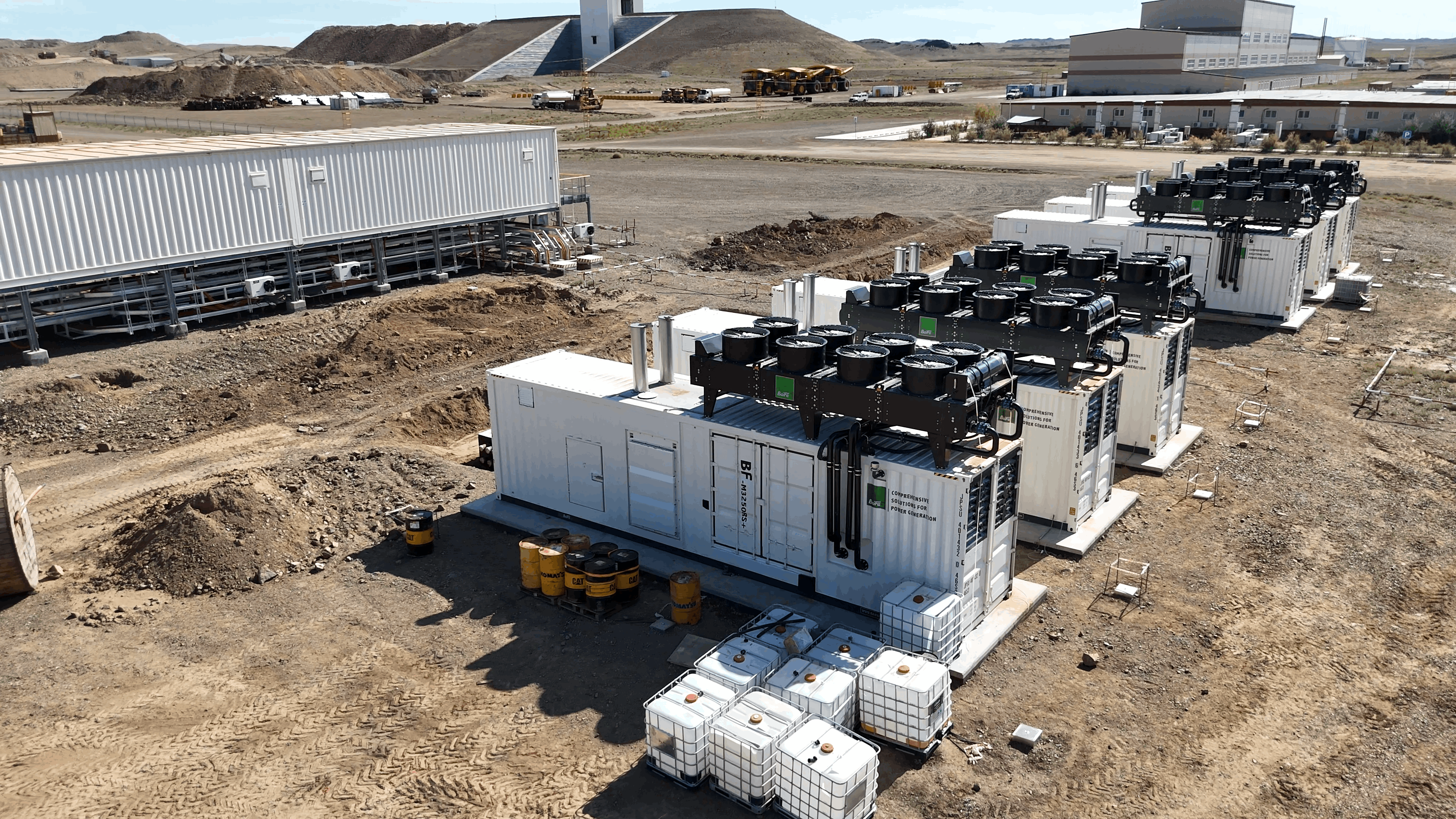
Mining reference: six units with built-in 22 kV transformers and IP54 protection.
CE certification is another evidence layer. The supplied CE certificate 3427/IST/23 was issued by SGS Supervise Gozetme Etud Kontrol Servisleri A.S. on 2023-04-04 and is valid to 2028-04-04. Its scope is BAIFA DIESEL GENERATING SET, and the listed standards are EN ISO 12100:2010, EN 60204-1:2018 and EN ISO 8528-13:2016. The applicable-product list includes the BF-C, BF-V, BF-M, BF-P, BF-SM, BF-DW and BF-BD model ranges. A buyer should still check the certificate’s model coverage and the destination-market requirements; a CE certificate is not a substitute for a project-specific emissions or marine classification approval.
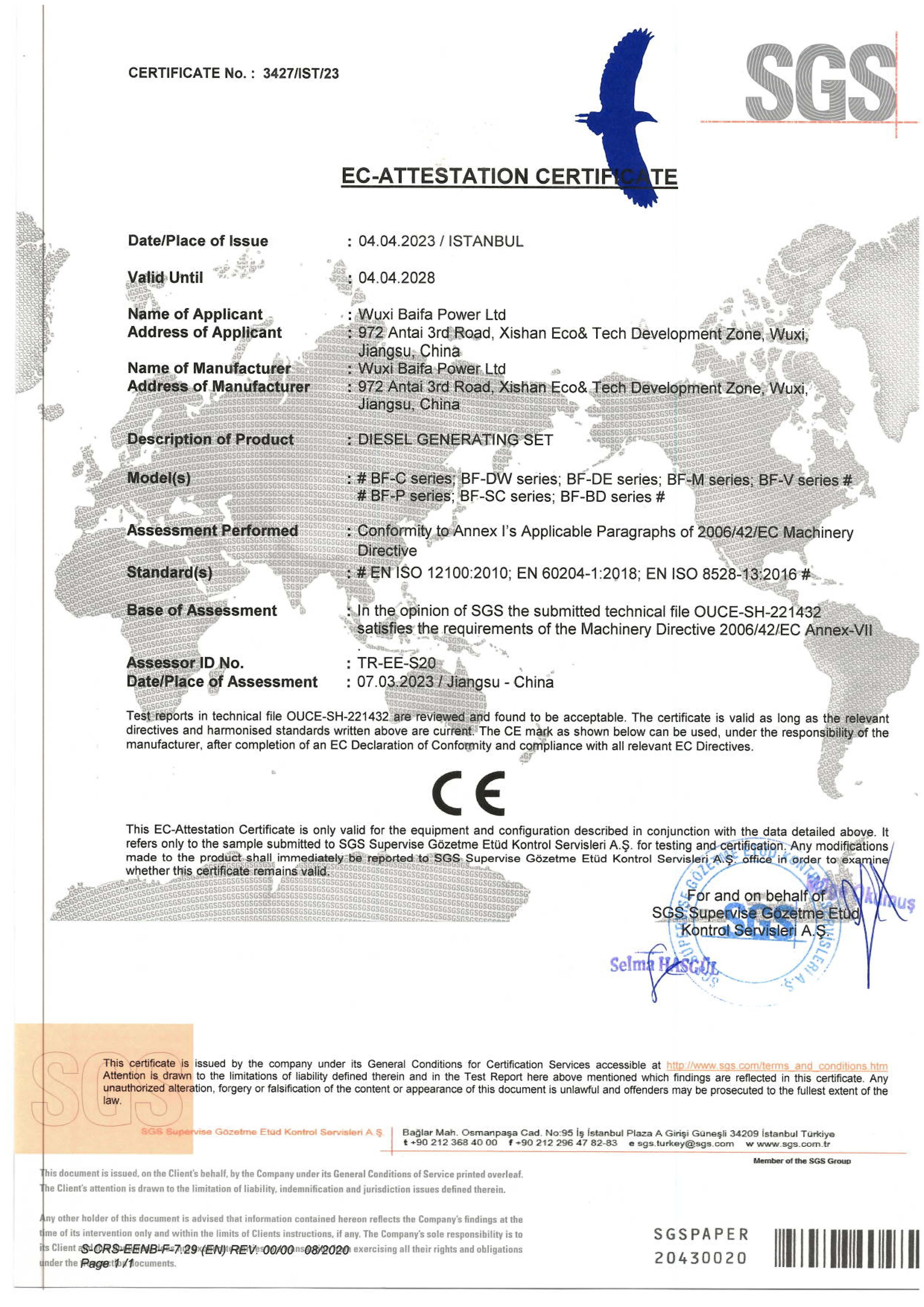
CE certificate 3427/IST/23 scope: BAIFA DIESEL GENERATING SET; validity to 2028-04-04.
What Project Scenarios Fit Each Platform?
Platform fit should be decided from the load profile, site conditions and service plan, not from the application label alone. The supplied references show this range: a Qatar hotel project lists five units for emergency power with robust and low-noise operation over 10 years; a data-center and telecom reference lists 12 units with BF-Volvo and BF-MTU series over eight years; a Mongolia mining project lists six units with 22 kV transformers and IP54 protection; and the Tianjin 117 high-rise reference lists seven units for emergency standby. These are project references, not a rule that one engine brand must be used for one industry.
For a construction diesel generator inquiry, the buyer should state the temporary or permanent nature of the site, the load profile, fuel storage, noise limits and transport plan. For an industrial diesel generator used in a factory, the buyer should add process-load harmonics, motor-starting duty, redundancy and maintenance access. For a 1000 kVA diesel generator set, the buyer should ask for the complete model datasheet and a like-for-like fuel and noise comparison. The engine platform is one input; the enclosure, alternator, control system and acceptance plan are the rest.
Climate fit needs its own line in the RFQ. High ambient temperature can affect derating and cooling; cold weather can affect starting, battery performance, coolant and oil selection. BAIFA’s customization list includes anti-condensation heater, control system, structure and configuration, ATS, DROOP, PMG, oil-water separator and float charger for the starting battery. Those options are relevant to climate and reliability discussions, but they must be selected for the actual site. An engineering review of altitude, ambient temperature, humidity, fuel quality and enclosure ventilation remains necessary.
What Market Context Matters for Platform Matching?
Published global diesel generator market estimates differ by scope and research method. This FAQ therefore does not use a single market-size or CAGR figure as a procurement forecast. The project references that matter here are application-specific: high-rise emergency standby, data centers, hotels, mining, construction and power-plant rental each place different demands on starting, noise, protection degree and acceptance testing. For a buyer, the useful market signal is not a headline number. It is whether the supplier can document a comparable model, a valid certificate scope and a project reference that matches the intended duty.
What Are the Most Common Procurement Mistakes?
- Treating the engine brand as the complete generator specification, without a model-level datasheet.
- Comparing prices without aligning rating basis, enclosure, control system, protection degree and Incoterm.
- Assuming IP23 is standard across a series instead of writing it into the RFQ and checking the FAT record.
- Checking only the CE certificate headline, without reviewing the exact model coverage, validity and destination-market requirements.
- Leaving FAT, SAT, spare-parts planning and lead-time conditions outside the purchase order.
FAQ: BAIFA Diesel Generator Platform Matching
Which BAIFA series is associated with Cummins, Volvo, MTU, Perkins or Doosan?
BAIFA’s product listing associates BF-C with Cummins, BF-V with Volvo, BF-M with MTU, BF-P with Perkins and BF-DW with Doosan. The supplied model references are BF-C25 to BF-2750QE, BF-V94 to BF-V836, BF-M825 to BF-M3600, BF-P10 to BF-P2500 and BF-DW190 to BF-DW1000. These are series references, not universal kW bands. For a specific project, request the exact model datasheet and confirm the kW rating, rating basis, rated speed, voltage, frequency, enclosure and certificate coverage.
What power range and rated speed should I put in the RFQ?
BAIFA’s published portfolio covers 8 kW to 3,200 kW, but the exact power must be stated at model level. State the required prime or standby rating, 50 Hz or 60 Hz, rated speed, voltage and connection type. BAIFA lists voltage, frequency and connection type among customization items. Do not infer rated speed from the series name. The technical offer should repeat the rated speed and rating basis for the exact generator set.
Is IP23 protection available, and how should noise and fuel efficiency be compared?
BAIFA lists protection degree among customization items, so IP23 should be written into the RFQ and confirmed on the model datasheet and FAT record. Noise and fuel efficiency should be compared only on a like-for-like basis: same rating, same enclosure and same test conditions. Ask for a fuel-consumption curve and a sound-pressure level at a stated distance. Qualitative project notes about low-noise operation are useful references, but they are not a guaranteed dBA value.
What are the MOQ, payment, delivery and lead-time terms?
BAIFA’s supplied procurement terms list MOQ 1 unit, payment by TT or LC, and delivery terms EXW, FOB or CIF. Acceptance is through FAT and SAT. The capability unit states a 25-60 day lead time and 400-500 unit monthly capacity. These figures should be confirmed for the exact model, enclosure, alternator and certificate package, and written into the quotation and order acknowledgement.
What high-temperature or cold-weather checks should be confirmed before order?
Confirm ambient temperature range, altitude, humidity, fuel quality and starting conditions. Ask how the supplier handles derating, cooling, enclosure ventilation, battery charging, coolant and oil selection. BAIFA’s customization list includes anti-condensation heater, control system, structure and configuration, ATS, DROOP, PMG, oil-water separator and float charger for the starting battery. These options should be selected for the actual site and recorded in the technical offer, not assumed from the engine platform.
Conclusion
Platform matching is a documentation exercise before it is a commercial decision. The engine family narrows the search, but the buyer still needs the exact model, rating basis, rated speed, protection degree, fuel and noise basis, acceptance plan and delivery terms. BAIFA’s five platform families provide a starting map for Cummins, Volvo, MTU, Perkins and Doosan inquiries. The exact datasheet, certificate scope and FAT record provide the answer. A buyer who fixes those items can compare offers on the same basis and avoid treating an engine badge as a complete generator specification.
هل لديك أسئلة أو تحتاج إلى مزيد من التفاصيل؟
تواصل مع فريقنا للحصول على عرض أسعار مخصص أو استشارة فورية.
طلب عرض أسعار
املأ النموذج أدناه وسيتواصل معك فريقنا بعرض مقترح مخصص.
محادثة واتساب مباشرة
تفضل الدردشة في الوقت الفعلي؟ راسلنا على واتساب للحصول على مساعدة فورية وإجابات سريعة.
- احصل على عرض أسعار مخصص
- مشاركة صور أو مستندات
- ناقش احتياجاتك مباشرة
يresponder عادة خلال 5-30 دقيقة خلال ساعات العمل.