
BESS Qualification Dossier: Compliance by Project Type
BESS Qualification Dossier: Compliance by Project Type
A battery energy storage system that clears qualification for a hospital campus can stall for months in a utility interconnection queue — with the same cells, the same cabinet and the same supplier. The obstacle is rarely the hardware. It is the obligation set that the project type attaches to the equipment.
Qualification is therefore a mapping exercise. A grid-tied commercial peak-shaving project is judged mainly on interconnection approval, protection coordination and fire safety. A remote mining microgrid is judged on motor-starting capability, spinning reserve, dust protection and remote maintenance. A solar-plus-storage site adds export limitation and coordinated photovoltaic–battery control. Each changes what the buyer must be able to evidence before a shortlist becomes a purchase order.
This guide maps the compliance, certification and acceptance obligations named in Xupernova's application material to seven project types — critical facilities, solar-plus-storage and PV self-consumption, remote mining microgrids, utility-scale renewable integration, EV charging hubs, C&I peak shaving, and critical-load backup — and sets out what procurement teams should verify in each case. Xupernova New Energy Technology Co., Ltd. is an energy storage and new energy solutions provider founded in 2015, manufacturing across a 700,000 m² footprint with 5 GWh+ annual capacity and exports to Europe, North America, South America, the Middle East and Asia.
Three layers of a qualification dossier
Most qualification failures happen because two parties are talking about different layers. Product certificates, network compliance and project acceptance are separate documents answering separate questions, and a supplier that holds one is not automatically able to provide the others.
Layer 1 — Product compliance evidence
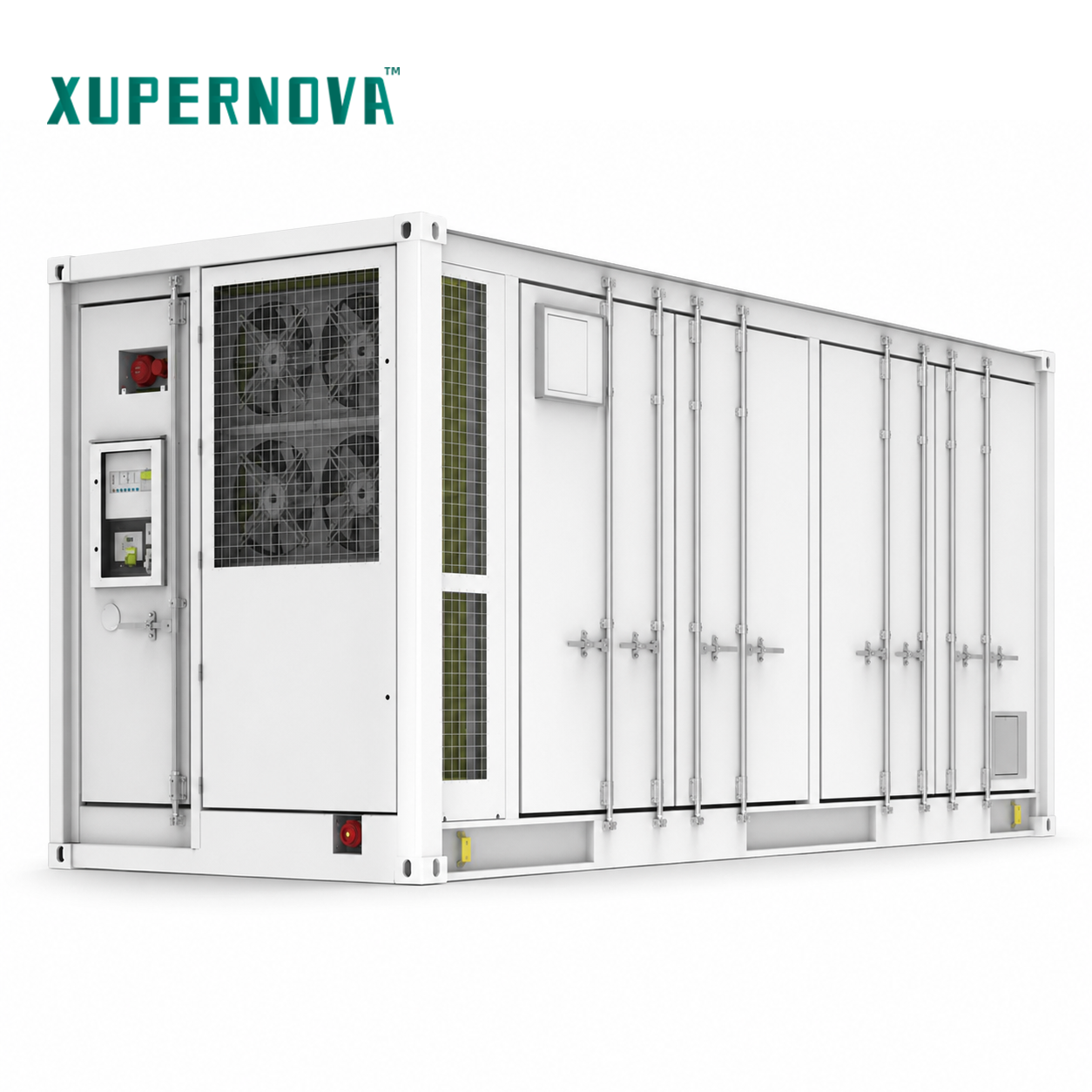
The first layer answers a narrow question: has this product family been tested against the relevant product standards by an accredited body? For the ECO-E261LP-2A energy storage system (125 kW, 261.248 kWh, IP55), the record includes an IEC 63056:2020 product certificate covering the rechargeable lithium-ion battery system at DC 832 V, 314 Ah (certificate B 125581 0022 Rev. 01, global market), an LVD Attestation of Conformity to EN 62477-1:2012/A12:2021 (N8A 125581 0024 Rev. 00, EU market) and an EMC Attestation of Conformity to EN IEC 61000-6-4:2019 and EN IEC 61000-6-2:2019 (E8A 125581 0023 Rev. 00, EU market). All three are issued by TÜV SÜD Product Service GmbH.
Layer 2 — Grid-interface compliance for the target market
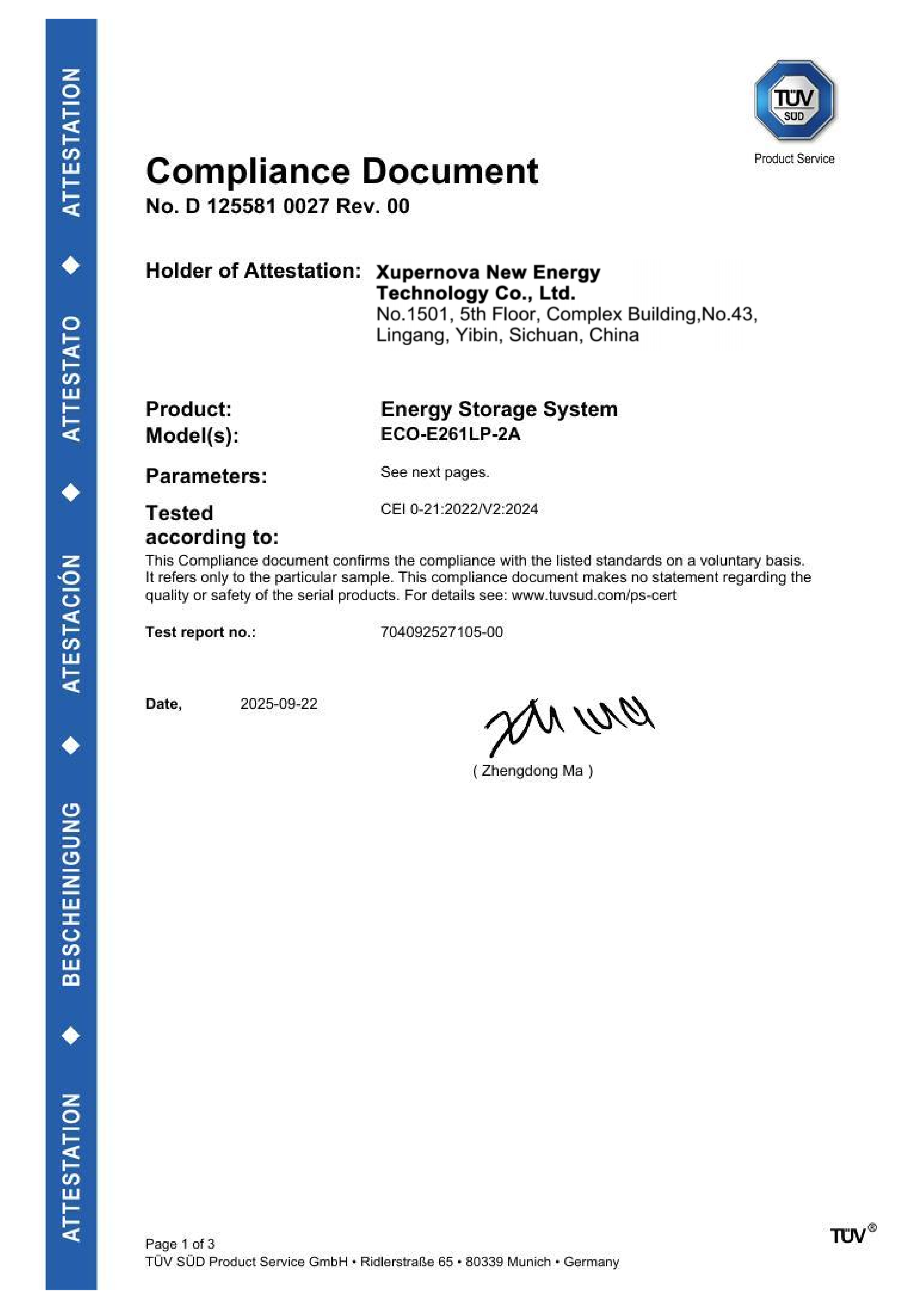
Product safety evidence does not connect a system to a network. That requires country-specific grid-code evidence, because the code defines how the equipment behaves at the point of connection rather than whether it is safe to install. For Italy, the same model is certified to CEI 0-21:2022/V2:2024 under certificate D 125581 0027 Rev. 00 and to CEI 0-16:2022/V3:2024 under certificate D 125581 0028 Rev. 00, both issued by TÜV SÜD Product Service GmbH on 22 September 2025 for the Italy market.
Layer 3 — Project-level acceptance
The third layer is built per site: factory acceptance testing, site acceptance, commissioning, protection coordination sign-off, fire-safety acceptance and network approval. Xupernova's quality process includes 100% factory acceptance testing, electrical safety testing, functional testing, aging testing and third-party inspection on request. The buyer's job at this layer is to agree the test plan and witness points before production starts, then receive records with the unit rather than after commissioning.
Reading a certificate correctly: five checks
A certificate is evidence of a specific claim, not of general capability. Five attributes determine whether it applies to the project in front of you.
- Model scope. The CEI, LVD, EMC and IEC 63056 documents named above identify the ECO-E261LP-2A at 125 kW and 261.248 kWh. They do not name the XA-C0261-L1 cabinet (125 kW / 261.25 kWh), the XA-X1044-L1 10-ft container (500 kW / 1044 kWh) or the XA-V5015-L1 20-ft container (5.015 MWh). Similar ratings are not identical scope; ask for the document that names the exact model and configuration offered.
- Standard version and revision. CEI 0-21:2022/V2:2024 is a specific revision. Confirm the revision number on the certificate rather than the standard number in a brochure.
- Market and jurisdiction. A global IEC 63056 certificate, an EU attestation and an Italy grid-code document serve three different purposes. Treat them as complementary, not interchangeable.
- Issuer and traceability. Record the issuing body, certificate number and revision (for example Rev. 00 versus Rev. 01) so that a later reissue can be matched against the file.
- What the certificate excludes. The IEC 63056 certificate covers the DC battery system at DC 832 V, 314 Ah. It does not cover the PCS, the transformer, the plant-level EMS or the interconnection function, which are qualified through the grid-code and project-acceptance layers.
| Certificate | Standard | Market | Number | What it supports |
|---|---|---|---|---|
| IEC 63056 product certificate | IEC 63056:2020 | Global | B 125581 0022 Rev. 01 | Battery system safety at DC 832 V, 314 Ah |
| LVD Attestation of Conformity | EN 62477-1:2012/A12:2021 | EU | N8A 125581 0024 Rev. 00 | Power electronic converter safety |
| EMC Attestation of Conformity | EN IEC 61000-6-4:2019; EN IEC 61000-6-2:2019 | EU | E8A 125581 0023 Rev. 00 | Emission and immunity behaviour |
| CEI 0-21 compliance document | CEI 0-21:2022/V2:2024 | Italy | D 125581 0027 Rev. 00 | LV connection to an Italian distribution network |
| CEI 0-16 compliance document | CEI 0-16:2022/V3:2024 | Italy | D 125581 0028 Rev. 00 | MV connection to an Italian network |
Supply-chain credentials: what they prove and what they do not
Certification is the technical half of qualification. The commercial half is the evidence that the supplier can build, test and support the same product for the life of the asset — and that evidence should be read with the same discipline as a certificate.
- BloombergNEF Tier 1 cell sourcing. The cabinet and container range is built on Grade A LFP lithium-ion cells from BloombergNEF Tier 1 energy-storage cell manufacturers. This addresses cell supply scale and the supplier-screening reference that lenders and independent engineers commonly request. It does not establish cycle life at your specific duty cycle, and it is not a substitute for the warranty terms.
- 7-year cell warranty. A stated seven-year cell term is a qualification asset only once its boundary is clear: whether it covers cells, modules or the full system; the throughput, temperature and operating conditions that apply; and how it interacts with PCS, EMS and thermal-system warranties from the same or other vendors.
- Chemistry flexibility. LFP is the standard configuration; semi-solid-state, solid-state and sodium-ion options are available subject to project requirements, technical validation and availability. That qualifier matters. The certificates listed earlier name an LFP system, so a chemistry change is a new qualification event rather than a configuration note on a purchase order.
- Integrated platform scope. Customisation covers system power and energy capacity, charge/discharge duration, AC/DC voltage, chemistry and cell supplier, PCS, BMS and plant-level EMS, PV input and solar-plus-storage configuration, on-grid/off-grid operation, STS/EPS backup, cooling system, fire protection, enclosure size and branding, IP rating and corrosion protection, grid code, communication protocols, and transformer and switchgear configuration. In practice this reduces the number of interface documents a project must reconcile.
- Manufacturing and delivery evidence. 5 GWh+ annual capacity, up to 500 MWh per month, a one-unit minimum order quantity, 25–35 days for standard systems and 35–60 days for customised projects, supported by 150+ R&D engineers. Note that a production lead time is not a permitting timeline; the two run on different calendars.
Read together, these credentials answer a supply question — can this supplier deliver a documented product at the required volume and support it afterwards. They do not answer the project question, which is whether the specific obligation set for the site has been satisfied.
Scenario mapping: obligations and verification points
The seven project types below share equipment families but not obligation sets. Each entry lists the requirements named in Xupernova's application material, then the checks a procurement team can run before qualification.
1. Critical facilities — hospitals, data centres, government sites
Here the obligation is continuity for defined loads rather than bulk energy shifting. The named requirements are a critical-load assessment, a defined backup duration, islanding protection, a black-start strategy, an emergency response plan and fire-safety compliance. The matched equipment confirms the architecture: STS or EPS cabinet, critical-load distribution panel, grid-forming PCS, transformer where required, switchgear, UPS for zero-interruption loads, plant-level EMS and an optional diesel generator.
- Request a circuit-level critical-load list with kW and duration per load, not a single facility-level figure.
- Ask for islanding protection settings and the test record showing the grid-connected to islanded transition.
- Confirm who owns the black-start procedure — supplier, EPC or facility team — and that it exists in writing.
- Check that fire-safety documentation and the emergency response plan are dated and match the site layout, not a reference project.
2. Solar-plus-storage and PV self-consumption
Obligations here are a PV generation assessment, export limitation requirements, grid-code compliance, a backup-load assessment and coordinated PV–battery control. The relevant products are the XA-H0261-L1, a 261 kWh liquid-cooled solar-plus-storage cabinet for commercial and industrial sites and microgrids, and the XA-H0064-A1, a 25–50 kW / 64.54 kWh air-cooled cabinet for small-scale commercial and industrial installations. Both operate from −30 °C to 55 °C at IP55 and support 0.5P, 1P and 2P C-rates.
- Confirm whether export limitation is a connection condition in your jurisdiction, and whether the certificate on file covers the hybrid PV–battery configuration rather than the battery cabinet alone.
- Check the PV input rating against the array actually planned, and ask what the control logic does at full state of charge with surplus generation.
- If STS/EPS backup is specified, the backup-load assessment becomes part of the acceptance scope, not an optional extra.
3. Remote mining microgrids
Off-grid and weak-grid mining sites combine unstable supply, high diesel consumption and large motor-starting loads. Named requirements are a site load study, motor-starting analysis, a spinning-reserve strategy, high-temperature and dust protection, black-start capability and remote O&M. The equipment set spans PV, diesel generators, grid-forming PCS, a microgrid controller, transformer, switchgear, load management, plant-level EMS and the communication network.
- Ask for the motor-starting study including the BESS contribution, with the largest motor and starting method stated explicitly.
- Establish how spinning reserve is divided between generators and storage, and which controller enforces it.
- Compare site ambient temperature and dust exposure against the −30 °C to 55 °C and IP55 envelope; where the site exceeds it, determine what additional protection is required before qualification closes.
- Confirm the remote support model: 24/7 remote support, diagnostics and spare parts are offered, while on-site service is optional and should be priced and scoped.
4. Utility-scale renewable integration
Utility projects carry the widest obligation set: grid impact study, local grid-code compliance, protection coordination, dispatch-interface requirements, cybersecurity, fire safety and environmental assessment. Matched equipment includes PCS, medium-voltage transformer, MV switchgear, AC collection system, substation equipment, protection and control, SCADA, plant-level EMS and communications. The XA-V5015-L1 20-ft liquid-cooled battery container at 5.015 MWh and the XA-X2170-L2 20-ft all-in-one container at 1125 kW / 2170.3 kWh sit in this segment.
- Match the grid-code certificate to the market and revision; a document issued for another jurisdiction does not transfer.
- Define where the protection coordination study ends — typically at the interface with the substation owner's protection — and get that boundary in the contract.
- Assign ownership of the dispatch interface and of cybersecurity across the communication path, which is the item most often left unowned between supplier and operator.
- Treat environmental assessment and fire safety as separate approval workstreams with their own timelines, not as attachments to the interconnection application.
5. EV charging hubs
Charging sites combine high short-duration demand, limited grid capacity and concentrated charging periods. Named requirements are a charging-load forecast, transformer-capacity assessment, dynamic power allocation, grid-connection approval and fire-safety compliance. The matched equipment includes chargers, a charging management system, PV where required, smart meter, CTs, EMS, transformer, switchgear and power distribution.
- Ask for the charging-load forecast at interval resolution and the transformer headroom it implies, rather than a nameplate charger total.
- Test the dynamic power allocation logic conceptually: what happens when the charger management system or EMS loses communication with the storage system?
- Clarify whether the grid-connection approval is for firm capacity or a flexible, limited connection — the answer changes the storage sizing logic.
- Fire safety on a site shared by chargers, vehicles and batteries is usually reviewed differently from a standalone storage yard; confirm which review applies.
6. C&I peak shaving and time-of-use arbitrage
Commercial and industrial peak shaving is driven by load profiles and tariff structures. Named requirements are a load-profile assessment, the time-of-use tariff, grid-connection approval, protection coordination and fire-safety compliance. The XA-C0261-L1 all-in-one cabinet (125 kW / 261.25 kWh) and the XA-X1044-L1 10-ft container (500 kW / 1044 kWh) are the relevant platforms, both liquid-cooled and rated IP55.
- Request interval meter data covering a full seasonal cycle; a two-week sample is not a load profile.
- Verify the demand-limit control logic and how it behaves when the facility load exceeds the configured limit.
- Review protection coordination with existing LV or MV protection, since the storage system introduces an additional source.
- In Italy, check the CEI 0-21 or CEI 0-16 evidence for the exact model offered. A 50-unit deployment of the 125 kW / 261.248 kWh system in a supermarket portfolio has operated for one year on peak shaving, time-of-use arbitrage and PV self-consumption, with remote monitoring and compatibility with Italian grid requirements.
7. Critical-load backup
The backup case is narrower than the critical-facility case. The question is not whether the facility is resilient overall but whether the transfer and backup sequence performs at a stated load for a stated time. Named requirements are the required backup duration, islanding protection, a black-start strategy, an emergency response plan and fire-safety compliance.
- Require backup duration to be demonstrated at a defined load and ambient temperature, with derating assumptions visible.
- Ask for transfer-sequence evidence — STS/EPS transition, islanding and reconnection — from site acceptance, not from a manual.
- Define the boundary with UPS-backed zero-interruption loads so that neither system is credited with the other's function.
- Check warranty conditions against the expected backup duty cycle, which differs from daily cycling.
Integrated platform versus multi-vendor scope: comparing the qualification burden
Qualification effort scales with the number of interfaces that must each produce a document. Across the seven scenarios, the matched equipment lists repeatedly include transformer, switchgear, protection and control, SCADA, plant-level EMS, communications and STS/EPS. Every one of those is a document owner during qualification. Xupernova's customisation envelope covers PCS, BMS and plant-level EMS, transformer and switchgear configuration, grid code and communication protocols, which allows a single factory acceptance plan and one set of interface drawings for those items.
The boundary is equally important. Integration does not move approval authority: the network operator still approves the connection, the fire authority still accepts the fire-safety design, and the protection coordination study still belongs to whoever owns the substation. Multi-vendor scope also remains the correct choice where existing substation equipment must be retained or where local-content rules apply. The comparison should therefore be made on document ownership and responsibility gaps — not on catalogue breadth.
Market context: more deployments, more evidence requests
Deployment volume is rising, and the paperwork rises with it. The IEA's Global Energy Review 2026 reports that global new battery storage capacity reached 108 GW in 2025, with LFP accounting for approximately 90% of global battery storage deployments in that year. The U.S. Energy Information Administration projected 19.6 GW of utility-scale battery storage additions in the United States in 2025.
Volume growth does not harmonise obligations. Two projects in the same country can face different connection requirements depending on the network level, and fire codes are applied locally. The practical consequence for buyers is that a dossier assembled for one site rarely transfers intact to the next — which is why the layer structure above matters more than any single certificate. For projects with US-bound equipment, trade compliance belongs in the commercial file as well: BESS fully encased in housing is classified under US HTS 8507.60.00.90, and the classification should be confirmed for the specific configuration with a customs broker.
Outlook
If deployment continues near the 2025 pace, the binding constraint on many storage projects is likely to shift from equipment availability toward evidence assembly — the time required to collect, verify and reconcile documents across the supplier, the EPC, the network operator and the fire authority. Two developments would reinforce that shift rather than reverse it. First, chemistry diversification: sodium-ion and solid-state options are offered subject to project requirements, technical validation and availability, and each chemistry requires its own qualification evidence because certificates are issued per product. Second, code revision cycles: grid codes such as CEI 0-21 and CEI 0-16 already carry dated revisions, so a dossier should record which revision it satisfies.
For procurement teams, the practical response is procedural rather than technical. Build the dossier against the three layers, map it to the project type before issuing an RFQ, and record the model, revision and market for every document retained.
FAQ
What should a BESS qualification dossier contain?
Three layers of evidence: product compliance certificates covering safety and electromagnetic behaviour, grid-interface compliance for the target market, and project-level acceptance documentation such as factory acceptance records, commissioning results, protection coordination and fire-safety sign-off. Cell-sourcing documentation and warranty terms sit alongside these as commercial evidence. Every document should name the exact model, standard revision and market it applies to.
Does one certificate cover every model in a supplier's range?
No. Certificates are issued against a named model and configuration. The ECO-E261LP-2A documents identify a 125 kW, 261.248 kWh, IP55 energy storage system; a 5.015 MWh container such as the XA-V5015-L1, or a 500 kW / 1044 kWh 10-ft container such as the XA-X1044-L1, is a different product that requires its own evidence. Buyers should request the document that names the model being purchased.
Is grid-code compliance the same as grid-connection approval?
No. Grid-code compliance shows that a product has been tested to a defined standard, such as CEI 0-21:2022/V2:2024 or CEI 0-16:2022/V3:2024 for Italy. Grid-connection approval is a project-level decision by the network operator covering the point of connection, protection settings, export limits and metering. A certificate supports that application but does not replace it.
How should a buyer verify BloombergNEF Tier 1 cell sourcing?
Ask for the cell manufacturer named for the specific model and production lot, confirm that Grade A LFP cells are specified for that model, and check the name against the current tier list. Then align the warranty terms with that sourcing, since a tier classification addresses supplier scale and screening criteria rather than cycle life at a particular duty cycle.
What should a BESS factory acceptance test include?
Xupernova's process includes 100% factory acceptance testing, electrical safety testing, functional testing and aging testing, with third-party inspection available on request. From the buyer's side, the test plan and witness points should be agreed before production begins: capacity at the specified C-rate, BMS and EMS communication checks, protection and interlock tests, thermal and fire-protection checks, and delivery of the test records with the unit rather than after commissioning.
The Xupernova energy storage product catalog lists the cabinet and container models referenced in this guide, together with their ratings and configurations, and can be downloaded here: XUPERNOVA Energy Storage Product Catalog.
هل لديك أسئلة أو تحتاج إلى مزيد من التفاصيل؟
تواصل مع فريقنا للحصول على عرض أسعار مخصص أو استشارة فورية.
طلب عرض أسعار
املأ النموذج أدناه وسيتواصل معك فريقنا بعرض مقترح مخصص.
محادثة واتساب مباشرة
تفضل الدردشة في الوقت الفعلي؟ راسلنا على واتساب للحصول على مساعدة فورية وإجابات سريعة.
- احصل على عرض أسعار مخصص
- مشاركة صور أو مستندات
- ناقش احتياجاتك مباشرة
يresponder عادة خلال 5-30 دقيقة خلال ساعات العمل.