
BGT Steel Plate: Wear Resistant Steel Plate Supply Profile
Wear resistant steel plate is bought in order to be consumed. Unlike structural steel, which is expected to outlive the equipment it forms, an abrasion resistant plate is designed to sacrifice itself so that a chute, hopper, bucket or crusher liner survives. That single characteristic shapes how the material should be sourced: grade consistency, verifiable hardness, available thickness range, and the speed at which replacement plate can be obtained matter far more than a headline price per tonne.
This profile examines one supplier in that segment — BGT Steel Plate — as an industry reference point rather than a promotional one. It sets out what the company is, how its stockholding and processing model works, which grades and thicknesses it holds, where those grades are actually applied, and where the model has real boundaries that buyers should understand before placing an order.
Why Wear Plate Supply Is a Procurement Problem, Not Just a Purchase
Most wear-related downtime in mining, cement, metallurgy and material handling is not caused by choosing the wrong alloy. It is caused by late replacement, inconsistent plate hardness between deliveries, or the absence of a specific thickness when a liner fails. A plant that runs continuously cannot wait weeks for a single plate in the 20 mm range.
Three procurement realities follow from this:
- Availability is a technical parameter. A grade that is theoretically correct but unavailable in the required thickness and width has the same practical value as no grade at all.
- Hardness must be verifiable, not assumed. Quenched and tempered plate is specified by a hardness band, and the delivered plate has to fall inside it — typically confirmed through an original mill test certificate or third-party inspection.
- Processing capacity changes lead time. Cutting to size, edge preparation and dimensional control frequently determine whether a repair happens during a scheduled stop or during an unplanned one.
BGT Steel Plate is the distribution brand of Jiangyin Baoguantao Import & Export Co., Ltd., a China-based wear resistant steel stockholder established in 2013. The company combines standing inventory, custom cutting and processing, and sales distribution of wear resistant and high strength steel plate, and reports that 40% of its sales are exported. Its offering therefore sits at the intersection of the three realities above.
BGT Steel Plate at a Glance: Scale, Stock and Structure
The company’s published operating data places it in the stockholding and processing tier of the supply chain rather than the steelmaking tier. The relevant figures are summarised below.
| Item | Detail |
|---|---|
| Legal entity | Jiangyin Baoguantao Import & Export Co., Ltd., operating under the brand BGT Steel Plate |
| Established | 2013, with more than a decade focused on wear resistant steel |
| Business model | Wear resistant steel stockholding, custom cutting and processing, and sales distribution |
| Warehouse network | 12 warehouses, including locations in Jiangsu, Shandong and Hunan provinces |
| Standing inventory | More than 30,000 metric tons of wear resistant steel plate |
| Facility footprint | 5,000 m² |
| Workforce | 40 employees, including a 3-engineer technical team |
| Annual output | 200,000 tons |
| Export share | 40% of sales |
| Main export markets | Middle East, Southeast Asia, South America, Africa, Central Asia, Russia |
| Mill relationships | Distributor partnerships with Xingcheng, Nisco, Shougang, Xisc, Shandong Steel, Hanye, Tangsteel, Rongshen, Tisco, Baosteel, Lianyuan and Puyang |
Company data as published by BGT Steel Plate. The company describes itself as China’s largest wear resistant steel stockholder, a claim based on its standing inventory position; buyers evaluating that statement should treat it as a supplier self-description and verify it against their own delivery requirements.
For a buyer in the awareness and research stage, the mill relationships are the more substantive signal. Being a distribution partner for mills including Xingcheng, Nisco, Shougang, Xisc, Shandong Steel, Baosteel, Tisco, Tangsteel, Hanye, Rongshen, Lianyuan and Puyang means the plate in stock is traceable to specific producers, and each delivery is accompanied by an original Mill Test Certificate (MTC). Traceability of that kind is the difference between a documented material and an anonymous one.
What the Stockholding Model Actually Changes
A single mill typically rolls to a production schedule, not to a maintenance schedule. A stockholder holds already-rolled material, which changes several variables at once.
- Smaller quantities become feasible. A plant replacing two chute liners does not have to place a mill-scale order.
- Mixed grades ship together. A project needing NM400 for a hopper and Mn13 for an impact zone can be consolidated into one delivery.
- Cutting replaces scrap. Material can be supplied to the required length rather than in full plate size, reducing offcut losses on site.
- Ground inventory shortens response time. With warehouses in Jiangsu, Shandong and Hunan, plus a standing inventory exceeding 30,000 metric tons, the practical question shifts from “can it be rolled?” to “is it in stock and how fast can it be cut?”
Product Portfolio: From NM400 to NM600, Mn13 and Q-Series Structural Plate
BGT Steel Plate’s range covers two distinct material families — quenched and tempered wear resistant plate, and high strength structural plate — plus work-hardening manganese steel. Understanding which family solves which problem is the core selection decision.
| Grade / material | Typical hardness or strength | Position in the range | Representative applications |
|---|---|---|---|
| NM400 | 400 HBW nominal | General-purpose abrasion resistance with good cold formability, weldability and cutting behaviour | Construction, mining, cement, excavator buckets, dump truck beds, crusher liners |
| XCHD450 | 450 HBW class | Upgrade over NM400 while retaining fabrication properties | Mining machinery, garbage compactors, chutes, loader cutting edges |
| NM450 | 450 HBW class | Balanced step up for medium-to-high wear | Mining machinery, garbage compactors, chutes, loader cutting edges |
| NM500 | 500 HBW | High-abrasion duty where replacement downtime is expensive | Mining, heavy engineering, steel mills |
| NM550 | 550 HBW | Severe sliding abrasion with moderate toughness demand | Severe-wear hoppers, ore conveying pipe liners |
| NM600 | Approximately 600 HBW | Extreme abrasion in low-impact conditions | Mining liners, vertical mill scrapers |
| Mn13 | Austenitic; roughly 200 HBW as supplied, work-hardening above 500 HBW under impact | Impact-dominant wear rather than sliding abrasion | Railway frogs, jaw crusher plates, shot blast liners |
| Q550D | 550 MPa minimum yield strength | High strength structural | Steel construction, heavy lifting, crawler crane booms |
| Q690D / Q690E | 690 MPa minimum yield strength; D rated to −20°C, E rated to −40°C impact toughness | High strength structural with low-temperature options | Coal mining, construction equipment, cold-resistant equipment and arctic wind towers |
| Q890D | 890 MPa class | Ultra-high strength | Extreme heavy duty equipment, special cranes |
| Q960E | 960 MPa class with −40°C toughness | Top-tier engineering steel | Top-tier heavy equipment, defence |
All grades are quoted with a thickness range of 3–150 mm, a width range of 600–3950 mm with custom sizes accepted, and standard lengths of 2438, 5800, 6000, 6096, 12000 and 12200 mm, also available as custom sizes. Mill coverage includes Xingcheng, Nisco, Shandong Steel, Shougang, Xisc, Lianyuan, Puyang, Rongshen and Yongfeng, and every shipment is accompanied by an original MTC.
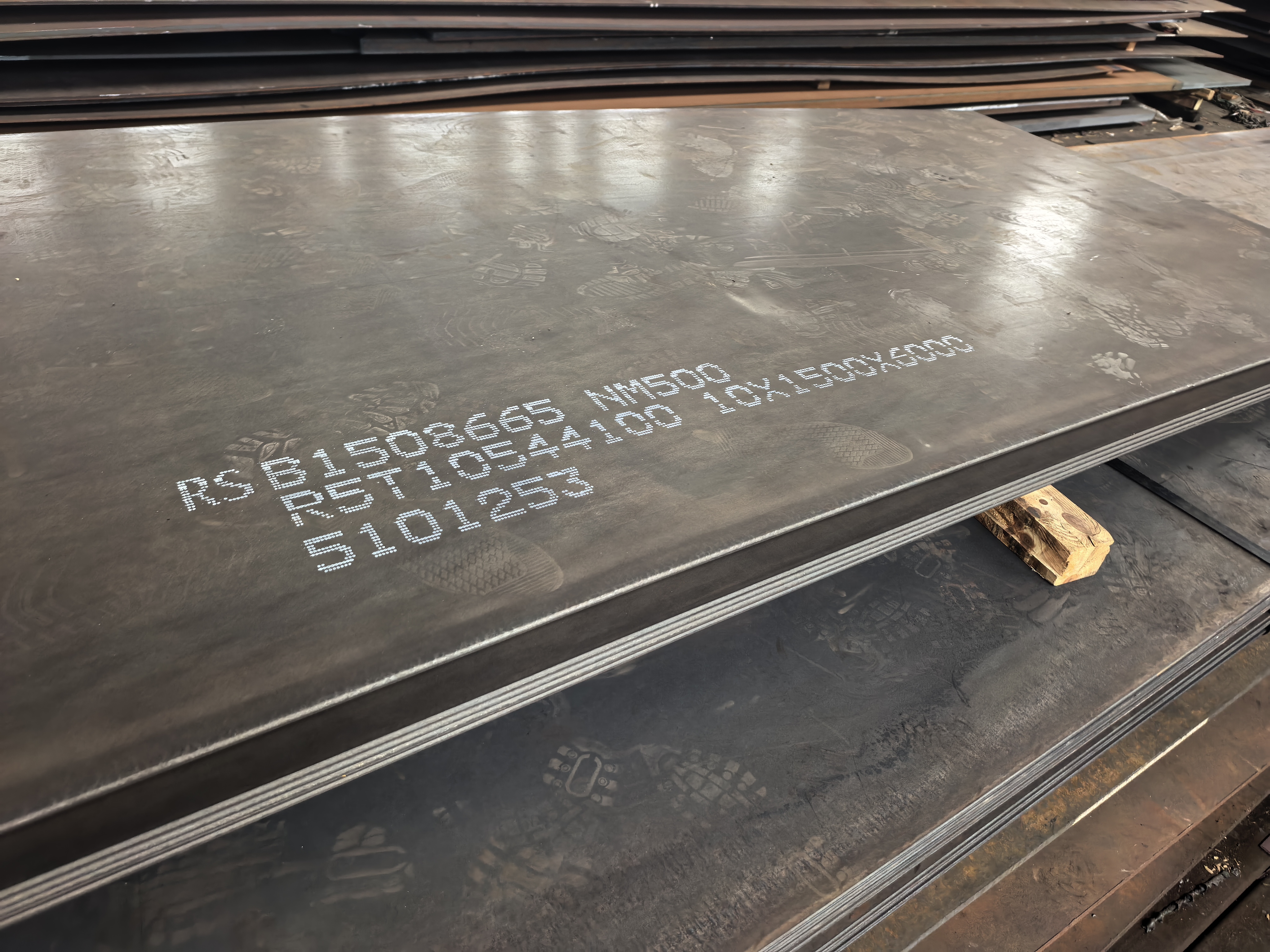
NM500 wear resistant steel plate, 10 mm thickness — a 500 HBW grade used for mining chutes, hoppers and heavy engineering wear protection.
Abrasion resistant steel plate at 500 HBW: the practical middle ground
Much of the commercial interest in this portfolio centres on the 500 HBW class. NM500 is the grade most often specified when NM400 and NM450 wear through faster than the maintenance interval allows, but when a jump to NM550 or NM600 would create fabrication problems on site. It is the grade that absorbs the largest share of mining chute wear resistant steel plate demand, because chute liners are replaced on a predictable cycle and the cost of a premature change is measured in production hours rather than material cost.
Mn13: work hardening instead of fixed hardness
High manganese steel plate Mn13 behaves differently from the NM series. It is supplied in an austenitic condition at roughly 200 HBW, and it hardens in service: under repeated impact and compressive load, the surface layer transforms and rises above 500 HBW while the core remains tough and ductile. This makes Mn13 the appropriate choice for railway frogs, jaw crusher plates and shot blast liners, where impact accompanies abrasion. It is not the right answer for pure sliding abrasion with little impact, where a quenched and tempered grade is more economical.
Q690 high strength steel plate and the ultra-high strength tier
The structural side of the range addresses a different problem: weight. Q690 high strength steel plate, supplied in D (−20°C) and E (−40°C) toughness versions, allows heavy machinery and lifting structures to shed mass while maintaining load capacity. Further up, Q890D supports heavy-duty equipment and special cranes, and Q960E combines 960 MPa-class strength with −40°C toughness for the most demanding lifting and defence applications. These are engineering materials with specific fabrication rules, not general-purpose plate.
Technical Explanation: Why Quenched and Tempered Plate Wears the Way It Does
The wear resistance of NM400-class plate does not come from surface hardness alone. It comes from a martensitic microstructure produced by controlled alloying and heat treatment. Carbon, chromium, molybdenum and boron are added in controlled amounts; the steel is then heated and rapidly quenched, which traps carbon in a distorted crystal lattice and converts the soft ferrite-pearlite structure into a needle-like martensite matrix. That matrix supplies the baseline hardness, typically in the 400–500 HBW range.
Two further mechanisms matter in service. During tempering, alloying elements form fine carbide precipitates that act as microscopic anchors, blocking dislocation movement and raising resistance to abrasive gouging. Equally important, professional wear plate is hardened through its full thickness rather than only at the surface. Even after the top layer is worn away, the remaining millimetres retain comparable wear resistance — a property that distinguishes quenched and tempered plate from surface-hardened carbon steel.
Hardness Verification: How Buyers Confirm What Was Delivered
Because hardness is the commercial promise of every one of these grades, verification practice deserves attention. The accepted procedure for wear resistant steel follows a defined sequence.
- Locate: select a flat area at least 50 mm away from any flame or plasma cutting edge, weld or heat-affected zone, and mark it.
- Grind: mechanically remove 1.5–2.0 mm to expose clean metal and eliminate rust, oxide and the decarburised layer. Grinding must stay below roughly 200°C to avoid tempering the surface and producing falsely low readings.
- Indent: for plates 6–80 mm thick — the most common case — use HBW 10/3000 (10 mm ball, 3000 kgf). For 3–6 mm plate, HBW 5/750 is used; for plate under 3 mm, HBW 2.5/187.5 or Rockwell/Vickers methods apply, with conversion back to HBW using tables such as ASTM E140 or GB/T 1172.
- Evaluate: take three consecutive measurements at least 10 mm apart, average them, and check the result against the grade tolerance — for example, NM400/AR400 acceptance typically falls within 360–440 HBW.
This is the method used for Mill Test Certificates and for third-party inspections such as SGS and BV. For buyers sourcing internationally, requiring an MTC plus an independent check on arrival is the most reliable way to confirm that an abrasion resistant steel plate claiming a 500 HBW class actually delivers it.
Application Fit: Where These Grades Are Actually Used
The value of a stockholding range is determined by how closely it maps onto real operating conditions. The scenarios below reflect the working environments these grades are specified into.
Cement production
Cement plants combine heavy abrasion, impact wear, sliding wear, material flow and continuous dust exposure. Wear protection is required on crushers, ball mills, vertical roller mills, chutes, hoppers, conveyors, bucket elevators, screens, separators, silos and clinker handling equipment. The governing requirements are high abrasion resistance, impact resistance, dimensional stability under continuous operation, and reliable plate hardness between deliveries. Cement plant hopper wear plates and mill liners are typically served by NM500, NM550, NM600 and Mn13 combinations, matched to whether the dominant wear mode is sliding or impact.
Mining and material handling
Mining duty is usually abrasive wear with medium impact, running 24/7 with intermittent loading. The critical components are mine hoppers and ore chutes, where high wear resistance, impact resistance and good weldability are required simultaneously because liners are welded in place during short maintenance windows. Excavator bucket wear resistant steel sheet follows a different logic again: the bucket combines gouging abrasion with direct impact, so grade selection balances hardness against the risk of cracking at the lip and side plates.
Metallurgy
Metallurgical plants run abrasive wear with medium impact and heavy abrasive wear in the same circuit. Ore chutes, hoppers, ball mill and crusher liners, and mining truck bodies all fall under this category. Where structural integrity is critical, ultrasonic testing (UT) inspection can be specified alongside hardness verification.
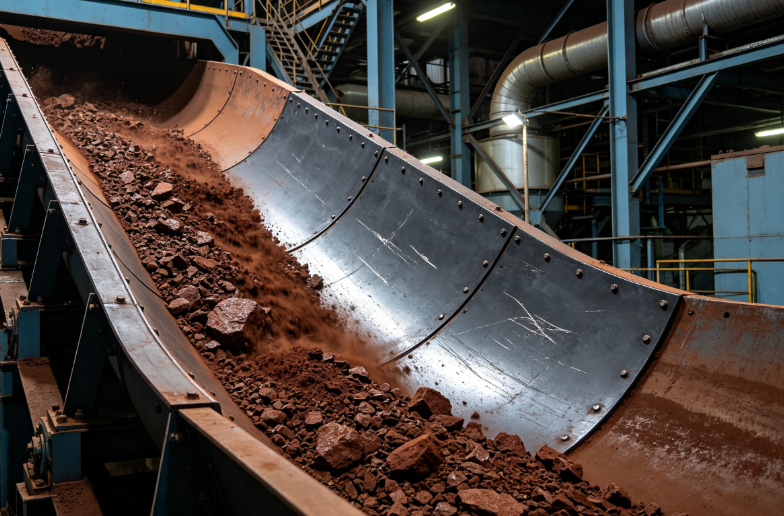
Ore chute wear lining in a metallurgical plant — a typical application for NM400 to NM500 grade abrasion resistant steel plate.
Power and coal chemical
Power and coal chemical installations operate 24/7 and are dominated by abrasive wear. Coal mill chutes and pipe bends are the primary wear points, and downtime for liner replacement is measured against generation or process output rather than against material cost.
Port handling and railway
Port handling is a structural rather than an abrasive application: crane structures operating under heavy load in low-temperature environments require low-temperature impact resistance, UT inspection and good weldability, which is where Q690D, Q690E and Q960E enter the discussion. Railway turnout frogs represent the classic Mn13 case, where severe impact plus work hardening defines the duty cycle.
Objective Position: Stockholder, Mill or Trading Intermediary?
Placing this supplier in context requires comparing sourcing models rather than brand names, because the relevant differences for a buyer are structural.
| Comparison criterion | Mill-direct purchase | Stockholding distributor (BGT Steel Plate model) | Trading intermediary without stock |
|---|---|---|---|
| Minimum order quantity | High; typically full rolling quantities | Flexible; drawn from standing inventory | Flexible but dependent on a third party’s stock |
| Delivery speed for standard grades | Governed by rolling schedule | Short for stocked grades and thicknesses | Unpredictable; adds a layer between buyer and stock |
| Grade and thickness breadth on hand | Narrow; what the mill rolls | Wide, including mixed grades in one shipment | Variable, usually limited |
| Traceability | Direct from producer | Original MTC from the producing mill | Traceability depends on the upstream source |
| Cutting and processing | Usually not provided | Custom cutting and processing included | Rarely provided |
| Technical selection support | Available for large projects | Available at grade-selection level | Limited |
The honest positioning is this: BGT Steel Plate is a stockholding and processing business, not a steel producer. The metallurgy and rolling of the plate are carried out by its partner mills, and the company’s contribution is inventory depth, grade selection, cutting, documentation and delivery. For a buyer whose primary risk is a maintenance schedule rather than a metallurgical development programme, that division of labour is usually an advantage — but it does mean the supplier’s technical authority on new alloy development is not the same as a mill’s.
Limitations and Boundaries Buyers Should Not Overlook
Every grade in this range has a defined operating envelope, and over-specifying is a common and expensive mistake.
- NM600 is not a general-purpose plate. At approximately 600 HBW it is the highest-hardness commercial option here, but cold forming and welding are difficult and must follow strict technical specifications. It belongs in extreme abrasive wear with low impact, such as mining liners and vertical mill scrapers — not in every wear position.
- Mn13 requires impact to work. Without significant impact or compressive loading, the work-hardening mechanism never activates, and a quenched and tempered grade is a more economical choice for pure abrasion.
- Ultra-high strength grades carry fabrication risk. Q890D and Q960E present risks of hydrogen-induced cracking and heat-affected zone softening. Preheating temperatures, low-hydrogen welding consumables and controlled heat input are mandatory rather than optional.
- Stock has physical limits. Custom widths up to 3950 mm and custom lengths are accepted, but these are processing and made-to-order arrangements; immediate availability applies to stocked grade, thickness and width combinations, and availability varies between the 12 warehouses.
- Hardness testing has procedural constraints. Testing on a raw or cut surface, or within the heat-affected zone, produces invalid readings. Grinding to 1.5–2.0 mm and testing at least 50 mm from a cut edge is not optional if the result is to be relied upon.
Market Trends Shaping Wear Plate Procurement
Several shifts are visible in how industrial buyers approach wear protection, and they favour the documented, stocked supply model over opportunistic purchasing.
Traceability has become a baseline requirement. Original mill test certificates are increasingly requested as standard documentation rather than as a special condition, and third-party verification by organisations such as SGS or BV is routinely specified for critical liners. This favours suppliers with direct mill relationships, because documentation begins at the producing mill.
Low-temperature toughness is filtering grade selection. Projects in Russia, Central Asia and other cold-climate regions require impact toughness at defined temperatures, which is why the D and E suffixes on Q-series plate (−20°C and −40°C respectively) function as a procurement filter rather than a technical detail.
Grade right-sizing is replacing maximum-hardness defaults. Specifying the hardest available plate is increasingly recognised as counterproductive: the higher cost and reduced formability of extreme grades only pay back where wear severity justifies them. The practical rule is to start at NM400 and step up only when measured service life falls short.
Wear plate is being managed as a planned consumable. Because cement, metallurgy and power installations run continuously, liner replacement is being scheduled rather than reacted to. That converts wear plate from a project purchase into a repeating consumption item — a pattern that rewards stock availability and consistent grade quality over one-off price advantage.
Future Outlook
Demand for wear resistant steel plate is structurally tied to maintenance and throughput in heavy industry rather than to new capacity alone, and the segments served here — cement, mining, metallurgy, power and coal chemical, port handling — all depend on continuous operation. Two directions appear likely to shape the next phase.
First, the balance between hardness and fabricability will keep moving. Higher-hardness grades deliver longer service life, but their forming and welding requirements push more of the decision into fabrication planning, which increases the value of suppliers who can supply cut-to-size material rather than raw plate.
Second, lightweighting pressure in lifting and transport equipment will continue to pull high strength structural plate such as Q690 high strength steel plate and the Q890D/Q960E tier into wider use, where the constraint is not availability but welding discipline and heat-input control.
For a stockholding distributor, the strategic question is therefore not whether more grades can be listed, but whether inventory depth, cutting capability and documentation quality can keep pace with buyers who are increasingly specifying by hardness band and delivery date at the same time.
FAQ
Why are wear resistant steel plates such as NM400 or AR400 so wear resistant?
Their wear resistance does not come from surface hardness alone but from a specialised martensitic microstructure produced by controlled alloying and heat treatment. Carbon, chromium, molybdenum and boron are added in controlled amounts and the steel is rapidly quenched, converting the soft ferrite-pearlite structure into a needle-like martensite matrix that provides baseline hardness, typically 400–500 HBW. During tempering, fine carbide precipitates form and block dislocation movement, raising resistance to abrasive gouging. The plate is also hardened through its full thickness, so the underlying material retains comparable wear resistance even as the top layer is worn away.
NM400, NM450 or NM500 — which wear resistant grade should be selected?
NM400 is the general-purpose standard for applications such as dump truck boxes, excavator buckets and hoppers, offering a balance of wear resistance, formability and weldability. NM450 is a balanced upgrade, delivering higher service life than NM400 in moderate-to-severe abrasion while retaining manageable fabrication properties. NM500 is selected for high-abrasion conditions such as concrete mixers, mining chutes and scrapers, where replacement downtime is costly and additional surface hardness is required. The practical rule is to avoid over-specifying: if NM400 or NM450 satisfies the wear requirement, a higher grade adds cost and reduces formability without proportionate benefit.
Why choose Mn13 high manganese steel plate instead of an NM series wear plate?
Mn13 has an austenitic microstructure rather than a quench-hardened one, so it work-hardens dynamically under heavy impact and compressive stress: surface hardness rises from roughly 200 HBW to above 500 HBW while the substrate remains tough and ductile. This makes it suitable for heavy shock and impact wear such as railway frogs, jaw crusher plates, cone crusher mantles and shot-blasting machine liners. It is not suitable for pure abrasive wear without impact, where conventional quenched wear plate is more economical.
When is it justified to upgrade from NM500 to NM550 or NM600?
NM550 is an intermediate grade, appropriate when NM500 suffers rapid material loss under heavy sliding abrasion but the application does not yet require ultra-hard plate. NM600 is the highest-hardness commercial option in this range at approximately 600 HBW and is engineered for severe abrasive wear, including sand chutes, slurry pipelines and cement plant equipment. However, cold forming and welding NM600 are difficult and must follow strict technical specifications, so it should not be specified where NM550 already satisfies the wear demand.
How should Q550D, Q690D and Q690E high strength steel plate be selected?
Q550D offers a minimum yield strength of 550 MPa and is widely applied in heavy engineering machinery, crane booms and bridge structures requiring high load capacity. Q690D and Q690E offer 690 MPa minimum yield strength; the D suffix guarantees impact toughness at −20°C and the E suffix ensures impact performance at −40°C. Q550D is preferred for general heavy-load structures above −20°C, balancing strength and cost; Q690D suits higher load-bearing demand down to −20°C; Q690E is the appropriate choice for heavy lifting equipment operating in extremely cold regions down to −40°C, where both high yield strength and low-temperature impact toughness are mandatory.
What are the key considerations when using Q890D or Q960E ultra-high-strength steel?
These grades, at 890 MPa and 960 MPa yield strength classes, are engineered for extreme lightweight designs in heavy transport trailers, hydraulic support brackets and long crane booms. The critical constraint is fabrication: because of the risk of hydrogen-induced cracking and heat-affected zone softening, strict control over preheating temperatures, low-hydrogen welding consumables and precise heat input is mandatory. Selection should be driven by the specific working condition rather than by strength alone.
How is the hardness of wear resistant steel plate tested?
Testing follows a defined procedure. Select a flat area at least 50 mm away from cutting edges, welds and heat-affected zones, then mechanically grind away 1.5–2.0 mm to expose clean metal, keeping grinding temperature below roughly 200°C to avoid falsely low readings. For plate 6–80 mm thick, the standard parameter is HBW 10/3000; for 3–6 mm plate, HBW 5/750; for plate under 3 mm, HBW 2.5/187.5 or Rockwell/Vickers methods with conversion via ASTM E140 or GB/T 1172. Take three consecutive measurements at least 10 mm apart and average them against the grade tolerance — for example, NM400/AR400 acceptance typically falls within 360–440 HBW. This is the method used for mill test certificates and third-party inspections.
Summary
BGT Steel Plate is best understood as a documentation-and-availability supplier in the wear resistant steel plate market: a 2013-established stockholder operating 12 warehouses, holding more than 30,000 metric tons of plate, distributing material from twelve named Chinese mills with original mill test certificates, and supporting the range with custom cutting and processing. Its strengths are inventory depth, grade breadth from NM400 through NM600 plus Mn13 and the Q-series structural grades, and traceability. Its boundaries are equally clear — it is a stockholder rather than a mill, and grades such as NM600, Mn13, Q890D and Q960E carry fabrication conditions that must be respected rather than assumed.
The company’s full product documentation, including grade tables and dimension ranges, is available in its published catalogue: BGT Steel Plate product catalogue (PDF). Additional company information is published at www.bgtsteel.com.