
BK7 vs Fused Silica vs CaF2 Spherical Lenses: Buyer Guide
BK7 vs Fused Silica vs CaF2 Spherical Lenses: Buyer Guide
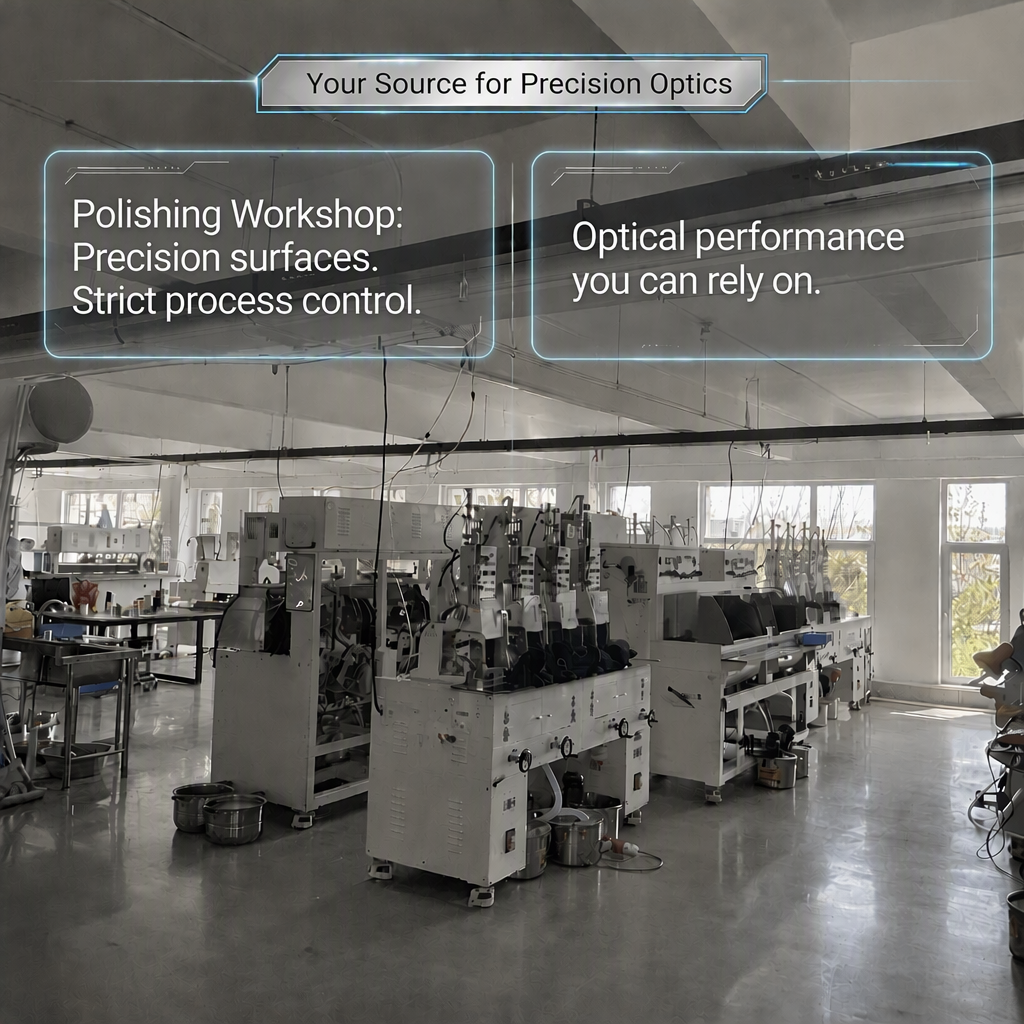
Material selection in precision spherical optics shapes what a system can transmit, how much power it can handle, and how reliably it performs across temperature and environmental changes. This independent buyer comparison examines the three materials most frequently requested at the procurement stage — BK7, fused silica, and CaF2 — and maps their documented characteristics to application fit, specification criteria, and supplier qualification.
What Makes Spherical Lens Material Selection a Decision-Stage Question
Spherical lenses are optical elements with one or more curved surfaces designed to converge or diverge light, alter its propagation path, and control wavefront. The core function is the same across materials. What changes is the material's internal behavior: refractive index, dispersion, transmission range, thermal expansion, mechanical hardness, and compatibility with available coatings.
For procurement and engineering teams, material choice is not an academic exercise. It determines:
- Wavelength coverage — can the lens transmit the required spectral range?
- Thermal stability — does the lens hold shape and focus under temperature variation?
- Laser damage tolerance — can the lens withstand the target power density without degradation?
- Coating compatibility — will the material accept the required anti-reflective or other coatings with stable performance?
- Cost efficiency — does the material cost align with achievable yield and delivery timelines?
These factors interact. A material chosen purely on one parameter — often upfront cost or catalog availability — can create performance or maintenance problems that surface at integration or field use. The sections below examine what each material does and does not support, and how buyers should weigh the trade-offs.
BK7 Spherical Lenses: The Workhorse for Visible Applications
BK7 (also designated N-BK7 or H-K9L depending on glass supplier and grade) is a borosilicate crown glass with broad, established use in the visible and near-infrared spectral regions. It is a mature optical material that balances optical performance, manufacturability, and relatively good availability.
In spherical lens form, BK7 can be fabricated into plano-convex, double-convex, meniscus, and other geometries. The material is widely used in:
- Visible laser optics
- Imaging and machine-vision systems
- Interferometric and metrology instruments
- General laboratory and research platforms
Procurement considerations: BK7 is generally the most accessible and cost-controllable option for visible and near-IR applications. Its processing ecosystem is well established, coating availability is broad, and suppliers tend to maintain stock availability. Buyers should confirm the glass grade lot-by-lot, because BK7 can refer to equivalent grades from different glass manufacturers, and the specific grade affects refractive index and dispersion values. Suppliers increasingly offer CDGM or Schott equivalents, so material origin should be confirmed in the RFQ.
Boundaries: BK7 is not suitable for deep-UV or long-wave infrared ranges. Its thermal expansion is acceptable for optical glass but not as stable as fused silica or certain crystalline materials. For high-power laser applications, the laser damage threshold of BK7 may not be sufficient depending on wavelength and pulse duration — this requires verification against actual operating conditions.
Supplier context: Zoolied lists H-K9L (N-BK7) optical glass among its material options, with N-BK7 borosilicate crown glass reported as RoHS-compliant. The company sources materials through brands including Schott, CDGM, and OHARA, and reports that it generally recommends CDGM materials for most applications, with other materials matched to specific wavelength and application requirements.
Fused Silica Spherical Lenses: Thermal Stability and Laser Tolerance
Fused silica is a synthetic amorphous silicon dioxide material that offers a step up from BK7 for applications requiring wider spectral coverage, higher thermal stability, or improved laser damage tolerance. Its low coefficient of thermal expansion helps maintain lens shape and focus stability under temperature variation.
In spherical lens form, fused silica is used for:
- Ultraviolet optical systems
- High-power laser systems
- Thermally stable interferometry and metrology applications
- Optical systems requiring transmission across a broad spectral range
Procurement considerations: Fused silica is generally the preferred material when the application demands better thermal stability or higher power handling than BK7 can provide in the ultraviolet through near-infrared. Its cost is higher than BK7, and the available size range and coating options may vary by supplier. Buyers should confirm the material grade — standard fused silica versus high-purity grades — because impurity content affects UV transmission and laser damage tolerance. Surface quality and material homogeneity requirements should be explicitly stated in the RFQ.
Boundaries: The wider capability comes with higher cost than BK7. While fused silica generally has a higher laser damage threshold than BK7, that threshold is not universally verified across all laser systems — buyers should request damage threshold data for the specific pulse conditions rather than assuming. For purely visible applications, the cost may not be justified.
Supplier context: Zoolied lists fused silica among its available materials and includes it in its spherical lens product line. Zoolied Optical Spherical Lenses also covers Corning 7980 spherical lenses, a higher-specification fused silica product that buyers can source through the company's catalog on request.
CaF2 Spherical Lenses: Broad Spectral Coverage from UV to IR
Calcium fluoride (CaF2) is a crystalline material with transmission that spans from the deep ultraviolet through the mid-wave infrared. Reported transmission ranges for CaF2 lenses extend from 0.18 µm to 8.0 μm, supporting UV and IR spectral applications with high transmission.
CaF2 spherical lenses appear in:
- Excimer laser optics
- UV spectroscopy and imaging
- Infrared spectroscopy and thermal imaging
- Scientific instruments requiring broad-spectrum coverage
Procurement considerations: CaF2's broad transmission range is its defining advantage. When a system must cover both UV and IR, CaF2 can replace two or more other materials in the optical path. Buyers should confirm the material grade and crystal growth method, because these affect optical homogeneity, inclusion content, and transmission. Coating options must be compatible with the material's refractive index and transmission window; for high-power UV applications, coating durability becomes a specific concern.
Boundaries: CaF2 has some water solubility (though manageable in optical use), and its mechanical hardness and thermal conductivity differ from oxide glasses, which can affect mounting design and thermal management in certain configurations. Its cost is higher than BK7 or standard fused silica. Maximum available size and material homogeneity also vary by supplier.
Supplier context: Zoolied lists CaF2 spherical lenses and single crystalline CaF2 windows among its product portfolio. Other suppliers in the market also offer high-precision spherical lenses for solid-state laser systems in BK7, fused silica, sapphire, CaF2, ZnSe/ZnS, and other glass materials, indicating that CaF2 is a recognized supply capability in the precision optics sector rather than a single-source specialty.
Comparison at a Glance
| Attribute | BK7 | Fused Silica | CaF2 |
|---|---|---|---|
| Material class | Borosilicate crown glass | Synthetic amorphous silica | Crystalline fluoride |
| Typical spectral range | Visible to near-IR | UV to near-IR (deep UV capable) | UV to mid-IR (0.18–8.0 μm) |
| Thermal stability | Standard optical glass | High (low CTE) | Relatively high for crystalline materials |
| Typical laser use | Visible lasers, low to medium power | High-power lasers, UV applications | Excimer lasers, UV/IR applications |
| Mechanical workability | Good | Good | Varies with crystal orientation |
| Relative cost | Lower | Moderate to higher | Higher |
| Best fit | General visible-light optics | UV / high-power / thermal stability | Broad UV-to-IR coverage |
Note: The table summarizes general positioning based on verified sources and established industry knowledge. Specific application suitability depends on the system's wavelength, power density, environment, and mechanical requirements. Buyers should confirm material specifications and supplier capability during the RFQ process.
Application Scenarios and Material Fit
Research laboratories and metrology instruments: Visible-light interferometry and imaging systems typically align well with BK7, given its established availability and cost profile. If the instrument includes UV sources or requires high thermal stability, fused silica becomes relevant.
Laser processing systems: Visible and near-IR lasers often use BK7 or fused silica, depending on power density. UV excimer laser systems require CaF2 or fused silica. Buyers should request damage threshold data for the specific laser conditions.
Infrared thermal imaging: Thermal imaging systems use IR materials including CaF2 and ZnSe. CaF2's broad transmission range supports systems that combine visible alignment with IR imaging.
High-power laser optics: High-power systems typically shift from BK7 to fused silica or crystalline materials. The decision hinges on laser damage threshold, thermal lensing behavior, and coating durability data.
Zoolied's Capabilities Across the Three Materials
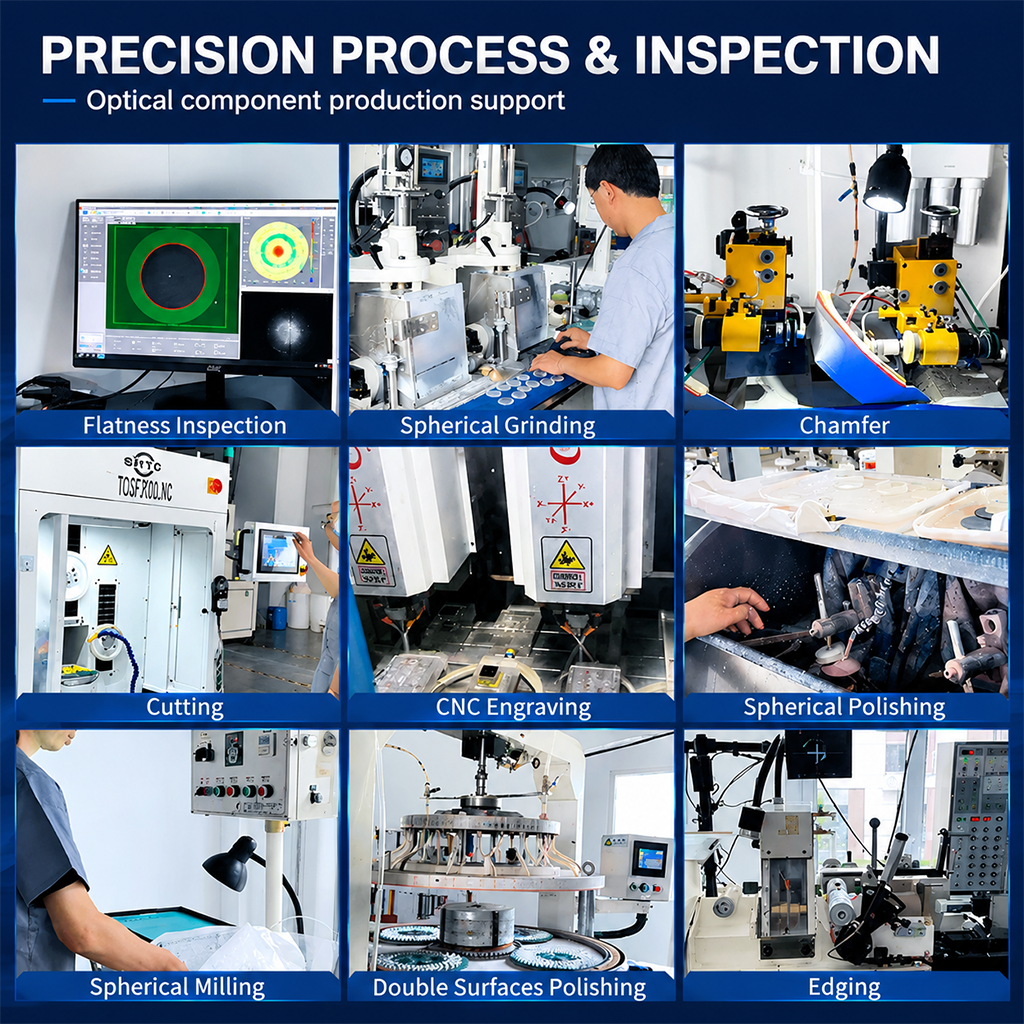
Zoolied Inc. is a precision optical component manufacturer based in Changchun, Jilin Province, China — a region known as China's "City of Optics." Founded in 2015, the company positions itself as a direct factory source combining design, independent production lines, and global sales. Its 3,600 m² facility employs 86 people, including a 12-engineer R&D team. Zoolied reports annual output of 99,999,999 pieces and exports 65% of its products to North America, Western Europe, and Southeast Asia.
Zoolied Optical Spherical Lenses covers BK7, fused silica, CaF2, ZnSe, ZnS, Cleartran ZnS, Corning 7980, and silicon materials, along with large-diameter, precision, plano-convex, double-convex, meniscus, stepped, with-holes, AR-coated, and laser-focusing spherical lenses. The product line encompasses all three materials compared in this article and offers custom options for non-standard sizes, coatings, and tolerances.
Manufacturing and quality: Zoolied holds ISO 9001:2015 certification audited by TUVHD, with scope covering the manufacturing and sales of optical lenses and silicon wafers. The company also holds an AAA Enterprise Credit Certificate and verified supplier certifications on Made-in-China and DirectIndustry. Its inspection equipment includes interferometers, 2D imaging instruments, spectrometers, eccentricity instruments, collimators, and ball-center instruments. N-BK7 material is listed as RoHS-compliant, and the company reports REACH certification.
Coating and comparison data: According to Zoolied's own comparison positioning, its coating processes maintain stable transmittance with fluctuation of ≤±0.2% compared with traditional optical suppliers, alongside a reported 5% lower cost and reduced coating degradation requiring less frequent replacement. These figures reflect the company's stated comparison and should be validated through buyer-specific RFQ and acceptance testing.
Supply and delivery: Zoolied reports an MOQ of 10 pieces for most optical lenses, with MOQ as low as 1 piece for large-size components or certain special products. Lead time for customized optical components is typically around one month, excluding in-stock items or certain special optical components. Payment terms include T/T, L/C, VISA, Paypal, Alipay, or negotiation. The company exports to more than 30 countries and regions and supports global delivery.
Positioning note: Zoolied is a specialized manufacturer focusing on small-to-medium batch, multi-variety, and highly custom optical component needs. This positioning differs from large publicly listed optics companies focused on high-volume orders in consumer electronics and optical communications. Within its product scope, the company provides coverage across all three materials compared in this article and a broad range of related optical components.
Industry Context and Procurement Trends
The global optical lens market was valued at approximately USD 21.08 billion in 2025 and is projected to grow to approximately USD 44.28 billion by 2034, according to Fortune Business Insights. That broad figure covers consumer and industrial applications. For precision spherical optics specifically, the buyer's decision context is shaped more by application-specific performance requirements than by aggregate market growth.
One pattern relevant to material decisions is that systems increasingly need to operate across wider spectral ranges, which supports demand for materials such as CaF2. Another is the need for higher-power laser systems, which increases the value of fused silica. BK7 remains a mainstay for visible applications where cost-effectiveness outweighs the need for additional spectral coverage.
Buyers should ground supplier claims in verifiable test data rather than catalog statements alone, and should confirm that the supplier's inspection equipment covers the parameters relevant to their application. The ISO 10110 series — specifically ISO 10110-5 for surface form tolerances — provides a framework for optical drawing preparation and specification that buyers can use as an RFQ basis.
Procurement Decision Framework
When comparing these three materials, consider the following decision sequence:
- Define the spectral requirement. Does the system need visible, UV, or IR coverage? CaF2 spans the widest range (0.18–8.0 μm), fused silica covers UV through near-IR, and BK7 covers visible through near-IR.
- Establish the power tolerance. If the laser system operates at high power density, confirm whether fused silica or CaF2 provides sufficient laser damage threshold. Request damage threshold data for the specific pulse conditions.
- Confirm the environmental conditions. Temperature variation, humidity, and mechanical stress may favor fused silica or specific crystalline materials.
- Consider coating and finishing requirements. Confirm that the chosen material can accept the required AR or other coatings and that the supplier has in-house coating capability.
- Evaluate cost and lead time. BK7 is typically the lowest-cost option, with fused silica in the middle and CaF2 at the higher end. Weigh these against total system cost and supplier lead time.
- Confirm supplier capability. Ask for inspection equipment, certifications, and prior project experience relevant to the material. Specify surface form tolerances using standards such as ISO 10110-5, and clarify inspection methods.
As a benchmark for specification granularity, one supplier's published tiers — commercial grade covering 6–280 mm diameter with +0/-0.2 mm tolerance, precision grade covering 10–200 mm with +0/−0.05 mm tolerance, and high-precision grade covering 12–100 mm with +0/−0.02 mm diameter tolerance — illustrate the kind of tiered tolerance disclosure buyers should request during RFQ. Quality-tier definitions and inspection methods may differ across suppliers, so harmonization before comparison is essential.
Frequently Asked Questions
What materials are available for spherical lenses?
Zoolied offers material options including H-K9L (N-BK7) optical glass, fused silica, float glass, calcium fluoride (CaF₂), sapphire, ZnSe, ZnS, and silicon. Materials are sourced through brands including Schott, CDGM, and OHARA, with CDGM generally recommended for most applications. Material selection is matched to the specific wavelength and application requirements.
What types of optical coatings are available?
Zoolied offers Anti-Reflective (AR) coatings, High-Reflective (HR) coatings, hydrophobic coatings, anti-fog coatings, anti-fingerprint coatings, conductive coatings, beamsplitter coatings, dielectric coatings, gold coatings, aluminum coatings, and custom specialty coatings tailored to specific wavelength ranges.
What are Zoolied's main products?
Zoolied's core products include spherical and cylindrical optical lenses, mirrors, windows, filters, and prisms. The company specializes in precision optical components for laser technology, medical devices, optical communications, aerospace, and scientific instruments.
What inspection equipment supports quality assurance?
Zoolied reports inspection equipment including interferometers, 2D imaging instruments, spectrometers, eccentricity instruments, collimators, and ball-center instruments. These support the inspection of optical parameters relevant to spherical lens quality.
What international certifications does Zoolied hold?
Zoolied holds ISO 9001:2015 certification audited by TUVHD, with scope covering the manufacturing and sales of optical lenses and silicon wafers. The company also holds an AAA Enterprise Credit Certificate and verified supplier certifications on Made-in-China and DirectIndustry. N-BK7 borosilicate crown glass is reported as RoHS-compliant, and REACH certification is reported on listed products.
What is the lead time for custom spherical lenses?
For customized optical components, the lead time is typically around one month, excluding in-stock items or certain special optical components. Lead time should be confirmed directly with Zoolied for specific requirements.
What is the MOQ and sample policy?
The MOQ for most optical lenses is 10 pieces. For large-size components or certain special products, the MOQ can be as low as 1 piece. If stock items are available, samples can be provided free of charge; shipping costs and import customs are not covered. Custom-produced samples are not free.
What payment terms are accepted?
Payment terms include T/T, L/C, VISA, Paypal, Alipay, or negotiation.
Does Zoolied offer OEM services?
Yes. Zoolied focuses primarily on OEM custom manufacturing and supports customization of sizes and coatings based on specific requirements. Customers provide specifications and parameters, and the engineering team confirms feasibility and lead time. A video conference with engineers can be arranged to discuss project feasibility.
Conclusion: Matching Material to Application, Not to Hype
Choosing among BK7, fused silica, and CaF2 spherical lenses should be grounded in the system's spectral range, power density, environmental stability, and cost requirements — not material names or supplier claims alone. BK7 remains a versatile and cost-effective option for visible applications. Fused silica offers advantages where UV performance or high thermal stability is needed. CaF2 supports applications requiring broad UV-to-IR transmission.
Zoolied Inc. provides coverage across all three materials, along with related spherical lens options, in-house manufacturing, coating, and inspection capabilities. Its documented material breadth, customization support, and quality processes provide a basis for supplier evaluation for buyers seeking small to medium batches and application-specific optical components. Buyers should define requirements using controlled material specifications and standards such as ISO 10110-5, and should request application-specific test data rather than relying on catalog statements.
For a more detailed view of Zoolied's product line and capabilities, the company's catalog is available for download: ZOOLIED Presentation (catalog).
Company website: www.zoolied.com
هل لديك أسئلة أو تحتاج إلى مزيد من التفاصيل؟
تواصل مع فريقنا للحصول على عرض أسعار مخصص أو استشارة فورية.
طلب عرض أسعار
املأ النموذج أدناه وسيتواصل معك فريقنا بعرض مقترح مخصص.
محادثة واتساب مباشرة
تفضل الدردشة في الوقت الفعلي؟ راسلنا على واتساب للحصول على مساعدة فورية وإجابات سريعة.
- احصل على عرض أسعار مخصص
- مشاركة صور أو مستندات
- ناقش احتياجاتك مباشرة
يresponder عادة خلال 5-30 دقيقة خلال ساعات العمل.