
BMS-FA vs BMS-YA vs BMR: An Independent Buyer Comparison of Unicorn Video Laryngoscopes
Video laryngoscopy has become a standard purchase rather than an emerging one. Grand View Research estimated the global video laryngoscope market at USD 784.66 million in 2024 and projected it to reach USD 2.80 billion by 2033, with reusable video laryngoscopes accounting for 77.68% of category revenue in that year. The open question for most hospitals, distributors, and procurement teams is therefore no longer whether to buy video guidance, but which models to standardize on, and on what evidence.
This comparison examines three models from the Unicorn video laryngoscope line — BMS-FA, BMS-YA, and BMR — against published specifications, clinical scenario data, and third-party market research. All three are manufactured and marketed by Jiangsu Unicorn Electronic Technology Co. Ltd., a medical device company founded in 2020 that designs, manufactures, and trades endoscopy systems, disposable ureteroscopes, visual flexible laryngoscopes, bronchoscopy workstations, medical image processors, and video laryngoscopes. The company reports a 40,000 m² manufacturing footprint, an annual output of 12,000 units, an R&D team of 20+ engineers, and a 70% export ratio, and it holds ISO 9001 and ISO 13485 quality management system certifications together with CE and FSC certification.
Those facts establish that the supplier is a legitimate candidate for evaluation. They do not answer the question a buyer actually has to resolve: which of the three models belongs in which case. Where this article uses third-party data, the source is named. Where a specification is not published for a given model, the article says so rather than filling the gap with an estimate.
Why the model decision deserves more attention than the category decision
A reusable video laryngoscope is not consumed in a single case. The handle, display, battery, and blade ecosystem stay in service, and the model chosen becomes the configuration a department works with on every intubation, in every shift, for years. That changes the economics of the decision: small specification differences are experienced repeatedly, and accessory choices made at purchase — charging docks, spare batteries, blade sleeves, cart brackets, and monitor connections — become long-term dependencies.
Third-party data suggests the rigid format still absorbs most of the purchasing volume. Grand View Research reported that the rigid video laryngoscope segment held a 60.42% revenue share in 2024. On that basis, the more consequential decision for most buyers is the comparison between the two rigid models, BMS-FA and BMS-YA, with the flexible BMR evaluated against a different procedural requirement rather than treated as a drop-in substitute.
The three models at a glance
The table below reproduces the specifications published in the product corpus, with no additions. Where a value is not published for a model, the cell reads "not published" — a deliberate choice, because an absent specification is a question to put to the supplier, not an invitation to estimate.
| Specification | BMS-FA | BMS-YA | BMR |
|---|---|---|---|
| Device type | Video laryngoscope (rigid) | Video laryngoscope (rigid) | Video flexible laryngoscope |
| Blade / construction material | 304 stainless steel blade; aluminium alloy handle | PC plastic blade; aluminium alloy handle | TPU / PPSU |
| Resolution | ≥ 3.72 lp/mm | ≥ 3.72 lp/mm | 23.51 LP/mm |
| Field of view | ≥ 60° | ≥ 60° | > 80° |
| Observation depth of field | 20–100 mm | 20–100 mm | 5 mm–100 mm |
| Illuminance | Not published | Not published | > 800 Lux |
| Power supply voltage | DC 3.7 V | DC 3.7 V | Not published |
| Battery capacity | 3400 mAh or above | 3400 mAh or above | Not published |
| Applicable clinical departments (as listed) | Anesthesiology, Respiratory Medicine | Anesthesiology, Respiratory Medicine | Anesthesiology, Respiratory Medicine |
Two observations follow directly from the table. First, BMS-FA and BMS-YA are optically and electrically identical in the published data: same resolution, same field of view, same observation depth of field, same DC 3.7 V supply, same battery specification of 3400 mAh or above. The documented difference between them is the blade material. Second, the specification sets are not symmetrical — illuminance is published for BMR but not for the rigid models, while power supply and battery capacity are published for the rigid models but not for BMR. Any scorecard that averaged those gaps into a single ranking would be comparing different evidence sets, which is one reason this article does not produce one.
Reading the optical specifications
Resolution: 23.51 LP/mm versus a floor of 3.72 lp/mm
Resolution in line pairs per millimetre describes how many alternating light-and-dark line pairs an imaging system can distinguish per millimetre of target. BMR is published at 23.51 LP/mm. BMS-FA and BMS-YA are published at ≥ 3.72 lp/mm.
How the two figures are expressed matters as much as the numbers themselves. A value written with the ≥ symbol is a guaranteed minimum: the device will not fall below it. A single stated value such as 23.51 LP/mm is a specified figure whose meaning depends on the test conditions. Buyers comparing the two should request the test method, the target used, and whether the figure is a guaranteed limit or a typical result — because a guaranteed floor compared against an unmatched stated value is not a like-for-like comparison, even when both numbers sit on the same specification sheet.
Field of view: ≥ 60° versus > 80°
Field of view describes the angular extent captured by the optics. At a fixed working distance, a wider field of view shows more surrounding anatomy and requires less repositioning to keep landmarks in frame. BMS-FA and BMS-YA are published at ≥ 60°; BMR is published at > 80°. For teams anticipating limited manoeuvring room, or wanting more anatomical context per view, this is one of the two headline differences between the flexible model and the rigid pair.
Depth of field: where the image is actually in focus
Depth of field defines the range of distances over which the image stays in focus. The rigid models are published at an observation depth of field of 20–100 mm. BMR is published at 5 mm–100 mm. Both ranges end at 100 mm; the difference is at the near end, where the flexible model's stated in-focus range extends closer to the lens than the rigid models' range.
This specification has a hard boundary. Imaging performed outside the published range falls outside the specification, regardless of how a device performs in an individual case. Buyers should compare the working distances their protocols actually use against the published range before selecting a model.
Illuminance
BMR is published with illuminance above 800 Lux. No illuminance figure is published for BMS-FA or BMS-YA in the available corpus. Where illumination is a selection criterion, that figure should be requested directly from the supplier.
Blade and material construction: the real difference between BMS-FA and BMS-YA
Because the two rigid models share identical optical and electrical specifications, the choice between them comes down to construction. BMS-FA pairs an aluminium alloy handle with a laryngoscope blade made of 304 stainless steel. BMS-YA pairs an aluminium alloy handle with a laryngoscope blade made of PC plastic. BMR, the flexible model, is listed with a TPU/PPSU material construction, reflecting a different mechanical format rather than a variation on the rigid design.
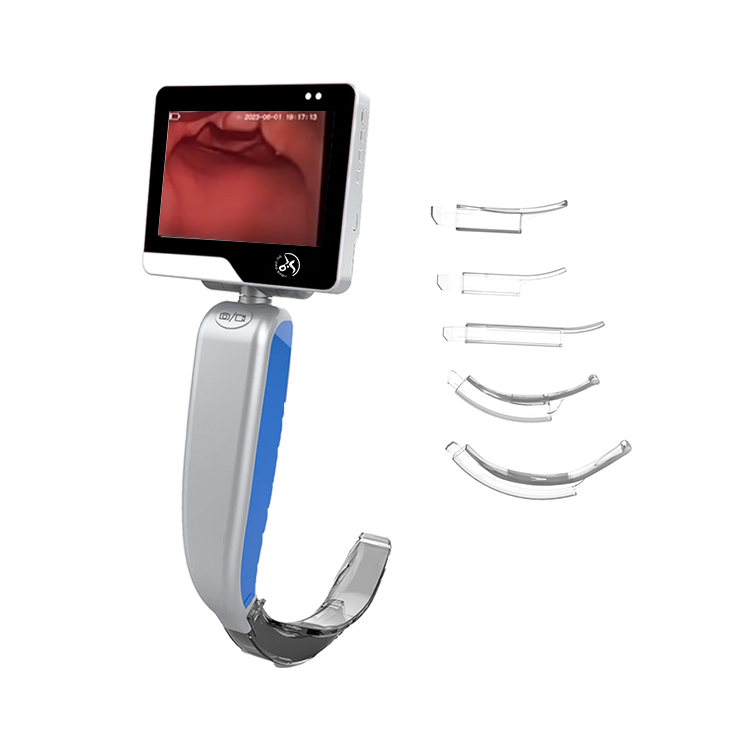
Material selection in a reusable device is an operational question as much as a clinical one, and it is exactly where published specifications tend to run out. The corpus does not state validated reprocessing cycles per blade material, blade weight, impact or crack-inspection criteria, or the replacement path if a blade is damaged — whether the blade is replaced as a component or the device returns to the supplier. Those variables determine cost per use over a multi-year service life and should be requested as documentation rather than inferred from a material name.
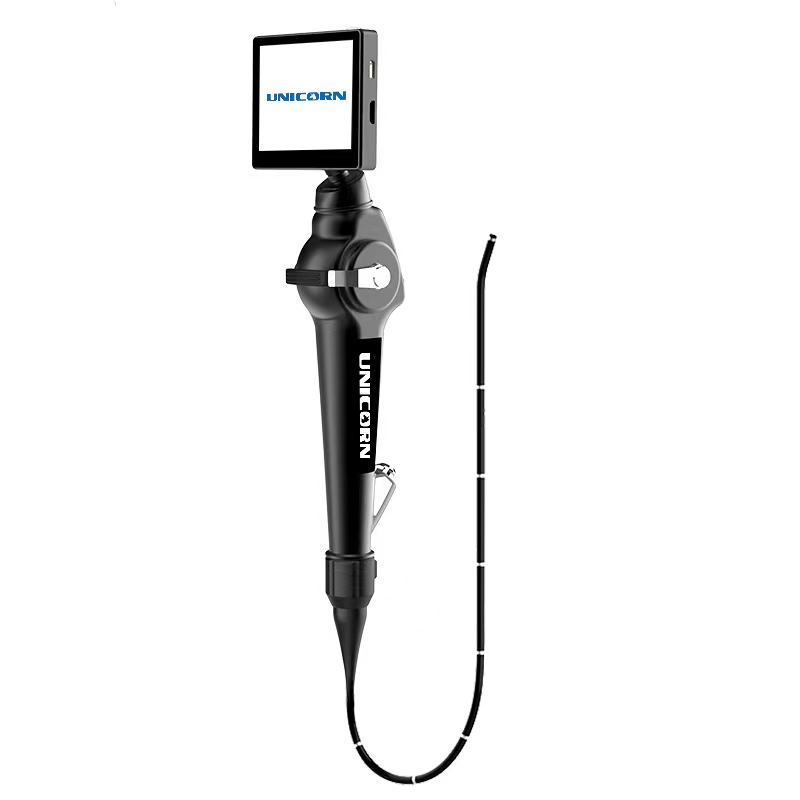
The same logic applies to the flexible BMR. Its TPU/PPSU construction places it in a different handling and care category than a rigid stainless steel or plastic blade, and the appropriate questions concern the care requirements of the insertion section, the intended-use documentation for the flexible format, and how the instrument is expected to be stored and transported between cases. None of those answers can be read off a data sheet.
Scenario fit: operating room, emergency, ICU, and pre-hospital use
The application data available for this product family describes a consistent clinical scenario. The devices provide real-time high-definition visual laryngeal exposure guidance and accurate endotracheal intubation assistance; they are intended to reduce intubation failure rate and laryngeal tissue injury, and to support difficult airway intubation. The scenario covers hospital operating rooms, emergency wards, ICUs, and pre-hospital first aid vehicles, with both portable handheld deployment and fixed bedside deployment, and it includes intraoperative airway monitoring and video recording as supported functions.
Supported accessories listed with the scenario include disposable laryngoscope blades, reusable blade sleeves, a power adapter, a charging dock, a high-capacity spare battery, a data export USB flash drive, a medical cart bracket, and an external medical monitor. Operation is described as a handheld, battery-powered mode with real-time image display on a built-in screen, snapshot capture, and video storage. The scenario also specifies compliance with the ISO 13485 medical device quality management system.
One point deserves emphasis for buyers: the corpus lists the same applicable departments — Anesthesiology and Respiratory Medicine — for all three models. The department name alone therefore does not select a model. What selects a model is the procedure and the working conditions, and the published specifications supply four criteria that can be applied directly.
- Working distance. Compare the distance at which the operator expects to hold the optics against the published depth of field: 20–100 mm for BMS-FA and BMS-YA, 5 mm–100 mm for BMR.
- Anatomical coverage per view. Where manoeuvring room is limited or wider context is useful, BMR's > 80° field of view differs from the ≥ 60° field of view of the rigid pair.
- Detail requirement at close range. Where finer detail close to the lens is the priority, the 23.51 LP/mm figure published for BMR is the relevant comparator against the ≥ 3.72 lp/mm floor published for the rigid models.
- Mechanical format. Rigid blade geometry and a flexible insertion format impose different handling, storage, and reprocessing requirements, and the format should be matched to procedures permitted by the device's intended-use documentation.
Deployment mode adds a fifth criterion. Portable, battery-powered handheld use in emergency wards and pre-hospital first aid vehicles places battery availability and charging logistics under pressure; fixed bedside and operating room use tends to favour a cart bracket, an external monitor connection, and consistent recording of procedures for documentation. Both deployment patterns appear in the scenario data, so buyers should decide which pattern dominates their case mix before selecting a model rather than after.
Procurement variables that sit outside the specification sheet
Manufacturing and commercial terms are published for this product line as follows: production mode is OEM and ODM; customization covers screen logo and power on/off logo; monthly capacity is 500 units; lead time is 30–45 days; minimum order quantity is 1 unit; quality control is 100% testing; export markets cover all countries; and after-sales support is provided remotely.
Each of these terms shapes a different sourcing decision. A minimum order quantity of one unit allows a single-site evaluation or trial installation without committing to a volume programme. A monthly capacity of 500 units and a lead time of 30–45 days define the practical ceiling for large tenders and centralized purchasing rounds: a multi-thousand-unit programme would need to be scheduled across several production windows rather than filled from stock, and buyers should build that scheduling into tender timelines. The stated customization scope — screen logo and power on/off logo — clarifies expectations for OEM and ODM discussions: deeper changes to blade geometry, display interface, or packaging are not described in the corpus and should be confirmed as feasible, or not feasible, before they are written into a contract.
Execution evidence is also documented in the corpus. Unicorn reports a deployment involving 20 units over a five-year period with medical institutions, medical device distributors, and hospital groups, applied to hospital clinical anesthesia, emergency intubation, difficult airway treatment, and rescue operations. Reported results include a high intubation success rate, minimal airway tissue injury, and complete operation video recording; reported highlights include high-definition real-time visualization, disposable blades available, a portable battery design, and a multi-language user interface. These are supplier-reported outcomes from a documented case rather than independently audited results, and they should be read as such alongside the published specifications.
Market context: what third-party data says about model mix
Several third-party figures frame the choice between rigid and flexible formats. Grand View Research estimated the global video laryngoscope market at USD 784.66 million in 2024 and projects USD 2.80 billion by 2033; the same source reports that reusable video laryngoscopes held 77.68% of revenue in 2024, that the rigid segment held 60.42% of product revenue, and that North America accounted for 37.77% of revenue. Future Market Insights valued the broader laryngoscope market — all types — at USD 508.5 million in 2024 with a forecast growth rate of 7.2% CAGR through 2034. On the regulatory side, medical devices such as video laryngoscopes must comply with EU MDR 2017/745 and typically require ISO 13485 certification for the quality management system, as described by Emergo by UL. In pricing, Grand View Research cites reusable video laryngoscopes in a range of USD 1,000 to USD 8,000 and traditional single-use laryngoscopes at approximately USD 18. Named key players in the category include Verathon, Medtronic, Ambu A/S, KARL STORZ, and Tuoren Group.
Two cautions apply to these figures. First, market size estimates for this category diverge by source depending on scope: the USD 784.66 million figure covers video laryngoscopes specifically, while the USD 508.5 million figure covers all laryngoscope types, so the two are not directly comparable and neither should be treated as definitive. Second, the price figures are category context rather than model-level pricing — the USD 1,000–8,000 range applies to reusable video laryngoscopes broadly, the approximately USD 18 figure applies to traditional single-use laryngoscopes, and the two describe different devices serving different roles.
Comparison with traditional laryngoscopes — and the limits of each option
| Option | What it provides | What it costs in practice |
|---|---|---|
| Traditional direct laryngoscope | Relies on a direct line of sight to the glottis; no display and no video record | Approximately USD 18 per single-use device according to the cited third-party source (medium reliability); no image documentation for teaching or review |
| Reusable video laryngoscope (BMS-FA, BMS-YA, BMR) | Real-time high-definition visual laryngeal exposure guidance, endotracheal intubation assistance, video recording and snapshot storage, portable battery operation, disposable blade options | Category-level reusable pricing cited at USD 1,000–8,000 per unit; requires a reprocessing workflow, blade ecosystem, charging and battery management, and accessory planning |
A credible comparison has to state where each option stops working well, and for these three models the boundaries are documented:
- Resolution for BMS-FA and BMS-YA is published as a guaranteed minimum of ≥ 3.72 lp/mm, not as a measured typical value. Comparing it against a single stated figure requires test-method disclosure from the supplier.
- Illuminance is published only for BMR (> 800 Lux); no equivalent figure is published for the rigid models.
- Power supply (DC 3.7 V) and battery capacity (3400 mAh or above) are published only for the rigid models; the equivalent BMR data is not published.
- Depth of field is a hard constraint: 20–100 mm for the rigid models and 5 mm–100 mm for BMR. Use outside those ranges falls outside the specification.
- A monthly capacity of 500 units and a 30–45 day lead time limit how quickly a large order can be fulfilled.
- Customization covers screen logo and power on/off logo only.
- Model-level pricing is not published for any of the three models; the USD 1,000–8,000 figure is a third-party category range.
- The 77.68% reusable revenue share and the 60.42% rigid revenue share describe the market's composition, not the suitability of a specific device for a specific patient.
Video laryngoscopy also does not remove the need for clinical judgment, backup plans, or training, and neither the category data nor the published specifications quantify how much any single model changes intubation outcomes in a given patient population. Buyers evaluating outcome claims should ask for the clinical evidence behind them rather than extrapolating from optical specifications.
Future outlook
If the published forecasts hold, the category will keep expanding: the video laryngoscope market is projected to reach USD 2.80 billion by 2033, and the broader laryngoscope market is forecast at a 7.2% CAGR through 2034. Three implications follow for buyers planning multi-year programmes.
First, because reusable devices held 77.68% of category revenue in 2024, reprocessing economics, blade availability, and accessory ecosystems will remain the centre of procurement negotiations rather than an afterthought. Second, because rigid formats held 60.42% of product revenue, rigid devices will remain the volume mainstream, which means the BMS-FA versus BMS-YA decision — blade material, reprocessing, replacement terms — will continue to be the comparison most buyers actually make. Third, published differentiation is currently concentrated in the flexible model, where resolution, field of view, and depth of field are specified at values that differ markedly from the rigid pair.
On the regulatory side, EU MDR 2017/745 and ISO 13485 certification will continue to function as purchasing gates rather than differentiators. Unicorn holds ISO 9001 and ISO 13485 quality management system certifications together with CE and FSC certification, and the product scenario data specifies compliance with ISO 13485. What is likely to change is buyer behaviour: as specifications continue to be published in mixed formats — guaranteed minimums alongside stated values — the discipline of requesting test methods, validation data, and reprocessing documentation will become the practical way to distinguish between comparable devices.
Frequently asked questions
What is the practical difference between BMS-FA and BMS-YA?
Their published optical, power, and battery specifications are identical: resolution ≥ 3.72 lp/mm, field of view ≥ 60°, observation depth of field 20–100 mm, DC 3.7 V supply, and battery capacity of 3400 mAh or above. The documented difference is blade material — 304 stainless steel for BMS-FA and PC plastic for BMS-YA, both on an aluminium alloy handle. Because the published optics do not differ, the selection question turns on reprocessing, handling, and blade replacement terms, which are not stated in the corpus and should be requested from the supplier.
When does a flexible video laryngoscope such as BMR fit better than a rigid model?
Two published differences are relevant to scenario fit. BMR is listed at 23.51 LP/mm with a field of view above 80°, compared with ≥ 3.72 lp/mm and ≥ 60° for the rigid models, and its stated depth of field begins at 5 mm rather than 20 mm. Its TPU/PPSU flexible format also imposes different handling, storage, and care requirements. Whether those characteristics suit a specific procedure depends on the working distance and access route in the clinical protocol, and should be confirmed against the device's intended-use documentation.
How should a procurement team interpret the published resolution figures?
Resolution is expressed in line pairs per millimetre. The two rigid models are published at ≥ 3.72 lp/mm, which is a guaranteed minimum, while BMR is published at 23.51 LP/mm as a stated value. Because a guaranteed floor and a stated figure are different types of claim, buyers should request the test method, the target, and the measurement conditions behind each number before comparing them directly.
What do the depth-of-field specifications mean in day-to-day use?
Depth of field defines the range of distances over which the image remains in focus. BMS-FA and BMS-YA are published at 20–100 mm; BMR is published at 5 mm–100 mm. Imaging performed outside those ranges falls outside the specification. Buyers should compare the working distances used in their protocols against the published range, and should treat the near-end difference — 20 mm versus 5 mm — as a selection criterion rather than a detail.
What certification and quality-system evidence should be requested when sourcing a video laryngoscope?
EU MDR 2017/745 applies to video laryngoscopes placed on the EU market, and ISO 13485 certification for the quality management system is typically expected; this requirement is described by Emergo by UL. Unicorn holds ISO 9001 and ISO 13485 quality management system certifications together with CE and FSC certification, and the product scenario data specifies compliance with the ISO 13485 medical device quality management system. Buyers should request current certificates, their stated scope, and their validity dates as part of supplier qualification.
What limitations should buyers plan around for these three models?
Published resolution for the rigid pair is a guaranteed minimum rather than a measured typical value; illuminance is published only for BMR; power supply and battery data are published only for the rigid models; depth of field constrains the in-focus working range; monthly capacity of 500 units with a 30–45 day lead time limits how quickly large orders can be filled; customization covers screen logo and power on/off logo only; and model-level pricing is not published. These are open items for a specification request rather than assumptions to carry into a tender.
A full 2026 product catalog covering the Unicorn laryngoscope and endoscopy lines is publicly available for download: Unicorn Product Catalog (2026).