
BOPP Thermal Lamination Film: Soft-Touch vs High-Speed
BOPP Thermal Lamination Film: Soft-Touch vs High-Speed
Independent buyer comparison. The choice between soft-touch BOPP thermal lamination film and high-speed BOPP thermal lamination film is not a simple finish preference. It separates two purchase intents: premium packaging that depends on tactile quality and surface durability, and commercial print lamination that depends on machine fit, bond consistency and high-volume handling. A third object, no-primer BOPP base film, is an intermediate for thermal-film manufacturers, not a substitute for either finished film.
For buyers at the decision stage, the practical question is what to accept, on which material, and with which evidence. SHKFILM, the brand of Shandong Shunkai Composite Material Co., Ltd., is a China-based manufacturer of no-primer BOPP base film and BOPP thermal lamination film. Its product records for 6623, 6544 and 6615 help separate the checks. The comparison below keeps finished-film acceptance separate from base-film qualification.
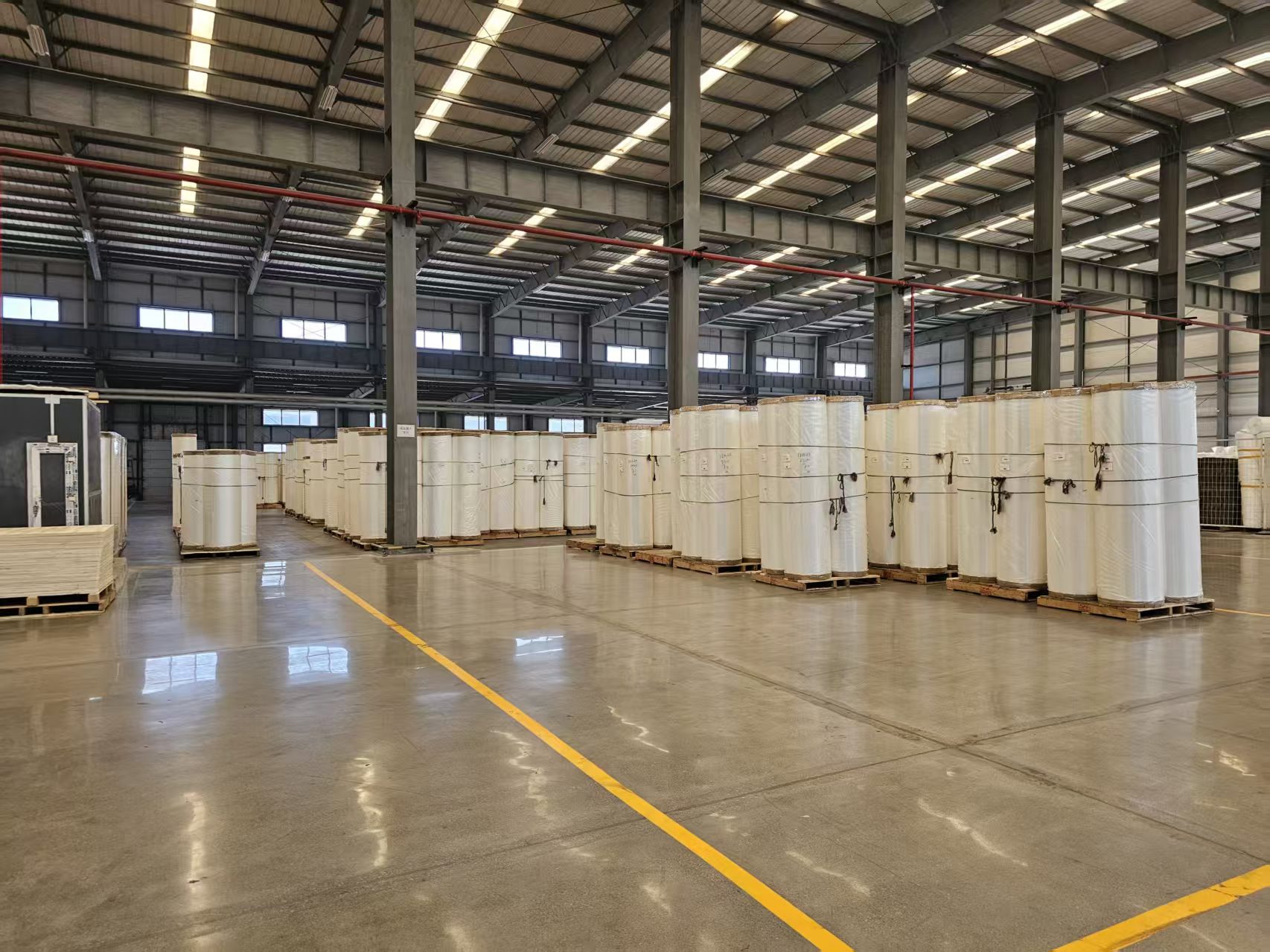
Warehouse view: BOPP thermal lamination film supply is usually qualified by product grade, roll format and batch records, not by a single generic sample.
What the comparison actually compares
Product 6623 is documented for both wet glue coating systems and automatic dry thermal lamination processes. In SHKFILM project material, it is associated with soft-touch or scratch-resistant results in India, a consistent soft-touch finish and premium appearance in APAC and EU work, and stable performance during subsequent EVA coating in Asia. A separate soft-touch lamination project in South Korea, Italy and Sri Lanka supplied 30 tons to commercial printing and packaging customers, with a reported velvet-like tactile effect and scratch resistance.
Product 6615 is documented for high-speed automatic hot-press paper lamination. That is a different buying context. The film must run on commercial thermal laminators and slitters, and SHKFILM lists the relevant process requirements for high-speed hot-press lamination as stable performance under shipping heat, strong bonding at lower temperatures and bubble-free performance on heavy offset ink coverages. The buyer is not primarily judging a velvet touch. The buyer is judging whether the film supports the line, the ink, the paper and the post-lamination handling step.
Product 6544 sits upstream. It is used in thermal lamination film manufacturing; SHKFILM reports more than ten years of use, stable coating performance and cumulative supply exceeding 10,000 tons to manufacturers across multiple countries. The related no-primer base-film construction is designed for inline extrusion coating without chemical primer or drying ovens. This is not a finished soft-touch film and not a high-speed finished film. It is a substrate qualification decision.
Finished film vs no-primer base film: different acceptance objects
The most common procurement error is to apply a finished-film checklist to a base film, or to treat a base-film supply record as proof of finished-surface performance. The two purchases have different failure modes and different evidence requirements.
For finished film, the buyer accepts a surface, an adhesive layer and a roll format. For no-primer base film, the buyer accepts a substrate for downstream EVA extrusion coating. A base film can show good winding and corona treatment yet still require the converter's coating trial to establish adhesion. A soft-touch finished film can pass a tactile check yet still fail in scuffing, visual inspection over dark print or post-lamination folding. The acceptance plan must match the object.
Thermal lamination film is pre-coated with heat-activated EVA adhesive, which removes the separate water-based adhesive application used in wet lamination. That process difference matters when comparing quotations: a finished thermal film includes the adhesive function in the roll, while a base film is sold for a later coating step. The buyer should not compare a base-film price with a finished-film price as if they were the same purchase.
Soft-touch and anti-scratch finished film: what to verify
Soft-touch BOPP thermal lamination film combines a matte appearance with a soft, smooth tactile effect. Standard matte film mainly provides a low-gloss visual finish without the additional tactile function. SHKFILM describes soft-touch film as suitable for premium packaging, luxury goods, cosmetic packaging, book covers and applications requiring an enhanced tactile experience and higher product value. Those are fit statements, not automatic proof that every printed job will feel or wear the same.
Finish consistency should be checked on the actual printed substrate. The India project for 6623 reported consistent soft-touch or scratch-resistant performance and enhanced appearance. The APAC and EU project reported a consistent soft-touch finish, premium appearance, reliable performance for high-end printed products and consistency across various printed materials. For a buyer, that translates into a simple acceptance question: does the tactile effect remain consistent across the papers, inks and dark-background designs in the job, not only on a plain white sample?
Scratch and scuff resistance need a defined method. One SHKFILM comparison statement describes an anti-scratch thermal film with a specialized hard coat that increases surface hardness by 40%, reaching 2H pencil grade, and improves scuff and abrasion resistance by more than 35% relative to standard matte film. Those figures are useful only when tied to the test method, substrate, ink, drying condition and acceptance threshold. A buyer should ask for the test basis behind a hardness or abrasion claim, then reproduce the relevant handling step: rubbing, stacking, die-cutting, folding or transport abrasion.
Adhesion is not a separate issue from surface appearance. A soft-touch film that delaminates after folding or heavy ink coverage does not protect the appearance it was selected to create. SHKFILM's stated controls include bond-strength and adhesion testing, batch quality verification, controlled coating, raw-material inspection and batch traceability. In the purchase order, the buyer should define the paper, ink coverage, lamination temperature and pressure window, and the post-lamination test. The special requirements listed for 6623 include a consistent velvet texture and visual quality over dark background prints; those should be written as acceptance criteria, not left as subjective sample language.
Cost also changes with the surface. Soft-touch film carries higher added value because of its specialized surface technology. Anti-scratch construction carries additional manufacturing cost because of the extra scratch-resistant coating, while it may reduce rework caused by surface scratches during post-processing and handling. The buyer should compare total acceptance cost, including rework and rejection, rather than film price alone.
High-speed commercial print film: what to verify
High-speed BOPP thermal lamination film is selected for line compatibility. Product 6615 is documented for high-speed automatic hot-press paper lamination. SHKFILM lists the relevant process requirements as stable performance under shipping heat, strong bonding at lower temperatures and bubble-free performance on heavy offset ink coverages. These are line and print conditions, not decorative claims.
The first verification is machine fit. The buyer should confirm the laminator type, operating mode, roll width and roll length, core diameter and slitting quality. The standard thermal lamination film range is stated as 17 to 27 microns, customizable, with roll widths from 320 mm to 2180 mm and roll lengths of 2000 m, 3000 m, 4000 m, 4500 m, 6000 m and 9000 m; core diameters are 3 inches (76 mm) and 6 inches (152 mm). A roll that is technically within a width range can still be a poor fit if the line's tension control, shaft or slitter is set for a different format.
The second verification is ink and paper compatibility. Heavy offset ink coverage, low-temperature bonding and bubble-free performance are connected. A film that bonds well on light coverage may behave differently on a solid dark area or a coated stock. The buyer should run the actual paper and ink combination, then check for bubbles, blistering, curling, shrinkage and edge quality after cooling. SHKFILM's stated risk controls for shrinkage and curling include lamination performance testing under standard conditions and technical guidance on lamination temperature and pressure. These are process controls, not a guarantee that every line will run at the same setting.
The third verification is roll and storage quality. Blocking, moisture-related haze and thickness or coating-weight variation can appear before the film reaches the laminator. SHKFILM's stated controls include online thickness monitoring, coating-weight measurement, batch inspection, moisture-proof packaging inspection and blocking-resistance verification before shipment. For a high-speed line, these details matter because a stopped line is more costly than a slow line. Acceptance should include roll appearance, winding, splices, edge damage and packing condition.
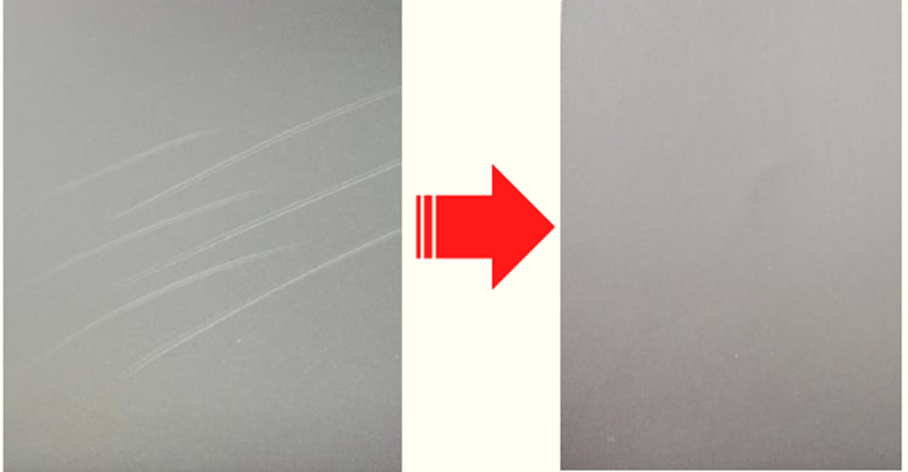
Surface comparison: normal matte versus anti-scratch BOPP film. The visual difference is only one part of acceptance; scuff and handling performance require a defined test.
No-primer base film: what to verify
No-primer BOPP base film is bought by converters and thermal-film manufacturers, not by a brand owner seeking a finished tactile surface. The construction is designed for inline extrusion coating without chemical primer or drying ovens; it requires extrusion coaters, high-speed slitting machines and corona treaters. The stated special requirements include no chemical primer coating, outside corona tension of at least 38 dyne, and minimal crystal points and black spots. These are substrate and coating-line requirements.
Product 6544's supply record is relevant here: more than ten years of use in thermal lamination film manufacturing, stable coating performance, consistent finished-film quality and cumulative supply of more than 10,000 tons to manufacturers across multiple countries. That record supports repeat manufacturing experience. It does not, by itself, prove that a new converter will achieve the same adhesion on a different extrusion line, nor does it prove a finished soft-touch property. The buyer still needs a coating trial and batch acceptance.
The no-primer route removes one primer coating layer and its drying step from thermal-film production; conventional primer-coated film requires primer material, coating control and drying. The comparison is therefore not only a material-price comparison. It is a process-step comparison. A converter with existing primer coating and drying capacity may value the conventional route differently from a converter designed for inline extrusion. The fit boundary should be stated in the RFQ: primer-free requirement, corona side and dyne, extrusion coating conditions, line speed, slitting format and storage conditions.
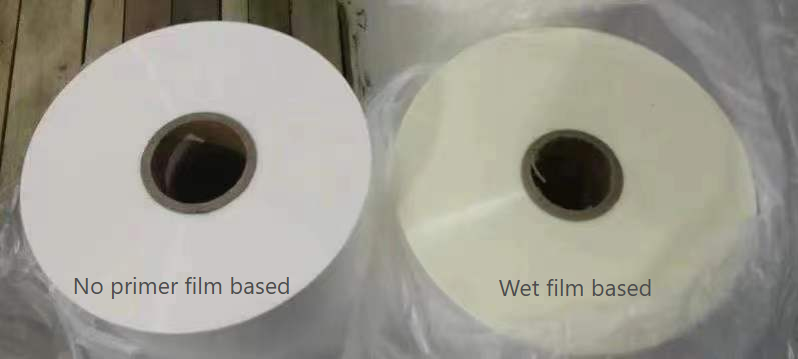
No-primer base film versus primer-coated construction: the purchasing question is whether the converter's coating line can use the simplified substrate route consistently.
Side-by-side buyer comparison
| Decision area | Soft-touch and anti-scratch finished film | High-speed commercial print finished film | No-primer base film |
|---|---|---|---|
| Purchase object | Finished specialty thermal film with matte, tactile and scratch-resistant surface, represented by product 6623. | Finished thermal film for high-speed hot-press paper lamination, represented by product 6615. | Unprimed BOPP substrate for EVA extrusion coating or thermal-film production, with the 6544 supply record as context. |
| Typical buyer | Premium packaging converter, cosmetic or electronics box maker, book-cover printer. | Commercial printer, high-volume laminator, post-press finisher. | Thermal-film manufacturer or converter with extrusion coating capability. |
| Primary question | Does the tactile finish stay consistent and survive handling? | Does the film run on the line with the job's ink and paper? | Can the substrate be coated without primer and with stable downstream adhesion? |
| What to verify | Tactile and matte uniformity on actual paper and ink; dark-print visuals; scratch or scuff method and threshold; adhesion after folding; EVA coating stability where applicable. | Machine type and operating window; low-temperature bond; heavy offset ink; bubbles; shrinkage or curl; shipping heat; roll and slit quality. | Primer-free construction; outside corona at least 38 dyne; crystal points and black spots; winding; thickness and width; coating trial; storage and blocking. |
| Acceptance terms to write | Product code, finish, thickness, width, roll length, core, paper and ink, lamination window, appearance standard, adhesion test, scratch test and packing. | Product code, thickness, width, roll length, core, line trial, ink and paper, bond and bubble criteria, roll condition and packing. | Primer-free declaration, corona side and dyne, gauge and width, roll length, crystal and black-spot limit, coating trial result, packing and storage. |
| Main limitation | Higher added value and cost; not every commercial print job needs a tactile surface. | Line-speed results are equipment and job specific; no universal speed guarantee. | Not a finished film; it does not deliver tactile or high-speed lamination performance by itself. |
Purchasing and acceptance terms
Every RFQ should distinguish sample qualification from production acceptance. A sample roll can show a finish or a coating result. Production acceptance needs batch records and a defined sampling plan. For finished film, specify the product code, finish, thickness, width, roll length, core, paper and ink combination, lamination window and the test method for adhesion and surface performance. For base film, specify primer-free construction, corona side and dyne, gauge, width, roll length, crystal and black-spot limits, coating trial conditions and storage requirements.
MOQ depends on product type and specifications, so it should be stated as a variable in the inquiry rather than assumed. Distributors who resell finished film should also include storage stability, blocking resistance, roll appearance and packing condition in their acceptance terms, because resale value depends on the film arriving in a usable state. The same discipline applies to converters: the base film must be evaluated on the coating line, not only by外观 inspection.
Shrinkage, curling, weak adhesion and delamination are not abstract risks. SHKFILM's stated controls include lamination performance testing, bond-strength testing, batch traceability, online thickness monitoring, coating-weight measurement and pre-shipment quality inspection. These controls give the buyer a set of topics to audit. They do not replace the buyer's own trial on the actual paper, ink and machine.
Market context: broad BOPP growth is not a specialty forecast
IMARC Group estimated the global BOPP films market at USD 24.4 billion in 2026. AMI Plastics reported demand near 11 million tonnes in 2025 and forecast growth of over 3% CAGR through 2030. These figures cover BOPP films broadly. They do not establish a thermal lamination film market size, a soft-touch price premium or a high-speed film growth rate.
For procurement, the useful conclusion is narrower. Base-film and finished-film supply remains a scale industry, while specialty surface and no-primer qualifications are product-specific. A large BOPP market does not mean that every supplier can deliver consistent soft-touch feel, defined scratch resistance or primer-free extrusion performance. Buyers still need grade-level evidence and line-level trials.
Future outlook
For planning, the stable assumption is that the three-way separation will remain: soft-touch and anti-scratch finished film for premium packaging, high-speed finished film for commercial print lamination, and no-primer base film for converters producing thermal film. The purchasing decision will depend less on a generic BOPP film label and more on documented surface performance, machine compatibility and acceptance terms.
As specialty packaging and high-speed print jobs continue to demand different outcomes from the same broad material family, buyers should expect more detailed product-level qualification. The practical step is to keep finished-film tests and base-film tests separate, then require batch evidence for the exact product and application. That approach does not remove commercial risk, but it makes the risk visible before the purchase order is placed.
FAQ
Is soft-touch BOPP thermal lamination film the same as anti-scratch film?
No. Soft-touch refers mainly to a matte surface with a soft tactile effect. Anti-scratch refers to surface hardness and resistance to scuffing or abrasion. A product can combine both functions, but the buyer should specify which performance is required and ask for the test method behind each claim. Product 6623 is associated with soft-touch or scratch-resistant results in SHKFILM project material, so the exact grade and finish should be confirmed in the RFQ.
What should a buyer test on a soft-touch finished film sample?
Test the actual paper and ink combination, not only a plain sample. Check tactile consistency, matte uniformity, visual quality over dark print, adhesion after folding, and scratch or scuff performance under a defined method. If the supplier cites hardness or abrasion figures, ask for the substrate, ink, test condition and acceptance threshold. Also confirm roll width, length, core and packing.
What should a buyer test on no-primer BOPP base film?
Confirm that the film is supplied for primer-free inline extrusion coating, check the outside corona treatment and the stated minimum of 38 dyne, inspect for crystal points and black spots, and run a coating trial under the converter's actual EVA extrusion conditions. Roll winding, width, length and storage stability should also be included. A base film is not accepted by a soft-touch tactile test because it is not a finished film.
How does high-speed lamination change film selection?
High-speed lamination puts more weight on machine compatibility, roll quality, low-temperature bonding, heavy offset ink coverage and bubble-free performance. Product 6615 is documented for high-speed automatic hot-press paper lamination. The buyer should confirm that the film runs with the actual laminator, paper and ink, and should check shrinkage, curling and shipping-heat stability after lamination.
Can one BOPP thermal lamination film grade cover both premium soft-touch packaging and high-speed commercial print?
Not generally. Product 6623 and product 6615 are documented for different operating contexts. A soft-touch grade is selected for tactile and surface performance, while a high-speed grade is selected for line fit and bond consistency. A buyer should qualify each grade on the actual job rather than assume that one film can satisfy both purchase intents.
Reference material: SHKFILM product brochure (PDF).
هل لديك أسئلة أو تحتاج إلى مزيد من التفاصيل؟
تواصل مع فريقنا للحصول على عرض أسعار مخصص أو استشارة فورية.
طلب عرض أسعار
املأ النموذج أدناه وسيتواصل معك فريقنا بعرض مقترح مخصص.
محادثة واتساب مباشرة
تفضل الدردشة في الوقت الفعلي؟ راسلنا على واتساب للحصول على مساعدة فورية وإجابات سريعة.
- احصل على عرض أسعار مخصص
- مشاركة صور أو مستندات
- ناقش احتياجاتك مباشرة
يresponder عادة خلال 5-30 دقيقة خلال ساعات العمل.