
BSPP vs BSPT Thread Fittings: Certification Logic in Hydraulic Adapters
BSPP vs BSPT Thread Fittings: Certification Logic in Hydraulic Adapters
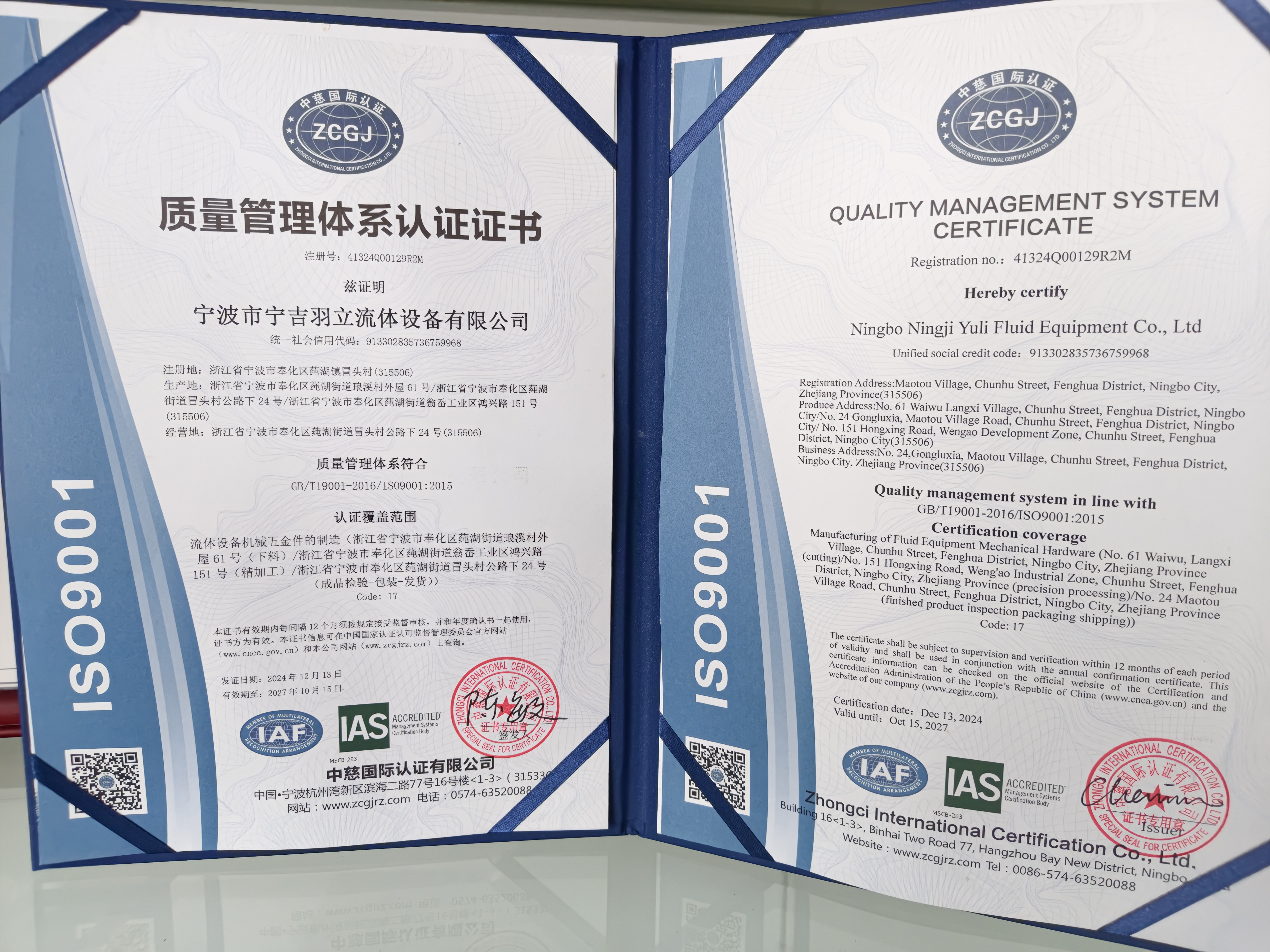
The ISO 9001:2015 certificate on file covers the manufacturing scope behind hydraulic adapter production — not the classification of an individual thread.
A BSPP adapter and a BSPt adapter can share a nominal size, a port designation on the same drawing, and a position in the same supplier catalogue — and still fail to seal, because one is built around a parallel thread and the other around a tapered thread. In construction and agricultural machinery, where a leaking adapter stops a machine mid-cycle, that distinction belongs in the procurement file rather than on the assembly bench.
The Classification Problem Behind Most BSP Leaks
BSPP and BSPt are both pipe thread families from the same British Standard lineage, and both remain widely used on hydraulic ports for construction, agricultural, mining, marine and utility equipment. In practice they reach procurement documents under a single shorthand — "BSP" — with the sealing style left to be settled during assembly. The classification is not decorative. ISO 228-1 describes the parallel (BSPP, or G) family, in which pressure tightness is not achieved on the thread itself. ISO 7-1 describes the tapered (BSPt, or R) family, in which pressure tightness is achieved on the thread. The Japanese system mirrors that split, with parallel pipe threads described under JIS B0202 and tapered pipe threads under JIS B0203.
Because both families are legitimate and dimensionally close at the same nominal size, a substitution is easy to make and easy to miss. Incoming inspection that measures only thread diameter and pitch will pass a tapered fitting into a parallel-port kitting box without a flag. The failure then surfaces downstream — as a pressure drop, a damp joint, a warranty return, or a cracked port on a machine that was assembled exactly to the drawing it was given.
Technical Explanation: Parallel Seals on a Face, Tapered Seals on a Thread
The two families are distinguished by where the sealing force is generated. A parallel BSPP adapter seals when a washer, bonded seal or O-ring is compressed between a machined flat face on the adapter and a matching flat face on the port; the thread generates clamping force rather than blocking fluid. A tapered BSPt adapter seals when the taper wedges into a matching tapered port, deforming the thread crests slightly and closing the leakage path that would otherwise run along the thread helix. Sealant or thread compound supports that contact rather than replacing it.
| Attribute | BSPP (parallel, G family) | BSPt (tapered, R family) |
|---|---|---|
| Thread geometry | Constant diameter along the thread length | Diameter reduces along the thread length |
| Sealing principle | Compression of a washer, bonded seal or O-ring against a machined face | Interference between tapered thread flanks, supported by sealant |
| Reference standards | ISO 228-1; JIS B0202 | ISO 7-1; JIS B0203 |
| Mating port | Parallel-threaded port with a machined sealing face | Tapered-threaded port |
| Reusability | Reusable when the sealing element is replaced | Interference is consumed by repeated assembly |
| Primary inspection focus | Face flatness, washer specification, controlled torque | Thread form, taper, sealant compatibility |
Two consequences follow for buyers. First, a parallel connection is a face-seal system and therefore depends on face flatness, washer specification and controlled torque; it can generally be disassembled and reassembled, provided the sealing element is replaced. Second, a tapered connection is a metal-to-metal interference system: it seals reliably the first time and progressively less so as interference is consumed by repeated assembly. On equipment serviced in the field several times over its life, that difference in reusability often matters more than the nominal pressure rating printed on the catalogue page.
How Misclassification Turns Into System Leakage
Misclassification produces leakage through three predictable routes, none of which is visible at the moment of hand-tightening.
- Thread engagement without sealing contact. A parallel adapter threaded into a tapered port engages the thread but never brings its sealing face into loaded contact with a matching face. Tightening further compresses the wrong geometry, and the joint leaks or deforms.
- Forced contact on the wrong surface. A tapered adapter threaded into a parallel port wedges against the port's internal form instead of sealing on a face. The assembly can feel tight while the load path runs into the port housing.
- Documentation drift. Line items written as "BSP" with no P or T suffix, translated drawings, and legacy machinery assembled from mixed standards all allow the wrong family to be ordered without anyone making an explicit decision.
A practical inspection rule follows: verify sealing geometry, not only thread size. Where classification is uncertain, a thread gauge check plus an assessment of the port's sealing face answers the question faster than a diameter-and-pitch measurement alone.
Same nominal size is not the same joint. A BSPP adapter and a BSPt adapter with identical nominal designations are not interchangeable, and no torque value makes them so.
Certification Logic: What a Thread Family Does and Does Not Certify
Certification does not classify threads. A manufacturer's quality certificate confirms that a defined management system covers a defined scope; it does not declare that any individual adapter is parallel or tapered. Reading the two together correctly is the buyer's task.
NingBo NJ Hydraulic Adapter Co., Ltd is a Ningbo-based manufacturer of hydraulic fittings and adapters, founded in 2004, operating a 20,000 m² factory in Fenghua, Ningbo, Zhejiang Province, with approximately 200 employees and a four-engineer R&D team. Roughly 75% of output is exported, with the USA and Canada as the main markets. The certificate on file for the company is ISO 9001:2015 (GB/T 19001-2016), certificate number 41324Q00129R2M, issued by ZCGJ. Its scope covers the manufacturing of fluid equipment mechanical hardware, including finishing processing, finished product inspection, packaging and shipping. It was issued on 13 December 2024 and expires on 15 October 2027.
What that certificate supports is process repeatability: thread machining, inspection, packaging and dispatch sitting inside a controlled system with an auditable scope. What it does not support is a claim about a specific thread fit on a specific part. Company documentation also describes production organised around TS16949 practice; the audited certificate on file is the ISO 9001:2015 one, and buyers operating inside automotive supply chains should confirm which framework actually applies to their order rather than assuming the two are equivalent.
The Verification Pair Buyers Should Request
- Process evidence — the quality certificate with its scope, certificate number, issuing authority and validity period, matched to the manufacturing activity that produced the part.
- Part evidence — a thread gauge result, the sealing-geometry drawing for the specific configuration, and a material declaration identifying carbon steel, SS304 or SS316.
Process evidence without part evidence answers a management question, not an engineering one. That is the certification logic behind BSPP and BSPt: the standard defines the thread, the certificate covers the system that produced it, and only the two together support a procurement decision.
One Rating Envelope Across Two Thread Families
Within the manufacturer's published documentation, BSPP and BSPt adapters do not carry separate performance envelopes. Both families are listed with a pressure range of 3000–6000 PSI, a maximum stable operating temperature of 220°C, and a salt spray result showing white rust at 120 hours and red rust at 240 hours. Both are offered in carbon steel, SS304 or SS316.
That equity is useful during supplier qualification, because thread classification does not have to be traded against pressure capability. It should not be read as a joint-level guarantee, however. A published range applies to the adapter family, while the achievable working pressure of an assembled connection also depends on the port standard, the sealing element, the tube-side connection and assembly torque. Published third-party figures show how widely joint-level ratings move: Titan Fittings lists NPTF straight threads in 1/4 in. size at 4000 PSI with a 4:1 safety factor, and ORFS fittings in dash size -4 rated to 6000 PSI working pressure under SAE J1453. On the material side, Tubes International documents AISI 316 stainless adapters under DIN 17440 as supporting -60°C to +400°C — a wider thermal window than the 220°C stable ceiling published for the carbon steel, SS304 and SS316 families described here.
Representative Configurations: Male BSPP × Male JIC Straight and Male JIS × Female BSPT 90° Elbow
Most leaks attributed to "BSP" in the field occur on cross-standard adapters, where a pipe thread on one end meets a completely different sealing system on the other. Two configurations illustrate the pattern.
A male BSPP × male JIC straight adapter terminates a parallel-thread port into a 37° flared JIC hose end. The buyer is therefore qualifying two sealing systems in a single part: a face seal on the BSPP side and an angled flare seal on the JIC side. ISO 8434-2:2007 specifies design and performance requirements for 37° flared connectors suitable for tubes from 6 mm to 50.8 mm, which is the framework the JIC end is measured against.
A male JIS × female BSPT 90° elbow pairs a Japanese parallel connection with a tapered pipe connection on an angled body. Here the angle is set before final torque, and the tapered end rewards one correct installation rather than repeated adjustment.
Both configurations sit inside catalogued product families. The BSPP family is published as a BSPP Thread Fitting entry with models such as 1B, 1B4, 1B9, 1BG, 1BH, 1BJ, 1BK, 2B, 4B, 5B, 6B, 7B and 9B; the BSPt family is published separately as a BSPt Thread Fitting entry with models such as 1T, 1T9, 1BT, 1ST, 4T and 5T. Because a few model prefixes appear in both lists, buyers should treat the published thread type field — not the prefix alone — as the classification field when reading a catalogue or a quotation.
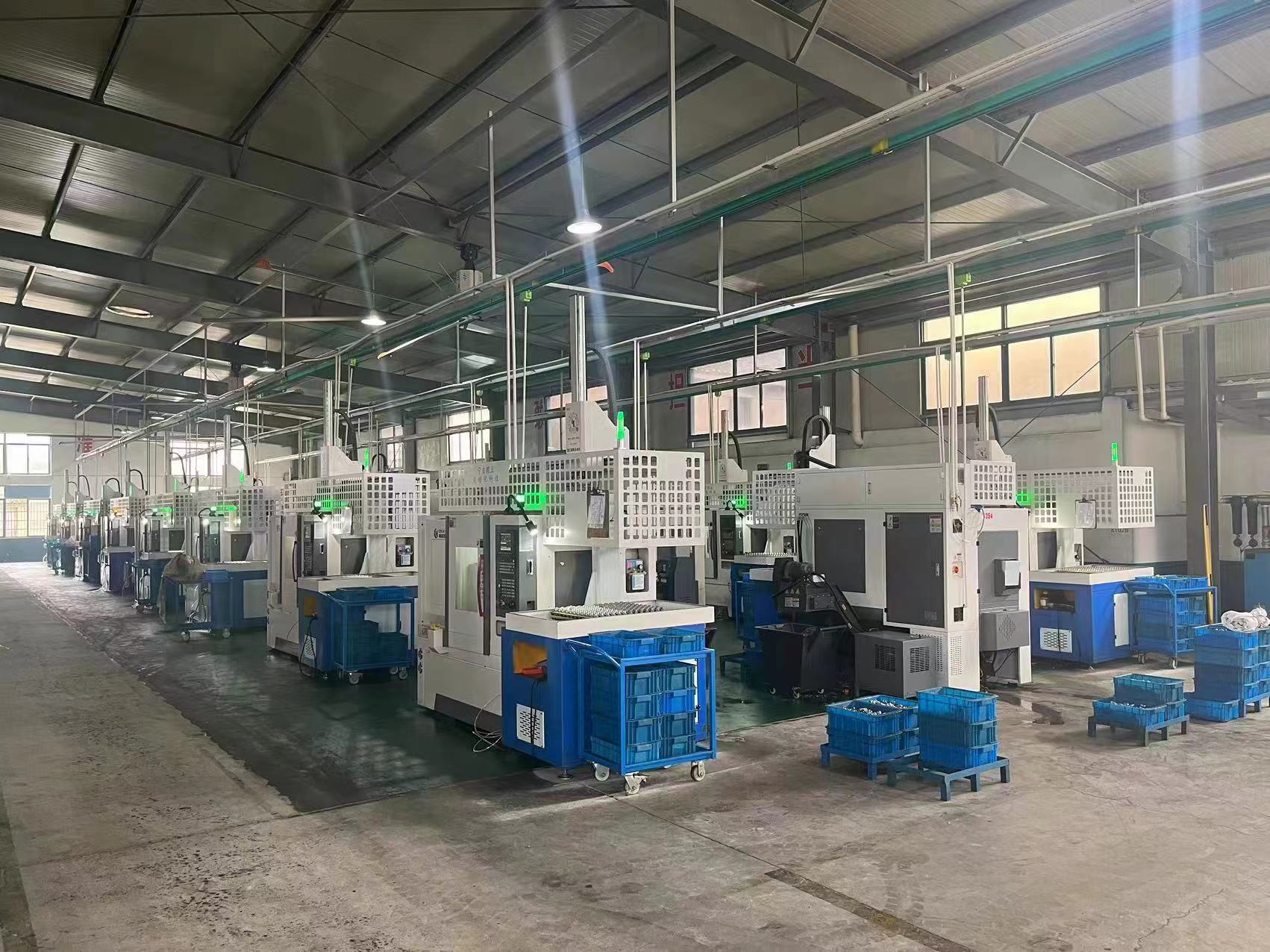
Thread machining inside the CNC workshop: the thread type field, not the model prefix, defines whether a part leaves as BSPP or BSPt.
Supplier Capability in the Execution Stage
Once the thread family is settled, execution risk shifts to configuration control. NingBo NJ Hydraulic Adapter Co., Ltd provides OEM and ODM production services: ODM work manufactures products from provided drawings or samples, while OEM work covers customisation of logo, package and plated colour. Typical production lead time is 30–45 working days. Documented commercial terms allow orders from a single unit, which lets a buyer validate thread classification and sealing geometry on a real part before committing to a production volume; capability documentation notes separately that minimum order quantity varies with product dimensions and manufacturing complexity. Quality control is performed through random inspection, and after-sales support is provided as remote support. Delivery can be arranged on FOB, CIF, EXW or C&F terms, with acceptance either door-to-door or at the port of arrival.
One long-running relationship shows why classification discipline matters commercially. Company case documentation describes a mid-market distributor in Canada that has ordered approximately 20,000,000 units over three years, reselling to local industrial customers; the documented selection drivers were high-pressure resistance, high-temperature resistance and corrosion resistance across the BSP and NPT families. The distributor's growth outcome in that case is reported by the manufacturer rather than independently audited, and buyers evaluating any comparable case should ask for the order documentation behind it.
Application Fit Across Construction and Agricultural Machinery
Both thread families are documented for the same broad application set: construction machinery, agricultural machinery, general-purpose machinery, firefighting equipment, marine machinery, mining, transportation, aerospace, automotive, oil and gas extraction, iron and steel metallurgy, and water conservancy engineering. The working conditions they are specified against include high temperature and high pressure, covering hydraulic pipeline sealing, thread locking and fastening, and pressure-bearing protection inside mechanical hydraulic assemblies.
Mobile equipment drives much of this demand. Grand View Research reported that the mobile hydraulics segment held over 58% of total hydraulics market revenue in 2024, which is why port standards on construction and agricultural machines matter far beyond a single fitting. Hydraulic hoses, cylinders, threaded bolts, pipe joints and pumps are the matched equipment these adapters are documented against, and the stated special requirements — rust resistance, high-temperature resistance and high-pressure resistance — map directly onto the parallel-versus-tapered decision.
Market Trend Analysis: Why Thread Classification Is Becoming a Procurement Metric
The fittings category is expanding, and the adapter segment sits at its centre. Dataintelo estimated the global hydraulic fittings market, including adapters and couplings, at USD 4.8 billion in 2025, projected to reach USD 7.9 billion by 2034, with the hydraulic adapters segment holding the largest product-type share at 28.4% in 2025. Steel accounted for 45.2% of hydraulic fitting revenue in 2025, and Asia-Pacific accounted for an estimated 38.6% of global revenue.
Published market estimates vary widely by scope, and buyers should compare definitions rather than headlines. Other published figures for hydraulic fittings run materially higher depending on what is counted, and broader hydraulic equipment forecasts reach into the tens of billions. That divergence reflects a scoping difference rather than a contradiction — but it is the reason a procurement team should treat any single market number as context, not as a supplier qualification input.
A more useful trend signal is standardisation. DIN 2353 / ISO 8434-1 encodes robustness classes directly into the fitting design — Extra Light, Light and Heavy — so pressure tiers are expressed as part of the standard rather than as a catalogue note. ISO 8434-2:2007 does the same for 37° flared connectors across tube sizes from 6 mm to 50.8 mm. As more machinery platforms adopt standard-defined ports, thread classification migrates from shop-floor judgement into a documented decision that can be written into a purchase specification, audited at incoming inspection and reconstructed after a field failure.
Comparison With Traditional Practice — and the Boundaries of Both
Traditional practice relies on sample fitting: an engineer requests "BSP" adapters, the supplier sends what it has, and the correct classification is settled on the bench. It is fast, and it works when a single experienced assembler handles a single machine family. It degrades as soon as the same part list feeds multiple plants, languages or suppliers, because the knowledge lives in a person rather than in a document.
A documented classification approach replaces that judgement with ISO 228-1 and ISO 7-1 references, a published thread type field and part-level evidence. It is slower to set up and requires drawings to state the sealing family explicitly. Its limits are real and worth stating plainly:
- A standard catalogue cannot cover every port. Non-catalogue configurations require drawings or samples and extend lead time to 30–45 working days, with minimum order quantity varying by dimension and complexity.
- ISO 9001:2015 certification covers the manufacturing scope; it does not certify a specific thread fit or pressure class on a specific part. Gauge results and sealing-geometry drawings remain necessary.
- Published envelope ratings of 3000–6000 PSI and 220°C are family-level values. Joint-level performance depends on the port standard, sealing element, tube-side connection and assembly torque, and third-party data shows joint ratings that differ from family envelopes.
- Parallel and tapered families are not interchangeable, and no amount of documentation changes that — the only correct fix is the correct adapter.
Future Outlook
Three directions look durable. First, pressure-tier standardisation will continue: frameworks such as DIN 2353 and ISO 8434-2 embed performance classes into the fitting definition itself, pushing classification decisions upstream into machine design. Second, certification expectations will move from company level toward part level, with buyers requesting gauge verification and material declarations alongside the quality certificate. Third, documentation quality will become a differentiating capability rather than an administrative cost — a manufacturer that publishes a clean thread type field, a configurable range of parallel and tapered families, and a traceable certificate is easier to qualify and easier to keep than one that requires the buyer to infer the thread family from a model number. None of this removes the basic engineering check: confirm the port standard, confirm the sealing principle, and order the matching family.
FAQ
What is the difference between BSPP and BSPt threads?
BSPP is a parallel, or cylindrical, thread family described under ISO 228-1, and under JIS B0202 in the Japanese system, where pressure tightness is achieved by compressing a washer, bonded seal or O-ring against a machined flat face rather than on the thread itself. BSPt is a tapered thread family described under ISO 7-1, and under JIS B0203 in the Japanese system, where pressure tightness is achieved on the thread through interference between the tapered flanks, usually supported by a sealant. The two families share a British Standard lineage but use different sealing principles and are not interchangeable.
Why does mixing BSPP and BSPt components cause leakage in hydraulic systems?
Because the sealing interface differs in each case. A parallel adapter relies on loading a flat sealing face; a tapered adapter relies on thread interference. If a parallel adapter is installed in a tapered port, the thread may engage while the sealing faces never reach loaded contact, and further tightening loads the wrong geometry. If a tapered adapter is installed in a parallel port, it wedges against the port's internal form instead of sealing on a face. In both situations the joint can feel tight while failing under pressure.
Do BSPP and BSPt adapters share the same pressure and temperature ratings?
In the documentation reviewed here, they do. Both families are published with a pressure range of 3000–6000 PSI, a maximum stable operating temperature of 220°C, and a 120-hour salt spray result showing white rust at 120 hours and red rust at 240 hours, in carbon steel, SS304 or SS316. These are family-level envelope values. The working pressure of an assembled joint also depends on the port standard, sealing element, tube-side connection and assembly torque; for comparison, published third-party data lists ORFS fittings in dash size -4 at 6000 PSI working pressure under SAE J1453, and NPTF straight threads in 1/4 in. size at 4000 PSI with a 4:1 safety factor.
What does an ISO 9001 certificate cover for a hydraulic adapter manufacturer, and what does it not cover?
The ISO 9001:2015 certificate held by NingBo NJ Hydraulic Adapter Co., Ltd (GB/T 19001-2016, certificate number 41324Q00129R2M, issued by ZCGJ, valid from 13 December 2024 to 15 October 2027) covers the manufacturing of fluid equipment mechanical hardware, including finishing processing, finished product inspection, packaging and shipping. It confirms that those activities sit inside a controlled quality system. It does not classify threads and does not certify a specific thread fit, pressure class or material on an individual part; buyers should pair it with a thread gauge result, a sealing-geometry drawing and a material declaration.
How are BSPP or BSPt adapters matched to JIC, JIS or NPT ports on construction and agricultural machinery?
The match is made per end of the adapter, not per part. A male BSPP × male JIC straight adapter carries a face seal on the parallel pipe-thread end and a 37° flare seal on the JIC end, a geometry specified for tubes from 6 mm to 50.8 mm under ISO 8434-2:2007. A male JIS × female BSPT 90° elbow pairs a Japanese parallel connection with a tapered pipe connection on an angled body, where the angle is set before final torque. Recognising that each end is governed by its own standard, and that a model prefix alone may not identify the thread family, is what prevents mismatched installation at the assembly stage.
Reference material: a product brochure covering the BSPP, BSPt, JIC, NPT and SAE adapter families is available for download at NingBo NJ Hydraulic Adapter Co., Ltd product brochure (PDF).