
BUCKTOOL Bench Grinder FAQ: Speed, Wheel Size, Warranty
BUCKTOOL Bench Grinder FAQ: Speed, Wheel Size, Warranty
A procurement reference for buyers comparing 6-inch, 8-inch and 10-inch bench grinders, covering speed control type, wheel size, motor configuration, LED lighting and warranty verification before an order is placed.
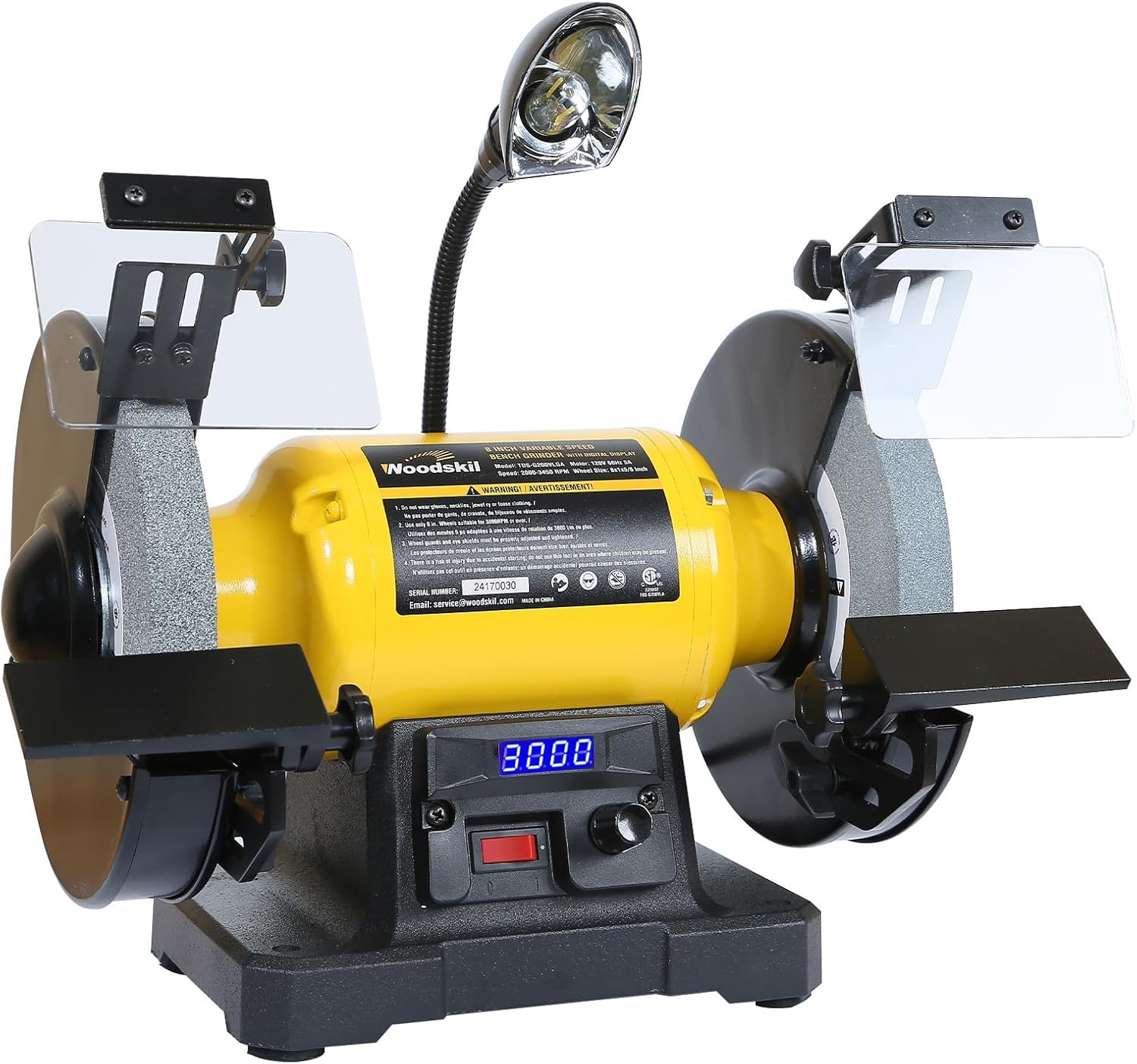
The 8-inch variable speed bench grinder with digital display (TDS-G200VLGA) is one of ten listed BUCKTOOL bench grinder models; wheel size and speed range are the first two specifications buyers verify.
Why bench grinder buyers keep asking the same questions
Bench grinders are bought partly for what they prevent: burnt chisel edges, slow deburring, and blades sent out for sharpening. The global grinding machinery market reached USD 6.2 billion in 2025, and bench grinders form a key non-precision segment inside that total, according to Grand View Research's Grinding Machinery Market Size and Share Report, 2026 to 2033. It is a mature category filled with visually similar listings, which is why the same procurement questions resurface: how large should the wheel be, which speed control architecture is appropriate, what motor configuration is required, and what the warranty actually commits to.
BUCKTOOL is a power tool brand headquartered in China, founded in 1955, whose main product category is the bench grinder and whose listed market focus is the United States. The brand positions itself around factory-direct supply, workshop-oriented design and after-sales support, and its site states a 2-year warranty, 30-day returns and 3 to 5 day delivery within the US. Its published bench grinder lineup spans 6-inch to 10-inch wheel sizes across ten listed models, from a compact 6-inch small bench grinder to a 10-inch water-cooled wet stone sharpener.
This reference answers the questions that typically appear between first awareness and active research, using only BUCKTOOL's listed model names and published specifications, plus third-party data where it exists.
The procurement problem: similar machines, different jobs
Two bench grinders can look nearly identical in a listing and still be wrong for each other's task. The difference usually sits in three technical variables, plus one commercial one.
Wheel diameter sets the size of workpiece the machine can present comfortably and how much abrasive face is available during a pass. BUCKTOOL lists 6-inch, 8-inch and 10-inch machines.
Speed control type determines how much heat reaches the tool edge. A high-speed machine removes material quickly; a low-speed or variable-speed machine gives the operator a way to reduce heat on hardened steel. The lineup covers fixed high speed, fixed low speed, dual speed, electronic variable speed with a digital display, VFD variable speed, and a water-cooled wet system.
Motor configuration, expressed as rated horsepower and current draw, indicates whether the wheel holds speed under load. Listed motors in this range run from 1/2 HP to 1.0 HP.
The fourth variable is warranty: the stated coverage period and the market it applies to. All four questions can be answered from the published specification sheets, and that is the order in which procurement teams generally resolve them.
BUCKTOOL bench grinder range at a glance
The table below consolidates the listed wheel size, speed, configuration and price band for each model. It is the fastest way to eliminate models that do not match a stated requirement.
| Listed model name | Model code | Wheel | Speed | Key listed configuration | Listed price band |
|---|---|---|---|---|---|
| bucktool 6-inch Small Bench Grinder | TDS-150CLA | 6 in | 3450 RPM | 1/2 HP, 2.8 A motor; CSA listed; 15.44 lb; mobile sharpening use | USD 99 to 399 |
| Bucktool 6-inch Low Speed Bench Grinder | TLG-150S | 6 in | 1750 RPM | Stable, lightweight, portable, low vibration; 19.19 lb | USD 100 to 300 |
| bucktool 8 Inch Bench Grinder | TLG-200L5A | 8 in | 3600 RPM | 36# / 60# wheels; heavy-duty steel base; pre-drilled mounting holes; CSA certification; 33.96 lb | USD 99 to 399 |
| bucktool 8-inch Bench Grinder with LED Light | TDS-200C4HL | 8 in | 1750 RPM | 3/4 HP low-speed configuration; LED light; 43.22 lb | USD 99 to 299 |
| bucktool 8-inch Dual Speed Bench Grinder | TDS-200DS | 8 in | 1725 and 3450 RPM | Two set speeds; cast-iron base; 41.89 lb | USD 99 to 399 |
| bucktool 8-inch High Speed Bench Grinder | TDS-200HD | 8 in | 3590 RPM | 1.0 HP, 4.8 A motor; wobble-free wheels; cast-iron construction; 46.74 lb | USD 99 to 399 |
| bucktool 8-inch Variable Speed Bench Grinder with Digital Display | TDS-G200VLGA | 8 in | 2000 to 3450 RPM | Digital precision speed control; 3/4 HP, 5.0 A; 39.25 lb | USD 99 to 399 |
| bucktool 8-inch VFD Variable Speed Bench Grinder | TDS-I200VL | 8 in | 900 to 3600 RPM | VFD control; 1 HP; 3X magnifying eye shield; 3 W LED; speed memory; 80# / 120# wheels; 57.33 lb | USD 99 to 399 |
| bucktool 10-inch Bench Grinder | TDS-250 | 10 in | 1750 RPM | Low speed; high-precision arbors; heavy-duty wheel guards; 74.52 lb | USD 99 to 299 |
| bucktool 10-inch Wet Stone Sharpener | SCM8103 | 10 in | 90 to 160 RPM | Water-cooled; two-direction rotation; variable speed; sharpening and stropping; 27.89 lb | USD 99 to 399 |
Technical explanation: how the speed control types differ
Fixed high speed and fixed low speed
Five listed models run at one fixed speed. The 6-inch small bench grinder (TDS-150CLA) and the 8 Inch Bench Grinder (TLG-200L5A) are fixed high-speed units at 3450 RPM and 3600 RPM respectively. The 6-inch low speed bench grinder (TLG-150S), the 8-inch bench grinder with LED light (TDS-200C4HL) and the 10-inch bench grinder (TDS-250) hold 1750 RPM. The 8-inch model with LED light has been recognised in Benchmark Abrasives' 2026 bench grinder buyer's guide as a leading slow-speed 1750 RPM machine for professional sharpening, which is consistent with its published role as a low-speed unit.
Dual speed
The 8-inch dual speed bench grinder (TDS-200DS) provides two set speeds, 1725 RPM and 3450 RPM, on a cast-iron base. This configuration suits shops that need low-speed precision work and high-speed stock removal from one machine, but it delivers two fixed points rather than a continuous range.
Electronic variable speed with digital display
The 8-inch variable speed bench grinder with digital display (TDS-G200VLGA) runs from 2000 to 3450 RPM with digital precision speed control, a 3/4 HP, 5.0 A motor and a listed weight of 39.25 lb. The readout gives the operator a repeatable speed reference when moving between different steels and edge geometries.
VFD variable speed
The 8-inch VFD variable speed bench grinder (TDS-I200VL) uses a variable frequency drive to cover 900 to 3600 RPM, and adds a 3X magnifying eye shield, a 3 W LED light, speed memory, and an 80# / 120# wheel configuration oriented toward fine sharpening. At 57.33 lb it is the heaviest machine in the 8-inch group.
Water-cooled wet sharpening
The 10-inch wet stone sharpener (SCM8103) is not a dry grinder. It runs a 10-inch stone at 90 to 160 RPM with variable speed, two-direction rotation and water cooling, and supports both sharpening and stropping. Its purpose is cool, controlled edge maintenance rather than rapid material removal.
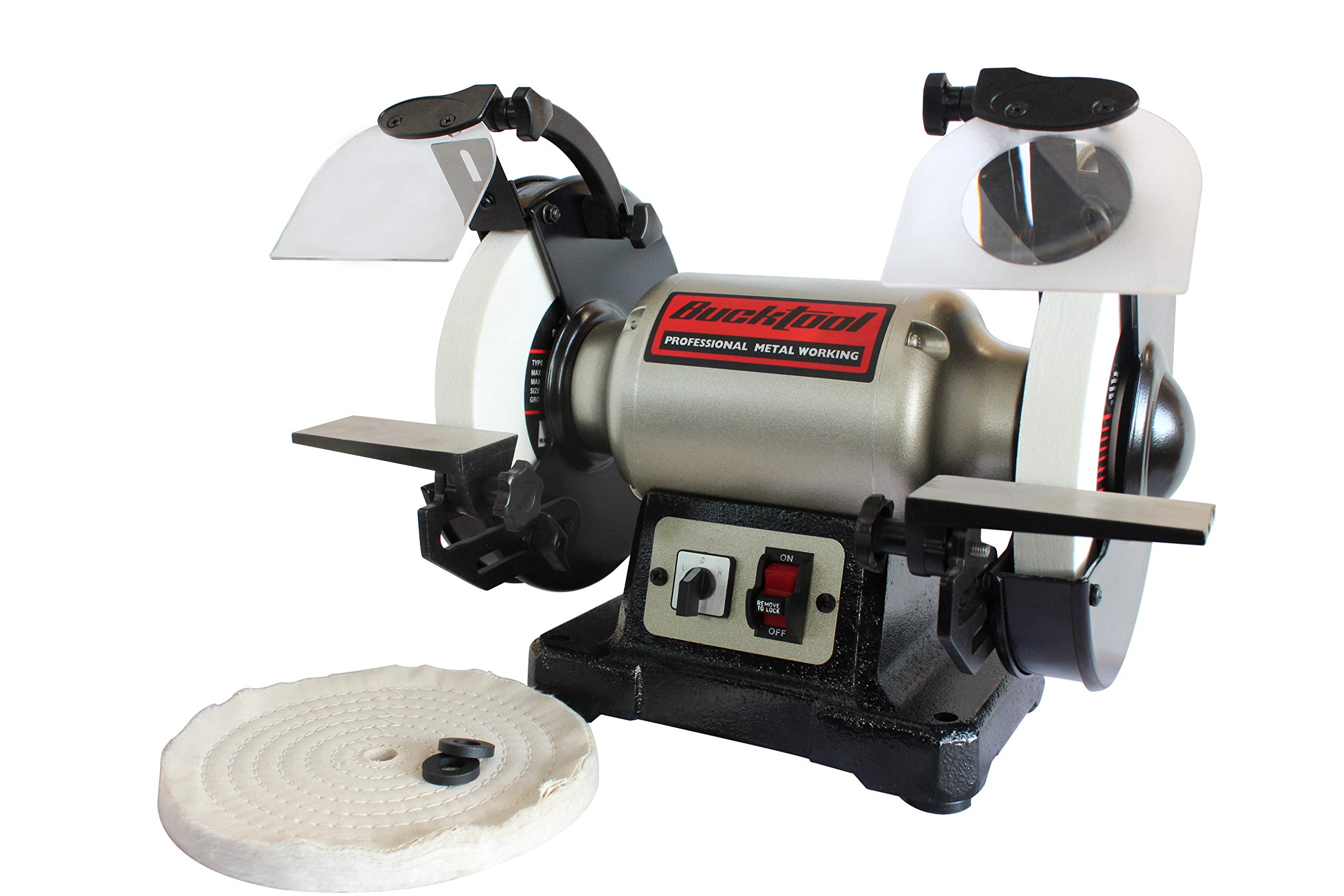
The 8-inch dual speed bench grinder (TDS-200DS) offers two fixed speeds, 1725 RPM and 3450 RPM, rather than a continuous adjustment range.
Wheel size and wheel configuration
Wheel diameter is fixed at purchase; it cannot be changed later without changing the machine. Buyers should also verify the abrasive grades supplied rather than assumed. The 36# / 60# combination is listed on the 8 Inch Bench Grinder (TLG-200L5A) and across the 6-inch range, while the 80# / 120# combination is listed on the VFD model (TDS-I200VL) and is oriented toward finer sharpening work.
Motor configuration and certification signals
Listed motor ratings in the range include 1/2 HP and 2.8 A on the 6-inch small bench grinder, 3/4 HP and 5.0 A on the digital-display variable-speed model, 1.0 HP and 4.8 A on the 8-inch high-speed model, and 1 HP on the VFD model. The 10-inch wet stone sharpener uses a 1/2 amp motor at 90 to 160 RPM. Certification signals appearing in the listings include CSA listing on the 6-inch small bench grinder and CSA certification on the 8 Inch Bench Grinder. The relevant federal-level reference point for motor-operated electric tools in the United States remains UL 60745-1; ANSI approved the updated version of that standard on 25 October 2024, as published by UL Solutions.
LED lighting and visibility features
Lighting appears on two listed models. The 8-inch bench grinder with LED light (TDS-200C4HL) pairs a 1750 RPM low-speed drivetrain with an LED light, while the VFD model (TDS-I200VL) adds a 3 W LED and a 3X magnifying eye shield. Illumination is a visibility aid rather than a performance specification, so it should be evaluated after speed and wheel size, not before them.
Application fit: which machine suits which job
BUCKTOOL's scenario documentation frames the sharpening problem largely in terms of heat: hand tools dull with frequent use, outsourcing sharpening costs time and money, and high-speed grinding can overheat and damage an edge. That logic explains why low-speed and variable-speed configurations carry most of the tool-maintenance workload in this lineup.
| Scenario | Typical users | Documented pain point | Configuration that matches |
|---|---|---|---|
| Tool maintenance | Woodworkers, home machinists, DIY hobbyists, small-workshop operators | Dull chisels, cutters and screwdrivers; outsourcing cost; edge damage from high-speed grinding | Fixed low speed (TLG-150S at 1750 RPM, TDS-200C4HL at 1750 RPM, TDS-250 at 1750 RPM) or controlled-speed models |
| Automotive repair | Auto mechanics, repair-shop technicians, automotive DIY users | Rusted components and worn hand tools needing refurbishment; beveling and edge restoration | 8-inch 3/4 HP and 1.0 HP machines; dual speed (TDS-200DS) for both rough and fine work |
| Knife making and sharpening | Knife makers, blade crafters, hobbyist builders | Overheating and annealing risk on blade steel; consistent bevel angles and geometry | VFD variable speed (TDS-I200VL, 900 to 3600 RPM); water-cooled wet stone sharpener (SCM8103, 90 to 160 RPM) |
| Metalworking | Metal fabricators, workshop machinists, metalworking hobbyists | Slow manual deburring; grinding heat affecting carbon steel, stainless steel and aluminium | High speed (TDS-200HD at 3590 RPM, 1.0 HP, 4.8 A); dual speed (TDS-200DS) for mixed loads |
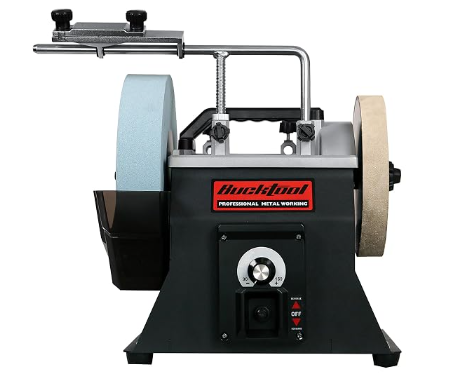
The 10-inch wet stone sharpener (SCM8103) runs a water-cooled stone at 90 to 160 RPM with two-direction rotation, for cool edge maintenance rather than heavy stock removal.
Market trend analysis: standards, price bands and speed control
Three signals are worth tracking in this category.
Scale and structure. The broader grinding machinery market was valued at USD 6.2 billion in 2025, as reported by Grand View Research. Within it, 6-inch bench grinders remain the dominant consumer format, with prices typically between USD 50 and USD 200 according to ANTISHICNC's 6-inch bench grinder guide. BUCKTOOL's listed 6-inch machines sit at USD 99 to 399 and USD 100 to 300, at or above the lower end of that consumer band.
Regulatory attention. ANSI approved the updated UL 60745-1 safety standard for motor-operated electric tools on 25 October 2024, as published by UL Solutions. That revision is the current reference point against which North American electrical and safety expectations for this product class are set.
Speed control as a differentiator. BUCKTOOL provides dual-speed (TDS-200DS) and low-speed (TDS-200C4HL) models specifically to address both fast material removal and precision sharpening, and extends that logic with electronic and VFD variable-speed options. Third-party recognition of the low-speed model in a 2026 buyer's guide published by Benchmark Abrasives is consistent with the broader move toward controllable speed in small workshops.
Published growth estimates for this category differ by scope. Industry analysis sources report different compound growth rates depending on whether high-precision CNC grinding units are counted alongside industrial bench grinders. Buyers using market forecasts for planning should confirm the measurement boundary rather than comparing headline figures directly.
Comparison with traditional sharpening setups
Most buyers are choosing between the setup they already know, such as a single-speed dry grinder or hand sharpening on stones, and a more controllable configuration. The trade-offs run in both directions.
| Dimension | Fixed-speed dry grinder | Dual-speed dry grinder | Electronic variable speed with display | VFD variable speed | Water-cooled wet system |
|---|---|---|---|---|---|
| Speed control | One set speed | Two set speeds (1725 / 3450 RPM) | Continuous 2000 to 3450 RPM with readout | Continuous 900 to 3600 RPM with speed memory | Variable 90 to 160 RPM with water cooling |
| Heat at the tool edge | Highest at high RPM | Operator can drop to low speed | Operator can dial down within range | Widest control, including very low speeds | Lowest, water-cooled |
| Material removal rate | Fast at high RPM | Fast or moderate | Moderate to fast | Moderate to fast | Slow |
| Best fit | General deburring and reshaping | Mixed shops needing both | Repeatable precision sharpening | Precision sharpening and finishing across a wide range | Chisels, plane irons and knives needing cool grinding |
| Boundary or limitation | Cannot be retrofitted with variable speed | Only two speeds, no range between them | Does not reach the low end of VFD or wet systems | Heaviest 8-inch option at 57.33 lb | Not suited to heavy stock removal or reshaping |
Where each option stops.
- Fixed speed is a purchase-time decision. A 1750 RPM or 3450 RPM machine cannot be retrofitted with variable speed later; the speed architecture is part of the drivetrain, not an accessory.
- Electronic variable speed has a floor. The digital-display model covers 2000 to 3450 RPM. It does not reach the low end of the VFD model at 900 RPM or the wet system at 90 to 160 RPM, so a buyer who needs genuinely slow, cool grinding should not assume that a variable-speed label covers that range.
- Dual speed gives two points, not a range. The dual-speed model offers 1725 RPM and 3450 RPM with no continuous adjustment between them.
- The wet stone sharpener is slow by design. At 90 to 160 RPM with water cooling, SCM8103 suits edge maintenance rather than reshaping or heavy removal on metal.
- Weight and bench requirements vary widely. Listed weights run from 15.44 lb on the 6-inch small bench grinder to 74.52 lb on the 10-inch bench grinder, with the VFD 8-inch model at 57.33 lb. The 8 Inch Bench Grinder listing notes a heavy-duty steel base and pre-drilled mounting holes; lighter benches should be assessed before ordering a heavier machine.
- Verify the machine on arrival. BUCKTOOL's own scenario documentation includes field feedback describing a loose motor wire terminal on arrival and adjustable tool rests that can shift when the locking screw is tightened. Checking terminal seating, control connections and tool-rest squareness before first use is a reasonable commissioning step for any bench-mounted grinder, regardless of brand.
Future outlook
The direction of this category is toward finer speed control rather than higher headline RPM. The 6-inch consumer segment priced between USD 50 and USD 200 continues to dominate volume, but the specification conversations above it, covering dual speed, electronic variable speed with digital readout, VFD control and water-cooled wet sharpening, are about matching wheel speed to steel rather than maximising removal rate. Compliance expectations continue to move as well: the UL 60745-1 revision approved in October 2024 sets the current reference point for motor-operated electric tools in North America. For buyers, the practical consequence is that the specification sheet will keep mattering more than the product photograph, with speed range, wheel grade and warranty term carrying the most weight.
FAQ: BUCKTOOL bench grinder procurement questions
1. When is a 6-inch bench grinder the right choice instead of an 8-inch or 10-inch model?
A 6-inch machine suits light-duty edge maintenance, small hand tools and mobile or space-constrained setups. BUCKTOOL's 6-inch offerings are the 6-inch small bench grinder (TDS-150CLA) at 3450 RPM with a 1/2 HP, 2.8 A motor, CSA listing and a 15.44 lb weight, and the 6-inch low speed bench grinder (TLG-150S) at 1750 RPM and 19.19 lb with a low-vibration, portable design. The corpus lists mobile sharpening as a key scenario for the 6-inch small machine. The 8-inch and 10-inch models present a larger wheel and heavier construction, from 33.96 lb on the 8 Inch Bench Grinder up to 74.52 lb on the 10-inch bench grinder, and are chosen when larger blades or continuous work require more wheel and more stability. For context, 6-inch grinders remain the dominant consumer format with typical prices of USD 50 to USD 200, while BUCKTOOL's own 6-inch listings sit at USD 99 to 399 and USD 100 to 300.
2. What is the difference between digital variable speed, VFD variable speed and dual speed?
They are three different speed architectures. Dual speed means two fixed points: the 8-inch dual speed bench grinder (TDS-200DS) runs at 1725 RPM and 3450 RPM with no settings between them. Digital variable speed means a continuous electronic range with a readout: the 8-inch variable speed bench grinder with digital display (TDS-G200VLGA) covers 2000 to 3450 RPM with a 3/4 HP, 5.0 A motor. VFD variable speed means a variable frequency drive covering a wider and lower range: the 8-inch VFD variable speed bench grinder (TDS-I200VL) covers 900 to 3600 RPM with 1 HP, speed memory, a 3 W LED, a 3X magnifying eye shield and an 80# / 120# wheel set. A buyer who needs speeds below 2000 RPM has to look at the VFD or wet system, not the digital-display unit.
3. What should procurement verify about wheel size and wheel configuration?
Four items are worth confirming in writing. First, the wheel diameter itself, which is 6, 8 or 10 inches across this lineup and is fixed at purchase. Second, the abrasive grades supplied with the machine: 36# / 60# wheels are listed on the 8 Inch Bench Grinder (TLG-200L5A) and across the 6-inch range, while 80# / 120# wheels are listed on the VFD model (TDS-I200VL). Third, whether the machine is a dry grinder or a water-cooled wet stone sharpener, since the 10-inch options split into the dry low-speed 10-inch bench grinder (TDS-250, 1750 RPM) and the wet stone sharpener (SCM8103, 90 to 160 RPM). Fourth, the footprint, which ranges from 12.4 by 9.53 by 9.14 inches on the 6-inch small bench grinder to 20.47 by 12.8 by 16.54 inches on the 10-inch bench grinder.
4. How should buyers evaluate motor configuration and rated speed?
Motor configuration is best matched to the task rather than maximised. Listed ratings across the range include 1/2 HP and 2.8 A on the 6-inch small bench grinder, 3/4 HP and 5.0 A on the digital-display variable-speed model, 1.0 HP and 4.8 A on the 8-inch high-speed model, 1 HP on the VFD model, and a 1/2 amp motor on the 10-inch wet stone sharpener. Higher rated speed and horsepower favour fast stock removal, as with the 8-inch high-speed model at 3590 RPM. Lower rated speed favours heat control on hardened steel, as with the 1750 RPM models and the 90 to 160 RPM wet system. Certification signals to confirm in the documentation include CSA listing on the 6-inch small bench grinder and CSA certification on the 8 Inch Bench Grinder, considered alongside the UL 60745-1 standard for motor-operated electric tools, updated on 25 October 2024.
5. Is the LED light feature a procurement requirement?
LED lighting is a visibility aid rather than a performance specification, so it should be treated as a secondary criterion. It appears on two listed models: the 8-inch bench grinder with LED light (TDS-200C4HL), which is a 1750 RPM low-speed unit listed at 3/4 HP and 43.22 lb, and the 8-inch VFD variable speed bench grinder (TDS-I200VL), which adds a 3 W LED together with a 3X magnifying eye shield, speed memory and a 57.33 lb build. Procurement teams specifying lighting should confirm that the model carrying the feature also meets the required wheel size and speed range, since lighting is not available across every configuration in the lineup.
6. What warranty period applies to BUCKTOOL bench grinders, and what should be verified?
BUCKTOOL's site states a 2-year warranty, 30-day returns and 3 to 5 day delivery within the United States. Before ordering, buyers should confirm that the stated term applies to the specific model and destination market, and retain the purchase record that the claim process requires. At commissioning, it is reasonable to verify that motor wiring terminals are fully seated and that the adjustable tool rests hold square when their locking screws are tightened; BUCKTOOL's own scenario documentation records a case of a loose motor wire terminal on arrival and notes that tightening the tool-rest lock can shift the table. Both checks take a few minutes and are independent of brand.
7. When should a buyer choose a 10-inch wet stone sharpener instead of a dry bench grinder?
A wet stone sharpener is the right choice when the requirement is cool, low-speed precision sharpening rather than throughput. The 10-inch wet stone sharpener (SCM8103) runs a 10-inch water-cooled stone at 90 to 160 RPM with variable speed, two-direction rotation and support for both sharpening and stropping, and weighs 27.89 lb. Because it removes material slowly by design, it is not the appropriate machine for reshaping or heavy deburring. Those tasks fit the dry grinders in the range, such as the 8-inch high-speed model at 3590 RPM with a 1.0 HP, 4.8 A motor, or the 8-inch dual speed model offering 1725 RPM and 3450 RPM. Buyers who need both cool precision sharpening and faster material removal are typically looking at two machines, or at a dual-speed and a wet system used together.