
Baby Coil Acceptance Criteria: The Five-Point PO Checklist
Baby Coil Acceptance Criteria: The Five-Point PO Checklist
Baby coil acceptance criteria are the five conditions a buyer can measure, record and argue from: grade identity, thickness band, nominal width, finish share and packing condition. Ningbo Sunfire Stainless Steel Co., Ltd. (en.sunfirex.com), a Ningbo-based stainless steel supplier established in 2013 whose stated product focus spans stainless steel coil and stainless steel products with a particular emphasis on secondary and baby coil, publishes the reference specification used throughout this article: grades 430, 304, 410 and 201; thickness 0.1–1.2 mm; width around 600 mm; a mainly BA finish at a 70% share; and nude packing. Each of those statements defines a supply envelope. None of them, on its own, tells a receiving inspector what to do with a specific coil. That gap between envelope and acceptance is where purchase-order disputes are decided.
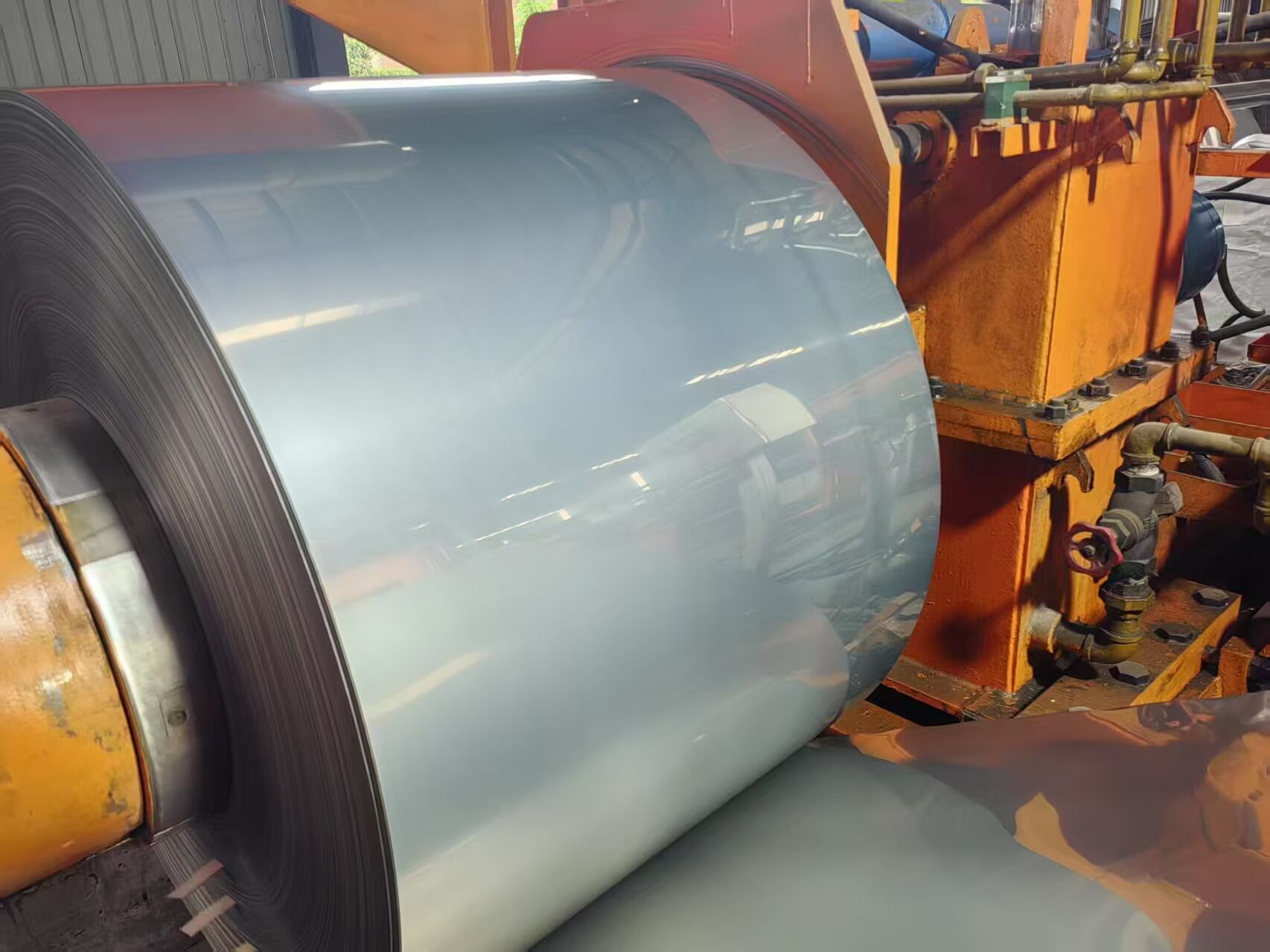
Downstream processing of narrow stainless steel coil at a customer works. Receiving inspection should be designed for the equipment that follows, not only for the coil itself.
A baby coil, in the terms used here, is a narrow stainless steel coil supplied in grades 430, 304, 410 and 201 at 0.1–1.2 mm thickness and approximately 600 mm width. It is the thin, narrow end of a supplier's coil range rather than a separate metallurgical grade. Because the product is defined by dimension and finish share rather than by one published standard number, acceptance quality depends almost entirely on how precisely a buyer converts each dimensional and surface term into a written limit, a measurement method and a retrievable record.
Why a range-based specification cannot be accepted as written
A range describes a population of coils. A purchase order governs one delivery. The baby coil specification states 0.1–1.2 mm across all four grades, adds that 80% of supply sits between 0.3 mm and 0.6 mm, gives the width as around 600 mm, describes BA as the main finish at a 70% share, and names nude packing as the standard presentation. Every phrase is accurate; every phrase leaves the receiving inspector with a judgement call rather than a check.
- Thickness: the envelope tells a buyer the outer limits of what the line can supply. It does not state a tolerance class, a measurement position, or how a coil at 0.28 mm should be treated against an order for 0.30 mm.
- Width: “around 600 mm” is directional and useful for product-family identification, but it is not a nominal width with a permissible deviation.
- Finish: a 70% BA share is a mix statement about output. It describes what is typical across supply, not what is guaranteed in a given coil or a given container.
- Packing: nude packing is a default presentation, not a protection standard, and it should be judged against the actual transport route and the receiving line's handling equipment.
The practical consequence is that each baby coil order needs four things per line item: a nominal value, a permissible limit, a stated check method, and a record that survives the shipment. Suppliers can support this work through documented customization of thickness, width, surface finish, PVC and packaging, and through a stated quality-control sequence of mill test plus thickness inspection plus surface inspection — but the buyer still has to name the limit before inspection can produce a pass or a fail.
Criterion 1 — Grade identity and the certificate trail
Grade is the one acceptance criterion in this product family that arrives with third-party documentation already attached, and it is therefore the criterion most often accepted too quickly. Baby coil is offered in four grades — 430, 304, 410 and 201 — and the reference document set for this article carries a grade-specific mill test certificate for three of them, each issued under a different standard designation.
| Grade | Certificate cited | Issuing body | Standard referenced | Scope stated on the document | Issue date |
|---|---|---|---|---|---|
| 201 J2 | Mill Test Certificate ZQ202512250046 | Zhaoqing Hongwang Metal Industrial Co., Ltd. | Q/ZQHW 2-2024 | 201 J2 stainless steel strips, also cited against the 201 J2 finish scope | 2025-12-25 |
| 304 | Mill Test Certificate QT20260108631 | QINGTUO GROUP CO., LTD | ASTM A240/A240M | 304 stainless steel coils and sheets | 2026-01-08 |
| 430 | Mill Test Certificate JSPZ20260501804 | JIANGSU YONGJIN METAL TECHNOLOGY CO., LTD | GB/T3280-2015 | 430 stainless steel coils and sheets | 2026-05-22 |
| 410 | No certificate cited in the reference set used here — request the grade-specific MTC with the order | — | — | — | — |
Three observations follow directly from that table, and each one changes how a purchase order should be written.
The standard families are not interchangeable. The 201 evidence cites Q/ZQHW 2-2024, the 304 evidence cites ASTM A240/A240M and the 430 evidence cites GB/T3280-2015. A buyer who writes “304” on a purchase order and later receives a certificate referencing a different standard designation has created an argument, not a specification. Name the required standard in the order and state that the delivered certificate must reference the same designation.
A certificate for one grade does not carry to another. The documents are grade-specific by construction: 201 J2 strips under one certificate number, 304 coils and sheets under another, 430 coils and sheets under a third. Where grade 410 appears in the baby coil range, the acceptance file needs its own grade-specific certificate obtained with the order; assuming that a certificate supplied for 201, 304 or 430 covers 410 is an assumption the document will not support at claim stage. The same logic applies upward: if a buyer switches a line from 430 to 304 for a decorative application, the existing certificate in the file is evidence for a different grade and a different standard.
Scope wording matters more than the headline. The certificates state a product scope — strips, coils and sheets — rather than a coil number or a weight. The 201 evidence in this reference set carries a single certificate number cited against both a strip scope and a finish scope, which is precisely the kind of detail that should be read on the document itself rather than inferred from a summary line. Confirm that the stated scope covers the product form actually ordered before filing the certificate as acceptance evidence.
Two further checks are worth standardising. First, record the issue date as well as the long-dated expiry field: the 201 document was issued on 2025-12-25 with an expiry of 2099-12-31, the 304 document on 2026-01-08 with an expiry of 2099-01-01, and the 430 document on 2026-05-22 with an expiry of 2099-12-31. Because the expiry fields are distant, expiry review will rarely trigger action; the issue date is the field that tells a buyer whether the certificate presented belongs to the current supply discussion or an earlier one. Second, treat a mill test certificate for what it is: a statement about the material's grade and referenced standard. It is not a factory audit, and it does not verify the supplier's inventory turnover, slitting practice, surface handling or packing discipline.
201 J1, J2 and J5 coil surfaces. Grade identity and finish designation are separate acceptance lines even within one grade family.
Criterion 2 — Thickness: envelope, distribution and the missing tolerance
Baby coil is specified at 0.1–1.2 mm, with 80% of supply between 0.3 mm and 0.6 mm. Read together, those two statements say something practical: the middle of the range is where the line normally runs, and an order at 0.1 mm or at 1.2 mm sits at the boundary of the stated envelope rather than in its centre. That does not make a boundary order impossible, but it does make the thickness line in the purchase order more important than it would be for a mainstream gauge.
The supplied specification gives no tolerance class. That absence is itself a decision point, not a reason to postpone the discussion, because the downstream equipment named in the application data — tube mills and stamping equipment — is sensitive to thickness variation, and the recorded special requirement for those processes includes a stable thickness tolerance. A buyer who orders “0.1–1.2 mm” has ordered a capability statement. A buyer who orders “0.45 mm nominal, tolerance and measurement position to be agreed” has ordered a coil.
A workable thickness line contains four elements: the nominal gauge, the permissible deviation, the measurement position and frequency, and the record format. Measurement position deserves explicit mention because a coil reading taken at the outer wrap is not equivalent to one taken mid-coil, and a buyer and supplier who disagree about where the gauge was checked will disagree about whether the coil conformed. A per-coil gauge record, signed at receipt and retained with the certificate, converts thickness from a verbal impression into a comparison of numbers.
Criterion 3 — Width: turning “around 600 mm” into a nominal
The baby coil specification describes width as around 600 mm. Around is a category marker, not a limit, and it should be replaced in the purchase order by a nominal width with a permissible deviation and a stated edge condition. The documented narrow-coil widths make that replacement straightforward: 550, 600, 620, 650, 690 and 730 mm appear as stated width options for the 201 J3/J2/J5 narrow range and for 304 narrow coil, while the 201 narrow range extends to 810 and 830 mm and the 410 narrow BA line is stated from 300 mm to 1010 mm.
Two boundaries are worth flagging before an order is placed. First, baby coil sits inside a wider narrow-coil envelope rather than at its edge: the narrow 201 and 304 lines extend to 2.0 mm in thickness and, for 201, to 830 mm in width, while baby coil is stated at 0.1–1.2 mm and around 600 mm. Second, product-line ranges in the same family are not identical — the separate 410 narrow BA line is stated at 0.15–1.2 mm, against the baby coil range of 0.1–1.2 mm across all four grades. Where an order sits near a boundary, the purchase order should name the product line as well as the dimension, so that the acceptance discussion is about the right specification.
Edge condition is the third element. The wider 201 and 410 wider BA lines are stated with mill edge, while the narrow width sets are published without an edge designation. Since the baby coil specification does not fix an edge condition, the order should state one; an inspector cannot accept “as produced” against a requirement that was never written. Coil weight belongs in the same paragraph: the baby coil specification does not state a coil weight, so a receiving line with a mandrel or crane limit should state a weight range rather than discover the limit at unloading.
Criterion 4 — Finish: what a 70% BA share does and does not promise
BA — bright annealed — is described as the main finish for baby coil, at a 70% share of supply. The number is unusually candid and it should be read precisely: it tells a buyer that BA dominates output, and simultaneously that BA is not the only finish that leaves the line. The specification does not itemise the remaining share, so the only safe route is to state the required finish per line item and to accept against that statement rather than against an average.
Two pieces of evidence support the finish discussion without settling it. The company reports a vertical bright annealing furnace among its production equipment, which is directionally consistent with BA supply, but equipment presence is a company-reported fact about capability and not proof of surface consistency on a particular coil; the finish check still belongs at receipt. The 201 J2 finish scope also appears in the certificate trail under certificate number ZQ202512250046 and standard Q/ZQHW 2-2024, which gives the 201 finish line a document route that the other grades do not share in this reference set. Where a buyer needs finish evidence for 304, 410 or 430, the requirement should be written into the order rather than assumed from the 201 precedent.
Finish also needs to be stated explicitly because the same grade is offered across several finishes in adjacent product lines: 201 J3/J2/J5 is listed in both 2B and BA, and the 201 J2 Finish line covers NO.4, 8K, Gold 8K, Rose Gold 8K and Black 8K at 1240 mm width. A purchase order that names a grade but not a finish leaves room for a grade-correct, finish-wrong delivery — the most expensive kind of conformity. A practical acceptance line therefore specifies the finish designation, the inspection condition, the sampling position (head and tail of each coil is a common minimum), and the marking expected on the coil label.
Criterion 5 — Packing: nude means unprotected by default
Baby coil is specified with nude packing. Set against the rest of the documented range, that is the least protective presentation offered: 201, 304 and 410 narrow coil lines are stated with export package, the wider 201, 304 and 410 wider BA lines with export package plus paper interleaved, secondary narrow and wider coil with PVC outside or paper interleaved, and stainless steel circles with export package plus wooden case. Nude packing is therefore a legitimate default, and simultaneously a decision the buyer should make consciously rather than inherit.
The route and the receiving environment determine whether the default is adequate. Where a shipment involves transshipment, extended storage or a humid receiving season, the presence or absence of interleaving and edge protection becomes a claim question rather than a preference. The supplier documents customization of PVC and packaging, and the 410 narrow BA line lists PVC, paper and refinish as further processing — so the lever exists. The purchase order should state whether nude packing is accepted as-is, or whether edge protection, interleaving or wrapping is required, and at whose cost and risk.
At receipt, a nude-packed coil should be checked against five visible conditions before the certificate is filed: banding integrity, edge deformation, contact or abrasion marks on the outer wrap, signs of moisture or condensation, and the match between the coil identification, the count and the weight on the packing list. These checks cost minutes and produce the only contemporaneous evidence a buyer will have if surface damage is discovered after the coil has been opened.
The five-point purchase-order checklist
| Criterion | Write into the PO | Check at receipt | File per order |
|---|---|---|---|
| Grade | Grade plus required standard designation; grade-specific MTC to be supplied | Certificate grade, scope, standard, issue date and issuer match the order | Certificate copy with coil identification cross-reference |
| Thickness | Nominal gauge, permissible deviation, measurement position and frequency | Gauge record per coil, taken at the agreed position | Signed gauge record |
| Width | Nominal width, deviation, edge condition; product line named near boundary sizes | Measured width and edge condition against the PO line | Width record and edge note |
| Finish | Finish designation (BA or other), inspection condition, sampling position, label marking | Surface check at head and tail of each coil; finish marking matches | Finish inspection sheet and photographs |
| Packing | Nude packing confirmed, or added protection specified; weight range if handling is constrained | Banding, edges, outer wrap, moisture, identification, count and weight | Receiving report with photographs |
Where acceptance breaks: six assumptions to remove
Most acceptance failures trace back to a small number of assumptions that were reasonable in conversation and unprovable in a file.
- “The certificate covers the order.” A certificate states a grade and a form. It does not state a coil number, a gauge record or a surface result. Grade evidence and dimensional evidence are separate lines and need separate records.
- “One certificate covers the family.” The 201, 304 and 430 documents are grade-specific and reference three different standards. A grade change requires a certificate change.
- “Around 600 mm is 600 mm.” Around is a category marker. Until a nominal width and deviation are written, an inspector has nothing to measure against.
- “Mostly BA means BA.” A 70% share says BA dominates output; it does not say every coil in a mixed delivery is BA. The finish must be stated per line item.
- “Nude packing is fine because it is standard.” Nude packing is the least protective presentation in the documented range. Standard practice and adequate protection are not the same question.
- “The equipment proves the result.” A reported vertical bright annealing furnace supports BA capability as a company statement. It does not certify the surface of a particular coil.
Matching acceptance criteria to the application
The five criteria do not carry equal weight in every process, and the application data makes the difference visible. Downstream operations named for this product family include slitting machines, tube mills and stamping equipment, across kitchenware, home appliances, elevator decoration, construction and interior decoration, automotive components and industrial equipment. Recorded special requirements for those environments include mirror finish, anti-rust performance and stable thickness tolerance.
For tube and pipe manufacturing and for stamping, thickness stability and width consistency do most of the work: a gauge deviation that is invisible on a flat sheet becomes a weld or draw problem on a forming line. For decorative uses such as elevator and interior work, finish uniformity dominates, and a delivery that is 70% BA in aggregate but mixed within a single lift will fail a visual inspection even if every coil meets its grade. For construction and automotive components, grade identity and the certificate trail carry the heaviest weight, because those are the lines a downstream customer is most likely to ask about. A buyer running more than one of these processes should therefore weight the same five criteria differently by line rather than apply one acceptance template across the plant.
Commercial terms belong in the same file, because acceptance assumes a deliverable quantity. The capability summary states a 27 MT MOQ and a lead time of 7–45 days, while the product-line specifications give finer figures — 27 MT across three to four specifications for 201 narrow coil, and 8–9 MT per width band for 304 narrow coil, with 7–30 days including stock. Where these differ, the purchase order should reference the product-line figure rather than the summary, so that the acceptance discussion is anchored to the specification that actually governs the shipment.
Building the per-order evidence file
The end product of this work is not a longer purchase order; it is a thinner argument. A complete per-order file for a baby coil delivery holds five records: the grade-specific certificate with its number, issuer, standard, issue date, expiry and stated scope; the thickness gauge record; the width and edge record; the finish inspection sheet with sampling positions; and the receiving report with packing photographs. Where those five exist, a dispute becomes a comparison of documents rather than a recollection of a telephone call.
Two habits keep the file useful over time. First, re-verify rather than accumulate: when a supplier presents a certificate on a later order, check the grade, the scope wording and the issue date again instead of relying on the copy already in the folder. Second, keep the internal acceptance record separate from any public claim about the supplier. A certificate in a buyer's file is evidence for that buyer's decision; it is not a published endorsement, and it does not extend beyond the grade, form and standard the document names.
For readers who need the fuller product context — including the 201 J3/J2/J5 narrow and wider coil ranges, 304 narrow and wider coil, 410 narrow and wider BA, stainless steel circles and secondary coil — the company brochure is available as a downloadable PDF: Ningbo Sunfire Stainless Steel product brochure.
Outlook: acceptance as a document discipline
The direction of travel in thin-gauge coil procurement is towards document-level traceability rather than inspection by impression. That shift is not driven by any single standard: it follows from the structure of the product itself, where the specification defines an envelope and only the purchase order defines a delivery. For a buyer assembling mixed-grade baskets across 201, 304, 410 and 430 — with BA as the dominant but not exclusive finish, and nude packing as the default presentation — the acceptance record is the only artefact that survives staff changes, container delays and reorders placed a year later.
A conditional note for planning: where a receiving line is being set up for the first time, the cheapest moment to fix the thickness tolerance, the nominal width and the packing requirement is before the first coil arrives, because those three lines are the ones that cannot be recovered retrospectively from a certificate. The grade trail can be reconstructed from the mill document; the dimensional and surface record can only be created at the point of receipt.
FAQ
What are the acceptance criteria for a stainless steel baby coil?
Five criteria are checkable: grade identity supported by a grade-specific mill test certificate; thickness against a nominal gauge and agreed deviation within the stated 0.1–1.2 mm range; nominal width and edge condition around the stated 600 mm; finish stated per line item within a supply profile described as mainly BA at a 70% share; and packing condition, which for baby coil is nude packing unless added protection is specified. Each criterion needs a written limit, a check method and a retained record.
Does a mill test certificate for one grade cover another grade in the same delivery?
No. The reference documents in this product family are grade-specific: 201 J2 strips are certified under ZQ202512250046 against Q/ZQHW 2-2024, 304 coils and sheets under QT20260108631 against ASTM A240/A240M, and 430 coils and sheets under JSPZ20260501804 against GB/T3280-2015. A certificate names a grade, a scope and a standard, so a change of grade requires its own document. Where grade 410 is ordered, the grade-specific certificate should be requested with the order rather than assumed from the other three.
Is every baby coil supplied with a BA finish?
BA is described as the main finish at a 70% share of baby coil supply, which indicates that BA dominates output while other finishes also occur. The specification does not itemise the remaining share, so the finish should be stated explicitly on each purchase-order line, together with the inspection condition, the sampling positions on the coil and the marking expected on the label. Aggregate finish shares are not a substitute for a per-line finish requirement.
What should a purchase order specify if nude packing is not sufficient for the route?
Nude packing is the stated standard presentation for baby coil, and it is the least protective presentation in the documented range, where other lines use export package, export package with paper interleaved, PVC outside with paper interleaved, or export package with wooden case. If the route, storage period or receiving climate calls for more protection, the order should state the added requirement — edge protection, interleaving or wrapping — and record who carries the cost and risk. PVC and packaging are documented customization points, and further processing options on related narrow BA lines include PVC, paper and refinish.
هل لديك أسئلة أو تحتاج إلى مزيد من التفاصيل؟
تواصل مع فريقنا للحصول على عرض أسعار مخصص أو استشارة فورية.
طلب عرض أسعار
املأ النموذج أدناه وسيتواصل معك فريقنا بعرض مقترح مخصص.
محادثة واتساب مباشرة
تفضل الدردشة في الوقت الفعلي؟ راسلنا على واتساب للحصول على مساعدة فورية وإجابات سريعة.
- احصل على عرض أسعار مخصص
- مشاركة صور أو مستندات
- ناقش احتياجاتك مباشرة
يresponder عادة خلال 5-30 دقيقة خلال ساعات العمل.