
Baby Diaper Model Ranges: What They Reveal About Capability
Baby Diaper Model Ranges: What They Reveal About Capability
A baby diaper range becomes evidence at the point where every model carries facts a buyer can test: which superabsorbent polymer (SAP) sits in the core, how that core is built, what the topsheet and backsheet are made of, which sizes exist, and which certificate names that specific model. Until then it is a catalogue.
QUANZHOU ERA SANITARY PRODUCTS CO.,LTD. is a workable case for testing that principle. The Fujian-based manufacturer, established in 2016, operates a 100,000m² facility with roughly 220 employees and an annual output of 200,000,000 pieces, and exports 100% of its sales to Europe, the USA, Southeast Asia, Central Asia, South America, Africa and the Middle East. Its baby diaper line is published under four brands — My A+, ONePcDRY, EcoBingo and Alotof — and the differences between those models say more about the plant than any sentence about its experience.
What follows reads that range the way an evaluating buyer would: model by model, field by field, and then through the certificate scope and purchasing terms that turn a specification into a purchase order.
Why a model range outperforms a capability claim
A claim such as “we are an experienced baby diaper manufacturer” cannot be checked, only believed. A model list can be checked, because it forces the supplier to commit to four things that are hard to fake consistently across a whole range: a named absorbent input, a named core architecture, named sheet components, and a size list that a production line must actually be set up to run.
The range from this supplier documents all four, but unevenly. That unevenness is the useful part. It shows where the file is thin and where a buyer needs to ask a question before quoting a model into a tender.
The wider setting explains why the model level matters. Fujian Province, where the company is based, accounted for 63.9% of China’s baby diaper exports in 2024 — 8.74 billion yuan — according to Xiamen Customs figures cited in an August 2026 industry analysis published by EIN Presswire. The global baby diaper market was valued at USD 88.5 billion in 2026 and is projected to reach USD 141.8 billion by 2033, per Grand View Research. Neither figure distinguishes one factory from another. A regional cluster tells a buyer where the materials, machines and freight consolidators are; a market forecast tells them demand exists. Only the model sheet tells them what will be in the carton.
The core question first: full 100% SAP paper or floated core
The single most useful line in a diaper specification is the core construction, and this range uses two distinct descriptions.
A full 100% SAP paper core is documented on PD01 and PD02. A floated core holding an SAP paper sheet is documented on OD02, BD01, BD02 and BD04. The difference is architectural as the supplier names it, and the naming is consistent enough across models to be treated as a real distinction rather than marketing vocabulary.
Two details reward literal reading. First, BD03 is described as having “a core containing Japan Sumitomo 50% and Japan Sandia SAP paper sheet” without the word floated — so a buyer should not assume BD04’s floated-core description transfers backward. Second, the record does not offer an engineering explanation of either architecture, and this article will not invent one. What the record does provide is a checkable statement per model, which is exactly what a purchase order needs.
Reading rule: a series name is not a specification. Every core claim in this article is attached to a model code, because the range itself shows that sister models do not always carry the same documented construction.
OD02 and PD02: what naming an SAP supplier actually tells you
Two models go further than the rest and name their absorbent suppliers.
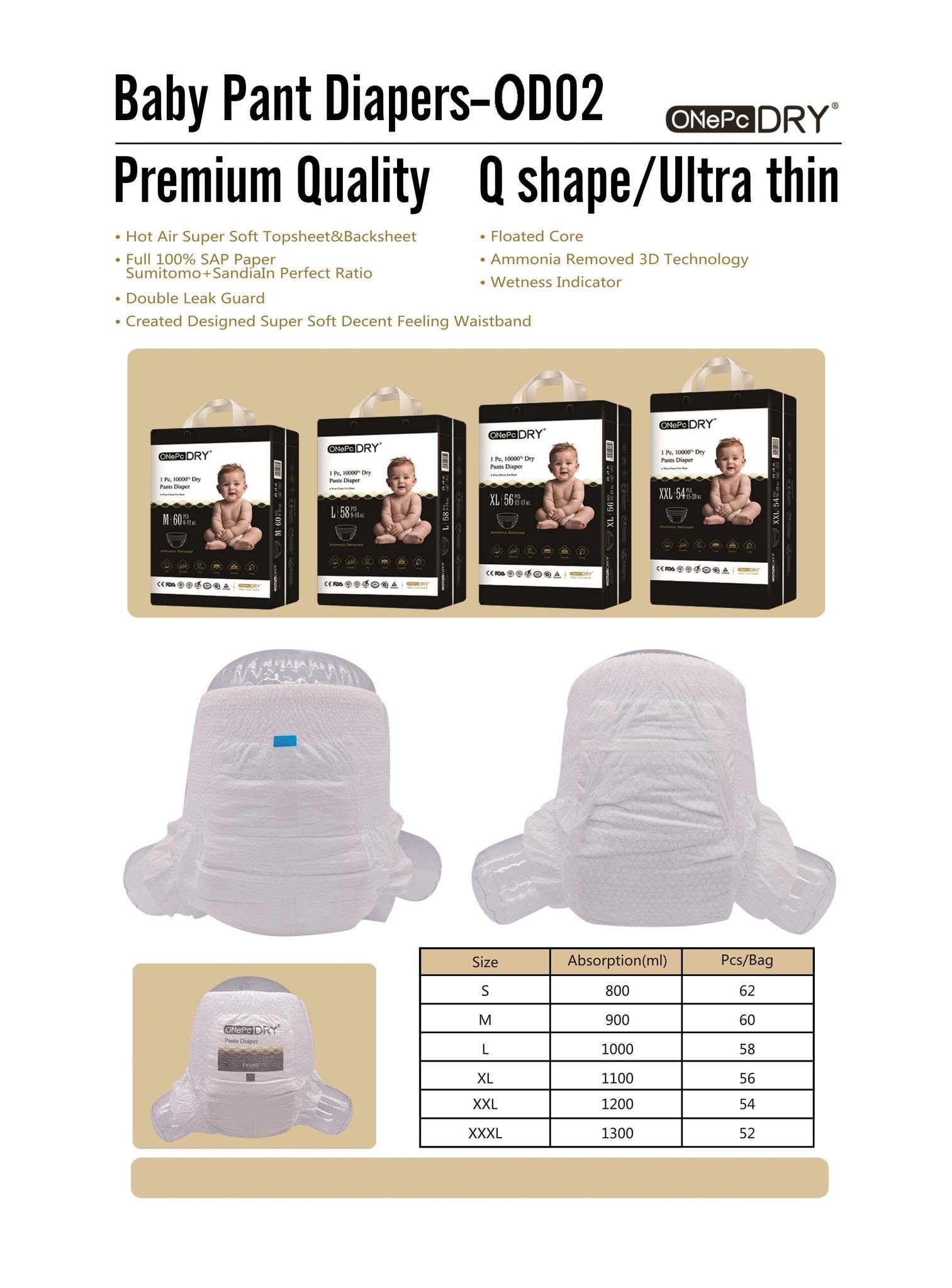
OD02, sold under the ONePcDRY brand, documents a floated core with 100% SAP paper containing Sumitomo and Sandia SAP. It adds a hot air super soft top sheet and back sheet, a double leak guard, a wetness indicator and ammonia removed 3D technology, and runs from size S to XXXL.
PD02, under My A+, documents a full 100% SAP paper core composed of LG and Sumitomo SAP, a super soft hot air non-woven top sheet and back sheet, a leak guard, crotch elastic design, a wetness indicator and the same ammonia removed 3D technology. It is stated as hypoallergenic and free of parabens, elemental chlorine and latex, and runs from S to XXL.
Why should a procurement team care about a supplier name inside a diaper? Three practical reasons.
- Traceability. A named polymer producer is a statement about what the plant actually buys, not what it could buy. It can be verified against incoming material records during an audit.
- Substitution risk. If the SAP brand is named in the catalogue, it should also be named in the order. Otherwise a later cost-driven change is invisible to the buyer until the absorbency profile shifts.
- Dual sourcing. OD02 and PD02 each name two polymer suppliers, which suggests a two-source input structure. The record does not disclose the ratio for LG and Sumitomo in PD02, and buyers should not infer it.
What naming does not do is prove performance. There is no absorbency, rewet or leakage test result in the reviewed record for either model. A buyer who needs a super absorbent or extra dry claim backed by numbers must commission or request testing; the supplier name is the starting point, not the conclusion.
Where the evidence thins out: OD01, PD01 and AL01
Three models illustrate the opposite lesson, and they are the reason this range is worth studying rather than simply approving.
PD01 documents a full 100% SAP paper core, a soft hot air non-woven top sheet, a super soft clothlike breathable spunbond back sheet, a leak guard, crotch elastic design and a wetness indicator, in sizes M to XXL. It does not name the SAP producer, while its sister model PD02 names LG and Sumitomo.
AL01, sold as Alotof, documents fluff pulp with SAP and USA fluff pulp, a hot air super soft embossed topsheet, a double leak guard, a wetness indicator, dispose tape, a crotch elastic design and a KeepDry liner, and states that it is hypoallergenic and free of parabens, elemental chlorine and latex. It runs from S to XXXL. Its SAP is named only as a category, not by producer.
OD01, the ONePcDRY model, carries a different kind of model-level evidence: a HALAL certificate, number 30113766206426, issued by Halal Foundation Center (Hong Kong) under the International Halal Standards for Hygiene Disposable Products, valid from 8 April 2025 to 7 April 2028 and applicable to the global market. The core composition of OD01 is not stated in the same record as its sister model’s.
None of this is a verdict on quality. It is a documentation gap, and the correct response is a question rather than an assumption. A buyer evaluating OD01 for a Muslim-majority market has the certificate they need; a buyer evaluating OD01 for absorbency should request the core specification and confirm whether it matches OD02 or differs from it.
EB01: what “eco-friendly” is actually documented as
EB01 is the EcoBingo model written for the US market, and it is the clearest example in the range of positioning built on material substitution.
The documented facts are specific: fluff pulp with USA fluff pulp and SAP; a bamboo fiber topsheet and backsheet; a T-shape design; a double leak guard; a wetness indicator; a hypoallergenic declaration free of parabens, elemental chlorine and latex; and sizes S to XXXL. Bamboo fiber in both sheet layers is a real, checkable material choice, and the free-of declaration is a real, checkable formulation statement.
What the record does not contain is equally important. There is no biodegradability or compostability certificate for EB01, and no stated bamboo content percentage. A buyer whose market requires a substantiated environmental claim should treat “eco-friendly” as a design direction to be evidenced locally, not as a finished claim to be reprinted on pack copy.
The range also shows that market-specific files exist rather than one global SKU. BD07 is documented for the EU market with a USA fluff pulp absorbent core and Japan SAP, a spunbond nonwoven top sheet, green ADL, a colorful clothlike breathable backsheet, S-shape magic tapes and sizes S to L. But market labelling is not certificate coverage: the CE, CPC and ASTM F963 records in this file name BD01, not BD07. That gap is the next thing to check.
Certificate scope: the field most buyers skip
Certificates are usually supplied as a folder of PDFs and read as a single reassurance. In this range, the scope field is where the real information sits, because the documents split cleanly into product-level certificates that name a model and system-level certificates that cover the plant.
| Certificate (number) | Subject named in the record | Standard | Validity |
|---|---|---|---|
| CE (ICR/VC/HM2507251) | Baby Diapers, Model BD01 | EN ISO 11948-1:1996; EN ISO 11948-2:1998 | 2025-07-28 to 2030-07-27 |
| CPC (XNO250113502YX2-1) | Baby Diaper, Model BD01 | 16 CFR Part 1500 series; ASTM F963; CPSIA | 2025-01-16 to 2030-01-16 |
| ASTM F963 (XNO250113503YX3-1) | Baby Diapers, Model BD01 | ASTM F963-23; 16 CFR Part 1500 series; CPSIA | Issued 2026-01-16 |
| REACH / SVHC (XMNCPCH25002810801) | Baby Diaper, My A+ Brand | Regulation (EC) No 1907/2006, SVHC candidate list | 2025-11-20 to 2027-12-27 |
| Dermatest (ST-ET-2026-00055) | My A+ Baby Diapers, non-woven top sheet skin compatibility | International clinical dermatology test guidelines | 2026-04-07 to 2031-04-06 |
| HALAL (30113766206426) | Baby diapers including OD01, per the model record | International Halal Standards for Hygiene Disposable Products | 2025-04-08 to 2028-04-07 |
| ISO 13485 (381240080R0S) | Disposable hygiene products: baby diaper, adult diaper, sanitary pad, under pad, tissue, absorbent pad | ISO 13485:2016 | 2024-03-12 to 2027-03-11 |
| ISO 14001 (29325E912342R0S) | Environmental management covering baby diapers and related hygiene products | GB/T 24001-2016 / ISO 14001:2015 | 2025-09-17 to 2028-09-16 |
| ISO 45001 (293250912341R0S) | Occupational health and safety, same product scope | GB/T 45001-2020 / ISO 45001:2018 | 2025-09-17 to 2028-09-16 |
Read across that table and a pattern appears. CE, CPC and ASTM F963 are attached to BD01 by name. REACH and Dermatest are attached to the My A+ brand and, in Dermatest’s case, to the non-woven top sheet specifically. The ISO trio covers the plant and its management systems.
So a buyer sourcing PD02, EB01 or OD02 cannot simply attach the BD01 CE file to their own compliance dossier without confirming applicability. The practical response is a scope-cross-reference sheet: model on one axis, certificate on the other, with the named subject and expiry date in each cell. Where a cell is empty, either request model-specific evidence or agree a pre-shipment test protocol that substitutes for it. The company portfolio also lists FDA, ISO 9001, ISO 11948, ISO 22716, SGS, MSDS and DERMATEST among its certifications; the same subject-and-expiry discipline applies to each.
Size coverage as a capability signal
A size list is a production statement. Running from newborn (NB) to XXXL requires different cutting, elastic and packing configurations, and the range shows the coverage is deliberately uneven by model rather than uniform.
| Model | Brand | Documented core | Named SAP | Sheet and closure notes | Sizes |
|---|---|---|---|---|---|
| AL01 | Alotof | Fluff pulp with SAP and USA fluff pulp | Category only, producer not stated | Hot air super soft embossed topsheet; double leak guard; KeepDry liner; dispose tape | S to XXXL |
| OD02 | ONePcDRY | Floated core with 100% SAP paper | Sumitomo and Sandia | Hot air super soft top and back sheet; double leak guard; ammonia removed 3D technology | S to XXXL |
| PD01 | My A+ | Full 100% SAP paper core | Not stated | Soft hot air non-woven top sheet; clothlike breathable spunbond back sheet | M to XXL |
| PD02 | My A+ | Full 100% SAP paper core | LG and Sumitomo | Super soft hot air non-woven top and back sheet; crotch elastic design | S to XXL |
| EB01 | EcoBingo | Fluff pulp with USA fluff pulp and SAP | Not stated | Bamboo fiber topsheet and backsheet; T-shape design; double leak guard | S to XXXL |
| BD01 | My A+ | Floated core with Sumitomo 50% and Sandia SAP paper sheet | Sumitomo and Sandia | Hot air super soft embossed top sheet; clothlike breathable backsheet; S-shape magic tapes | NB to XL |
| BD02 | My A+ | Floated core, 50% Sumitomo and 50% Sandia | Sumitomo and Sandia | Hot air super soft embossed top sheet; clothlike breathable backsheet; S-shape magic tapes | NB to XL |
| BD03 | My A+ | Core with Sumitomo 50% and Sandia SAP paper sheet | Sumitomo and Sandia | Hot air super soft embossed top sheet and hot air super soft backsheet; KeepDry liner | S to XL |
| BD04 | My A+ | Floated core with Sumitomo 50% and Sandia SAP paper sheet | Sumitomo and Sandia | Hot air super soft embossed top sheet and hot air super soft backsheet | S to L |
Three practical readings follow. First, a newborn programme has to route to BD01 or BD02, because PD01 begins at M. Second, a retailer needing extended sizes for older toddlers and larger children can look at AL01, OD02 or EB01, all of which reach XXXL. Third, comfort language in this range is documented as “hot air super soft” rather than as cotton-touch wording, and breathability is documented through the breathable backsheet naming on BD01 and BD02. Buyers who need those phrases on pack should match them to the model that actually states them.
One boundary is worth flagging early. The model-level baby diaper records reviewed here describe tape-style diapers with S-shape magic tapes. The company portfolio also lists pant diapers, but pull-up style models are not specified in the same record set; a buyer sourcing pull-up pants should request that model family separately rather than assume tape-model specifications carry over.
From specification to purchase order: terms, acceptance criteria and boundaries
The commercial terms are the second half of the evidence, because a model that cannot be ordered in the right quantity at the right interval is not a usable capability.
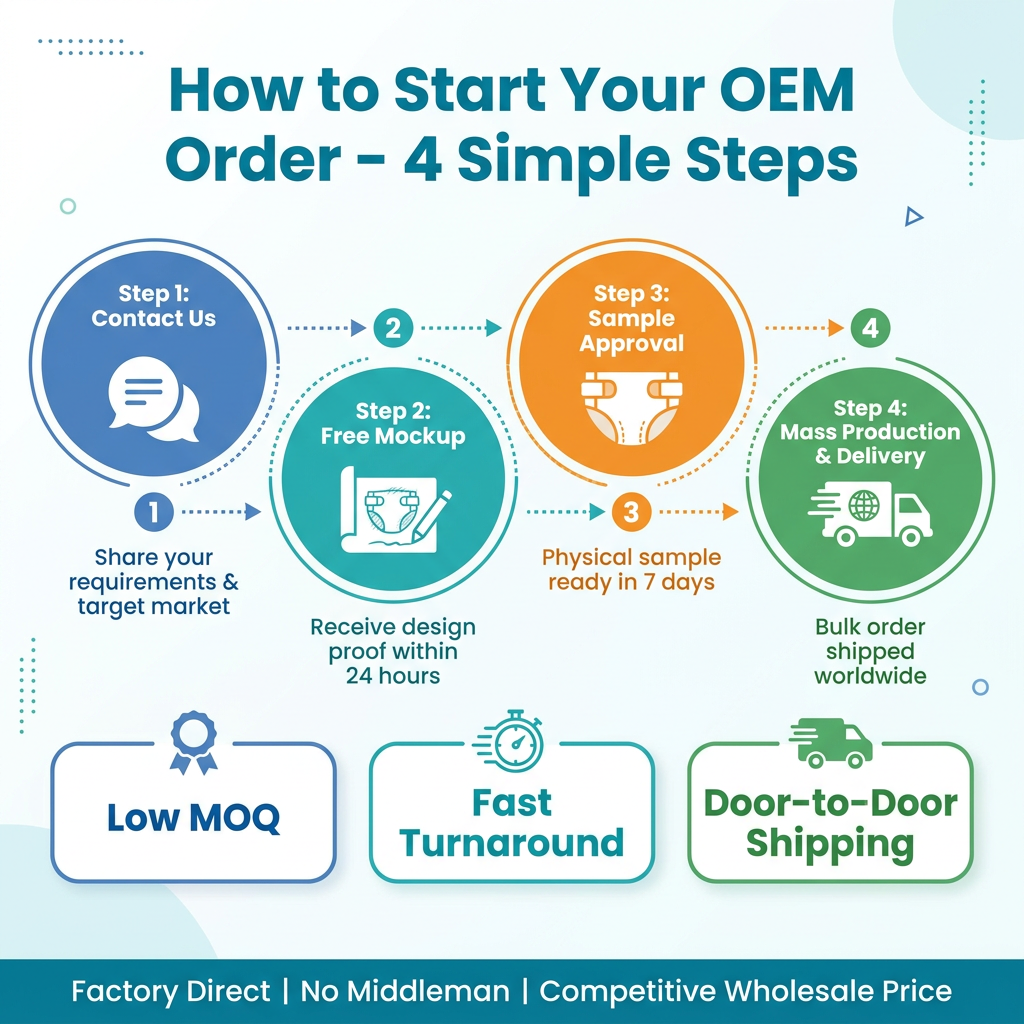
The stated terms are: OEM and ODM production with material and logo customization; a minimum order quantity of 100,000 pieces; monthly production capacity of 20,000,000 pieces; a typical production lead time of 25–35 days; quality control by 100% test; acceptance criteria of a pre-shipment test; delivery terms FOB, CIF or DDP; payment terms 30/70; and after-sales support provided remotely.
Each of these needs one translation step before it becomes contract language.
- MOQ against capacity. At 100,000 pieces against a stated 20,000,000 pieces per month, the minimum order represents roughly 0.5% of one month’s output — a figure calculated from the two supplied values, not a stated supplier policy. That ratio suggests small trial and replenishment orders can fit inside the production calendar, but the scheduling commitment should be confirmed for the specific model and size mix.
- Lead time. The 25–35 day window covers production, not transit. Buyers using DDP should confirm whether the quoted window includes transport and customs clearance, because the same number means very different things under FOB and DDP.
- Pre-shipment test. This names a stage, not a method. Convert it into a test list: which characteristics are measured on which model, the sampling plan, whether third-party inspection is allowed, who bears the cost, and the consequence of a failed result. Without that, “pre-shipment test” and “100% test” describe two different things — in-line process control and pre-shipment verification — and neither is an independent audit.
- Payment split. A 30/70 structure places most of the value after production. That is normal in this trade, but it raises the importance of agreeing the inspection evidence that releases the 70% before the deposit is sent.
- Customization scope. Material and logo customization are documented. Beyond the logo, printed artwork is not stated in this record, so decorative print programmes should be raised as a specific question rather than assumed to be included.
The supplier reports cumulative supply of 10,000,000 pieces to OEM clients, with steady repeat orders and stable market share growth in maternity and baby product store applications. Those are company-reported outcomes, useful as context for a first conversation and not a substitute for referenceable accounts or a buyer’s own trial order.
What this range does not establish
Ranges are persuasive precisely because they look complete. Naming what is missing is part of reading them honestly.
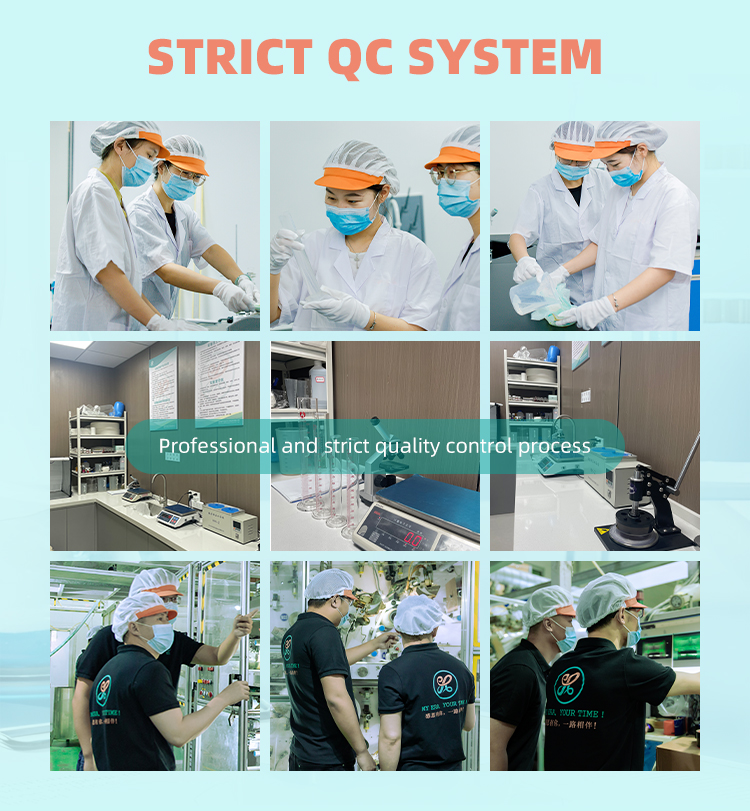
- No independent absorbency, rewet or leakage test results appear in the reviewed record for any model. Super absorbent, extra dry and leak proof are therefore buyer test targets, not supplier-verified performance claims.
- No third-party factory audit or social compliance report is included. The ISO 13485, ISO 14001 and ISO 45001 certificates cover management systems within their stated scopes; they are not product performance evidence for a named model.
- No biodegradability or recycled-content certification is attached to the bamboo-fiber EB01. Environmental claims need their own documentation trail per destination market.
- Documentation depth varies between sister models, as OD01 versus OD02 and PD01 versus PD02 show. A gap is a question, not a defect — and not a licence to assume the better-documented sibling applies.
- Market size and regional export concentration describe the category, not this supplier. They belong in a business case, not in a supplier scorecard.
A five-step reading method
The whole method condenses into a sequence a procurement team can run in a single review session.
- Fix the model, not the series. Quote OD02, PD02, EB01 or BD04 by code. A series-level discussion will migrate toward the best-documented member.
- Read the core sentence literally. Full 100% SAP paper core, floated core, or an unqualified core description — and note whether the SAP producer is named or only the category.
- Match the certificate subject to the model. Check the named model or brand, the standard, and the expiry date. Product-level and plant-level certificates answer different questions.
- Match the size list to the market. NB coverage on BD01 and BD02, M as the floor on PD01, and XXXL on AL01, OD02 and EB01 all point to different retail assortments.
- Convert terms into contract text. MOQ, delivery term, payment split, lead-time definition, test list and any substitution-approval clause for named SAP suppliers.
Outlook: evidence discipline as a sourcing habit
The direction of travel in this category favours suppliers who publish model-level facts and buyers who read them literally. A cluster that handles 63.9% of China’s baby diaper exports and a market projected to reach USD 141.8 billion by 2033 create plenty of choice; they do not create differentiation between suppliers. Differentiation comes from the paperwork that survives an audit — a named SAP, a stated core architecture, a certificate whose subject matches the model on the order, and a test protocol both parties signed.
Read that way, this range is informative in an unusual sense: its stronger models show what full disclosure looks like, and its thinner models show exactly which questions to ask. A buyer who can name the difference is already ahead of one who is comparing catalogue covers.
The supplier’s ERA 2026 product catalogue (PDF) lists the wider model set for cross-checking against the specifications discussed here.
FAQ
What are the purchasing terms and acceptance criteria?
The stated terms are a minimum order quantity of 100,000 pieces, delivery under FOB, CIF or DDP, and payment split 30/70. The stated acceptance criterion is a pre-shipment test. Because that phrase names a stage rather than a method, buyers normally convert it into a written test list covering which characteristics are measured, the sampling plan, who performs the test, and the consequence of a result outside the agreed limit.
How can a buyer tell a documented diaper specification from a general claim?
Four fields are checkable. First, a named absorbent input — for example Sumitomo and Sandia in OD02, or LG and Sumitomo in PD02. Second, a named core architecture, such as a full 100% SAP paper core or a floated core. Third, named sheet components, such as a hot air super soft embossed top sheet or a bamboo fiber backsheet. Fourth, a size list and a certificate whose subject names the model. A statement that lacks all four is a claim, not a specification.
What is the difference between a full 100% SAP paper core and a floated core in this range?
PD01 and PD02 are documented with a full 100% SAP paper core. OD02, BD01, BD02 and BD04 are documented with a floated core holding an SAP paper sheet, and BD03 is described as having a core containing Japan Sumitomo 50% and Japan Sandia SAP paper sheet without the word floated. The record does not state an engineering explanation or a performance difference between the two architectures; it states which architecture applies to which model, which is what a buyer needs in order to specify and to control substitution.
Which models are documented for the US and EU markets?
EB01 is documented for the US market, with a bamboo fiber topsheet and backsheet, T-shape design, double leak guard, wetness indicator, a hypoallergenic declaration free of parabens, elemental chlorine and latex, and sizes S to XXXL. BD07 is documented for the EU market, with a USA fluff pulp absorbent core and Japan SAP, a spunbond nonwoven top sheet, green ADL, a colorful clothlike breathable backsheet, S-shape magic tapes and sizes S to L. Market labelling is not the same as certificate coverage: the CE, CPC and ASTM F963 records in this file name BD01.
Which certificates name a specific model rather than the factory?
The CE certificate ICR/VC/HM2507251, the CPC certificate XNO250113502YX2-1 and the ASTM F963 certificate XNO250113503YX3-1 each name Model BD01. The REACH certificate XMNCPCH25002810801 names the My A+ brand, and the Dermatest certificate ST-ET-2026-00055 covers non-woven top sheet skin compatibility for My A+ baby diapers. By contrast, ISO 13485, ISO 14001 and ISO 45001 cover the plant and its management systems. Buyers should check the named subject and the expiry date on each document rather than treating the folder as one approval.
What sizes are available across the range?
BD01 and BD02 run from NB to XL. PD01 runs from M to XXL, and PD02 from S to XXL. BD03 runs from S to XL, BD04 from S to L, and BD05, BD06 and BD07 from S to L or S to XL depending on the model. AL01, OD02 and EB01 extend to XXXL. A newborn programme therefore needs a model with NB coverage rather than the widest model overall.
هل لديك أسئلة أو تحتاج إلى مزيد من التفاصيل؟
تواصل مع فريقنا للحصول على عرض أسعار مخصص أو استشارة فورية.
طلب عرض أسعار
املأ النموذج أدناه وسيتواصل معك فريقنا بعرض مقترح مخصص.
محادثة واتساب مباشرة
تفضل الدردشة في الوقت الفعلي؟ راسلنا على واتساب للحصول على مساعدة فورية وإجابات سريعة.
- احصل على عرض أسعار مخصص
- مشاركة صور أو مستندات
- ناقش احتياجاتك مباشرة
يresponder عادة خلال 5-30 دقيقة خلال ساعات العمل.