
Baby Diaper Model Shortlist: AL01, OD, PD, EB01 and the BD Series
In baby diapers, the model number — not the brand name — determines what an order actually contains. AL01, OD01, OD02, PD01, PD02, EB01 and the eight BD models documented by QUANZHOU ERA SANITARY PRODUCTS CO.,LTD. differ in size ladders, absorbent core construction, top sheet, back sheet and closure design. Those are differences a buyer can verify on a specification sheet before requesting a single sample.
Baby diapers are a specification-driven purchase. Two packs can share a shelf position, a pack count and a similar look, yet be built on different absorbent architectures, different sheet materials and different size ranges. For a distributor or importer, that gap between appearance and specification is where most sourcing errors start.
This shortlist is built only from the manufacturer's published model data. It compares grounded attributes — fluff pulp material, SAP paper composition, available sizes, top sheet, back sheet, leak guard and stated channel application — and deliberately avoids absorbency, rewetting or leakage claims that are not documented per model.

QUANZHOU ERA SANITARY PRODUCTS CO.,LTD. is a disposable hygiene manufacturer based in Jinjiang City, Quanzhou, Fujian, China, established in 2016. The company operates a 100,000 m² facility with approximately 220 employees and an annual output of 200,000,000 pieces, holds independent import and export rights, and records export business as 100% of total sales, with Europe, the USA, Southeast Asia, Central Asia, South America, Africa and the Middle East listed as main markets. Its certification portfolio covers CE, FDA, ISO9001, ISO13485, ISO11948, ISO14001, ISO45001, ISO22716, SGS, Halal, CPC, MSDS and DERMATEST. Its registered brands include Alotof, ONePcDRY, EcoBingo, my A+, my ERA and Binnions.
Why a Model-Level Shortlist Beats a Brand-Level One
A brand tells a buyer where a product sits in a portfolio. A model number tells them what is inside the product. In this portfolio the two are not interchangeable: Alotof carries AL01, ONePcDRY carries OD01 and OD02, EcoBingo carries EB01, and the my A+ line carries PD01, PD02 and the BD01–BD08 series. A buyer who negotiates on brand alone leaves the specification field open.
The clearest evidence for shortlisting at model level is the channel field itself. Every model in this shortlist lists the same four application areas — baby care, mother & baby retail, supermarket and cross-border e-commerce. Because the channel statement is identical across fourteen models, it cannot be the deciding variable. What actually varies is the size ladder, the core build, the sheet materials and the closure system.
The Shortlist at a Glance
| Model | Brand | Sizes | Core / absorbent construction | Top sheet | Back sheet |
|---|---|---|---|---|---|
| AL01 | Alotof | S–XXXL | Fluff pulp; SAP plus USA fluff pulp; KeepDry liner; crotch elastic design | Hot air super soft embossed | Clothlike breathable |
| OD01 | ONePcDRY | NB–XL | Floated core; 100% SAP paper (Sumitomo + Sandia); Ammonia Removed 3D Technology | Hot air super soft | Hot air super soft |
| OD02 | ONePcDRY | S–XXXL | Floated core; 100% SAP paper (Sumitomo + Sandia); Ammonia Removed 3D Technology | Hot air super soft | Hot air super soft |
| PD01 | my A+ | M–XXL | Floated core; full 100% SAP paper (LG + Sumitomo); anti-rash oil lines | Soft hot air non-woven | Super soft clothlike breathable spunbond |
| PD02 | my A+ | S–XXL | Floated core; full 100% SAP paper (LG + Sumitomo) | Super soft hot air non-woven | Super soft hot air non-woven |
| EB01 | EcoBingo | S–XXXL | Fluff pulp; USA fluff pulp plus SAP; T-shape design | Bamboo fiber | Bamboo fiber |
| BD01 | my A+ | NB–XL | Floated core; Japan Sumitomo 50% + Japan Sandia SAP paper sheet | Hot air super soft embossed | Clothlike breathable |
| BD02 | my A+ | NB–XL | Floated core; 50% Japan Sumitomo + 50% Japan Sandia SAP | Hot air super soft embossed | Clothlike breathable |
| BD03 | my A+ | S–XL | Floated core; Japan Sumitomo 50% + Japan Sandia SAP paper sheet | Hot air super soft embossed | Hot air super soft |
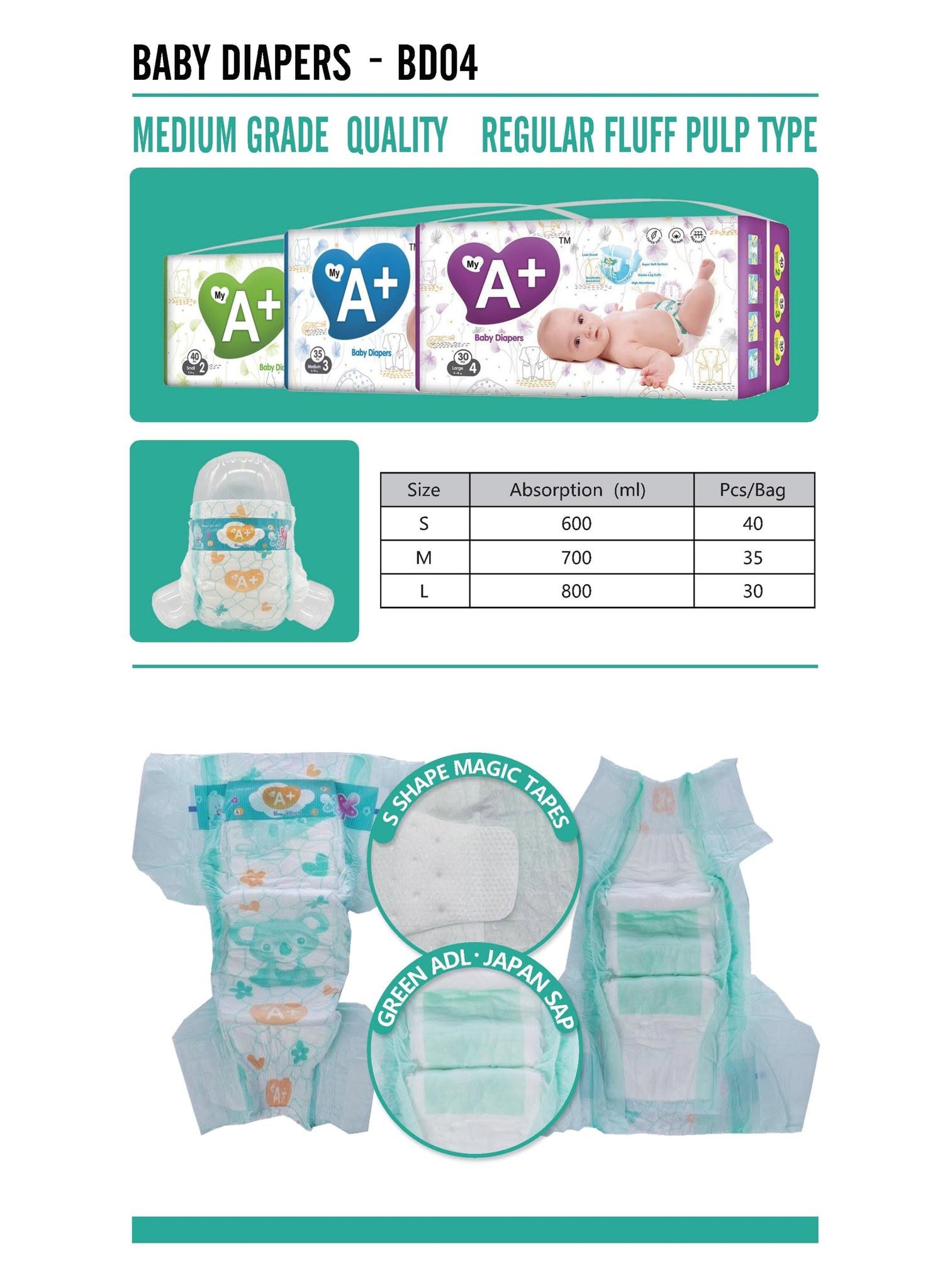
| BD04 | my A+ | S–M–L | Floated core; Japan Sumitomo 50% + Japan Sandia SAP paper sheet | Hot air super soft embossed | Hot air super soft |
| BD05 | my A+ | S–M–L | Japan SAP + USA fluff pulp; green ADL; threefolded | Spunbond nonwoven | Colorful clothlike breathable |
| BD06 | my A+ | S–XL | Japan SAP + USA fluff pulp; green ADL; threefolded | Spunbond nonwoven | Colorful clothlike breathable |
| BD07 | my A+ | S–M–L | Japan SAP + USA fluff pulp; green ADL; threefolded | Spunbond nonwoven | Colorful clothlike breathable |
| BD08 | my A+ | S–XXL | Japan SAP + USA fluff pulp; green ADL; threefolded | Spunbond nonwoven | Colorful clothlike breathable |
Source: manufacturer model documentation for AL01, OD01, OD02, PD01, PD02, EB01 and BD01–BD08. All fourteen models list baby care, mother & baby retail, supermarket and cross-border e-commerce as intended application areas.
AL01: The Widest Size Ladder, With a KeepDry Liner
AL01 is the Alotof model and the simplest way to cover a full shelf with one article number. It runs from S to XXXL across six sizes, which is the broadest documented range in this shortlist alongside OD02 and EB01.
Its construction is stated as fluff pulp with SAP and USA fluff pulp, a KeepDry liner, a hot air super soft embossed top sheet, a clothlike breathable back sheet, a double leak guard, a wetness indicator and dispose tape, plus a crotch elastic design. The manufacturer documents it as hypoallergenic and free of parabens, elemental chlorine and latex.
For a buyer, the operationally relevant points are the sixth size and the closure set. A range that reaches XXXL lets a distributor serve households with older children still in diapers without adding a second supplier. The crotch elastic design and dispose tape are handling features that matter in markets where used-diaper disposal discipline is part of the retail proposition. AL01 does not start at NB, so it cannot be the only article in a newborn-first programme.
OD01 and OD02: The 100% SAP Paper Platform
The ONePcDRY models share one absorbent architecture and split the size ladder between them. Both are documented with a floated core built on 100% SAP paper using Sumitomo and Sandia SAP, Ammonia Removed 3D Technology, a double leak guard, a wetness indicator, and a hot air super soft top sheet and back sheet.
OD01 covers NB, S, M, L and XL. OD02 covers S, M, L, XL, XXL and XXXL, and its documentation adds a designed super soft waistband. Read together, the pair forms a continuous NB-to-XXXL ladder requiring only two model families — the practical reason buyers often trial them as a set rather than separately.
The distinguishing detail is the SAP paper itself. OD01 and OD02 specify 100% SAP paper rather than a blended SAP paper sheet over a fluff core, and they name both Sumitomo and Sandia as the SAP sources. Buyers who track SAP provenance as a supply-continuity question rather than a marketing claim will find the supplier names useful because they are stated on the specification, not inferred.
PD01 and PD02: 100% SAP Paper With LG and Sumitomo
The my A+ PD family is the only group in this shortlist whose documentation names LG alongside Sumitomo as the SAP source. Both models are built on a floated core with full 100% SAP paper, a leak guard, a crotch elastic design and a wetness indicator.
PD01 runs M, L, XL and XXL. Its top sheet is a soft hot air non-woven and its back sheet a super soft clothlike breathable spunbond; the model documentation also lists anti-rash oil lines. PD02 runs S, M, L, XL and XXL, with a super soft hot air non-woven top sheet and back sheet, and adds dispose tapes.
The buyer-relevant conclusion is scope, not superlatives. PD01 starts at M, so it excludes newborn and small sizes; PD02 adds S but neither model reaches XXXL. The PD family therefore fits a mainstream infant-to-toddler programme or a companion line alongside a newborn-starting model such as OD01 or BD01 — not a full-ladder single-model strategy. The back sheet difference between the two is the cleanest basis for deciding which one goes on which shelf: clothlike spunbond on PD01, hot air non-woven on PD02.
EB01: Bamboo Fiber Sheets and a Paper-Based Pack
EB01 is the EcoBingo model and the only entry in this shortlist documented with bamboo fiber top sheet and back sheet. It runs S to XXXL, uses a T-shape design, USA fluff pulp and SAP, a double leak guard and a wetness indicator, and is packed in a biodegradable kraft paper bag. The manufacturer describes it as eco-friendly, hypoallergenic and free of parabens, elemental chlorine and latex, and positions it for the US market in its documentation.
Material-based environmental positioning is a live shelf argument. Industry analysis cited by EIN Presswire projects that bamboo biodegradable diapers will capture 39% of the biodegradable diaper market by 2026 — a segment-level figure, not a statement about this model. The distinction matters for buyers: EB01 offers a bamboo fiber sheet specification and kraft paper packaging, which are verifiable material facts, whereas compostability or biodegradability certification for the finished product is not part of the model documentation reviewed here.

The BD Series: Two Construction Families in One Ladder
The eight BD models are not one product repeated with different numbers. They split into two clearly documented construction families, and the split matters more to a buyer than the numbering.
Family A — BD01 to BD04. These use a floated core with a SAP paper sheet built on 50% Japan Sumitomo and 50% Japan Sandia, a hot air super soft embossed top sheet, a spandex elastic waistband, S shape magic tapes, a double leak guard and a wetness indicator. The differentiator inside the family is the back sheet: BD01 and BD02 use a clothlike breathable back sheet, while BD03 and BD04 use a hot air super soft back sheet. Size coverage runs NB–XL for BD01 and BD02, S–XL for BD03, and S–M–L for BD04. BD02 additionally states hypoallergenic status and freedom from parabens, elemental chlorine and latex.
Family B — BD05 to BD08. These are documented with Japan SAP and USA fluff pulp, a green ADL acquisition layer, a spunbond nonwoven top sheet, a colorful clothlike breathable back sheet, a spandex elastic ring waistband and a leak guard, and are threefolded. Sizes run S–M–L for BD05 and BD07, S–XL for BD06 and S–XXL for BD08. BD07 is the model whose documentation specifically references the EU market.
Used as a ladder, the series is efficient: BD01 or BD02 covers the newborn end with a paper-sheet core, BD06 covers the mainstream middle, and BD08 extends the same construction to XXL. A buyer who wants one consistent construction across most of the shelf can build it from Family B alone; a buyer who wants a paper-sheet core from newborn upward starts in Family A.
What the Specifications Do and Do Not Tell You
Specification data is a screening tool, not a performance verdict. For this shortlist, that boundary needs stating plainly.
- No per-model absorbency, rewet or leakage figures are published. Nothing in the model documentation ranks AL01 against PD02, or OD02 against BD08, on absorbent performance. Any such ranking would be unsupported.
- Three distinct architectures coexist. 100% SAP paper over a floated core (OD01, OD02, PD01, PD02); a 50/50 Sumitomo–Sandia SAP paper sheet over a floated core (BD01–BD04); and Japan SAP with USA fluff pulp plus a green ADL (BD05–BD08). EB01 forms a fourth variant with bamboo fiber sheets. These are material differences, not a published quality order.
- Certification is documented at two levels. The company holds CE, FDA, ISO9001, ISO13485, ISO11948, ISO14001, ISO45001, ISO22716, SGS, Halal, CPC, MSDS and DERMATEST. Model-level documents include a REACH certificate under Regulation (EC) No 1907/2006, SVHC Candidate List, certificate number XMNCPCH25002810801 issued by SGS, and a Halal certificate, number 30113766206426, issued by Halal Foundation Center (Hong Kong) against the International Halal Standards for Hygiene Disposable Products. Because the model reference attached to a certificate can vary between documents, buyers should confirm which specific model each certificate covers before quoting it to a retailer, importer or regulator.
- Commercial terms are absent. This shortlist contains no MOQ, price band, lead time or freight data. Those are negotiation variables, not specification variables.
Compared with the common alternative — selecting a diaper supplier from a catalogue photo and a headline absorbency claim — a model-level shortlist is slower to assemble but far cheaper to correct. The trade-off is real: spec sheets lengthen the evaluation phase, and they still cannot substitute for physical sampling.
Market Signals Behind the Shortlist
Three published data points frame why this model set looks the way it does.
Global baby diaper revenue was valued at USD 88.5 billion in 2026 and is projected to reach USD 141.8 billion by 2033, according to Grand View Research. A market of that scale rewards range depth over single-article strategies, which is consistent with a portfolio that already spans newborn to XXXL rather than concentrating on the middle sizes.
Supply geography is equally concentrated. Fujian Province accounts for 63.9% of China's total baby diaper exports, generating 8.74 billion yuan in export volume in 2024, according to customs data cited by EIN Presswire. For buyers, the practical reading is that sourcing within the Fujian cluster puts a purchase inside the densest export infrastructure in the category — a logistics and supplier-density argument, not a quality claim about any individual plant.
Material segmentation is the third signal. Bamboo-based diapers are projected to hold 39% of the biodegradable diaper segment by 2026, per the same industry analysis, which is the segment context in which a bamboo fiber sheet model such as EB01 becomes commercially relevant rather than decorative.
Matching a Model to a Market Scenario
The following mappings are buyer-side interpretations of documented specifications, not manufacturer claims. They are offered as a starting framework for sampling.
| Buyer requirement | Models whose documentation supports it | Reason from the spec sheet |
|---|---|---|
| Newborn-first range | OD01, BD01, BD02 | Documented NB size at the start of the ladder |
| Toddler and plus-size depth | AL01, OD02, EB01 (XXXL); BD08, PD01, PD02 (XXL) | Ladders extend to XXXL or XXL |
| Clothlike breathable back sheet | AL01, BD01, BD02, BD05–BD08, PD01 | Back sheet material named in the model data |
| Hot air super soft back sheet | OD01, OD02, BD03, BD04, PD02 | Back sheet material named in the model data |
| Magic tape closure | BD01–BD08 | S shape magic tapes documented across the series |
| Dispose tape | AL01, PD02 | Dispose tape listed in the closure set |
| Material-led eco positioning | EB01 | Bamboo fiber sheets plus biodegradable kraft paper bag |
| Single-model full ladder | AL01, OD02, EB01 | S through XXXL in one article number |
In practice, a supermarket listing usually needs the dense middle sizes — S, M, L, XL — where BD03, BD06 and PD02 sit comfortably. Mother & baby retail can carry a narrower, more differentiated range, which is where PD01's M–XXL scope or EB01's bamboo fiber sheets become arguments rather than gaps. Cross-border e-commerce is the channel most exposed to size gaps, because returns are expensive; a ladder that starts at NB and ends at XXXL, such as OD01 plus OD02, or AL01 alone, removes that exposure more cheaply than parallel single-size suppliers.
Future Outlook
Two patterns in this shortlist are worth tracking into 2027.
The first is size distribution. Six of the fourteen models listed here now reach XXL or XXXL, and three reach XXXL outright. That is a catalogue-level signal that range depth at the top end is being treated as a standard requirement rather than a special order, which in turn changes how buyers plan SKU counts and shelf allocation.
The second is supplier transparency on SAP. Naming Sumitomo, Sandia and LG on the specification sheet turns an invisible input into a procurement talking point. For buyers, that is a useful development: it makes supply-continuity conversations possible at the model level instead of the contract level. It also raises the bar, because a named supplier claim should be verifiable in documentation rather than accepted from a brochure.
FAQ
What is the main material difference between the OD and PD models and the BD series?
OD01, OD02, PD01 and PD02 are documented with a floated core and 100% SAP paper — OD using Sumitomo and Sandia SAP, PD using LG and Sumitomo SAP. BD01 to BD04 use a SAP paper sheet built on 50% Japan Sumitomo and 50% Japan Sandia over a floated core, while BD05 to BD08 use Japan SAP with USA fluff pulp and a green ADL. These are three different constructions, not three grades of the same construction.
Which shortlisted models start at newborn size?
Three models are documented with NB as their smallest size: OD01 (NB–XL), BD01 (NB–XL) and BD02 (NB–XL). AL01, OD02 and EB01 start at S but extend to XXXL, so a newborn-to-toddler programme is normally built from a pairing rather than a single article.
Which model is positioned for eco-friendly or bamboo-based ranges?
EB01, under the EcoBingo brand, is the only model in this shortlist documented with bamboo fiber top sheet and back sheet, USA fluff pulp and SAP, a T-shape design and a biodegradable kraft paper bag. Its documentation states it is eco-friendly, hypoallergenic and free of parabens, elemental chlorine and latex, and references the US market.
What certification evidence is available for these models?
At company level the manufacturer lists CE, FDA, ISO9001, ISO13485, ISO11948, ISO14001, ISO45001, ISO22716, SGS, Halal, CPC, MSDS and DERMATEST. Model-level documents include a REACH certificate under Regulation (EC) No 1907/2006, SVHC Candidate List, certificate number XMNCPCH25002810801 issued by SGS, and a Halal certificate, number 30113766206426, issued by Halal Foundation Center (Hong Kong). Buyers should verify which model each certificate is issued against before relying on it in a retail or customs submission.
Can one model cover both supermarket and cross-border e-commerce?
All fourteen models list baby care, mother & baby retail, supermarket and cross-border e-commerce as intended application areas, so the channel statement alone does not separate them. The practical constraint is the size ladder: cross-border e-commerce typically needs newborn and the largest sizes covered, which favours AL01, OD02, EB01 or a pair such as OD01 with OD02, while a supermarket listing usually concentrates on S to XL, where BD03, BD06 and PD02 sit.
The full 2026 product catalogue, including model images and specification tables, can be downloaded here: ERA Catalog 2026 (PDF).
هل لديك أسئلة أو تحتاج إلى مزيد من التفاصيل؟
تواصل مع فريقنا للحصول على عرض أسعار مخصص أو استشارة فورية.
طلب عرض أسعار
املأ النموذج أدناه وسيتواصل معك فريقنا بعرض مقترح مخصص.
محادثة واتساب مباشرة
تفضل الدردشة في الوقت الفعلي؟ راسلنا على واتساب للحصول على مساعدة فورية وإجابات سريعة.
- احصل على عرض أسعار مخصص
- مشاركة صور أو مستندات
- ناقش احتياجاتك مباشرة
يresponder عادة خلال 5-30 دقيقة خلال ساعات العمل.