
Baby Diaper Options Shortlist: Style, Core and Size Choices for Importers
Baby Diaper Options Shortlist: Style, Core and Size Choices for Importers
For importers building a baby diaper range, the useful shortlist is not a single product. It is a set of style, core and size choices matched to use case, target absorbency, packaging and compliance scope. Yibero baby diaper options can be reviewed through tape-style diapers for caregiver-assisted changing, pull-up pants for active toddlers, and two core directions for selected products: fluff pulp & SAP and ultra-thin SAP paper.

What an importer shortlist should decide
An importer shortlist has three layers. The first is style: tape-style diapers or pull-up pants. The second is absorbent-core structure: fluff pulp & SAP or ultra-thin SAP paper for selected products. The third is size and specification: the size range, reference absorbency, pack count, artwork and target-market documentation. A product can look similar on a shelf and still differ in core, fit, weight, material configuration and approved specification.
Fujian Jiayue Sanitary Products Co., Ltd. is a Quanzhou-based hygiene products supplier established in 2016. Yibero baby diaper is one of the company's owned brands, and the company provides OEM, ODM and private-label support for importers, distributors, brand owners and retail channels. Its product scope includes baby diapers and baby pull-up pants, with customization covering size, absorbency targets, core structure, materials, graphics, pack count and packaging.
| Shortlist layer | Options to review | Buyer question |
|---|---|---|
| Style | Tape-style diapers; pull-up pants | Does the format match the changing routine and the child's activity level? |
| Core | Fluff pulp & SAP; ultra-thin SAP paper for selected products | Which core matches the target absorbency, thickness, weight and approved sample? |
| Size and fit | Tape-style S/M/L/XL references; CE scope from NB through XXXXXL | Does the ordered size and SKU fall inside the approved specification and documented scope? |
| Compliance | CE Declaration of Conformity; ISO 9001 sales coverage; product-specific ISO 13485 scope | Do the documents cover the exact product and market being sourced? |
The table is a decision map, not a ranking. The correct combination depends on the buyer's market, price position, pack architecture and target user. A shortlist should make those dependencies visible before sampling, not hide them behind one headline specification.
Style choice: tape-style diapers and pull-up pants
Tape-style baby diapers are designed for caregiver-assisted changes, especially for younger babies who spend more time lying down. Tape tabs allow a caregiver to open, position and refasten the diaper while the baby is lying down. Pull-up pants are worn like underwear and are generally more convenient for crawling or walking babies. Elastic waist openings let pull-up pants slide on and stay secure during movement. The choice depends on age, activity level, fit, absorbency requirements and changing habits.
For an importer, the practical split is use-case based. Tape-style diapers can anchor newborn and younger-baby SKUs where caregiver-assisted changing is the main routine. Pull-up pants can serve active toddlers and older babies where dressing convenience matters more. Neither format is automatically superior. The fit range, absorbency target, leakage protection, material configuration and approved sample still determine whether the format works for a specific market.
Yibero tape-style references list S/M/L/XL at 500/600/700/800 ml reference absorbency. These values are reference points for range planning. They should not be read as a universal performance ranking across all sizes, markets or core structures. Buyers should confirm the final absorbency target, test method and acceptance criteria against the approved specification and sample. Pull-up pants have their own size and specification confirmation and should not be assumed to share the tape-style reference values.
A two-format range can be commercially useful because it gives distributors a clearer shelf story: tape-style for caregiver-assisted changing and pull-up pants for active toddlers. The value is in the fit between product format and routine, not in a claim that one format replaces the other. For private-label programs, the format decision should be locked before artwork and pack-count planning, because the bag front, size mix and carton configuration depend on it.
Core choice: fluff pulp & SAP versus ultra-thin SAP paper

A fluff pulp & SAP core combines cellulose fluff pulp with superabsorbent polymer. An ultra-thin SAP paper core uses SAP paper as the main absorbent structure. Jiayue offers both core options for selected diaper products. The two structures are different design routes, not a simple good-versus-better hierarchy.
There is no universal performance advantage between a fluff pulp & SAP core and an ultra-thin SAP paper core. Buyers should compare thickness, target absorbency, product weight, fit, material configuration and test results against the approved specification and sample under the same conditions. A core that suits one SKU, size or market position may not suit another. The correct question is not which core sounds more advanced, but which core meets the agreed specification at the target cost, thickness and fit.
Core selection also interacts with other customization choices. Jiayue's customization scope includes product size and weight, absorbency target, SAP/fluff-pulp or composite core, hot-air or spunbond nonwoven, cloth-like backsheet, tape or pull-up format, 3D leak guards, wetness indicator, waistband, graphics, printed bags and cartons, and pack count. These are specification choices, not separate promises of performance. The approved sample and approved specification should lock them before mass production.
For importers, the core decision should be made with the sample, not from a label alone. If a buyer wants a thinner product, the review should still include target absorbency, fit and test results. If a buyer wants a fluff pulp & SAP structure, the review should still confirm thickness and weight against the intended price position. The absence of a universal advantage means the buyer needs a specification-based comparison, not a generic preference.
Size and compliance scope: read the range, not the label alone
The CE Declaration of Conformity for baby diapers is a document buyers should read at size and SKU level. The supplied record is CE/PPE-JY-01, issued 2025-05-15, and described as a self-declaration by Fujian Jiayue Sanitary Products Co., Ltd., with SUNGO Europe B.V. identified as the EU representative. It cites Regulation (EU) 2016/425 on Personal Protective Equipment, Module A according to Annex IV, and covers baby diapers in Category I across sizes NB/S/M/L/XL/XXL/XXXL/XXXXL/XXXXXL. The listed dimensions are length 36–58 cm and width 28–45.5 cm. The record supplied does not list an expiry date.
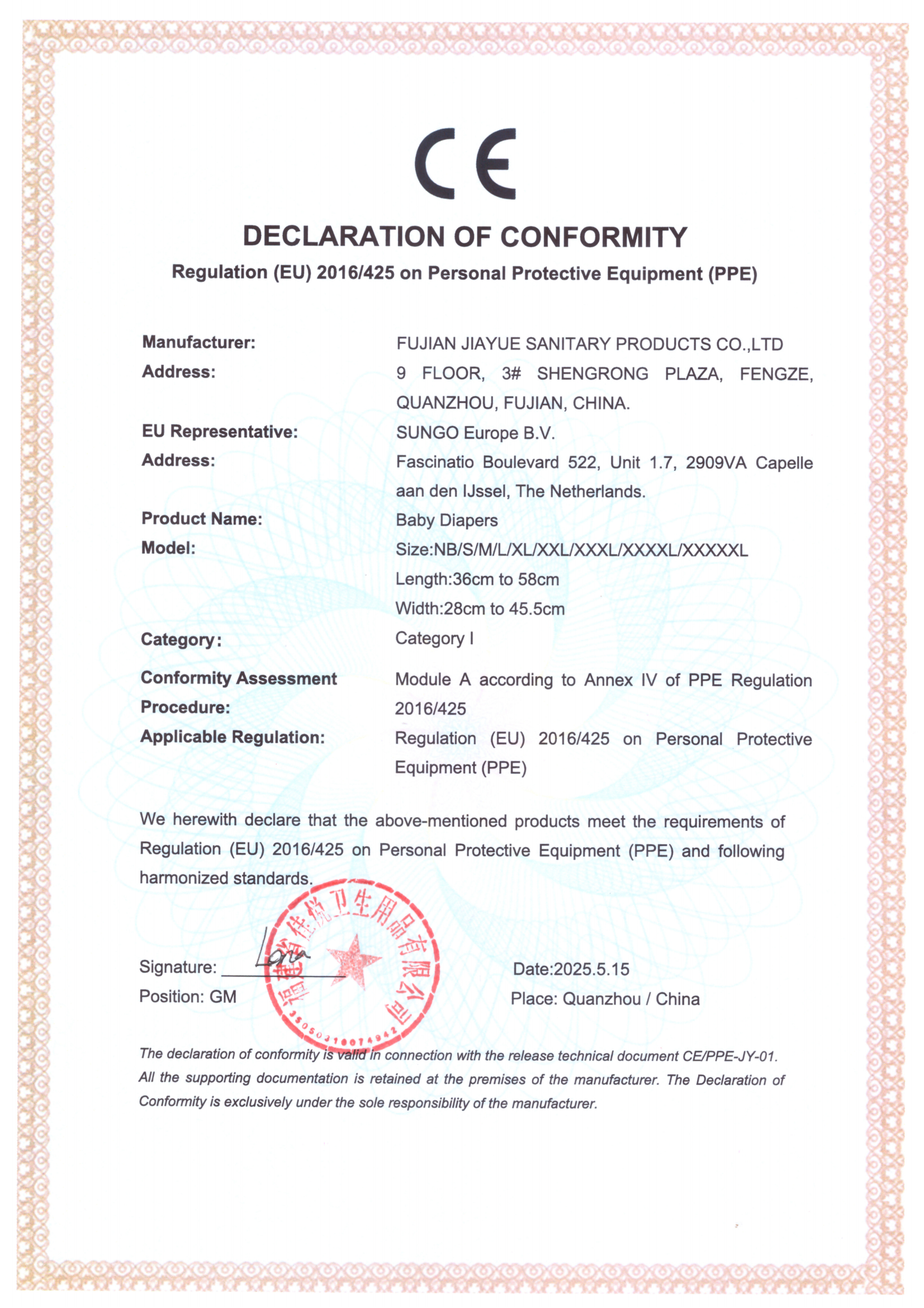
Importers should verify that the declaration's product description and size range match the exact SKU being ordered. A declaration covering baby diapers in a stated size range is not automatically evidence for every product in a wider portfolio. The buyer should also confirm the target market's requirements, label language, packaging information and any additional testing or documentation requested for the order. The CE record should be read as one part of the compliance file, not as a substitute for market-specific due diligence.
ISO 9001 coverage is separate. The supplied ISO 9001 certificate is NOA2314690, issued 2023-12-12 with an expiry date of 2026-12-11 by NOA Testing & Certification Group Ltd. Its scope is sales of sanitary products, maternal and infant products, and Class I medical devices, under GB/T 19001-2016 / ISO 9001:2015. For a baby diaper buyer, this is relevant to the sales and management-system coverage described in the certificate. It should be checked against the legal entity, site and activity being used for the order.
ISO 13485 has a narrower product relationship in the supplied record. Certificate NOA2314356 is issued 2023-12-06 with an expiry date of 2026-12-05 by NOA Testing & Certification Group Ltd., under GB/T 42061-2022 / ISO 13485:2016. Its scope is Class I medical device sales, and the related product listed is Ultra Thick Yibero Adult Women Diapers. ISO 13485 does not apply to baby diapers in the supplied record. Buyers should not present it as baby diaper certification. The certificate is relevant to the adult product scope, not to the baby diaper range.
Because both ISO certificate records list expiry dates in December 2026, buyers should confirm current validity and renewal status at the time of order. Certificate scope, legal entity and product coverage should be checked together. A certificate number alone is not enough; the buyer needs the document and its scope to match the transaction.
Application scenarios: how the shortlist maps to buyer programs
The applicable scenario material describes disposable baby hygiene and infant personal-care use in household daily indoor settings, at normal ambient temperature. The products are single-use articles for frequent daily changes, stored and used according to packaging instructions. Optional end-user items include diaper storage bins, wet wipes and changing mats. For an importer or private-label program, this scenario supports a range approach: tape-style diapers for caregiver-assisted changing and pull-up pants for active toddlers, with the core and size mix matched to the target market.
A company-published case reference describes an anonymized private-label baby diaper importer or distributor client. The project is described on a global basis, with the specific country not publicly disclosed. The case says the customer started with a trial container and progressed to repeat orders, with exact order volume not publicly disclosed. The listed baby diaper configuration has a product shelf life of 5 years under recommended storage conditions. The case also highlights flexible customization and free design support for private-label diaper programs.
A separate case reference covers overseas markets in Southeast Asia, South Asia and the Middle East and refers to more than 5 long-term OEM customers across multiple overseas markets. These are company-published references, not independently audited customer outcomes. They are useful for understanding the type of support a private-label program may involve: specification and absorbency adjustment, packaging and artwork coordination, size-mix planning, sampling, export documentation and repeat-order support. They should not be read as proof of demand in a specific country or as a guarantee of repeat orders for every buyer.
Procurement checks before a trial order
A practical shortlist review should end with a documented sample and specification, not a general impression. The buyer should request a sample set that covers the intended formats, sizes and core options. The sample review should compare the same criteria across options: reference absorbency against the agreed target, thickness, product weight, fit, material configuration and test results. Packaging, pack count, artwork, bag design and carton configuration should be reviewed at the same time, because they affect the SKU and order quantity.
Shortlist verification points
- Confirm tape-style or pull-up format by use case and size range.
- Confirm core structure and absorbency target against the approved sample.
- Check CE Declaration scope for the exact baby diaper SKU and size.
- Check ISO 9001 sales coverage and keep ISO 13485 in its adult product scope.
- Review packaging, artwork, pack count and size mix before mass production.
- Agree QC plan, test method, sampling level and acceptance criteria in the contract.
- Confirm MOQ, lead time, payment terms and export documentation in the quotation.
Jiayue's capability information states that the self-owned factory, Quanzhou Jiarun Paper Industry Co., Ltd., supports monthly production and shipment of more than 100 × 40HQ containers, subject to product specifications, packaging and production schedule. Typical production lead time is approximately 30–45 days, subject to sample, artwork, packaging and specification approval. The buyer FAQ also states that free samples are prepared in 1–3 working days with courier costs paid by the buyer, that baby-diaper containers may mix 3–4 sizes, and that payment methods include T/T, L/C at sight and Alibaba Trade Assurance. Final capacity, MOQ, lead time, testing requirements and payment terms are confirmed in the quotation, approved sample and sales contract.
Quality control is order-specific. The described process includes specification review, pre-production sample approval, in-process checks and pre-shipment inspection. The test method, sampling level and acceptance criteria must be agreed in the contract. Export documentation, artwork and packaging coordination, shipment planning and post-delivery issue handling are also part of the support scope according to the contract. For an importer, these are verification points, not automatic guarantees; they become meaningful when written into the approved specification and purchase order.
Market context: why range decisions matter
Third-party market estimates give context for range planning, but they do not replace SKU-level demand work. Grand View Research's 2026 report estimated the global baby diaper market at USD 83.3 billion in 2025. Fortune Business Insights' 2026 update reported Asia Pacific at 61.92% of the global diaper market in 2025. The verified data package notes that sources may define diaper and baby diaper differently, so these figures should be treated as directional context rather than directly interchangeable measurements.
For an importer, the practical implication is not to copy a headline market number into a purchase plan. It is to recognize that a baby diaper range often needs more than one format and more than one core direction. A distributor may need tape-style and pull-up coverage, different size bands, and packaging that fits local retail or wholesale channels. The shortlist should therefore be built around the buyer's channel, target user and compliance file, with market data used as background rather than as proof of demand for a specific SKU.
Outlook: shortlist discipline over a single hero SKU
The evidence supports a range-based approach rather than a single-product answer. Tape-style diapers and pull-up pants serve different changing routines. Fluff pulp & SAP and ultra-thin SAP paper cores are different design routes, with no universal performance advantage between them. CE scope, ISO 9001 sales coverage and the product-specific ISO 13485 scope must be read carefully and kept with the correct product.
The practical outlook is that importers will continue to need a shortlist that separates style, core, size and compliance. That shortlist should be rechecked against the approved sample, the final specification, the target market and the current certificate documents before each order. This is a repeatable procurement logic, not a promise about future demand or a claim that one option wins in every market.
For buyers who need a broader reference, the public JIAYUE Product Catalog 2026 is available here: JIAYUE Product Catalog 2026.
FAQ
What is the difference between tape-style baby diapers and baby pull-up pants?
Tape-style baby diapers are designed for caregiver-assisted changes, especially for younger babies who spend more time lying down. Pull-up pants are worn like underwear and are generally more convenient for crawling or walking babies. The choice depends on age, activity level, fit, absorbency requirements and changing habits. Neither format is universally better; the fit between format and routine is the relevant decision.
What is the difference between a fluff pulp & SAP core and an ultra-thin SAP paper core in diapers?
A fluff pulp & SAP core combines cellulose fluff pulp with superabsorbent polymer. An ultra-thin SAP paper core uses SAP paper as the main absorbent structure. Jiayue offers both core options for selected diaper products. There is no universal performance advantage between them. Buyers should compare thickness, target absorbency, product weight, fit, material configuration and test results against the approved specification and sample under the same conditions.
What should importers verify in Jiayue's CE Declaration of Conformity for baby diapers?
Importers should check that the declaration covers the exact product and size range being ordered. The supplied baby diaper record is CE/PPE-JY-01, issued 2025-05-15, and covers baby diapers in Category I across NB/S/M/L/XL/XXL/XXXL/XXXXL/XXXXXL, with listed dimensions of length 36–58 cm and width 28–45.5 cm. It is a self-declaration with SUNGO Europe B.V. identified as the EU representative. Buyers should also confirm the target market's own labeling, testing and documentation requirements.
Does ISO 13485 cover Yibero baby diapers?
In the supplied record, ISO 13485 certificate NOA2314356 has a scope of Class I medical device sales, and the related product listed is Ultra Thick Yibero Adult Women Diapers. It does not apply to baby diapers in that record. Buyers should not present ISO 13485 as baby diaper certification. The relevant baby diaper compliance document is the CE Declaration of Conformity, together with the applicable ISO 9001 sales coverage and any target-market requirements.
What should importers know before ordering Jiayue hygiene products?
Importers should confirm the product specification, approved sample, packaging and artwork, size mix, compliance documents and quality-control plan before mass production. The company states that monthly capacity exceeds 100 × 40HQ containers, typical production lead time is about 30–45 days, free samples are prepared in 1–3 working days with courier costs paid by the buyer, and baby-diaper containers may mix 3–4 sizes. Payment methods include T/T, L/C at sight and Alibaba Trade Assurance. Final capacity, MOQ, lead time, testing requirements and payment terms are confirmed in the quotation, approved sample and sales contract.
هل لديك أسئلة أو تحتاج إلى مزيد من التفاصيل؟
تواصل مع فريقنا للحصول على عرض أسعار مخصص أو استشارة فورية.
طلب عرض أسعار
املأ النموذج أدناه وسيتواصل معك فريقنا بعرض مقترح مخصص.
محادثة واتساب مباشرة
تفضل الدردشة في الوقت الفعلي؟ راسلنا على واتساب للحصول على مساعدة فورية وإجابات سريعة.
- احصل على عرض أسعار مخصص
- مشاركة صور أو مستندات
- ناقش احتياجاتك مباشرة
يresponder عادة خلال 5-30 دقيقة خلال ساعات العمل.