
Baby Diaper Procurement FAQ: SAP Paper, Fluff Pulp & Acceptance Criteria
Baby Diaper Procurement FAQ: SAP Paper, Fluff Pulp & Acceptance Criteria
Most disagreements between a diaper buyer and a diaper factory do not begin with quality. They begin with a sentence both sides read differently. A specification line reading “fluff pulp core, SAP paper, Sumitomo” can support two entirely different expectations, and neither party discovers the gap until the first container is opened.
QUANZHOU ERA SANITARY PRODUCTS CO.,LTD. (ERA) is a disposable hygiene manufacturer based in Jinjiang, Quanzhou, Fujian, China, founded in 2016, operating a 100,000 m² facility with approximately 220 employees and an annual output of 200,000,000 pieces. It produces baby diapers, pant diapers, sanitary pads, adult diapers, wet wipes and tissue under brands including my A+, OnePcDRY, Alotof, EcoBingo, my ERA and Binnions, and exports 100% of its output to Europe, the USA, Southeast Asia, Central Asia, South America, Africa and the Middle East.
This reference walks through nine procurement questions that determine whether a fluff pulp-based diaper programme is specified correctly, using ERA’s published model range — OD01, OD02, PD01, PD02, EB01, BD01 through BD08, AL01 and the OD01 catalogue record 6591 — as the working example. Each answer converts a material label into something a buyer can sign off, sample and test.
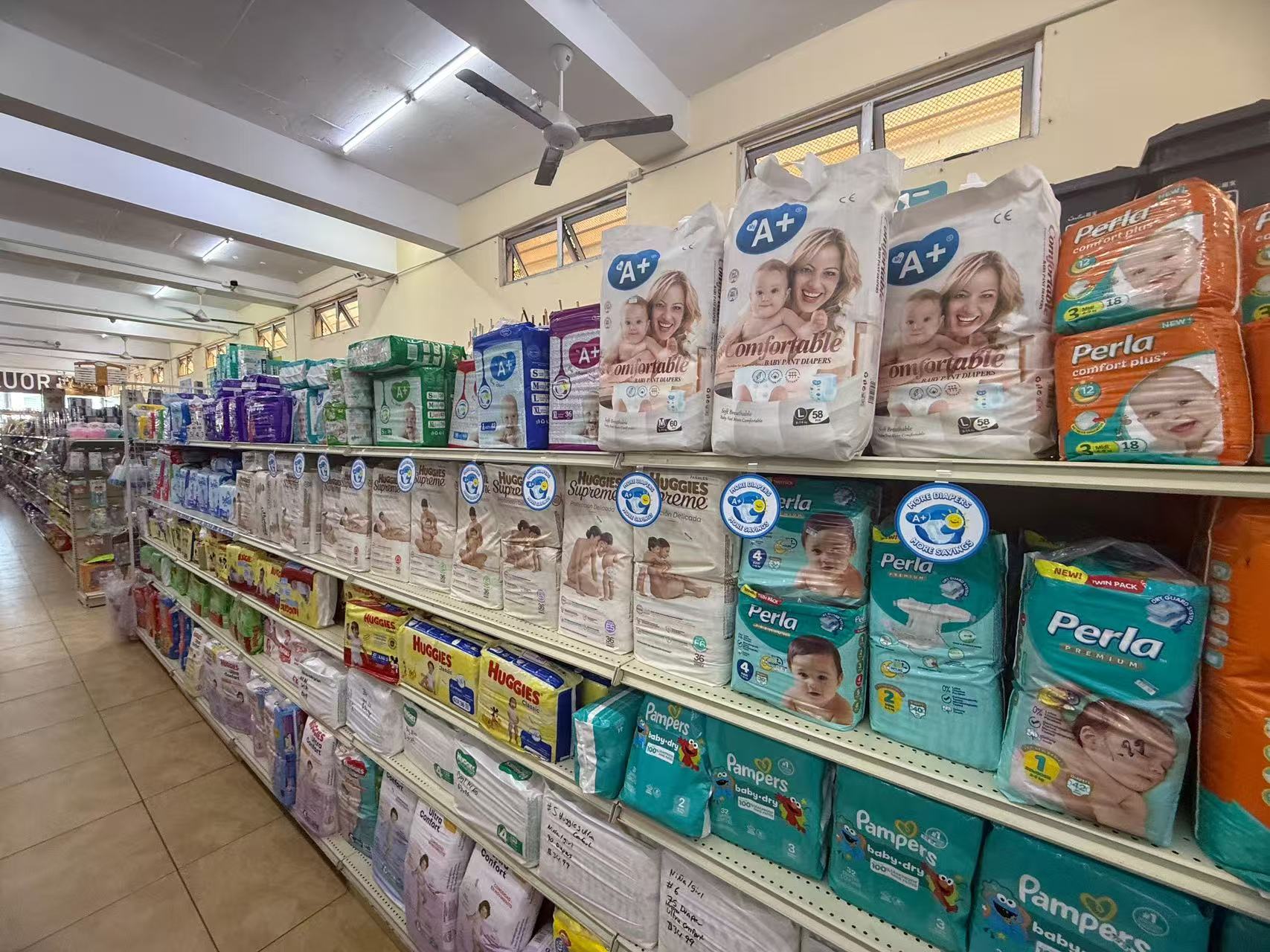
Retail shelf decisions are made upstream: the pack on the left is only as consistent as the signed specification behind it.
Why diaper specifications drift between sample and bulk order
Diaper specifications are written in material language, but they are enforced in performance language. “Full 100% SAP Paper” describes a core format. “Japan Sumitomo 50% + Japan Sandia” describes a supplier split. Neither sentence tells a buyer what absorbency, rewet or retention the finished product must reach, and neither states the test method that decides pass or fail. That gap is where sample-stage optimism becomes bulk-stage dispute.
The sourcing environment amplifies the problem. According to Xiamen Customs data reported by EIN Presswire, Fujian Province accounted for 63.9% of China’s total baby diaper exports in 2024, with export volume of 8.74 billion yuan. Supplier density is high, which makes shortlisting easy and differentiation hard. When several factories in the same industrial cluster quote the same headline specification, the deciding variable shifts from “who has SAP paper” to “who documents the specification precisely enough to be audited.”
Grand View Research values the global baby diapers market at USD 88.5 billion in 2026, projected to reach USD 141.8 billion by 2033. Growth of that scale keeps new buyers entering the category every quarter — and most of them arrive with a specification template that has never been tested against a real production line.
Core material questions buyers ask first
In the ERA range it is a core-format designation. OD01, PD01 and PD02 list “Full 100% SAP Paper” as the absorbent core, with OD01 specifying Sumitomo + Sandia SAP “in perfect ratio” and PD01/PD02 specifying LG + Sumitomo. It is not a statement about the percentage of SAP in total product weight, and it is not a performance guarantee.
The distinction matters because the same range also contains models built differently. BD01–BD04 use a floated core built on a Japan Sumitomo 50% + Japan Sandia SAP paper sheet. BD05, BD06 and BD07 pair Japan SAP with USA fluff pulp and green ADL and are threefolded. AL01 lists “SAP Paper” together with USA fluff pulp in a single feature line — precisely the kind of compound phrase that should be broken into separate sign-off items before a purchase order exists.
Practical rule: convert the label into four auditable entries — core type, SAP supplier designation, ratio where the specification publishes one, and the acceptance test method. Only the fourth entry is enforceable.
Three supplier patterns appear across the range. BD01, BD03 and BD04 state Japan Sumitomo 50% plus a Japan Sandia SAP paper sheet; BD02 states the split explicitly as 50% Japan Sumitomo and 50% Japan Sandia. OD01 states Sumitomo + Sandia “in perfect ratio” without publishing a numeric split. PD01 and PD02 state LG + Sumitomo. BD05, BD06 and BD07 specify Japan SAP without naming the supplier.
For procurement, the ratio is a specification attribute, not marketing copy. Once a ratio is written into a signed specification, changing it is a spec change and should trigger written notification rather than a silent substitution. Where no ratio is published — OD01, for example — the buyer should either accept that the ratio is supplier-controlled and request batch-level supplier confirmation, or require the ratio as a condition of sign-off. Both are defensible; leaving it undefined is not.
A second supplier designation also implies a dual-source core. Dual sourcing is a supply-continuity advantage, but it only holds if the buyer knows which two suppliers and under what substitution rules. Record both.
Limitation to note: ratio alone does not predict absorbency. Two cores with identical supplier ratios can behave differently if the pulp grade, core density or ADL construction differs. The ratio tells you about sourcing discipline, not about performance.
The declared material field for the whole range — AL01, BD02, BD03, BD05, BD06, BD07, EB01, PD01, PD02 and OD01 — reads “Fluff Pulp.” Named USA fluff pulp appears in the feature lists of AL01, BD05, BD06, BD07 and EB01. SAP paper appears as a sheet format in OD01, PD01, PD02 and BD01–BD04.
The two materials therefore coexist in the same range rather than competing. The buyer-relevant question is not “fluff pulp or SAP paper” but “what function does the pulp perform in this core — carrier, distribution layer or part of the absorbent body?” The published specifications do not state pulp grade or pulp-to-SAP ratio by weight. Those are exactly the fields that must be fixed during specification sign-off, because they are the fields a factory can change without visibly changing the product.
No single model spans the full size ladder. Newborn (NB) is available on BD01, BD02 and OD01. XXXL is available only on AL01 and EB01. PD01 starts at M and stops at XXL. BD05, BD06 and BD07 stop at L or XL. BD04 covers S, M and L only.
The procurement consequence is structural: a single-supplier programme running from newborn to XXXL requires at least three models, and possibly two core formats. A distributor that shortlists one model and assumes size extension later will end up re-qualifying a second model mid-programme — with a second sample cycle, a second set of artwork and a second certificate review.
Model-by-model comparison for specification sign-off

Model BD05: USA fluff pulp with Japan SAP and green ADL, threefolded, in sizes S–L — a different core architecture from the SAP paper group.
| Model (brand) | Core / SAP designation | Fluff pulp named | Sizes | Backsheet | Closure / waist | Wetness indicator |
|---|---|---|---|---|---|---|
| OD01 — catalogue record 6591 (ONePcDRY) | Full 100% SAP paper; Sumitomo + Sandia “in perfect ratio”; floated core; ammonia-removed 3D technology | Not stated in feature list | NB, S, M, L, XL | Hot air super soft backsheet | Not stated; double leak guard | Listed |
| OD02 (ONePcDRY) | Detailed specification not included in the documentation reviewed | To be confirmed | To be confirmed | To be confirmed | To be confirmed | To be confirmed |
| PD01 (my A+) | Full 100% SAP paper (LG + Sumitomo); floated core; anti-rash oil lines | Not stated in feature list | M, L, XL, XXL | Super soft clothlike breathable spunbond backsheet | Crotch elastic design; leak guard | Listed |
| PD02 (my A+) | Full 100% SAP paper (LG + Sumitomo); floated core | Not stated in feature list | S, M, L, XL, XXL | Soft hot air non-woven backsheet | Dispose tapes; crotch elastic design | Listed |
| EB01 (EcoBingo) | USA fluff pulp + SAP; T-shape; eco-friendly construction | Yes — USA fluff pulp | S, M, L, XL, XXL, XXXL | Bamboo fiber backsheet | Double leak guard; biodegradable kraft paper bag | Listed |
| BD01 (my A+) | Floated core; Japan Sumitomo 50% + Japan Sandia SAP paper sheet | Declared material: fluff pulp | NB, S, M, L, XL | Clothlike breathable backsheet | S-shape magic tapes; spandex elastic waistband; double leak guard | Listed |
| BD02 (my A+) | Floated core; Japan Sumitomo 50% + Japan Sandia 50% | Declared material: fluff pulp | NB, S, M, L, XL | Clothlike breathable backsheet | S-shape magic tapes; spandex elastic waistband; double leak guard | Listed |
| BD03 (my A+) | Japan Sumitomo 50% + Japan Sandia SAP paper sheet | Declared material: fluff pulp | S, M, L, XL | Hot air super soft backsheet | S-shape magic tapes; spandex elastic waistband; double leak guard; KeepDry liner | Listed |
| BD04 (my A+) | Floated core; Japan Sumitomo 50% + Japan Sandia SAP paper sheet | Declared material: fluff pulp | S, M, L | Hot air super soft backsheet | S-shape magic tapes; spandex elastic waistband; double leak guard | Listed |
| BD05 (my A+) | Japan SAP + green ADL; threefolded | Yes — USA fluff pulp | S, M, L | Colorful clothlike breathable backsheet | S-shape magic tapes; spandex-elastic-ring waistband; leak guard | Not listed in feature set |
| BD06 (my A+) | Japan SAP + green ADL; threefolded | Yes — USA fluff pulp | S, M, L, XL | Colorful clothlike breathable backsheet | S-shape magic tapes; spandex-elastic-ring waistband; leak guard | Not listed in feature set |
| BD07 (my A+) | Japan SAP + green ADL | Yes — USA fluff pulp | S, M, L | Colorful clothlike breathable backsheet | S-shape magic tapes; spandex-elastic-ring waistband; leak guard | Not listed in feature set |
| BD08 (my A+) | Series variant; detailed specification not included in the documentation reviewed | To be confirmed | To be confirmed | To be confirmed | To be confirmed | To be confirmed |
| AL01 (Alotof) | SAP paper with USA fluff pulp; T-shape; crotch elastic design | Yes — USA fluff pulp | S, M, L, XL, XXL, XXXL | Hot air super soft backsheet | Dispose tape; double leak guard | Listed |
Table note: supplier designations and ratios are reproduced as printed in the model specifications. Where a field reads “to be confirmed,” the information is not part of the documentation reviewed and must be obtained from the current specification sheet before shortlisting.
Acceptance criteria and sample validation
Each of these features differs by model, so a single blanket line in the purchase contract will not hold. Leak protection is specified as “double leak guard” on OD01, AL01, EB01, BD01–BD04, and as “leak guard” on BD05–BD07 and PD01/PD02. Backsheets differ in construction: clothlike breathable on BD01 and BD02, hot air super soft on BD03, BD04, PD02 and OD01, colorful clothlike breathable on BD05–BD07, super soft clothlike breathable spunbond on PD01, and bamboo fiber on EB01. Closures split between S-shape magic tapes with spandex elastic waistbands (BD series), spandex-elastic-ring waistbands with S-shape magic tapes (BD05–BD07), dispose tapes (AL01, PD02) and crotch elastic designs (OD01, PD01, PD02, AL01).
One difference is easy to miss and expensive to discover late: the wetness indicator is listed for AL01, EB01, OD01, PD01, PD02 and BD01–BD04, but is not part of the published feature set for BD05, BD06 and BD07. A buyer who assumes it is standard across the BD series will approve a sample that does not match the bulk order expectation.
The correct approach is to write the acceptance criteria as a per-model feature table, then attach it as an annex to the purchase agreement. Criteria should name the model code, not the product family.
Sample validation is a sequence of confirmations, not a single approval moment.
- Specification sign-off first. The model code, core format, SAP supplier designation, ratio (where published), size list and feature set are agreed in writing before samples are requested. Without this, sample feedback has no reference point.
- Sample both ends of the size range. A single mid-size sample will not reveal fit behaviour at NB on BD01 or at XXXL on EB01 and AL01, where the construction stresses are different.
- Verify the feature list item by item. Leak guard count, backsheet type, closure type, waistband type, wetness indicator presence — each confirmed against the annex, not against a marketing page.
- Match certificates to the exact model and market. Certificate scope is model-specific and market-specific, and this is where most tender reviews fail (see question 7).
- Retain a sealed reference sample. The approved sample becomes the golden sample against which bulk shipments are compared. Without a retained reference, bulk disputes become opinions.
- Agree the deviation process before the purchase order. Decide in advance who is notified, how quickly, and what remedy applies if a material substitution occurs.
ERA states 100% test as its quality-control approach, with material and logo customization available under OEM/ODM. A recorded OEM programme delivered 10,000,000 pieces into maternity and baby products retail, with repeat orders and a stated shelf life of three years — a useful reference point for what a stable programme looks like after validation, though it is a single case rather than a performance benchmark.

Third-party test documentation is only useful in acceptance if the certificate names the exact model and market it covers.
Certification in this category is issued against a model or a defined scope, not against a brand in general. In the ERA documentation, CE certification ICR/VC/HM2507251 under EN ISO 11948-1:1996 and EN ISO 11948-2:1998 applies to model BD01 for the EU market. ASTM F963 certification XNO250113503YX3-1 (ASTM F963-23, 16 CFR Part 1500 Series, CPSIA requirements) and CPC certificate XNO250113502YX2-1 also attach to BD01. ISO 13485:2016 certification 381240080R0S covers disposable hygiene products including baby diapers, adult diapers, sanitary pads, under pads, tissue and absorbent pads. ISO 14001:2015 certification 29325E912342R0S, issued by Aopeng Certification Co., Ltd., covers the hygiene product scope including baby diapers. Dermatest ST-ET-2026-00055, issued by Dermatest GmbH, covers the my A+ non-woven top sheet skin compatibility test. REACH testing was issued by SGS under certificate XMNCPCH25002810801, and HALAL certification 30113766206426 was issued by the Halal Foundation Center (Hong Kong).
The tender implication is direct: a certificate held for BD01 does not automatically extend to BD08, OD02 or EB01. Buyers should request certificate copies that name the model and the destination market, and should treat scope language — “disposable hygiene products” versus a named model — as part of the acceptance review rather than an administrative detail.
The documented commercial terms are a minimum order quantity of 100,000 pieces, a lead time of 25–35 days, monthly capacity of 20,000,000 pieces, OEM/ODM production with material and logo customization, and remote after-sales support.
Two clarifications are worth raising before signature. First, whether the 100,000-piece MOQ applies per model or per size: a six-size programme such as AL01 or EB01 could otherwise split a single order into six sub-MOQ decisions. Second, how the lead time is measured — from purchase order, from artwork approval, or from specification sign-off — because artwork approval is frequently the step that slips.
On cost, no unit price is published in the source documentation, and it would be inaccurate to quote a price band here. What can be said structurally is that SAP paper cores and fluff-pulp-plus-SAP cores carry different raw-material bills, so comparing them on piece price alone compares two different things. The comparison should be run at equal acceptance performance: same size, same absorption test method, same leakage criterion. Only then does a per-piece difference mean anything.
Treat the gap as a data request, not as a reason to guess. OD02 and BD08 appear in the model range and in the associated certificate records, but their detailed construction is not part of the documentation reviewed here. Requesting the current specification sheet is the correct action; assuming the specification matches a neighbouring model is not.
The same rule applies to fields marked “not stated” in the comparison table. Absence of a stated field is not evidence that the feature is missing — it is evidence that the field has not been documented, and therefore cannot be enforced.
Boundaries: what this specification set does not settle
Three limits deserve equal weight to the strengths.
First, none of the published specifications contain absorbency, rewet or retention values, and none define the test method used to accept them. A buyer who signs on material labels alone has signed a sourcing document, not a performance contract. The performance criteria must be added by the buyer or agreed jointly, and they should reference the standards already cited in the certification set where applicable.
Second, certificate coverage is uneven by design. Model-specific certificates for BD01, a scope-level environmental certificate for the hygiene product range and a top-sheet skin compatibility certificate for my A+ do not add up to a uniform compliance position across fourteen models. A multi-model programme should expect to build a model-by-market certificate matrix rather than rely on a single document package.
Third, the material platforms are not interchangeable. EB01 uses a bamboo fiber top sheet and back sheet with USA fluff pulp and SAP; the OD and PD models use SAP paper cores; the BD05–BD07 group uses USA fluff pulp with Japan SAP and green ADL. Switching between these to chase a cost target changes the supply base, the acceptance test set and often the packaging format — EB01, for example, ships in a biodegradable kraft paper bag. Treat each platform as a separate qualification, not as a variant of the same product.
Market signals shaping specification discipline
Two signals are relevant to how buyers will write specifications over the next cycle. The first is scale: a market moving from USD 88.5 billion in 2026 toward USD 141.8 billion by 2033, on Grand View Research figures, attracts new capacity and new supplier entrants, which raises the value of auditable documentation over brand claims.
The second is material diversification. A secondary industry analysis cited in the 2026 sourcing literature estimates that bamboo biodegradable diapers could take 39% of the biodegradable diaper segment by 2026. That figure should be treated as a directional signal from a secondary source rather than a settled statistic, but the direction is consistent with what the model range already shows: a bamboo fiber platform sitting alongside SAP paper and fluff pulp platforms in the same catalogue.
Future outlook
The next phase of diaper procurement will be less about which SAP brand appears on the spec sheet and more about whether the specification can be tested. Three developments are likely to matter. Supplier designations will increasingly be written with substitution-notification clauses, because dual-source cores such as Sumitomo plus Sandia and LG plus Sumitomo only deliver continuity if the substitution rules are explicit. Size ladders will be planned as multi-model programmes from the outset, since no single model in this range spans newborn to XXXL. And acceptance criteria will migrate from feature lists into test protocols, because feature lists describe what a factory intends to build while test protocols describe what it has to prove.
For buyers evaluating ERA specifically, the practical starting point is the model matrix above: choose the core architecture first, the size coverage second, and the certificate matrix third. That order keeps the commercial negotiation anchored to something verifiable.
Short-answer FAQ for tender documents
What is the difference between a 100% SAP paper core and a fluff pulp core in this range?
A 100% SAP paper core is built on SAP paper as the absorbent format (OD01, PD01, PD02). BD01–BD04 use a floated core with a Sumitomo and Sandia SAP paper sheet plus declared fluff pulp. BD05–BD07 pair Japan SAP with USA fluff pulp and green ADL. The declared material field across the range reads “Fluff Pulp” in every case.
Does every model carry the same certifications?
No. CE, ASTM F963 and CPC documentation in the reviewed set attaches to model BD01; ISO 13485 covers the disposable hygiene product scope; ISO 14001 covers the hygiene product scope including baby diapers; Dermatest covers the my A+ non-woven top sheet. Certificate scope must be checked per model and per market.
Which models cover newborn and which cover XXXL?
NB is available on BD01, BD02 and OD01. XXXL is available on AL01 and EB01. A newborn-to-XXXL programme therefore requires multiple models.
What are the standard order terms?
MOQ is 100,000 pieces, lead time is 25–35 days, monthly capacity is 20,000,000 pieces, and production is OEM/ODM with material and logo customization.
Do all BD models include a wetness indicator?
It is listed for BD01, BD02, BD03 and BD04, but is not part of the published feature set for BD05, BD06 and BD07. Confirm per model during sign-off.
For the full model and certification reference, the 2026 ERA catalogue is available for download: ERA Catalogue 2026 (PDF).
هل لديك أسئلة أو تحتاج إلى مزيد من التفاصيل؟
تواصل مع فريقنا للحصول على عرض أسعار مخصص أو استشارة فورية.
طلب عرض أسعار
املأ النموذج أدناه وسيتواصل معك فريقنا بعرض مقترح مخصص.
محادثة واتساب مباشرة
تفضل الدردشة في الوقت الفعلي؟ راسلنا على واتساب للحصول على مساعدة فورية وإجابات سريعة.
- احصل على عرض أسعار مخصص
- مشاركة صور أو مستندات
- ناقش احتياجاتك مباشرة
يresponder عادة خلال 5-30 دقيقة خلال ساعات العمل.