
Baby Diapers in 2026: A Buyer’s Map of Types, Materials and Market Signals
Baby diapers are no longer described by one product sheet. For importers, distributors and private-label buyers, the category now includes age-specific sizing, different absorbent cores, materials, formats and retail logic. This overview is intended for buyer teams that are at the awareness-to-research stage and need a neutral map before comparing suppliers.
Industry context: a broad category is becoming more segmented
According to data cited by Grand View Research, the global baby diapers market was valued at approximately USD 83.3 billion in 2025 and is projected to reach USD 141.8 billion by 2033. Fortune Business Insights estimates that Asia Pacific dominated the diaper market with a 61.92% share in 2025, generating approximately USD 50.01 billion. On the manufacturing side, Fujian Province accounted for 63.9% of China’s total baby diaper exports in 2024, with an export value reaching 8.74 billion yuan. Together, these figures explain why many buyers start their search with the broad term baby diapers, but then quickly need a clearer structure: the product type, the buying channel, the material story and the supplier’s capability are separate decisions.
The buyer’s problem: one search term hides many product decisions
Procurement teams often begin with a simple search for baby diapers and then discover that the market is divided among newborn diapers, toddler products, tape-style diapers, pull-up pants, plus-size fits, night-use concepts, ultra-thin designs, breathable backsheets, anti-rash materials and eco-friendly versions. Each of these descriptions points to a different set of technical choices. Without a category map, a buyer may compare products that look similar but use different acquisition layers, fluff pulp ratios, SAP combinations, backsheet structures or elastic systems.
The opportunity is significant. The premium segment within the baby diaper market is projected to grow at a CAGR of 7.2% through 2027, outpacing conventional products. Bamboo-based biodegradable diapers are also expected to hold a 39% share of the biodegradable segment by 2026, based on projections from Future Market Insights. These numbers suggest that buyers who understand segment-level product architecture can source with more confidence than buyers who simply ask for one specification.
A reference example: how a full-category manufacturer maps the market
Quanzhou ERA Sanitary Products Co., Ltd. is a useful example for this kind of early-stage research because its portfolio is structured across multiple diaper models and brands. The company is based in Jinjiang, Quanzhou, Fujian, China, and was established in 2016. It operates a 100,000 square metre facility, employs approximately 220 people and has an annual production capacity of 200,000,000 pieces. Its main products include baby diapers, pull-up pant diapers, sanitary pads, adult diapers, wet wipes and tissue paper. Export business accounts for 100% of total sales, with major markets in Europe, the USA, Southeast Asia, Central Asia, South America, Africa and the Middle East.
The company owns multiple registered brands, including my A+, OnePcDry, Alotof, EcoBingo, my ERA and Binnions. Its product catalogue includes tape-style baby diapers with S-shape magic tapes, diaper models with clothlike breathable backsheets, models positioned around super absorbent cores and a bamboo fibre option in the EcoBingo line. For a buyer in the discovery phase, this variety is more useful than a single product claim because it shows the range of decisions that must be made before choosing a supplier.
Technical explanation: what matters inside a baby diaper specification
Disposable baby diaper specifications are usually built around several functional layers: a topsheet that touches the skin, an acquisition or distribution layer, an absorbent core with fluff pulp and SAP, a backsheet, elastics and closure systems. Many models in the current specification set list fluff pulp as the primary material and use Japan SAP or USA fluff pulp in the core. The topsheet can be hot-air nonwoven or spunbond nonwoven. Backsheets can be clothlike, breathable, hot-air treated or bamboo fibre based, depending on the product position.
The table below groups the representative models by their core positioning:
| Model examples | Core features from current specifications | Size range |
|---|---|---|
| BD01, BD02, BD03, BD04 | Hot-air super soft embossed topsheet, double leak guard, wetness indicator, spandex elastic waistband, S-shape magic tapes, floated core with Japan Sumitomo SAP and Japan Sandia SAP. BD01 and BD02 include clothlike breathable backsheets; BD03 and BD04 use hot-air super soft backsheets. | NB, S, M, L, XL depending on model; BD04 is available in S, M, L |
| BD05, BD06, BD07, BD08 | Threefolded diapers with Japan SAP and USA fluff pulp, green ADL acquisition layer, spunbond nonwoven topsheet, S-shape magic tapes, colorful clothlike breathable backsheet, spandex-elastic-ring waistband and leak guard. | S, M, L, XL, XXL depending on model |
| PD01, PD02 | Full 100% SAP paper core using LG and Sumitomo SAP, leak guard, crotch elastic design, wetness indicator, soft hot-air nonwoven topsheet. PD01 has a super soft clothlike breathable spunbond backsheet and anti-rash oil lines; PD02 is described with a super soft hot-air nonwoven backsheet and dispose tapes. | S, M, L, XL, XXL depending on model; PD01 begins at M |
| OD01, OD02 | ONePcDRY models with 100% SAP paper core containing Sumitomo and Sandia SAP in a balanced ratio, Ammonia Removed 3D Technology, floated core, hot-air super soft topsheet and backsheet, double leak guard and wetness indicator. | NB, S, M, L, XL up to XXL or XXXL depending on model |
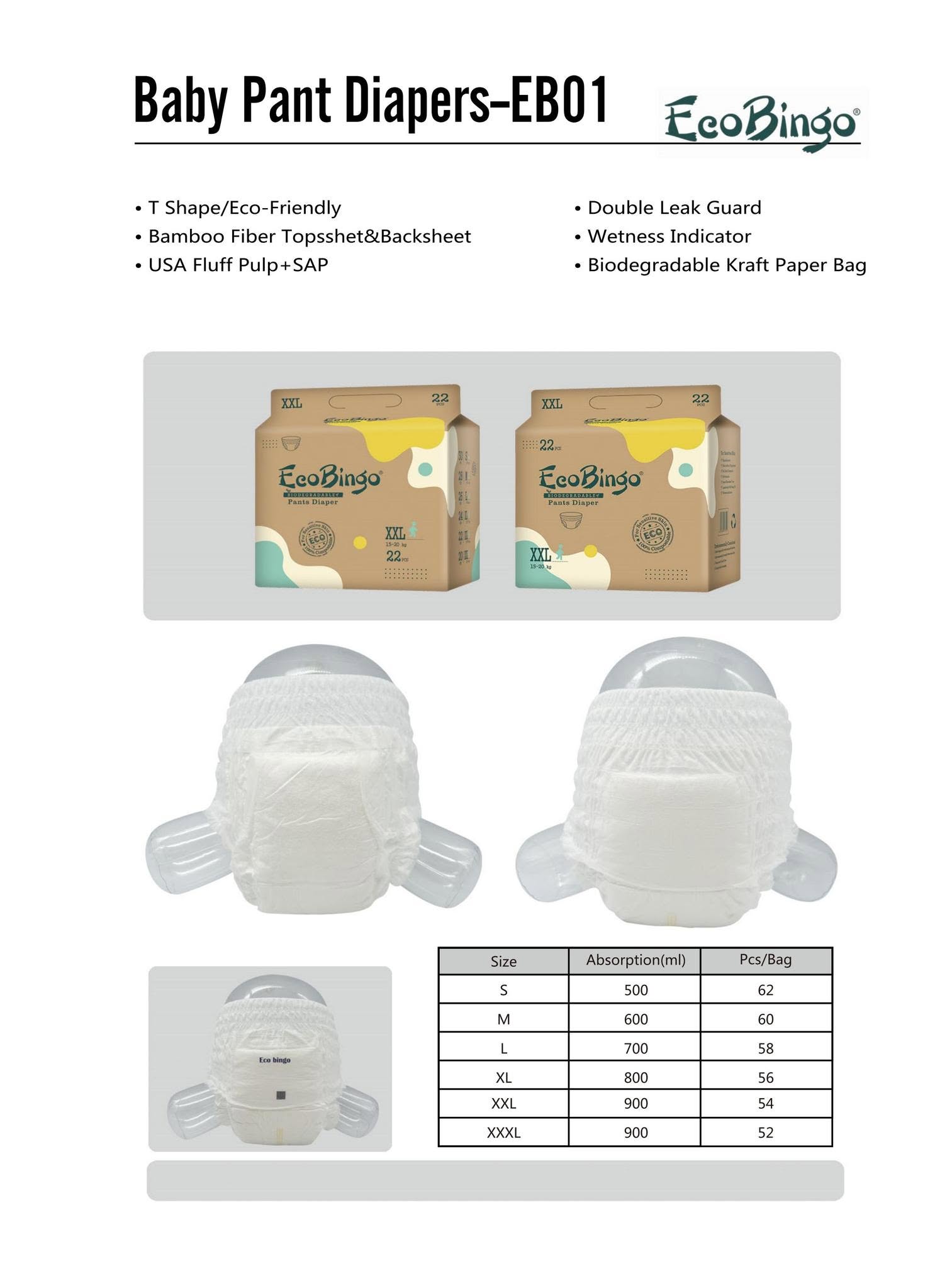
| EB01 | EcoBingo model with T-shape design, bamboo fibre topsheet and backsheet, double leak guard, wetness indicator, USA fluff pulp and SAP, packaged in a biodegradable kraft paper bag. | S, M, L, XL, XXL, XXXL |
For a buyer, these specification differences are not academic. Models with a breathable backsheet address warm-climate markets. Models with a double leak guard respond to leakage complaints. Models with a wetness indicator help parents reduce unnecessary changes. Models with a full SAP core may be positioned for longer wear. Hypoallergenic formulations and freedom from parabens, elemental chlorine and latex are common claims across the model list and are relevant when a retail channel expects a skin-friendly message.
Application and use cases: matching product architecture to channel reality
The application scenario in the product data describes indoor daily home use, suitable for all climate conditions and normal ambient temperature. It also covers travel and childcare centre scenarios, with emphasis on comfort, breathability, long-lasting absorbency and leak prevention. These daily conditions may seem obvious, but they explain why retailers carry multiple diaper models instead of a single SKU.
In mother-and-baby retail stores, buyers usually need a size ladder that moves from newborn to toddler. In supermarkets, the product should have packaging and case logic that supports self-service purchase and regular replenishment. In cross-border e-commerce, clear product descriptions, certifications and brand differentiation become part of the physical product. The current portfolio is described as intended for the baby care, mother and baby retail, supermarket and cross-border e-commerce industries. A supplier with multiple registered brands can support channel separation more easily than a factory that only offers one brand and one packaging format.
For wholesale buyers, the combination of size range and model positioning deserves attention. Newborn-oriented models such as BD01 and BD02 are available from NB size. Plus-size and larger toddler requirements can be covered by models that extend to XXL or XXXL, such as BD08, EB01 or OD02, though every order should be matched to the actual model specification sheet.
Market trend analysis: what the data suggests for 2026 buyers
Several verified market signals help place baby diapers in a longer sourcing context:
The global baby diaper market is projected to grow from about USD 83.3 billion in 2025 to USD 141.8 billion by 2033. This scale makes baby diapers one of the largest product groups in the daily consumer goods space.
Asia Pacific’s 61.92% share in 2025 indicates that demand, manufacturing and trade will continue to be concentrated around this region. At the same time, Fujian’s 63.9% share of China’s baby diaper exports confirms that the province is not just an ordinary manufacturing location; it is the core export cluster for this product category.
The premium segment’s projected 7.2% CAGR through 2027 suggests that future growth will not be limited to low-tier price competition. Retailers and distributors will continue to look for products that can justify a higher price through materials, comfort, fit or certification evidence.
Bamboo-based biodegradable diapers are projected to hold a 39% share of the biodegradable segment by 2026. This data point explains why the EcoBingo model, with its bamboo fibre topsheet and backsheet and biodegradable kraft paper bag, fits into an emerging conversation about material choice and disposal footprint.
Comparison: modern disposable diapers versus traditional cloth/reusable alternatives
Buyers entering the baby diaper category will also hear retailer debate about disposable versus cloth or reusable diapers. The comparison is useful because it forces the buyer to define which problem the product is solving.
| Consideration | Modern disposable baby diaper | Traditional cloth/reusable alternative |
|---|---|---|
| Absorbency | SAP and fluff pulp core can hold a relatively large amount of liquid for its weight, which supports fewer changes. | Absorbent fabric layers must be changed soon after wetness; retention depends on layering and cover. |
| Convenience | Single-use format is easy for travel, childcare centres and busy caregivers. | Requires washing, drying and rotation; more practical in stable home settings. |
| Fit and sizing | Models can span NB to XXL or XXXL, with elastic waistbands and leak guards. | Adjustable snaps and covers can adapt to many body sizes but may involve extra fitting effort. |
| Skin and allergy | Several current models are hypoallergenic and free of parabens, elemental chlorine and latex. | Cloth reduces synthetic SAP exposure but detergent residue and washing routines can also affect skin. |
| Environmental impact | Single-use disposables create solid waste that must be disposed responsibly. | Reusables reduce single-use waste but use water, energy and detergent over their lifecycle. |
One real boundary should be stated clearly: disposable baby diapers are designed for single use. Buyers should not interpret high absorbency as a reason to extend wearing time beyond safe hygiene practice. For families or institutions with strong waste-reduction requirements, cloth/reusable alternatives may be appropriate, but they answer a different operational need. A sourcing strategy can include both formats without treating one as a universal replacement for the other.
Future outlook: evidence and segmentation will shape supplier choice
Looking ahead, baby diaper buyers will probably face more product segmentation rather than less. The market signals point in three directions. First, premium growth will encourage suppliers to explain why their SAP selection, core construction or backsheet material deserves a higher price. Second, environmental claims will need to be supported by credible material and certification information rather than by packaging colour alone. Third, channel-specific demands will increase: e-commerce sellers may need smaller pack configurations, while supermarkets may need larger value packs and consistent replenishment.
For a manufacturer such as Quanzhou ERA, the practical consequence is that its value is not only in one diaper model but in the range of evidence it can show: a 100,000 square metre production base, an annual capacity of 200 million pieces, 15 engineers in R&D, more than 10 patents, over 100 copyrights, and international certifications covering CE, FDA, ISO9001, ISO13485, ISO11948, ISO14001, ISO45001, ISO22716, SGS, Halal, CPC, MSDS and DERMATEST. These factors are important signals for buyers moving from simple product discovery to supplier evaluation.
FAQ
What are disposable baby diapers made of?
A typical disposable baby diaper uses an absorbent core combined with synthetic absorption material. In the current model set, fluff pulp is the primary material for many diapers, and SAP is used as the super absorbent polymer. The topsheet may be hot-air nonwoven or spunbond nonwoven, while the backsheet can be clothlike breathable, hot-air nonwoven or bamboo fibre. Construction also includes elastic waistbands, S-shape magic tapes, leak guards and wetness indicators on many models.
What is the difference between newborn, baby, toddler and plus-size diaper sizing?
In the product data, sizes are expressed as NB, S, M, L, XL, XXL and XXXL. NB generally refers to newborn sizing. S, M and L cover the progression from infant to toddler sizes. XL, XXL and XXXL extend the range to larger toddlers or plus-size fits. For example, BD01, BD02 and OD01 are available from NB size, while BD08 and EB01 extend to XXL or XXXL. Pull-up pant diapers are also listed in the company’s overall main product range for later toddler stages.
Which certifications matter for baby diaper sourcing?
Certification requirements depend on destination market. In the EU, for example, baby diapers must comply with REACH, which restricts more than 1,900 hazardous substances. Many suppliers also follow OEKO-TEX Standard 100. For Quanzhou ERA, the corporate certification list includes CE, FDA, ISO9001, ISO13485, ISO11948, ISO14001, ISO45001, ISO22716, SGS, Halal, CPC, MSDS and DERMATEST. Specific models may carry additional certificates. For example, model OD01 is described as certified to REACH standards by SGS, with certification number XMNCPCH25002810801.
Are bamboo fibre baby diapers a practical option?
The EcoBingo model EB01 is an example of a bamboo fibre baby diaper. It uses bamboo fibre topsheet and backsheet, a T-shape design, a double leak guard and a wetness indicator, and it is packaged in a biodegradable kraft paper bag. It is described as eco-friendly and hypoallergenic, and free of parabens, elemental chlorine and latex. Market projections from Future Market Insights indicate that bamboo-based biodegradable diapers could account for a 39% share of the biodegradable diaper segment by 2026. The practical fit depends on the target consumer and local disposal infrastructure.
What should a buyer do after reading a baby diaper specification?
After reviewing the specification, the buyer should map the product to a specific retail channel and use case. Useful next questions include: which sizes are available for this model, what type of SAP and fluff pulp are used, whether the backsheet is breathable, which leak protection features are included, whether there is a wetness indicator, which certificates are held by the manufacturer, and whether the packaging format matches the target market. These questions turn a general baby diaper search into a clear purchasing brief.
Further reference
The company publishes a current product catalogue for public reference. Buyers who want to review the full product range and detailed specification sheets can access it here: ERA 2026 Product Catalog.
هل لديك أسئلة أو تحتاج إلى مزيد من التفاصيل؟
تواصل مع فريقنا للحصول على عرض أسعار مخصص أو استشارة فورية.
طلب عرض أسعار
املأ النموذج أدناه وسيتواصل معك فريقنا بعرض مقترح مخصص.
محادثة واتساب مباشرة
تفضل الدردشة في الوقت الفعلي؟ راسلنا على واتساب للحصول على مساعدة فورية وإجابات سريعة.
- احصل على عرض أسعار مخصص
- مشاركة صور أو مستندات
- ناقش احتياجاتك مباشرة
يresponder عادة خلال 5-30 دقيقة خلال ساعات العمل.