
Baby Identification Wristbands: A Hospital Buyer's Reference
Few consumables in a hospital carry as much identity risk per unit as a newborn band. A baby identification wristband is the physical link between an infant and a maternal record: it is the object staff compare at birth, at every feed and weighing, at each ward transfer, and at discharge. A band that smudges, slips or falls off does not simply create paperwork — it removes the fastest verification step available at the bedside.
This reference is written for hospital procurement teams, distributors and care providers researching patient identification wristbands for neonatal and paediatric use. It explains what baby identification wristbands are inside the wider medical wristband category, how the main material and printing technologies differ, what current European regulatory and labelling changes mean for buyers, what the published market data does and does not show, and where the practical limits of each option sit.
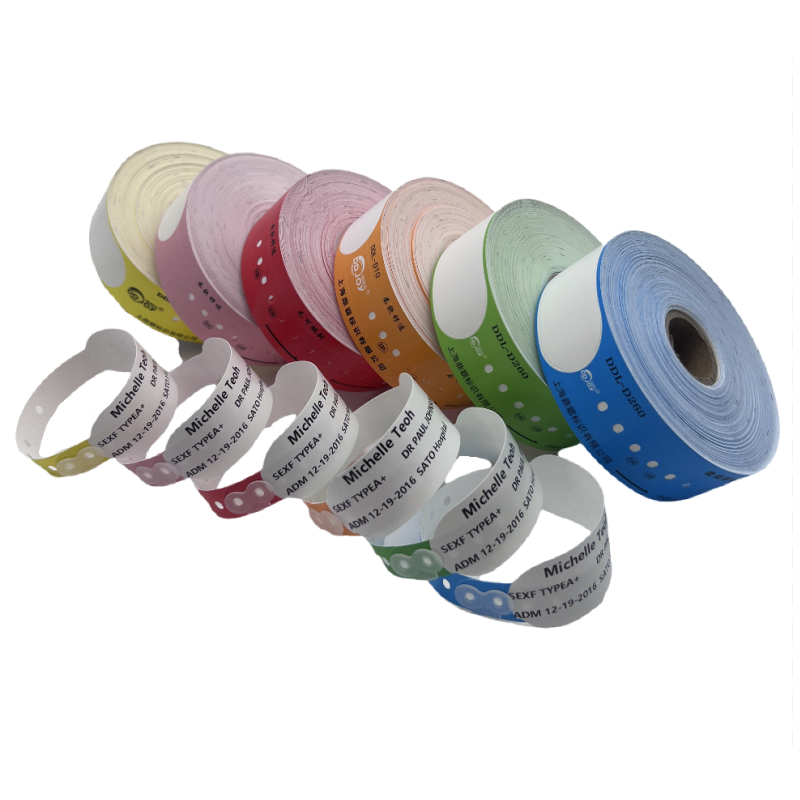
Why Baby Identification Wristbands Sit Apart from Adult Patient ID
A baby identification wristband is a single-use identification band specified for neonatal and infant wrists and ankles. Maternity units print an infant identifier — usually a record number matched to the mother — and band the newborn shortly after birth, while the mother receives a corresponding band. The band is not the medical record; it is the verification object that lets staff confirm at a glance that the right baby is with the right mother and the right chart.
Three physical constraints separate an infant band from a general adult band:
- Circumference and width. Neonatal wrists and ankles are small, and an over-wide or over-long band can fold, twist or press against the skin. Narrower and shorter formats are therefore the starting point for this use case.
- Moisture and handling. Infant bands are exposed to bathing, weighing, feeding and frequent transfer between rooms. Water resistance and tear resistance are functional requirements, not premium features.
- Single use and skin contact. Because the band stays on the skin for the length of the stay, disposability and skin safety are typically specified together with the identification function.
In the application profile that Shanghai Dingba Identification Co., Ltd. records for this work, the special requirements for a custom patient identification project are listed as waterproof, tear-resistant, disposable and skin-safe, with the stated function being patient identification and ward information management. Those four requirements are a useful shortlist for any maternity unit writing a specification, because they describe the band's job rather than its appearance.
Materials and Printing Options Inside the Medical Wristband Range
Baby identification wristbands are not a single product. They are a specification that can be met by several base materials, and the choice of material usually determines the printing method, the lifespan of the band and how it is removed at discharge. The four formats below all appear in the current patient identification range and cover the neonatal use case from short-stay maternity wards through to longer-stay paediatric and elderly care environments.
| Format | Base material | Sizes recorded | Printing | Characteristics |
|---|---|---|---|---|
| Medical thermal wristband | Thermal-sensitive synthetic paper | 260 × 25 mm standard, custom sizes supported | Direct thermal printing, no ink required | Disposable, water-resistant, tear-resistant, patient information printable, clear print result |
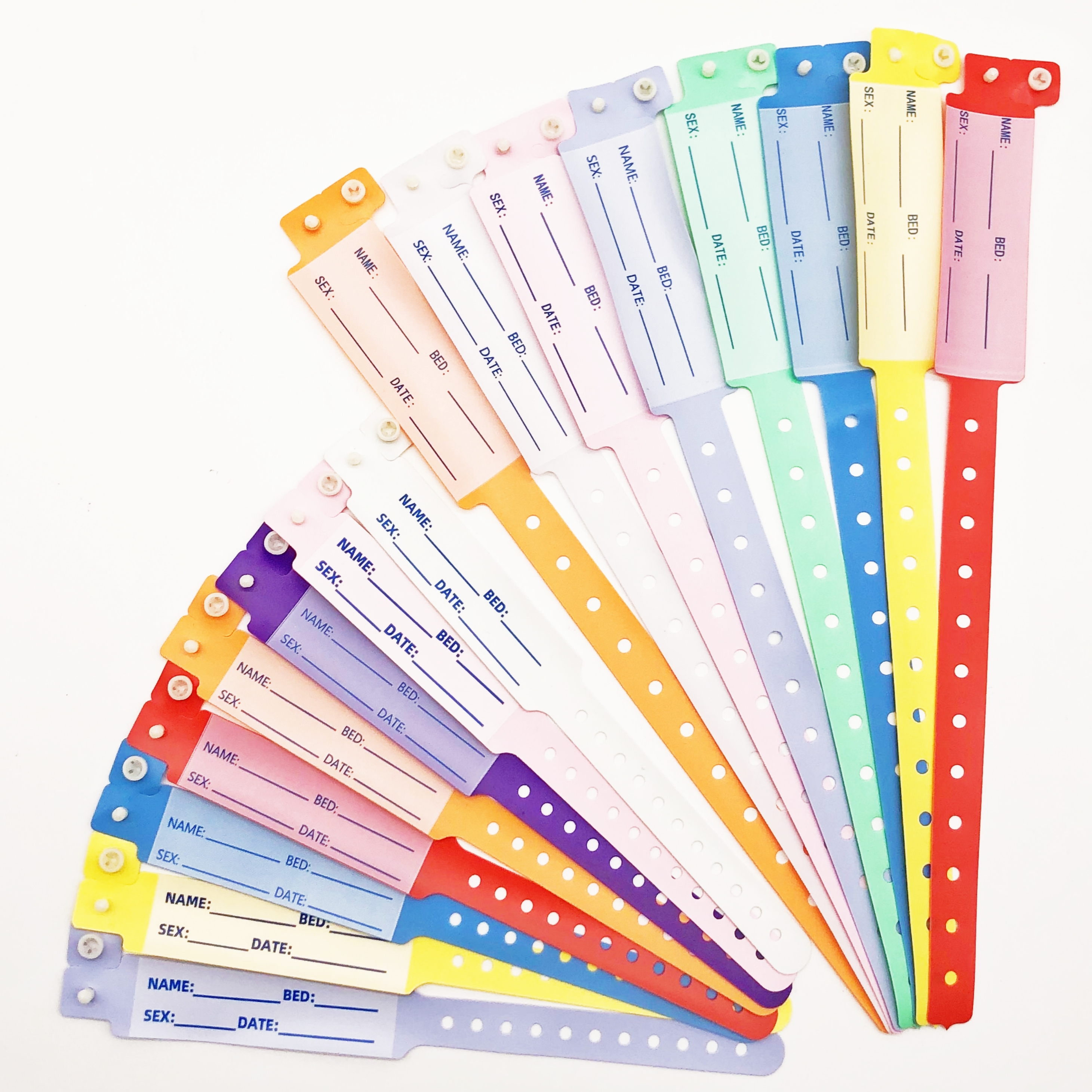
| PVC patient ID wristband | PVC | 250 × 25 mm / 250 × 16 mm | Patient information printed on the band surface | Durable, waterproof, comfortable for long-term wear, intended for hospitals and elderly care institutions |
| Tyvek wristband | Tyvek | 250 × 19 mm / 250 × 25 mm | Clear printing | Disposable, waterproof, tear-resistant, lightweight |
| RFID wristband | Paper, Tyvek, PVC or silicone | 250 × 25 mm / 250 × 16 mm and other specifications | Encoded chip, low / high / ultra-high frequency, readable and writable | Contactless identification, supports access control and payment functions, used in medical environments as well as logistics and member management |
Two practical readings follow from that table. First, the smaller formats in the range — 250 × 16 mm and 250 × 19 mm — are the relevant starting points when a maternity unit is fitting smaller wrists, while the thermal format supports custom sizing when a hospital wants a single catalogue item across neonatal and paediatric wards. Second, printing method and material are linked: a thermal-sensitive synthetic paper band is designed for a direct thermal printer, whereas a PVC or Tyvek band is printed through other processes and is chosen for durability rather than for on-demand bedside printing.
How the Identification Loop Works on the Ward
The technical explanation for this category is simple to state and easy to get wrong in procurement. A band only works as an identification control if the data on it is produced at the point of care, at the moment the record is created, and if the printed result stays legible for the length of the stay.
In the recorded application scenario for this project type, the operating mode is wearing mode, the matched equipment is a direct thermal printer, and the working condition is an indoor and outdoor normal-temperature environment. That produces a five-step loop:
- An admission record is created and a matched identifier is assigned to mother and infant.
- The band is printed on the ward using a direct thermal printer — no ink, ribbon or toner is involved.
- The band is applied at birth, and the mother's corresponding band is applied in parallel.
- Staff verify the identifier at feeding, weighing, medication, transfer and handover.
- The band is removed and disposed of at discharge or at the end of the encounter.
The equipment dependency in step two is the part that most often surprises buyers. A thermal band is only as good as the printer paired with it, so the media specification and the printer specification have to be confirmed together rather than purchased separately. Where a hospital cannot place a printer on the ward, a pre-printed PVC patient ID band or a Tyvek band is the more realistic route, because those formats do not depend on a thermal print head at the bedside.
Regulatory and Labelling Signals Buyers Should Track in 2026
The regulatory picture for patient identification bands has become clearer, and the change matters directly to how an infant band is specified and purchased. In Case C-427/24, effective 2 July 2026, the Court of Justice of the European Union ruled that blank patient wristbands are not classified as medical devices under EU MDR 2017/745. The decisive factor in the ruling is intended purpose rather than the hospital setting in which the product is used.
What this means at the purchasing desk: a blank band supplied as an identification consumable is treated differently from a band that forms part of a system with a stated medical intended purpose. Buyers should ask a supplier to state the intended purpose of the band explicitly, and then check that the labelling and instructions match the way the hospital actually uses it. A product being worn in a maternity unit is not by itself evidence of device classification.
A second signal sits in labelling standards. ISO 15223-1:2021 Amendment 1 (2025) introduces changes to the authorized representative symbol, moving from the EC REP marking to the EU-REP marking. For buyers, this is a low-cost check with a real compliance consequence: artwork and instructions for use should reflect the current symbol set, and older artwork should be reviewed rather than assumed to be current.
Supplier-side verification is the third signal. Documentation such as ISO 9001 certification, or independent on-site verification of a manufacturing site, is a proxy for process control rather than a guarantee of product performance. Shanghai Dingba Identification Co., Ltd., for example, holds ISO 9001 certification and has undergone on-site verification from Alibaba and SGS — two verifiable reference points that a distributor can check before placing a first order.
One data gap is worth flagging honestly. There is currently no trade-level dataset broken out for medical wristbands at HS-code level, so buyers cannot reconstruct supply flows for this specific product from published customs statistics. Supply-chain mapping for this category has to be built from supplier-level information instead.
Where the Manufacturing Side Fits: DDJOY Medical Wristbands
Shanghai Dingba Identification Co., Ltd. (DDJOY) is a manufacturer based in Shanghai, China, established in 2010, specialising in the R&D, production and sales of wristbands and RFID products with both software and hardware development capability. Its main product line is the medical thermal wristband, and medical wristbands in general are the category in which its patient identification formats sit.
The operational facts that matter to a maternity unit or a distributor evaluating this supplier are:
- Factory area of 10,000 m², with approximately 50+ staff and a five-engineer R&D team.
- Annual production capacity of 120,000,000 units, which is relevant when a hospital group or distributor needs seasonal peaks covered without re-sourcing.
- Export share of roughly 70%, with the main markets listed as the EU and the USA, and exports reaching more than 100 countries and regions.
- Product development and production capability spanning materials, printing processes and RFID encoding, rather than a single-format catalogue.
For a baby identification project, the capability that carries the most weight is customisation. The medical thermal wristband supports custom size options against a 260 × 25 mm standard, and the wider patient identification range already includes the narrower 250 × 16 mm and 250 × 19 mm formats. A hospital that needs a single band design across neonatal, paediatric and adult wards can work from one specification instead of three unrelated items.
Applications and Use Cases
The recorded application profile for this work spans healthcare, hospital and clinic settings, with patient identification and ward information management as the stated functions. In day-to-day terms, that covers several distinguishable situations:
- Birth and immediate postpartum banding. The band is applied once and must survive the first hours of handling, bathing and weighing without losing legibility.
- Mother–baby reconciliation. Matched identifiers on two bands make verification a comparison task rather than a documentation task.
- Ward transfers and internal transport. Movement between rooms is where a loose or fragile band is most likely to be lost, which is why tear resistance is specified alongside water resistance.
- Longer-stay paediatric and elderly care identification. Here the durable PVC patient ID band is the more suitable format, and it is explicitly intended for hospitals and elderly care institutions.
- Contactless identification programmes. Where a hospital has already invested in readers and a patient management system, an RFID wristband with a readable and writable chip extends identification into contactless access and system-integrated workflows.
The material choice should therefore follow the length of the encounter and the printing infrastructure available, not the reverse. Short-stay, print-on-demand workflows point to thermal synthetic paper. Long-stay, pre-printed workflows point to PVC. Contactless workflows point to RFID, with the added requirement of reader infrastructure and system integration.
Market Trend Analysis
Published estimates for the patient identification wristband category differ widely, and the difference itself is informative. Future Market Insights projects the global patient identification wristbands market to reach USD 576.1 million in 2025, while Precedence Research estimates USD 1.61 billion for the same year. The comparison note attached to these two figures attributes the variance to scope: one dataset focuses on patient ID wristbands as a product category, while the other appears to include a broader identification accessory definition. Precedence Research additionally reports that North America accounted for a 41% share of the market in 2025.
Concentration is the second observable trend. PDC Healthcare, a Brady Corporation brand, is projected to hold a 14–18% share of the patient identification wristbands market, a derived estimate published by Future Market Insights. On the technology-supply side, Zebra Technologies reported net sales of USD 346 million for its Asset Intelligence & Tracking segment in Q4 2023 — a segment that includes wristbands alongside other tracking products, so it should be read as an indicator of segment scale rather than of wristband revenue alone.
How to use these numbers: headline market values in this category are not directly comparable across publishers, because the product definition behind each figure differs. For a hospital or distributor building a business case, unit-level pilot pricing and validated consumable consumption per bed are more reliable planning inputs than a single published market value.
Comparison with Traditional Identification Methods — and Where the Limits Are
Traditional identification in maternity units relies on handwritten cards, adhesive labels or hand-completed paper records, and the failure modes are well understood: handwriting is misread, adhesive labels lift at the edges when wet, and ink can transfer or fade. Printed wristbands address the legibility problem directly, but each printed format carries its own boundary.
| Method | Legibility | Moisture behaviour | Infrastructure needed | Best fit |
|---|---|---|---|---|
| Handwritten card or adhesive label | Depends on handwriting and label condition | Adhesive can lift when wet | None | Very short encounters, non-critical marking |
| Direct thermal wristband | Clear machine-printed text | Water-resistant and tear-resistant | Direct thermal printer on or near the ward | Print-on-demand admission and birth banding |
| Printed PVC patient ID wristband | Clear printed text, durable surface | Waterproof | Pre-printing before delivery to the ward | Longer stays, elderly care, high-turnover pre-printed stock |
| RFID wristband | Text plus encoded data | Waterproof depending on base material | Readers plus system integration | Contactless identification and access workflows |
The limits deserve the same attention as the advantages, because they determine whether a specification survives contact with a real ward:
- Thermal printing is monochrome and equipment-dependent. A direct thermal band delivers clear patient information without ink, but it requires a compatible direct thermal printer and correct media loading. Thermal print is also generally more sensitive to prolonged heat, abrasion and chemical contact than a printed PVC surface, so for very long stays a PVC patient ID band is often the more appropriate choice.
- Sizing is not universal. Standard catalogue formats may not suit every neonatal wrist circumference. Where the smallest wrists are involved, custom sizing should be confirmed at the specification stage rather than assumed from an adult-oriented size list.
- RFID adds infrastructure cost. The band itself covers contactless identification, but readers, middleware and system integration are separate purchases and separate projects.
- Lead time is a real constraint, not a formality. The standard lead time recorded for these products is 7–10 working days, with production scheduling and reserved monthly capacity used to absorb larger orders. The recognised delay drivers listed alongside that figure include upstream shortages of key materials such as PVC, Tyvek and RFID chips, sudden large-volume orders, internal equipment or staffing problems, late specification revisions from the buyer, and logistics or port disruption. Buyers specifying a custom baby band should treat late specification changes as a supply risk they control directly.
- Classification is not implied by use. Following the CJEU ruling, a blank wristband is not a medical device under EU MDR 2017/745. Buyers should not assume that hospital use alone establishes device status for the product they are ordering.
.JPG)
Future Outlook
Three directions look likely to shape this category over the next procurement cycles. First, regulatory clarity will push intended-purpose documentation further upstream: as the CJEU ruling settles the status of blank bands, the practical differentiator between suppliers becomes how clearly they describe what a band is for and how consistently the labelling matches that description. Second, labelling standards will continue to evolve — the ISO 15223-1 Amendment 1 symbol transition is a reminder that artwork maintenance is an ongoing compliance task rather than a one-off design job. Third, contactless identification will keep expanding from event and access-control environments into hospital workflows, which raises the value of suppliers who can produce printed, thermal and chip-embedded formats from one specification.
For maternity units, the near-term practical implication is narrower than the market narrative suggests. The specification that matters is still the one that survives a bath, a weighing and a ward transfer with the identifier intact — which keeps material choice, printing method and sizing discipline at the centre of the decision.
FAQ
What is a baby identification wristband?
A baby identification wristband is a single-use identification band sized for neonatal and infant wrists or ankles, printed with an identifier that is matched to the mother's record. It is used in maternity and paediatric settings so that staff can verify the link between an infant, a mother and a medical record at every care event, including feeding, weighing, transfer and discharge.
Which materials are used for baby identification wristbands?
Four base materials are commonly used in patient identification ranges. Thermal-sensitive synthetic paper is used for the medical thermal wristband, which is printed with a direct thermal printer and requires no ink. PVC is used for the PVC patient ID wristband, available in 250 × 25 mm and 250 × 16 mm and intended for hospitals and elderly care institutions. Tyvek is used for disposable bands in 250 × 19 mm and 250 × 25 mm. Paper, Tyvek, PVC or silicone can be used for RFID wristbands with an embedded readable and writable chip.
Does a blank patient wristband count as a medical device in the European Union?
No. In Case C-427/24, effective 2 July 2026, the Court of Justice of the European Union ruled that blank patient wristbands are not classified as medical devices under EU MDR 2017/745. The ruling turns on intended purpose, so the relevant question for a buyer is how the supplier defines the product's intended purpose and whether the labelling matches the way the hospital uses the band.
How are baby identification wristbands printed in a hospital?
The medical thermal wristband uses direct thermal printing, which produces patient information without ink, ribbon or toner and pairs with a direct thermal printer as the matched equipment in the recorded application scenario. Pre-printed formats such as the PVC patient ID wristband and the Tyvek wristband are printed before delivery to the ward instead, which removes the need for a printer at the bedside but requires the hospital to hold pre-printed stock.
What should be confirmed before ordering baby identification wristbands for a maternity unit?
Five points are worth confirming in writing: the band dimensions against the smallest wrist circumference in use, the intended purpose statement and labelling symbols, whether the ward has a compatible printer or will work from pre-printed stock, the customisation requirements for printed identifiers, and the delivery schedule. The recorded standard lead time for these products is 7–10 working days, and late specification revisions by the buyer are listed among the recognised causes of delay.
Shanghai Dingba Identification Co., Ltd. manufactures medical thermal wristbands and a wider patient identification range including PVC patient ID, Tyvek and RFID formats. The company's product brochure with specification details is available for download: DDJOY product brochure (PDF).
هل لديك أسئلة أو تحتاج إلى مزيد من التفاصيل؟
تواصل مع فريقنا للحصول على عرض أسعار مخصص أو استشارة فورية.
طلب عرض أسعار
املأ النموذج أدناه وسيتواصل معك فريقنا بعرض مقترح مخصص.
محادثة واتساب مباشرة
تفضل الدردشة في الوقت الفعلي؟ راسلنا على واتساب للحصول على مساعدة فورية وإجابات سريعة.
- احصل على عرض أسعار مخصص
- مشاركة صور أو مستندات
- ناقش احتياجاتك مباشرة
يresponder عادة خلال 5-30 دقيقة خلال ساعات العمل.