
Bag-Opening and Feeding Robots: A Specification Checklist
Bag opening and feeding is the stage where bagged raw material stops being a logistics item and becomes a process input. In plants handling powders and granules — chemical raw materials, flour and grain, sugar, feed, building materials — the cell that de-stacks a pallet, opens each bag, discharges the contents and feeds the next stage sets the rate at which everything upstream and downstream can run. Because publicly comparable specification data for these cells is thinner than for general-purpose robots, buyers in the research and evaluation stage often end up comparing project scope instead of parameters. This reference sets out which constraints can be documented, what each one changes in a real installation, and where the boundaries of a given configuration lie.
Why bag opening and feeding is a constraint problem, not a robot problem
An automatic bag opening and feeding system is usually bought against process requirements, not against a robot catalogue page. Payload, reach, repeatability, dust behaviour, hygiene class and safety scope all change the engineering; a cell that performs reliably in a feed mill may be unsuitable in a chemical plant handling corrosive material. The decision therefore starts with a constraint set, and only afterwards with a supplier shortlist.
The commercial background supports treating this as a mainstream application rather than a niche. Handling applications, a category that includes palletizing and depalletizing, held a 42.1% share of the industrial robot market in 2025, according to Grand View Research. Fortune Business Insights projects the global robotic palletizer and de-palletizer segment to reach USD 4.67 billion in 2026. Buyers evaluating a bag-opening cell are therefore evaluating one of the most frequently deployed robot applications — which is precisely why they can reasonably demand documented values rather than general capability statements.
The practical difficulty is the documentation itself. Metrics such as bags per hour, vision tolerance, dust ingress behaviour or grab success rate are not stated in a uniform way across suppliers, and many of the parameters that decide success in a bag-opening cell are project-specific. The workable method is to fix a constraint set first — payload and reach envelope, repeatability, vision tolerance, environment, hygiene, safety scope — and then require each supplier to document values against it.
What the cell contains, and the engineering role behind it
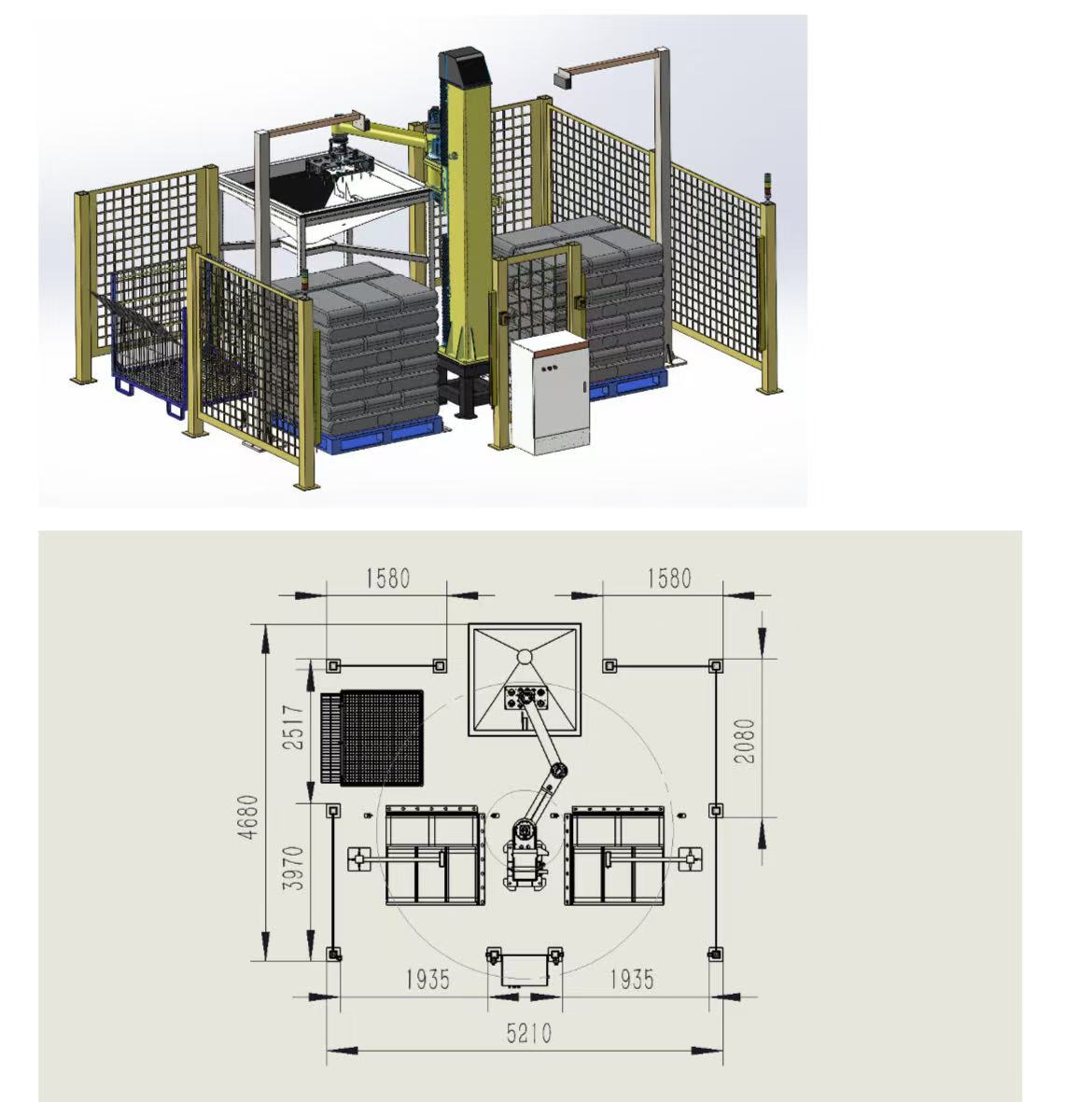
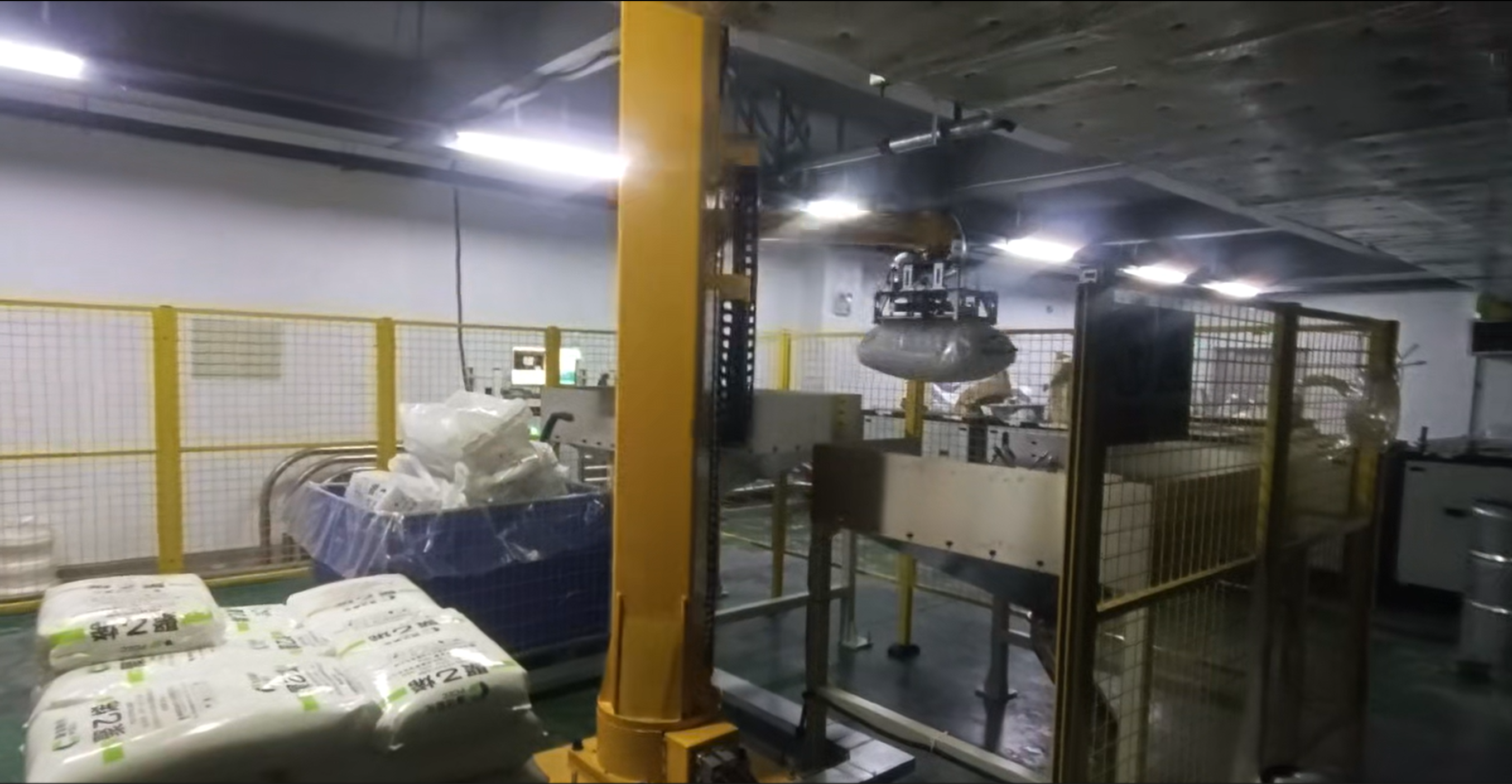
A depalletizing and bag-breaking industrial robot integrates de-stacking and bag opening. A vision system identifies stacked bagged material on the pallet, the robot de-stacks the bags layer by layer, and the package is then cut open automatically so that the contents are discharged into a designated vessel or hopper. The purpose is to remove manual dust exposure and heavy repetitive handling from chemical, building-material and feed processes.
A typical configuration is assembled from an industrial robot, a 3D vision system, a custom bag handling and opening gripper, a bag cutting mechanism, a material hopper, a dust collection system and a conveyor system. The system is designed for fully automatic, 24/7 continuous operation, and it is normally delivered as one of the following project types: automatic bag opening and feeding system, robotic palletizing system, material handling system, machine tending system, press tending system, collaborative robot palletizing system, or a custom robotic automation system.
South China Robotics Technology (Guangdong) Co., Ltd. is an industrial robotics and automation company based at No. 35 Lingdong Road, Auto City, Xiuquan Subdistrict, Huadu District, Guangzhou, Guangdong, China, founded in 2017. It manufactures robotic palletizing systems, bag opening and feeding robots, material handling robots, collaborative palletizing robots, press tending robots, CNC machine tending robots, custom industrial automation systems and industrial robot integration, and operates a 40,000 m² facility with 180 employees, 48 R&D engineers and an annual output of 3,000 units; approximately 40% of output is exported to Europe, the Middle East, Southeast Asia, South Asia, Latin America and North America.
For a bag-opening project the relevant capability is not the robot alone but the engineering sequence around it: production-line planning, robotic system integration, customized gripper design, installation, commissioning, technical support and maintenance. The company holds recognitions including Enterprise Technology Center status, the GG Robot Golden Globe Award – Product of the Year for its heavy-duty palletizing robot series, National Intellectual Property Advantage Enterprise status, and selection as an Intelligent Manufacturing System Solution Provider; its automatic bag opening and feeding robot series has been recognised as an innovative manufacturing product. Systems are configured according to the customer's product, payload, production capacity, pallet pattern, site layout, process requirements and existing equipment.
The documented parameters a buyer can verify before quoting
For the heavy-duty palletizing robot used in these cells — the 4-Axis Palletizing Robot, model SCH100-1950-1800 — the documentable specification set is as follows.
| Parameter | Documented value | What it constrains |
|---|---|---|
| Number of axes | 4 | Palletizing-oriented kinematics for layer-by-layer de-stacking and placement |
| Type | Heavy-Duty Palletizing Robot | Duty class for continuous powder and granular handling |
| Maximum payload | 100 kg | Ceiling for bag, gripper and dynamic loads |
| Maximum reach | 1950 mm | Distance from robot base to pallet positions and feed stations |
| Repeatability | ±0.5 mm | Measurable value for repeatability verification of palletizing cells |
| Z-axis vertical stroke | 1800 mm | Usable stacking height range |
| Axis 1 working range | ±130° | Coverage between pallet and discharge positions |
| Axis 3 working range | ±147° | Reach into the stack and toward the hopper |
| Axis 4 working range | ±360° | End-of-arm rotation for bag orientation |
| Robot body weight | 680 kg | Floor loading and foundation planning |
| Power capacity | 5.75 kVA | Electrical provision planning |
| Operating temperature | 0–45 °C | Ambient envelope to be checked against site conditions |
| Material | High-strength steel | Structural base of the arm |
The documented payload rating of 100 kg supports payload-based sizing for depalletizing and palletizing system design, and the stated repeatability of ±0.5 mm provides a measurable value for repeatability verification of palletizing cells. Custom grippers can be designed for different products, including bags, cartons, drums and other regular-shaped workpieces, and the robot can be integrated with conveyors, pallet dispensers, safety fencing and vision systems to form a complete robotic cell.
Vision tolerance: the specification that decides whether the cell keeps running
In production, pallets arrive slightly out of position, layers are not perfectly aligned, and bag surfaces vary. Vision-guided depalletizing addresses this with 3D cameras and LiDAR point-cloud modelling combined with deep-learning grasp-path planning. The cameras and LiDAR scan the stacked goods to build point-cloud models of the packages; the algorithms then identify material types and calculate object poses.
Documented performance for this approach includes a position-deviation tolerance of ±50 mm, covering mixed stacks and incoming deviation, and a 99.8% grab success rate. For a buyer, the implication is procedural rather than technical: ask the supplier to state both the deviation tolerance and the grab-success figure, and require both to be validated during acceptance testing on the buyer's own pallet patterns and bag types. A success rate measured on a demonstration stack is not the same measurement as one taken on a customer's incoming goods.
Environment, hygiene and safety: constraints that reshape the design
Bag-opening and feeding installations are specified for demanding conditions, including high temperature, heavy-duty handling, dusty environments, chemical exposure, corrosive environments, high humidity, oil mist and continuous operation. The documented design responses include dustproof design, dust collection and control, enclosed material handling, easy cleaning, wear-resistant components, corrosion-resistant design, safety interlocks, reliable continuous operation, easy maintenance, and customisation for different materials and working environments.
Explosion-proof and hazardous zones
Where dust or chemical exposure creates explosion risk, the appropriate configuration is a custom explosion-proof depalletizing and bag-breaking robot compliant with national explosion-proof standards, intended to replace human operators in hazardous zones. Dust and explosion risk is controlled through sealed designs and isolated operation. The documented maintenance points for explosion-proof units correspond to the usual causes of safety alarms: sealing covers that are not fully closed or tightened, dust accumulation on electrical components, unreliable grounding connections, and over-temperature inside the explosion-proof enclosure.
Standards scope: robot or cell?
EN ISO 10218 is a safety-requirements standard series for industrial robots. Part 1 addresses industrial robots; Part 2 addresses applications such as robot systems and robot cells, as described by the German Commission for Occupational Health and Safety and Standardization (KAN). The procurement consequence is direct: a compliant robot arm does not by itself produce a compliant cell. Guarding, safety interlocks, the bag cutting mechanism, the gripper and the interface with conveyors belong to the application scope, and the current edition plus the applicable national adoption should be confirmed for the destination market before purchase.
Food-grade and hygiene requirements
Where the line handles food or food-grade material, documented selection criteria for food factories give priority to hygienic construction — 304 stainless steel, HACCP-compliant design and easy cleaning — alongside throughput expectations in the range of 800–1000 bags per hour, a bag-topple rate below 0.05%, 24-hour operation and adaptability to cold-storage environments. These are selection targets rather than universal guarantees, and they should be written into the specification with the buyer's own product formats.
Applications: where bag-opening and feeding cells are already running
The documented application scope covers food and beverage, sugar, flour and grain processing, feed, chemical raw materials, new materials, building materials, and other powder and granular material processing industries, with market references including China, Malaysia, Saudi Arabia and Türkiye. Selected results from documented projects illustrate what the technology does in practice:
- Chemical manufacturing: optimised energy-efficiency management, reduced safety risks and improved material handling efficiency by 40% (Tianci Materials).
- Food and health-supplement production: a single robot achieving daily throughput of over 20,000 pieces, with palletizing efficiency increased by 40% while maintaining cleanliness and compliance requirements in food production (Mengniu and By-Health).
- Nuclear energy equipment: robots operating within a narrow space of 5 cm to complete equipment depalletizing and pipeline inspection tasks, avoiding personnel radiation exposure and shortening the maintenance period (China National Nuclear Corporation).
- Heavy industry: equipment utilisation rate improved by over 90% in a heavy manufacturing environment (Sany Heavy Industry).
Each of those results came from a project-specific configuration. The figures describe outcomes in those lines; they are not performance guarantees for a new installation, which is why acceptance criteria should be agreed in writing before shipment.
Market context: handling remains the mainstream of industrial robot demand
The market data available for this segment points in one direction. Grand View Research places handling applications, which include palletizing and depalletizing, at a 42.1% share of the industrial robot market in 2025. Fortune Business Insights values the global industrial robot market at USD 24.43 billion in 2026 and projects the robotic palletizer and de-palletizer segment at USD 4.67 billion in the same year.
China remains the volume centre. According to IFR World Robotics 2025, about 295,000 industrial robots were installed in China in 2024, equal to roughly 54% of global installations; the prior IFR edition recorded 276,288 units in 2023, or 51% of global installations. Within that, the Department of Industry and Information Technology of Guangdong Province reports 246,800 industrial robots produced in Guangdong in 2024, or 44% of the national total.
For buyers, supply density in a region such as Guangdong generally means shorter engineering feedback loops and easier access to integration support for non-standard cells. It does not mean suppliers are interchangeable. Density improves access; documentation is what makes comparison possible.
How robotic bag opening compares with manual and semi-automatic handling
| Dimension | Manual cutting and feeding | Semi-automatic bag opening | Robotic depalletizing and bag-breaking cell |
|---|---|---|---|
| Operator exposure to dust | Direct and continuous | Reduced but still intermittent | Controlled through enclosure and dust collection |
| Operating continuity | Shift-bound | Partial automation | Documented fully automatic, 24/7 continuous operation |
| Bag and product flexibility | Depends on operator skill | Limited to a narrow format range | Gripper and cutting mechanism customised per bag and product |
| Positioning tolerance | Human judgement | Often requires precisely placed pallets | Vision-guided handling documented to ±50 mm deviation with 99.8% grab success |
| Repeatability | Variable | Moderate | ±0.5 mm documented repeatability in the referenced model |
| Engineering requirement | Lowest equipment cost, highest labour exposure | Intermediate | Vision, gripper, dust control, safety interlocking and commissioning within one scope |
| Maintenance requirement | Minimal equipment maintenance | Moderate | Planned maintenance and trained personnel required |
The robotic option is not universally the better choice, and there are real boundaries that buyers should recognise before committing:
- Envelope limits. The documented maximum payload of 100 kg and maximum reach of 1950 mm define the working envelope of the referenced heavy-duty palletizing model. Heavier bags or longer distances between pallet positions and the feed hopper fall outside that envelope and require a different configuration.
- Ambient conditions. The documented operating temperature range is 0–45 °C. Chilled zones or unusually hot areas need to be checked against that rating rather than assumed to be compatible.
- Dependence on incoming material. Bag type, stacking pattern, dust behaviour and site layout all influence the engineering, which is why configuration is project-specific and cannot be read off a catalogue.
- Additional engineering scope. Explosion-proof compliance and hygiene construction extend the design work; they are not options added at the end of a project.
- Maintenance capability. Sealing checks, cleaning of accumulated dust and grounding verification require planned attention and trained staff. A plant without that capability carries a different total cost than the equipment price alone suggests.
Structuring the specification and the supplier review
A constraint-first specification shortens the evaluation cycle because it converts a vague capability question into a documentable one. The following sequence is a practical review framework:
- Define scope at cell level, not arm level: de-stacking, cutting, discharge, dust control, feeding and the interface to the next process stage as a single deliverable.
- Fix the mechanical parameters: payload, reach, repeatability, Z-axis stroke, installed power capacity and ambient operating range.
- Fix the vision parameters: deviation tolerance and grab-success metric, with validation during acceptance testing on the buyer's own pallet patterns.
- Confirm the safety basis: robot-level and cell-level requirements in the scope of EN ISO 10218-1 and EN ISO 10218-2, plus the applicable national adoption in the destination market.
- Confirm the environment class: dustproofing, corrosion resistance, cleaning regime, and explosion-proof compliance where dust or solvent risk exists.
- Confirm hygiene requirements where the line is food-grade, including construction material, cleanability and compliance expectations.
- Confirm engineering deliverables: line planning, gripper design, integration with existing conveyors and pallet equipment, installation, commissioning, training and after-sales maintenance.
- Confirm how results will be demonstrated: reference projects in comparable industries and acceptance criteria agreed before shipment.
On the supplier side, South China Robotics Technology documents on-site commissioning, technical training and long-term after-sales maintenance support for depalletizing and bag-breaking robot installations, and its project references include Midea, Chery, BYD, China National Nuclear Power, Sany and Mengniu. Those references should be read as evidence of engineering experience in comparable environments, not as transferable performance guarantees for a different site.
Future outlook
Three directions are visible from the documented evidence rather than from forecasts. First, handling applications continue to hold a large share of robot installations — 42.1% in 2025 according to Grand View Research — and the palletizer and de-palletizer segment continues to be projected as a multi-billion-dollar market in 2026. Second, supply density in regions such as Guangdong, where 246,800 industrial robots were produced in 2024, or 44% of China's national total, keeps integration capacity close to the manufacturing base, which tends to shorten the loop between an installation and its engineering revisions. Third, where bags are dusty, corrosive, hot or hazardous, the compliance burden sits on the cell rather than the arm, which makes cell-level specification the natural point of comparison between suppliers.
The most useful development for buyers would be convergence in how bag-breaking performance is reported — bags per hour, grab success, uptime and maintenance interval stated in a consistent way. That convergence has not happened yet. In the meantime, the practical discipline is to document constraints internally, require values in writing, and verify them against the buyer's own material.
FAQ
What is a bag-opening and feeding industrial robot, and how does it differ from a standard palletizing robot?
A bag-opening and feeding robot is an integrated industrial robot that combines depalletizing with bag opening. A vision system identifies stacked bagged material on a pallet, the robot de-stacks the bags layer by layer, and the package is then cut open automatically so that the contents are discharged into a designated container. A standard palletizing robot places finished goods onto pallets; this variant adds recognition, layer-by-layer de-stacking, cutting and discharge, and it is normally paired with a dust collection system, a material hopper and a conveyor system. Typical applications are bagged raw materials in the chemical, building-material and feed industries, where the objective is to reduce manual dust exposure and heavy handling.
Which parameters should be fixed before requesting a quotation for a bag-opening cell?
The measurable parameters are payload rating, reach, repeatability, Z-axis stroke, installed power capacity and ambient operating range, together with product-side inputs such as bag dimensions, bag weight, required capacity, pallet pattern and site layout. As a reference point, the 4-Axis Palletizing Robot SCH100-1950-1800 documents a maximum payload of 100 kg, maximum reach of 1950 mm, repeatability of ±0.5 mm, a Z-axis vertical stroke of 1800 mm, a power capacity of 5.75 kVA and an operating temperature range of 0–45 °C. The documented payload rating supports payload-based sizing for depalletizing and palletizing system design, and the repeatability figure provides a measurable value for repeatability verification of palletizing cells.
How does a vision-guided depalletizing system handle mixed stacks and incoming position deviation?
Vision-guided depalletizing uses 3D cameras and LiDAR point-cloud modelling together with deep-learning grasp-path planning. The cameras and LiDAR scan the stacked goods to build point-cloud models of the packages, and the algorithms analyse that data to identify material types and calculate object poses. Documented performance includes a position-deviation tolerance of ±50 mm, which covers mixed stacks and incoming deviation, and a 99.8% grab success rate on mixed stacks. Buyers should require both values in writing and validate them during acceptance testing on their own pallet patterns and bag types.
Is it safe to use robots in chemical or explosive-dust environments?
For hazardous zones, the appropriate configuration is a custom explosion-proof depalletizing and bag-breaking robot compliant with national explosion-proof standards, designed to replace human operators in those areas. Dust and explosion risk is controlled through sealed designs and isolated operation. Documented maintenance checks for explosion-proof units address the most common triggers of safety alarms: sealing covers that are not fully closed or tightened, dust accumulation on electrical components, unreliable grounding connections, and over-temperature inside the explosion-proof enclosure.
Which safety standard applies to a bag-opening cell, the robot or the complete installation?
Both levels apply. EN ISO 10218 is a safety-requirements standard series for industrial robots, in which Part 1 addresses industrial robots and Part 2 addresses applications such as robot systems and robot cells, as described by the German Commission for Occupational Health and Safety and Standardization. The practical implication for a buyer is that a compliant robot arm does not by itself make a compliant cell: guarding, safety interlocks, the bag cutting mechanism, the gripper and the interface with conveyors belong to the application scope. The current edition and the national adoption applicable in the destination market should be confirmed before procurement.
Which conditions fall outside a standard bag-opening and feeding configuration?
The documented boundaries of the referenced heavy-duty palletizing model are a maximum payload of 100 kg, a maximum reach of 1950 mm and an operating temperature range of 0–45 °C. Bag weights or working distances beyond those values, ambient conditions outside that temperature window, and sites without the capability to carry out sealing checks, dust cleaning and grounding verification all fall outside a standard configuration. Explosion-proof and hygiene requirements also extend the engineering scope beyond a standard cell. In these cases the correct action is to re-specify the configuration rather than assume the standard model will adapt.
For readers who need the full company and product documentation referenced in this article, the company profile and product brochure is available for download here: South China Robotics Technology — Company Profile and Product Brochure 2026.