
Bakery Oven Compliance Checks: Voltage, Power, and Site Acceptance
A commercial bakery oven is qualified twice: once on paper and once on site. The paper stage decides whether the site stage can happen at all. Rated voltage, connected power, overall dimensions and deck capacity are the four figures that determine whether an oven can be wired into an existing supply, moved through a building to its position, and operated in the space available. They are also the four figures that acceptance documents should reference before anyone signs.
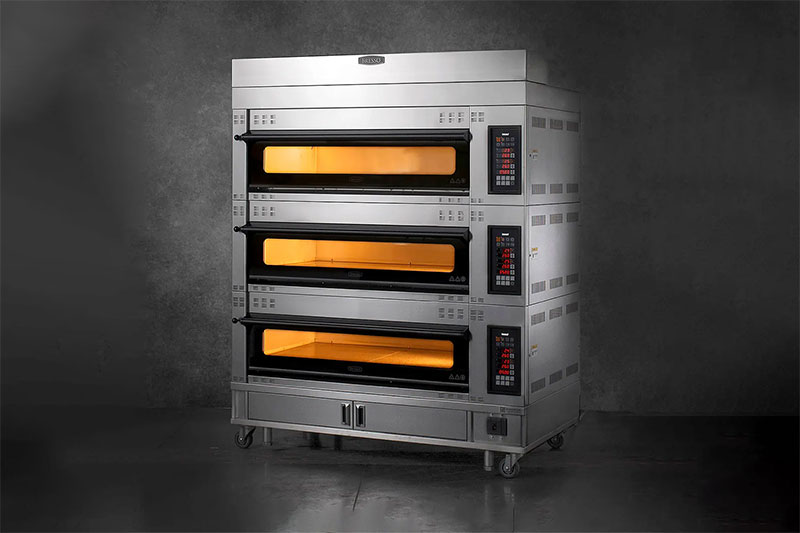
Deck ovens are qualified against a site survey before the purchase order is signed, not at handover.
BRESSO is a South Korean baking equipment brand with a branch in Shanghai, China, manufacturing European-style ovens, Korean-style ovens, convection ovens and proofers, with a stated annual production capacity of 8,000 units and approximately 100 to 200 staff. Its published model data is specific to each model — voltage, rated power, deck and tray counts, and overall dimensions — which makes the range a practical worked example of how nameplate figures feed into installation planning and acceptance criteria.
The exercise below is deliberately narrow. It treats compliance as an engineering check performed before purchase, works through published nameplate data from the HBVO, HBWO, HBDC, HCV and Champions League MAX lines, and then maps each figure to the purchasing terms and acceptance criteria a buyer should confirm. No certification body is named beyond the certifications the manufacturer states, because a spec-to-site qualification is a different question from a certificate audit.
Compliance Is a Pre-Purchase Engineering Exercise
In many procurement processes, compliance is handled as a delivery transaction: a certificate folder handed over, a checklist signed, an invoice released. For electric bakery ovens the sequence is inverted. Voltage class and connected power are fixed attributes of the unit ordered. An oven built for 380V cannot be adapted to a 220V supply through documentation, and a unit 3,100 mm deep does not become 2,400 mm deep because a certificate states that it meets a standard. Verification has to happen while the specification is still negotiable.
A workable method is a three-way match between nameplate, site survey and purchase order. The nameplate states what the equipment requires. The site survey states what the facility actually provides — supply type, available circuit capacity, delivery route, floor area and headroom. The purchase order fixes the criteria that determine whether the delivered unit matches both. When the three documents disagree, the disagreement is almost always cheaper to resolve before shipment than after installation.
This is where compliance and procurement meet. A buyer who confirms voltage, power, dimensions and capacity at quotation stage is not performing an administrative step; they are preventing a rework event that would otherwise land on the installation contractor, the production schedule, or both.
The Four Nameplate Figures That Determine Site Fit
Four data points do most of the work in an electrical and dimensional qualification. Each answers a different question, and a site can pass one while failing another.
| Nameplate field | What the published BRESSO data shows | Site question it resolves |
|---|---|---|
| Rated voltage | 380V for HBVO, HBWO, HCV and MAX models; 220V for HBDC Air and Pro retarder-proofers | Does the facility provide the correct supply class at the installation point? |
| Rated power | 12.4 kW to 27 kW across the 380V deck ovens; 9 kW for HCV-5 AIR; 2 kW for every HBDC unit | Can protection and cabling be sized to the real connected load rather than an estimate? |
| Overall dimensions | From L1330 D1200 H2065 mm (HBVO-2003) to L1930 D3100 H2250 mm (HBVO-400ЗMAX-ZS3) | Will the unit pass the delivery route, fit the footprint, and leave usable service access? |
| Deck and tray capacity | 3 decks with 6, 9 or 12 trays (HBVO); 2 to 4 trays per deck across 3 decks (HBWO); 5 decks / 5 trays (HCV-5 AIR); 18 to 32 trays (HBDC) | Does batch size match the production plan and the tray standard already in use? |
A site that satisfies voltage but not footprint fails the qualification. A site that satisfies footprint but not connected load also fails. This is why acceptance criteria should list the four figures separately, rather than compressing them into a single statement that the equipment is compliant.
Voltage and Connected Power: The First Gate
The published range splits into two supply classes. The HBVO Asian Ovens, HBWO European Ovens, HCV convection oven and Champions League MAX Series all operate at 380V. The HBDC Air and HBDC Pro retarder-proofers operate at 220V with a rated power of 2 kW across every model in both lines.
Voltage matching alone is not sufficient, because the 380V group spans a wide connected load. Within the HBVO series, rated power runs from 15 kW on HBVO-2003 to 24 kW on HBVO-3003 and 27 kW on HBVO-4003. The HBWO series runs from 12.4 kW to 20.2 kW. HCV-5 AIR is rated 9 kW, and the MAX model is rated 27 kW. Two units on the same nominal voltage can therefore differ by a factor of three in connected load, which is why the kW figure — not the voltage label — is the number an electrical contractor needs.
The retarder-proofers sit on a different circuit class at 220V and 2 kW. In process terms they support the baking line rather than bake: dough mixers and proofers typically sit in the same production flow as the ovens. Because their load is small relative to the deck ovens, the acceptance risk in a proofer is usually footprint and process sequencing rather than electrical capacity.
The nameplate gives connected load. The published model data does not state how that load is distributed across individual decks, nor how much spare capacity a circuit should carry. Both points belong in the wiring documentation requested from the manufacturer, not in an assumption made on site.
Model-Level Reference: Published Ratings Across the Range
The table below consolidates published figures for the models referenced in this article. It works as a qualification worksheet rather than a summary: each row can be checked against a site survey line by line.
| Group | Model | Capacity | Voltage / Power | Overall dimensions (mm) |
|---|---|---|---|---|
| Asian Oven | HBVO-2003 | 3 decks / 6 trays | 380V / 15kW | L1330 D1200 H2065 |
| Asian Oven | HBVO-3003 | 3 decks / 9 trays | 380V / 24kW | L1730 D1420 H2065 |
| Asian Oven | HBVO-4003 | 3 decks / 12 trays | 380V / 27kW | L1730 D1200 H2065 |
| European Oven | HBWO-2003 | 2 trays x 3 decks = 6 trays (EN600x400mm) | 380V / 12.4kW | L1120 D1310 H2065 |
| European Oven | HBWO-3003 | 3 trays x 3 decks = 9 trays (EN600x400mm) | 380V / 16.1kW | L1500 D1310 H2065 |
| European Oven | HBWO-4003 | 4 trays x 3 decks = 12 trays (EN600x400mm) | 380V / 20.2kW | L1500 D1495 H2065 |
| Retarder-proofer Air / Pro | HBDC-2018AIR / HBDC-2018PRO | 18 trays | 220V / 2kW | L600 D955 H2065 |
| Retarder-proofer Air / Pro | HBDC-2032AIR / HBDC-2032PRO | 32 trays | 220V / 2kW | L780 D1220 H2065 |
| Retarder-proofer Air / Pro | HBDC-1618AIR / HBDC-1618PRO | 16 trays chilled / 18 trays frozen | 220V / 2kW | L780 D1220 H2065 |
| Retarder-proofer Air / Pro | HBDC-2032SAIR / HBDC-2032SPRO | 32 trays | 220V / 2kW | L780 D1220 H2065 |
| Convection Oven | HCV-5 AIR | 5 decks / 5 trays | 380V / 9kW | L1900 D1220 H2065 |
| Champions League MAX Series | HBVO-400ЗMAX-ZS3 | 4 trays x 3 decks = 12 trays | 380V / 27kW | L1930 D3100 H2250 |
Reading the table by group is more useful than reading it by model, because each group has a different failure mode on site.
HBVO Asian Ovens: 380V, 15 kW to 27 kW
The HBVO series is a three-deck platform offered in three models. HBVO-2003 carries 6 trays at 15 kW inside a L1330 D1200 H2065 mm envelope. HBVO-3003 raises capacity to 9 trays and power to 24 kW while growing to L1730 D1420 H2065 mm. HBVO-4003 holds 12 trays at 27 kW in L1730 D1200 H2065 mm. For acceptance purposes the important detail is that the two larger models reach 24 kW and 27 kW on the same 380V supply, so electrical design — not voltage class — is what separates them in a utility plan.
Note the depth movement inside the series: HBVO-3003 is 1,420 mm deep while HBVO-4003 returns to 1,200 mm at higher capacity. A footprint check performed against one model does not automatically carry to another, even within the same family.
HBWO European Ovens: 3-Deck Builds on EN600x400 mm Trays
HBWO models use a 3-deck structure with EN600x400 mm trays, a format widely used in European bakery production. HBWO-2003 takes 2 trays per deck (6 total) at 12.4 kW in L1120 D1310 H2065 mm. HBWO-3003 takes 3 per deck (9 total) at 16.1 kW in L1500 D1310 H2065 mm. HBWO-4003 takes 4 per deck (12 total) at 20.2 kW in L1500 D1495 H2065 mm.
Tray format is a purchasing term rather than a detail. A site already tooled for EN600x400 mm trays is qualifying the oven against its existing rack, trolley and loading system at the same time as its electrical supply. Mixing tray standards between the oven and the rest of the line creates a handling problem that no compliance certificate resolves.
HBDC Air and Pro Retarder-Proofers: 220V, 2 kW
Both HBDC lines run at 220V and 2 kW across all models, with capacity and footprint as the differentiators. HBDC-2018 is an 18-tray unit in L600 D955 H2065 mm. HBDC-2032 offers 32 trays in L780 D1220 H2065 mm. HBDC-1618 handles 16 trays chilled or 18 trays frozen in L780 D1220 H2065 mm. The Air and Pro variants share the same electrical and dimensional profile, so the Air-versus-Pro decision does not change the site qualification.
Because the connected load is small relative to the ovens, the acceptance risk for a proofer is different in character. What matters is whether the unit sits in the right place in the process flow, whether the chilled or frozen configuration matches the production schedule, and whether the door and tray access work in the available aisle.
Convection Oven HCV-5 AIR: 380V, 9 kW
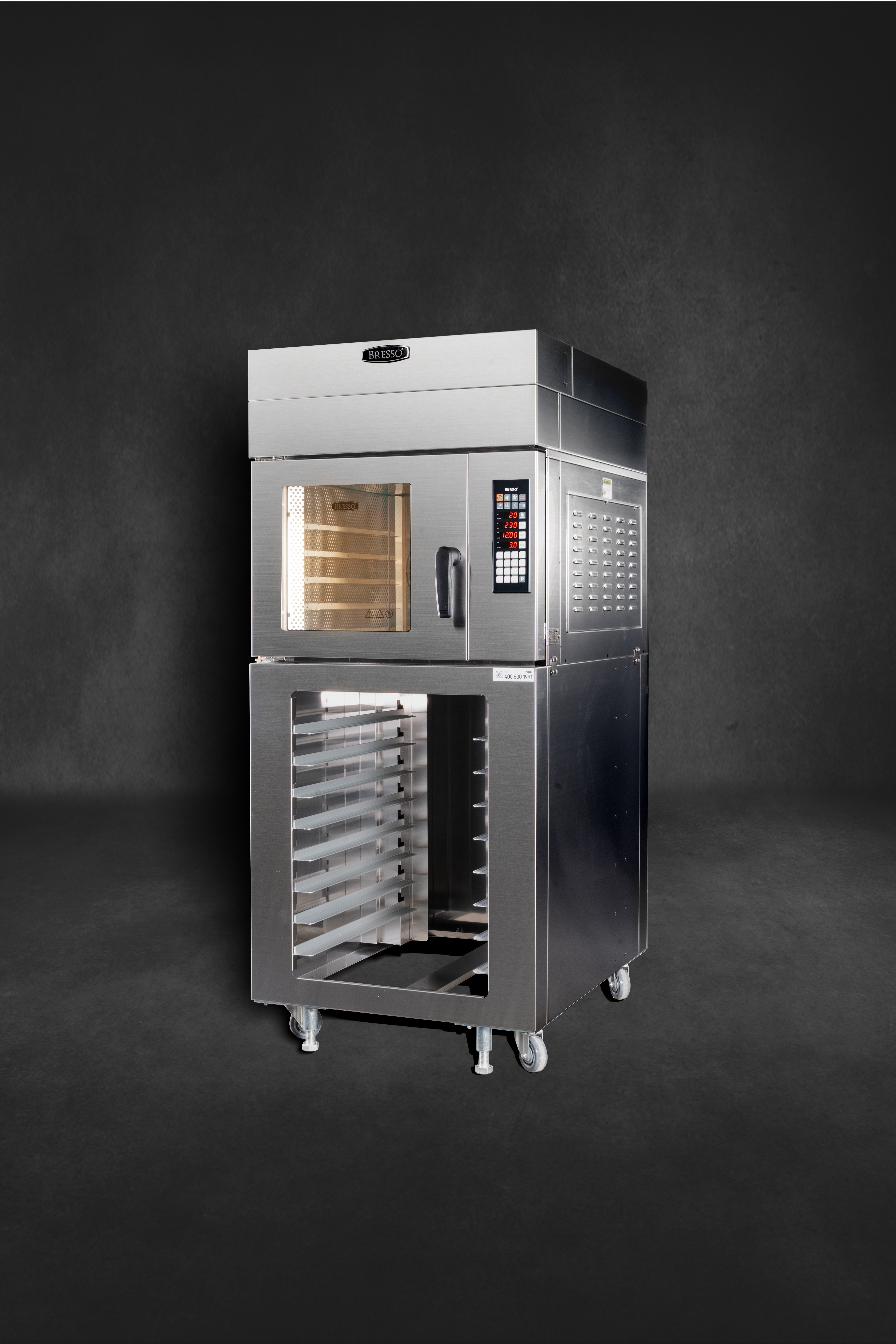
HCV-5 AIR is rated 380V and 9 kW, with a 1,900 mm width that exceeds the deck ovens in the published set.
HCV-5 AIR is specified at 380V and 9 kW with 5 decks and 5 trays in a L1900 D1220 H2065 mm envelope. The width is the notable figure: at 1,900 mm it is wider than any HBVO or HBWO model in the published data. A site survey that cleared a deck oven footprint does not automatically clear the convection unit, and a delivery route cleared for a 1,500 mm wide deck oven may not accept a 1,900 mm wide cabinet without door or corridor adjustments.
Power is the counterweight. At 9 kW, HCV-5 AIR draws less than half the connected load of HBVO-3003 or HBVO-4003, which makes it the easier unit to place on an existing supply and the harder one to place in a narrow room.
Champions League MAX Series HBVO-400ЗMAX-ZS3: 380V, 27 kW
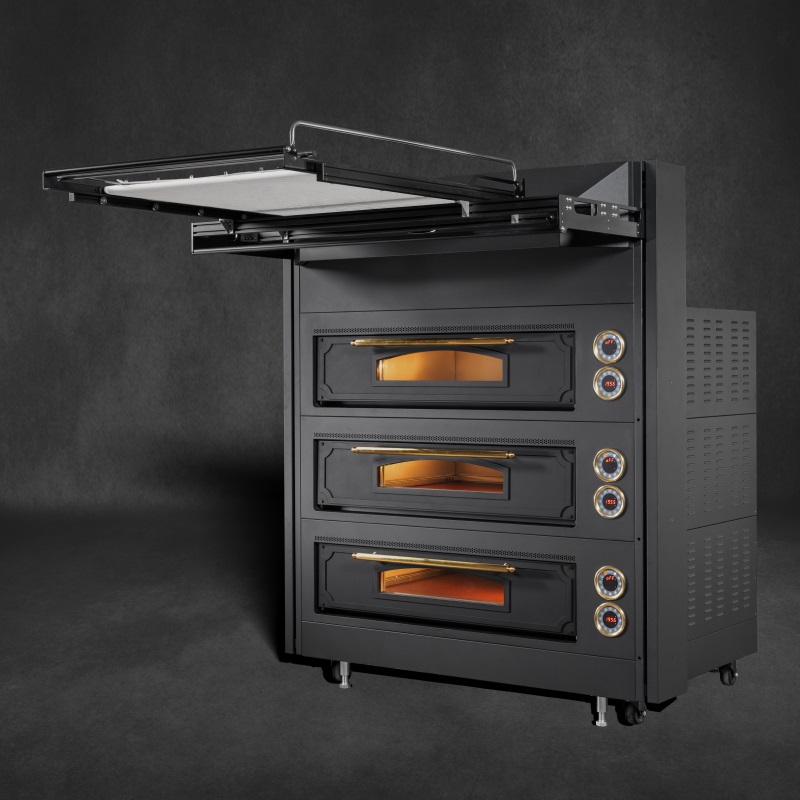
The MAX Series occupies L1930 D3100 H2250 mm at 27 kW, making floor area and headroom the binding constraints.
The MAX model is specified at 380V and 27 kW, with 4 trays across 3 decks (12 trays) and overall dimensions of L1930 D3100 H2250 mm. Both depth and height exceed the rest of the range: 3,100 mm depth against 1,200 to 1,495 mm for the deck ovens, and 2,250 mm height against 2,065 mm. Capacity is comparable to HBVO-4003 at the same 27 kW; the difference is floor area and vertical clearance, not throughput potential alone.
For a buyer, this is the clearest example of why spec-to-site qualification precedes model selection. The MAX configuration is a strong fit for a facility with generous floor space and a 380V supply already engineered for a 27 kW load. In a constrained retail unit it is not a candidate, regardless of how well it bakes.
From Overall Dimensions to Installation Clearance
Overall dimensions are a starting point, not a clearance figure. Length, depth and height describe the box. Installation planning needs the space around the box: door swing and tray extraction in front of each deck, control access, service access at the rear or side, and the delivery route itself — corridor width, lift dimensions, doorway heights and any turn that a 3,100 mm deep unit cannot negotiate.
The published model data for the range above gives overall dimensions only. Clearance and service envelopes are not part of that published set, and they should be requested as a dimensioned drawing before the layout is signed off. Treating an overall dimension as an installation dimension is one of the most common conversion errors in bakery projects.
A 3,100 mm deep MAX unit and a 1,200 mm deep HBVO-2003 are separated by 1,900 mm of depth. On a constrained site that single figure decides whether a model is a candidate at all — before power, capacity or price are discussed.
Electrical planning is only one half of utility planning. The application context for this equipment assumes commercial kitchen conditions with high temperature and high humidity, stainless steel construction, and compliance with safety and sanitation standards for European and American commercial equipment, running on a 20/7 schedule. Ventilation, ambient heat management and floor loading therefore belong in the same pre-purchase review as the electrical supply, because all three are difficult to retrofit once the unit is in position.
Acceptance Criteria Buyers Should Write Into the Purchase Order
Acceptance criteria convert a specification sheet into something a site can be measured against. The following items are drawn directly from the published data above and can be listed as verification lines rather than general statements of quality.
| Criterion | What to verify | Document or evidence to request |
|---|---|---|
| Deck and tray capacity | Decks and trays per deck match the production plan (for example 3 decks / 12 trays on HBVO-4003, or 5 decks / 5 trays on HCV-5 AIR) | Model datasheet with capacity stated per model |
| Tray format | EN600x400 mm compatibility where the site already runs that standard (HBWO series) | Tray and rack specification |
| Voltage | 380V or 220V at the installation point matches the ordered model | Nameplate rating and wiring diagram |
| Connected power | kW figure matches the electrical design (12.4 kW to 27 kW across the 380V range; 2 kW for HBDC units) | Electrical data sheet and load schedule |
| Overall dimensions | Verified against the site survey, including delivery route and headroom | Dimensioned drawing, not only the catalogue line |
| Duty and environment | 20/7 operation in high-temperature, high-humidity kitchen conditions is within the intended application | Application and installation guidance |
| Construction and sanitation | Stainless steel construction and stated conformity with safety and sanitation standards for European and American commercial equipment | Material statement and certification documentation |
| Supporting equipment | Dough mixers and proofers are available and positioned to match the oven throughput | Process layout and equipment list |
| Certification scope | Stated certifications cover the specific model and destination market | Certificate numbers, covered models, issuing bodies, validity dates |
| Field performance | Long-run operating record for comparable installations | Reference list and site contacts |
| Commercial terms | Price basis, lead time, warranty, spare parts and service coverage | Quotation and commercial annex |
The pattern is consistent: every criterion should be answerable with a document, not with an assurance. Where a document does not exist, the criterion is not yet an acceptance criterion — it is a preference.
Documented Long-Run Performance as an Acceptance Input
A nameplate proves that a unit can be connected. It says nothing about how the unit behaves in its twelfth year of operation. That gap is why field evidence belongs alongside electrical and dimensional data in an acceptance review, particularly for equipment specified for 20/7 duty in hot, humid production environments.
BRESSO's referenced field record includes installations reported to have operated continuously for 15 years with no recorded failures in Canada and Australia. For a buyer, the value of that record is not the sentence itself but the verification path it opens: names of comparable installations, the model operated, the duty cycle actually run, and the maintenance regime applied over the period. A supplier able to answer those follow-up questions is demonstrating something a specification sheet cannot.
Two cautions apply. First, a zero-failure record describes a population of installations and does not guarantee the next unit. Second, the record should be matched to the model under consideration — a field history for a three-deck deck oven does not automatically transfer to a 27 kW MAX configuration on a different footprint. Buyers should ask for the model-to-reference mapping explicitly.
Where Nameplate Compliance Stops
A spec-to-site qualification is a necessary check, but it is a narrow one. Being explicit about its boundaries is part of using it honestly.
- It does not establish energy consumption. Rated power describes connected load, not the energy a bake cycle actually uses. Consumption data is not part of the published specification set and must be requested separately.
- It does not establish bake performance. Even browning, steam behaviour and bake uniformity are performance characteristics, not nameplate fields, and cannot be inferred from kW or dimensions.
- It does not confirm site power quality. Voltage class matching says nothing about supply stability, harmonic conditions or existing load on the circuit. Those are site measurements, not equipment specifications.
- It does not resolve clearance or per-deck load distribution. Neither is published at model level, so both depend on manufacturer documentation that must be requested.
- Certification statements remain company-stated at model level. Where ETL, CE, FCC and ISO9001 are listed, the buyer still needs certificate numbers, covered models, jurisdictions and validity dates before treating the claim as a market-access conclusion.
- It does not substitute for commercial terms. Price basis, lead time, warranty, spare parts and service coverage sit outside the published specification and belong in the quotation review.
A further practical limit is scale. The MAX Series at L1930 D3100 H2250 mm and 27 kW is not a general-purpose answer to bakery capacity needs; it is a fit for facilities that can supply the footprint, headroom and electrical capacity. Recommending it without that check would invert the entire logic of pre-purchase qualification.
Market Context: Why Electrical Qualification Is Gaining Weight
The commercial oven market was estimated at USD 25.45 billion in 2024, according to Market Research Future. The same source forecasts that electric ovens will account for 57.8% of commercial oven market revenue in 2025.
That share matters for acceptance practice rather than for marketing. As electric equipment becomes the default specification for bakery production, the constraint that decides whether a project proceeds shifts from fuel supply and flue routing to electrical capacity, circuit design and dimensional fit. Every figure in this article — 380V, 220V, 12.4 kW to 27 kW, 1,200 mm to 3,100 mm of depth — becomes a procurement gate rather than a technical footnote. Buyers who treat the nameplate as the first document to examine, rather than the last to be filed, are working with the direction the market is already moving.
Future Outlook
Two developments are likely to strengthen the pre-purchase compliance model. The first is documentation. As more buyers request dimensioned drawings, wiring diagrams and model-level certification scope alongside the quotation, acceptance criteria will increasingly be written in measurable terms — millimetres, kilowatts and certificate numbers — rather than in assurances about quality.
The second is the separation of equipment classes. Ranges that span 12.4 kW to 27 kW on the same nominal voltage, plus a 220V proofer line, cannot be sold as a single recommendation. Selection is becoming a matching exercise in which the site survey, not the catalogue, narrows the shortlist. Suppliers who publish per-model figures clearly — as the HBVO, HBWO, HBDC, HCV and MAX data does — are easier to qualify, and easier to hold to an acceptance standard once the order is placed.
FAQ
What nameplate data should be checked before accepting a bakery oven?
Four fields carry most of the decision: rated voltage, rated power, overall dimensions, and deck and tray capacity. Voltage determines whether the facility's supply class matches. Rated power determines circuit and protection sizing. Overall dimensions determine delivery route, footprint and access. Deck and tray capacity determine whether batch size matches the production plan. A complete acceptance review verifies all four against a site survey rather than against the catalogue alone.
Which BRESSO bakery ovens require 380V, and which run on 220V?
In the published range, 380V applies to the HBVO Asian Ovens (HBVO-2003 at 15 kW, HBVO-3003 at 24 kW, HBVO-4003 at 27 kW), the HBWO European Ovens (12.4 kW, 16.1 kW and 20.2 kW), the HCV-5 AIR convection oven at 9 kW, and the Champions League MAX Series HBVO-400ЗMAX-ZS3 at 27 kW. The HBDC Air and HBDC Pro retarder-proofers operate at 220V with 2 kW across all models in both lines.
What are the tray capacities and dimensions of the HBVO and HBWO series?
HBVO-2003 holds 3 decks and 6 trays at L1330 D1200 H2065 mm. HBVO-3003 holds 3 decks and 9 trays at L1730 D1420 H2065 mm. HBVO-4003 holds 3 decks and 12 trays at L1730 D1200 H2065 mm. The HBWO series uses EN600x400 mm trays in a 3-deck structure: HBWO-2003 takes 6 trays at L1120 D1310 H2065 mm, HBWO-3003 takes 9 trays at L1500 D1310 H2065 mm, and HBWO-4003 takes 12 trays at L1500 D1495 H2065 mm. All six models are rated 380V.
How much installation clearance is needed beyond the published overall dimensions?
Clearance figures are not included in the published model data, which lists overall dimensions only. Installation planning therefore requires a dimensioned drawing from the manufacturer covering door swing, tray extraction space in front of each deck, control and service access, and the delivery route. This matters most at the extremes of the range: the MAX Series at L1930 D3100 H2250 mm needs substantially more depth than HBVO-2003 at 1,200 mm, and HCV-5 AIR at 1,900 mm wide needs more lateral space than any HBWO model.
What long-run performance evidence can buyers request before acceptance?
Buyers can ask for comparable installation references, the specific model operated at each site, the duty cycle actually run, and the maintenance regime applied. BRESSO's referenced field record includes installations reported to have operated continuously for 15 years with no recorded failures in Canada and Australia. Because a field record describes past installations rather than guaranteeing a future unit, the reference should be matched to the model under consideration and followed up with direct site contact where possible.
For buyers who want the complete model-level specification set in one document, the BRESSO product brochure is available for download.
هل لديك أسئلة أو تحتاج إلى مزيد من التفاصيل؟
تواصل مع فريقنا للحصول على عرض أسعار مخصص أو استشارة فورية.
طلب عرض أسعار
املأ النموذج أدناه وسيتواصل معك فريقنا بعرض مقترح مخصص.
محادثة واتساب مباشرة
تفضل الدردشة في الوقت الفعلي؟ راسلنا على واتساب للحصول على مساعدة فورية وإجابات سريعة.
- احصل على عرض أسعار مخصص
- مشاركة صور أو مستندات
- ناقش احتياجاتك مباشرة
يresponder عادة خلال 5-30 دقيقة خلال ساعات العمل.