
Bakery Packaging Buyer Comparison: PPWR Test Evidence
Independent Buyer Comparison
Bakery packaging sourcing now includes a question purchasing teams did not ask a few years ago: can you show me a test report that is still valid, for this exact model, for the length of my contract?
The question became normal because EU packaging and packaging waste rules shifted material compliance from a verbal assurance into a documented one. Buyers supplying European supermarkets, bakery chains or online channels increasingly place evidence next to price, lead time and tooling compatibility on the same request-for-quote sheet.
TÜV Rheinland PPWR Product Test Report 178251114a 001 is a concrete example of how one bakery packaging supplier has structured that evidence. The report covers a defined basket of cake containers, tamper-evident packaging and trays, and remains valid from 2026-08-14 to 2030-08-14.
The products in this comparison are manufactured by Weifang Chuanhe New Material Co., Ltd. (brand: CHUAN HE), a PET and PP thermoformed packaging manufacturer based in Weifang, China, operating a 62,000 m² facility with 20 fully automatic and 20 standard thermoforming machines.
What follows is a buyer-side reading of the report: which formats it names, what each test scope actually screens, where the evidence stops being useful, and what to write into acceptance criteria before a purchase order is issued.
Why PPWR evidence moved into the bakery packaging quotation
A bakery packaging specification used to be settled with three words: food grade PET. Buyers accepted a supplier declaration, a material data sheet, or a line in a catalogue.
That is no longer sufficient for a buyer who has to defend a purchase decision internally. Modern bakery packaging ranges mix transparent clamshells, tamper-evident containers and rigid trays, and each format carries a different exposure profile: different resins, different sheet thickness, different forming temperatures, different secondary operations such as printing or lidding.
One report therefore cannot be assumed to cover a whole catalogue. Buyers now separate three questions that used to be merged into one:
- Which exact model numbers are named in the report?
- Which test scopes were performed on them?
- How long does the evidence remain valid relative to my supply agreement?
Report 178251114a 001 answers those three questions for a specific set of items rather than for a general product family, and that distinction is the heart of the comparison below.
What TÜV Rheinland PPWR Report 178251114a 001 actually covers
The document is a product test report issued by TÜV Rheinland against PPWR requirements, valid from 2026-08-14 to 2030-08-14. Its value to a buyer comes from scope, not from the logo on the cover page.
Five test areas are named in the report, and each one addresses a different failure mode a bakery packaging buyer might otherwise have to assess alone.
| Test scope | What it screens for | What it means for a bakery packaging buyer |
|---|---|---|
| Overall migration | Total mass transfer from the plastic article into a food simulant under defined conditions | Indicates the article behaves as a food-contact material as a whole, not only component by component |
| Specific migration of metals | Transfer of metallic elements from resin, additives, pigments or print into the food simulant | Relevant where colourants or printed decoration sit close to the food-contact surface |
| SVHC screening | Presence of substances of very high concern above the screening threshold | Supports the buyer's own substance-of-concern due diligence and customer questionnaires |
| PFAS | Per- and polyfluoroalkyl substances associated with grease and water resistance | Directly relevant to bakery items with high fat content, where repellent additives are sometimes used |
| Heavy metals | Elements such as lead and cadmium that may enter through pigments or recycled feedstock | Addresses a common rejection reason in European retail compliance checks |
Read together, the five scopes describe a chemistry review rather than a physical performance review. They tell a buyer what the article releases and what it contains. They do not describe how the container behaves when a customer drops it, how it stacks, or how it performs in a blast chiller.
Which bakery packaging formats sit inside the report scope
Three format families are named in Report 178251114a 001: cake and bakery containers, tamper-evident packaging, and trays. Five models carry the coverage.
| Item | Format family | Published dimension | Where it fits in a bakery range |
|---|---|---|---|
| HB-SP1510 | Cake & bakery packaging | 16 × 16 × 6.7 cm | Single-portion cakes, pastries and dessert cups for counter or shelf display |
| HB-5209 | Cake & bakery packaging | 21.5 × 21.5 × 15.3 cm | Larger celebration cakes and multi-piece assortment units |
| HB-1966 | Cake & bakery packaging | Not stated in the available product data | An additional container size within the same report scope |
| HB-32 OZ | Tamper evident packaging | Model designation references 32 oz | Grab-and-go desserts and delivery portions where opening evidence matters |
| HB-MG40 OZ | Tray | Model designation references 40 oz | Tray-based bakery presentation, assortment sets and prepared bakery items |
Naming five items inside one report is a practical advantage during a tender. A buyer assembling a mixed bakery range usually needs more than one shape, and a single evidence document that covers several shapes reduces the number of separate files a compliance team has to chase.
Cake and bakery containers: HB-SP1510, HB-5209 and HB-1966
Rigid transparent containers dominate bakery retail because they sell the product and protect it at the same time. The three cake and bakery items in this report represent three different positions in a range rather than three competing options.
HB-SP1510
At 16 × 16 × 6.7 cm, HB-SP1510 is a compact square footprint aimed at individual cakes, pastries, mousse and small dessert items. Square containers stack predictably on a retail shelf and photograph well for online listings, which is why this footprint tends to appear in both counter display and e-commerce packaging specifications.
HB-5209
At 21.5 × 21.5 × 15.3 cm, HB-5209 is a considerably taller and wider container. Height is the decisive number here: celebration cakes, layer cakes and multi-item assortment boxes need vertical clearance that a shallow pastry clamshell cannot provide. Buyers evaluating this model should confirm clearance against the tallest decoration on the finished product, not against the cake body alone.
HB-1966
HB-1966 is named in the report as a further cake and bakery container. Because no dimension is documented in the product data available for this comparison, a buyer should request the drawing or specification sheet directly and verify it against the intended SKU before assuming it sits between the two models above.
All three are PET-based transparent containers intended for bakeries and food retailers, and all three appear inside the same PPWR test scope, which means a buyer can shift volume between them without reopening the chemistry question.
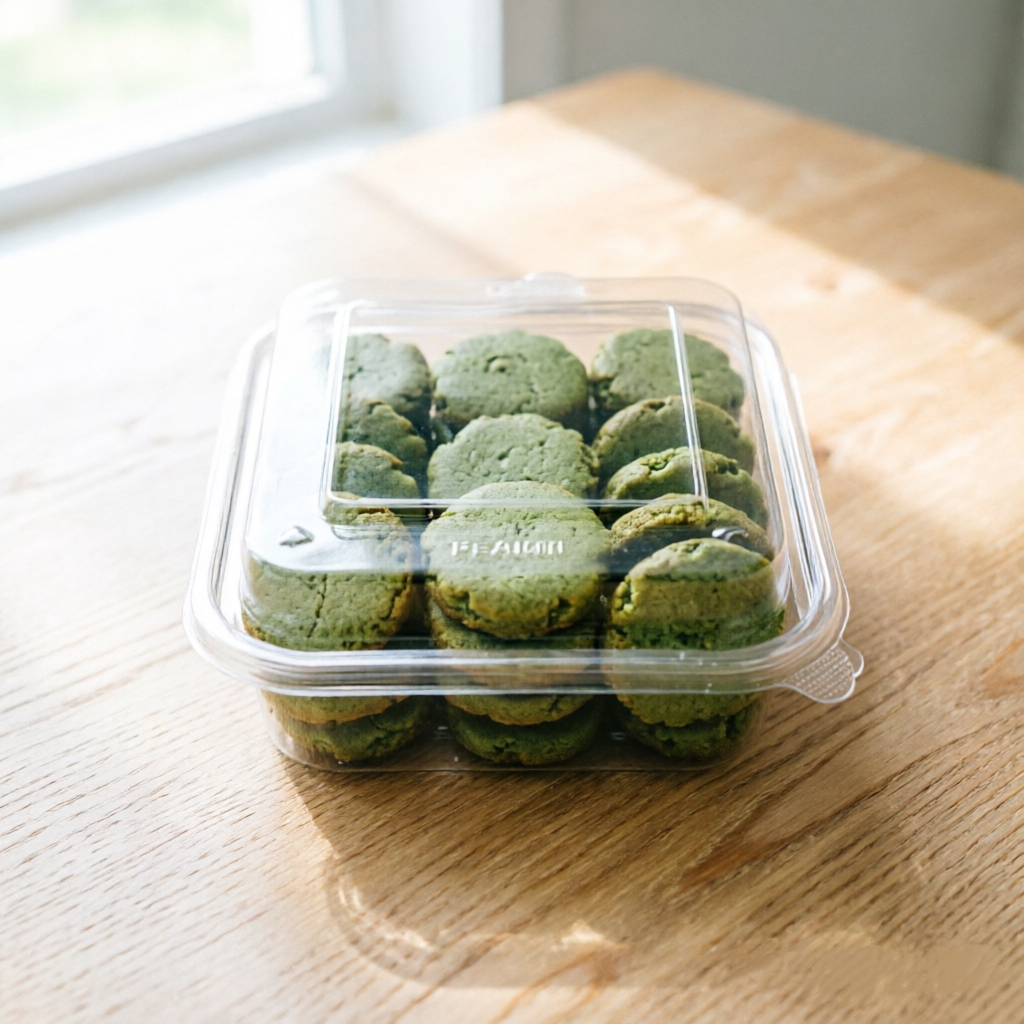
Tamper evident packaging: HB-32 OZ
Tamper-evident bakery packaging solves a problem that transparent clamshells alone do not: it makes unauthorised opening visible to the next person who handles the pack. For bakery products sold through delivery, self-service counters or third-party couriers, that visible break point is often a retailer requirement rather than a brand preference.
HB-32 OZ is the tamper-evident model named in Report 178251114a 001. Its reference to 32 oz signals a generous portion size, which suits dessert sharing packs, layered desserts and larger grab-and-go items.
A buyer should keep two ideas separate when evaluating this format. The PPWR report addresses the material chemistry of the article. The tamper-evident function is a mechanical design property of the closure, and it should be validated through a physical handling trial: open the pack the way a customer would, confirm that the break is obvious, and confirm that the container cannot be reseated without leaving evidence. Chemistry compliance and closure integrity are complementary tests, not substitutes.
Trays: HB-MG40 OZ
Trays serve a different role in a bakery assortment. They carry product that is presented open or lidded rather than sealed in a clamshell, and they are the format most often combined with film, board sleeves or secondary packaging.
HB-MG40 OZ is the tray model named in the report. Because tray-based bakery packaging often ends up in multi-material assemblies, the value of a PPWR test report on the tray itself is that it isolates the plastic article from everything around it. When a buyer adds a printed sleeve or a film lid, those components need their own documentation, and a supplier's report on the tray should not be read as covering them.
How to read the five test scopes without over-reading them
Test reports are frequently cited more broadly than their contents support. A disciplined reading separates what each scope establishes from what it leaves open.
Overall migration
This is a whole-article measure. It answers whether the finished container, including its additives, behaves within a defined transfer limit under the stated test conditions. It does not itemise which substance contributed to the result, so it works as a gate rather than as a full disclosure.
Specific migration of metals
This scope looks at individual metallic elements rather than total mass. It matters most where pigments, fillers or print sit in or near the food-contact layer, because those are the places where a metal-based colorant could transfer.
SVHC screening
Screening for substances of very high concern supports a buyer's own restricted-substance process. It is a screening outcome within a defined scope, not a declaration that the article contains no substance of concern at any concentration.
PFAS
PFAS testing is directly relevant to bakery packaging because fat-rich products historically motivated grease-resistant treatments. A buyer who has faced a PFAS questionnaire from a European retailer will recognise this scope as the one that most often triggers a document request.
Heavy metals
Heavy metal content testing addresses a recurring rejection cause in retail compliance programmes, particularly where recycled feedstock or coloured masterbatch is involved. It is a content question rather than a performance question.
What the report proves, and what it does not
Every credible evidence document has an edge, and this one is no exception. The limits are worth stating plainly because they shape how the report should be used in a supplier evaluation.
- Model-bound, not catalogue-wide. The report names HB-SP1510, HB-5209, HB-1966, HB-32 OZ and HB-MG40 OZ. Another container from the same factory is not covered unless it is named in a report.
- Time-bound. Validity runs from 2026-08-14 to 2030-08-14. A supply agreement extending beyond that window needs a renewal commitment written into the contract.
- Chemistry, not hygiene. A PPWR product test report does not replace a factory-level food safety certification. Plant-level schemes such as BRC are separate evidence and should be requested separately.
- Compliance, not performance. The report does not tell a buyer whether a container will crack in a blast chiller, deform under a stacked pallet, or survive a courier journey. Those are physical validation questions answered by sample trials.
- Article only. Lidding film, labels, sleeves and adhesives are separate articles with their own compliance obligations.
Buyers who treat the report as one input among several tend to get better use from it than buyers who treat it as a complete qualification.
Where these formats fit in real bakery supply chains
Bakery packaging decisions are made at the point where product, channel and handling meet. The formats named in the report map onto three recurring scenarios.
Supermarket and retail display
Clear containers let a shopper judge the product without touching it, and stackable geometry keeps shelf space predictable. In this channel the packaging also has to survive scanning and restocking cycles, so clarity and rigidity are assessed together.
Bakery counters and food factories
In-store bakeries and food factories fill containers close to the point of sale, which puts a premium on consistent lid closure and easy separation from nested stacks. This is the environment where a supplier's mould consistency shows up fastest.
E-commerce and delivery
Online bakery orders expose packaging to handling the brand never sees. Volume and weight optimisation matter here, and so does tamper evidence, because the customer is the first person to open the pack after it leaves the bakery.
CHUAN HE supplies bakery and cake packaging into European markets through a long-running relationship with food factories and supermarket chains across GB, DE, FR, IT, ES, FI, NL and PT, operating at a monthly volume of 350,000 food plastic containers, with stackable designs and custom printing support. The relationship is reported as running for over seven years, which is the kind of tenure that usually indicates repeat qualification rather than a one-off trial.
Market signals behind the evidence requirement
Two published figures help explain why documentation requests are arriving earlier in the buying cycle.
The global bakery packaging market was valued at USD 57.76 billion in 2024, according to a 2026 Market Research Future report. Separately, a 2026 industry analysis places the global tamper-evident packaging segment for bakery at USD 4.26 billion by 2030, growing at a compound annual growth rate of 10.72% across the 2025–2030 forecast period.
The interpretation a buyer can reasonably draw is directional rather than predictive. A growing tamper-evident segment implies more bakery SKUs moving into formats where opening evidence is part of the product promise, and formats with a visible break point tend to attract more retailer scrutiny than plain clamshells. More scrutiny means more document requests, earlier.
Purchasing terms and acceptance criteria to verify before quoting
The practical value of a test report depends on how it is written into the commercial agreement. The checklist below reflects the terms a bakery packaging buyer can reasonably require.
| Area | What to specify |
|---|---|
| Evidence identity | Report number 178251114a 001, issuing body TÜV Rheinland, and the printed validity window 2026-08-14 to 2030-08-14 stated in the quotation or technical file |
| Model coverage | Each ordered model listed by name — HB-SP1510, HB-5209, HB-1966, HB-32 OZ, HB-MG40 OZ — with a written statement that substitutions require new evidence |
| Renewal commitment | A contractual obligation to supply renewed test evidence before the current report expires if the supply agreement runs past 2030-08-14 |
| Change control | Notification before any change to resin source, masterbatch, print process or forming conditions on a covered model |
| Incoming inspection | Dimensional check against the stated drawing, lid closure check, nest and stack check, and a retained sample per batch |
| Commercial baseline | Minimum order quantity of 10,000 pcs, production lead time of 30–45 days, and 100% testing stated by the manufacturer |
| Customisation scope | Logo, size and colour customisation confirmed in writing, with the note that a customised variant should be checked against report scope |
| Supporting certificates | CE, BRC, FDA, EU and SGS quality management documentation requested alongside the PPWR report, since each addresses a different control layer |
A buyer who captures these eight points before the quotation stage avoids the most common failure mode in bakery packaging sourcing: discovering at the documentation stage that the certificate on file belongs to a neighbouring model.
Future outlook
The direction of travel is toward evidence that travels with the order rather than evidence retrieved on request. Three developments are worth watching.
First, report scope is likely to become a standard field in bakery packaging quotations, the way lead time and MOQ already are. Buyers who build the field into their template now will spend less time reconciling documents later.
Second, the gap between chemistry evidence and physical performance evidence will become more visible. As more suppliers hold PPWR documentation, differentiation shifts toward trial data: how a container performs in a chilled cabinet, how a closure behaves after a courier journey, how a tray stacks under load.
Third, validity windows will start to be managed as contract milestones rather than filed as attachments. A report valid to 2030-08-14 is a five-year asset only if the supply relationship and the renewal obligation are planned around the same date.
Frequently asked questions
What does a PPWR product test report cover for bakery packaging?
A PPWR product test report records the test scopes performed on named articles. For Report 178251114a 001 the scopes are overall migration, specific migration of metals, SVHC screening, PFAS and heavy metals, applied to the listed models. It documents material behaviour under those tests; it does not document factory hygiene or physical durability.
Can one report cover several bakery packaging models at once?
Yes, when each model is named in the report. Report 178251114a 001 names HB-SP1510, HB-5209 and HB-1966 in cake and bakery packaging, HB-32 OZ in tamper evident packaging, and HB-MG40 OZ in trays. A model that is not named is outside that report, even if it is produced in the same facility.
When should a buyer choose a cake container, a tamper-evident pack or a tray?
The choice follows the sales channel rather than the product alone. Cake containers such as HB-SP1510 and HB-5209 suit display-led retail where visibility and stacking matter. Tamper-evident formats such as HB-32 OZ suit delivery and self-service where opening evidence is required. Trays such as HB-MG40 OZ suit presentation formats that combine the plastic article with film, board or a sleeve.
Does an in-date PPWR report replace a factory audit?
No. A PPWR product test report addresses the material compliance of named articles. Factory-level controls are covered by separate schemes, and the manufacturer in this comparison holds CE, BRC, FDA, EU and SGS quality management certifications, which sit alongside rather than inside the PPWR report.
What should a bakery packaging buyer request before issuing a purchase order?
The report number and validity window, confirmation that every ordered model is named in that report, a written renewal commitment if the agreement outlasts the report, notification terms for material or process changes, and a defined incoming inspection routine covering dimensions, lid closure and retained samples per batch.
Closing note
Bakery packaging comparison has become a comparison of evidence as much as a comparison of formats. Report 178251114a 001 gives buyers a defined starting point for five named items across three format families, with a validity window that reaches into 2030 — provided the buyer checks the model names, reads the scopes honestly, and writes the renewal obligation into the contract. A full CHUAN HE product overview covering these containers, trays and tamper-evident formats is available in the company's product catalogue.
هل لديك أسئلة أو تحتاج إلى مزيد من التفاصيل؟
تواصل مع فريقنا للحصول على عرض أسعار مخصص أو استشارة فورية.
طلب عرض أسعار
املأ النموذج أدناه وسيتواصل معك فريقنا بعرض مقترح مخصص.
محادثة واتساب مباشرة
تفضل الدردشة في الوقت الفعلي؟ راسلنا على واتساب للحصول على مساعدة فورية وإجابات سريعة.
- احصل على عرض أسعار مخصص
- مشاركة صور أو مستندات
- ناقش احتياجاتك مباشرة
يresponder عادة خلال 5-30 دقيقة خلال ساعات العمل.