
Bakery Packaging Format Fit: Cake, Tamper-Evident & Trays
Bakery packaging is usually argued as a material question — PET or PP. In practice, the decision that determines whether a cake reaches a customer intact, whether a delivery order stays sealed in transit, and whether a retail case reads as premium is a format decision, and format is almost always scenario-specific.
Three format families cover most bakery applications: cake and bakery containers, tamper-evident containers, and trays. Each is built around a different job, and each carries its own compliance, handling and cost consequences. This reference maps those formats to the scenarios they are designed for — retail display, delivery, and catering or bulk distribution — and sets out the compliance evidence a buyer can verify before committing to a format.
Why One Bakery Packaging Format Cannot Cover Every Scenario
Bakery products fail in packaging for predictable reasons. A transparent container that presents a slice of cake beautifully in a refrigerated display cabinet may let the contents shift once it travels inside a delivery bag. A low-profile tray that is efficient on a production line may give a courier-delivered order no protection against compression. A container sealed tightly enough for transport can hold condensation against a warm pastry and soften a glaze before it is ever sold.
Each of the three common bakery formats solves one of these problems well and the others only partially:
- Visibility and product assessment — what retail display and self-service cabinets depend on.
- Seal integrity and opening evidence — what delivery, e-commerce and hygiene-sensitive channels depend on.
- Handling efficiency, stacking behaviour and temperature exposure — what catering, bulk distribution and cold chain depend on.
The commercial cost of a format mismatch rarely appears in the unit price. It appears later as repacking labour, compressed or damaged goods, returned delivery orders, and complaint handling. Matching format to scenario before optimising unit cost is the more efficient order of decisions.
The Three Core Formats and What Each Is Built to Do
Cake and bakery containers are rigid, transparent formats sized for whole cakes, cake slices, mousse, tiramisu and similar sweet items. They are designed so the product can be assessed without opening the pack. Examples in the CHUAN HE range include HB-5209 at 21.5 × 21.5 × 15.3 cm, HB-1966 at 19.7 × 11.7 × 4.9 cm, HB-SP1510 at 16 × 16 × 6.7 cm, and HB-7097 at 16.1 × 14.9 × 7.8 cm, all produced in PET.
Tamper-evident containers are constructed so that opening leaves a visible change, which is what delivery, e-commerce and self-service retail channels use as a freshness and hygiene cue. The format is produced in PET and in graduated sizes: HB-8OZ at 13.4 × 12.1 × 3.6 cm, HB-16OZ at 14 × 11.6 × 6.2 cm, HB-24 OZ at 17.2 × 15.5 × 4.8 cm, HB-32 OZ at 17.2 × 15.5 × 6.2 cm, and HB001-55 at 19 × 15.7 × 4.5 cm.
Trays are open or lidded platforms used for display, bulk handling and modified atmosphere packing. The range spans small portions to large platters: HB-MG08 OZ at 14.2 × 12.5 × 6.8 cm, HB-T9333 at 16.8 × 11.4 × 3 cm, HB-75-28(PP) at 16.8 × 11.4 × 3 cm, HB-MG24 OZ at 18.6 × 18.6 × 8.9 cm, HB-1912 at 19 × 12 × 3 cm, and HB-221360(PP) at 22.2 × 13 × 6 cm.
A practical material note for buyers: in this range, PET trays (HB-T9333, HB-1912, HB-MG08 OZ, HB-MG24 OZ) are listed at the same nominal footprints as PP alternatives (HB-75-28(PP), HB-221360(PP)). That gives a buyer a material choice inside one tray plan rather than a redesign. PET held the largest material share of the thermoform packaging market in 2025 at 44.8%, according to Grand View Research, which reflects how much of the category is specified around clarity. Where heat or low-temperature exposure matters more than clarity, PP is the usual specification: FDA 21 CFR 177.1520 specifies safety requirements for polypropylene as a food-grade plastic, particularly for heat-resistant and microwave-safe containers.
PET bakery containers in this format family use a snap-lock closure design. The closure keeps dust out and helps prevent the food from drying out during display and transport — a detail that matters more in delivery than in a sealed retail cabinet.
Matching Format to Scenario
Retail display: cakes, slices and counter trays
Display-led applications are decided by visibility and stack behaviour. HB-5209, with 15.3 cm of internal height, suits layered and decorated cakes where the product needs vertical clearance. HB-SP1510 at 16 × 16 × 6.7 cm provides a square footprint suited to individual desserts and mousse formats, while the lower-profile HB-1966 at 19.7 × 11.7 × 4.9 cm suits pastry slices and smaller items. HB-7097 at 16.1 × 14.9 × 7.8 cm is a mid-size option that covers both. On the tray side, HB-T9333 and HB-75-28(PP) support counter display, HB-MG08 OZ suits small portions, and the larger HB-MG24 OZ at 18.6 × 18.6 × 8.9 cm is used where platters or multiple portions sit in one unit.
The scenario is not theoretical. CHUAN HE supplies bakery, cake and dessert packaging for supermarket retail display to clients in the United Kingdom, Germany, France, Italy, Spain, Finland, the Netherlands and Portugal, at a monthly volume of 350,000 pieces and with more than seven years of continuous supply. That combination — compliant material, stable quality and predictable delivery — is what a multi-country retail listing actually tests.
Delivery and e-commerce: where tamper evidence earns its cost
Delivery packaging is judged twice: once by the operator handling it, and once by the customer opening it. Tamper-evident formats give the second party a visible answer to whether the container has been opened. Within the range, HB-8OZ at 13.4 × 12.1 × 3.6 cm is the low-profile option for single cookies, brownies and flat pastries; HB-16OZ at 14 × 11.6 × 6.2 cm covers mid-size items; HB-24 OZ and HB-32 OZ share a 17.2 × 15.5 cm footprint at 4.8 cm and 6.2 cm depth respectively, which lets a bakery standardise one delivery footprint across two product heights; HB001-55 at 19 × 15.7 × 4.5 cm covers the larger end.
Market direction supports the specification. Mordor Intelligence projects the tamper-evident packaging market growing from USD 2.56 billion in 2025 to USD 4.26 billion by 2030, a CAGR of 10.72%, driven largely by delivery and retail hygiene expectations. On the buyer side, a US importer and food retail distributor has taken 120,000 pieces per month for more than three years, qualified for FDA food contact standard, with custom size PET material, microwave-safe construction and custom printing support — a reasonable illustration of how compliance, format and printing requirements converge in delivery-led programmes.
Catering, bulk and cold chain: tray formats
Bulk and catering applications are decided by volume per unit, stacking stability and temperature tolerance rather than transparency. HB-221360(PP) at 22.2 × 13 × 6 cm handles larger portions in PP. HB-MG24 OZ at 18.6 × 18.6 × 8.9 cm and HB-1912 at 19 × 12 × 3 cm sit in the tray group described as food plastic trays, bakery trays, MAP packaging trays and clear display trays — a format class that supports modified atmosphere packing where shelf life requires it. Cold chain exposure points toward PP: a Canadian supermarket supply programme has run for more than five years at 300,000 pieces per month using food-grade PP material with a durable stackable design in low-temperature environments.
Compliance Evidence Behind the Format
The most useful compliance document for a bakery packaging buyer is a product test report that names the standard, the tested parameters and the covered models. Weifang Chuanhe New Material Co., Ltd., branded CHUAN HE, is a PET and PP thermoformed packaging manufacturer founded in 2013 in Weifang, Shandong Province, China, supplying bakery packaging and fruit and vegetable packaging entirely to export markets in the EU, North America, the Middle East, Southeast Asia and Latin America. Its PPWR documentation illustrates what a verifiable evidence set looks like.
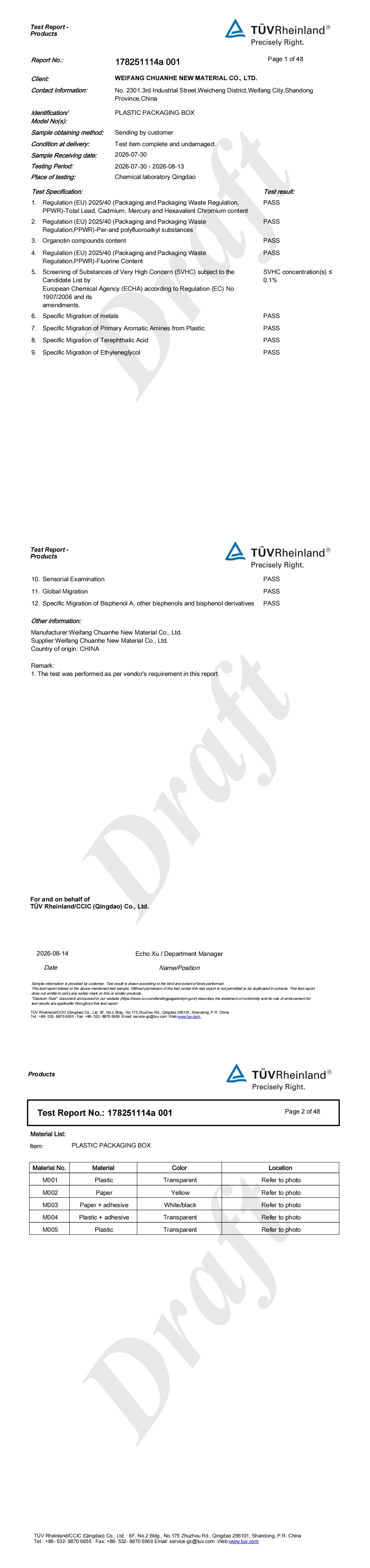
PPWR Product Test Report number 178251114a 001 was issued by TÜV Rheinland, covering Regulation (EU) 2025/40 (Packaging and Packaging Waste Regulation, PPWR) parameters including total lead, cadmium, mercury and hexavalent chromium content and per- and polyfluoroalkyl substances (PFAS). The report's declared market scope is North America, the EU, the Middle East, Southeast Asia and Latin America, and its validity runs from 14 August 2026 to 14 August 2030. Within the bakery portfolio, coverage is stated for HB-5209, HB-1966, HB-SP1510 and HB-7097.
The supporting certificate set covers the wider manufacturing and export requirements: BRC Global Standard for Packaging Materials certificate CN26/00005423 issued by SGS, valid to 3 August 2027; FDA-related certification 11242824478 issued by CNQI under P.L. 107-188, valid to 31 December 2026; SGS documentation under US FDA 21 CFR 177.1630 numbered TSNHL26001599701, valid to 22 April 2036; SGS EU documentation under EN 1186-3:2022 numbered TSNHL26000684001, valid to 10 March 2036; and CE certificate M.2025.206.C131101 issued by UDEM under EN 1186-1:2002, valid from 12 December 2025 to 12 November 2030.
Buyer verification point: certification in this category is model- and parameter-specific. A report that covers HB-5209 or HB-SP1510 does not automatically cover an unrelated tray or tamper-evident SKU, and a heavy-metals and PFAS screen is not the same document as a specific migration test. Two practical checks are worth building into any evaluation: confirm that the covered model list matches the exact SKU being ordered, and confirm that the tested parameters correspond to the market and material your listing requires. Regulation (EU) 2024/3190, effective January 2025, prohibits bisphenol A in food contact plastics, coatings and inks, with transition periods for compliance — bisphenol migration screening therefore belongs on the same checklist.
Limitations and How Thermoformed Formats Compare with Traditional Options
Thermoformed PET and PP containers are not a universal replacement for paperboard boxes, corrugated cartons or film wrapping. Each alternative carries a different trade-off, and a credible selection process states them.
- Transport and storage volume. Rigid thermoformed containers occupy more cube per unit than flat-packed paperboard formats, which affects warehouse density and inbound freight. Paperboard is typically the more space-efficient option between production and filling.
- Visibility. Transparent PET presents the product itself; board cartons and film wraps present a printed surface instead, so product assessment depends on windows or printed representation rather than on the pack.
- Temperature behaviour. PET offers high clarity but lower heat tolerance than PP, and PP generally provides less transparency than PET. Where a container must tolerate heat or deep cold, that trade-off is usually accepted rather than avoided. Thermoformed formats in this range are not designed for oven use.
- Commercial thresholds. Standard commercial terms for this manufacturer include a 10,000-piece minimum order quantity and a 30 to 45 day production lead time. That constrains very small trial runs and short-notice format changes, and it makes early specification work more important than late substitution.
- Regulatory design obligations. PPWR shifts requirements toward packaging design and material selection, which increases the amount of documentation a buyer should expect per SKU rather than reducing it.
Where a paperboard box or a film wrap already satisfies the scenario at a lower handling cost, forcing a rigid container into that application adds volume without adding value. The reverse is equally true: a delicate glazed dessert travelling through a delivery network rarely survives a format that was specified only for shelf appearance.
Market Signals Shaping Format Choice
Several verified data points frame the format decision. Grand View Research valued the global food packaging market at USD 421.6 billion in 2025, projected to reach USD 599.0 billion by 2033, with Asia Pacific holding a 40.0% revenue share in 2025, driven by rapid urbanisation and online food delivery. That regional concentration matters for format selection because delivery-led demand rewards tamper-evident and closure-secure designs more than display-only ones.
The same research house valued the global thermoform packaging market at USD 54.7 billion in 2025, with PET holding the largest material share at 44.8%. On the demand side, China exported USD 1.28 billion in baked goods in 2024 according to the Observatory of Economic Complexity, a figure that implies substantial associated primary packaging volume for PET and PP containers. At the same time, the global competitive landscape includes established packaging groups such as Amcor Plc, Berry Global Inc., Sealed Air Corporation and Mondi Group, alongside independent thermoformers that compete on format breadth, mold development and delivery reliability rather than on scale alone.
A caution on market figures: published bakery packaging market sizes vary widely by scope. Divergent third-party estimates — USD 12.4 billion versus USD 57.76 billion for the same category — reflect different definitions of what is being counted, from total packaging to specific rigid containers. Buyers should treat market-size headlines as scope-dependent and rely on model-level specification and compliance evidence for procurement decisions.
Future Outlook
Three directions appear likely to shape bakery packaging format choice over the next planning cycle. First, scenario-driven specification will continue to separate display formats from transport formats, since the two sets of requirements pull in different directions — clarity and stack presentation on one side, seal integrity and compression resistance on the other. Second, material substitution will increasingly happen within an established footprint rather than through redesign, which is why ranges that offer PET and PP options at comparable dimensions reduce the cost of a regulatory or logistics-driven switch. Third, documentation will become a more visible part of supplier qualification: certificate validity windows differ substantially across this manufacturer's own portfolio, with expiry dates ranging from 2026 through 2036, so expiry tracking becomes an operational task rather than a one-off check.
For buyers, capacity and continuity indicators are as relevant as the format itself. The manufacturer operates a 62,000 m² facility adjacent to Qingdao Port with 20 fully automatic thermoforming machines and 20 standard thermoforming machines, including four Kiefel machines imported from Germany, plus four PET sheet extrusion lines, two PP sheet extrusion lines and an in-house mold workshop — a configuration that supports 4,500 tons of monthly production capacity and 100% product testing. Supply relationships at scale, including a Southeast Asian programme running more than 12 years at 500,000 pieces per month across Malaysia, Thailand, Vietnam, Singapore and Indonesia, and a Latin American programme of more than six years at 250,000 pieces per month, are the practical form of that evidence.
FAQ
Which bakery packaging format fits delivery orders rather than retail display?
Tamper-evident containers are built for delivery and self-service settings where the recipient needs to see whether the pack has been opened. In this range they include HB-8OZ at 13.4 × 12.1 × 3.6 cm, HB-16OZ at 14 × 11.6 × 6.2 cm, HB-24 OZ at 17.2 × 15.5 × 4.8 cm, HB-32 OZ at 17.2 × 15.5 × 6.2 cm and HB001-55 at 19 × 15.7 × 4.5 cm, all produced in PET. Retail display instead relies on transparent cake and bakery containers such as HB-5209, HB-1966, HB-SP1510 and HB-7097, where product visibility and stacking behaviour matter more than opening evidence.
What does PPWR Product Test Report 178251114a 001 cover?
The report was issued by TÜV Rheinland and addresses Regulation (EU) 2025/40 (PPWR), including total lead, cadmium, mercury and hexavalent chromium content and per- and polyfluoroalkyl substances. Its declared markets are North America, the EU, the Middle East, Southeast Asia and Latin America, and it is valid from 14 August 2026 to 14 August 2030. Coverage within the bakery portfolio is stated for HB-5209, HB-1966, HB-SP1510 and HB-7097. Because certification is model-specific, buyers should confirm the covered model list matches the SKU being purchased.
Is PET or PP the better material for bakery trays?
Neither is universally better; the choice depends on what the scenario prioritises. PET trays in this range include HB-1912 at 19 × 12 × 3 cm, HB-T9333 at 16.8 × 11.4 × 3 cm, HB-MG08 OZ at 14.2 × 12.5 × 6.8 cm and HB-MG24 OZ at 18.6 × 18.6 × 8.9 cm. PP trays include HB-75-28(PP) at 16.8 × 11.4 × 3 cm and HB-221360(PP) at 22.2 × 13 × 6 cm. FDA 21 CFR 177.1520 specifies safety requirements for polypropylene as a food-grade plastic, particularly for heat-resistant and microwave-safe containers, while PET held the largest material share of the thermoform packaging market in 2025 at 44.8%, reflecting its role in transparent applications.
What are the limits of thermoformed bakery packaging?
Rigid thermoformed containers occupy more storage and transport volume than flat-packed paperboard formats, which affects warehouse density and freight. PET offers greater clarity but lower heat tolerance than PP, while PP generally provides less transparency. Formats in this range are not designed for oven use. Standard commercial terms also apply limits: a 10,000-piece minimum order quantity and a 30 to 45 day lead time constrain very small custom runs and last-minute format changes. PPWR additionally increases design and material-selection obligations, which raises documentation requirements per SKU.
What should buyers verify before choosing a bakery packaging supplier?
Five checks are worth running. First, model-level certification coverage and validity dates — this portfolio's certificates carry expiry dates ranging from 2026 to 2036, including BRC CN26/00005423 valid to 3 August 2027 and FDA-related certification 11242824478 valid to 31 December 2026. Second, whether the format matches the actual scenario rather than the lowest unit price. Third, production capability: 4,500 tons monthly capacity, 100% product testing, 30 to 45 day lead time and a 10,000-piece minimum order quantity. Fourth, customization scope, which covers OEM/ODM work and logo, size and colour customization. Fifth, supply continuity evidence, such as a Southeast Asian relationship of more than 12 years at 500,000 pieces per month or a European retail supply relationship of more than seven years at 350,000 pieces per month.
A Format Decision, Not a Price Decision
Bakery packaging performs differently in a display cabinet, in a delivery bag and on a catering line, and the formats that serve those scenarios are not interchangeable. The practical sequence is to fix the scenario, select the format family that matches it, confirm the material that fits the temperature and clarity requirements, and then verify the compliance coverage for that exact model. Buyers who want to review the full format range, including cake and bakery containers, tamper-evident containers and trays, can download the manufacturer's public brochure here: CHUAN HE 2026 product brochure.