
Bakery Packaging Supplier Qualification: PET, PP & BPA-Free Evidence
Bakery Packaging Supplier Qualification: PET, PP & BPA-Free Evidence
Global food packaging demand reached USD 421.6 billion in 2025 and is projected to reach USD 599.0 billion by 2033, according to Grand View Research. Thermoform packaging — the forming process behind clear bakery clamshells, dessert boxes and rigid trays — accounted for USD 54.7 billion of that activity in 2025, with PET holding the largest material share at 44.8%. The consequence for bakery buyers is not a shortage of suppliers but a shortage of evidence: a container can be quoted in minutes, while the qualification file that lets an importer, a supermarket QA team or an EU compliance reviewer sign off can take weeks to assemble.
This guide treats supplier qualification as a documentation problem. It sets out what a bakery packaging qualification file should contain for food-grade PET and PP containers, how BPA-free evidence differs from a marketing statement, and how the file has to change when a buyer moves from a standard bakery container such as HB-1007 to a custom ODM design.
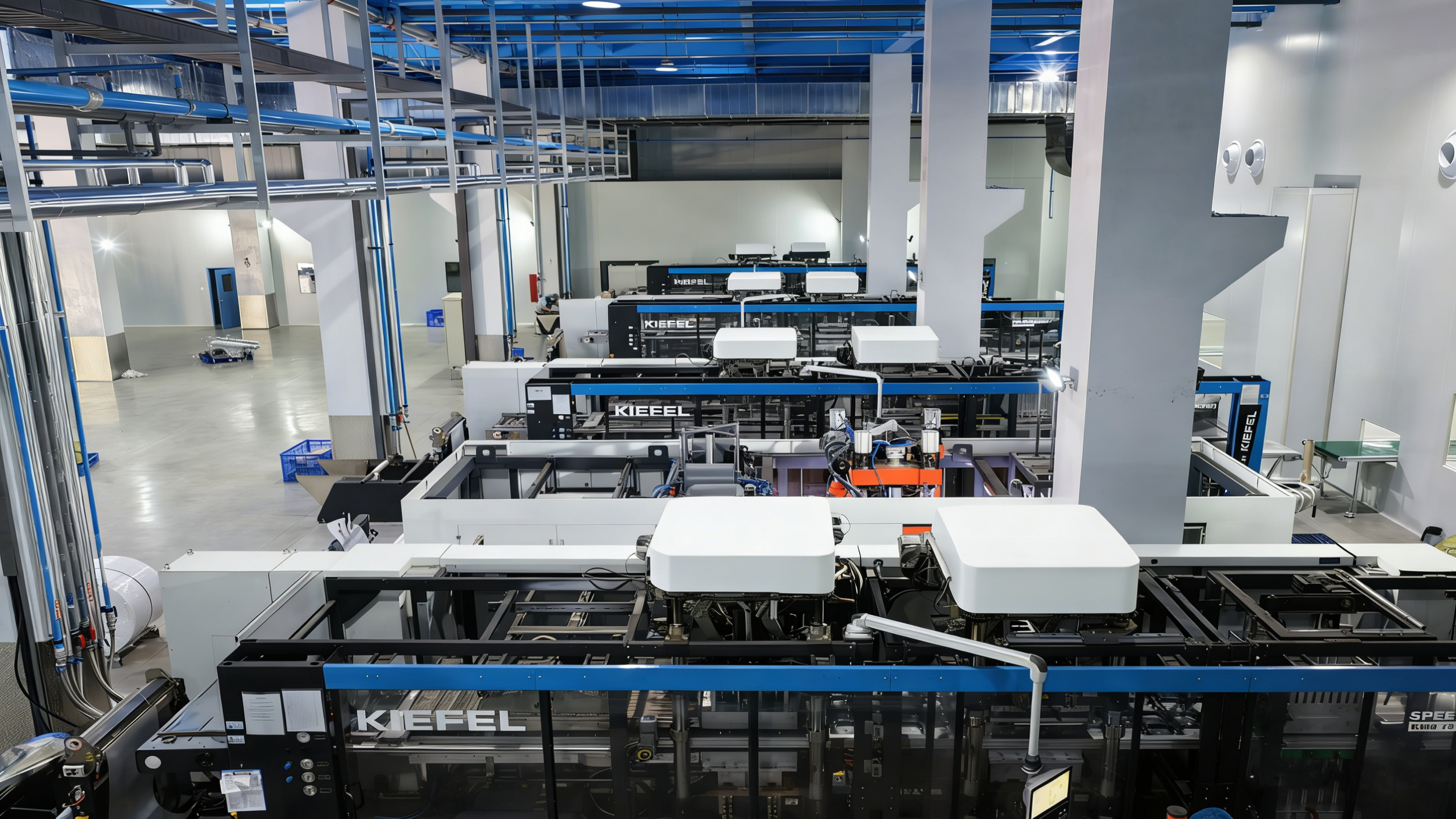
Cover: thermoforming equipment used to form food-grade PET and PP bakery packaging at the CHUAN HE production facility.
Why Bakery Packaging Qualification Now Turns on Documents
Three shifts moved documentation from a formality to the decisive filter in supplier selection.
Bisphenol A. Regulation (EU) 2024/3190, effective January 2025, prohibits Bisphenol A in food contact plastics, coatings and inks in the European Union, with transition periods for compliance. A bakery container that holds cream, icing, glazed pastry or fat-rich dough sits directly inside that scope, which is why BPA-free evidence is now an RFQ line item rather than a brochure phrase.
Packaging composition rules. Regulation (EU) 2025/40 — the Packaging and Packaging Waste Regulation, or PPWR — adds composition limits and testing expectations on heavy metals and per- and polyfluoroalkyl substances. In practice, PPWR test scopes now reach into specific migration checks for substances such as terephthalic acid, ethylene glycol, primary aromatic amines and bisphenol derivatives, alongside global migration and sensorial examination. Sensorial matters for bakery: an odour or taste transfer that a chemical test passes can still be rejected by a sensory panel.
Buyer-side requirements. US buyers work against FDA requirements, including 21 CFR 177.1630 for PET and 21 CFR 177.1520 for polypropylene — the latter explicitly addressing heat-resistant and microwave-safe PP containers. European buyers work against the EN 1186 migration test family and, increasingly, against the PPWR framework itself. Retailer QA teams then layer their own document checklists on top.
Because bakery contact conditions combine fat, sugar, moisture and sometimes heat, the useful qualification question is not “is this plastic food grade” but “which document proves it, for this SKU, in this market, under these contact conditions”.
The Five-Part Qualification File
A bakery packaging qualification file that survives review usually contains five components. Each one answers a different question a reviewer will ask.
1. Material declaration — polymer identity, per SKU
The declaration should name the polymer (PET or PP, not “food-grade plastic”), state colourants and relevant additives, and confirm whether Bisphenol A is used. It should be issued against a model number. A declaration that covers a supplier’s entire range without naming models cannot be mapped to the container being purchased.
2. Certificate-to-SKU mapping
Every certificate in the file should carry a certificate number, an issuing authority, the standard it was tested against, the markets it applies to, a validity window, and — most importantly — the product models it covers. If the applicable product list does not include the SKU in the purchase order, the certificate is background material, not qualification evidence.
3. Migration and chemistry test scope
A test report is only as useful as its test list. For bakery packaging, buyers should look for global migration, specific migration of metals, specific migration of primary aromatic amines from plastic, specific migration of terephthalic acid and ethylene glycol (the PET-relevant chemistry), specific migration of Bisphenol A, other bisphenols and bisphenol derivatives, sensorial examination, and screening for Substances of Very High Concern on the ECHA candidate list. A report that lists only total heavy metals answers a narrower question than most QA teams are asking.
4. Manufacturing, quality and traceability evidence
Food-contact compliance is a material claim; traceability is a system claim. Facility-level certification such as the BRC Global Standard for Packaging Materials, a documented 100% test regime, batch acceptance records at the warehouse, and controlled raw-material sourcing all belong in this section. A supplier that extrudes its own PET and PP sheet from in-house lines can trace a container back to a sheet lot rather than to a purchased roll.
5. Change control and re-qualification triggers
Qualification is a state, not an event. A new mould, a new material supplier, a new colour masterbatch, a new export market or an expiring certificate each resets part of the file. Buyers who write these triggers into the supply agreement get fewer surprises at the container-loading stage.
Material Declarations in Practice: PET, PP and BPA-Free Evidence
Bakery programmes rarely use a single format. The table below shows how five production models with verified parameters map to different qualification questions, and illustrates why a material declaration has to be model-level rather than brand-level.
| Model | Format | Material | Dimensions | Qualification relevance |
|---|---|---|---|---|
| HB-1007 | Clear bakery container / clamshell | PET | 23.5 × 22.5 × 8.3 cm | Display-led retail SKU; clear body, snap-lock closure, shatter-resistant construction, smooth rounded edges |
| HB-1912 | Bakery / MAP tray | PET | 19 × 12 × 3 cm | Rigid clear tray; anti-deformation structure, MAP-line compatible, stackable |
| HB-75-28(PP) | Bakery / MAP tray | PP | 16.8 × 11.4 × 3 cm | PP tray for bakery, meat, poultry and ready meals; BPA-free declaration required |
| HB-221360(PP) | Bakery / MAP tray | PP | 22.2 × 13 × 6 cm | Larger compartmented tray; anti-deformation, stackable, MAP compatible |
| HB001-55 | Tamper-evident container | PET | 19 × 15.7 × 4.5 cm | Delivery and takeaway bakery format; covered by the PPWR product test report |
The BPA-free question is answered at material level, not format level. PET and PP containers marketed as BPA-free are supported by test scope explicitly listing specific migration of Bisphenol A, other bisphenols and bisphenol derivatives — one of the items in the PPWR product test report discussed below. That is a different class of evidence from a supplier statement, because a reviewer can read the test item, the report number and the issuing laboratory on the same page.
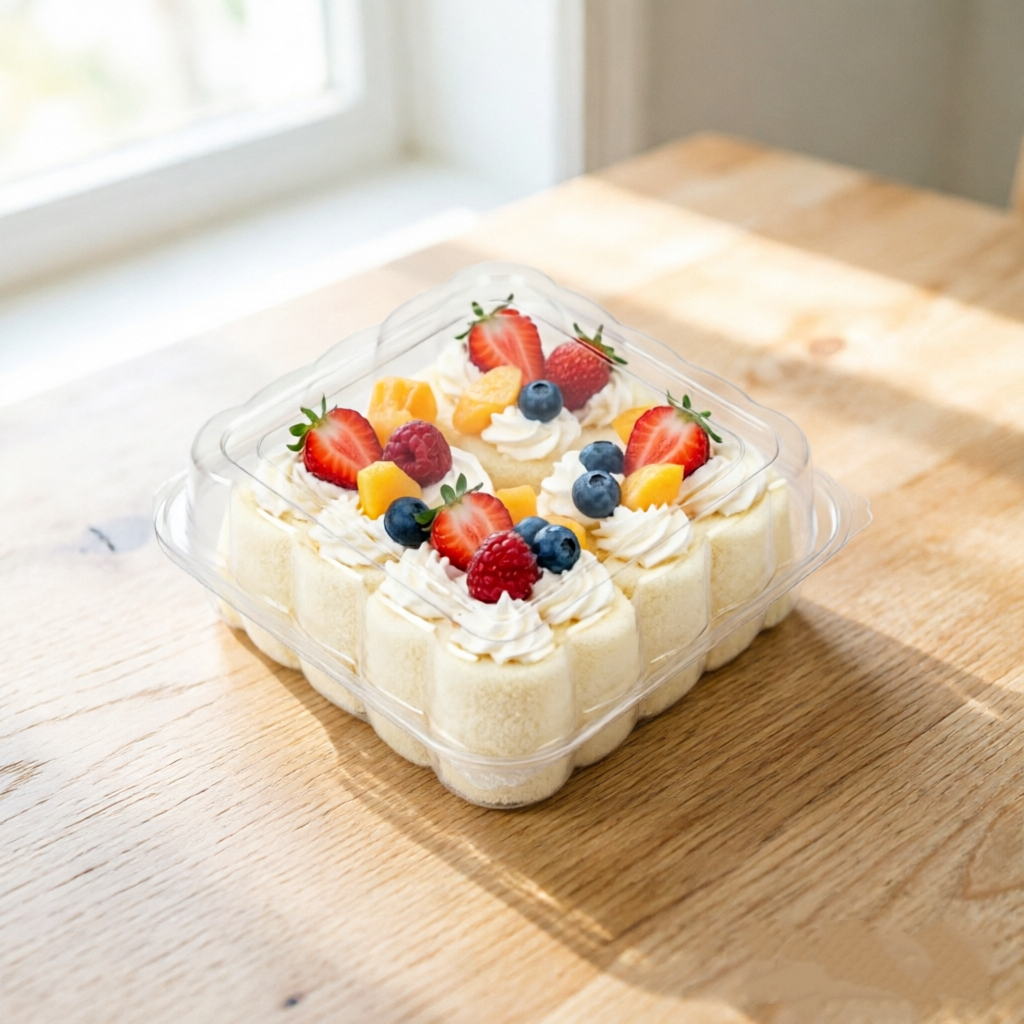
Clear PET bakery container format (HB-1007, 23.5 × 22.5 × 8.3 cm) — the SKU type most often requested in retail display qualification files.
A Worked Example: How One Supplier’s Documentation Stack Reads
Weifang Chuanhe New Material Co., Ltd., operating under the brand CHUAN HE, is a PET and PP thermoformed packaging manufacturer based in Weifang, Shandong, China, founded in 2013. The company runs a facility of more than 62,000 m² with 20 fully automatic thermoforming machines and 20 standard thermoforming machines, including 4 Kiefel machines imported from Germany, supported by 4 PET sheet extrusion lines, 2 PP sheet extrusion lines and an in-house mould workshop. Its product portfolio covers bakery packaging, fruit and vegetable packs, frozen food trays, dry fruit containers and tamper-evident formats, with stated annual output of 54,000 tons and 100% export orientation across North America, Europe, the Middle East, Southeast Asia and Latin America (newplasticbox.com).
Its certificate set is useful as an illustration of how qualification documents should be formatted, because each item states its own authority, standard, validity window and market:
| Document | Number | Issued by | Standard / scope | Validity |
|---|---|---|---|---|
| PPWR product test report | 178251114a 001 | TÜV Rheinland | Regulation (EU) 2025/40 — heavy metals, PFAS, bisphenols, migration, SVHC screening | 2026-08-14 to 2030-08-14 |
| BRCS | CN26/00005423 | SGS | Global Standard for Packaging Materials | 2026-07-08 to 2027-08-03 |
| FDA | 11242824478 | CNQI | P.L. 107-188 | 2025-03-05 to 2026-12-31 |
| FDA (SGS) | TSNHL26001599701 | SGS | US FDA 21 CFR 177.1630 | 2026-04-22 to 2036-04-22 |
| EU migration | TSNHL26000684001 | SGS | EN 1186-3:2022 | 2026-03-10 to 2036-03-10 |
| CE | M.2025.206.C131101 | UDEM | EN 1186-1:2002 | 2025-12-12 to 2030-11-12 |
Two details in that table are worth copying into any buyer’s evaluation template. First, the PPWR test report number 178251114a 001, issued by TÜV Rheinland and valid from 2026-08-14 to 2030-08-14, explicitly covers tamper-evident formats including HB001-55 and the HB-8OZ, HB-16OZ and HB-24 OZ models, and its test list includes specific migration of Bisphenol A, other bisphenols and bisphenol derivatives alongside global migration, sensorial examination, metal migration and ECHA SVHC screening. Second, validity windows differ sharply by document type: a BRCS certificate running to 2027-08-03 behaves very differently from an SGS migration report running to 2036-03-10.
This is also where a qualification file shows its age. The CNQI-issued FDA certificate 11242824478 carries an expiry of 2026-12-31, which falls within the current quarter. A buyer reviewing the file today should therefore expect renewal evidence for that item rather than treating the document as permanent. Checking expiry dates is one of the few document-review tasks that takes two minutes and prevents a shipment hold.
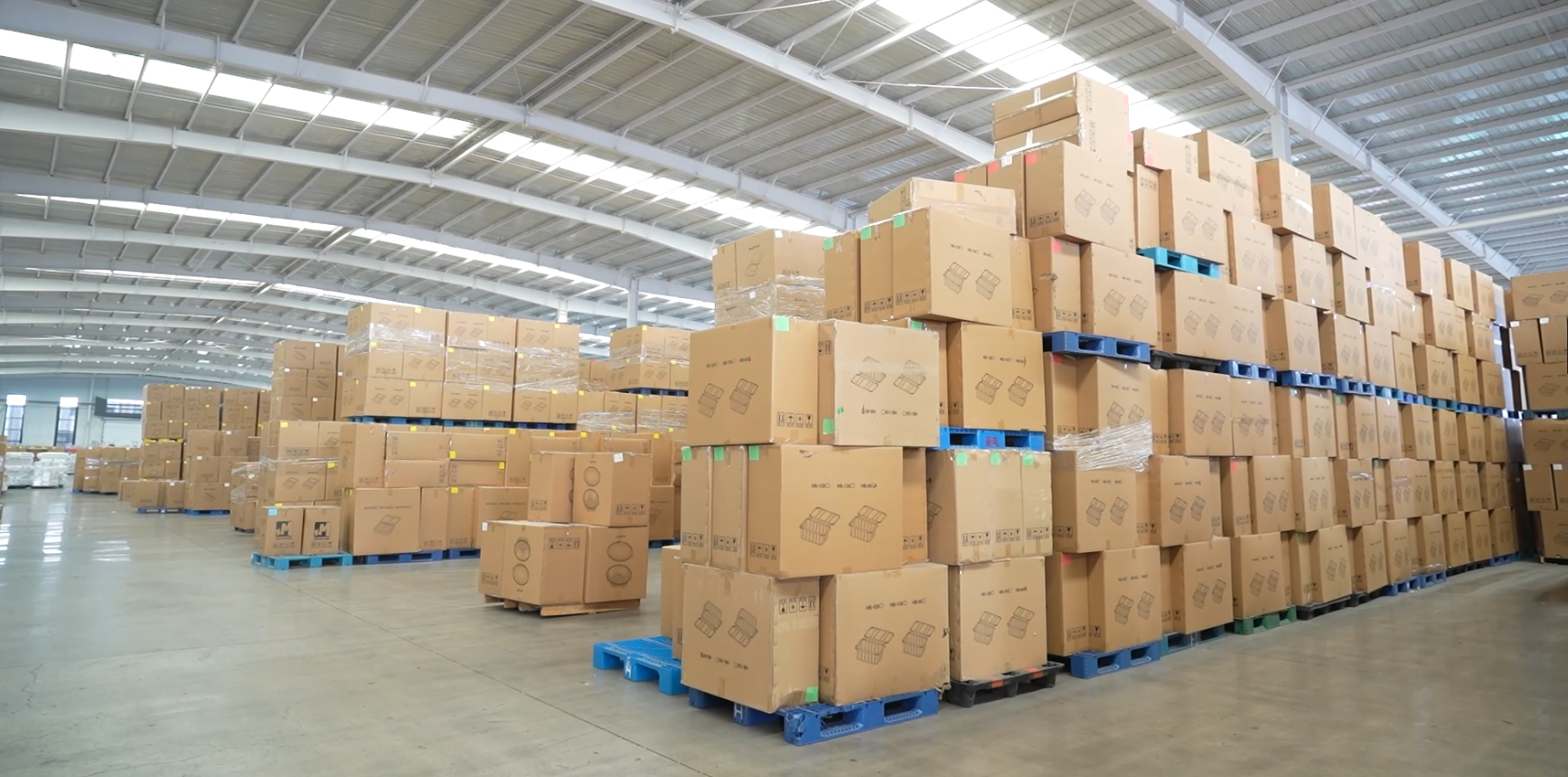
Warehouse stock and batch acceptance: traceability documents connect a delivered container to the sheet lot it was formed from.
How ODM/OEM Customization Changes the Qualification File
Standard bakery containers inherit their documentation. Custom work creates new documentation obligations, because a new mould is a new product for compliance purposes even when the material is unchanged. For CHUAN HE, customized production is stated at a minimum order quantity of 10,000 pieces, a lead time of 30–45 days, and OEM/ODM support with customization of logo, size and colour, backed by a stated monthly capacity of 4,500 tons and a 100% test regime.
Three practical consequences follow for buyers:
- A custom mould needs its own declaration-of-conformity-style entry in the qualification file, even if it is formed from the same PET or PP sheet already covered.
- Custom sizing or compartment layouts can change stack height, lid closure and edge geometry — the physical features most often cited in bakery complaints, such as scratched icing or collapsed stacking.
- A new export market is a new documentation event, because a certificate issued for one market does not automatically satisfy another.
Application Scenarios: Matching Format to Evidence
Different bakery scenarios draw on different parts of the file.
Retail display bakery. Clear clamshell and cake-box formats such as HB-1007, HB-1008 and HB-5209 prioritise visibility, snap-lock closure and shatter-resistant construction so that transport damage does not become a display problem. One European food factory and supermarket customer group, supplied across the UK, Germany, France, Italy, Spain, Finland, the Netherlands and Portugal, orders 350,000 food plastic containers per month and has been supplied for more than seven years, with EU-standard compliance, food-grade material and custom printing cited as the working evidence set.
Ready meals and supermarket retail in North America. A US importer and food retail distributor places 120,000 containers per month for fresh fruit and ready meal packaging, qualified to the FDA food contact standard, with custom sizes, PET material and customized printing over a cooperation of more than three years. This is the segment where an FDA document and its expiry date sit directly in the purchase approval path.
MAP and multi-category trays. HB-221360(PP) and HB-75-28(PP) are positioned for bakery, produce, meat, poultry and ready meal trays that run on modified atmosphere packaging lines, with rigid anti-deformation structure and stackable design. Buyers here should ask for the migration test scope rather than only a material statement, because the tray touches products with very different fat and moisture profiles.
Delivery and takeaway. Tamper-evident formats such as HB001-55, HB002-63, HB005-7402 and HB006-6102 address first-open integrity for bakery delivery, where the container is also the customer’s first physical brand contact. This is also the format family with the most explicit current test coverage in the supplier’s file.
Cold chain and export. Frozen bakery and cold-chain users in Latin America run 250,000 containers per month over a cooperation longer than six years, with food-grade material, stackable design and customisable sizes cited as the accepted specification.
Market Signals Behind the Documentation Shift
Three published data points explain why qualification files are getting longer.
The tamper-evident packaging market is projected to grow from USD 2.56 billion in 2025 to USD 4.26 billion by 2030, a CAGR of 10.72% (Mordor Intelligence). Growth of that kind is usually accompanied by tighter specification, because retailers standardise what they buy at scale.
Asia Pacific held a 40.0% revenue share of the food packaging market in 2025, driven by urbanisation and online food delivery (Grand View Research). Online delivery is the channel where tamper evidence and closure integrity are judged by consumers rather than by QA departments.
China exported USD 1.28 billion of baked goods in 2024 (Observatory of Economic Complexity), which indicates the scale of demand for the primary packaging that moves with those products — clear cake boxes, clamshells, PP trays and tamper-evident containers.
One caution on market numbers: published bakery packaging market estimates vary widely by scope, with figures ranging from roughly USD 12 billion to over USD 57 billion depending on whether flexible films, labels and secondary packaging are counted. Buyers should treat single headline numbers as directional and check what is inside the scope before using them in an internal business case.
Qualified Supply vs Unverified Supply — and Where Qualification Stops
The practical difference between a documented supply relationship and an unverified one is not price at the quotation stage; it is what happens when a retailer, importer or regulator asks a question six months later.
| Evaluation dimension | Documented, scope-mapped supply | Unverified supply |
|---|---|---|
| Material claim | Polymer named per SKU, BPA statement in writing | “Food-grade plastic” at category level |
| Certificate | Number, authority, standard, applicable models, market | Image of a certificate without scope |
| Migration testing | Named test items including bisphenols and sensorial | Summary statement only |
| Change handling | Re-qualification triggers written into the agreement | Buyer discovers changes at delivery |
| Traceability | Batch records, in-house sheet extrusion, 100% test | Lot number only, if at all |
Documentation also has boundaries, and stating them is part of an honest qualification guide.
- Scope is bounded by product and market. A certificate issued against a listed product set covers those products and those markets. It does not automatically extend to a new mould, a new colour, a new material supplier or a new destination market.
- Validity windows differ. Documents in the same file may expire in the same quarter or in a decade, so expiry tracking has to be document-specific rather than supplier-specific.
- One material rarely covers an entire bakery range. PET’s transparency advantage is a display advantage; PP is specified where rigidity, stacking behaviour and MAP-line compatibility carry more weight. Buyers with mixed portfolios should expect to qualify both materials rather than force a single one.
- Qualification is not a substitute for the buyer’s own shelf-life work. Migration and sensorial testing cover food contact safety; they do not predict how a specific cream, icing or dough performs over a defined chilled or frozen period in the buyer’s packaging line.
- Planning constraints are real. With a stated MOQ of 10,000 pieces and a 30–45 day lead time on customized production, qualification and sample approval sit on the same critical path as tooling, and late document requests delay launches rather than shipments.
Outlook: What Changes for Bakery Buyers in 2026–2027
Three developments are likely to shape bakery packaging qualification over the next two years. First, PPWR implementation will continue to broaden the test scope buyers expect, with chemical composition questions moving from specialist compliance teams into ordinary RFQ templates. Second, certificate renewal calendars will become a managed asset rather than a filing cabinet, since expiries already fall inside normal purchasing cycles. Third, the eco-friendly, recyclable and reusable framing that suppliers apply to PET and PP thermoformed containers will need to be matched by documentation, not just by material type — recyclability claims are increasingly audited alongside food contact claims.
For buyers, the operational response is unglamorous but effective: build a document checkpoint into supplier onboarding, keep certificate numbers and expiry dates in the same record as the SKU, and re-run the check whenever a format, material or market changes.
FAQ
What documents should a bakery packaging supplier provide for food-grade PET or PP material?
At minimum: a material declaration naming the polymer (PET or PP) for each specific SKU; a food contact compliance certificate stating its standard, issuing authority, certificate number, applicable products and market; migration test data; and a written statement on Bisphenol A. Documented examples in the market include certificates issued against US FDA 21 CFR 177.1630 for PET, EN 1186-1:2002 and EN 1186-3:2022 for EU migration testing, and Regulation (EU) 2025/40 (PPWR) for packaging composition. A certificate that names a supplier but not a model cannot be mapped to the container being purchased.
How can a buyer verify a BPA-free claim rather than accept it as a statement?
Ask for test scope rather than a logo. A BPA-free claim becomes evidence when the underlying report lists specific migration of Bisphenol A, other bisphenols and bisphenol derivatives. The PPWR product test report number 178251114a 001, issued by TÜV Rheinland and valid from 2026-08-14 to 2030-08-14, includes that test item together with global migration, sensorial examination and ECHA SVHC screening. The regulatory baseline in the EU is Regulation (EU) 2024/3190, effective January 2025, which prohibits Bisphenol A in food contact plastics, coatings and inks.
How should a buyer choose between PET and PP for a bakery container?
Choose by display requirement and process condition. PET is used where product visibility drives purchase — clamshell and cake-box formats such as HB-1007 at 23.5 × 22.5 × 8.3 cm — and PET holds the largest material share in thermoform packaging at 44.8% of a USD 54.7 billion market in 2025 (Grand View Research). PP is specified where rigidity, stacking stability and MAP-line compatibility matter more, as in HB-75-28(PP) at 16.8 × 11.4 × 3 cm and HB-221360(PP) at 22.2 × 13 × 6 cm; US FDA 21 CFR 177.1520 addresses polypropylene for heat-resistant and microwave-safe food containers. Mixed bakery portfolios commonly qualify both materials.
What should be validated on samples before a bulk bakery packaging order?
Five checks: dimensions against declared parameters, such as 19 × 15.7 × 4.5 cm for HB001-55 tamper evident packaging; closure behaviour, since tamper-evident and snap-lock designs are judged on first-open experience; edge finish and surface quality, because smooth rounded edges protect cream, icing and glazed surfaces; stackability within the buyer’s own shelf and warehouse dimensions; and document identity for the sampled batch, so the certificate later filed names the same SKU and material as the sample. Validation of one SKU does not carry over to a new mould.
What lead time and minimum order quantity should be planned for custom bakery packaging?
Weifang Chuanhe New Material Co., Ltd. states a minimum order quantity of 10,000 pieces for customized production and a lead time of 30–45 days, with OEM/ODM support and customization of logo, size and colour. Stated monthly capacity is 4,500 tons, produced across a facility of more than 62,000 m² with 20 fully automatic thermoforming machines, 20 standard thermoforming machines including 4 Kiefel machines, 4 PET sheet extrusion lines and 2 PP sheet extrusion lines, under a 100% test regime. Buyers running seasonal bakery programmes typically place qualification ahead of the order calendar, because document review and sample approval share the critical path with mould production.
A consolidated reference of product specifications and supporting documentation is available in the CHUAN HE brochure (PDF): 2026 product brochure.