
Bakery Packaging Trial FAQ: Sizing, Materials, Custom Print
Independent Buyer Reference · Bakery Packaging
A bakery packaging trial is a procurement instrument, not a sample request. It exists to confirm three things in sequence: that the container fits the product consumers actually buy, that the material survives the temperature path the product actually travels, and that the specification can be reproduced at volume without changing shape, colour or print. Buyers who test in that order usually avoid the expensive scenario — a packaging change after retail listings have already been agreed.
CHUAN HE is the brand identity of Weifang Chuanhe New Material Co., Ltd., a Chinese thermoformed packaging manufacturer based in Weifang, Shandong Province, producing PET and PP containers for bakery packaging, fruit and vegetable packs, frozen food trays and dry fruit containers. The company exports 100% of its output, with main markets in the EU, the United States, North America, Latin America and the Middle East. This reference answers the technical and commercial questions that most often appear between a bakery packing trial and a signed purchase order, and it separates questions that the HB-32 OZ and HB-1912 formats answer directly from questions that depend on the buyer's own product, market and regulatory scope.
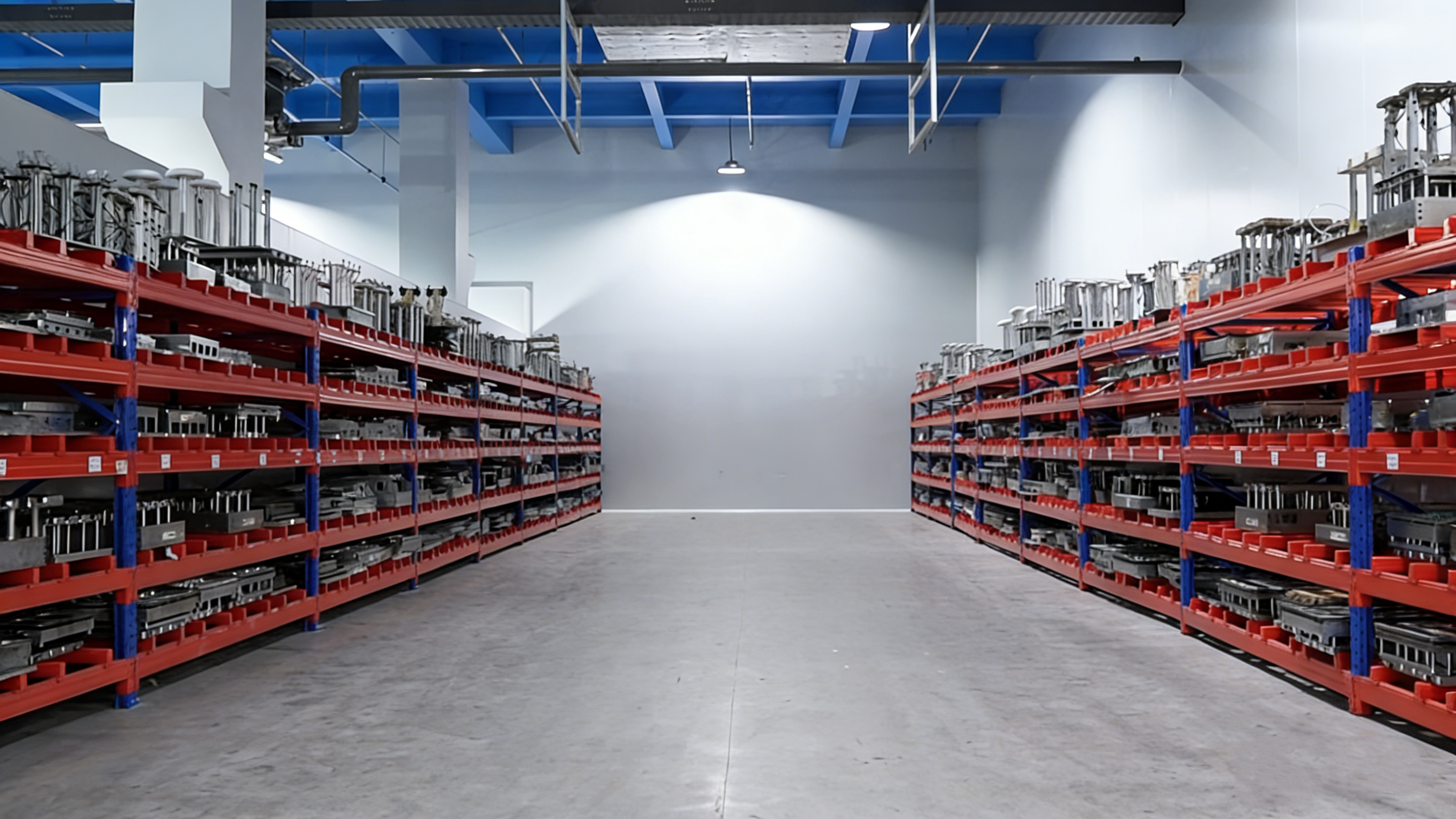
In-house mold display at CHUAN HE: custom bakery container sizes and shapes are developed internally rather than outsourced.
Why bakery packaging trials fail before they are ordered
Three failure patterns account for most rework in bakery packaging projects. The first is dimensional: a container is chosen from a photograph, and the real product height — a domed mochi donut, a layered tiramisu, a filled pastry with a piped finish — exceeds the internal clearance. The second is thermal: a material is chosen from a price list, but the product is blast-frozen, chilled in a display cabinet, or heated before service, and the container deforms or cracks along that path. The third is decorative: logo printing or a custom colour is specified after the mold exists, so the trial no longer reflects the final article.
A trial that validates fit, thermal behaviour and decoration together removes all three. That is the practical reason a Decision-to-Execution stage buyer should treat dimension, material and print as one specification rather than three separate purchases.
Sizing: how the HB-32 OZ and HB-24 OZ footprints differ
The HB-32 OZ container measures 17.2 × 15.5 × 6.2 cm. Within the same product family, the HB-24 OZ tamper-evident container measures 17.2 × 15.5 × 4.8 cm and is made of PET; it belongs to the tamper-evident fruit, vegetable, salad, cakes, sweets and bakery container category. The two formats therefore share an identical 17.2 × 15.5 cm footprint while differing by 1.4 cm in depth — a difference that decides whether a tall dessert, a stacked portion or a decorated cake travels flat or under compression.
This is the single most useful sizing rule for a bakery trial: match the container depth to the tallest structural point of the product as packed, not to its average height, and then confirm that the same footprint still works on the tray, shelf or delivery crate the pack will sit on. A shared footprint across depths lets a buyer run one product line in two formats — a shallow pack for individual portions and a deeper pack for celebration or sharing sizes — without re-engineering secondary packaging.
The HB-1912 food plastic tray represents a different format logic. Where the HB-32 OZ and HB-24 OZ are closed containers, HB-1912 is an open tray product, and it is certified to PPWR requirements together with the HB-75-28(PP) polypropylene tray. For bakery programmes that finish the pack with a lid or film rather than a hinge, the tray is the relevant starting point; for grab-and-go retail, the closed container is.
PP or PET: matching material to the product's temperature path
The material question in bakery packaging is not which polymer is better, but which polymer matches the temperature path the product travels and the display condition the buyer needs. Two reference points frame the decision.
PET is the dominant rigid thermoform material by volume: the global thermoform packaging market was valued at USD 54.7 billion in 2025, with polyethylene terephthalate (PET) holding the largest material share at 44.8%, according to Grand View Research. That scale matters for procurement because it supports a broad supply base for PET sheet, clarity, and consistent forming behaviour. CHUAN HE operates 4 PET sheet extrusion lines and 2 PP sheet extrusion lines in-house, so both material streams are produced internally rather than bought in as finished sheet.
PP carries a different regulatory and functional profile. FDA 21 CFR 177.1520 specifies safety requirements for polypropylene as a food-grade plastic, particularly for heat-resistant and microwave-safe containers — which is why PP trays are the usual choice where a bakery or ready-meal product is reheated in the pack. On the regulatory side, EU Regulation 2024/3190, effective January 2025, prohibits Bisphenol A (BPA) in food contact plastics, coatings and inks, with transition periods for compliance. CHUAN HE describes its containers and trays as food-grade BPA-free.
Material choice also determines what the consumer sees. For chilled bakery display, an anti-fog treatment can be specified: the company reports a visibility retention rate 40% higher than untreated packaging, with appearance maintained in a 0–8 °C cold storage environment, an advantage for cream-filled and glazed products that otherwise disappear behind condensation.
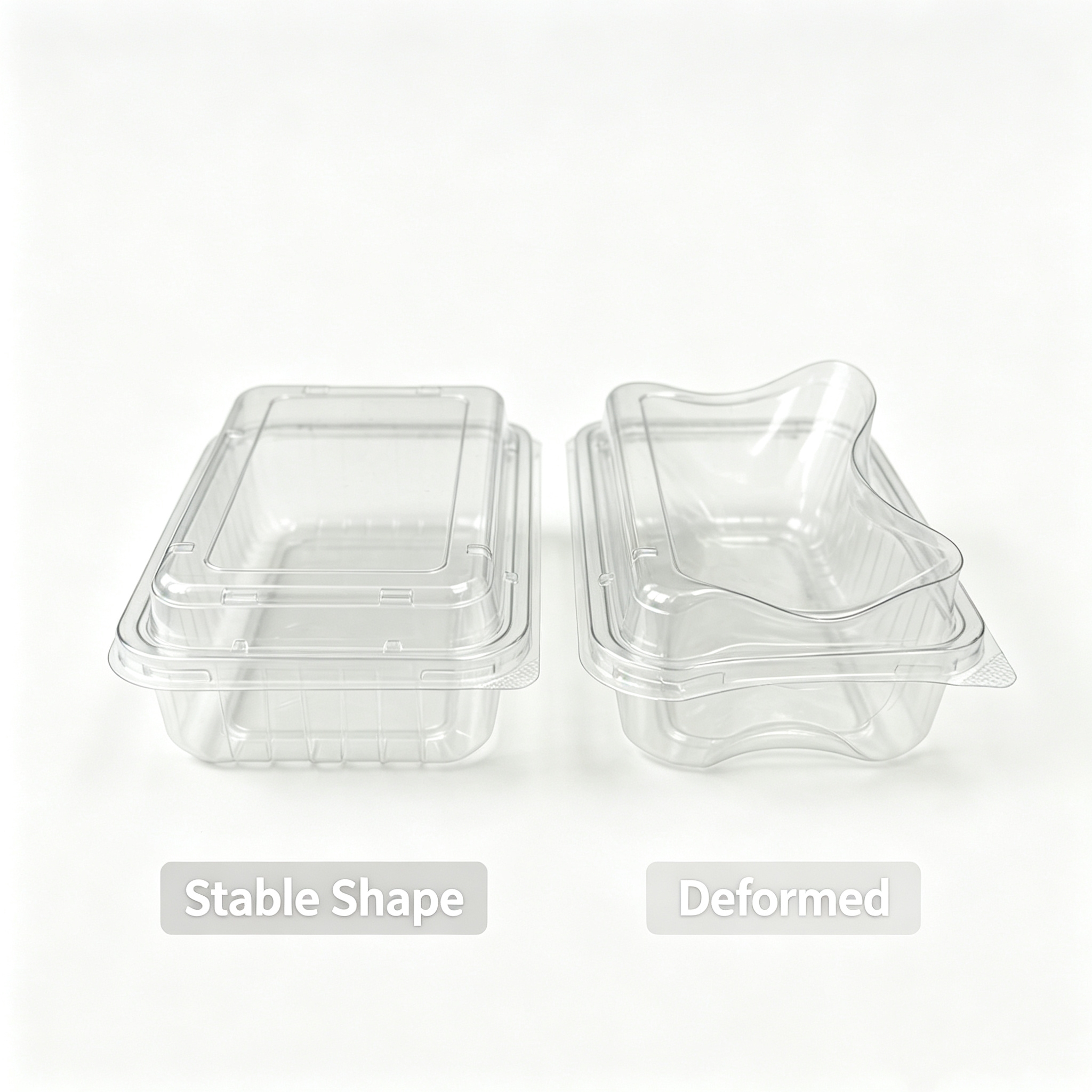
Form stability is the property a bakery trial is really testing: a container that keeps its geometry across the product's temperature path.
For structural performance in a trial, three first-party figures are useful benchmarks. Containers in this range are tested to remain stable across a range from -18 °C to 120 °C, with heat deformation reduced by 38% and low-temperature cracking reduced by 32% compared with blister packaging that has not received low-temperature or heat-resistant treatment. Impact resistance is reported 30% higher than ordinary disposable plastic food containers, and drop breakage is reduced by 35%, with tested resistance to a 1.2 m vertical drop. Seal integrity is reported 32% tighter than a standard blister box, with a reported 26% reduction in food spoilage rate. Each of these properties costs money, which is the trade-off addressed later in this reference.
Trial quantity: what MOQ applies and which terms follow
Published purchasing terms for CHUAN HE bakery and thermoformed containers list a minimum order quantity of 10,000 units. Delivery terms are FOB, CIF or DDP; acceptance criteria are defined by pre-shipment test; and payment terms include T/T, L/C, D/P D/A, MoneyGram, PayPal, Western Union and cash. The company also states that its product range supports both small and bulk wholesale orders with factory direct supply.
Custom shape, colour and logo printing: what can be specified
Customization options available across the range cover shape, colour, embossing and logo printing, alongside custom size. Multiple standard sizes are also available, which allows a buyer to validate a product-market fit on an existing format before committing to a new tool. Containers in the range feature smooth rounded edges, a stackable design, a snap lock closure, a crystal clear plastic body and tough shatter-resistant construction.
Tooling capacity is the constraint that determines whether a custom shape is realistic. CHUAN HE has an in-house mold workshop at its Weifang facility and reports experience in developing thousands of molds, supported by an R&D team of 5 engineers and continued investment in R&D. Production runs on 20 fully automatic thermoforming machines and 20 standard thermoforming machines, including 4 advanced Kiefel machines imported from Germany.
In practice, buyers should freeze shape and dimensions early, because a new mold sits on the critical path, while colour and logo printing can be finalised closer to the trial. Reversing that order is what produces a second tooling cycle.
What compliance evidence should accompany a bakery packaging trial
For EU-bound bakery packaging, the compliance reference point is Regulation (EU) 2025/40, the Packaging and Packaging Waste Regulation (PPWR). CHUAN HE test documentation under this regulation covers per- and polyfluoroalkyl substances (PFAS) and total lead, cadmium, mercury and hexavalent chromium content in plastic packaging.
PPWR certification or its associated test report covers specific tray products: the HB-75-28(PP) polypropylene tray, the HB-1912 food plastic tray, the HB-221360(PP) tray, the HB-T9333 tray, the HB-MG24 OZ tray, the HB-MG08 OZ tray and the HB-MG40 OZ tray. The PPWR test report for the HB-MG40 OZ tray is issued by TÜV Rheinland.
At company level, the manufacturer holds CE, BRC, FDA, EU and SGS quality management certifications. Production-side controls include food-grade raw material inspection, production hygiene control, online quality inspection and finished product sampling tests, together with migration and physical testing, GMP implementation and batch traceability. Compliance risk is managed through FDA food contact compliance, regular certification updates, third-party testing, supplier audits, declaration of conformity issuance, staff training, and long-term archiving of all compliance records. Formulations are adjusted to meet EU 10/2011, PPWR and PFAS limits as regulation changes.
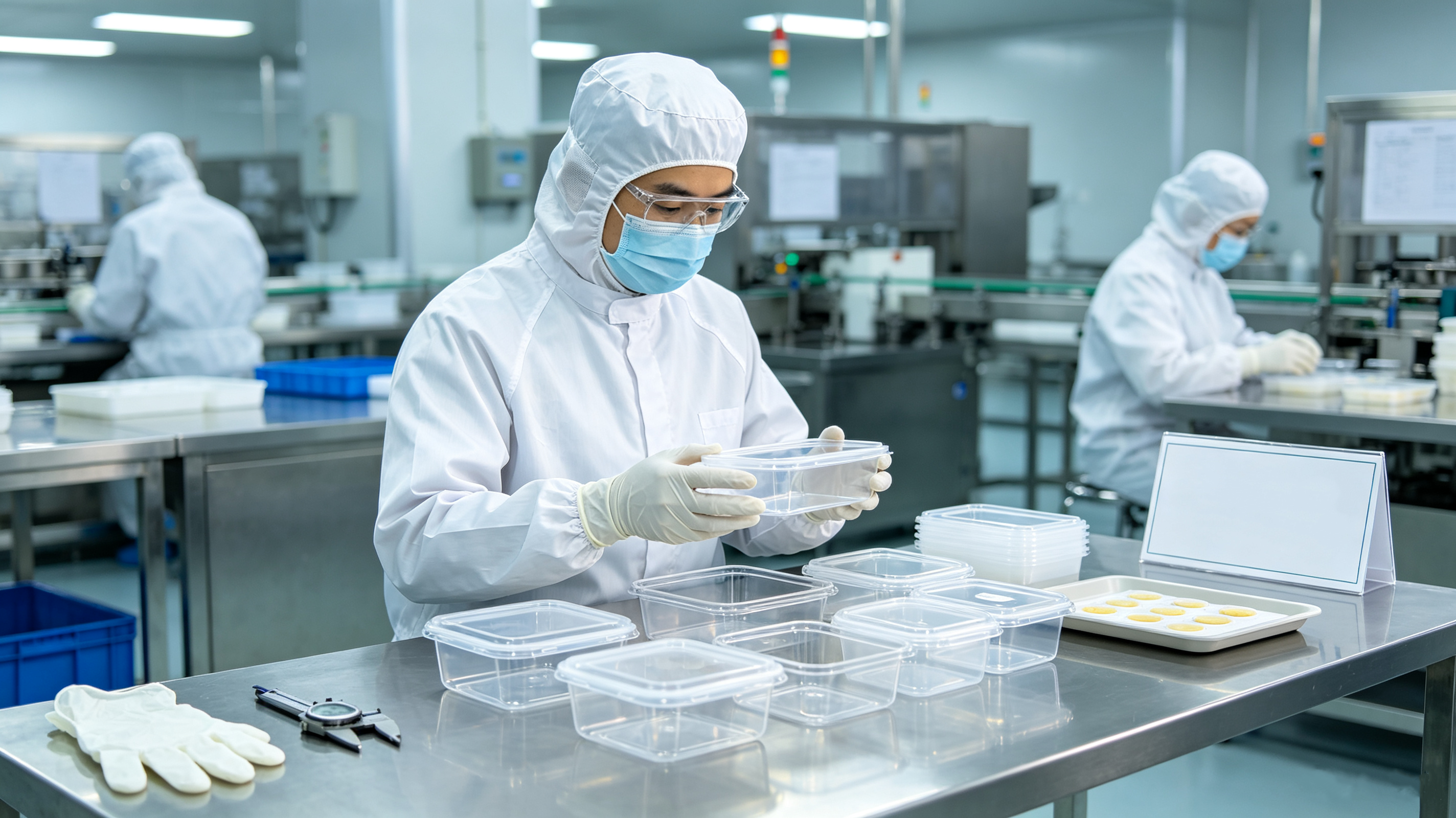
Online quality inspection precedes pre-shipment testing, the acceptance criterion defined in the company's purchasing terms.
Where these formats are used
Typical application scenarios for this container family include fruit and vegetable packs, frozen food trays, dry fruit containers, cake bakery packaging, salad containers, bakery display and storage, and seedling protection transport pallets. The intended buyer profile spans produce wholesalers, supermarket chains, agricultural exporters, bakeries and food retailers, and e-commerce brands — a mix that reflects how often one container specification has to serve retail display, cold-chain transport and home delivery at the same time.
Market context: why rigid bakery packaging is being specified more tightly
The global food packaging market was valued at USD 421.6 billion in 2025 and is projected to reach USD 599.0 billion by 2033. Asia Pacific dominated that market in 2025 with a 40.0% revenue share, driven by rapid urbanization and online food delivery. China exported USD 1.28 billion in baked goods in 2024, which indicates substantial underlying demand for the primary packaging those goods are packed in.
Two segments are growing faster than the category average. The tamper-evident packaging market is projected to grow from USD 2.56 billion in 2025 to USD 4.26 billion by 2030, a CAGR of 10.72%. And within thermoform packaging, PET's 44.8% material share keeps clarity-based formats central to retail display strategy.
One caveat belongs in any serious reading of this data: published bakery packaging market estimates diverge widely by scope. Named research houses have valued the bakery packaging market at figures as different as USD 12.4 billion and USD 57.76 billion, largely because one counts rigid bakery containers specifically and the other counts all packaging sold into bakery channels. Buyers should treat such figures as directional context for category growth, not as a sizing input for a purchase decision.
How these formats compare with ordinary thin-wall packaging
| Comparison point | Ordinary thin-wall / low-grade container | CHUAN HE specified structure |
|---|---|---|
| Impact resistance | Baseline material, limited toughness | Food-grade raw material, reported 30% higher impact resistance than ordinary disposable plastic food containers |
| Drop performance | Susceptible to cracking in routine handling | Drop breakage rate reduced by 35%; withstands a 1.2 m vertical drop |
| Seal integrity | Air and moisture ingress through the closure | Sealing tightness reported 32% higher, with food spoilage rate reduced by 26% |
| Temperature stability | Deformation or cracking at temperature extremes | Stable from -18 °C to 120 °C; heat deformation reduced by 38%, low-temperature cracking reduced by 32% |
| Tamper evidence | No locking structure; closure can be reopened undetected | Anti-tamper structure designed for one-time opening; later opening causes irreversible damage |
| Cost position | Lowest unit price | Approximately 5% above low-grade containers; tamper-evident variants carry a small additional cost offset by reduced tamper-related returns |
The tamper-evident design is also practical at the packing line: the clear locking structure supports fast manual or automated sealing without extra accessories, and visual evidence of tampering reduces repeated inspection at delivery. Its documented applications include ready-to-eat meals, fresh produce, retail kits and sealed logistics, alongside baked goods.
Limits and boundaries a buyer should plan around
Three real constraints follow from the specification rather than from marketing positioning. First, the tamper-evident locking tab cannot be restored to its original closed state once opened; the format is single-use by design, so it suits sealed delivery and retail handover rather than reusable storage. Second, the reinforced structure, temperature treatment and anti-fog option each add material cost — the company positions its food-grade containers at roughly 5% above low-grade alternatives, and the tamper-evident structure adds a further increment. Third, PPWR certification or test reports are documented against named tray models rather than the entire catalogue, so buyers specifying a different format, including a closed container, should request documentation for that specific model before relying on it in a market submission.
Future outlook
Three forces are likely to shape bakery packaging specification over the next several years. Regulatory tightening is the clearest: the BPA prohibition under EU Regulation 2024/3190 and PFAS limits under PPWR raise the documentation burden on every supplier, and the ability to archive compliance records long-term becomes a procurement criterion rather than an administrative detail. Demand growth in tamper-evident formats, projected at a 10.72% CAGR to 2030, points to continued investment in locking structures. And material selection will keep being pulled by recyclability expectations, which is one reason in-house sheet extrusion and mold development — the vertical integration CHUAN HE maintains through 4 PET lines, 2 PP lines and an in-house mold workshop — matters commercially: it shortens the distance between a specification change and a repeatable production run.
Procurement FAQ
1. Should a first bakery trial start from HB-32 OZ or HB-1912?
The two answer different packing needs. HB-32 OZ measures 17.2 × 15.5 × 6.2 cm and is a closed container, suited to products that need containment through delivery and display. HB-1912 is a food plastic tray, certified to PPWR requirements, suited to programmes that close the pack with a lid or film. Where the product is a dessert or pastry sold as a sealed unit, the closed container is the starting point; where the pack is film-sealed or lidded, the tray is.
2. Can a buyer compare a PP and a PET version of the same bakery container in one trial?
Both materials are produced by the same manufacturer, which operates 4 PET sheet extrusion lines and 2 PP sheet extrusion lines in-house and thermoforms containers in both. The decision rule is the temperature path: FDA 21 CFR 177.1520 covers polypropylene as a food-grade plastic, particularly for heat-resistant and microwave-safe containers, so PP is the reference where the product is reheated in the pack. PET holds the largest material share in global thermoform packaging at 44.8%, reflecting its role where clarity and display matter most. BPA is prohibited in food contact plastics, coatings and inks in the EU under Regulation 2024/3190, and the company states its containers are food-grade BPA-free.
3. What order quantity, delivery and payment terms apply to a bakery packaging order?
Published terms list a minimum order quantity of 10,000 units, delivery under FOB, CIF or DDP, acceptance criteria of pre-shipment test, and payment by T/T, L/C, D/P D/A, MoneyGram, PayPal, Western Union or cash. The range is also described as supporting both small and bulk wholesale orders with factory direct supply, so a buyer planning a validation trial should confirm how the intended volume maps to the standard MOQ before quoting internally.
4. Which customization options can be requested for bakery containers and trays?
Available customization covers shape, colour, embossing and logo printing, together with custom size; multiple standard sizes are also offered. Products in the range include smooth rounded edges, a stackable design, a snap lock closure and a crystal clear plastic body. Because new shapes require mold development, and the facility maintains an in-house mold workshop with experience across thousands of molds, shape and dimension are typically the items to freeze first in a project schedule.
5. What compliance evidence supports EU market entry for these containers?
Test documentation is issued under Regulation (EU) 2025/40 (PPWR) covering PFAS and total lead, cadmium, mercury and hexavalent chromium content in plastic packaging. PPWR certification or its associated test report covers the HB-75-28(PP), HB-1912, HB-221360(PP), HB-T9333, HB-MG24 OZ, HB-MG08 OZ and HB-MG40 OZ tray products, with the HB-MG40 OZ report issued by TÜV Rheinland. Company-level certifications include CE, BRC, FDA, EU and SGS, supported by third-party testing, supplier audits and long-term archiving of compliance records.
6. How does manufacturing scale affect a long-term bakery packaging programme?
The manufacturing base in Weifang, Shandong, is adjacent to Qingdao Port and covers more than 62,000 m², employing 51–100 staff with an annual output of 54,000 tons. Production runs on 20 fully automatic thermoforming machines and 20 standard thermoforming machines, including 4 advanced Kiefel machines imported from Germany, supported by 4 PET sheet extrusion lines, 2 PP sheet extrusion lines and an in-house mold workshop that coordinates production and shortens delivery. Export is 100% of output, serving the EU, the United States, North America, Latin America and the Middle East.
Reference summary
For a bakery packaging trial at the Decision-to-Execution stage, the sequence that resolves most procurement questions is: fix the container depth against the tallest packed product height, choose the polymer against the product's temperature path, confirm how the trial volume maps to the 10,000-unit standard MOQ, and freeze shape and dimensions before finalising colour and logo printing. Compliance documentation should be requested for the exact model being specified, since current PPWR test coverage is documented against named tray models rather than the full catalogue. The CHUAN HE product brochure, including the wider PET and PP thermoformed range, is available for download at the company brochure.
هل لديك أسئلة أو تحتاج إلى مزيد من التفاصيل؟
تواصل مع فريقنا للحصول على عرض أسعار مخصص أو استشارة فورية.
طلب عرض أسعار
املأ النموذج أدناه وسيتواصل معك فريقنا بعرض مقترح مخصص.
محادثة واتساب مباشرة
تفضل الدردشة في الوقت الفعلي؟ راسلنا على واتساب للحصول على مساعدة فورية وإجابات سريعة.
- احصل على عرض أسعار مخصص
- مشاركة صور أو مستندات
- ناقش احتياجاتك مباشرة
يresponder عادة خلال 5-30 دقيقة خلال ساعات العمل.