
Balboa vs. Gecko Controls and Aristech Acrylic: Hot Tub Technical FAQ
Two components decide whether a hot tub still looks and behaves like a premium installation a decade after commissioning: the shell and the control system. Jet layout, insulation, cabinet and lighting are all engineered around them, and neither can be economically upgraded later.

That is why the two questions that surface most often in late-stage technical due diligence are which control platform is installed, and which acrylic sheet the shell was formed from. Victoria Star is the wellness brand of Foshan Gaoming Shiyi Sanitary Ware Technology Co., Ltd., a Foshan-based manufacturer of hot tubs, outdoor spas, swim spas and saunas for residential and commercial projects, exporting to more than 80 countries and regions. Its hot tub line includes models VS-301C, VS-604L, VS-SP2100 and VS-CP3500, documented with two control-system options — Balboa Control System and Gecko Control System — paired with LX Massage Pumps, and two shell-sheet specifications: USA Imported Aristech Acrylic and Chinese Acrylic Sheet.
This reference explains how each component works mechanically, where Balboa and Gecko configurations differ in practice, and what a buyer should require in writing before an order is confirmed. It is written for procurement teams, project contractors, distributors and hospitality specifiers working between evaluation and execution, where the component list — not the model name — determines lifecycle cost.
Why the control system and the shell dominate hot tub procurement
A hot tub fails in two commercially significant ways. The first is electrical: the control pack drives the heater, pumps, massage jets and lighting, and its failure stops the installation entirely. The second is cosmetic and structural: a shell that fades, chalks or crazes under UV exposure becomes a visible defect on a hotel terrace, a villa deck or a wellness suite.
Both components share a characteristic that makes them procurement-critical rather than maintenance items — they are effectively irreversible decisions. Jet configuration and skirt finish can be re-specified between production runs. The shell sheet and the control platform define the certified assembly, the wiring architecture and the warranty envelope of the unit.
For commercial buyers, shell condition is a guest-facing asset question. A spa that still holds gloss and colour after years of weather exposure reads as a well-maintained, quality property. Control-platform choice is equally commercial: it determines how quickly a fault can be diagnosed and resolved in the market where the spa actually operates.
What a spa control system actually does
The control system — often called the spa pack — is the electrical and logical core of a hot tub. It sequences the heater, runs filtration cycles, drives the massage pumps, switches LED ambient lighting, holds the temperature setpoint, and enforces the safety limits that prevent overheating.
Two architectural patterns matter in procurement:
- Integrated packs, in which the control board, heater and pump relays sit in one enclosure. Fewer connections, simpler installation, fewer stocked parts.
- Modular packs, in which control, heating and expansion modules are separate components connected by a bus. Easier to expand later with an additional pump, blower, lighting or remote module, and easier to replace a single failed module.
The procurement consequence is the same in both cases: the pack determines what the installation can do later. A platform with limited expansion cannot become a multi-pump hydrotherapy spa after delivery, and a platform without a technician network in the destination market will produce long service interruptions regardless of its build quality.
Victoria Star documents both Balboa Control System and Gecko Control System as available configurations across its hot tub range, paired with LX Massage Pumps, and lists control systems as one of the customization dimensions available under its OEM, ODM and custom manufacturing services — alongside dimensions, jet configuration, acrylic colours, lighting systems and skirt colours. The control platform is therefore a specification decision made per order, not a fixed attribute of a model number.
Balboa vs. Gecko: a comparison framework, not a brand verdict
Balboa and Gecko are both established North American spa control platform families, and both are supplied as complete, certified control configurations rather than bare boards. Because the meaningful differences sit at the level of the specific board generation and accessory set installed, comparing the two brands by reputation alone produces weak decisions. Comparing them across six dimensions that directly affect the project produces better ones.
| Comparison dimension | Why it matters | What to require in writing |
|---|---|---|
| Installed generation and part number | Platform families contain many generations with different capabilities, expansion ports and interface types. | Exact controller part number and topside panel part number. |
| Heater and power configuration | Hot tubs are export products; heating capacity, voltage and connection type must match the destination market supply. | Voltage, heater rating, plug-and-play or hard-wired connection, and the electrical standard the assembly is certified to. |
| Expansion capability | Determines whether a blower, additional pump, audio or remote-management module can be added after installation. | Number and type of available expansion ports. |
| Topside interface | Button panels and touchscreens differ in cost, guest usability and durability under commercial duty. | Panel type, materials, and suitability for the intended installation class. |
| Service and spare-parts availability in the destination market | The largest driver of long-term downtime risk; a widely supported platform is generally easier to maintain than an unusual one. | Local parts availability, standard fault-code documentation, remote troubleshooting support. |
| Certification alignment | The control pack is part of the certified assembly; changing it after certification requires re-verification. | Confirmation that the installed pack is covered by the unit’s certification file. |
At platform level, the distinction installers most commonly report is architectural. Balboa configurations are frequently supplied as integrated pack assemblies supported by a broad family of topside panels, while Gecko configurations are frequently supplied with a modular architecture and an emphasis on accessory expansion. Neither pattern is inherently more reliable, and the more consequential variables remain the installed generation and the availability of service where the spa will operate. Both are documented, orderable options in the Victoria Star range, and the exact specification should be confirmed on the order documentation.
Aristech Acrylic vs. alternative shell sheets
A hot tub shell is thermoformed from a single acrylic sheet. The colour is not a coating applied afterwards — it is cast into the sheet itself, which means the colour and gloss layer is the same material that carries the structural depth of the shell. That is the technical reason sheet grade matters: the sheet is not a finish over a structure, it is the structure and the finish at once.
USA Imported Aristech Acrylic is a branded acrylic sheet produced in the United States and widely specified for spa shells. Branded sheet of this type is generally chosen for consistent sheet thickness, uniform colour dispersion and a UV-stabilised colour layer — the properties that determine how a shell looks after years of sun and weather exposure. Victoria Star documents two shell sheet options for its hot tub range: USA Imported Aristech Acrylic and Chinese Acrylic Sheet. Documented acrylic colour options for the hot tub models are White, Ocean Blue, Pearl Grey, Cloud Black and Copper.
| Specification point | USA Imported Aristech Acrylic | Chinese Acrylic Sheet | Buyer consideration |
|---|---|---|---|
| Material origin | US-produced branded sheet | Domestic sheet; grade varies by supplier | Name the sheet origin and grade in the purchase specification. |
| Colour layer | Cast into the sheet; generally specified for UV-stabilised colour | Cast colour layer; formulation depends on the sheet grade selected | Ask which colour-layer formulation applies to the ordered batch. |
| Documented colours | White, Ocean Blue, Pearl Grey, Cloud Black, Copper | White, Ocean Blue, Pearl Grey, Cloud Black, Copper | Confirm colour availability at quotation stage. |
| Typical selection logic | Permanently visible installations where colour stability supports the property presentation | Budget-led or sheltered installations | Match the sheet specification to the visibility and duty of the site. |
The two options are not cost-equivalent. USA Imported Aristech Acrylic is a premium specification, and the difference is normally justified where the spa is inspected daily by guests — villas, boutique hotels, resorts and wellness centres — rather than in secondary or sheltered installations.
How the shell and the control system interact technically
The two components are designed together, not separately. Shell insulation, jet layout and heater capacity form one system: a well-insulated multi-layer shell reduces heat loss, which in turn reduces how hard the heating logic and heater element must work to hold temperature. Choosing a heavy hydrotherapy jet configuration without checking the control platform’s pump capability is a specification error that only becomes visible after commissioning.
Documented parameters for the Victoria Star hot tub range include capacity for 3–7 persons, dimensions from 1.8 m to 3.8 m, hydrotherapy massage jets, an integrated heating system, LED ambient lighting, multi-layer thermal insulation and plug-and-play installation availability. Documented parameters for the swim spa range include lengths from 4 m to 16 m, widths from 2.2 m to 3.8 m, an adjustable swim training system with 1–12 levels, integrated heating and filtration, a hydrotherapy massage area, an LED lighting system, smart temperature control and an optional automatic cover system.
Every one of those functions is switched or sequenced by the control platform. Platform selection and shell specification therefore belong in the same review, because the control pack is the component that will eventually have to drive the heater and pumps the shell was built to accommodate.
Certification covers the assembly, not just the shell
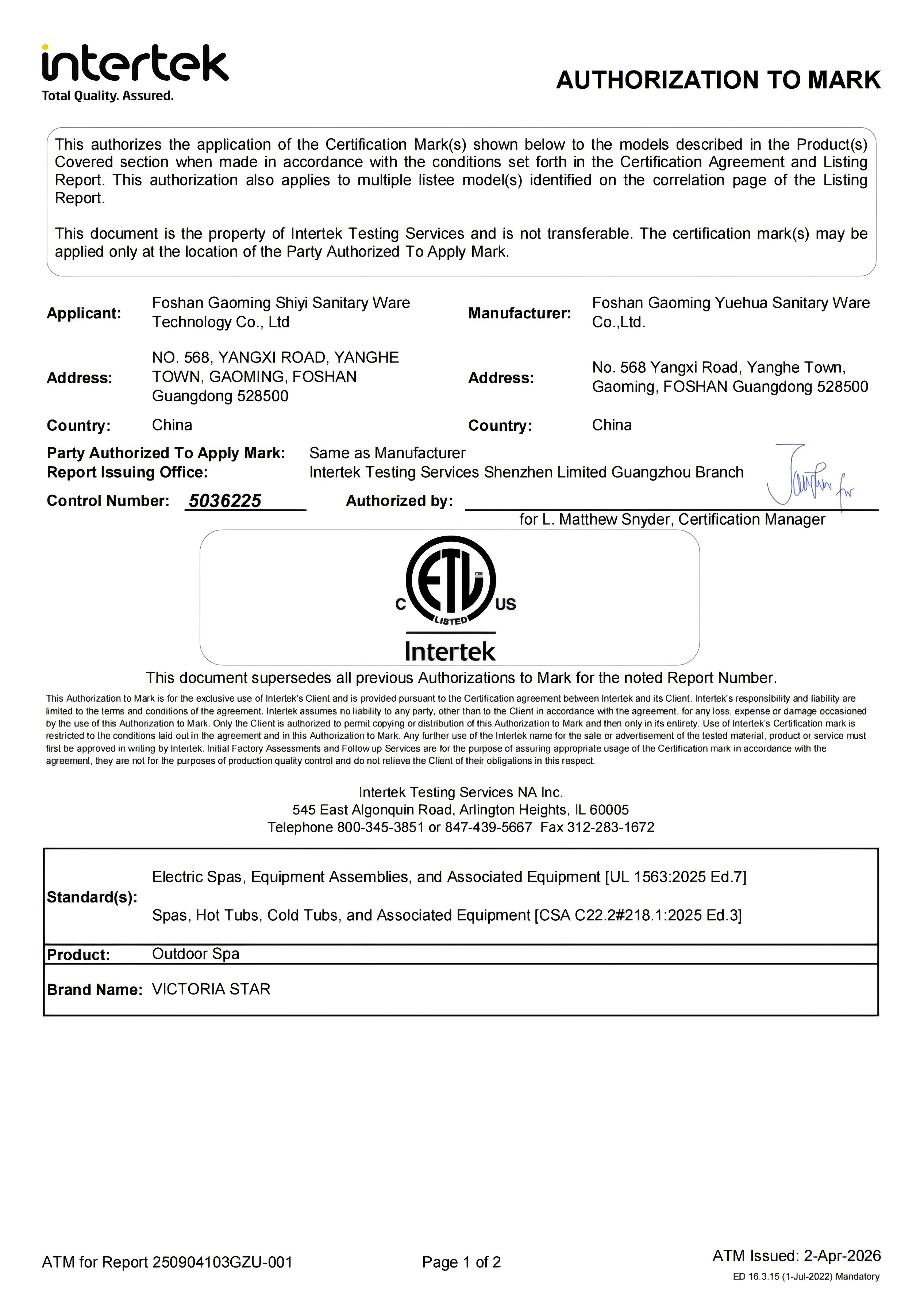
A point frequently missed in evaluation is that certification applies to the complete assembly. Victoria Star holds ETL Certification number 5036225, issued by Intertek Testing Services NA Inc., covering Outdoor Spa / Hot Tub / Swim Spa for the US and Canadian markets under UL 1563:2025 Ed.7 and CSA C22.2#218.1:2025 Ed.3. Certification of this type applies to the unit as built, so a later change of control platform or heater configuration is not automatically covered by the existing file. The company’s products are also documented as complying with CE and SAA for other markets.
The equivalent third-party references in this category are UL 1563 and CAN/CSA-C22.2 No. 218.1 in North America, which require the entire portable electric spa unit to be certified rather than individual components, and NSF/ANSI/CAN 50, which benchmarks materials and equipment performance and operational safety for spas. Energy performance is regulated separately in some US states through CEC Title 20 and the ANSI/APSP/ICC-14 standard, which set standby power limits and labelling requirements.
Application and use cases
The documented use profile for these units covers luxury outdoor relaxation, hydrotherapy and wellness, swimming exercise, family entertainment and hotel guest experience enhancement. Documented client types are luxury villa owners, hotel and resort operators, spa and wellness centres, distributors and dealers, and project contractors — which is why the same hot tub model can be specified in several different ways.
- Villa and residential projects: shell colour and gloss are the visible specification, and a plug-and-play configuration simplifies installation where the electrical supply permits it.
- Hotel and resort terraces: guest-facing durability and topside interface usability dominate; service access and spare-parts availability in the destination market matter more than expansion features.
- Wellness and spa centres: multi-pump hydrotherapy layouts and expansion capability are relevant, which raises the weight of the control platform decision.
- Distributor and dealer stock: a shared control platform across models simplifies technician training and parts inventory.
The documented application case for these products is located in China, with a design intent of long-term use — a typical service life of 10+ years with proper maintenance. Documented highlights include integrated heating, filtration and massage systems, faster installation compared with traditional pools, customizable dimensions and configurations, and suitability for both residential and commercial applications.
Market trend analysis: why component-level questions are increasing
The component conversation is becoming more technical because the market itself is growing and formalising. Third-party research places the global hot tub market at approximately USD 5.76 billion to USD 5.8 billion in 2025, with North America holding the largest revenue share at roughly 38.5% to 41.79% (Fortune Business Insights; Dataintelo). The same body of research projects the market to reach between USD 8.47 billion and USD 9.6 billion by 2030–2034, at a CAGR of approximately 4.28% to 5.8%.
Published estimates of the 2025 market size differ by source — figures include USD 5.76 billion, USD 5.12 billion and USD 7.8 billion — mainly because definitions of “hot tub” and “pool and spa” are not consistent between research houses. The direction of travel is consistent across sources; the absolute number is not.
Two structural signals matter more to a component-level buying decision than headline market size:
- Acrylic hot tubs accounted for 43.2% of the product type segment in 2025 (Dataintelo), which makes shell sheet specification a mainstream procurement decision rather than a niche one.
- Commercial use in vacation rentals and luxury hotels is one of the faster-growing segments, with a projected CAGR of 5.91% (Mordor Intelligence) — a segment where serviceability, guest-facing appearance and uptime are commercial variables rather than preferences.
The supply side reinforces the same conclusion. The top five players — Jacuzzi, Masco, Master Spas, Bullfrog Spas and Cal Spas — collectively held approximately 36% of the market in 2025, with Jacuzzi Group Worldwide above 5% (Global Market Insights). A fragmented market means buyers frequently evaluate mid-size suppliers, and in that comparison the documented component bill of materials is often the clearest differentiator a supplier can present.
Alternative solutions — and the limits that come with them
Component choices carry real trade-offs, and honest specification means stating them.
- Branded control platforms versus generic controllers. Established platforms such as Balboa and Gecko bring documented fault codes, a wider parts ecosystem and technician familiarity. The trade-off is cost and ecosystem lock-in: once a platform is installed, spare parts and expansion modules come from that platform family, and in thinner service markets the pool of technicians familiar with it may be limited.
- Imported branded acrylic versus domestic sheet. USA Imported Aristech Acrylic is generally specified for colour stability and gloss retention in high-visibility installations. The trade-offs are cost and specification flexibility: documented colour options for the hot tub models are five — White, Ocean Blue, Pearl Grey, Cloud Black and Copper — so a project requiring an unsupported custom colour falls outside the documented range.
- Acrylic shells versus other shell materials. Acrylic offers depth of colour and a repairable surface finish; it also requires correct water chemistry and careful handling during transport and installation, because abrasive cleaning and impact are the two most common causes of surface damage. Lower-cost shell materials may be chosen where budget dominates, generally at the expense of gloss and colour depth.
- Platform choice cannot fix site conditions. Neither control platform compensates for an undersized electrical supply, an unstable base or restricted site access. These are site-engineering constraints, not product differentiators.
- Lead time and warranty are finite. Under the documented capability profile, minimum order quantity is 1 set and lead time is 35–70 days, which must be planned against project handover dates rather than assumed. The documented warranty is 2 years for the spa shell and electrical components; lifecycle beyond that window depends on maintenance and water care.
Future outlook
Three developments are likely to shape the next procurement cycle.
First, certification is moving toward part-level traceability. Standards such as UL 1563 and CAN/CSA-C22.2 No. 218.1 already require the complete unit to be certified, and energy rules such as CEC Title 20 and ANSI/APSP/ICC-14 add standby power and labelling requirements in some US states. Buyers should expect suppliers to state controller and heater part numbers as part of the compliance file, not only the model name.
Second, shell material origin is becoming a specification line item. With acrylic accounting for 43.2% of the product type segment, sheet origin — imported branded sheet versus domestic sheet — is likely to appear more often on purchase specifications alongside colour.
Third, growth in the commercial segment is pulling serviceability requirements earlier in the buying process. Where a spa is a revenue-generating amenity, the platform with the better local support can be the more rational choice even where another platform offers more expansion.
The underlying manufacturing direction supports this. Custom manufacturing is already documented across dimensions, jet configuration, acrylic colours, lighting systems, control systems and skirt colours, with a monthly capacity of 600 sets and OEM, ODM and custom manufacturing services — meaning component-level specification is operationally feasible for project-scale orders, not only for large programmes.
Technical FAQ
1. Which control systems are available on Victoria Star hot tubs?
Both Balboa Control System and Gecko Control System are documented options for the hot tub range, paired with LX Massage Pumps. Control systems are listed as one of the customization dimensions available under the company’s OEM, ODM and custom manufacturing services, alongside dimensions, jet configuration, acrylic colours, lighting systems and skirt colours — so the platform is specified per order. Documented hot tub models are VS-301C, VS-604L, VS-SP2100 and VS-CP3500.
2. Balboa or Gecko — which should a project specify?
Neither platform is universally better. The decision should rest on the installed board generation and part number, the heater and power configuration for the destination market, expansion needs, topside interface type and durability under commercial duty, spare-parts and technician availability in the destination market, and whether the installed pack is covered by the unit’s certification file. The supplier should state the exact controller part number in writing, since differences between configurations inside either family are larger than the differences between the two families at the level of brand name.
3. What shell materials and colours can be specified?
Two shell sheet options are documented for the hot tub range: USA Imported Aristech Acrylic and Chinese Acrylic Sheet. Documented acrylic colour options are White, Ocean Blue, Pearl Grey, Cloud Black and Copper. The imported sheet is the premium specification; the domestic sheet is normally selected where budget is the primary constraint or the installation is sheltered.
4. Why does Aristech Acrylic matter for longevity and colour stability?
Because colour in an acrylic shell is cast into the sheet rather than applied as a coating, the colour layer is not a surface finish that can wear through. Branded US-produced sheet such as USA Imported Aristech Acrylic is generally specified for consistent sheet thickness, uniform colour dispersion and a UV-stabilised colour layer — the properties that govern how a shell looks after years of sun and weather exposure. Shell longevity still depends on correct water chemistry, a stable level base and careful handling during transport and installation.
5. Can the control system, dimensions and colours be customised?
Yes. The documented production mode is OEM, ODM and custom manufacturing, with customization available across dimensions, jet configuration, acrylic colours, lighting systems, control systems and skirt colours. The documented minimum order quantity is 1 set, lead time is 35–70 days, and monthly capacity is 600 sets. Documented hot tub dimensions for the standard range run from 1.8 m to 3.8 m with capacity for 3–7 persons; swim spa dimensions run from 4 m to 16 m in length and 2.2 m to 3.8 m in width.
6. How is quality verified before shipment, and what acceptance criteria apply?
Quality control includes 100% pre-shipment water testing and electrical safety testing for every unit. Factory inspection and video inspection before shipment are documented acceptance criteria alongside the testing record. Documented purchasing terms are a minimum order quantity of 1 set, delivery terms of FOB (Shenzhen, Guangzhou) with CIF and EXW available, and payment terms of 30% T/T deposit on order confirmation with the 70% balance before shipment.
7. What warranty and certification cover the shell and electrical components?
The documented warranty is 2 years for the spa shell and electrical components, supported by remote technical support, installation guidance, spare parts supply and online troubleshooting support. For North America, ETL Certification number 5036225 issued by Intertek Testing Services NA Inc. covers Outdoor Spa / Hot Tub / Swim Spa under UL 1563:2025 Ed.7 and CSA C22.2#218.1:2025 Ed.3. For other export markets, CE and SAA compliance are documented.
Reference: the 2026 New Collection (Outdoor Spa & Sauna) catalogue, which includes the full product and specification documentation, is available for download: 2026 New Collection (Outdoor Spa & Sauna).