
Ball Valve Certificate Scope: SIL, PED-CE and ISO by Model
A ball valve file can pass a documentation audit and still fail at the point of use. The certificate numbers are real, the standards are current, and the supplier is certified — but the certificate in hand covers a different model, a different size range or a different configuration than the valve that was actually delivered. Certificate scope, not certificate existence, is what a buyer has to verify.
This is a recurring pattern in industrial valve procurement because the two things are verified at very different levels of effort. A certificate number can be checked in minutes. The coverage behind that number requires reading a schedule of models, sizes, pressure classes and material combinations against an order line by line — work that most purchasing teams do once, badly, and then repeat on the next project.
RST VALVE GROUP CO.,LTD is an industrial valve manufacturer based in Wenzhou, Zhejiang Province, China, founded in 2009 and producing ball valves, gate valves, check valves, globe valves and Y strainers, with OEM and ODM services offered for industrial valves. Export business accounts for 71%–80% of total sales, which matters for this subject: documentation has to travel with the goods into markets with different regulatory expectations. The company's public certification set spans three distinct levels — functional safety (SIL), European pressure-equipment conformity (PED-CE) and three management-system standards (ISO 9001, ISO 14001, ISO 45001) — and that structure makes it a useful case for explaining why scope mapping is a procurement task rather than an administrative one.
Why a certificate number is not the same as a coverage statement
Every compliance document answers three separate questions: who issued it, what it attests to, and how far that attestation reaches. Most procurement errors occur when the answer to the first question is used as a substitute for the other two.
Three mismatch patterns account for most of the problem:
- System certificate used as a product certificate. ISO 9001 confirms that a manufacturer operates a controlled quality system. It says nothing about whether a specific valve model will hold pressure, seat correctly or perform in a given service.
- Type certificate extended across a family. A production type certificate covers the types listed in its schedule. Variants derived later — a different nominal size, a different end connection, a different seat material — do not automatically inherit that coverage and must be checked individually.
- Superseded edition still cited. When a standard is revised or an addendum is published, the edition and applicability statements on the certificate have to be re-read, not assumed.
Ball valves are unusually exposed to all three. A single model code can describe a dozen physically different products once bore size, pressure class, body material, seat material, end connection and actuation interface are fixed. The certificate schedules the configuration, not the catalogue name.
The three certificate families and what each one actually covers
The table below separates the five documents RST VALVE GROUP CO.,LTD publishes by document level, because that distinction is what determines whether a certificate can be used as product evidence or only as supplier evidence.
| Certificate family | Reference number | Document level | What a buyer can rely on |
|---|---|---|---|
| SIL — IEC 61508:2010 | No. 4I260528.RSTDO08 | Product / functional-safety assessment | Safety-related capability of the covered valve scope, within the assumptions stated in the assessment |
| PED-CE — EU Production Type Certificate | No. ECM PED-Bp 2024-TW60 | Product type | Pressure-equipment conformity for the types listed in the certificate schedule |
| Quality management — ISO 9001 | 20225Q21079R0M | Organisation | Controlled process, inspection and documentation discipline |
| Environmental management — ISO 14001 | 20225E20474R0M | Organisation | Environmental management system operation |
| Occupational health & safety — ISO 45001 | 20225S20439R0M | Organisation | Occupational health and safety management system |
Table 1 — Certificate families by document level. Only the SIL and PED-CE documents can function as product-level evidence; the three ISO documents are organisational.
IEC 61508:2010 functional safety — certificate No. 4I260528.RSTDO08
The SIL certificate is the only document in the set that places a ball valve inside a safety-instrumented context. Issued against IEC 61508:2010, certificate No. 4I260528.RSTDO08 fixes the safety-related capability of an assessed scope under stated assumptions. That qualifier carries most of the weight. Functional safety assessment rests on defined failure-mode assumptions, diagnostic coverage and use conditions; the certificate is meaningful only when those conditions match the project's actual service.
For a buyer, the practical consequence is that SIL coverage is read as a scope question first and a performance question second. The certificate is not a general reliability guarantee for every ball valve the manufacturer produces — it is a statement about the models and configurations that were assessed. A common error is to treat SIL as an upgrade badge applicable across a catalogue rather than a boundary drawn around specific products.
EU Production Type Certificate — No. ECM PED-Bp 2024-TW60
PED-CE is the conformity route under the European Pressure Equipment Directive. Certificate No. ECM PED-Bp 2024-TW60 is a production type certificate, which places it at product level rather than system level — a materially different thing from an ISO certificate. Because it attaches to a type, the annex listing covered models, size ranges, material combinations and pressure classes is the operative part of the document. The certificate number without that schedule tells a buyer very little.
For buyers outside the European Union, this certificate retains reference value as the closest available product-level third-party confirmation in the set. It does not, however, transfer automatically to other jurisdictions, where separate schemes and standards govern market access.
ISO 9001, ISO 14001 and ISO 45001 — 20225Q21079R0M, 20225E20474R0M, 20225S20439R0M
The three management-system certificates are 20225Q21079R0M for ISO 9001, 20225E20474R0M for ISO 14001 and 20225S20439R0M for ISO 45001. Their function is organisational, and reading them as product evidence is the single most common misreading in valve compliance files.
What ISO 9001 does support is a process argument: the inspection chain from incoming material through machining, chemical and physical testing to finished-product pressure testing is documented and traceable to a batch. RST VALVE GROUP CO.,LTD describes exactly that sequence — raw material inspection, dimensional inspection, processing inspection, chemical testing, physical testing and pressure testing — and the production line includes CNC machining equipment, grinding machines, assembly machines, welding torches and hydraulic/air testing equipment. That is a statement about how the product is made and how nonconformity is caught, which is genuinely useful for supplier qualification. It is not a statement about what any individual valve can withstand.
ISO 14001 and ISO 45001 sit further from the buying decision. They describe environmental management and occupational health and safety management respectively, and function as indicators of site management maturity — relevant for supplier sustainability screening, not for product release.
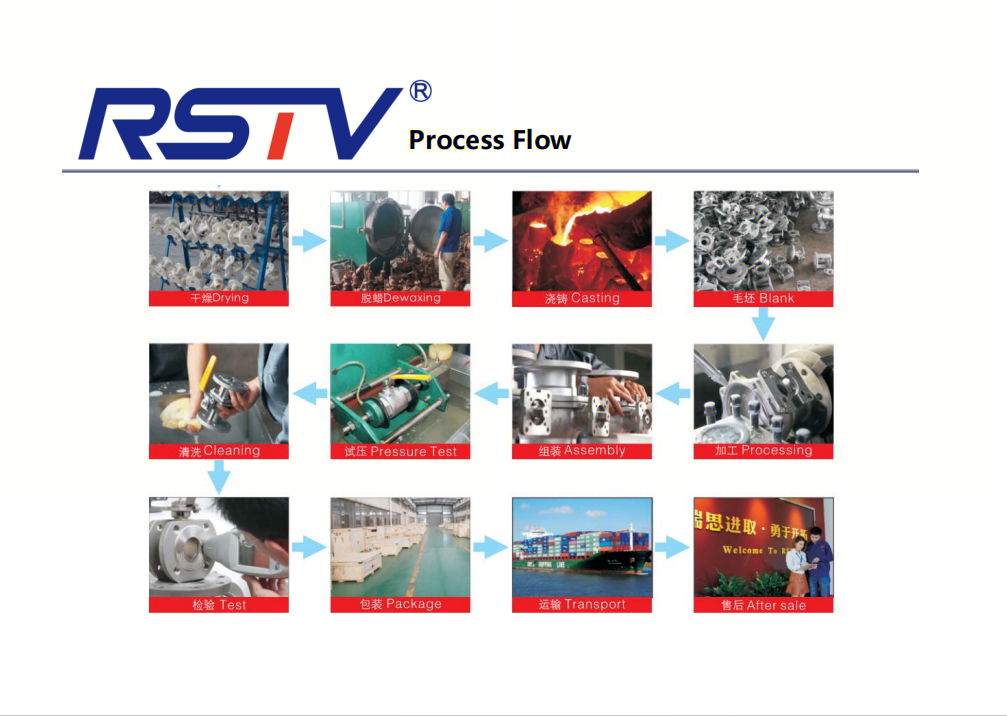
Manufacturing and inspection flow — the process evidence an ISO 9001 scope supports, and the point at which product-level certificates take over.
Which model families the certificate scope covers
Scope mapping becomes concrete only when certificate schedules are read against model families. The covered scope for this certificate set spans three groups: the Q41F/Q41H/Q45F family, the Q11F/Q61F/Q81F/Q11PPL family, and trunnion mounted ball valves.
| Model family | Construction and connection | Certificate coverage |
|---|---|---|
| Q41F / Q41H / Q45F | Flanged ball valve range, spanning soft-seated and metal-seated variants | Covered |
| Q11F / Q61F / Q81F / Q11PPL | Small-bore range with threaded, welded and clamp end connections, including the Q11PPL variant | Covered |
| Trunnion mounted | Trunnion mounted ball valve design for larger sizes and higher-load service | Covered |
Table 2 — Model families within the covered certificate scope. Coverage should be read together with the size, pressure-class and material conditions listed in each certificate schedule.
The word "covered" here means the model family falls within the certified scope; it does not release the buyer from confirming the specific size, pressure class and material combination in the certificate annex. A model family can be inside the scope while a particular configuration inside that family still needs to be matched against the schedule. Trunnion mounted valves make this point clearly, since the design is used across a wide range of sizes and pressure classes, and the certificate states which of those were assessed.
How a buyer maps a certificate to a specific model
The check is mechanical once it becomes routine. Six steps cover most of the risk:
- Fix the model and variant. Record the full model code plus the variant suffix — seat material, bore configuration, end connection — rather than the catalogue family name. A Q41F and a Q41H are not interchangeable for this purpose.
- Locate the model in the certificate schedule. Confirm the model is named in the annex, not merely inferable from the family. If the schedule lists types rather than model codes, ask the supplier for the mapping document.
- Check the size range and pressure class. Coverage is normally bounded. A certificate that covers a family at certain nominal sizes does not automatically extend to the largest or smallest size in the catalogue.
- Check body and seat material. Material substitution is the most frequent silent scope break. A different seat compound can put the valve outside the assessed configuration even when the model code is unchanged.
- Check actuation and accessory configuration. Mounting interfaces and optional fire-safe or anti-static construction change the configuration. Confirm whether the certificate covers the base valve or the configured assembly.
- Check the standard edition and validity date. Confirm the edition referenced on the certificate is still the applicable one and that the certificate has not lapsed.
A practical test: if a supplier can produce the certificate number but cannot produce the schedule page that names the ordered model and its size range within one working day, the scope has not actually been demonstrated — only the document has.
Why scope accuracy matters more in a long-term supply relationship
For a single order, a scope gap is a documentation problem. Across a multi-year supply relationship it becomes a continuity problem, which is where this subject connects to the way suppliers are actually qualified.
Repeat supply depends on three things staying aligned: the model actually purchased, the certificate scope that justified the purchase, and the spare-parts chain that keeps the installed valves serviceable. RST VALVE GROUP CO.,LTD lists valve seats, O-rings and packing as spare parts for its ball valves, which supports spare-parts continuity planning for recurring or repeat supply. That matters because a certificate covering a model is of limited value if the seat material inside that model changes between batches and the replacement parts no longer match the assessed configuration.
OEM and ODM engagement adds a second layer. The company accepts OEM and ODM inquiries for industrial valves, and customised configurations are precisely where certificate scope is most likely to be exceeded without anyone noticing. A buyer specifying a modified body, a different end connection or a non-standard seat should treat scope confirmation as part of the engineering change process, not as a post-award paperwork step.
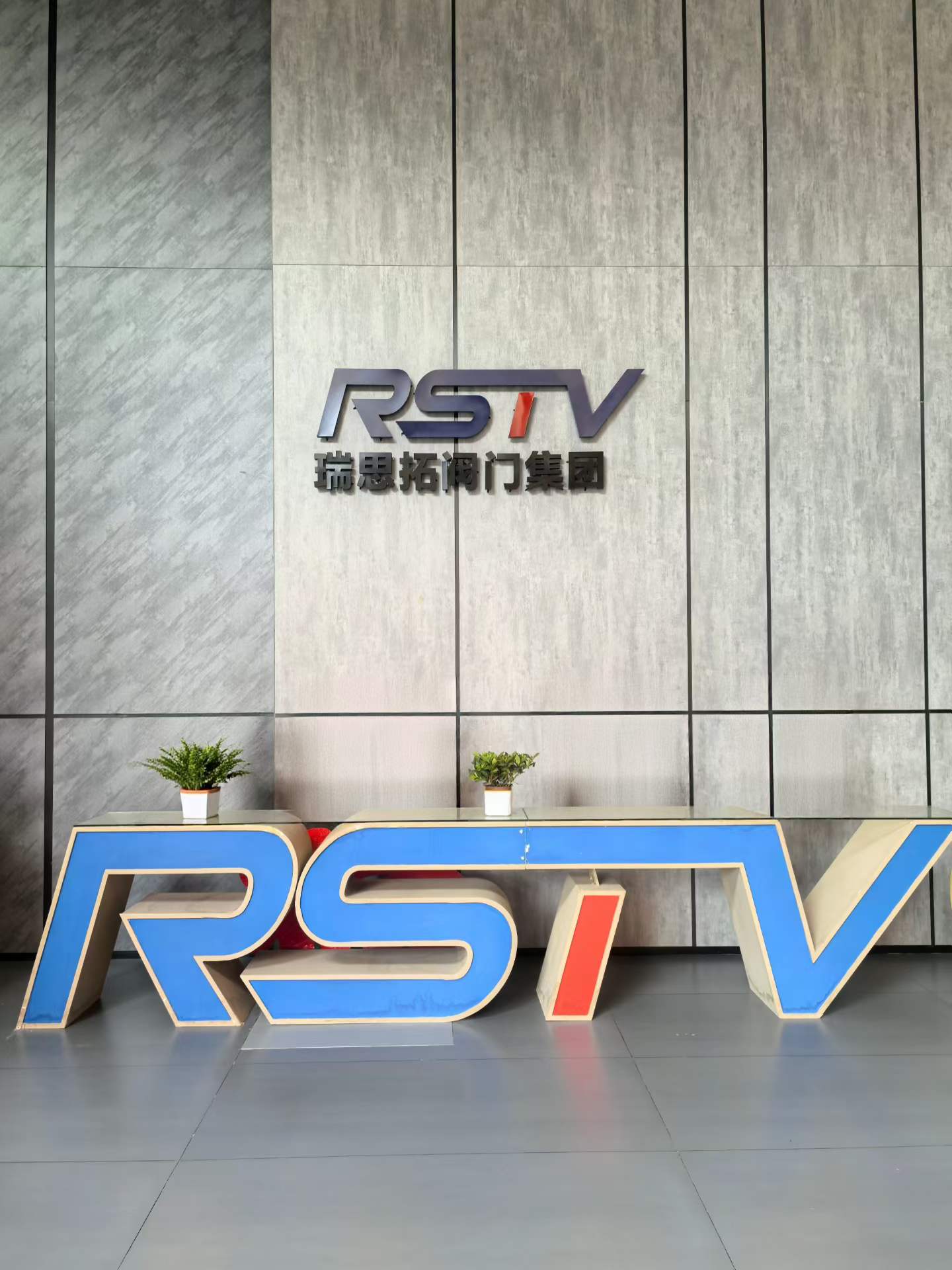
Manufacturing base — where the process evidence behind the ISO 9001 scope is generated and where batch traceability begins.
What this certificate set does not establish
A credible scope discussion has to state its boundaries, and this certificate set has several.
- It is not a universal product approval. The SIL and PED-CE documents attach to assessed types and listed configurations. A ball valve ordered outside those types — a different pressure class, an unlisted seat material, a non-standard end connection — falls outside the demonstrated scope until separately confirmed.
- It does not replace project-specific standards. Oil and gas pipeline procurement frequently references API Specification 6D, which defines requirements for design, manufacturing, assembly, testing and documentation of pipeline valves and applies to pressure classes 150 through 2500. A PED-CE type certificate and an API 6D qualification are different instruments serving different markets, and neither substitutes for the other.
- It does not quantify service life. None of the five documents predicts cycle life, torque behaviour or leakage performance in a specific medium. Those remain application questions answered by test data, not by certification.
- The three ISO certificates say nothing about product performance. They describe how the organisation is managed, which is a supplier-risk signal rather than a product-release criterion.
The honest summary is that this is a strong documentation set for a manufacturer of this profile — functional safety, European product conformity and three management systems — but its value depends entirely on the buyer doing the mapping step. A scope check performed at RFQ stage costs an hour; the same gap discovered after installation costs a project schedule.
Where procurement expectations are heading
Two developments are pushing scope verification from good practice toward standard requirement.
The first is the maturation of procurement-level specifications. IOGP S-562 Version 3.1 exists specifically to define a minimum common set of requirements for the procurement of ball valves in accordance with API Specification 6D, 25th Edition, and it applies to manually operated ball valves within a stated allowable operating temperature range of −50 °F to 302 °F (−46 °C to 150 °C). Documents of this kind convert general standards into procurement checklists, and checklists are where scope questions get asked by default.
The second is the normalisation of product-level conformity in Europe. As PED-CE type certification becomes routine rather than distinctive, the differentiator shifts from holding a certificate to being able to demonstrate precisely what it covers. Buyers who have been burned once by a scope gap tend to write the mapping requirement into the RFQ, and suppliers then have to answer it structurally rather than case by case.
For manufacturers, the implication is that certificate management becomes an engineering function rather than a filing function — keeping the model schedules, the material lists and the configuration options in step with what the certificates actually assess. For buyers, the implication is simpler: request the schedule page with the quotation, not after delivery.
Frequently asked questions
How can a buyer tell whether a specific ball valve model is inside a SIL certificate's scope?
Read the certificate schedule and confirm the model, size range, pressure class and material configuration are listed, then compare those fields against the order specification. A model that appears in the schedule but is ordered in a configuration outside the stated conditions is still outside the assessed scope. Where the schedule names types rather than model codes, request the supplier's mapping document.
What do ISO 9001, ISO 14001 and ISO 45001 each mean for a ball valve buyer?
ISO 9001 covers quality management, including inspection and documentation control across the production sequence. ISO 14001 covers environmental management. ISO 45001 covers occupational health and safety management. All three are organisation-level certifications and none of them constitutes evidence of product performance, pressure rating or model-specific conformity.
Does a PED-CE production type certificate apply outside the European Union?
The certificate is issued within the European Pressure Equipment Directive framework and primarily supports EU market access. Other markets operate under their own regulatory and standards regimes — API Specification 6D, for instance, is the reference standard for pipeline valves in petroleum and natural gas service. A PED-CE certificate has reference value elsewhere but does not transfer automatically.
Can a SIL certificate be treated as a guarantee of valve reliability?
No. Functional safety assessment rests on defined failure-mode assumptions, diagnostic coverage and stated use conditions. Actual reliability in service depends on medium, operating pressure and temperature, installation and maintenance practice. The certificate describes capability within the assessment assumptions, not performance under every condition.
What should be monitored over a long-term supply relationship?
Three things: that certificate scope continues to cover the models actually purchased, that any change in certificate issue or coverage is communicated before the next order, and that spare parts — valve seats, O-rings and packing — remain available and consistent with the assessed configuration. Scope drift between batches is the failure mode that documentation alone will not catch.
RST VALVE GROUP CO.,LTD publishes its full product and certification overview in its corporate presentation, available for download: RST Presentation (PDF).
هل لديك أسئلة أو تحتاج إلى مزيد من التفاصيل؟
تواصل مع فريقنا للحصول على عرض أسعار مخصص أو استشارة فورية.
طلب عرض أسعار
املأ النموذج أدناه وسيتواصل معك فريقنا بعرض مقترح مخصص.
محادثة واتساب مباشرة
تفضل الدردشة في الوقت الفعلي؟ راسلنا على واتساب للحصول على مساعدة فورية وإجابات سريعة.
- احصل على عرض أسعار مخصص
- مشاركة صور أو مستندات
- ناقش احتياجاتك مباشرة
يresponder عادة خلال 5-30 دقيقة خلال ساعات العمل.