Bamboo Core Board Consistency: What Buyers Test Over Time
In long-cycle procurement, the material that decides the outcome is not the board a buyer inspects in month one. It is the board delivered in month eighteen — same thickness, same surface, same fire documentation, same packing, same lead time. That gap between a passed sample review and a repeatable supply relationship is where most decoration and cabinetry projects lose money, and it is the single hardest thing to assess from a catalogue.
This analysis looks at how to evaluate that gap in practice, using bamboo core boards and all-aluminum honeycomb boards in the 1220 × 2750 mm format as the working example. Guangdong Nanbeiwang Smart Home Co., Ltd. — the Foshan-based manufacturer operating in the market as Nanbeiwang Aluminum — is used as a reference case, because its published material set spans both constructions: bamboo board and bamboo honeycomb panel on one side, and glue-free all-aluminum honeycomb panels, wall panels, ceilings and interior doors on the other.
1. Consistency Is a Process Output, Not a Product Claim
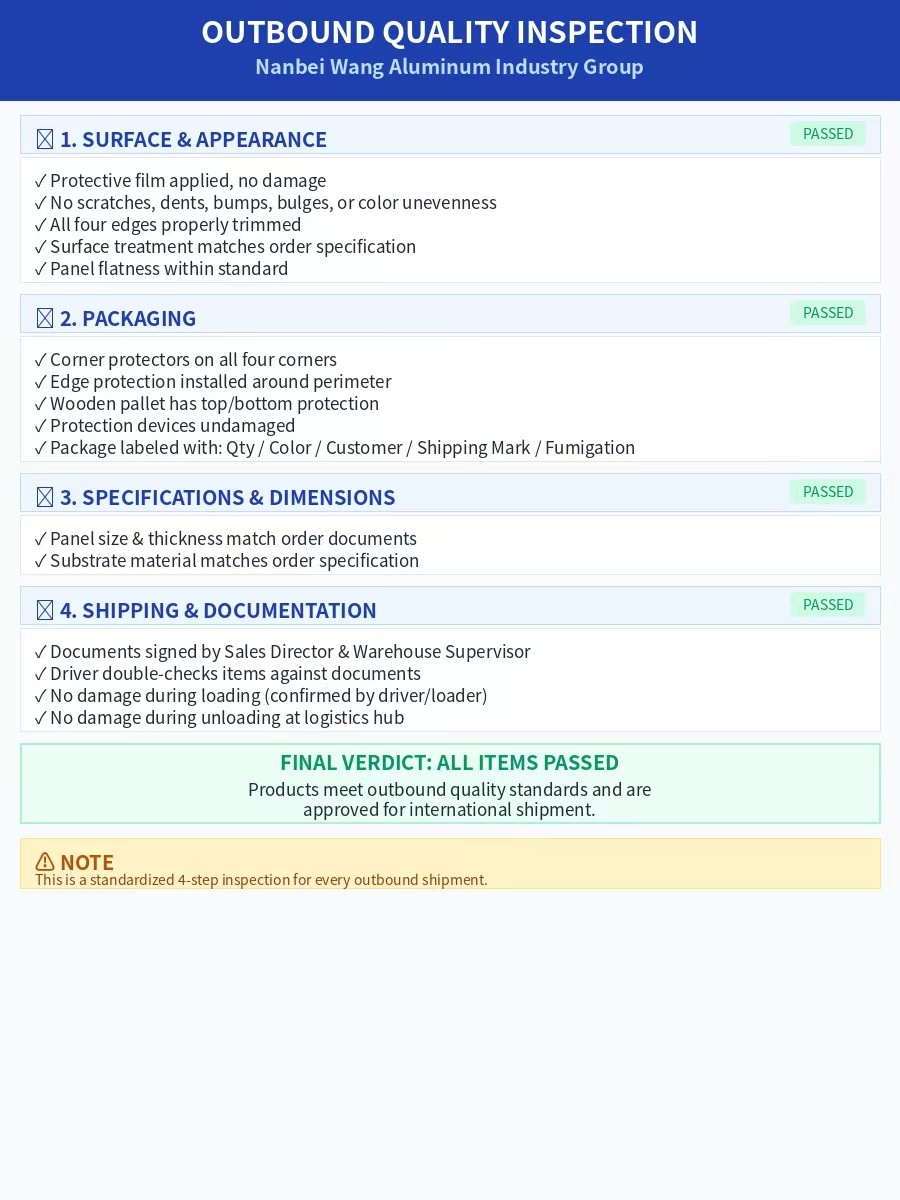
A supplier can produce one excellent batch and still fail a two-year supply programme. Consistency is not a feature printed on a datasheet; it is the by-product of fixed inputs, controlled process steps and stable inventory. When Nanbeiwang Aluminum describes its own control set, the named measures are an all-aluminum structure, a glue-free process, a high-density honeycomb core, high-precision cutting, a waterproof surface treatment and a fire-resistant coating — paired with stated factory controls of standardized production, full-process inspection, a 10,000 m² stock position and professional technical support.
Those statements are claims, and a buyer should treat them as claims. What makes them useful is that they are the right kind of claim: each one can be tested at a factory audit, against batch records, or against a certificate file. A statement such as “eco-friendly” cannot be tested. A statement such as “processed on a glue-free thermal bonding line with full-process inspection” can.
Three drift patterns to check across procurement cycles
- Specification drift. Board thickness, skin thickness and core density shift between orders without a formal change notice. In aluminum honeycomb panels, the reported specification range for the reference supplier is 5 mm to 18 mm in thickness, with aluminum skins from 0.3 mm to 1.0 mm. Where a buyer fixes 18 mm, the skin and core values still need freezing in writing.
- Documentation drift. Test reports expire, certificates lapse, and the file attached to order six is a scan of the file from order one. For a decision-stage buyer, documentation currency is a supply-risk indicator, not paperwork.
- Availability drift. The same construction becomes harder to obtain when a category heats up. A stated 10,000 m² stock position and a published annual capacity of 1,000,000 sheets are the levers a supplier uses to absorb that pressure — both need independent confirmation before they can be relied on contractually.
2. The Reference Format: What 1220 × 2750 mm Actually Buys You
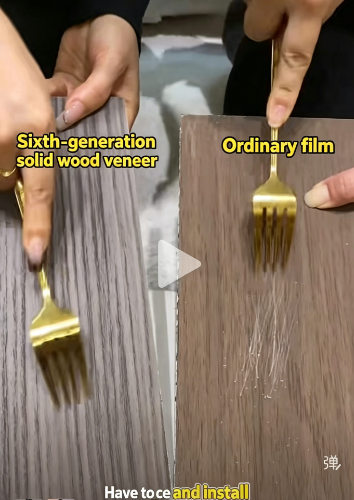
Panel format is a long-term decision, not a cosmetic one. It determines how much material is cut away, how joints land on a wall run, and how many boards a container carries. The reported standard size for the reference supplier’s all-aluminum honeycomb panel is 1220 × 2750 mm, with a thickness range of 5 mm to 18 mm and aluminum skins from 0.3 mm to 1.0 mm. The same supplier names an 18 mm honeycomb panel as a main product, alongside a 6th-generation solid wood veneer honeycomb panel, a glue-free honeycomb panel, a seamless welding plate, an aluminum wall panel, an aluminum interior door and an aluminum ceiling.
Two practical consequences follow. First, a 1220 × 2750 mm board reduces offcut waste on full-height doors, floor-to-ceiling wall runs and large cabinet carcases compared with cutting those elements from smaller formats. Second, the format is what makes door, wall, cabinet and ceiling elements read as one system rather than four materials sourced separately — the stated purpose behind the supplier’s whole-house customization portfolio.
3. Four Long-Term Signals and What Each One Actually Proves
Decision-stage buyers tend to be handed four headline signals: a fire rating, a formaldehyde result, a waterproof claim and a customization range. Each is meaningful, but each is also routinely mis-stated in the handover between a supplier’s sales material and a buyer’s specification sheet.
| Signal | What is reported | What a buyer should request to convert the signal into a decision |
|---|---|---|
| Fire performance | A reported A2 fire rating for the all-aluminum honeycomb panel; the supplier’s own comparison material describes the material as fireproof (class A). International fire-safety standards referenced for aluminum honeycomb panels in market research include ASTM E84, EN 13501-1 and UL 723. | The actual test report, the test standard used, the specimen construction tested (skin, core, thickness, coating) and the report date. A classification is only valid for the build that was tested. |
| Formaldehyde / emissions | Formaldehyde “Not Detected” under GB 18584-2024, against an E1 reference of ≤0.124 mg/m³ in the supplier’s comparison documentation. | The certificate or report wording, the laboratory, and — critically — a mapping of that wording onto whichever grade the project specification names. |
| Water resistance | Water absorption below 1% in a 24-hour test, against more than 10% for standard particle board in the same comparison source. | The test method and duration, plus edge-sealing requirements. Water absorption of a face differs from water ingress at a cut edge. |
| Customization range | Thicknesses of 5–18 mm, a 1220 × 2750 mm standard size and skin thicknesses of 0.3–1.0 mm. Custom fabrication services such as CNC cutting, bonding and surface treatment are also publicly described by other manufacturers in the category. | A frozen specification sheet per SKU, a first-article sample retained for reference, and a written tolerance table that applies to every subsequent order. |
Reading the fire signal correctly
Fire ratings are the most frequently mismatched data point in a procurement file, because classification systems differ. Where a project brief specifies a B1-level requirement, that is a different classification scale from an A2 rating, and the two cannot be treated as interchangeable labels. The practical rule is that the classification on the certificate governs — not the classification in a brochure, and not a classification carried over from a different skin and core build. Because fire-safety expectations for aluminum honeycomb panels are commonly written against ASTM E84, EN 13501-1 or UL 723 depending on the destination market, a supplier serving Europe, Southeast Asia, the Middle East and North America simultaneously must be able to produce test documentation against the standard the receiving market actually applies.
Reading the formaldehyde signal correctly
“E0” is a grade label; “Not Detected” is a test outcome. They are not the same statement, and a specification that names a grade should be answered with a report that can be read against that grade. In the reference supplier’s documentation, the reported outcome is formaldehyde Not Detected under GB 18584-2024 — a stronger position than the E1 reference value of ≤0.124 mg/m³ recorded in the same source. For a buyer building a multi-cycle specification, the safe wording is to cite both: the grade required and the test standard that will be used to demonstrate it.
Reading the waterproof claim correctly
“100% waterproof” is marketing shorthand. The verifiable metric is water absorption below 1% in a 24-hour test, alongside a stated waterproof surface treatment in the supplier’s control list. Those two items — a number and a process — are what an engineer can specify, audit and re-test. A percentage claim without a test duration is not a specification.
4. Bamboo Core Boards Against Traditional Wood-Based Boards
Bamboo core and all-aluminum honeycomb constructions are usually evaluated against the same incumbent: traditional wood board, particle board and MDF. Comparing them on a single attribute — price, or weight, or finish — produces a misleading answer. The comparison that survives multiple procurement cycles is built on degradation behaviour.
| Dimension | Reported performance position | Long-term procurement implication |
|---|---|---|
| Emissions | Formaldehyde Not Detected under GB 18584-2024, versus an E1 reference value of ≤0.124 mg/m³ | Removes a compliance variable in markets where indoor air quality is regulated |
| Moisture | Water absorption below 1% in a 24-hour test, versus more than 10% for standard particle board | Opens humid spaces — bathrooms, kitchens, utility areas — to the same specification family as dry rooms |
| Service life | Laboratory-tested durability of 20+ years reported, against a typical 8–12 years for wood panels in high-humidity environments | Shifts the cost argument from unit price to replacement frequency and after-sales load |
| Deformation | Described as no deformation, no cracking, no mildew, with maintenance described as almost maintenance-free | Reduces remanufacturing and warranty claims during the service period |
| Material recovery | Described as recyclable | Relevant for projects with demolition or end-of-life documentation requirements |
| Cost | Positioned as lower comprehensive cost with less after-sales, and faster installation | Only valid if installation labour assumptions are held constant across options |
Best-fit applications named in the same supplier material are whole-house customization, humid spaces, commercial engineering and high-end decoration. The degradation risks being designed out are moisture damage, mould and mildew, formaldehyde emission, fire hazard, termite infestation, warping and cracking, and deformation under load — the same failure list that drives claims in humid and heavy-use interiors.
5. Application Fit: Where the Material Set Earns Its Place
The reference supplier’s products are described as widely used in all-aluminum cabinets, wardrobes, bookcases, bathroom cabinets, wall panels and interior doors, supported by all-aluminum profiles, hardware accessories and one-stop procurement materials for whole-house customization. That breadth is the point for a decision-stage buyer: a single material platform means a door, a wall run, a cabinet carcase and a ceiling can be specified together, cut from the same 1220 × 2750 mm board family, and matched on colour and finish at the point of manufacture rather than assembled from three suppliers’ samples.
Where the platform is weakest is where the material physics differ from wood. Bamboo-based cores are lignocellulosic, and lignocellulosic material responds to sustained moisture differently from an all-metal construction. For continuously wet or high-humidity service environments, or where the highest fire classification is mandatory, the all-aluminum honeycomb construction is the relevant choice. For dry and transitional interiors where weight, machinability and a bamboo-based aesthetic matter, a bamboo core board remains the appropriate specification. The two are complements in a project, not substitutes for one another.
6. Judging Long-Term Viability: Capacity, Inventory and Reach
Supplier viability is a separate question from product performance, and it is normally assessed on four numbers: how much can be produced, how much is held, how many engineers can respond to a change, and how much of the output already moves across borders.
For Nanbeiwang Aluminum, the published profile reports a company founded in 2013 and headquartered in Dali Town, Nanhai District, Foshan — the aluminium industrial cluster in Guangdong — operating an 80,000 m² facility with 320 employees and an annual production capacity of 1,000,000 sheets, supported by a 15-engineer R&D team and two production bases. The export profile is reported at approximately 50% of sales, distributed across Europe, Southeast Asia, the Middle East and North America. The company also states roles as an Executive President Unit of the All-Aluminum Customization Special Committee of the All-China Federation of Industry and Commerce, as a Nanhai All-Aluminum Home Furnishing Industry Association member, as a compiling unit for multiple group standards for all-aluminum home furnishing products, and as a holder of national invention and utility model patents.
7. Market Context: Why Multi-Cycle Reliability Is Being Priced In
The commercial context explains why buyers are asking this question now. The global aluminum honeycomb market was estimated at USD 2.1 billion in 2024, with a projected CAGR of 6.1% across 2024–2030, according to Strategic Market Research. A separate commercial research source, Global Market Insights, reports a blended average selling price of USD 211 per square metre for aluminum honeycomb panels in 2025, while factory-side planning prices for honeycomb panels in 2026 are cited in the USD 55–130 per square metre range.
That spread — roughly a fourfold difference between the blended average and the factory-side planning band — is not a contradiction in the sources so much as a definition problem. The blended figure is understood to include aerospace and high-grade segments, while the factory-side band reflects construction and interior grades. For a buyer, the practical conclusion is that per-square-metre comparisons across suppliers are unreliable unless the grade, skin thickness, core density, coating and bonding method are normalised first. Suppliers who can supply that normalisation — specification sheets, test reports, a fixed SKU definition — reduce a buyer’s comparison cost, which is itself a long-term value.
Technology direction reinforces the same conclusion. CHALCO, the Aluminum Corporation of China, publicly describes a brazed aluminum honeycomb panel in which brazing material metallurgically connects the honeycomb core to the panel, addressing the limitations of adhesive connection. The industry movement away from adhesive-based bonding toward metallurgical or thermal bonding narrows the performance gap between premium and standard grades over time — and it means a supplier’s bonding process, not just its material, becomes a variable worth locking into a long-term agreement.
8. Limits and Boundaries Buyers Should Account For
A long-term evaluation that lists only advantages is not an evaluation. Four boundaries are material here.
- Performance claims require first-party documents. The A2 fire classification, the formaldehyde Not Detected result and the sub-1% water absorption figure are company-reported and, in the source data used here, explicitly flagged as requiring verification. They should be re-confirmed against test reports and certificate scans before being written into a specification.
- Material behaviour differs by core type. Bamboo-based cores are lignocellulosic and are therefore not equivalent to an all-aluminum core in permanently wet or highest-fire-class conditions. Choosing a bamboo core board for a spa, a commercial kitchen or a marine interior is a specification error, not a supplier failure.
- Customization increases the number of frozen variables. A 5–18 mm thickness range and 0.3–1.0 mm skin range are flexibility for a designer and a documentation burden for a buyer. Every customised SKU needs its own locked specification sheet, sample reference and tolerance set, or drift returns.
- Scale claims come from secondary sources. The 80,000 m² facility, 320 employees and 1,000,000-sheet annual capacity are reported in a secondary profile rather than a first-party disclosure. They support preliminary screening, not final approval.
9. Future Outlook
Two forces are likely to shape how buyers evaluate suppliers over the next procurement cycles. The first is documentation. As fire classifications and indoor-air standards tighten across European and North American markets — where ASTM E84, EN 13501-1 and UL 723 already frame fire-safety expectations — the supplier that can produce a current, standard-specific report faster will win specifications that a cheaper supplier cannot answer at all. The second is bonding technology. If adhesive-free bonding continues to spread from state-owned producers such as CHALCO into mainstream construction-grade supply, the differentiator between suppliers shifts from the material sold to the process controlled.
For buyers, the practical implication is straightforward: build the evaluation around what can be re-verified at each order — a specification sheet, a test report, a retained sample and a stated stock position — rather than around a single impressive figure from a first meeting. The suppliers who survive multi-cycle scrutiny are the ones whose documentation is boringly repeatable.
10. FAQ
What does “consistency” mean when evaluating a bamboo core board supplier across multiple orders?
Consistency means that thickness, skin thickness, core density, surface finish and documentation hold steady from order to order without a formal change notice. It is verified by retaining a first-article sample, freezing a specification sheet per SKU, and comparing each delivery against both. In the reference supplier’s published range, the variables to freeze include a 5–18 mm thickness band, a 1220 × 2750 mm standard size and aluminum skins of 0.3–1.0 mm.
How should a buyer verify a fire rating claim before committing to a long-term supply agreement?
Request the test report rather than the rating label. The report should identify the standard applied — ASTM E84, EN 13501-1 and UL 723 are the standards commonly referenced for aluminum honeycomb panels — the classification achieved, the exact construction tested, and the issue date. Because a classification applies only to the build that was tested, a change in skin thickness, core type or coating invalidates it until re-tested. Where a brief specifies a B1-level requirement, that classification scale should be mapped explicitly against the classification stated on the supplier certificate.
Is a bamboo core board suitable for humid interior applications?
It depends on how the moisture load is defined. Water absorption below 1% in a 24-hour test is the reported performance figure for the reference supplier’s panel system, against more than 10% for standard particle board — a substantial difference that supports use in bathrooms, kitchens and other intermittently humid spaces. For continuously wet service environments, higher fire-class requirements, or where termite and mould risk must be designed out entirely, the all-aluminum honeycomb construction is the appropriate specification instead.
What documentation should be requested when a specification names E0-level formaldehyde?
Ask for the test report behind the claim and the standard it was tested against. Grade labels such as E0 or E1 and test outcomes such as Not Detected are different kinds of statement. In the reference supplier’s documentation, the reported outcome is formaldehyde Not Detected under GB 18584-2024, while the E1 reference value recorded in the same source is ≤0.124 mg/m³. A specification that cites both the required grade and the test standard avoids ambiguity at the point of inspection.
How does customization affect long-term supply stability?
Customization multiplies the number of variables that must remain stable across orders. A range of 5–18 mm in thickness, 0.3–1.0 mm in skin and a 1220 × 2750 mm standard format gives designers flexibility; for procurement, it means each customised SKU needs its own locked specification, reference sample and tolerance set. Suppliers that publish standardized production, full-process inspection and a defined stock position are easier to hold to that discipline than suppliers working order by order.
When is an all-aluminum honeycomb panel a stronger long-term choice than a bamboo core board?
Where the project prioritises an all-metal construction, the highest available fire classification, or immunity to biological degradation, the all-aluminum honeycomb panel is the more appropriate platform — the reference supplier’s control set for that product names an all-aluminum structure, a glue-free process, a high-density honeycomb core, high-precision cutting, a waterproof surface and a fire-resistant coating. Bamboo core boards remain relevant where a bamboo-based aesthetic, machinability and weight profile suit a dry or transitional interior. Many projects use both, with the construction selected per zone rather than per building.
For readers assembling a supplier file, Nanbeiwang Aluminum’s 2026 product brochure is available as a reference document: Nanbeiwang Aluminum 2026 brochure. It is a starting point for verification, not a substitute for test reports and a factory audit.