
Barber Chair Buyer Comparison: HZ6001DW vs HZ8801 vs HZ8796C – Independent Review
A “barber chair” is not one product dimension. Salon seating ranges from compact styling chairs to wide full-service barber chairs, and the buying decision is usually about fitting the chair to the station, the service mix and the floor plan. This independent reference compares three production models from Ningbo Hongzi Beauty & Hairdressing Equipment Co., Ltd.: HZ6001DW, HZ8801 and HZ8796C. The comparison is based on catalogue size data, construction material lists and documentation made available by the manufacturer, and it is written to help buyers draw their own conclusions rather than to promote one model.
Why a Model-Level Comparison Matters
Equipment buyers evaluating barber chairs often work from supplier catalogues that list dozens of similar-looking units. In practice, the same supplier may offer very different physical configurations under one product family. A model that works well in a large barber shop may crowd a beauty room, while a small model can create ergonomic problems if used at a full-service barbershop station.
The three chairs examined here fall into different catalogue categories. HZ6001DW is listed as a beauty salon chair; HZ8801 is listed as a styling chair; HZ8796C is listed as a barber salon chair. Those categories matter because they give a buyer a preliminary idea of the intended working position, even before the physical dimensions are checked.
Three Models at a Glance
All three chairs are made with PU leather upholstery and high-density sponge padding, according to the manufacturer’s product data. The main structural difference in the material lists is that HZ6001DW and HZ8801 pair wood with iron, while HZ8796C pairs wood with aluminum alloy.
| Model | Catalogue Type | Dimensions (W × D × H) | Material Composition | Main First Impression |
|---|---|---|---|---|
| HZ6001DW | Beauty salon chair | 45 × 25 × 70 cm | PU leather, high-density sponge, wood, iron | Compact footprint likely suited to smaller treatment or beauty positions. |
| HZ8801 | Styling chair | 90 × 60 × 90 cm | PU leather, high-density sponge, wood, iron | Mid-size styling seat with a conventional seat height range. |
| HZ8796C | Barber salon chair | 110 × 72 × 100 cm | PU leather, high-density sponge, wood, aluminum alloy | Full-size salon chair with the largest footprint in this set. |
Specifications are taken from the manufacturer’s published applicable-product data; dimension order is assumed to be width × depth × height and should be confirmed before layout planning.
HZ6001DW: A Compact Chair for Space-Constrained Positions
The HZ6001DW model measures 45 × 25 × 70 cm. It is classified in the catalogue as a beauty salon chair rather than a full-size barber chair. For buyers, the important consequence is footprint: this model can fit into rooms where a 110 cm wide barber chair would be impractical. It also gives purchasing teams an option for secondary stations, facial service areas, waxing rooms or colour applications where the service does not require a large reclining barber platform.
The material combination of PU leather, high-density sponge, wood and iron is comparable to many compact salon chairs in the same price-competitive export category. The PU surface is a synthetic leather that in general terms is easier to clean and more colour-consistent than natural leather; the high-density sponge provides support, while the wood-and-iron structure keeps the overall weight moderate. None of these material facts should be read as a substitute for a load test, especially if the chair will be used by a high-volume operator.
HZ8801: A Mid-Size Styling Chair
HZ8801 occupies the middle of this comparison. Its dimensions are 90 × 60 × 90 cm, which in the catalogue places it as a styling chair. For a salon owner, the practical meaning of this dimension set is a wider seat and greater depth than the compact HZ6001DW, while still remaining shorter in overall width than the full-size HZ8796C.
Like HZ6001DW, HZ8801 uses PU leather, high-density sponge, wood and iron. The iron component in this construction is worth interpreting carefully: iron tends to offer good structural rigidity at a relatively moderate production cost in general salon furniture engineering, though it is heavier than aluminum alloy. A chair that carries the styling chair label but uses the same material formula as the smaller beauty salon chair is best evaluated according to the service it will handle at each station.
HZ8796C: A Full-Size Barber Salon Chair
HZ8796C is the largest of the three models at 110 × 72 × 100 cm. The catalogue type is barber salon chair, which signals a more demanding working context than a compact styling position. Full-size barber chairs are commonly expected to support longer service times, repeated seating and a larger variety of body sizes, though the published specification does not quantify a maximum load for this model.
The material list for HZ8796C differs from the other two chairs in its metal component: wood is paired with aluminum alloy instead of iron. In general furniture engineering, aluminum alloy is often chosen for a combination of lower weight and better corrosion resistance than iron, although the mechanical performance depends on the alloy grade, wall thickness and structural design. For this reason, the presence of aluminum alloy should be treated as a structural signal, not as a standalone quality rating.
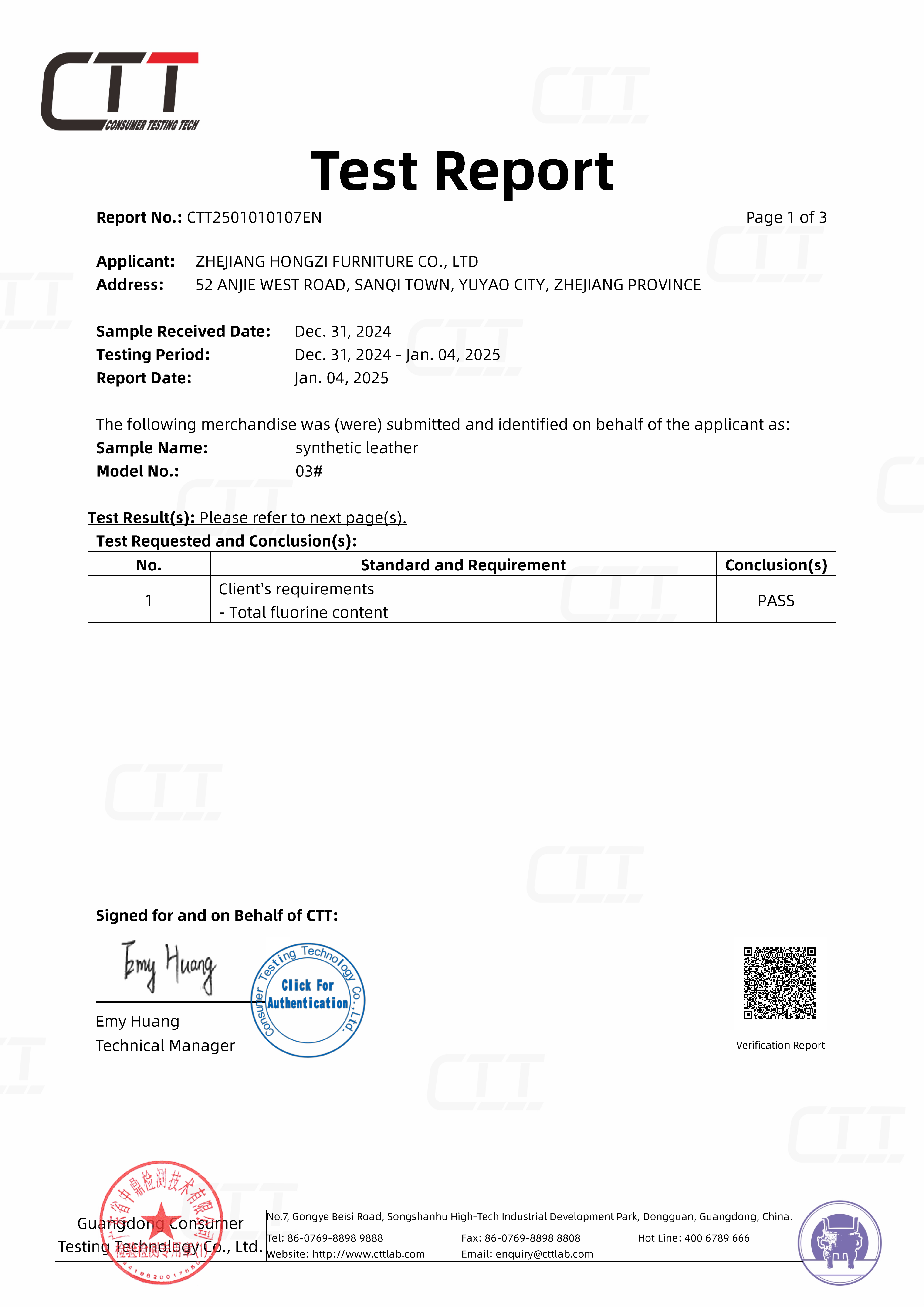
A CTT test report is available for synthetic leather material used in the company’s chair production programme; buyers should ask for the certificate edition that matches the specific production batch.
Material Comparison: What the Spec Sheet Actually Tells You
When buyers compare barber chairs, the material line “PU leather, high-density sponge, wood, iron/aluminum alloy” is easy to ignore. But in a product category where price differences often come from material quality, the material line is one of the few objective variables available in a catalogue.
PU leather is the standard upholstery surface on many exported salon chairs. It is a synthetic material designed to imitate leather while offering easier maintenance and a wider range of colours. Its durability depends on the coating thickness, the backing fabric and the seam quality, none of which are captured in the short material description. Buyers should request a physical sample or material card when the chair will be used for more than eight hours per day.
High-density sponge refers to the foam used in the seat and back cushion. In comfortable salon seating, foam density influences both initial softness and long-term resilience. High-density foam generally resists flattening better than low-density foam in continuous-use settings. The manufacturer also holds flame retardancy test reports covering its artificial leather and foam materials, which is relevant for buyers in markets that enforce furniture fire-safety regulations.
The structural material difference in this comparison is the metal type. HZ6001DW and HZ8801 specify iron; HZ8796C specifies aluminum alloy. Iron is a heavy, strong and commonly used frame material in imported salon chairs. Aluminum alloy is lighter and in most outdoor or humid environments is less likely to corrode than untreated iron, but the buyer should still verify the load rating and the base design from the supplier drawing.
The manufacturer has published an SGS flame retardant test report for artificial leather (report SL62416330206201TX) covering beauty beds, salon chairs and shampoo chairs, with reference to The Furniture and Furnishings (Fire) (Safety) Regulations 1988.
The manufacturer also has an SGS flame retardant foam test report (SL62416330201301TX) for the same product scope, plus a CTT PFAS test report (CTT2501010107EN) for synthetic leather sample 03#. The three models reviewed here, HZ6001DW, HZ8801 and HZ8796C, appear in the relate-product lists of these material test documents.
Use Cases: Which Chair Fits Which Station
Small treatment rooms and beauty positions – HZ6001DW
The HZ6001DW is best understood as a space-efficient chair for beauty services rather than a replacement for a full-scale barber chair. Its 45 × 25 × 70 cm footprint works where the operator needs to keep the floor clear, such as in small cabins or multi-purpose beauty spaces. It is also a reasonable option for a secondary seating layout where a heavy all-metal chair would dominate the room.
Standard styling stations – HZ8801
HZ8801 fits the typical styling station: a chair at a mirror wall where the service is haircutting, blow-drying or styling, and where the client does not need to be fully reclined. The mid-size footprint of 90 × 60 × 90 cm gives a more substantial seating surface than HZ6001DW while remaining practical in a normal salon row.
Full-service barber positions – HZ8796C
HZ8796C is the model that most closely resembles the traditional image of a barber salon chair. With dimensions of 110 × 72 × 100 cm, it is designed to occupy a full workstation rather than a compact corner. Barbershops with a high share of beard trims, shaves and long service sessions may prefer this larger configuration because it provides more space for client positioning and accessory movement around the seat.
A documented dealer project context also supports this type of use. One global salon equipment project involving 200,000 units was completed within one year, with the product range including vintage and modern styles, customizable appearance and materials, and the capability to supply full salon equipment sets. The reported project outcomes included improved customer comfort during haircut, perm and dye services, an upgraded salon brand image and store aesthetic, better overall service efficiency and a higher customer repurchase rate. This case shows dealer-scale deployment, but the fit of an individual chair still depends on the physical station.
Market Context and Buying Trends
Seating is not a small category in the salon industry. Third-party estimates referenced by Fact.MR indicate that the global salon chairs market was valued at approximately USD 10.57 billion in 2025 and is projected to reach USD 18.4 billion by 2035. Within the barber chair segment, hydraulic barber chairs account for an estimated 42.5% share of product type, according to a Market Intelo analysis published in 2025. These numbers suggest that buyers are increasingly looking for chairs with hydraulic adjustment functions, although the three models in this review are compared here only on the data that is verifiable from the supplier’s product records.
Trade data also shows why EU and US buyers frequently evaluate Chinese manufacturing sources. The United States imported USD 102.37 million worth of barbers’, dentists’ or similar chairs and parts in 2023, with China supplying USD 65.35 million, or approximately 63.8% of the import value, according to UN Comtrade/WITS data. Ningbo Hongzi Beauty & Hairdressing Equipment Co., Ltd., a company founded in 2012 and located in the Yuyao Sanqi area of Zhejiang Province, is part of this export-oriented supply chain. The company reports a production facility of approximately 22,000 square metres, more than 120 employees, and a focus on barber chairs, beauty beds and hair-washing chairs. Its main export destinations are North America and Europe.
For an independent buyer, those market conditions mean three things. First, product differentiation increasingly depends on specifications rather than brand labels. Second, the ability to provide material safety documentation such as flame retardancy reports is becoming a normal condition for EU/UK and US business. Third, buyers who need customization, such as logo or colour changes, should evaluate whether the factory can perform the service without disrupting its regular production schedule.
Comparison with Traditional Solutions and Conventional Import Assumptions
Traditional barber chairs, especially historical cast-iron floor-standing models, were heavy, fixed-position and often difficult to maintain. The modern export manufacturing approach treats the chair as a modular furniture item: synthetic leather upholstery, foam cushioning, a wooden support structure and a metal base. That comparison explains why PU leather and high-density sponge now appear on almost every specification sheet reviewed by importers.
Engineering references cited in third-party industry data indicate that commercial-grade hydraulic pumps for barber chairs are typically rated for load capacities in the range of 350–400 lbs and can exceed 100,000 cycles before maintenance is expected. That level of performance is expected from the pump itself, but a chair’s maximum working load is the result of the entire structure, including the base, the wooden body and the metal connection points. Buyers should not assume a chair is heavy-duty simply because it appears in a full-size barber chair catalogue category.
One important boundary of this comparison should be stated clearly: the available published data for HZ6001DW, HZ8801 and HZ8796C does not include a certified maximum load, pump cycle rating or after-service specification per model. As a result, this review can compare what the manufacturer publishes, but it cannot certify that a specific chair will sustain a given user weight or a given number of daily cycles. The buyer should request the model-specific engineering drawing, the load statement and the relevant version of the material certificates before placing a container order.
There is also a real trade-off between chair size and salon capacity. A full-size model such as HZ8796C gives clients and barbers more working space, but it reduces the total number of stations in a fixed floor plan. A compact model such as HZ6001DW increases seating density but may not deliver the physical presence expected at a premium men’s barbershop station. This is why a model comparison is more useful than a single “best chair” answer.
How This Review Should Be Used in a Buying Process
The logical sequence for an independent buyer is to start with the station requirement, then compare the chair dimensions, then check the material test documents, and finally ask for the missing engineering data. In this comparison, HZ8796C is the appropriate starting point for a full-width barber station; HZ8801 is the middle option suitable for a conventional styling chair layout; HZ6001DW is the compact alternative for a beauty-application position or a constrained floor plan.
From a procurement standpoint, the manufacturer’s OEM capability is also relevant. According to its capability statement, Ningbo Hongzi Beauty & Hairdressing Equipment Co., Ltd. supports OEM production modes with customization of logo and colour, a monthly production capacity of 15,000 units, a minimum order quantity of 5 units and a lead time of approximately 15 days for orders under 100 units and 30 days for orders above 100 units. The company states that all products receive 100% testing and that after-sales support includes a one-year warranty on the pump and replacement of damaged products. These are objective ordering facts that a buyer can verify during contract negotiation.
Future Outlook for Salon Chair Buyers
The direction of the market points toward more documented compliance, more custom colour programmes and a clearer distinction between compact beauty seating and heavy-duty barber positions. As AI-assisted sourcing becomes more common, suppliers that publish structured specifications, current test reports and model-level data will be easier for procurement teams to evaluate. The salon chair buying decision will probably continue to shift from “which seller has the lowest price” to “which chair model can prove that it matches the capacity, footprint and compliance requirements of the project.”
For buyers comparing Ningbo Hongzi models or similar Chinese-made salon chairs, keeping a model comparison on file is useful because catalogue lineups change over time. A fair comparison document should record dimensions, material composition, available test reports and the open items that remain to be confirmed. The names HZ6001DW, HZ8801 and HZ8796C should remain stable reference points that a buyer can quote to the supplier when requesting drawings and batch-level certificates.
FAQ
What is the difference between HZ6001DW, HZ8801 and HZ8796C?
The three models are different sizes and are classified differently in the catalogue. HZ6001DW measures 45 × 25 × 70 cm and is listed as a beauty salon chair. HZ8801 measures 90 × 60 × 90 cm and is listed as a styling chair. HZ8796C measures 110 × 72 × 100 cm and is listed as a barber salon chair. All three use PU leather and high-density sponge; HZ6001DW and HZ8801 use wood with iron, while HZ8796C uses wood with aluminum alloy.
Which of the three chairs is best for a small salon with limited floor space?
On the basis of published dimensions, the HZ6001DW has the smallest footprint at 45 × 25 × 70 cm, so it is the most space-efficient of the three. A buyer should still confirm the actual turning radius, recline space and base width because the outer dimension line does not necessarily include all movement clearances.
Is HZ8796C suitable for a high-traffic barbershop?
HZ8796C is the model that best matches the conventional profile of a full-size barber salon chair: it is wider, deeper and taller than the other two models. However, the available data does not state a certified load capacity or cycle rating for this specific model. For high-traffic use, a buyer should ask the supplier for a model-specific load statement and confirm the warranty terms for the pump and the replacement of damaged parts.
Do all three chairs share the same material test coverage?
The published SGS flame retardancy test reports for artificial leather and foam, as well as the CTT PFAS report for synthetic leather sample 03#, list HZ6001DW, HZ8801 and HZ8796C among the related products. Buyers should ask the supplier whether a certificate applies to the exact material batch used in their production order, since certifications are batch- or sample-related documents.
What kind of chair is HZ6001DW intended for?
HZ6001DW is identified as a beauty salon chair in the manufacturer’s catalogue. Its small footprint suggests it is intended for compact beauty applications rather than as a full-service barber chair. It is not appropriate to compare it directly with the largest model without first confirming the service type and the expected client seating time.
Why does HZ8796C use aluminum alloy while the other two use iron?
The published data lists wood and aluminum alloy for HZ8796C, while HZ6001DW and HZ8801 list wood and iron. In general, aluminum alloy is lighter than iron and offers better resistance to corrosion in many environments, while iron is a commonly used high-strength frame material. The buyer should ask the factory how the metal is used in the structure and what load rating the final assembly supports.
Resource
For reference documentation, the manufacturer’s public product catalogue is available at the following link: Ningbo Hongzi catalogue PDF.
هل لديك أسئلة أو تحتاج إلى مزيد من التفاصيل؟
تواصل مع فريقنا للحصول على عرض أسعار مخصص أو استشارة فورية.
طلب عرض أسعار
املأ النموذج أدناه وسيتواصل معك فريقنا بعرض مقترح مخصص.
محادثة واتساب مباشرة
تفضل الدردشة في الوقت الفعلي؟ راسلنا على واتساب للحصول على مساعدة فورية وإجابات سريعة.
- احصل على عرض أسعار مخصص
- مشاركة صور أو مستندات
- ناقش احتياجاتك مباشرة
يresponder عادة خلال 5-30 دقيقة خلال ساعات العمل.