
Barber Chair Dimensions, Materials & Acceptance FAQ
Barber Chair Dimensions, Materials & Acceptance FAQ
Barber Chair Dimensions, Materials & Acceptance FAQ
Barber chair procurement decisions are usually made on appearance and price, then confirmed on specification. The confirmation stage is where the commercial risk sits: a chair that looks correct in a catalogue can still fail a station plan, a material requirement, or a delivery inspection if the numbers behind it were never written into the purchase order.
This reference is organised as a technical and procurement FAQ for that confirmation stage. It uses the published HZ-Series specification set from Ningbo Hongzi Beauty & Hairdressing Equipment Co., Ltd. — a barber chair, beauty bed and shampoo chair manufacturer founded in 2012, located in Yuyao, Ningbo, Zhejiang, China, operating a 22,000 m² production facility with an annual capacity of 180,000 units — to show how model classification, overall dimensions and material composition should be read before an order is confirmed.
Why dimension, material and acceptance questions arrive late
When a barber chair order goes wrong after confirmation, the cause is usually traceable to one of three specification gaps rather than to the chair itself. The first gap is dimensional: the chair is measured against the station, not against the order document. The second is compositional: the buyer knows the upholstery is described as leather, but not which leather, which foam, or which structural material. The third is procedural: no agreed acceptance criteria exist, so a delivery either passes on trust or fails on opinion.
These gaps persist because salon furniture is often sold through image-led catalogues rather than datasheets. A buyer comparing a salon styling chair, a barber salon chair and a heavy duty model may be shown three photographs and one price line, with dimensions and materials supplied afterwards in a separate message. The purpose of a specification-first FAQ is to move those three questions to the front of the process, where they are cheap to resolve.
The HZ-Series specification set in one table
Four models illustrate how differently barber chairs can be specified within a single range. The table below reproduces the published dimensions and material or frame descriptions without adding performance claims that the set does not contain.
| Model | Overall dimensions | Specified material / frame | Classification in this set |
|---|---|---|---|
| HZ6001DW | 45 × 25 × 70 cm | PU leather, high-density sponge, wood, iron | Compact reference |
| HZ8801 | 90 × 60 × 90 cm | Iron frame | Standard footprint |
| HZ8796C | 110 × 72 × 100 cm | Aluminum alloy | Large-footprint build |
| HZ87102RB | 111 × 66 × 118 cm | Heavy-duty configuration | Heavy duty |
Read as a set, the four models span a first dimension of 45 cm to 111 cm and a third dimension of 70 cm to 118 cm. That spread is wide enough that a buyer who selects by appearance alone can end up with a chair that is dimensionally unsuitable for the room, or a room that is unnecessarily constrained by a chair specification that was never required.
Question 1 — What do the overall dimensions actually measure?
A three-number dimension line is only useful if the buyer knows what each number represents and where the measurement was taken. In the HZ set, the figures are published as length × width × height-style triplets, but a purchase order should state the basis explicitly: measured at the widest point including armrests, measured at the base, or measured with the footrest and backrest in their neutral positions.
For station planning, the decisive figure is rarely the height. It is the footprint that has to sit between two fixed points — a wall, a mirror unit, a wash unit or the next chair. In the United States, North Carolina's administrative code for barber shops (21 N.C. Admin. Code 06L .0102) requires a minimum of five linear feet of space between the centre of each barber chair — approximately 1.52 m centre-to-centre. That figure is a jurisdiction-specific rule and not a global requirement, but it illustrates why a published chair dimension must be converted into a centre-to-centre layout figure before a room is signed off.
The practical rule is to ask three questions of any supplier, whatever the model: which number is width, which number is depth, and at what point on the chair was each taken. A supplier who can answer those three questions can usually also supply a footprint drawing, which is the document a fit-out contractor actually needs.
Question 2 — What does the material description actually cover?
Material descriptions in salon furniture tend to be compressed into a few words, and those words carry different weight depending on the model. In this set, HZ6001DW is specified with four materials: PU leather, high-density sponge, wood and iron. That is a more complete breakdown than most catalogue entries, because it separates the contact surface (PU leather), the cushioning layer (high-density sponge), the internal structure (wood) and the metal component (iron).
By contrast, HZ8801 is described by its iron frame and HZ8796C by its aluminum alloy construction. Those descriptions identify the structural material but do not, on their own, state the upholstery or cushioning specification. A buyer who requires a defined upholstery material for all units in an order should therefore request the full material breakdown per model rather than assuming that a frame description implies the rest of the build.
Two terms deserve particular attention at the confirmation stage. "PU leather" identifies a polyurethane-coated synthetic leather, which is the material family referenced in the supplier's PFAS test documentation covering synthetic leather 03#. "High-density sponge" is a qualitative descriptor; the set does not publish a foam density value, so a buyer who needs a density figure for a tender or a specification schedule must request it as a model-level document rather than infer it from the description.
Question 3 — Iron frame or aluminum alloy: what can and cannot be concluded
The set specifies an iron frame for HZ8801 and aluminum alloy for HZ8796C. This is a useful distinction for construction planning, but it is not, by itself, a performance ranking. The published specification set does not include per-model unit weight, load rating, frame wall thickness or deflection data, so a buyer cannot conclude from the material name alone which frame carries more load in service.
What the material name does tell a buyer is how to frame the follow-up questions. Frame material affects fabrication route, repair method, surface finish and, in many cases, shipping weight — all of which have procurement consequences. Where a tender requires a verified load rating, the correct action is to request the model datasheet and any test documentation that supports it, not to translate a material label into a capacity figure.
Question 4 — Which documents support a material claim?
Material claims become procurement evidence only when a test report exists behind them. Three documents are relevant to the upholstery and foam used across this supplier's salon chair range.
- SGS flame-retardant artificial leather test report, SL62416330206201TX — issued 27 September 2024 by SGS-CSTC Standards Technical Services Co., Ltd. Hangzhou Branch, referencing The Furniture and Furnishings (Fire) (Safety) Regulations 1988, with a stated scope covering beauty beds, salon chairs and shampoo chairs, for the UK market.
- SGS flame-retardant foam test report, SL62416330201301TX — issued 27 September 2024 by the same laboratory against the same regulation, for the EU and US markets.
- PFAS test report CTT2501010107EN — issued 4 January 2025 by a third-party testing laboratory, referencing EN 14582:2016, with a stated scope of synthetic leather 03#, for the EU and US markets.
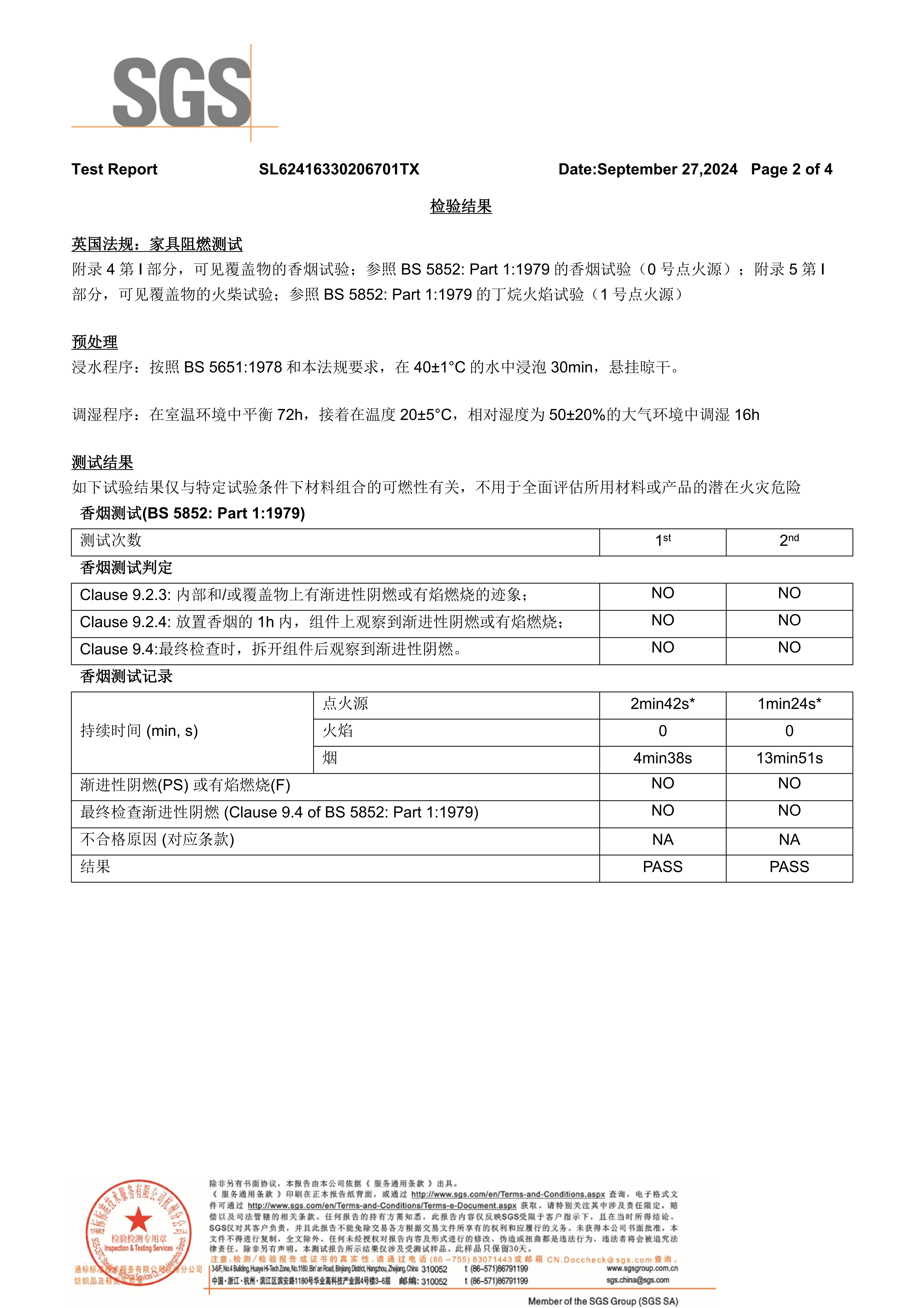
The scope wording matters as much as the certificate number. A report issued for a defined material — synthetic leather 03#, artificial leather, foam — supports a claim about that material, not automatically about every model in a catalogue. Buyers preparing an import file should confirm that the model on the purchase order is built with the material named in the report, and should keep the document reference in the order paperwork so that the link is auditable later.
Question 5 — What are the acceptance criteria at delivery?
Acceptance criteria are the part of a barber chair order most often left verbal. A workable inspection list for hydraulic, reclining and heavy-duty barber chairs covers six checks, all of which can be completed without laboratory equipment.
Delivery acceptance checklist
- Dimensional verification — measure each unit against the ordered dimensions (for example 90 × 60 × 90 cm for HZ8801) and record the measurement basis used.
- Material verification — confirm the upholstery and cushioning match the ordered composition, and check seams, stitching and panel alignment across the full seat and backrest.
- Mechanism function — operate the hydraulic lift and recline through the full range on every unit, checking for smooth travel and consistent return.
- Structural check — confirm frame, base and footrest are free of deformation, and that all fasteners are present and seated.
- Documentation match — verify model labels, quantities and packaging marks against the purchase order, and confirm that the agreed test reports or certificate copies are included in the shipment file.
- After-sales terms recorded — note the applicable support terms in writing before signing acceptance; the pump on this supplier's barber chairs carries a one-year warranty, and damaged products are resent under the stated after-sales arrangement.
Writing these six checks into the order as acceptance criteria changes the character of the transaction. Instead of a subjective judgement at the loading dock, the buyer has a documented pass/fail test that can be repeated on later shipments and used as a baseline for supplier performance review.
Question 6 — Which model fits which station?
Model selection follows the station plan, not the other way round. Within this set, the compact end is represented by HZ6001DW at 45 × 25 × 70 cm, the standard footprint by HZ8801 at 90 × 60 × 90 cm, the larger aluminum alloy build by HZ8796C at 110 × 72 × 100 cm, and the heavy-duty configuration by HZ87102RB at 111 × 66 × 118 cm.
For a salon styling chair in a tight retail footprint, the smaller dimension set is the starting point, because it leaves more usable circulation space per station. For a barber salon chair in a high-throughput shop where the chair is occupied continuously through cut, perm and dye services, the larger builds are the more natural comparison — with the caveat that the heavier classification should be verified against a model datasheet rather than assumed from the name.
Scale effects also appear at programme level. A supplier relationship used by dealer clients has covered 200,000 units supplied within one year, across vintage and modern styles with customizable appearance and materials, supporting full salon equipment sets for salon use, barber workstation seating, chain store outfitting and distributor orders. That is a programme-level fact rather than a model-level one: it indicates range breadth and repeat supply experience, not a performance claim about any single chair.
Market context: why documentation-led buying is increasing
The commercial case for specification-led purchasing is visible in the category data. Fact.MR estimated the global salon chairs market at approximately USD 1.5 billion in 2025, and projected hydraulic salon chairs to account for a 63.4% share by 2026. The same research notes that commercial-grade hydraulic pumps are typically rated for load capacities between 350 and 400 lbs and for more than 100,000 cycles — a durability benchmark that is meaningful only if the pump specification is actually documented for the model being purchased.
Trade classification adds a second layer. Barber and similar chairs fall under HS Code 9402.10, the subheading covering dentists', barbers' and similar chairs with rotating as well as both reclining and elevating movement. That classification describes function, not quality, which is precisely why the technical specification has to travel with the shipment: customs documents establish what the product is, while a datasheet establishes what the buyer ordered.
At the supplier level, this manufacturer exports to EU and US markets and provides OEM production services, with logo and colour customisation, a minimum order quantity of 5 units, a monthly production capacity of 15,000 units, and a stated lead time of 15 days for orders under 100 units and 30 days for orders above that threshold. Products are reported as 100% tested. These are supplier-reported terms and belong in the quotation rather than in the assumption set — but they are the terms that convert a catalogue entry into a procurement plan.
Where specification-led selection stops
A specification-first approach has a clear boundary, and it is worth stating plainly. The published HZ set gives model classification, overall dimensions and material or frame composition — it does not publish per-model load ratings, hydraulic cycle counts, foam density values, recline angles or unit weights. A buyer who needs those figures for a tender must request them as model-level documents; they should not be calculated or inferred from the dimensions and material names in this table.
Certification evidence is bounded in the same way. The SGS reports and the PFAS report support claims about the specific materials tested, within the stated scope and market. They are not a blanket conformity statement for every model in the range, and they do not replace destination-market checks that a buyer's own compliance team must complete.
Capacity figures also require care. Company-reported manufacturing figures appear in different forms across sources and use different bases, so a buyer evaluating delivery reliability should ask for the capacity definition, the product mix behind it and recent order references, rather than comparing headline numbers from separate documents.
Future outlook
The direction of travel in salon furniture procurement is towards documents rather than descriptions. As hydraulic seating continues to dominate the category — the projected 63.4% share for 2026 points that way — buyers will increasingly compare chairs on pump documentation, material test reports and stated acceptance criteria, because those are the elements that determine uptime in a working shop.
For manufacturers, the implication is that a published specification table is becoming a commercial asset in its own right. A range that states dimensions and material composition per model, and can attach the matching test documentation on request, is easier to onboard into a dealer programme than one that requires a separate email exchange for every technical question. The models discussed here — HZ6001DW, HZ8801, HZ8796C and HZ87102RB — illustrate the format that buyers are likely to expect as standard.
Frequently asked questions
What dimensions should be confirmed before a barber chair order is placed?
Confirm three things: the full dimension triplet for the specific model, which figure corresponds to width, depth and height, and the point on the chair where each was measured. Then convert the footprint into a centre-to-centre station figure. Where local rules apply — for example North Carolina's five-linear-foot centre-to-centre requirement for barber chairs — the layout must be checked against that rule rather than against the catalogue image.
What materials are specified for the HZ6001DW barber chair?
HZ6001DW is specified with PU leather, high-density sponge, wood and iron, at overall dimensions of 45 × 25 × 70 cm. The four-material breakdown distinguishes the upholstery, the cushioning layer, the internal structure and the metal component, which allows each element to be checked separately at acceptance.
Which model in the HZ range is the heavy-duty option?
HZ87102RB is the model classified as heavy duty in this specification set, at 111 × 66 × 118 cm. Because the published set does not state a load rating or cycle count for the model, the heavy-duty classification should be confirmed against a model datasheet when the chair is intended for continuous commercial use.
Which test documents support barber chair material claims?
Three documents are referenced: SGS flame-retardant artificial leather test report SL62416330206201TX, SGS flame-retardant foam test report SL62416330201301TX, both issued 27 September 2024 against The Furniture and Furnishings (Fire) (Safety) Regulations 1988, and PFAS test report CTT2501010107EN, issued 4 January 2025 against EN 14582:2016 for synthetic leather 03#. Each report supports the material within its stated scope.
What acceptance checks should be applied when chairs arrive?
Measure each unit against the ordered dimensions and record the measurement basis; verify upholstery and cushioning against the ordered composition while inspecting seams and panel alignment; operate the hydraulic lift and recline through the full range on every unit; check frame, base and footrest for deformation and fastener seating; match model labels, quantities and documentation to the purchase order; and record the applicable after-sales terms in writing before signing acceptance.
What order terms apply to HZ-Series barber chair purchases?
The supplier reports a minimum order quantity of 5 units, a monthly production capacity of 15,000 units, and a lead time of 15 days for orders under 100 units and 30 days for orders over 100 units, with 100% testing on all products. The pump carries a one-year warranty, and damaged products are resent under the stated after-sales arrangement. These are supplier-reported terms and should be confirmed in the current quotation.
What can a specification comparison not tell a buyer?
It cannot supply figures that were never published. For this range, per-model load ratings, hydraulic cycle counts, foam density values, recline angles and unit weights are not included in the specification set, so they must be requested as model-level documents. Material test reports are also scope-limited to the materials tested, and do not constitute a full conformity statement for every model.
A downloadable product brochure covering the HZ-Series barber chair range is available here: HZ-Series product brochure (PDF).
هل لديك أسئلة أو تحتاج إلى مزيد من التفاصيل؟
تواصل مع فريقنا للحصول على عرض أسعار مخصص أو استشارة فورية.
طلب عرض أسعار
املأ النموذج أدناه وسيتواصل معك فريقنا بعرض مقترح مخصص.
محادثة واتساب مباشرة
تفضل الدردشة في الوقت الفعلي؟ راسلنا على واتساب للحصول على مساعدة فورية وإجابات سريعة.
- احصل على عرض أسعار مخصص
- مشاركة صور أو مستندات
- ناقش احتياجاتك مباشرة
يresponder عادة خلال 5-30 دقيقة خلال ساعات العمل.