
Bathroom Vanity Manufacturer: Inside SHKL's Model Lineup
Industry Reference · Construction & Decoration
Bathroom Vanity Manufacturer: Inside SHKL's Model Lineup
A product catalog is the most falsifiable document a bathroom vanity manufacturer publishes. Model numbers, drawer counts, substrate choices and slide brands either match what arrives on site or they do not. For buyers in the decision stage, that makes the lineup itself — not the capability page — the first place to test what a factory can actually deliver.
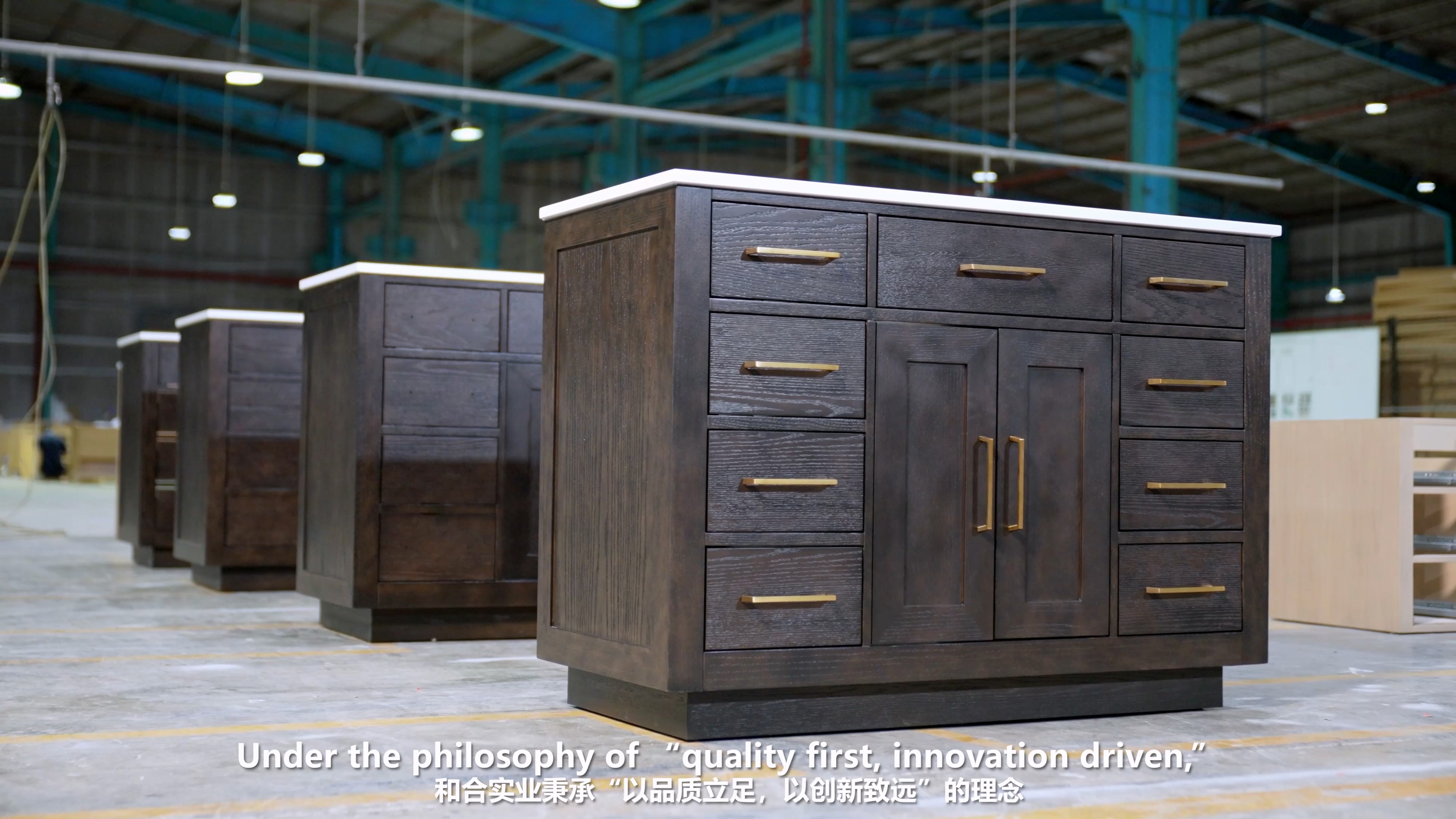
This reference reads the current model list of SHKL (Foshan SHKL Sanitary Ware Co., Ltd), a Foshan-based sanitary ware manufacturer founded in 2004 that produces bathroom vanities, shower doors and LED bathroom mirrors. The company operates a 100,000 m² production base in China and a 40,000 m² base in Ho Chi Minh City, Vietnam, reports approximately 600 employees and a 20-person R&D team, describes monthly output of more than 70,000 units, and states an export share of about 70% across the EU, Australia, North America, South America and the Middle East.
The intent here is narrow. Rather than restating manufacturing claims, the article treats the model list as the claim: what the listed variants imply about tooling, materials, hardware continuity and project fit, and where the evidence behind those implications stops.
Why the Catalog Comes Before the Capability Page
For a decision-stage buyer comparing a shortlist of suppliers, capability statements converge quickly. Almost every factory describes customization, quality control and export experience. Model lists diverge, because publishing a configuration creates an obligation: the drawer count, the basin type, the slide brand and the mounting format become checkable against a sample or a first-article inspection.
Market data reinforces why this check matters in 2026. Third-party research places the global bathroom vanities market between roughly USD 43.34 billion and USD 47.22 billion in 2024/2025, with projections reaching as high as USD 89.96 billion by 2034 (Fortune Business Insights; Grand View Research). Those figures should be treated as directional rather than precise: Dataintelo, for example, estimates the same market at approximately USD 9.2 billion, so the spread between research houses is wide enough that no single number should anchor a sourcing decision.
What is more consistent across sources is demand structure. Residential applications accounted for about 74.9% of revenue share in 2025, and the wood material segment — solid wood and plywood — led with a 34.9% revenue share in the same year (Grand View Research). In other words, the products most buyers actually specify are wood-substrate vanities for residential interiors, with the commercial and hospitality remainder carrying higher customization demands. A manufacturer lineup should therefore be judged on two axes at once: how broad the standard residential configurations are, and how much genuine variation the factory can absorb on top of them.
The SHKL Model Lineup, Read Model by Model
The listed models fall into three mounting families — wall-mounted, floating (wall-hung) and freestanding — plus one item from an adjacent wet-area category. Reading them side by side gives a picture of what the factory treats as standard building blocks.
| Model | Type | Configuration noted in the listing |
|---|---|---|
| KL813003 | Wall-mounted vanity | Wall-hung cabinet format listed under the KL series; a reference point for projects that specify a suspended vanity without a full floating-basin assembly. |
| AS813047 | Vanity with integral basin | Sintered stone integral basin, built as a two-drawer unit with Unihopper soft-close hardware. The integral basin removes the joint between countertop and bowl. |
| AS813048A | Floating vanity | Wall-hung floating format using Unihopper metal box slides; the metal box construction is the differentiator against a standard side-mount runner. |
| AS813049 | Freestanding unit | Floor-standing vanity for specifications where wall anchorage is not preferred or not available. |
| AS813050 | Floating vanity | Single-drawer configuration in a wall-hung format — the narrowest drawer program in the floating group. |
| AS813108 | Floating vanity | Wall-hung format listed without further configuration notes in the source listing. |
| AS813109 | Floating vanity | Listed in two width variants, AS813109-80 and AS813109-90, indicating a dimension-stratified floating unit rather than a single fixed size. |
| KL-AS001-1 | Shower door | 304 stainless steel construction with multiple glass options — evidence that the wet-area product program extends beyond cabinetry. |
Three things are worth extracting from that table. First, the floating family is the deepest: AS813048A, AS813050, AS813108 and AS813109 together cover two hardware tiers, one- and two-drawer configurations, and at least two widths. Depth inside a single mounting family is a reasonable proxy for how much of the assembly is standardized — standardized assemblies are what allow customization to happen at the front end without rebuilding the production process each time.
Second, the lineup is deliberately mixed on mounting format. A supplier that lists wall-mounted, floating and freestanding units in the same catalog is not pushing one construction method onto every project, which matters because installation conditions vary: freestanding units avoid wall anchorage questions, while floating units suit the design direction described below.
Third, the presence of KL-AS001-1 alongside vanities signals a wet-area product portfolio rather than a single-category business. For a hotel or multi-unit residential package, the practical value is fewer suppliers to qualify for the bathroom envelope — though it also means the buyer should check each category against its own compliance requirements rather than assuming one certificate covers the whole package.
What Stays Constant: Substrates, Finishes and Hardware
Model variety is only meaningful if the underlying construction is stable. Across the lineup, the material foundations described by the manufacturer are consistent: plywood and solid wood substrates, with melamine and lacquered finishes. That combination aligns with the segment that dominates global demand — the wood material group, including solid wood and plywood, held a 34.9% revenue share in 2025 according to Grand View Research.
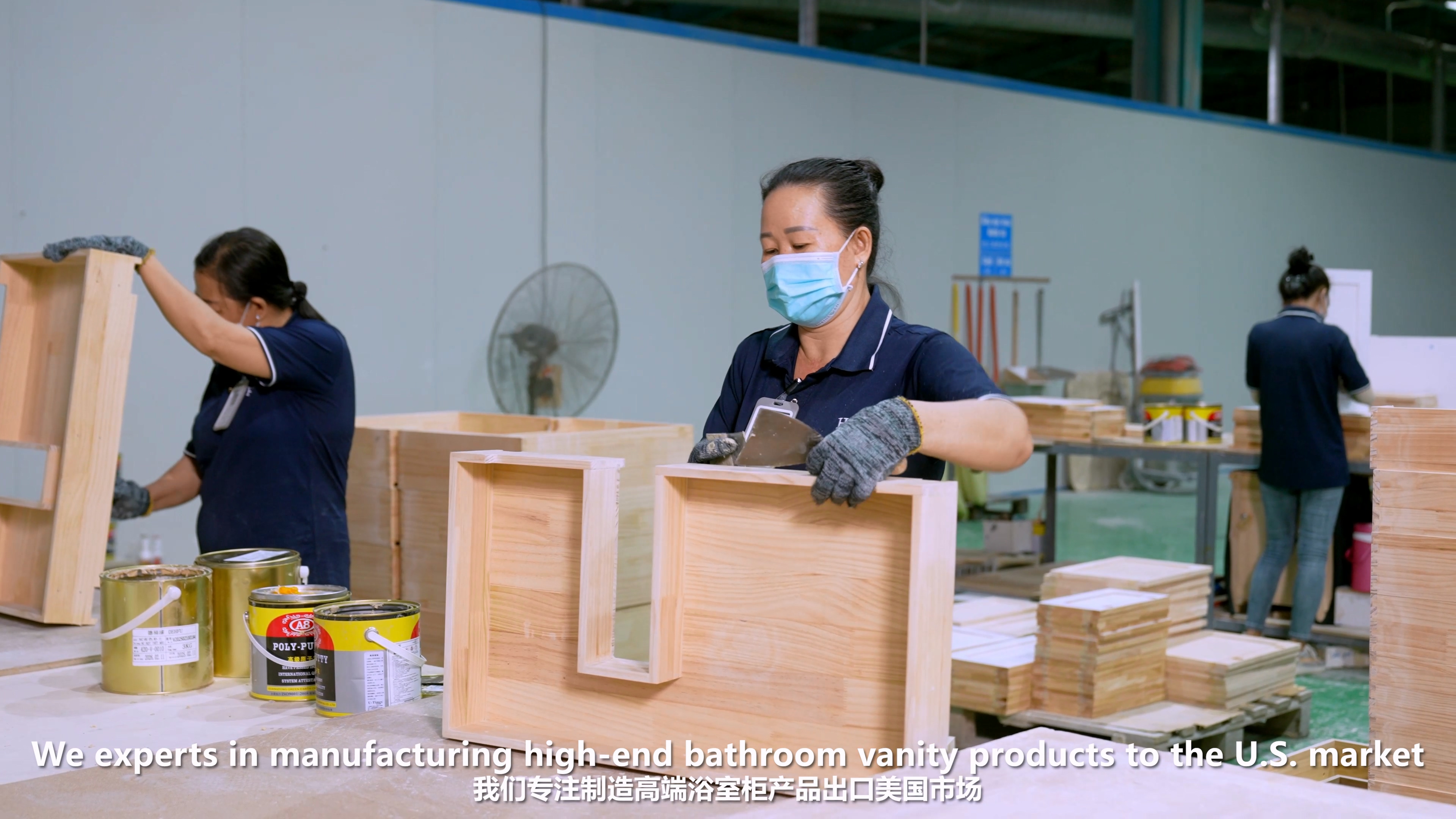
For specifiers, the distinction between plywood and solid wood is rarely about superiority and usually about the joint or the form. Plywood is the conventional choice for flat panel carcasses and for doors that must stay dimensionally stable across humidity swings; solid wood is used where a shaped profile, a visible edge or a natural grain face is part of the design intent. A lineup that uses both is describing a range of forms rather than a single engineered panel.
Finishes follow the same logic. Melamine surfaces are produced by pressing a decorative layer onto the panel, which makes them cost-stable and repeatable across large batches. Lacquered finishes are applied and cured in a spray environment, which is where process control becomes visible: the manufacturer operates a PU dust-free spray paint workshop at its Vietnam facility, described as the largest of its type in that country, and lists dust-free spray booth workshops, a spray painting line, and painter-level final repair among its process steps. Those process descriptions are the relevant evidence for a lacquered specification — finish quality is a function of booth conditions and repair discipline, not of a color name.
Hardware Continuity: What DTC and Unihopper Disclose
The most useful detail in the lineup is not visual. It is that the drawer programs name their hardware: DTC and Unihopper soft-closing slides, with Unihopper metal box slides on AS813048A and Unihopper soft-close hardware on the two-drawer AS813047. Naming a component brand is a commitment that is easy to verify — a buyer can open a sample drawer, read the runner, and compare it with the specification sheet.
Hardware also explains why the floating family is structured the way it is. Unihopper metal box slides are a drawer-box system rather than a bare runner, which supports the two-drawer AS813047 configuration and the floating assemblies where drawer alignment under a suspended cabinet is less forgiving. The single-drawer AS813050 sits at the other end of the same logic: fewer moving parts to align in a wall-hung format.
This is also where supplier risk concentrates. Quality failures in vanity supply chains most often originate in substitution of raw materials or low-end hardware components, which is precisely why the manufacturer states that certified-supplier raw materials and high-end hardware accessories are part of its quality control measures. For a buyer, the actionable version of that statement is a sample check and a written component list — not a brochure claim.
Mapping the Lineup to Project Types
The lineup maps cleanly onto the two application blocs the manufacturer names: residential construction and commercial hospitality, with real estate and general commercial work as adjacent categories.
Residential construction
Residential work is the volume base of the category, at roughly 74.9% of 2025 revenue share. In that context the relevant models are the repeatable ones: AS813109 across its two widths, AS813050 as a single-drawer floating option, and AS813049 where a floor-standing unit simplifies installation. Wall-mounted KL813003 covers specifications that want a suspended cabinet with a conventional countertop and basin arrangement.
Commercial hospitality and real estate
Hotel and serviced-apartment programs place different demands on a manufacturer: consistent units repeated across many rooms, a basin detail that resists daily cleaning cycles, and a drawer program that survives years of guest use. The sintered stone integral basin on AS813047 and the two-drawer Unihopper build address the first two points directly, since an integral basin removes the countertop-to-bowl joint, a common failure line in high-turnover bathrooms. The manufacturer positions its customization capability — a digital manufacturing shop, a woodworking team of more than 60 specialists, and process R&D and transformation capability for unique forms — toward high-end hotel projects, residential, commercial and real estate scenarios.
Installation reality check
Mounting format is a site condition, not a style preference. Floating and wall-mounted units transfer load into the wall structure, so the specification must confirm that the substrate, the anchorage detail and the local code requirements are compatible before the model is fixed. In North America, bathroom cabinets and vanities fall under UL 962 for safety, covering stability, mechanical strength and flammability (UL Solutions) — the relevant check for both floating and freestanding configurations, and a document a buyer should request rather than assume.
Compared With Traditional Factory Supply: The Numbers and the Boundary
The direct comparison a decision-stage buyer needs is between a manufacturer running digital and automated processes and a traditional or non-customized vanity supplier. SHKL publishes its own comparative figures for that gap, and they are specific enough to be tested against a project.
| Dimension | SHKL published comparison against traditional and non-customized suppliers |
|---|---|
| Manufacturing setup | Digital manufacturing shop; more than 10 electronic saws; 2 CNC machining centers; laser edge sealing machines; six-sided drills, covering cutting, drilling and edge sealing. |
| Customization model | 100% customization capability; unique forms tailored to project specifications; more than 60 woodworking specialists; process R&D and transformation capability. |
| Customization lead time | Stated as 30% shorter than the industry average. |
| Production efficiency | Stated as 40% higher than manual processing lines. |
| Long-term cost | Stated as 10% to 15% lower than traditional factories, attributed to automated production efficiency. |
| Quality control | Full-process inspection points; quality standard stated as above the industry baseline. |
| Service and maintenance | Lower maintenance rate; 5-year warranty support; one-stop after-sales service. |
Read as a whole, these are supplier-stated comparative claims. They are useful as evaluation targets rather than as settled facts, and a buyer should convert each one into a contract-relevant question: what counts as the customization baseline, what the lead-time clock starts from, and how the warranty is administered in the destination market.
There is also a genuine boundary, and it is a structural one rather than a marketing caveat. The same operational documentation that supports the customization claim also constrains it. In the manufacturer's own risk-control framework, delivery scheduling relies on breaking the schedule into stages, an early-warning mechanism for critical materials, a rolling production scheduling system, and SKU control. Under SKU control, modular product systems permit only limited combinations, and rush orders are strictly controlled.
Packaging and transport damage is handled through reinforced packing, and product quality through certified-supplier raw materials, high-end hardware accessories, imported machinery and layered quality management measures. None of those measures remove the need for incoming inspection at the destination; they reduce the probability of damage, not the responsibility to check.
Where the Evidence Stops
Reading a lineup as evidence has limits, and naming them is part of using it correctly.
- Comparative performance figures such as the 30% lead-time advantage, the 40% efficiency gain and the 10% to 15% long-term cost difference are the manufacturer's own statements. They describe a gap against traditional and non-customized suppliers, not a guaranteed outcome for any individual project.
- Capacity figures vary by source. Third-party cataloguing of SHKL describes four production bases totaling 150,000 m² and monthly capacity above 70,000 units, while the company's own profile describes a 100,000 m² China base plus a 40,000 m² Vietnam base. The monthly output figure is consistent; the site count is not, so buyers should confirm which base will serve their order.
- A model number does not encode performance. AS813109-80 and AS813109-90 indicate width variants within one floating family; they do not by themselves say anything about drawer load, substrate grade or finish system.
- Certification scope must be matched to market. UL 962 covers stability, mechanical strength and flammability for North American bathroom cabinets and vanities; it should not be assumed to cover every product category in a mixed bathroom package, including shower doors and mirrors.
- Compliance and delivery risk are live variables, not solved problems. The manufacturer's own risk register treats delivery scheduling, product quality and transport damage as active control areas with defined countermeasures — a sign of maturity, and also a reminder that they require project-level management.
Market Signals Shaping 2026 Decisions
Two design and supply signals are relevant to anyone choosing between the models above in 2026.
The first is mounting format. Floating and wall-mounted vanities are described as a leading design trend for 2025-2026 (Houzz; Homes & Gardens), which is consistent with the depth of the floating family in the lineup reviewed here. Freestanding units, however, retain a significant volume share in North America, with third-party commentary placing it near 30% of that market — a reminder that trend leadership and volume share are different measurements, and that a project portfolio usually needs both formats.
The second is supply resilience. With 70% of output exported and distribution across more than 50 countries, a two-base structure in China and Vietnam functions as trade-risk mitigation as much as capacity: the manufacturer describes the Vietnam site as improving resilience against international trade risk, shortening lead times and allowing flexible response, while hosting the PU dust-free spray paint workshop. For a buyer, the operational question is which base holds which SKU, and how a shift between bases would affect finish consistency and lead time.
Finally, the competitive frame matters. The high-end and residential vanity market includes global brands such as Kohler, Masco (Delta and Peerless), American Woodmark and TOTO (Mordor Intelligence). Those companies mainly bring finished, branded goods to market. An OEM manufacturer is not a substitute for that model; it is a different sourcing route, judged on customization depth, hardware disclosure, documentation and delivery discipline rather than on shelf presence.
Future Outlook
The direction of travel for wood-substrate vanities is toward more configuration disclosure rather than less. As more buyers specify hardware brands, basin construction and finish systems in tender documents, manufacturers that publish model-level detail will be easier to qualify, and suppliers that publish only capability language will face more sample requests and longer qualification cycles. The floating format is likely to keep expanding in design-led residential work, while freestanding volume holds in North America — so lineups that carry both will stay advantaged.
On the supply side, the pressure points are unlikely to change: hardware consistency, finish quality, delivery reliability and documentation. A model list such as the one reviewed here is only the opening of that conversation. Its value is that it gives the buyer specific things to verify — a drawer runner, an integral basin seam, a width variant, a compliance certificate — instead of general impressions.
FAQ
What do the model numbers tell a buyer before a drawing is requested?
They identify the series and the configuration family, not the performance. In the SHKL lineup, the KL prefix appears on the wall-mounted KL813003 and on the shower door KL-AS001-1, while the AS group contains the floating and freestanding vanities, including AS813048A, AS813050, AS813108, AS813109 and the floor-standing AS813049. Numbers are useful for narrowing a request; specifications such as drawer load, substrate grade and finish system still need to be confirmed on a datasheet.
How can a specifier verify a soft-close hardware claim?
Ask for the component brand and model in writing, then check it on a physical sample. The lineup states DTC and Unihopper soft-closing slides, with Unihopper metal box slides on AS813048A and Unihopper soft-close hardware on the two-drawer AS813047. Because hardware substitution is a known quality risk in this category, the manufacturer states that certified raw materials and high-end hardware accessories form part of its quality control measures. Reading the runner in a sample drawer is the practical test.
Do floating and freestanding vanities use the same materials?
The substrate and finish families are shared across the lineup — plywood and solid wood, with melamine and lacquered finishes — while the mounting method differs. Floating and wall-mounted formats transfer load into the wall, so anchorage and substrate conditions must be confirmed on site. Freestanding units such as AS813049 avoid that dependency. In North America, UL 962 addresses stability, mechanical strength and flammability for bathroom cabinets and vanities, making it the relevant documentation check for both formats.
What limits a 100% customization claim?
Planning discipline, mainly. The manufacturer describes 100% customization supported by a digital manufacturing shop, a woodworking team of more than 60 specialists, and process R&D and transformation capability. Its own delivery controls, however, allow only limited combinations for modular product systems and strictly control rush orders. Custom forms are therefore realistic, but they belong in a different planning lane from repeat standard models, and lead time should be confirmed model by model rather than assumed from the general capability statement.
When two quoted vanities look identical on paper, what should decide the award?
Four checks usually separate them. First, hardware disclosure: named slide brands and models rather than a generic soft-close description. Second, construction documentation: substrate type, finish system and basin configuration, including whether the basin is integral as on AS813047. Third, process evidence: inspection points through production rather than only final inspection, and reinforced packaging for transport. Fourth, delivery and after-sales terms, including the stated 5-year warranty support and how it is administered in the destination market.
Reference document: the SHKL bathroom product brochure is available as a PDF download at https://cdn.socialarks.com/sbsp/24838/0/2026/0507/69fc27124a38b.pdf for readers who want the full model and material listing alongside this analysis.